THCP Drug Test: What the Panel Is Actually Looking For
Page one says THCP breaks down into THC-COOH and that tests do not care which cannabinoid you took. The federal confirmation names one molecule whose own systematic name says pentyl. THCP says heptyl. Here is what the screen and the product each contribute.
Search for what a THCP drug test does and the first page of results will tell you, in near-identical wording across several sites, that your system breaks THCP down into THC metabolites, mainly THC-COOH, and that drug tests do not care which cannabinoid you actually took. No published work supports the first claim. The second is contradicted by the federal panel's own text, which names exactly one cannabis molecule and explains, in the same document, why the abbreviation was rewritten to keep it apart from other compounds. A drug test is two tests: an antibody screen that responds to shapes, and a confirmation that looks for a named molecule. THCP gets a different answer from each, and neither answer has anything to do with how strong the molecule is.
Planntz sells four CBD tinctures and does not sell THCP, so there is nothing to buy at the end of this page. What follows is the published record as of September 8, 2026: the analyte a federal confirmation actually names, the two cross-reactivity results that disagree with each other, what a research instrument sees when it looks for THCP, and the parts nobody has measured. There is no detection window here, because none has been published, and no timing plan, because that is not what this page is for. Nothing here predicts what any individual's test will do.
A THCP drug test is two tests, and they ask different questions
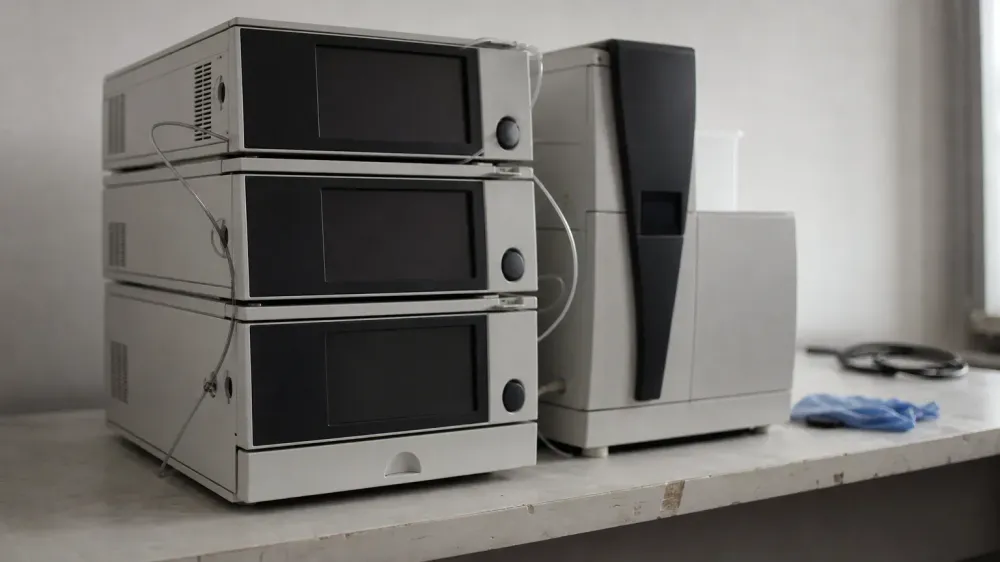
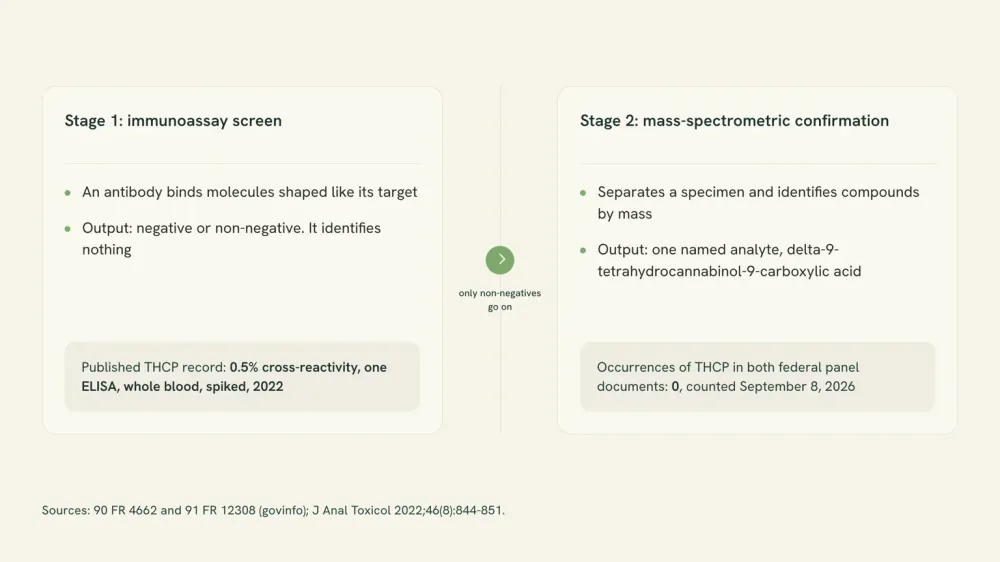
Almost every answer on the first page of results collapses a drug test into one event. It is two, and they run on different physics. The first is an immunoassay screen: an antibody raised against a particular target molecule, which binds things shaped enough like that target and produces a signal once enough of them are present. It identifies nothing. It sorts specimens into negative and non-negative. The second is a confirmation, usually chromatography coupled to mass spectrometry, which separates the compounds in a specimen and identifies them by mass. That step names a molecule, and in a workplace program it is the step that decides consequences.
So the two halves have different relationships with a cannabinoid neither of them was designed around. A screen can respond to something it was never aimed at, because recognition is approximate. A confirmation will not report a molecule that is not on its analyte list, because identification is exact. Our delta-8 testing page walks through that machinery in detail, including the delta-8 carboxy metabolite, the immunoassay results and the review step that follows a non-negative result, and this page does not rebuild any of it. What this page does instead is answer the question our own THCP explainer leaves open in its own words, that what a workplace panel actually screens for is a different question with a different answer.
The confirmation names one molecule, and its name contains the word pentyl
The panel HHS published for federal workplace drug testing programs, 90 FR 4662, published January 16, 2025 and effective July 7, 2025, gives cannabis a single row in urine: an initial test for what it calls the marijuana metabolite at 50 ng/mL, and a confirmatory test at 15 ng/mL for an analyte it abbreviates delta9THCC and expands, in the same document's report nomenclature table, as delta-9-tetrahydrocannabinol-9-carboxylic acid. The same notification explains why those abbreviations were rewritten: adding the delta-9 designation, it says, "distinguishes them from other compounds", and the examples it gives are delta-8 compounds. The panel was made more specific on purpose. It was then republished on March 13, 2026 at 91 FR 12308 with, in the department's own words, "no changes to the drug testing analytes, test cutoffs, and report nomenclature".
That analyte is not a category. It is one molecule with a systematic name, and the systematic name carries its own side chain. PubChem's record for it, CID 108207, gives the formula C21H28O4 and an IUPAC name built on the fragment 3-pentyl. Pentyl means a five-carbon chain. The record for delta-9-THCP, CID 6453074, gives C23H34O2 and a name built on 3-heptyl. Heptyl means seven. That two-carbon difference is the entire definition of the homolog, it is the reason THCP has a different name from THC in the first place, and it is not something metabolism removes.
Be careful about what this does and does not establish, because the distinction is the whole reason page one gets it wrong. This is an identity argument. It shows that THCP is not delta-9-tetrahydrocannabinol-9-carboxylic acid, which is a fact about two molecules. It does not, by itself, show that no metabolic route runs from THCP to some five-carbon compound. That is a separate question with separate evidence, and it is the next section.
So what does THCP actually turn into?
The claim to beat is the one repeated in near-identical wording on several page-one results: that your system breaks THCP down into THC metabolites, mainly THC-COOH. It is worth noticing how unstable those pages are about it. One of them writes that "it is very likely that THC-P products usage will cause a person to fail a drug test" three sentences after writing that "we don't have any evidence that its usage will cause the body to produce THC-COOH". Another states flatly that "drug tests don't care what the actual cannabinoid is". None of them cites a metabolism study, and one does exist.
A 2026 study in the Journal of Analytical Toxicology, run at Virginia Commonwealth University with the Armed Forces Medical Examiner System, incubated delta-9-THCB, delta-9-THCH and delta-9-THCP with pooled human liver microsomes. That is metabolism in a tube, not in a person. Its methods "presumptively identified" that all three produced hydroxylated and carboxylated phase I biomarkers "similar to those of" delta-9-THC. Similar to is not identical to: a homolog produces a homologous metabolite. The same abstract reports that one carbon of deviation from the five-carbon side chain decreased the amount of hydroxylated biomarker formed, two carbons decreased it further, and any deviation increased the conversion from the hydroxylated form to the carboxylated one. The authors describe their own output as "new analytical targets for toxicology laboratories", which is a precise way of saying these compounds are not on routine panels yet.
So THCP does form a carboxy metabolite of its own in that system. Nobody has published one under a name. On September 8, 2026, a PubMed search for it under five different names, 11-nor-9-carboxy-tetrahydrocannabiphorol, THCP-COOH, THCPCOOH, carboxy-THCP and 11-nor-THCP, returned zero records for each. Read that carefully, because it is easy to over-read: PubMed indexes journals, not laboratories. The supportable claim is that nobody has published this molecule, not that it does not exist and not that no laboratory could measure it. If you want the acid-form distinction in a case where the acid is well documented, our page on THCA and drug tests has it.
The screen is a different story, and the two published records disagree
A 2022 cross-reactivity panel from a US forensic laboratory fortified whole blood with individual cannabinoids and ran them against a cannabinoids direct ELISA. Its printed list reads 200% for delta-8-carboxy-THC, 25% for delta-9,11-THC, 13% for delta-10-THC, 7% for delta-6a(10a)-THC, 3% for THC-O-acetate and 0.5% for tetrahydrocannabiphorol. Now sort that list by what kind of molecule each entry is, and something falls out of it. The only entry above 25% is a carboxy metabolite, the delta-8 acid our delta-8 page is built around, and every other entry, THCP included, is a parent or neutral compound. A screening antibody raised against a carboxy acid is being asked to recognize a parent phytocannabinoid, which is why the number is small. The 0.5% figure answers a different question from the one readers think it answers, and this is whole blood in forensic and postmortem casework, spiked in a tube, on one kit, with nobody dosed.
A Swedish clinical laboratory reported a different kind of result in 2024, in Scandinavian Journal of Clinical and Laboratory Investigation. As unregulated cannabinoids spread, the frequency of false positive screening tests in its own caseload, for THC in oral fluid and for the THC carboxy metabolite in urine, rose from under 2% to over 10%. Spiking experiments confirmed the cause, and the compounds spiked included THC-P. Two limits belong in the same breath as that. The paper's subject is HHC, so THC-P is a member of its panel rather than its focus, and it publishes no THCP-specific percentage; its full text is not openly reachable, so nobody should be quoting one from it. What it does conclude, about the class, is that cannabis drug testing "cannot rely on results from immunoassay screening, as it cannot distinguish between different tetra- and hexahydrocannabinols".
Two laboratories, two matrices, two devices, two answers. That is not a contradiction waiting to be resolved. It is the actual shape of the thing: cross-reactivity is a property of an antibody and a device, not a property of a molecule. Our HHC testing page reaches the same rule on a second molecule, partly from the same Swedish report read against a German counterweight this page does not carry, and our CBN testing page reaches it again on a third molecule from a dataset this article never touches. That is roughly as much confirmation as this corner of the literature offers.
The instruments can see it, the question is whether they are asked to look
A 2026 LC-QTOF-MS screening method for whole blood, validated for 24 phytocannabinoids and semi-synthetic cannabinoids, answers the can-a-laboratory-tell-them-apart question directly. Three of the rows in its analyte table matter here: the carboxy metabolite the federal confirmation names, delta-9-THC itself and delta-9-THCP.
| Analyte | Measured mass [M+H]+ | Limit of detection (ng/mL) | Retention time |
|---|---|---|---|
| 11-COOH-delta-9-THC (the analyte a federal confirmation names) | 345.2060 | 0.8 | 9.93 min |
| delta-9-THC | 315.2319 | 2 | 10.85 min |
| delta-9-THCP | 343.2632 | 4 | 11.40 min |
Four decimal places of mass and about a minute and a half of chromatography separate delta-9-THCP from the analyte a federal confirmation names. There is no difficulty here, and there never was. Note the boundaries, though: this is one laboratory's research method, in whole blood rather than urine, targeting parent THCP rather than a metabolite, and the detection limits in that table are instrument sensitivities. Do not read 4 ng/mL as a cutoff, and do not set it beside a workplace cutoff, because they are different matrices measuring different molecules for different purposes.
The most comprehensive published cannabinoid confirmation is a different paper again. In 2025 the Armed Forces Medical Examiner System's forensic toxicology division argued that traditional assays containing delta-9-THC, its hydroxy metabolite and its carboxy metabolite are "no longer sufficient", and published a method that quantitatively confirms delta-8- and delta-9-THC, their hydroxylated and carboxylated metabolites and the two HHC stereoisomers in blood, identifies those analytes qualitatively in urine, and qualitatively confirms a further list of homologs that includes tetrahydrocannabiphorol, at detection limits of 1 ng/mL for non-carboxylated analytes and 5 ng/mL for carboxylated ones. Read where THCP sits in that sentence. It is in the parent-homolog list. The carboxylated analytes this method adds are HHC's and delta-10's, not THCP's. Even in a military forensic laboratory building specifically for this problem, there is no THCP carboxy metabolite among the analytes, which is exactly what the empty literature search predicted.
Why the potency argument points the wrong way
THCP's entire market story is a multiplier, and it is worth one paragraph here because it is the intuition most readers arrive with. The 2019 paper that isolated the molecule measured a binding affinity of 1.2 nM at the human CB1 receptor in a radioligand assay run in duplicate on purified receptors, and reported it in its results as 33 times more active than delta-9-THC against a comparator value taken from the literature rather than measured in the same experiment. Our comparison of THCP and CBD covers where that number comes from, what the animal work in the same paper did and did not measure, and why affinity is not potency. The testing version of the point is shorter. An antibody is not a receptor, and a mass spectrometer is not a receptor either. A screen is not a strength meter, it is a concentration meter: it asks whether enough of a particular molecule is present to move an antibody past a decision point. Quantity in the specimen matters and receptor affinity does not, and for a cannabinoid sold on the strength of a very small amount, those two run in opposite directions.
What is in the product is the part that decides consequences
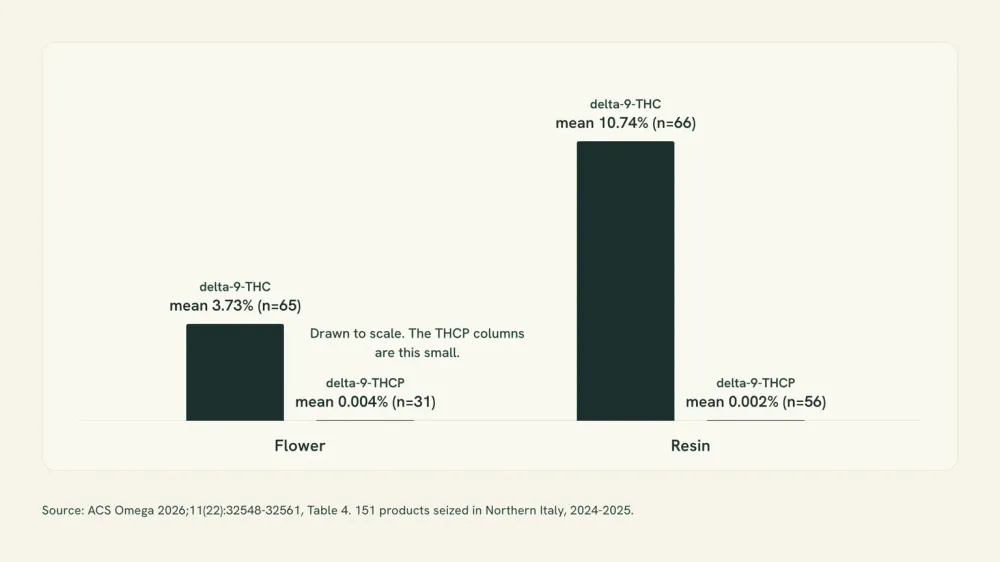
A 2026 profiling study in ACS Omega analyzed 151 cannabis-derived products seized in Northern Italy between 2024 and 2025 and identified delta-9-THCP in 61% of them, and that number is seized European flower, resin and vape liquid, material that contains delta-9-THC by definition, so the percentage does not describe the US hemp retail market and must not be read as if it did. What transfers is the pattern sitting next to it in the same tables. THCP appears at a mean of 0.004% across 31 flower samples and 0.002% across 56 resins, while delta-9-THC appears at a mean of 3.73% across 65 flowers and 10.74% across 66 resins, and delta-9-THC and its acid were detected in almost all samples. The cannabinoid a product is sold on is not the one present at percent scale.
Labels are unreliable in the other direction too. A 2025 paper in Drug Testing and Analysis from Japan's National Institute of Health Sciences bought seven oil products and one herbal product online and found acetate and butanoate esters, including a delta-9-tetrahydrocannabiphorol acetate and a THCP butanoate, rather than the parent compounds those products were sold as. Eight products from one market is not a survey. It is a reason to distrust a front label, and the acetate ester has its own chemistry that this page does not cover.
Now the counterweight, because everything above could be misread as "nothing happens". A 2025 study of 1,300 authentic urine specimens that had already screened positive by immunoassay, collected between April 2022 and May 2024 in a US military forensic caseload, found the delta-8 and delta-9 carboxy metabolites to be the most commonly observed analytes, with the delta-10 acid in 77 specimens, and concluded that a panel containing the delta-8 and delta-9 acids "appears to be sufficient for revealing cannabinoid exposure within workplace monitoring and deterrence programs". THCP is not among its reported analytes. That is a share of an already-selected set, not a population rate. Put those three findings together and the honest conclusion is not that a THCP product is invisible to a testing program. It is that the analyte most likely to produce a confirmed positive after a product sold as THCP is probably not THCP.
What to check, and what to ask
None of this tells you what your test will do, and nothing can. What you can do is work out which of these questions has an answer available to you, before anyone asks you to explain a result. Reading a certificate is a skill of its own, and our guide to reading a COA covers the fields that carry information and the ones that carry marketing.
- Which program is testing you. A federal agency program runs the panel published in 90 FR 4662. A private, non-regulated employer sets its own analytes and cutoffs and is bound by neither that notification nor the DOT rules.
- What the employer's written policy actually says, including who reviews a non-negative result, what you are expected to disclose, and when.
- Whether a non-negative screen is confirmed by mass spectrometry at all, and whether the laboratory reports the name of the analyte it confirmed rather than a drug class.
- Whether the product has a batch-specific third-party certificate, and whether the batch number on that certificate matches the one printed on the package in your hand.
- Whether that certificate reports delta-9-THC and total THC with its limits of detection and quantitation printed, rather than a sentence about purity.
- What else the certificate lists. A product sold on one cannabinoid routinely contains others, and the ones present at percent scale are the ones a panel is built to find.
- Who to ask when it matters: your employer's written policy and a clinician. Not a search result, and not us.
What nobody has measured about THCP and testing
Here is the inventory, with a date on it so you can re-run it yourself. On September 8, 2026, PubMed indexed 17 papers that mention tetrahydrocannabiphorol at all. Three of them touch drug testing. A search pairing tetrahydrocannabiphorol with pharmacokinetics returned zero records, and so did a search pairing it with workplace, oral fluid or hair. That is the whole record on the question this page is about, and it will be out of date at some point, which is why the searches are printed rather than summarized.
- No human pharmacokinetic study of THCP, of any size, by any route. That is the gap under every other gap on this list.
- No published urine detection window, which means every table stating that THCP stays in your system for some number of days is a delta-9-THC number under a different molecule's name.
- No named, standardized THCP carboxy metabolite, and therefore no reference standard for a confirmation to quantify one against.
- No hair record and no oral fluid record at all; the federal oral fluid panel targets a parent drug rather than a metabolite, which is a different question again.
- In blood, the only THCP records in any matrix are analytical method papers, which describe what an instrument can do rather than what happens in people.
One paragraph on the law, because it is the question readers ask next and it is not the same question. A Federal Register full-text search for tetrahydrocannabiphorol, recorded on August 16, 2026 and not re-run for this page, returned no scheduling rule naming it, and the statutory definition of hemp is being rewritten on a timeline our hemp law hub and our coverage of the 2026 hemp changes both track. We are not going to tell you which side of the new definition THCP lands on, because the published documents do not say. What we can say is that legality and detectability are unrelated: a testing panel is not a drug schedule, and "hemp-derived" is a claim about a plant rather than a defense at a review step, as our CBD drug testing guide sets out in the place where that distinction actually gets applied. This is information, not legal advice, and every dated claim on this page was verified on September 8, 2026.
The two halves of a test answer differently, which is why page one contradicts itself. The confirmation used by federal workplace programs names one cannabis analyte, delta-9-tetrahydrocannabinol-9-carboxylic acid, and neither document that publishes those panels mentions THCP, counted on September 8, 2026. The screen is a separate question with a disputed answer: one US forensic laboratory measured 0.5% cross-reactivity for THCP on one ELISA in whole blood, and a Swedish clinical laboratory included THC-P in the spiking set behind a false-positive rate in its own caseload that rose from under 2% to over 10% on different kits. Private employers set their own panels, and nobody can tell you what a specific test will do.
No published work says so. THC-COOH is a specific molecule whose systematic name is built on a five-carbon side chain; THCP's is built on a seven-carbon chain, and the side chain is what defines a homolog. What has been measured is that pooled human liver microsomes converted THCP into hydroxylated and carboxylated products similar to those of delta-9-THC, in a tube, presumptively identified, with no reference standards. Similar to is not the same as, and no THCP carboxy metabolite has been published under any of five searched names.
Nobody has published an answer. On September 8, 2026 a PubMed search pairing tetrahydrocannabiphorol with pharmacokinetics returned zero records, as did a search pairing it with workplace, oral fluid or hair. The detection-window tables circulating under THCP's name are delta-9-THC figures relabeled, the same defect the delta-8 tables have. We are not going to print a number that does not exist, and we do not publish timing or clearance advice. Our page on how long cannabinoids stay in your system covers what has actually been measured, for the molecules that have been measured.
Easily, when it is configured to. In one validated whole-blood method, delta-9-THCP is measured at 343.2632 and elutes at 11.40 minutes, while the carboxy metabolite a federal confirmation names is measured at 345.2060 and elutes at 9.93 minutes. The instrument has no difficulty at all. The question was never capability, it was configuration: whether the panel in front of the instrument was ever asked to look for that analyte, and on the federal urine panel it was not.
No. A testing panel is not a drug schedule. A confirmation reports which molecules it found at or above its cutoffs, and it has no field for the plant a molecule came from or for its legal status. Where origin does come up, it comes up at the review step after a laboratory result, and that step has its own written rules; our CBD drug testing guide walks through them for the workplace and DOT case. Legality and detectability are separate questions and neither answers the other.
Nobody has published a testing study of THCP-O. What is published is a product-chemistry finding: a Japanese national laboratory that bought eight products marketed as THC analogs found acetate and butanoate esters, including a THCP acetate and a THCP butanoate, rather than the parent compounds. Treat that as a reason to distrust a label, not as a basis for predicting a result, and read our acetate article for the chemistry of that ester family.
If you arrived here from a CBD question rather than a THCP one, what a workplace test measures in a CBD user is the page you want, and how long cannabinoids stay in your system covers what has actually been measured for the molecules that have been measured. If you came for the molecule itself, the THCP entity page has the chemistry, the discovery paper and the 33 times number in full. And if one sentence survives this article, make it the one about configuration: the question was never whether a laboratory could tell THCP from delta-9-THC, it was whether the panel in front of it was ever asked to look.
Writing about hemp, wellness and the small rituals that keep us balanced.