Does THCA Show Up on a Drug Test? The Heat Step Is the Answer
THCA is not the molecule a federal urine panel names, which is true and almost useless on its own. Heating it is the exposure event, and the published conversion figures are not what most pages assume. Here is the chain, with a number at every link.
Does THCA show up on a drug test? The honest answer starts with a correction: a federal urine panel is not looking for THCA, and it is not looking for THC either. It names one molecule, the carboxy metabolite your body makes after delta-9 THC has been in it. That is why every page telling you that THCA is not what the test detects is technically right and practically useless. A panel is a question about your exposure, and the moment heat touches THCA, your exposure changes.
Here is the short version. THCA is the acid the plant actually makes, and it turns into delta-9 THC when it is smoked, vaped or baked. That conversion is real, it is large, and it is not complete: a 2005 experiment that simulated the smoking process recovered only about 30 percent of the acid as delta-9 THC, and the best of the four conditions in a 2023 laboratory evaluation reached only 83.2 percent. Whatever survives the heat is an intact plant acid that has been found in real forensic samples and was not detected at all in a controlled human dosing study. So this page does two things. It follows the chain from the plant to the confirmatory cutoff with a number at every link, and it separates the part of this question that is settled from the part nobody has measured.
What the panel is actually looking for, from the plant to the cutoff
A workplace urine test is not a search for cannabis. It is a targeted measurement of one named molecule, at one named concentration, performed twice. The document that names it is public and short: HHS published its authorized testing panels at 90 FR 4662 on January 16, 2025, effective July 7, 2025. The marijuana row calls the analyte the "Marijuana metabolite" and writes it delta9THCC, and it carries two cutoffs, one for the initial test and a lower one for the confirmation. Both figures are in the table below, and this page prints them once. Those cutoffs bind federal-agency testing. A private, non-regulated employer sets its own panel and its own cutoffs, which is one reason a number from a federal document describes a procedure and never predicts a person. For the wider workplace picture, what a drug test actually measures and how the process runs covers it.
| Step | What is present, or what is measured | The number, and where it comes from |
|---|---|---|
| In the plant | Delta-9-tetrahydrocannabinolic acid (THCA), PubChem record 98523 | C22H30O4, molecular weight 358.5. About 90 percent of a fresh plant's total THC sits here as the acid, not as THC. |
| Heat | Decarboxylation to delta-9 THC, PubChem record 16078 | Partial, never total. About 30 percent recovered as THC in a smoking simulation; 83.2 percent under an optimized laboratory condition. |
| In the body | Liver metabolism to 11-nor-9-carboxy-delta-9-THC, also written THC-COOH | PubChem record 108207, C21H28O4, molecular weight 344.4. This is the molecule HHS writes as delta9THCC. |
| Screening test | Immunoassay calibrated to that carboxy metabolite | Initial test cutoff 50 ng/mL (90 FR 4662). |
| Confirmation | Mass spectrometry: GC-MS, LC-MS, GC-MS/MS, LC-MS/MS or equivalent | Confirmatory cutoff 15 ng/mL (same panel, same document). |
Two details in that chain do more work than they look like they do. First, the screen and the confirmation are different measurements with different specificities. The initial test is an immunoassay, an antibody-based method calibrated to a single target, while Section 11.13(a) of the mandatory guidelines says of the confirmation that "The analytical method must use mass spectrometric identification", and offers gas chromatography-mass spectrometry, liquid chromatography-mass spectrometry, their tandem forms or an equivalent as the examples. That section sits in the guidelines published at 88 FR 70768 on October 12, 2023, effective February 1, 2024, which are still in force. Second, a targeted measurement is silent about everything it does not name. A compound that is not on the panel is not "undetectable" in any interesting sense. It is simply not being looked for, which is a fact about the method and not a property of the molecule.
Two molecules are abbreviated THCA, and only one of them is in a plant
This is the fact that explains most of the confusion online, and on September 3, 2026 not one consumer page on the first page of results printed it. Open those same 2023 guidelines and read the footnote under the panel: an immunoassay "must be calibrated with the target analyte, [Delta]-9-tetrahydrocannabinol-9-carboxylic acid (THCA)". That is a federal document using THCA as the abbreviation for the metabolite your liver makes, not for the compound in the plant. It is the collision in a single line of official text. Two years later, HHS fixed it and said why.
That naming is current. HHS republished the panels at 91 FR 12308 on March 13, 2026 and stated it had made "no revisions to the current drug testing panels for both urine and oral fluid and current required nomenclature". The chemistry underneath becomes obvious the moment you read the two systematic names side by side. The plant acid is a benzo[c]chromene-2-carboxylic acid: PubChem record 98523, formula C22H30O4, molecular weight 358.5. The molecule on the federal panel is a benzo[c]chromene-9-carboxylic acid: PubChem record 108207, formula C21H28O4, molecular weight 344.4. Same scaffold, carboxyl group in a different position, two separate database entries, and one abbreviation that was applied to both of them in federal text. That January 2025 renaming also matters to anyone reading a delta-8 result, which is the subject of our page on delta-8 and workplace testing.
The heat step is the exposure event, and it is not a switch
Every page that says heat converts THCA into THC is correct and then stops one sentence too early. How hot, for how long, and how much actually converts are the questions that decide what your exposure is, and there are published numbers for all three. The numbers are not what most readers would guess.
Read those four figures together and the shape of the thing appears. In fresh plant material, about 90 percent of the total delta-9 THC is present as the acid, which a 2009 paper in the Journal of Mass Spectrometry stated plainly, and a 2016 review says the acid accumulates in the glandular trichomes of flowers and leaves, "where it represents up to 90% of the total THC". Those are two independent statements about plant chemistry, not measurements of any retail product. Then comes the heat. The 2005 analytical paper that isolated THCA and heated it reports that "Maximal conversion in an optimised analytical equipment yields about 70%", and that a simulation of the smoking process recovered only about 30 percent of the spiked substance as delta-9 THC. That 30 percent is a recovery figure from an apparatus, not a conversion rate inside a person, and part of the shortfall is material lost to pyrolysis or to smoke that never reached the collection point at all.
The ceiling is real even under laboratory conditions designed to push the reaction as far as it will go. In 2023, a team at Japan's National Research Institute of Police Science evaluated the UN Office on Drugs and Crime's decarboxylation method and measured THC production of 83.2 percent with tribenzylamine added to help the reaction along, against 53.4 percent in a simply capped vial and 10.1 percent or less uncapped. Their conclusion is that even with the base present, production "did not reach 100%". Those are 2 mL glass vials at 150 degrees Celsius for 12 minutes, chosen to make quantitation reliable in a forensic laboratory. It is not a description of anything a person does, and nothing in it is a method.
Underneath all of it is kinetics. A 2016 study at the University of Mississippi's National Center for Natural Products Research heated cannabis extracts at temperatures from 80 to 145 degrees Celsius and found that decarboxylation follows first-order kinetics, with THCA-A converting at roughly twice the rate constant of the CBD and CBG acids, and with no side reactions or by-products. Time and temperature are the two dials, which is exactly why "heated" is not one thing. The chemistry itself belongs to our comparison of THCA and CBD rather than to this page. What matters for a drug test is far simpler: nobody smokes, vapes or bakes THCA without converting a large fraction of it first, so "THCA is not what the test looks for" is a statement about a molecule and not a statement about an exposure.
Run the arithmetic on your own certificate
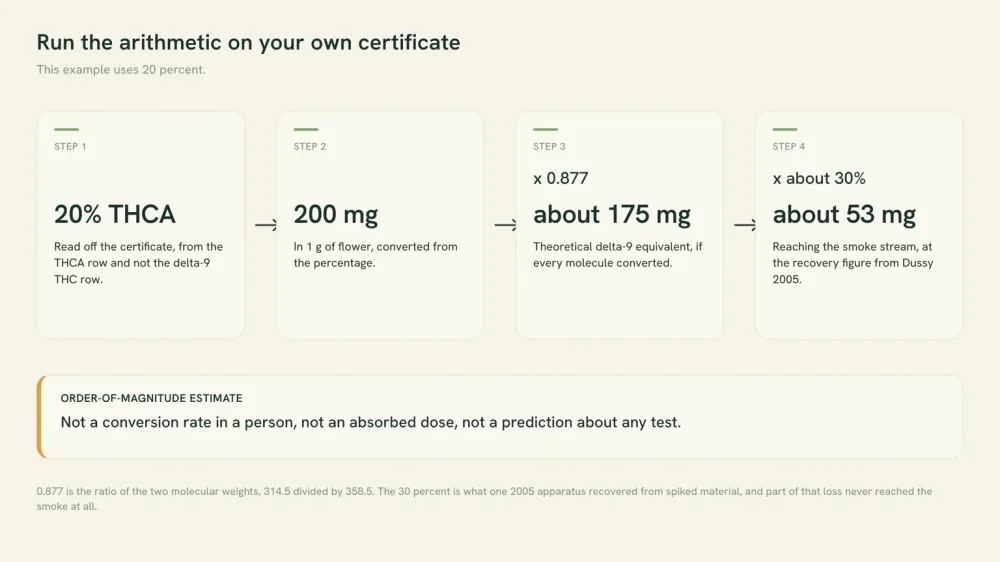
Here is something you can actually do with a certificate of analysis, and it is not a prediction about a test. A THCA product's own laboratory report already tells you roughly what scale of delta-9 THC the label implies once heat is applied. The conversion factor is not ours to invent: 0.877 is the multiplier hemp laboratories print on their certificates, and the federal crop rule quoted further down this page requires total THC to include the potential conversion of the acid into THC. It is also just the ratio of the two molecular weights, and you can check that with the PubChem values above: 314.5 divided by 358.5 is 0.877, which is our arithmetic on two published numbers rather than a quotation from either. Where the factor comes from and what it governs is covered in our explainer on the total THC standard.
- 1Find the THCA row on the certificate, not just the delta-9 THC row, and read its percentage. This example uses 20 percent.
- 2Convert to milligrams for the quantity in front of you. One gram of flower at 20 percent THCA contains 200 mg of THCA.
- 3Multiply by 0.877 to get the theoretical delta-9 THC equivalent if every molecule converted. 200 mg becomes about 175 mg.
- 4Apply the recovery figure from that 2005 smoking simulation, about 30 percent, and roughly 53 mg of delta-9 THC reaches the smoke stream. For scale, the controlled human study described further down this page administered 50.6 mg.
The unheated question, and the study nobody has run
So what about a product nobody heats: raw acid, an unheated tincture, juiced leaf? This is where the confident answers online run out of evidence, and it is worth being exact about what exists. What exists from a living body, on the searches printed below, is a rat study. In the same 2009 paper that reported the 90 percent plant figure, pure delta-9-THCA-A was given orally to rats at 15 mg per kilogram and their urine was worked up. The acid produced a full set of metabolites of its own, including 11-hydroxy and 11-nor-9-carboxy forms of the acid itself, plus glucuronides, and the authors' sentence is unambiguous: "In vivo conversion of Delta9-THCA-A to Delta9-THC was not observed." That is rats, one dose, one route. It says nothing about a person, and it says nothing about whether a rat's acid metabolites would cross-react on a human immunoassay calibrated to delta9THCC, because nobody has measured that.
The nearest thing to a human answer is a 2025 laboratory study from the Johns Hopkins Behavioral Pharmacology Research Unit, run with the manufacturer of the product being tested: four of its ten authors are listed at that company, Cultivate Biologics, and six at Johns Hopkins. Call it an industry-partnered academic study, because that is what it is. Fifteen healthy adults swallowed hemp extract soft gels at three levels, delivering mean THCA doses of 1.6, 2.9 and 5.3 mg alongside mean delta-9 THC doses of 2.2, 3.9 and 7.2 mg, with plasma followed for 48 hours. The acids behaved very differently from the neutral cannabinoids: across all doses, peak plasma concentrations for CBDA and THCA were 19 to 25 times higher than for CBD and THC, and they arrived up to twice as fast. The report also states that these compounds and their metabolites, THCCOOH among them, were "often detectable 48 h post-dosing" in plasma. And then the limit that matters more than any of those numbers: the same capsule contained delta-9 THC, so nothing in that study can separate what the acid did from what the THC did.
That leaves a gap, and the gap is measurable rather than rhetorical. Here is what the literature returned when it was counted on September 3, 2026.
Counts move, so the field searched and the date belong beside every one of them. All six clinical-trial-tagged records were opened rather than assumed, and by their titles they are: a 2026 study of cannabinoid compositions across three classes of chronic pain, the Johns Hopkins full-spectrum study described above, a trial of delta-9 THC and gamma-band neural oscillations, a 2012 paper on agreement between plasma THC and self-reported use, a 2005 paper on estimating the time of last cannabis use, and a 1997 study of hemp oil ingestion and urine tests. Not one of the six gave a person THCA as such. ClinicalTrials.gov returns 3 registered studies that mention tetrahydrocannabinolic acid at all, against 611 for cannabidiol. So when a seller tells you what raw THCA does to a workplace panel, understand where that confidence comes from: a rat, an assumption, or nothing. The study that would answer the question has not been run.
What an intact-acid finding actually proves
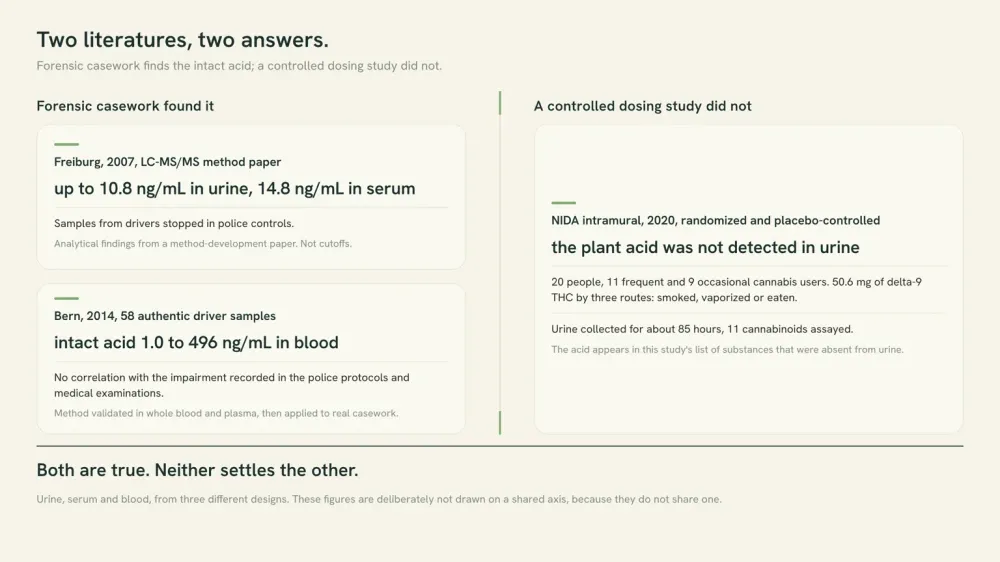
Because conversion is partial, the plant acid does not always disappear, and there is a small forensic literature about finding it. In 2007 a Freiburg team wrote down the old assumption, that decarboxylation was complete and therefore no intact acid should ever be detectable in a consumer's urine or serum, and then reported the opposite in the same sentence: "we found Delta9-THCA-A in the urine and blood serum samples". Their LC-MS/MS method paper reports up to 10.8 ng/mL in urine and 14.8 ng/mL in serum, with acid-to-THC molar ratios in serum of roughly 5.0 to 18.6 percent, in samples from drivers stopped in police controls. Those are analytical findings from a method-development paper. They are not cutoffs, they are not comparable to the panel figures in the table above, and the people involved had consumed cannabis rather than any labelled THCA product.
The most-quoted number about this molecule comes from 58 authentic samples. In 2014, the Institute of Forensic Medicine at the University of Bern validated a method for the acid in whole blood and plasma and applied it to drivers suspected of driving under the influence of cannabis. Delta-9 THC was present in every one of the 58 blood samples, from 0.7 to 51 ng/mL. The intact acid ranged from 1.0 to 496 ng/mL in blood and 1.4 to 824 ng/mL in plasma, with a mean plasma-to-blood partition coefficient of 1.7, against a limit of detection of 0.3 and a limit of quantitation of 1.0 ng/mL. Then comes the sentence the retail pages never quote: "No correlation was found between the degree of intoxication or impairment stated in the police protocols or reports of medical examinations and the detected THCA-A-concentration in blood." The same authors do propose a use for the acid, and it is not impairment: because prescribed THC medication contains only pure THC while cannabis products carry the acid alongside the THC, detecting the acid "may serve as a marker" for telling those two intakes apart. They add, in the same abstract, that knowledge of its usefulness in forensic cases is very limited.
Now the counterweight, because the literature does not agree with itself and pretending otherwise would be the easy version of this page. In 2020 the intramural research program at the National Institute on Drug Abuse published a randomized, placebo-controlled study across three routes in which 20 people, 11 frequent and 9 occasional cannabis users, received 50.6 mg of delta-9 THC smoked, vaporized or eaten, with urine collected for about 85 hours and 11 cannabinoids assayed. Their results line puts the plant acid in a list of things that were absent, and the record prints the Greek letter where this page writes delta: "No cannabidiol, cannabinol, cannabigerol, tetrahydrocannabivarin (THCV), THC, 11-OH-THC and Δ9-tetrahydrocannabinolic acid were detected in urine." Two literatures, two answers. Forensic casework finds the intact acid; a controlled dosing study did not. We report both and pick no winner. What they agree on is which molecule was present in quantity, and it is the carboxy metabolite the panel names.
That same study also shows how much the route changes the size of the signal. At an identical 50.6 mg dose, the median peak urinary concentration of the carboxy metabolite's glucuronide in occasional users was 360 µg/L after eating it, 68.0 after smoking and 26.7 after vaporizing: roughly five times and roughly thirteen times, on the same administered amount. Those are research-assay concentrations of a glucuronide, measured on a different basis from a confirmatory cutoff, and they come from a study of cannabis rather than of any THCA product. Read them as one thing only: "heated" is not a single exposure.
Why "it was legal hemp" is not a chemistry argument
A confirmatory test identifies a molecule at a concentration. A molecule does not carry a receipt. Whatever the jar said, whatever the certificate said, and whatever the law said on the day of the purchase, the instrument reports the analyte it was told to look for, and that analyte is the same one regardless of which legal category the plant material was sold under. This is the part of the topic where the retail pages are most reassuring and least useful.
For one category of testing there is a regulation that says so in a single line. Under 49 CFR 40.151(f), which governs Department of Transportation safety-sensitive testing, the reviewing physician "must not accept an assertion of consumption or other use of a hemp or other non-prescription marijuana-related product as a basis for verifying a marijuana test negative", because "consuming or using such a product is not a legitimate medical explanation". That rule binds DOT-regulated testing. A private, non-regulated employer is not bound by Part 40 and writes its own policy, which may be stricter or looser. How that verification actually runs, and what a medical review officer does inside it, belongs to our page on delta-8 results and the review process rather than here. None of this is legal advice.
The legal layer around THCA is moving, and every sentence of it needs a date. Federal crop testing already counts the acid in: in its 2021 final rule, published January 19, 2021, USDA requires "that the total THC, which includes the potential conversion of tetrahydrocannabinolic acid (THCA) into THC, be reported and used for purposes of determining the THC content of a hemp sample", and in the same rule the agency drew its own boundary, stating that it "does not cover cannabinoid products". As of September 3, 2026, and through November 11, federal law defines hemp by delta-9 THC alone at not more than 0.3 percent on a dry weight basis. Section 781 of Public Law 119-37, enacted November 12, 2025, will replace that with a standard written as "a total tetrahydrocannabinols concentration (including tetrahydrocannabinolic acid) of not more than 0.3 percent", and Section 2019 of H.R. 6500, signed September 2, 2026, limits how much of Section 781 applies before December 11, 2026. We wrote up that two-date split in the news item on the December 11 deadline, and the wider federal picture sits on our hemp law hub. State law is a separate layer and is sometimes stricter than the federal one. None of that changes what an analyzer measures in a specimen, and none of it is legal advice.
Why this page has no clearance timetable, and what to check instead
You will not find a detection-window table here, and the reason is not squeamishness. The study that would justify one for this compound has not been run, and the pages that publish those tables are filling that hole with confidence rather than data. What has actually been published, in the controlled study of cannabis described above, is a median specific-gravity-normalized time to peak of 5.1 to 7.9 hours across all three routes, and a urine collection period of about 85 hours. Those are study parameters, from a study of cannabis rather than of a THCA product, and converting a sampling schedule into a personal clearance estimate is precisely the move that makes those tables wrong. No product can guarantee a drug-test outcome, and no page, including this one, can tell you what a specimen of yours would show.
What you can do is read the documents in front of you properly. None of the following is about affecting a result; all of it is about understanding what a number on a page means.
- Read the THCA row on a certificate, not only the delta-9 THC row, and then read the laboratory's own Total THC formula printed on the report, because that formula tells you how the lab counted the acid.
- Treat ND as a ceiling, not a zero. Not detected means not detected against that batch's stated limit, and the limit is printed on the report.
- Remember that the screen and the confirmation are two different measurements with two different specificities, and that a targeted panel is silent about any molecule it does not name.
- Know which specimen your program collects. In the federal panel the urine analyte is the metabolite, while the oral fluid analyte is the parent drug, so the two are not asking quite the same question.
- Treat your employer's written testing policy as the operative document, and route any result you do not understand to the program's medical review officer rather than to a forum.
That first item is more useful than it sounds, and you can see it working on any certificate, including ours. Every Planntz certificate of analysis prints its own arithmetic on the report itself: Total THC = Delta-10-THC + Delta-8-THC + (Delta-8-THCA x 0.877) + Delta-9-THC + THC-O-acetate + (THCA x 0.877). On the Full Spectrum CBD Mango & Peach report for batch 260310, the THCA row reads ND and so does the delta-8 THC row, so that batch's Total THC equals its delta-9 THC row of 0.239 percent. ND is not a synonym for zero: it means the analyte was not detected against a stated limit. If you have never worked through a report line by line, how to read a certificate of analysis walks through it, and our own batch reports are public.
If what you actually need is the workplace picture rather than the molecule, start with what a panel looks for and how the process runs end to end. If you arrived here from a jar and the real question is which legal category the plant material sits in, hemp and marijuana as legal and chemical categories is the better next page.
The molecule itself is not what a federal urine panel names. The panel names delta9THCC, the carboxy metabolite the body makes from delta-9 THC, screened by immunoassay and confirmed by mass spectrometry. But smoking, vaping or baking converts a large share of the acid into delta-9 THC before it is ever consumed, so the question a panel answers is about the exposure, not about the molecule on the label. That is why "THCA is not what the test detects" is true and beside the point.
No, and HHS said so in writing. Until the January 2025 rule, the federal guidelines used THCA as the abbreviation for delta-9-tetrahydrocannabinol-9-carboxylic acid, which is the metabolite. HHS renamed its own analyte to delta9THCC specifically to distinguish it from the plant cannabinoid "that is also commonly abbreviated as THCA". Two carboxylic acids, two separate PubChem records, one abbreviation: the plant acid is a chromene-2-carboxylic acid at molecular weight 358.5, and the panel analyte is a chromene-9-carboxylic acid at 344.4.
Honestly: nobody has run the study. The only evidence from a living body is a 2009 rat study, in which oral THCA-A at 15 mg per kilogram produced the acid's own metabolites and the authors reported that conversion to delta-9 THC was not observed. Those are rats, one dose, one route. The closest human study used a product that contained delta-9 THC as well as THCA, so it cannot separate the two, and it was run with the product's manufacturer as co-authors. A dated census of PubMed and ClinicalTrials.gov on September 3, 2026 returned zero human studies of raw or unheated THCA.
Once it is lit, the exposure is a delta-9 THC exposure. About 90 percent of a fresh plant's total THC is present as the acid, the smoking step converts a substantial part of it, and the metabolite that results is the molecule the federal panel names. The word on the jar does not change the analyte, and a laboratory that measures one named compound has no way to see what the label said.
For DOT-regulated testing there is a regulation on exactly this question. 49 CFR 40.151(f) says a reviewing physician must not accept an assertion of consumption or other use of a hemp or other non-prescription marijuana-related product as a basis for verifying a marijuana test negative, because using such a product "is not a legitimate medical explanation". Private employers are not bound by Part 40 and write their own rules. This is not legal advice, and your employer's written policy is the operative document.
This page does not publish a clearance timetable, because the study that would justify one for this compound has not been run and because a timetable invites people to treat an average as a personal prediction. What has been published, in a controlled study of cannabis rather than of a THCA product, is a median urinary metabolite peak at 5.1 to 7.9 hours after dosing, with sampling continued for about 85 hours. Those are the parameters of a study design. They are not a clearance estimate, and nobody can predict an individual result.
The confirmatory step identifies a molecule at a concentration; it does not identify where the molecule came from. A distinction the intact plant acid has actually been proposed for is different and narrower: because prescribed THC medication contains only pure THC while cannabis products carry the acid as well, detecting the acid has been proposed as a marker for separating those two intakes, though the authors who proposed it add that knowledge of its forensic usefulness is very limited. That is not the same as separating one legal category of plant material from another. Planntz does not sell THCA flower, THCA concentrate or any THCA product, and this page is not an endorsement of any of them.
Writing about hemp, wellness and the small rituals that keep us balanced.