CBD vs CBG vs CBN: What the Label Actually Subtracts
Page one gives each of these three a job title and cites nothing. Here is what is checkable instead: the subtraction three certificates print, the cost per milligram both ways, and three evidence bases counted on the same day.
CBD vs CBG vs CBN is almost always presented as a choice between three job titles: one molecule for the day, one for the evening, one for everything in between. Nobody who prints that sentence attaches a study to it, and the reason is that the study does not exist. What does exist, and what no one prints, is the arithmetic on the three bottles themselves. Putting a second cannabinoid in a CBD tincture does not add anything to it. It replaces some of the CBD, and the two blends do not replace it the same way.
Here is the short version, up front. The second cannabinoid is a subtraction, not an addition. On our own front panels, the plain CBD bottle and the CBD + CBG bottle both name 15,000 mg of active while the CBD + CBN bottle names 12,000 mg, at the highest price of the three. On the certificates the gap is sharper still: 16,300 mg of total cannabinoids on the plain batch, 16,100 on the CBG batch, and 13,000 on the CBN batch. The evidence behind the three molecules is not one size either, it is three sizes that differ by orders of magnitude. And the receptor sentence that half the internet repeats about CBG has the molecules the wrong way round. None of that requires a claim about what any of it does, which is convenient, because on that question there is nothing honest to say yet.
The one sentence every page agrees on, and the citation none of them has
Open the pages that rank for this search and you will meet the same sentence over and over, close to word for word on at least four of them: one of these three is for everyday balance, one is for the evening, one is for the day. It reads like a summary of a literature. It is not attached to one. The second thing those pages agree on, also with no citation, is that a blend is more effective than a single cannabinoid. We are not going to name any of the sellers, because the problem is the claim and not the company. The problem is that a job description has been handed to a molecule and nobody has run the experiment that would justify handing it out.
“CBD supports everyday balance and calm, CBN supports evening wind-down and sleep, and CBG supports daytime focus and mood.”
You can measure how much evidence sits behind that sentence in about a minute, and the answer is a number rather than an opinion. On September 9, 2026, PubMed held two records that mention cannabidiol, cannabigerol and cannabinol in the title or abstract and carry the clinical-trial publication type. Two is small enough to open, so we opened both. One compared oral CBD against two roadside oral-fluid screening devices. The other measured whole-blood cannabinoid levels after people smoked, vaporized or swallowed cannabis. Neither gave anyone CBG or CBN as an intervention; both simply measured the molecules as analytes in a sample. The head-to-head comparison this page is named after has not been run.
One registered study does give people all three at once, and it still cannot answer the question. It is listed on ClinicalTrials.gov as NCT07769164: 332 participants, randomized, parallel assignment, double masked, completed in August 2024 and first posted in August 2026. Every one of its three active formulas also contains THC, and one of them also contains melatonin, so nothing it eventually reports can be attributed to any single cannabinoid. As of September 9, 2026 its results are not posted. A registration is a plan, not a result, and a multi-ingredient arm cannot show which ingredient did the work.
What the three molecules actually are
CBD is what the plant makes most of. CBG is what the plant started with and spent. In the living plant, the acid form of CBG is the raw material. An enzyme purified in 1996 and named CBDA synthase performs, in the title of that paper, the oxidocyclization of cannabigerolic acid to cannabidiolic acid: it folds an open chain into the closed ring that makes CBD what it is. The paper describes a 74 kDa single polypeptide working in a tube. That is the whole basis of the nickname "mother cannabinoid", and it is a biosynthetic fact rather than a claim about what either molecule does in a person. If you want the molecular half of that story, what one closed ring changes between these two is its own article.
CBN is what THC becomes with time, heat and air. It is the odd one out, because the plant has no enzyme that makes it at all. A 2021 review in a peer-reviewed cannabinoid research journal says it plainly: unlike other phytocannabinoids, CBN is not biosynthesized in an acid form by the plant, it is a degradative product of delta-9-tetrahydrocannabinol. It accumulates as THC ages. That review screened 99 human studies and extracted 8 full texts, and its own conclusion is that the popular associations attached to CBN may be rooted in cannabis lore rather than in measurement. It is a single-author narrative review, and its author is medical director of a for-profit cannabis clinical and consulting entity, which belongs in the same sentence as the finding.
A CBG-rich plant is CBG-rich because a conversion never happens. A 2021 genetics paper built two purpose-made crossing populations and reports that CBGA dominance is inherited as a single recessive gene, potentially governed by a non-functioning allelic variant of the THCA synthase: a broken copy of the enzyme that would otherwise have spent the CBG on something else. The authors hedge that twice, with "potentially" and "may", and all three of them are employed by a hemp seed company, so keep both hedges. Put the three origins side by side and the framing on page one falls apart. One of these molecules is a product, one is a leftover raw material, and one is a wearing-out. They are not three flavors of the same thing. The family map is on the parent article about what cannabinoids are, and the precursor-versus-degradation pair itself belongs to the CBG and CBN comparison.
The arithmetic already printed on the front panel
You can see the first half of the subtraction without opening a single document. Read the front of the three full spectrum bottles we sell and add the two numbers on each. Full Spectrum CBD names 15,000 mg of CBD and costs $80. Full Spectrum CBD + CBG names 9,000 mg of CBD and 6,000 mg of CBG, which comes to the same 15,000 mg of named active, and costs $84. Full Spectrum CBD + CBN names 8,000 mg of CBD and 4,000 mg of CBN, which comes to 12,000 mg, and costs $88. The most expensive bottle of the three names three thousand milligrams less of active than the other two. That is not a verdict on any of them. It is the first thing a three-way comparison should tell you, and it is the thing none of them does.
| Bottle (60 mL) | Actives named on the label | Label total | Price | Per drop at about 0.05 mL |
|---|---|---|---|---|
| Full Spectrum CBD | 15,000 mg CBD | 15,000 mg | $80 | about 12.5 mg CBD |
| Full Spectrum CBD + CBG | 9,000 mg CBD + 6,000 mg CBG | 15,000 mg | $84 | about 7.5 mg CBD + 5 mg CBG |
| Full Spectrum CBD + CBN | 8,000 mg CBD + 4,000 mg CBN | 12,000 mg | $88 | about 6.7 mg CBD + 3.3 mg CBN |
The same split shows up per drop, which is where most people actually meet it. At the house convention of about 0.05 mL per drop, one drop of the plain bottle carries about 12.5 mg of CBD. One drop of the CBG bottle carries about 7.5 mg of CBD and about 5 mg of CBG, which is the same 12.5 mg split two ways. One drop of the CBN bottle carries about 6.7 mg of CBD and about 3.3 mg of CBN, which is 10 mg. Two things travel with those numbers. They describe what is in the liquid, not what to take: this page publishes no amount, and drop size varies with the dropper and with how you hold it. And they are label figures rather than measured ones, which is what the next section is about. The per-drop arithmetic for any bottle is worked through separately.
Three certificates, one flavor, one laboratory
A front panel is a target. A certificate is what the batch landed on, and it is where the second half of the subtraction becomes visible. Below are three of our published certificates, all Mango & Peach so the flavor is not a variable, all from the same laboratory, Infinite Chemical Analysis Labs, and all printing the same package size of 56.7 g. Every figure in the table is printed on the report itself. Nothing in it is computed.
| Batch | Bottle | CBD | CBG | CBN | Total cannabinoids (potency table row) | Total THC |
|---|---|---|---|---|---|---|
| 260310 | Full Spectrum CBD | 15,900 mg (267 mg/mL) | ND | ND | 16,300 mg | 136 mg (0.239%) |
| 260314 | CBD + CBG | 9,640 mg (158 mg/mL) | 6,290 mg (103 mg/mL) | under 1 mg/mL, below the quantitation limit | 16,100 mg | 88.5 mg (0.156%) |
| 260311 | CBD + CBN | 8,680 mg (144 mg/mL) | 17.5 mg (0.290 mg/mL) | 4,110 mg (68.0 mg/mL) | 13,000 mg | 79.4 mg (0.140%) |
Now subtract the printed numbers. That subtraction is the only arithmetic in this section and we are naming it as arithmetic. Going from the plain bottle to the CBG bottle, 6,260 mg of CBD left and 6,290 mg of CBG arrived, and the total cannabinoids row moved by 200 mg. Going from the plain bottle to the CBN bottle, 7,220 mg of CBD left and only 4,110 mg of CBN arrived, and the total cannabinoids row fell by 3,300 mg. The second cannabinoid is not an addition on either bottle, and the two bottles do not subtract the same way. That is neither an upgrade nor a downgrade. It is a different formulation carrying less total cannabinoid per bottle, and it is the single most useful thing to know when you are standing in front of three products. The two-certificate version of this subtraction, along with the ratio question and the blend-versus-two-bottles question, lives on our article about taking CBD and CBG together.
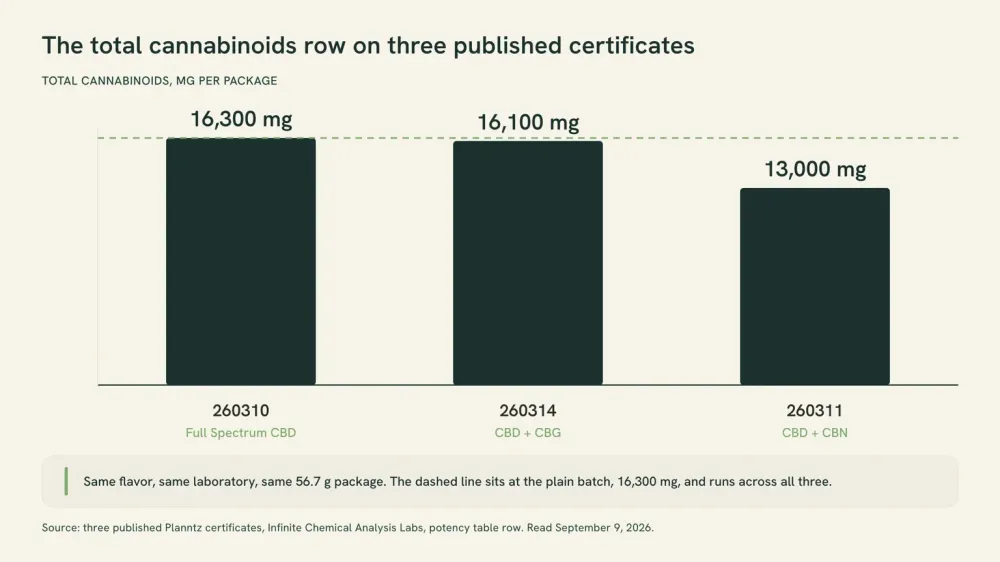
One flavor could be one odd batch, so check the other six. Across all nine of our published full spectrum certificates the pattern holds. The plain CBD family reads 16,100 to 16,300 mg of total cannabinoids across batches 260310, 260309 and 260303. The CBD + CBG family reads 16,100 to 16,300 across 260314, 260315 and 260313. The CBD + CBN family reads 12,500 to 13,100 across 260311, 260312 and 260304. Three production runs of each product, the same shape every time, which is what makes this a fact about the formulation rather than a fact about one batch. And here is a counter-intuition sitting in the same nine reports: CBN is what THC turns into, so you would expect the CBN bottle to sit closest to THC. It does not. The plain CBD bottle prints the highest total THC of the three, 136 to 143 mg per package, against 73.1 to 92.4 mg on the CBD + CBN bottles.
Cost per milligram, computed in the open
Two divisions, and the part that matters is saying which number you divided by. Against the label totals: $80 divided by 15,000 mg is $0.0053 per milligram, $84 divided by 15,000 is $0.0056, and $88 divided by 12,000 is $0.0073. Against the total cannabinoids row on the three certificates above: $80 divided by 16,300 on batch 260310 is $0.0049, $84 divided by 16,100 on batch 260314 is $0.0052, and $88 divided by 13,000 on batch 260311 is $0.0068. Both denominators produce the same ordering, and both are arithmetic rather than evidence about what anything does. Note also that the certificate figures come from one batch of one flavor each, which is why the batch codes are printed beside them.
If you are going to divide by a label figure, it helps to know how often label figures are right. A 2024 analysis of 202 retail CBD products bought online in 2021 included 100 tinctures, and of those 100, 53 measured more than ten percent above the CBD figure on their label and 18 measured more than ten percent below. Across all 202 products, 149 fell outside a plus-or-minus ten percent band. Three things belong in the same breath: the study was sponsored by Jazz Pharmaceuticals, the company that makes the one FDA-approved CBD medicine, several of its authors were compensated by that company, and it tested one unit per product, so it cannot measure batch-to-batch variation and it is not a verdict on any particular brand. What it is good for is settling which number to divide by. Divide by the certificate. Reading a front panel line by line and how price per milligram behaves across a whole category are separate articles; this page prints the three-way division once and hands the topic over.
Three evidence grades, and they are three different sizes
Put the three molecules in one table with three equal columns and the format has already told you something false. Here are the counts, all run on September 9, 2026, all reproducible by anyone. Searching PubMed's title and abstract fields: cannabidiol 8,477 records, cannabinol 932, cannabigerol 574. Filter those to the randomized-controlled-trial publication type and you get 346, 11 and 9. Filter to the humans tag instead and you get 4,014, 428 and 219. On ClinicalTrials.gov, searching interventions: 535 studies for cannabidiol, 11 for cannabinol, 14 for cannabigerol. Counts move, which is why the date sits inside the sentence and not only under the table.
| Measure, all read September 9, 2026 | Cannabidiol (CBD) | Cannabinol (CBN) | Cannabigerol (CBG) |
|---|---|---|---|
| PubMed records with the name in the title or abstract | 8,477 | 932 | 574 |
| Of those, records carrying the randomized-controlled-trial publication type | 346 | 11 | 9 |
| Of those, records that administered the molecule to people | Not counted (346 records, not opened) | 3 | 3 |
| PubMed records filtered to humans | 4,014 | 428 | 219 |
| ClinicalTrials.gov studies listing it as an intervention | 535 | 11 | 14 |
| Times the abbreviation appears on FDA's cannabis page | 63 | 0 | 0 |
| Cannabis-derived drug products FDA has approved that contain it | 1 (Epidiolex, a prescription oral solution) | 0 | 0 |
Nine records and eleven records are small enough to open, so we opened all twenty, and the counts turn out to be generous. Of the nine cannabigerol records, three gave CBG to people on its own (PMIDs 42575778, 39003387 and 38574248), two gave it inside multi-ingredient formulas, three only measured it in blood or urine after somebody took cannabis, and one is a rodent study. Of the eleven cannabinol records, three administered CBN (41698831, 37796540 and 37162192, the last of those inside a formulation that also contained melatonin and with no placebo arm), five only measured it as an analyte, and three are not about the molecule at all: a THC and CBD capsule trial with no CBN arm, a 1980 antiemetic trial of cyclizine, metoclopramide and nabilone, and a psychotherapy trial whose abstract uses the word cannabinol as a name for cannabis dependence. Three each. That is the size of the thing being printed in an equal-width column next to 346.
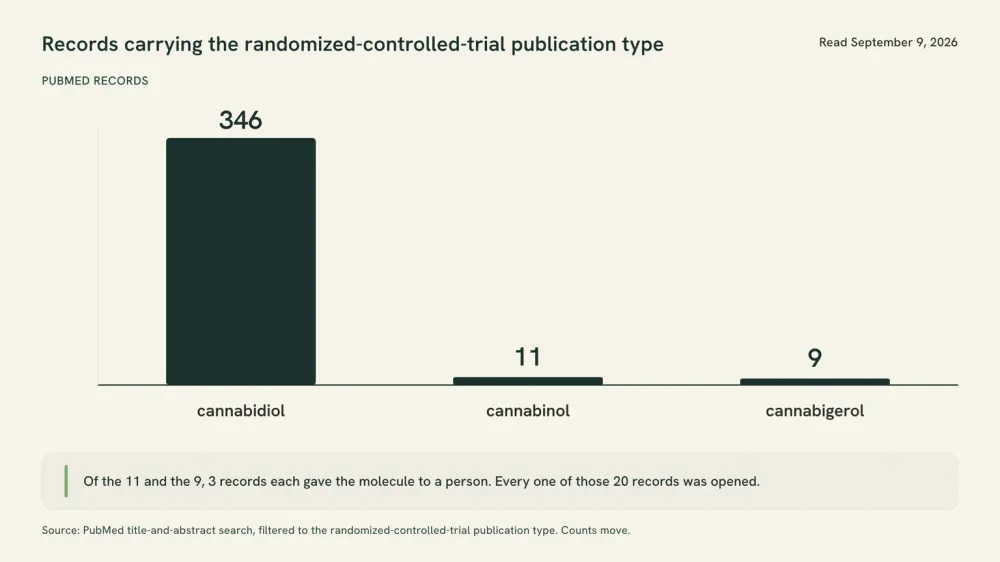
How many people are actually taking each of the three is a different question with a different answer. A 2023 national survey of US adults reported past-year use of 21.1% for CBD, 5.2% for CBG and 4.4% for CBN, against awareness of 71.7%, 18.4% and 16.8% respectively. It was a research letter, fielded across five days in June 2023, 1,169 of 6,666 panelists completed it, and its AAPOR research response rate was 2.9%, all of which belongs beside the percentages. It measures what people say they took. It measures nothing about what any of it did, and popularity is not evidence in either direction. Why "minor" is an abundance word rather than a ranking is covered in our piece on major and minor cannabinoids.
The third grade shows up somewhere people do not think to look. On September 9, 2026, FDA's own page on cannabis and cannabis-derived products used the abbreviation CBD sixty-three times and the word cannabidiol fourteen times. It used CBG zero times and CBN zero times, and every one of its seven hits for the string cannabinol sits inside the word tetrahydrocannabinol. Read that carefully, because it is easy to read backwards: a silence is not a permission. The absence of CBG and CBN from the federal regulator's cannabis page is a gap in guidance, and it is not a reason to treat either one as freer, safer or less regulated than CBD.
What has actually been given to people, one molecule at a time
CBD. Its evidence grade has a floor the other two do not have, because there is an approved medicine. The same FDA page states that the agency has approved one cannabis-derived drug product: Epidiolex, a purified form of CBD, for seizures associated with Lennox-Gastaut syndrome or Dravet syndrome in patients one year and older. That page stops at those two indications; the current prescribing information adds seizures associated with tuberous sclerosis complex, and describes a prescription oral solution dosed in milligrams per kilogram of body weight. That is not a bottle of drops, and none of its evidence transfers to one. The honest reading is narrower than it sounds and still decisive: CBD has by far the largest human literature of the three, and the single approved product inside that literature is a drug you cannot buy off a shelf.
CBG, first measurement. The dose-ranging study in that set of three is a human laboratory study of oral CBG, published in July 2026. Twelve healthy adults, five levels from 0 to 200 mg of CBG isolate in MCT oil, placebo slotted randomly into the sequence, plasma and pharmacodynamic measures across eight hours, and liver function tests after the two highest doses. No drug-related adverse events occurred. Liver function tests never exceeded the upper limit of normal. The authors' own summary sentence is that CBG was well tolerated with no robust pharmacodynamic effects, and that chronic dosing studies are needed. The subjective ratings that did move were decreases in Jittery and Active at 50 mg, a decrease in Calm at 100 mg, and an increase in Appetite at 200 mg. Those are four readings on four named scales, from twelve people, at single doses, in one laboratory, on an isolate rather than a product, with one author affiliated with a cannabinoid company. A movement on a scale called Active is a movement on a scale, not a property of a molecule, and none of those milligram figures is a serving.
CBG, second measurement. The other placebo-controlled CBG trial in that set is a 2024 double-blind crossover in 34 healthy adults: a single 20 mg hemp-derived CBG tincture against placebo, one-week washout, with the sessions run at home over Zoom. It reported lower self-rated anxiety overall, lower stress at one timepoint, a secondary and unreplicated verbal-memory result, and no evidence of subjective drug effects or impairment. Its own abstract notes that there are no published clinical trials to corroborate those findings in humans, and one of its co-authors founded and runs a company that formulates with CBG. Thirty-four people, one dose, one product, self-report from home, not replicated. Those two are the placebo-controlled members of that set of three: the third gave a single 25 mg dose to compare delivery vehicles and meal conditions and had no placebo arm at all. And the two that did carry a placebo do not obviously agree with each other. The pairwise CBG and CBD comparison carries the rest of it.
CBN. Small, specific, and reported here as design and pre-registered primary endpoint only, because what those trials found on their other measures has to be read next to that endpoint, and that reading is not a job for a three-way comparison page. Of the three records in that set that gave CBN to people, two ran a placebo comparison with a pre-registered primary endpoint, and neither endpoint was met. A seven-night trial across five arms analyzed 293 adults, and its pre-registered primary endpoint, a sleep-quality rating, was not met: odds ratio 2.26, 95% CI 0.93 to 5.52, p = 0.082. Its authors give two cannabis companies as their affiliations. An overnight polysomnography crossover measured 20 adults with physician-diagnosed insomnia in a laboratory, three arms in a single night with a two-week washout, at 30 mg and 300 mg against placebo. Its pre-registered primary outcome, wake after sleep onset, was also not met: 6.3 minutes less at 300 mg, 95% CI -18.2 to +5.5, p = 0.29, and 4.0 minutes less at 30 mg, 95% CI -15.9 to +7.9, p = 0.50. It recorded 247 mild-to-moderate adverse events across its arms, it was run by a philanthropically funded university centre, several of its authors hold cannabinoid patents, and its abstract closes that larger and longer trials are warranted. Everything else those two trials measured lives on our CBN and CBD page, beside the endpoints it has to be read against.
The receptor sentence almost every page gets backwards
Here is a sentence that appears on this search result in several places: unlike CBD, CBG binds directly to both the CB1 and CB2 receptors. Both halves of it are wrong, and correcting it makes no health claim in either direction, which is why it is the most useful thing on this page that is not a milligram. Open the database pharmacologists actually maintain, the IUPHAR/BPS Guide to PHARMACOLOGY, and on September 9, 2026 it listed cannabidiol at the human CB1 receptor as an allosteric modulator with a negative action, and cannabinol at the same receptor as a partial agonist. Cannabigerol had no CB1 record and no CB2 record at all; its listed targets were TRPA1, TRPM8 and two sodium channels. Neither CBD nor CBN has a CB2 record either. A curated database holds what has been submitted and curated rather than everything anyone has ever measured, so this is not proof that nobody has measured CBG at CB1. It is proof that the marketing sentence has the molecules the wrong way round.
The primary papers do not rescue it either. A 2010 study asking whether CBG activates or blocks G-protein-coupled receptors found it behaving at 10 micromolar as a CB1 competitive antagonist, in mouse brain membranes and mouse isolated vas deferens, and its authors flag their own inconsistency between assays. A 2018 study in transfected cells found CBG competing at CB2 but not at CB1, with a Ki of 2.7 micromolar against greater than 30, and described it as a partial agonist at CB2; five of its thirteen authors are employed by a cannabis company. And CBD, the molecule that sentence says does not touch CB1, was characterized in 2015 as a non-competitive negative allosteric modulator of exactly that receptor, in transfected cells and a striatal-neuron cell model.
- A receptor name is not a feeling. Knowing where a molecule sits on a target tells you nothing about what a person notices after swallowing it.
- In vitro is not in you. Mouse brain membranes, mouse isolated vas deferens, transfected HEK-293T cells and a striatal-neuron cell model are the preparations behind every number in this section.
- An absence in a curated database is an absence of curated records, not an absence of biology. It is still enough to falsify a sentence claiming the opposite, which is all it is being used for here.
- None of the three molecules has a CB2 record in that database, which is worth knowing before you read any marketing claim built on CB2.
One more thing about this search result as it stood on September 9, 2026: the only primary source that surfaces anywhere in it is a 2026 study of cultured mouse dorsal-root-ganglion neurons, and no seller page uses it. What it reports is that four minor cannabinoids behave differently from one another, which is the opposite of a ranking. Our CBG and CBN comparison reads that one in full, and the fourth molecule in it, CBC, has its own comparison with CBG.
Trace THC, and the thing no certificate can tell you
All three of these bottles are full spectrum, which means all three carry trace THC. Across the nine published certificates the total THC row runs from 0.129% to 0.252%: 0.239%, 0.243% and 0.252% on the plain CBD batches, 0.156%, 0.159% and 0.142% on the CBD + CBG batches, and 0.140%, 0.163% and 0.129% on the CBD + CBN batches. Every one of the nine is under the federal 0.3% limit, and not one of them is zero. Choosing the CBG bottle or the CBN bottle does not remove it. One note on rounding: you will see the CBD + CBN trace summarized as about 0.14%, and batch 260312 prints 0.163%, so read the certificate for the batch in your hand and treat a summary as a summary rather than a ceiling. What a drug test actually looks for is the article to read before you decide, and what full spectrum means as a category covers the rest.
And here is the limit on the entire document. A certificate settles composition and it settles nothing else. It tells you how many milligrams of each molecule the laboratory measured in that batch, what the trace THC was, and what the detection limits were. It cannot tell you what any of it will do in a person, and no laboratory report from any company can. Anyone who hands you a COA as evidence of an effect has quietly changed the subject.

Five questions that actually discriminate
A comparison table cannot make this decision for you, because the column that would decide it is empty. A procedure can get you most of the way, as long as it only asks questions that have answers. Work through these five in order.
- 1Do you want trace THC in the bottle at all? All three of these are full spectrum, so all three carry it, measured between 0.129% and 0.252% across nine certificates. That question is answerable today, and it settles a whole category.
- 2Do you want the milligrams on one molecule or split between two? The plain bottle puts all 15,000 mg on CBD. The CBG bottle moves 6,000 mg of the label total onto the second cannabinoid, and the CBN bottle moves 4,000 mg out of a smaller total.
- 3What did the batch you are actually buying land on? Find the batch code, open its certificate, and read two rows: total cannabinoids and total THC. Then check whether the front panel and the report are telling you the same story.
- 4What is the cost per milligram, and per milligram of what? Divide the price by the label total and then by the certificate's total cannabinoids row. Say which denominator you used, because the two do not agree and only one of them was measured.
- 5Is there any evidence you can check that discriminates between the three? Today, no. Two PubMed records name all three, and neither gave anyone CBG or CBN. Re-run the searches yourself.
If none of those five discriminates for you, then the two things left that are genuinely decidable are cost per milligram and whether you want trace THC in the bottle. That is not a disappointing answer, and it is not a hedge. It is the only answer the evidence currently supports, and every page that hands you a more satisfying one is handing you a sentence with no study behind it.
What this comparison cannot settle
Three limits, said plainly, because a page that lists none is not being careful. This one cannot tell you which of the three to buy, since nobody has run the trial that would answer it and a page that pretends otherwise is guessing on your behalf. It cannot give you an amount to take: amounts belong on our dosage article, and two of these three molecules have no human dosing evidence to derive an amount from anyway. And it cannot promise you a drug-test outcome for any full spectrum product. What it can do is hand you three certificates, six divisions and a set of dated searches you can re-run yourself, which is more than the whole first page of results currently offers between them.
CBD vs CBG vs CBN: frequently asked questions
The question has no evidence-backed answer today, and the reason is a number rather than an opinion. On September 9, 2026, PubMed held two records naming all three of cannabidiol, cannabigerol and cannabinol that carry the clinical-trial publication type. Both were opened, and neither administered CBG or CBN: one compared oral CBD against two roadside saliva screening devices, and the other measured cannabinoid levels in blood after people smoked, vaporized or swallowed cannabis. The head-to-head comparison has not been run. What you can decide today is in the five questions above: whether you want trace THC, how the milligrams are split, what the batch certificate says, and cost per milligram.
Because the second cannabinoid replaces the first rather than adding to it, and CBN does not replace it milligram for milligram. On the label, the CBD bottle and the CBD + CBG bottle both name 15,000 mg of active while the CBD + CBN bottle names 12,000 mg. The certificates show the same shape in the total cannabinoids row: 16,300 mg on batch 260310 and 16,100 mg on batch 260314, against 13,000 mg on batch 260311. That is a formulation difference rather than a value judgment. It is a different product carrying less total cannabinoid at a higher price, and the division is yours to run: 0.53, 0.56 and 0.73 cents per milligram against the label totals.
A blend bottle is a formulation choice rather than an addition, which is the only part of that question this page answers. How cannabinoids are combined, whether there is a sensible ratio, and whether a blend or two separate bottles makes more sense are all handled on our article about taking CBD and CBG together. If you take prescription medication, that conversation belongs with a pharmacist or a doctor before it belongs with any blog, ours included.
Nobody can honestly tell you yes and nobody can honestly tell you no. All three of the bottles compared here are full spectrum, and across our nine published certificates the total THC row runs from 0.129% to 0.252%: under the federal 0.3% limit, and never zero. Standard workplace screens look for THC metabolites rather than for CBG or CBN, and cutoffs, assay sensitivity and how much of a product you use all move the outcome. Our drug-test article covers what those screens actually measure. No product, ours included, can guarantee a result.
CBN is a chemically different molecule from THC, and the honest version of this answer is dose-qualified rather than absolute. The human trials that gave CBN to people used 20 mg a night for a week, or single doses of 30 mg and 300 mg, and those are study amounts rather than servings. What each of those trials recorded on its subjective measures is reported on our CBN and CBD page, which is where the question is answered in full and where it can be read next to the endpoints each trial registered in advance. Treating any cannabinoid as guaranteed non-intoxicating without naming an amount is the kind of absolute this blog does not print.
There is no controlled human comparison that answers that, so what you can do instead is count. On the labels, the blend does not add a cannabinoid, it moves 6,000 mg or 4,000 mg of the total onto a second molecule, and on the certificates the CBN blend's total cannabinoids row sits 3,300 mg below the plain bottle's. In the one registered study that gives people all three, every active formula also contains THC and one also contains melatonin, so even once its results are posted, nothing in it will be attributable to a single cannabinoid. A multi-ingredient arm cannot demonstrate which ingredient did the work.
This page publishes no amount, for two reasons. Amounts are the subject of our dosage article, and two of these three molecules have almost no human dosing evidence to derive an amount from: the CBG record includes a twelve-person laboratory study across five dose levels and a thirty-four-person crossover at a single 20 mg dose, and the CBN record is three administration studies. The per-drop figures in this article describe what is in the liquid, about 12.5 mg of CBD on the plain bottle and about 7.5 plus 5 or 6.7 plus 3.3 on the blends, and drop size varies with the dropper and the technique. That is composition, not a serving suggestion.
Every batch of all three bottles has a public certificate on our lab results page, with the total cannabinoids row and the total THC row printed on it. Find the batch code on the bottle you are considering, open its report, and do the division yourself. That is the part of this comparison that is settled, and it is the part nobody else will hand you.
The certificate is the part you can check
All three full spectrum tinctures are 60 mL and publish a per-batch certificate of analysis from a third-party laboratory: 15,000 mg of CBD, or 9,000 mg of CBD with 6,000 mg of CBG, or 8,000 mg of CBD with 4,000 mg of CBN. All three carry trace THC under the federal 0.3% limit, and none of them is zero. Read the total cannabinoids row, then divide by the price.
Browse the Planntz tincturesWriting about hemp, wellness and the small rituals that keep us balanced.