What Is Bhang? What's in the Glass and Why It Hits Late
Bhang is cannabis leaf ground to a paste and usually drunk in milk. Here is what is actually in the glass, why it acts like an edible, how India's 1985 law treats it and what doctors have reported.
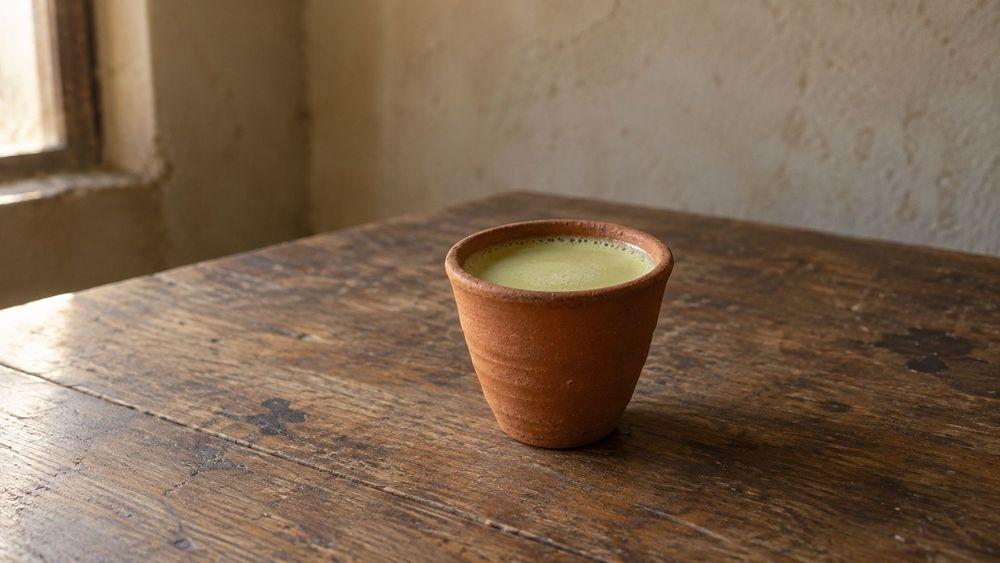
Bhang is cannabis leaf, ground to a green paste and usually drunk in milk, in yogurt or in a spiced milk-and-nut drink called thandai. It is a traditional preparation in north India, drunk by many people at Holi and Maha Shivaratri, and because you swallow it, it behaves like an edible: it starts late and lasts for hours. What nobody can tell you is how much THC is in a given glass, because we could not find a single published lab measurement of one.
The word has other meanings, so it helps to pin it down first. In Kenya and parts of East Africa, "bhang" simply means marijuana, usually smoked, and a 2011 survey of 217 rural Kenyan adults used the word exactly that way. It is also the name of a North American cannabis brand, which has nothing to do with the Indian drink. This article is about the Indian preparation: what goes into it, what is actually known about its strength, why it hits late, how India's law treats it and what doctors have documented. It is not a recipe, and nothing here is legal or medical advice.
What bhang actually is
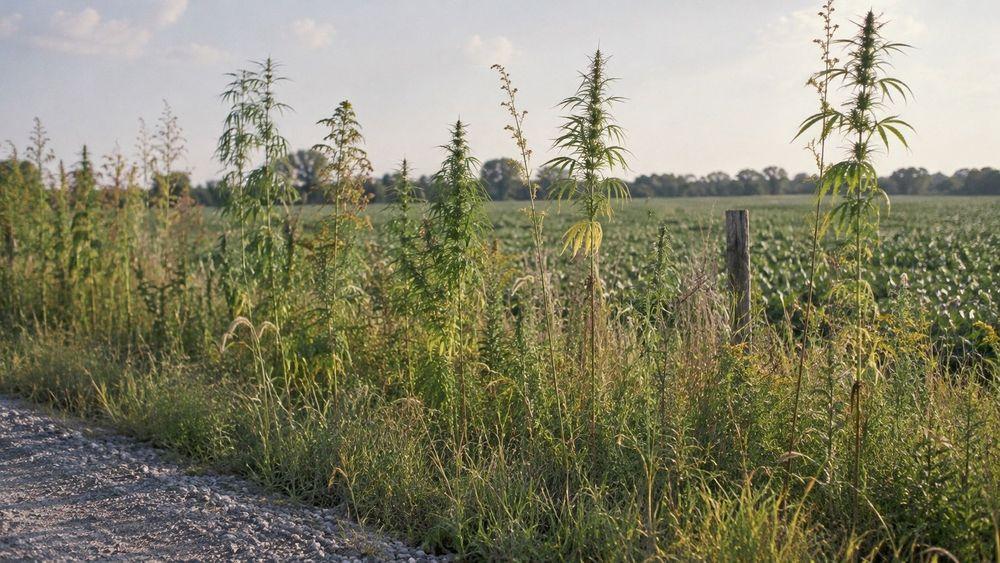
Bhang starts with the leaves of the cannabis plant, ground into a soft paste. That paste is then taken in a few broad ways. A 2012 review of bhang's place in Hindu worship describes the oral forms as "wet resinous leaves formed into pills or a drink made of milk, cannabis, and various spices consumed by worshipers of Shiva on festival days". The drinks have names you will see in festival coverage: bhang thandai, a chilled milk drink with ground nuts and spices, and bhang lassi, made on a yogurt base. The paste can also be cooked into sweets.
This is an old, ordinary category in the region, not a modern invention. Colonial excise records from British Punjab for 1907 to 1918 tracked bhang and charas as two separate legal, taxed goods, and the 2015 analysis of those ledgers describes bhang as "traditionally ingested in liquid or solid (usually cooked) form". The point to hold on to is the plant part. Popular recipe pages often call for buds, and by the legal definition below, a drink made from buds is not bhang at all. If you are curious about the words themselves, our piece on where marijuana, ganja and other cannabis names come from covers that history.
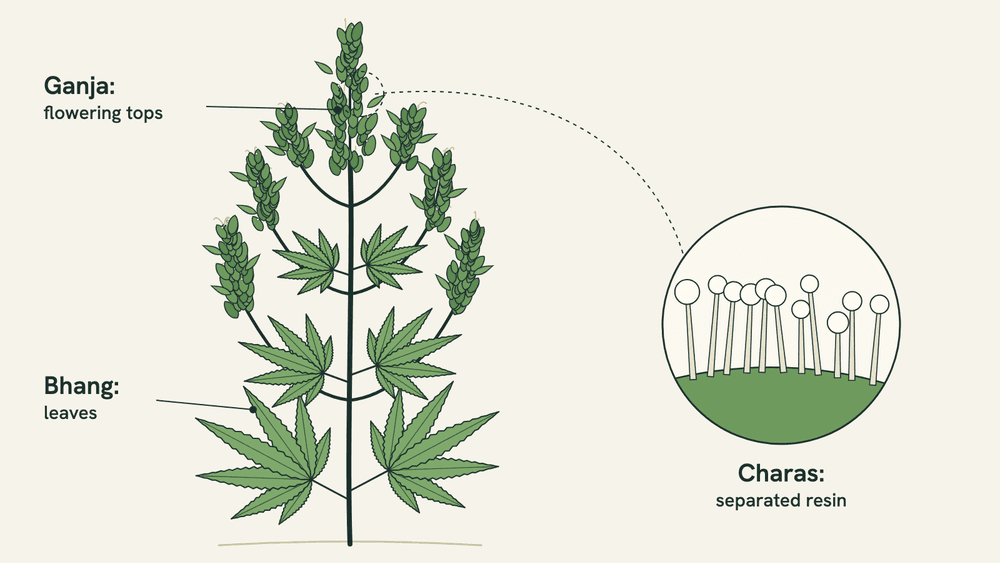
Bhang vs ganja vs charas
All three come from the same plant. What separates them is which part is used, how it is usually taken and how India's narcotics law treats it. The legal column is explained in full further down.
| Name | Plant part | Usual form | Under India's NDPS Act 1985 |
|---|---|---|---|
| Bhang | Leaves, without the flowering tops | Paste, drink or cooked sweet | Outside the Act's definition of cannabis. States license, regulate or restrict it |
| Ganja | Flowering or fruiting tops | Usually smoked | Defined as cannabis. Non-medical use prohibited |
| Charas | Separated resin | Usually smoked | Defined as cannabis. Non-medical use prohibited, and excluded from what states may permit |
Within Hindu tradition the three are not treated alike either. A 1985 anthropological study described bhang and thandai as the socially accepted, lower-strength forms, with ganja and charas regarded "more ambivalently as poisons or semipoisons", and noted that "moderation is enjoined". Lower strength there is the author's characterization, not a lab number, and the next section covers what has actually been measured. Charas has its own story, told in our guide to hash, charas and other resin preparations.
What's in the glass, and what nobody has measured
Here is the plain answer: as of November 2026 we could not find a single published lab measurement of how much THC is in a served glass of bhang. We searched PubMed on November 9, 2026. Of the 42 records that mention bhang in the title or abstract, none analyzes a prepared drink. That is an absence in the indexed literature, not proof that no lab anywhere has tested one. It does mean that every potency figure you see online for "a glass" is an estimate, and you will not find one here.
What does exist is thin. The only lab measurement of bhang leaf we found is a 2026 analysis of shade-dried cannabis leaves from a single licensed vendor in north India. Using HPLC, a standard lab method for separating cannabinoids, it read 0.74% delta-9 THC, 0.77% CBD, 1.30% CBDA and only 0.001% THCA. That is one bag of leaves from one vendor, not a typical value. The near-absence of THCA beside 0.74% THC is also unusual for dried leaf, and the paper does not explain it. The authors themselves note that geography, harvest and storage were not considered.
For a broader sense of scale, the UN drug-lab manual on analyzing cannabis puts leaves at roughly 1-2% THC against 10-12% for female flowers. That figure comes from a 2006 German study of drug-type plants, not from Indian bhang, so treat it as a ratio worth knowing rather than a measurement of the drink. The gap is anatomy: the resin glands that make most of the plant's THC crowd the flowers, as our explainer on trichomes, the plant's resin glands shows.
Why milk, ghee and nuts matter
THC barely dissolves in water: about 2.8 mg per liter at 23 °C, according to PubChem's chemistry record for THC. It dissolves readily in fat, which is why the FDA-approved synthetic THC capsule, dronabinol, is supplied in sesame oil. Our explainer on why THC is fat-soluble and what that changes has the full chemistry. For bhang, the short version is that the dairy fat, ghee and ground nuts are not just flavor. They are what carries the THC out of the leaf and into the glass.
Bhang itself has never been measured this way, but cannabis tea has. In a 2024 Czech lab study of cannabis tea, plain steeping pulled out under 2% of the delta-9 THC (0.4-1.9%), and adding cream during steeping pushed the transfer to 53-64%. A Danish lab study the same year found that adding a fat-containing creamer raised the THC in tea 2.3 to 4.4 times. Both used flower, not leaf paste, and the Czech authors note that an earlier study found the opposite, so the fair summary is that most of the evidence points one way. The idea is not new. A British pharmacologist writing in 1973 explained traditional cannabis sweets as "extraction of the psychically active principle into butter, a partition which then resists washing with water".
Read those numbers for what they are:
- What they show: the fat in the liquid largely decides how much THC leaves the plant material and ends up in what you drink.
- What they do not show: how strong any particular glass is. The tea studies used flower, fixed amounts and lab measurement. A festival drink has none of those.
- What follows: a richer drink is not a gentler one. More fat can mean more THC in the same glass.
- What fat does not change: the THC still has to pass through the gut and the liver, which is why the effects arrive late.
Why bhang hits late and lasts long
No published study we found has timed bhang itself. It is swallowed THC in fat, though, which is the same situation as an edible, and edibles have been studied. In a placebo-controlled study of 17 adults who rarely used cannabis, effects from THC brownies did not show up until 30-60 minutes after eating, peaked at 1.5-3 hours and were still fading at the 8-hour mark. A 2003 review of cannabinoid pharmacokinetics gives a similar picture for oral THC: onset at 30-90 minutes, a maximum at 2-3 hours and effects lasting about 4-12 hours. Our guide on why edibles take so long to kick in walks through each stage of that delay.
Two things make the swallowed route different from smoking. First, the liver turns a large share of THC into 11-hydroxy-THC on the way in. After an oral dose, blood levels of that metabolite run at roughly half to equal those of THC, against about one-tenth to one-twentieth in an older intravenous study. In a 2017 brownie study measuring blood levels, one dose level peaked at 3.5 ng/mL of THC and 3.3 ng/mL of the metabolite. Our page on 11-hydroxy-THC, the metabolite behind edible highs covers what it does. Second, only a small and variable share of swallowed THC reaches the blood: 4-20% in a major review of how the body handles cannabinoids, and 10-20% on the dronabinol prescription label. That variability, on top of a drink nobody has measured, is why a home-made glass is so hard to predict.
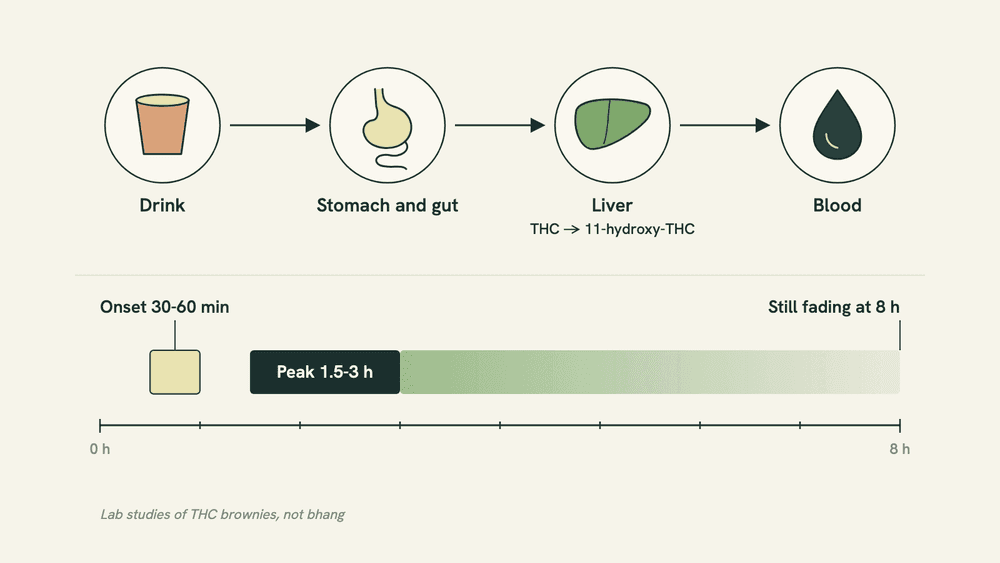
The late start is the part that catches people out. Someone who feels little after half an hour may conclude the glass was weak. The case reports below show a second problem: once intoxication arrives, it can blunt attention to warning signs. Because bhang contains THC, it can also show up on a drug test like any other form of cannabis, and our guide to how long THC stays in your blood explains how detection works.
Where bhang is legal, and why "legal in India" is the wrong summary
Most pages say bhang is legal in India. The law is narrower than that. India's Narcotic Drugs and Psychotropic Substances Act of 1985, known as the NDPS Act, defines cannabis as charas, ganja and any mixture or drink made from those two. Its definition of ganja carries the carve-out that matters:
“ganja, that is, the flowering or fruiting tops of the cannabis plant (excluding the seeds and leaves when not accompanied by the tops)”
A drink made from leaves alone falls outside that definition. The format does not rescue anything else: the same clause covers "any drink prepared therefrom", meaning from ganja or charas, so on the text a drink made from flowering tops or resin is still cannabis under the Act. What matters is which part of the plant went in. Section 10 then lets state governments permit and regulate the cultivation, sale and use of cannabis "(excluding charas)", which is why the practical answer changes at state borders. The Act has been amended three times since 1985, and a 2022 review by specialists at India's national drug-dependence treatment centre reports that none of those amendments changed the regulatory control of cannabis.
An addiction psychiatrist at that centre had put it plainly in a 2014 letter on bhang and the law: bhang "is the only preparation of cannabis that is not covered" by the Act, technically and legally it should include only leaves, and India's own national drug policy notes that its production and sale "is permitted by many State Governments". The 2022 review adds that licensed bhang shops had been reported in at least Rajasthan, Uttar Pradesh, Punjab and Odisha, with excise licenses in some states. The authors note that most of that record comes from news reports and that sales figures could not be accessed. Rules can also shift with the calendar. A 2001 forensic report from Gujarat, a state that prohibits alcohol, described the state relaxing its rules on bhang for a single day at Shivratri. That is a 2001 description, not current law.
The leaf carve-out did not start in India. The 1961 UN Single Convention on Narcotic Drugs defines cannabis with the same words, "excluding the seeds and leaves when not accompanied by the tops". For leaves, it asks countries only to "prevent the misuse of, and illicit traffic in" them, and it gave countries 25 years to end traditional non-medical cannabis use. India's own law arrived in 1985. So the line you may have read, that cannabis "was legal in India until 1961", compresses a longer story. This section reflects the statute text and published reviews as of November 2026. It is not legal advice, it does not describe any particular state's current rules, and it is not a guide for travelers.
A short history: scripture, a colonial commission and early research
Bhang has a long written record. Hindu scripture names bhanga among its sacred plants: the Atharvaveda lists it within the "five kingdoms of herbs headed by Soma", which the 2022 review calls the earliest written reference in India. In Hindu practice bhang is associated with Shiva and is drunk by worshippers on festival days, notably Holi and Maha Shivaratri. That is a description of religious practice, not evidence about health.
The first large inquiry came from the British. The Indian Hemp Drugs Commission of 1893-94 took evidence across India and concluded that "the moderate use of hemp drugs is practically attended by no evil results at all", while "excessive use ... tends to weaken the mind. It may even lead to insanity." It also found "little or no connection" between hemp drugs and crime. That was a colonial inquiry using the methods of its day, not a clinical study, and historians have cautioned against taking it at face value. The report was revisited in the journal Addiction in 2019, and the modern case literature in the next section is the better guide to harm.
Social scientists took an interest early. In 1954 a psychiatrist published a paper titled "Daru and bhang: cultural factors in the choice of intoxicant", daru being a common Hindi word for liquor. Even the title makes a point worth keeping: bhang and alcohol were being studied as culturally shaped choices, not as interchangeable ways to get intoxicated.
What doctors have documented
The top search results for bhang are almost entirely celebratory. The medical literature is small, but it is not empty. Psychiatrists in India were already publishing under the title "Bhang psychosis" in 1973. The most useful psychiatric report is a 1991 study from Lahore that compared 15 people treated for psychosis after drinking bhang with people who drank it without problems. The patients were more often chronic users and more often had a past psychotic episode. Their symptoms resembled "a brief mania-like disorder with paranoid psychotic features" and settled within five days on antipsychotic medication. The study describes who ended up in hospital. It cannot say how often that happens.
Heart events appear as single case reports. In a 2024 case from AIIMS Rishikesh, a 28-year-old man drank bhang and alcohol at Holi, did not seek care for chest pain for about 24 hours because he was intoxicated, and turned out to be having a major heart attack with two arteries blocked. He survived after stenting. He also smoked one to two cigarettes a day and had raised triglycerides, and the authors suggest a possible role for THC-related clotting and artery spasm, "aggravated by concurrent alcohol". One case cannot show cause. The clearest lesson in it is the delay. A 2016 case from Raipur described a young man with both heart ischemia and a stroke after drinking bhang. Only the abstract is available, so other exposures are unknown. For the wider picture on combining the two drugs, see our comparison of alcohol and cannabis harms.
The one published death we found is in the 2001 Gujarat forensic report: a man of about 25 died within 24 hours of drinking a glass of bhang at Shivratri. He had rheumatic heart disease affecting several valves and had previously had open-heart surgery. The forensic doctors who reported it called a bhang fatality "extremely rare". Separately, a 2013 Mumbai case described a first-time drinker with a frightening reaction that the psychiatrist attributed to anticholinergic effects. What else was in that drink was not characterized.
Case reports collect the worst outcomes, so a comparison helps. A 1975 Indian study of long-term users compared 25 heavy bhang drinkers and 25 charas smokers, all with 10 or more years of use, against 25 non-users. It found no definite psychosis, but poorer physical health and nutrition and more trouble at work and at home among the users. It is small, from one city and about 50 years old.
Taken together, here is what these reports can and cannot tell you:
- They show that serious events after bhang have been documented, including in young adults.
- They cannot give a rate. A case report describes one person, and nobody knows how many glasses were drunk without incident.
- They cannot prove cause. Alcohol, tobacco and pre-existing heart disease all appear in the heart cases.
- They do point to two practical risks: an unmeasured amount of THC, and intoxication that delays noticing a medical problem.
For the milder end of too much THC, such as anxiety, nausea and a pounding heart, our guide to greening out and how to handle it has a fuller red-flag list.
Same plant, different part. Bhang is made from cannabis leaves. "Weed" usually means the flowering tops, which in India are called ganja, and leaves generally carry far less THC than flowers. In Kenya and parts of East Africa, though, "bhang" is simply a word for marijuana.
Not in the blanket sense most pages suggest. India's 1985 NDPS Act defines cannabis as ganja, charas and mixtures or drinks made from them, and leaves without tops fall outside that definition. States then decide whether to license, regulate or restrict bhang, and licensed shops have been reported in several states. This is a summary of the statute as of November 2026, not legal advice.
It delivers swallowed THC, so it behaves like an edible. No published study we found has timed bhang itself, but in studies of THC brownies, effects began 30-60 minutes after eating, peaked at 1.5-3 hours and were still fading 8 hours later. How strong it feels depends on an amount that is never measured in a home-made glass.
They are two common ways the leaf paste is served. Bhang lassi uses a yogurt base, and bhang thandai is a spiced milk drink with ground nuts. The dairy fat and nuts matter chemically: THC dissolves in fat rather than water, so they are what carries the THC into the drink.
In Hindu practice bhang is associated with Shiva, and it is drunk by worshippers on festival days, Holi and Maha Shivaratri in particular. Tradition sets it apart from ganja and charas, which are viewed far more warily, and moderation is expected.
No one can say for a given glass, because we found no published measurement of a served glass. Leaves carry less THC than flowers, but a drink can contain a lot of leaf, and swallowed THC arrives late, lasts longer and is partly converted to 11-hydroxy-THC. The late onset and the unknown amount are what catch people out.
It can. Bhang contains THC, and standard cannabis tests look for THC and its breakdown products whatever form it was taken in. How long it stays detectable depends on the type of test and on how much and how often someone has used.
If you want to understand why the milk in bhang matters at all, start with the chemistry. Our explainer on THC's fat solubility and what it means for edibles and drinks covers it, and the guide to the major cannabinoids puts THC in context with the rest of the plant.
Writing about hemp, wellness and the small rituals that keep us balanced.