What Is Ditch Weed? Feral Hemp, Its THC and Its History
Ditch weed is feral hemp, escaped from 19th-century and wartime fiber crops. Here is what field surveys measured in it, how DEA counted it by the hundreds of millions, and what the law says as of November 2026.
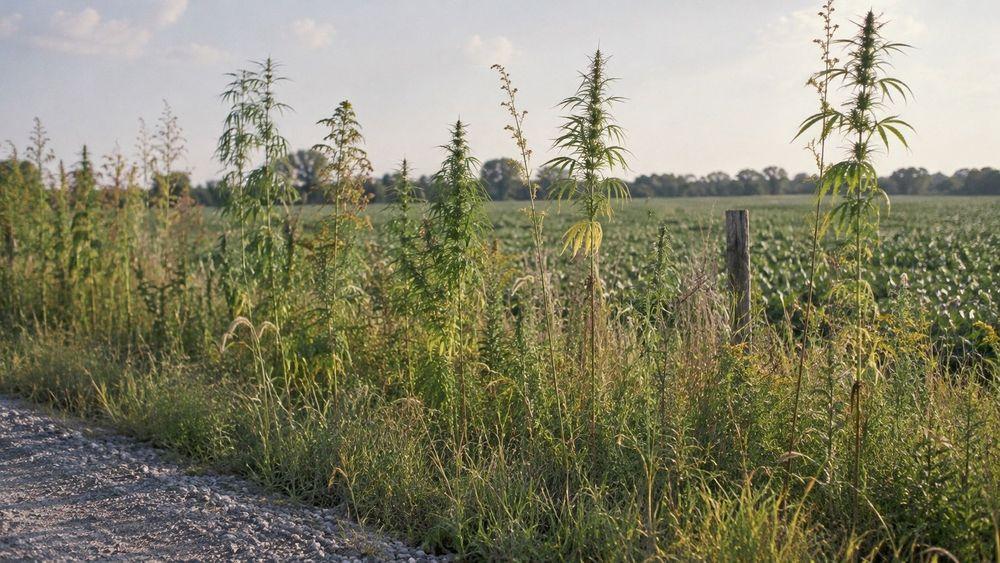
Ditch weed is the common name for cannabis that grows on its own, unplanted, along roadsides, fence lines, field edges and riverbanks across much of the Midwest. It is not a wild species. It is escaped hemp, descended from fiber crops planted in the 1800s and again during World War II. And the honest answer to the question most people actually have, whether it can get you high, is not a yes or a no. It is a measured distribution.
The short answer. When botanists have tested feral plants, most turned out to be CBD-type: plants whose main cannabinoid is CBD and whose THC sits around 0.1%. But not all of them. In a 2025 Scientific Reports survey that genotyped about 1,400 feral plants across 12 states, 78% were CBD-type, 15% intermediate and 6% THC-type, and the authors report that most populations held at least some plants above the 0.3% THC limit used to define hemp under federal law. Nobody can tell which plant is which by looking at it. Below: what the plant is, where it came from, what has been measured in it, and why the federal government once destroyed it by the hundreds of millions.
One note before going further. In irrigation and weed-control writing, "ditch weeds" can mean any weed growing on a ditch bank. This page is about the cannabis meaning: the feral hemp that USDA, DEA and plant scientists have been writing about for more than a century.
What ditch weed actually is
Botanists call it feral cannabis: a population of a domesticated plant that has gone back to living on its own. USDA's PLANTS database lists Cannabis sativa as an introduced annual in the lower 48 states. Introduced means it is not native; annual means each plant lives a single season, so a stand survives only by dropping seed every year. DEA's 1989 eradication report described ditchweed as "low potency wild growing cannabis plants", and that phrase still captures the common view. The measurements further down show it is mostly right and sometimes wrong.
"Wild" is the wrong word, though. A 2021 genome study of 110 cannabis plants in Science Advances concluded that all the feral plants it examined "are not wild types, but historical escapes from domesticated forms", and it placed two US feral plants in a group with Chinese landraces, most likely descended from 19th-century imports. Our guide to landrace strains and what their genomes reveal covers that domestication story in full. For the chemistry vocabulary used below (CBD, THC and their acid forms), start with what cannabinoids are and how they differ.
Where it came from: three waves of seed
Ditch weed was a roadside fixture long before anyone had heard of "Hemp for Victory". Hemp was a working fiber crop in America well before the 20th century (the story of hemp on George Washington's farm is a good place to start). In the 1913 Yearbook of the US Department of Agriculture, the department's fiber botanist, Lyster Dewey, noted that hemp "readily becomes naturalized" and recorded that it had already spread well beyond the fields:
“Hemp is abundant as a wild plant in many localities in western Missouri, Iowa, and in southern Minnesota, and it is often found as a roadside weed throughout the Middle West.”
- 1The 19th-century fiber crop. Dewey's chapter notes that the first Chinese hemp seed was imported in 1857 and that larger Chinese types displaced the older European hemp, which fits the genome study's Chinese link.
- 2The wartime crop. With imported abaca and jute cut off in World War II, USDA's Commodity Credit Corporation contracted War Hemp Industries, Inc. for seed and fiber. Acreage peaked near 176,000 in 1943.
- 3The long tail. A small Wisconsin hemp fiber industry ran until 1958, the year the last legal US hemp crops were planted. After that, stands kept reseeding on roadsides, field borders, flood plains and rail lines.
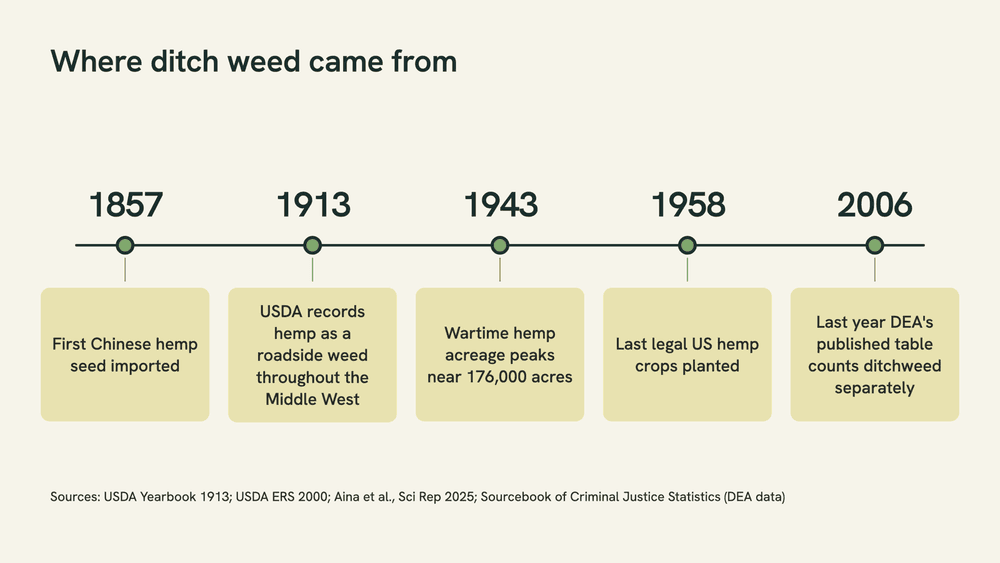
The wartime facts come from USDA's Economic Research Service report on industrial hemp from 2000, which says production peaked in 1943 and 1944, and the acreage and 1958 dates come from the background section of the 2025 survey. How the 1937 Marihuana Tax Act fits into this timeline is covered in when and why weed was made illegal, and what hemp fiber and seed are grown for today is in our explainer on hemp's uses.
One more piece of history ties this roadside plant to the compound printed on every CBD label. According to a 2020 historical review in the Journal of Cannabis Research, chemist Roger Adams of the University of Illinois, working with the Treasury's narcotics laboratory between 1939 and 1942, used Minnesota wild hemp, "often viewed as just a roadside weed", as the critical plant source for the work that isolated and characterized cannabidiol, first reported in 1940. In other words, the roadside plant this page is about sits at the very start of the CBD story.
Hemp for Victory: the film, the program and the myth
"Hemp for Victory" is both a real government program and a real film, and the internet has wrapped both in myth. The program was the wartime contract system described above. The film is a short USDA production about growing hemp for the war effort. The National Archives catalog record for Hemp for Victory lists it as a 1942 production, filed with the records of the Office of the Secretary of Agriculture. The National Agricultural Library's record describes a 16 mm black-and-white sound film running 14 minutes 13 seconds that illustrates how hemp and hemp seed were grown and harvested and how the fiber was made into coarse cloth for military use.
What is actually in ditch weed: the surveys, measured
Most pages about ditch weed assert a potency without measuring one. Three studies have measured or genotyped US feral plants in numbers, and two more have sequenced their genomes. They agree on the broad picture and differ in the details, so here they are side by side.
The 2020 Minnesota survey in the American Journal of Botany tested 317 female feral plants from three sites in one Minnesota river valley in 2015 and 2016. Of those, 280 were CBD-type, with THC averaging 0.11% of dry weight and CBD averaging 2.40%. But 37 were not: 33 intermediate plants averaged 1.42% THC and 4 THC-type plants averaged 2.62%. Total cannabinoids averaged 2.80%, ranging from under 1% to over 10%, and 62% of plants were under 3%. At one site the team also found three plants someone had planted on purpose and left them out of the data as not part of the feral population. Not every plant in a feral stand is necessarily feral.
A 2022 University of Nebraska study in Phytochemistry tested 28 feral plants from 17 Nebraska counties, sampling both male and female flowers. CBD was usually the primary cannabinoid in both, male flowers made cannabinoids too (less than female flowers), and genetically the plants were much more similar to hemp-type cannabis than to drug-type. The abstract does not give THC percentages, so we do not print any.
The 12-state survey is the largest. Its team collected about 1,800 female plants from roughly 90 populations in 2022 and 2023 and genotyped about 1,400 of them at the gene that steers a plant toward CBD or THC: 1,120 came out CBD-type, 208 intermediate and 91 THC-type. Total cannabinoid content in the plants tested chemically ranged from 0.21% to 4.73%, and the authors' own summary is the sentence that matters most here: "Most populations contained at least some individual plants with THC content above the US statutory threshold of 0.3%." In the populations the paper breaks out by genotype, CBD-type groups averaged 0.04% to 0.10% THC, while intermediate and THC-type groups averaged 0.13% to 1.16%.
| Survey | Plants | Where | Method | CBD-type / intermediate / THC-type | THC finding | Main limit |
|---|---|---|---|---|---|---|
| Wenger et al. 2020, American Journal of Botany | 317 female plants | 3 sites in one Minnesota river valley | Gas chromatography (GC), % dry weight | 88% / 11% / 1% (280 / 33 / 4 plants) | Group means 0.11% / 1.42% / 2.62% THC | One valley, two seasons |
| Busta et al. 2022, Phytochemistry | 28 plants, male and female flowers | 17 Nebraska counties | GC-MS plus RNA sequencing | CBD usually the main cannabinoid | No THC percentages in the abstract | Small sample |
| Aina et al. 2025, Scientific Reports | About 1,400 genotyped; 523 tested chemically | About 90 populations in 12 states | Gene test (CBDAS) plus GC | 78% / 15% / 6% (1,120 / 208 / 91 plants) | Most populations had some plants above 0.3% THC | Chemistry subsample chosen by genotype; gene assay failed on 20% of samples |
| Ren et al. 2021, Science Advances; Woods et al. 2022, G3 | Small US feral subsets | Several sources | Whole-genome sequencing | Not measured | Not measured: origin and adaptation | Few US plants |
Why do neighbors in the same stand differ so much? The Minnesota team found that one gene with two versions decides whether a feral plant leans CBD or THC. All 280 CBD-type plants carried two copies of the working CBD version, all 33 intermediates carried one of each, and all 4 THC-type plants carried two copies of the other version, a simple Mendelian pattern confirmed by a test cross. That gene sets the ratio, not the amount: total cannabinoid content varied on its own. The same chemotype genetics underlies the difference between hemp and marijuana as cultivated crops.
The 2025 authors offer two explanations for the THC-type minority, both hedged: there is little reason to think the original 19th-century introductions were pure hemp, and some stands may have crossed with drug-type cannabis grown nearby more recently. The genomes also show the plants adjusting to life on their own. A 2022 whole-genome study in G3 found six stress-response regions under balancing selection and one disease-resistance gene under positive selection in the US feral group, which the authors read as local adaptation. Its corresponding author is chief science officer of a hemp genetics company, New West Genetics.
One method note matters for reading all of these numbers. Both the Minnesota and the 12-state surveys used gas chromatography, where the heat of the instrument converts THCA, the acid form the living plant makes, into THC. So the figures sit closer to "total THC" than to delta-9 THC alone, and a 2025 methods comparison in Pharmaceutics found that gas chromatography without a derivatization step converts the acids only partly, so totals can, if anything, read low (that study tested oils, not flower). For what a THC percentage does and does not tell you, see whether THC percentage really matters.
Can you get high from ditch weed? Can you smoke it?
This is the question behind most searches, so here is the answer the measurements give. Pages that say ditch weed "cannot get you high" are contradicted by the data above, and so are pages that treat every plant as interchangeable. The honest summary: most feral plants measured were CBD-type with THC around 0.1%, and a minority carried much more.
- Variation is large from plant to plant. In Minnesota, 280 plants averaged 0.11% THC while 4 averaged 2.62%, all in the same valley.
- Total cannabinoids are modest. They averaged 2.80% in Minnesota (the highest topped 10%) and ranged from 0.21% to 4.73% in the 12-state chemistry sample.
- You cannot tell which plant you are looking at. Height, branching and leaf shape say nothing reliable about THC; only a lab test does.
- What else is in it is unknown. No one has published measurements of metals or herbicide residue in US ditch weed (see the risks section below).
There is one documented answer to why anyone went after it. Describing a marijuana shortage in late 1986, DEA's 1987 eradication report said reports from many Midwestern states noted out-of-state violators "intent on harvesting ditchweed which could be mixed with commercial grade marijuana to increase poundage". The interest, in DEA's own words, was weight to stretch a scarce supply, not strength. It is a record of a shortage, not a reason to pick it.
How to recognize it, and why looks tell you nothing about THC
Feral hemp looks like what it is, an escaped fiber crop. Dewey's 1913 description of the plant still fits, and the parts named below are explained in our guide to cannabis plant anatomy.
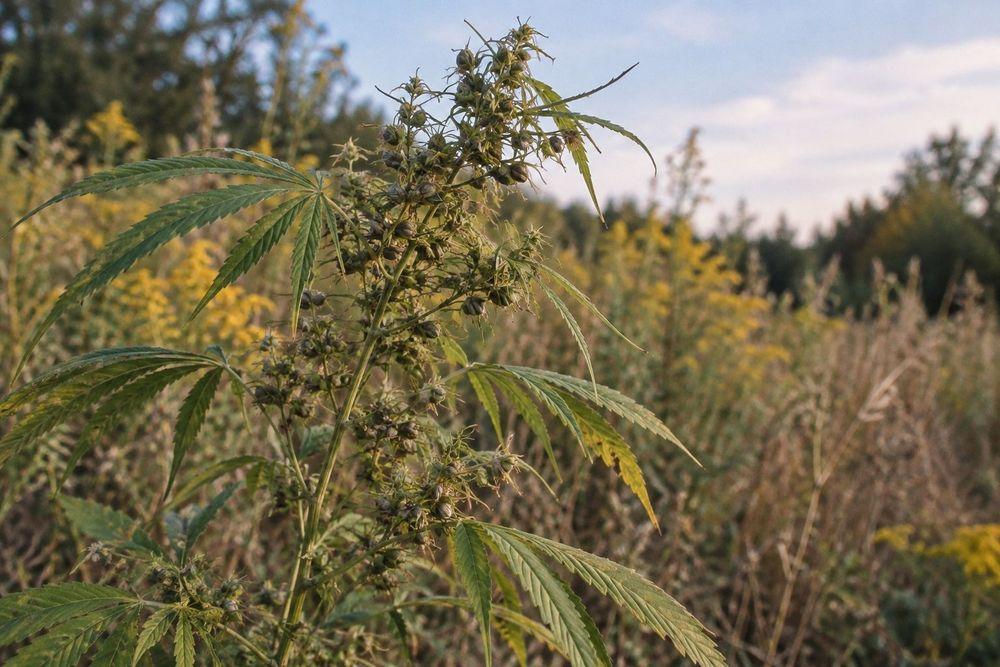
- An annual: each plant lives one season and reaches 1 to 5 meters (3 to 16 feet) tall.
- Hand-shaped (palmate) leaves made of 5 to 11 leaflets, usually 7.
- Separate male and female plants. Males shed abundant yellow pollen and die after shedding it; females go on to set seed.
- Shape follows crowding. A plant with room spreads many branches; a crowded one grows tall, with branches and leaves only near the top.
None of that tells you what is inside. USDA's economists put it plainly in their 2000 report: the two varieties are indistinguishable by appearance, and short of chemical analysis of the THC content there is no way to tell a hemp plant from a marijuana plant. They added that planting density and other production traits are not a reliable guide either. Tall, sparse, weedy-looking plants tell you how a plant grew, not what it contains. Plant sex matters for seed and pollen rather than for telling hemp from marijuana, and our guide to male and female cannabis plants explains the difference.
The real risks: pollen, roadside soil and spray
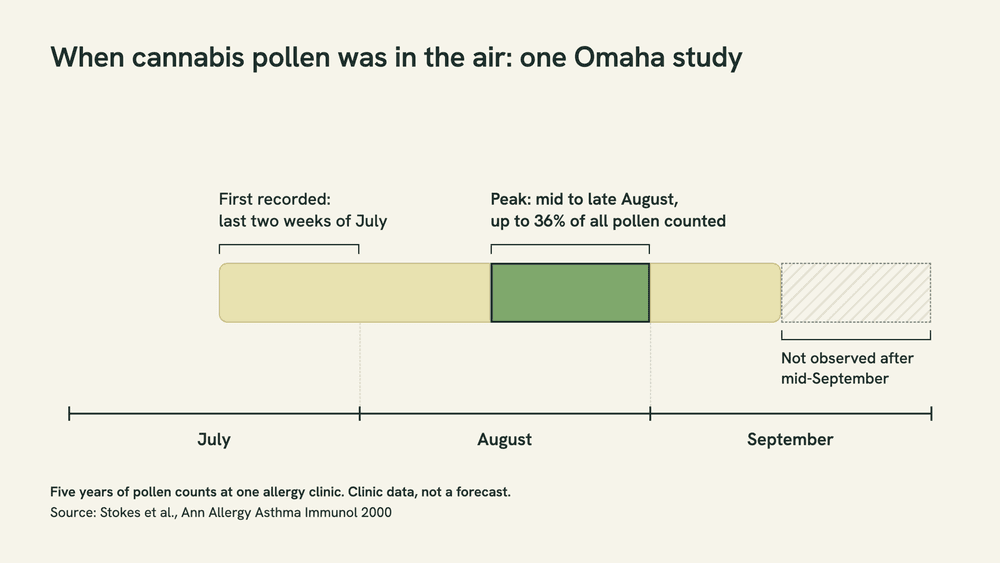
The best-documented health issue with feral cannabis has nothing to do with smoking it. An Omaha allergy clinic study published in 2000 counted airborne pollen for five years. Cannabis pollen first appeared in the last two weeks of July, peaked in mid to late August at up to 36% of all pollen captured, and was gone by mid-September. Of 127 patients skin-tested, 78 (61%) reacted. Of 30 patients asked about symptoms, all 22 who reported them also reacted to other weeds that pollinate at the same time, such as ragweed, so the study cannot say cannabis alone caused them, and the authors said the question should be studied further. These were allergy-clinic patients, not the general public. For cannabis allergy more broadly, see whether you can be allergic to CBD.
Contamination is where you have to be careful about what is actually known. Three facts point the same way. First, roadside cannabis has been a spray target: DEA's 1993 eradication report describes a statewide South Dakota herbicide program, funded through DEA's eradication program, that contracted county weed boards to spray "ditchweed" and raised the number of plants eradicated by 122 million over the previous year. Second, a review of 64 European roadside sites found chromium, copper, nickel, lead and zinc highest in the topsoil within 5 meters of the road. Third, USDA scientists describe hemp as a promising plant for cleaning up metal-contaminated soil, precisely because its deep roots tolerate taking metals up. Put together, a roadside offers the conditions under which a plant could take up metals or carry spray, even though no one has tested ditch weed for either.
How DEA counted hundreds of millions of plants, then stopped
For about two decades, much of federal marijuana eradication was, by plant count, the removal of this weed. DEA's Domestic Cannabis Eradication/Suppression Program reported ditchweed separately from cultivated plants, and in every year below ditchweed made up between 93% and just over 99% of all the cannabis plants destroyed.
| Year | Ditchweed destroyed | Cultivated plants destroyed | Ditchweed share | Note from the document | Source |
|---|---|---|---|---|---|
| 1987 | 105,841,990 | 7,432,834 | 93% | Indiana reported the most, about 67 million | DEA DCE/SP 1987 report (NCJ 114531) |
| 1989 | 124,288,999 | 5,635,696 | 96% | Nebraska reported the most, 73.2 million | DEA DCE/SP 1989 report (NCJ 126492) |
| 1993 | 387.9 million ("tended ditchweed") | 4.33 million | 99% | New counting method adds tended ditchweed | DEA DCE/SP 1993 report (NCJ 152429) |
| 1996 | 419,662,422 | 3,060,155 | 99.3% | South Dakota reported the most, 189.7 million | Sourcebook 1996, Table 4.36 (DEA data) |
| 2005 | 218,633,492 | 4,209,086 | 98.1% | Indiana reported the most, 212.4 million | Sourcebook Table 4.38.2005 (DEA data) |
| 2006 | 83,903,653 | 5,231,658 | 94.1% | Last year the table counts ditchweed separately | Sourcebook Table 4.38.2006 (DEA data) |
| 2007 | Not reported | 7,034,327 | n/a | Footnote: cultivated count "may include tended ditchweed" | Sourcebook Table 4.38.2007 (DEA data) |
Every number in the table comes from a primary record: the 1987, 1989 and 1993 annual program reports digitized by the National Criminal Justice Reference Service, and the DEA data printed in the federal Sourcebook of Criminal Justice Statistics, namely the 1996 edition's Table 4.36, Table 4.38 for 2005, Table 4.38 for 2006 and Table 4.38 for 2007. The cultivated figure for 1996 adds 2,842,961 outdoor plants and 217,194 indoor plants. State figures are enforcement history, not a description of where the plant grows today.
Two details in those records are worth knowing. In 1993 DEA began counting "tended ditchweed", and its own report says that change was the main reason the total plant count jumped, and that including large numbers of low-potency ditchweed samples affected its THC content averages. The federal potency-monitoring program at the University of Mississippi likewise filed ditchweed as its own category in an analysis of 35,312 seized samples from 1980 to 1997, next to marijuana, sinsemilla and Thai sticks.
Then the column disappears. The 2007 table has no ditchweed figure at all, only a footnote saying the cultivated count "may include tended ditchweed, a type of marijuana that grows wild." The published record does not say why, and it does not tell us whether eradication of feral plants ended or simply stopped being broken out. So the accurate statement is a narrow one: 2006 is the last year the published DEA table counts ditchweed on its own line.
Is ditch weed legal? The law as of November 2026
Federal law has no category for "wild". Under 21 U.S.C. 802(16), marihuana means all parts of the plant Cannabis sativa L., "whether growing or not", except anything that qualifies as hemp. Under 7 U.S.C. 1639o, hemp is defined by measured THC, currently a delta-9 THC concentration of not more than 0.3% on a dry weight basis. So the law sorts plants by a lab number, and nobody standing beside a ditch has one. Given the surveys above, any single feral plant could land on either side of the line.
Federal hemp law is also built around licensed producers. 7 U.S.C. 1639q makes it unlawful to produce hemp in a state without an approved plan unless you hold a USDA license, and state plans carry their own licensing. A plant nobody planted has neither a license nor a test. Whether collecting one counts as "producing hemp" is a question the statute does not answer, and state law may. It is telling that the scientists behind both large surveys collected under federal paperwork: a DEA-approved research protocol in Minnesota and a USDA hemp producer license for the 12-state study. Local weed rules point the same way. The Minnesota Department of Agriculture's county noxious weed lists include three counties that name Cannabis sativa L. as "Non-licensed Hemp". The license, not the plant, is the line.
A plant that tests above the hemp limit is marijuana, which remains a controlled substance under federal law. The April 2026 federal rescheduling order moved marijuana in FDA-approved drug products, or held under a state medical marijuana license, to Schedule III and says any other form remains in Schedule I; broader rescheduling is not final. The definition itself also moves this fall, in two steps. On November 12, 2026, only the exclusion of products containing cannabinoids the plant cannot naturally produce takes effect. On December 11, 2026, the rest arrives, including a total THC standard that counts THCA. For a raw plant, the December change is the one that matters: as the Minnesota survey's authors note, the plant makes THCA, which heat converts to THC. The full timeline is in our guide to the 2026 hemp ban.
What the research does not show
- No random national sample. Every survey sampled populations its researchers chose to collect.
- The chemistry rests on gas chromatography, which reports something close to total THC and may read low.
- No published measurements of metals or herbicide residue in US feral plants.
- No studies of what happens to people who consume feral material.
- The Nebraska abstract gives no THC percentages, and the 12-state chemistry subsample was chosen by genotype, so its chemical counts are not population frequencies.
One forward-looking note. A 2024 habitat model in Ecology and Evolution, built by USDA and university researchers, projects that climate change could expand the area suitable for feral hemp. That is a model, not a count, but it suggests this plant is not going anywhere.
Frequently asked questions
There is no reliable yes or no. Most feral plants that have been measured are CBD-type, with THC averaging 0.11% of dry weight in the Minnesota survey. But about 1 in 8 Minnesota plants was intermediate or THC-type, averaging 1.42% and 2.62% THC, and a 12-state survey found at least some plants above 0.3% THC in most populations. You cannot tell which kind of plant you are looking at without a lab test, and its contamination and legal status are unknown, so this page does not recommend consuming it.
By ancestry, yes: it descends from fiber hemp, and genetic studies group it with hemp rather than drug-type cannabis. Legally, "hemp" is not a kind of plant but a status: Cannabis sativa L. with THC under the federal limit, produced within a licensed system. A wild plant has no test and no license, and surveys show some feral plants exceed 0.3% THC, so a given plant is not automatically hemp under the law.
Usually CBD is its main cannabinoid. 88% of Minnesota feral plants were CBD-type (averaging 2.40% CBD), CBD was usually the primary cannabinoid in Nebraska plants, and 78% of plants genotyped across 12 states were CBD-type. Total cannabinoids are modest, from 0.21% to 4.73% in the 12-state chemistry sample. That is a plant measurement, not a product: wild plants are not dosed, tested or labeled.
Because of the ground it grows on: disturbed places such as roadside ditches, field borders, pastures, flood plains and rail rights-of-way. In irrigation and weed-control writing, "ditch weeds" can also mean any weed on a ditch bank, which is a different subject.
History. Fiber hemp was grown there in the 1800s, Chinese seed arrived in 1857, and USDA already called hemp a roadside weed throughout the Middle West in 1913. National wartime acreage peaked near 176,000 acres in 1943, and the last legal US crops were planted in 1958. An annual that drops plenty of seed has kept those stands going ever since.
As of November 9, 2026, federal law has no category for wild cannabis. A plant is hemp only if its THC is under the legal limit, and federal hemp rules are built around licensed producers; a plant above the limit is marijuana, a controlled substance under federal law. State and local rules vary, and some county weed lists target "non-licensed hemp". Even the researchers who surveyed feral plants collected under a DEA-approved protocol or a USDA license. This is not legal advice.
Yes. DEA's eradication program counted ditchweed separately for years, and in every year shown on this page it made up between 93% and just over 99% of all cannabis plants destroyed, including about 419.7 million ditchweed plants in 1996. The separate count disappears from the published table after 2006, and the record does not say why.
Not in the strict sense. Genome research finds that feral plants are historical escapes from domesticated cannabis rather than truly wild types, and it places some US feral plants with Chinese landraces brought in during the 19th century. Our landrace strains guide covers how domestication shaped today's cannabis.
Ditch weed is a living record of America's hemp history: a crop that escaped, adapted and outlasted the farms that planted it. To see how the legal line works for products you can actually buy, read how the law separates hemp from marijuana. For the crop these plants escaped from and what it is grown for today, see the many uses of hemp fiber and seed.
Writing about hemp, wellness and the small rituals that keep us balanced.