When Was Weed Made Illegal? A Dated History, 1906 to 2026
Cannabis was not banned on one day. States moved from 1913, a 1937 federal tax worked as a ban, the Supreme Court broke that tax in 1969, and Schedule I arrived in 1970. Here is the dated record, the myths it does not support, and federal status in October 2026.
When was weed made illegal in the United States? Not on a single day. It happened in layers: state laws from the 1910s, a federal tax in 1937 that worked as a ban, a Supreme Court ruling that broke that tax in 1969, and a new federal law in 1970 that put marijuana in Schedule I. Here is the dated timeline, built from the statutes and court opinions themselves, what the record shows about why it happened, which popular explanations it does not support, and where federal law stands as of October 16, 2026.
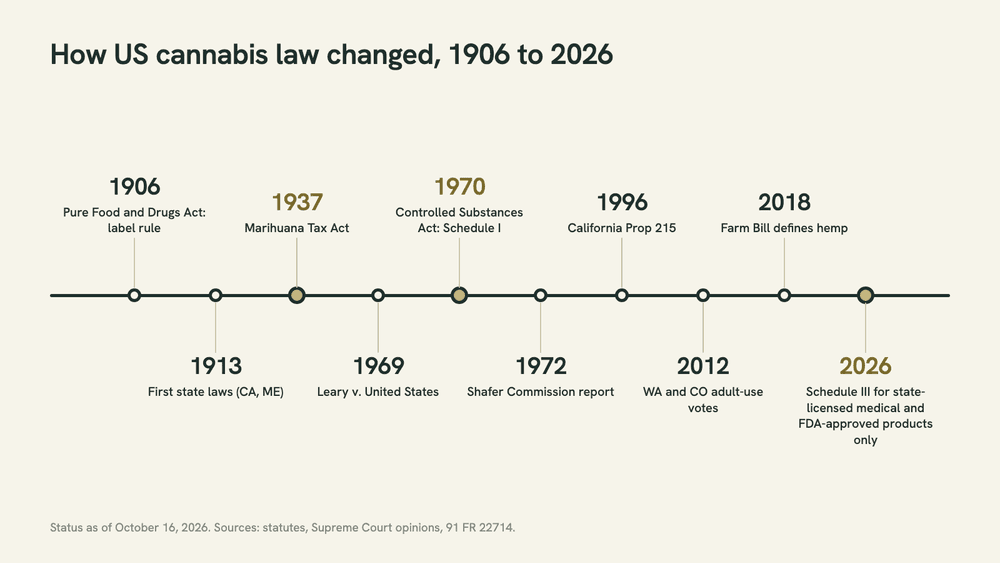
The short answer: marijuana became illegal under federal law in practice when the Marihuana Tax Act of 1937 took effect, which by its own terms works out to October 1, 1937. That law taxed and registered every transfer instead of banning the plant outright. The formal federal ban came with the Comprehensive Drug Abuse Prevention and Control Act of 1970, signed October 27, 1970, whose Controlled Substances Act listed "Marihuana" in Schedule I. Several states had acted first, starting in 1913. As of October 16, 2026, marijuana is still a federally controlled substance: a DEA final rule published April 28, 2026 moved state-licensed medical marijuana and FDA-approved marijuana drug products to Schedule III, and all other marijuana remains in Schedule I. This is a history, not legal advice.
When was weed made illegal? A dated timeline, 1850 to 2026
Most pages that answer this question disagree with each other on basic dates and rarely name a law. Every row below points to a primary record: a statute, a Supreme Court opinion, an official federal report or a peer-reviewed history. Where two sources disagree, the sections that follow say so instead of picking a winner.
| Year | Event | Record | What it did |
|---|---|---|---|
| 1850 | Cannabis enters the US Pharmacopoeia | Bridgeman and Abazia, 2017 review | Listed as an official medicine |
| 1906 | Pure Food and Drugs Act (June 30) | 34 Stat. 768 | Required "cannabis indica" to be declared on medicine labels; no ban |
| 1913 | California and Maine restrict cannabis | Gonzales v. Raich, fn. 2; Bonnie and Whitebread, fn. 29 | California: sale and possession. Maine: sale without a prescription |
| 1915 | Utah statewide law | Bonnie and Whitebread, 1970 | Named as the first state statute banning sale or possession |
| 1920 | Mexico prohibits marijuana | Hall and Yeates, Addiction, 2025 | 17 years before the US federal law |
| 1931 | 22 states have sale or possession laws | Bonnie and Whitebread, 1970 | One count among several; counts vary by source |
| 1932 | Uniform Narcotic Drug Act | Shafer Commission report, 1972 | Offered states an optional marihuana provision |
| 1937 | Marihuana Tax Act signed August 2 | 50 Stat. 551 | $100 per ounce tax on unregistered transfers; in force October 1 |
| 1942 | Cannabis dropped from the Pharmacopoeia | Bridgeman and Abazia, 2017 | No longer an official medicine |
| 1951 and 1956 | Federal narcotics penalties raised | Shafer Commission report, 1972 | Marijuana included both times |
| 1961 | Single Convention on Narcotic Drugs | UN Treaty Collection | Parties commit to control cannabis; the US joined in 1967 |
| 1969 | Leary v. United States (May 19) | 395 U.S. 6 | Transfer-tax scheme violated the Fifth Amendment privilege |
| 1970 | Controlled Substances Act signed October 27 | Pub. L. 91-513, 84 Stat. 1236 | Marihuana listed in Schedule I; the 1937 tax law repealed |
| 1972 | Shafer Commission report (March 22) | Marihuana: A Signal of Misunderstanding | Recommended ending federal penalties for personal possession; not adopted |
| 1996 | California Proposition 215 | Gonzales v. Raich | Medical use allowed under state law; still illegal federally |
| 2005 | Gonzales v. Raich (June 6) | 545 U.S. 1 | Federal law reaches home-grown medical marijuana |
| 2012 | Washington I-502 and Colorado Amendment 64 (November 6) | RCW 69.50.4013 history note (Washington) | First voter-approved adult-use laws |
| 2018 | Farm Bill defines hemp | 7 U.S.C. 1639o | Hemp (no more than 0.3% delta-9 THC) leaves the marijuana definition |
| 2026 | DEA final rule (April 28); hemp definition change scheduled for November 12 and December 11 | 91 FR 22714; Pub. L. 119-37, timing set by Pub. L. 119-103 | Two narrow categories move to Schedule III; all other marijuana stays in Schedule I |
Before 1937: medicine, labels and the first state laws
For most of the 1800s, no federal law restricted cannabis. It was a recognized medicine: a 2017 review of medicinal cannabis in the journal P&T notes that cannabis was described in the United States Pharmacopoeia for the first time in 1850 and was dropped from it in 1942. The first federal law to name the plant did not ban it either. The Pure Food and Drugs Act of June 30, 1906 treated a medicine as misbranded if its label failed to state the quantity of certain ingredients, and "cannabis indica" was on that list, next to morphine, opium, cocaine and chloroform. It required a label, not a ban.
The Harrison Narcotics Act of 1914 then set up federal control of opiates and cocaine, and left cannabis out. When the Supreme Court retold this history in its 2005 opinion in Gonzales v. Raich, it put it plainly: "Marijuana itself was not significantly regulated by the Federal Government until 1937." Before then, the action was in the states, and south of the border. The same opinion says that in 1913 California was "one of the first States to prohibit the sale and possession of marijuana."
Richard Bonnie and Charles Whitebread's 1970 history, "The Forbidden Fruit and the Tree of Knowledge", published in the Virginia Law Review (DOI 10.2307/1071903; the link goes to a full-text reproduction hosted by the Schaffer Library of Drug Policy), fills in the rest: Maine prohibited selling cannabis indica without a prescription in 1913, Utah in 1915 "passed the first state statute prohibiting sale or possession of the drug", and by 1931 twenty-two states had such laws. In 1932, as the federal Shafer Commission later recorded, the Uniform Narcotic Drug Act, a model law for states, included an optional marihuana provision. The Mexico date comes from historian Isaac Campos, whose book is summarized by Wayne Hall and Sarah Yeates in Addiction: they report that Mexican beliefs that marijuana caused madness and violence led Mexico's government to prohibit it in 1920. By 1937, according to the same commission, every state had prohibited marijuana use, "either by adoption of the Uniform Act or by separate legislation."
| Count | Year | What it counts | Source |
|---|---|---|---|
| 22 states | 1931 | Statutes prohibiting sale or possession | Bonnie and Whitebread, 1970 |
| All but two states west of the Mississippi, and several in the East | 1931 | "Prohibitory legislation" | Shafer Commission, 1972 |
| Every state | 1937 | Prohibited use, through the Uniform Act or separate laws | Shafer Commission, 1972 |
| 19 states | 1933 | Not stated | Popular web source, no citation given |
| 46 of 48 states | 1937 | Not stated | Popular web source, no citation given |
The Marihuana Tax Act of 1937: how a tax worked as a ban
The federal law is short: six pages in the Statutes at Large. H.R. 6906, "An Act to impose an occupational excise tax upon certain dealers in marihuana" and a transfer tax on dealings in it, was approved on August 2, 1937 as Public No. 238 (50 Stat. 551). Its Section 18 gives the name: "This Act may be cited as the 'Marihuana Tax Act of 1937.'" Section 17 says it takes effect "on the first day of the second month after the month during which it is enacted", which works out to October 1, 1937. (The House hearings were held on an earlier version, H.R. 6385. Both bill numbers are real.)
The Act never declared marijuana illegal. It required everyone who imported, grew, compounded, dealt in, prescribed or researched it to register and pay an annual occupational tax, and it taxed every transfer. The mechanism was the gap in that transfer tax. A registered buyer paid $1 an ounce. Anyone else paid $100 an ounce, and breaking the rules carried up to five years in prison. Here is what the statute charged:
| Who or what | Tax or penalty |
|---|---|
| Importers, manufacturers and compounders | $24 a year (occupational tax) |
| Producers (growers) | $1 a year |
| Physicians, dentists and veterinarians | $1 a year |
| Research use | $1 a year |
| Other dealers | $3 a year |
| Transfer to a registered buyer | $1 per ounce or fraction of an ounce |
| Transfer to an unregistered buyer | $100 per ounce or fraction of an ounce |
| Violating the Act | Fine up to $2,000, prison up to 5 years, or both |
“Not only to raise revenue from the marihuana traffic, but also to discourage the current and widespread undesirable use of marihuana by smokers and drug addicts.”
The Treasury said so openly. The quote above comes from the government's lead witness, as preserved in the Supreme Court's 1969 opinion in Leary v. United States. Before the Senate, Hester described the goal as using "the $100 transfer tax to prevent the drug from coming into the hands of those who will put it to illicit uses." Sixty-eight years later, the Court in Raich summed up the effect: "while the Marihuana Tax Act did not declare the drug illegal per se, the onerous administrative requirements, the prohibitively expensive taxes, and the risks attendant on compliance practically curtailed the marijuana trade." That is why the honest answer to "when was weed made illegal" starts in 1937, even though the law was written as a tax.
Who testified for the 1937 Act, and who objected
The House Ways and Means Committee held hearings from April 27 to May 4, 1937. The transcripts linked in this section are reproductions hosted by the Schaffer Library of Drug Policy, a third-party archive; the original is Taxation of Marihuana, Hearings on H.R. 6385, 75th Congress, 1st Session. Harry J. Anslinger, head of the Treasury's Federal Bureau of Narcotics, was the main enforcement witness. In his House testimony, as reproduced by the Schaffer Library, he told the committee that "Marihuana is the Mexican term for cannabis indica" and called the drug "entirely the monster Hyde, the harmful effect of which cannot be measured."
The hemp industry was in the room too. Hester filed an additional statement on April 28, 1937 telling the committee that exempt buyers included "purchasers of the mature stalk of marihuana for use in the making of fiber products such as twine, purchasers of marihuana seed for the further planting of marihuana and the manufacture of oil, and purchasers of such oil for use in the manufacture of paints and varnishes." Hemp companies also appeared at the Senate hearing, and one Wisconsin hemp firm warned that the tax would make growers hesitate. So hemp growers had real concerns, but the law was not written against fiber.
The sharpest objection came from medicine. Dr. William C. Woodward, testifying for the American Medical Association on May 4, 1937, told the committee that the case for the bill rested on newspaper stories:
“We are referred to newspaper publications concerning the prevalence of marihuana addiction. We are told that the use of marihuana causes crime. But yet no one has been produced from the Bureau of Prisons to show the number of prisoners who have been found addicted to the marihuana habit.”
Woodward also complained that the bill had been "prepared in secret for 2 years without any intimation, even, to the profession." He was not arguing for open sale; his position was that state law, not a federal tax, should handle the problem. The AMA repeated its objection in a letter dated July 10, 1937, entered in the record of the Senate Finance subcommittee hearing on H.R. 6906 two days later: "There is no evidence, however, that the medicinal use of these drugs has caused or is causing cannabis addiction," and "the obvious purpose and effect of this bill is to impose so many restrictions on their use as to prevent such use altogether."
On the House floor there was almost no debate. Bonnie and Whitebread, quoting the Congressional Record, report that when Representative Bertrand Snell asked "What is the bill?", Representative Sam Rayburn answered: "It has something to do with something that is called marihuana. I believe it is a narcotic of some kind." The bill reached the floor on June 14, 1937 and, in their words, "after less than two pages of debate, the Act passed without a roll call." The same history reports that Representative Fred Vinson told the House the AMA did not object, and even claimed its support, "when in fact their committee witness had dissented strenuously."
Why was marijuana made illegal? What the record shows, and what it does not
This is where most retellings go wrong, so start with the federal government's own assessment. The National Commission on Marihuana and Drug Abuse, known as the Shafer Commission, wrote in its 1972 report: "A difference of opinion among historians still exists as to why policymakers thought national legislation was necessary at that time. Whatever the reason, however, Congress responded swiftly, without much attempt to learn the facts about the drug and its use."
The 1937 House committee report, as reprinted by the Shafer Commission, shows the kind of evidence Congress accepted: "Under the influence of this drug the will is destroyed and all power of directing and controlling thought is lost," and "cases were cited at the hearings of school children who have been driven to crime and insanity through the use of this drug." The record also shows prejudice. Among the exhibits Anslinger submitted to the House was a September 4, 1936 letter from the city editor of the Alamosa Daily Courier in Colorado that blamed local crime on "Spanish-speaking residents" in openly racist language.
Historians weigh these pieces differently. Bonnie and Whitebread concluded in 1970 that "Congress was hoodwinked by the Federal Bureau of Narcotics", and described the early state laws as "kneejerk responses uninformed by scientific study or public debate and colored instead by racial bias and sensationalistic myths." A 2026 paper by Wayne Hall and Sarah Yeates on the origins of the 1937 Act, also in Addiction, argues that popular histories overstate Anslinger's part: he "initially opposed federal marijuana prohibition for practical reasons before apparently responding to pressure from state officials and orders from his superiors." Drawing on Campos, Hall and Yeates also give more weight to beliefs from Mexico that marijuana caused madness and violence. The documented pieces are not really in dispute. How much each one mattered is.
| Claim | What the record shows | Verdict |
|---|---|---|
| Racial prejudice shaped the campaign | A racist 1936 letter sits in the hearing exhibits; Bonnie and Whitebread describe early state laws as colored by racial bias; Hall and Yeates give more weight to Mexican-origin beliefs about madness and violence | Documented; its weight is debated |
| Anslinger pushed the Act through | He testified and supplied exhibits. Bonnie and Whitebread say the Bureau "hoodwinked" Congress; Hall and Yeates say he first opposed federal prohibition | Documented role; its size is contested |
| Doctors opposed it | AMA testimony on May 4, 1937 and an AMA letter dated July 10, 1937 | Documented |
| Congress barely debated it | House floor June 14, 1937; less than two pages of debate; no roll call (Congressional Record, as quoted by Bonnie and Whitebread) | Documented |
| Reefer Madness helped pass the law | Its producer approached Anslinger in May 1938, after the Act passed, and he refused to endorse it (Hall and Yeates, 2026) | Not supported |
| Hearst and DuPont engineered it to kill hemp | Nothing in the statute or hearing record shows it; fiber was exempt; hemp firms testified; Hall and Yeates list it as a misconception | Not documented |
| The 1937 Act banned hemp | The statute's definition excluded mature stalks, fiber, seed oil and cake, and sterilized seed | False as stated |
| El Paso banned marijuana first, in 1915 | Often repeated; we could not locate the ordinance text | Unverified |
| Famous racist quotes from Anslinger's testimony | Several widely shared quotes do not appear in his House testimony | Not traceable to the hearing record |
| "46 of 48 states" or "19 states" had banned it | Counts depend on the year and on what is counted; the Shafer Commission says every state by 1937 | Depends on what you count |
Two of those rows deserve a closer look because they are the most repeated explanations online. The hemp conspiracy was popularized by Jack Herer's 1985 book The Emperor Wears No Clothes. No document in the statute or the hearing record supports the idea that Hearst or DuPont engineered the Act, and the law exempted hemp fiber. Reporting in AlterNet in 2008 quoted researcher Dale Gieringer calling the theory "fanciful", and quoted sociologist Mark Mizruchi noting that a standard history of Depression-era corporate finance does not mention "even the smallest financial connection between DuPont and Mellon." "Not documented" is not the same as disproven, but it is the honest verdict. As for Reefer Madness, Hall and Yeates report that its producer approached Anslinger for an endorsement in May 1938, after the Act passed, and that Anslinger refused and tried to suppress showings after the film's 1939 release. Finally, some harsher quotes attributed to Anslinger online do not appear in his House testimony, and we could not trace them to the hearing record, so we do not repeat them here.
1969 and 1970: Leary v. United States and the Controlled Substances Act
The 1937 Act lasted 32 years. Its undoing started at the border bridge in Laredo, Texas, in December 1965, when inspectors found small amounts of marijuana in a car carrying Dr. Timothy Leary and his party. Leary was convicted for failing to comply with the Act's transfer-tax provisions and under a separate law that let a jury presume marijuana had been illegally imported. Leary v. United States was argued December 11 and 12, 1968 and decided May 19, 1969, in an opinion by Justice Harlan.
The Court ruled for Leary on both questions. It held that complying with the transfer-tax rules would have exposed him to "a 'real and appreciable' risk of self-incrimination", so "a timely and proper assertion of the privilege should have provided a complete defense" to the tax charge. It also held that applying the importation presumption to him denied due process. The ruling did not strike down the whole Marihuana Tax Act. It gutted the Act's main enforcement tool, the transfer tax, and left Congress needing a new framework.
Congress replaced it about 17 months later. President Nixon signed the Comprehensive Drug Abuse Prevention and Control Act on October 27, 1970. Its Title II, the Controlled Substances Act, sorted drugs into five schedules and listed "Marihuana" in Schedule I at item (c)(10), with "Tetrahydrocannabinols" at (c)(17). The same law repealed the part of the Internal Revenue Code that held the 1937 marihuana tax. The schedules took effect in 1971 (the effective-date clause works out to May 1, 1971), and the list still lives at 21 U.S.C. 812. In the 1970 statute's words, a Schedule I drug is one where:
- 1"The drug or other substance has a high potential for abuse."
- 2It "has no currently accepted medical use in treatment in the United States."
- 3"There is a lack of accepted safety for use of the drug or other substance under medical supervision."
Schedule I was not meant to be the last word. The Raich opinion notes that the 1970 placement was a "preliminary classification", based partly on a recommendation from the Assistant Secretary of Health, Education and Welfare "that marihuana be retained within schedule I at least until the completion of certain studies now underway." Writing in 2005, the Court added that the DEA had "routinely denied petitions to reschedule the drug, most recently in 2001." Meanwhile, Congress had already raised federal narcotics penalties in 1951 and again in 1956, and the Shafer Commission notes that both times marijuana was included. Internationally, the US is also a party to the 1961 Single Convention on Narcotic Drugs, which it joined in 1967 and which commits its parties to control cannabis.
1972 to 2012: a federal commission says decriminalize, then the states move
The 1970 Act also created a commission to study marijuana. The Shafer Commission's first report, Marihuana: A Signal of Misunderstanding, transmitted March 22, 1972, recommended that possession of marijuana for personal use "would no longer be an offense" under federal law, and that casual distribution of small amounts for little or no profit would no longer be an offense either, while marijuana possessed in public would remain contraband subject to seizure. Congress did not adopt that recommendation.
Change came from the states instead. In 1996 California voters passed Proposition 215, the Compassionate Use Act, which allowed medical use under state law. Federal law did not bend: in Raich, decided June 6, 2005, the Supreme Court held that Congress could reach even marijuana grown at home for medical use under California law, because it had "a rational basis for believing that failure to regulate the intrastate manufacture and possession of marijuana would leave a gaping hole in the CSA." On November 6, 2012, voters in Washington (Initiative 502) and Colorado (Amendment 64) approved the first adult-use laws. A 2026 review of US cannabis policy in Cannabis and Cannabinoid Research counted adult-use programs in 24 states plus DC and medical programs in 47 states as of 2025.
That gap between state and federal law is the legacy you live with. It is why police and courts still argue over whether the smell of weed is probable cause in states that changed their laws, and why workplace drug tests can still matter even where cannabis is legal.
Hemp's separate path: from the 1937 exemption to the 2026 definition change
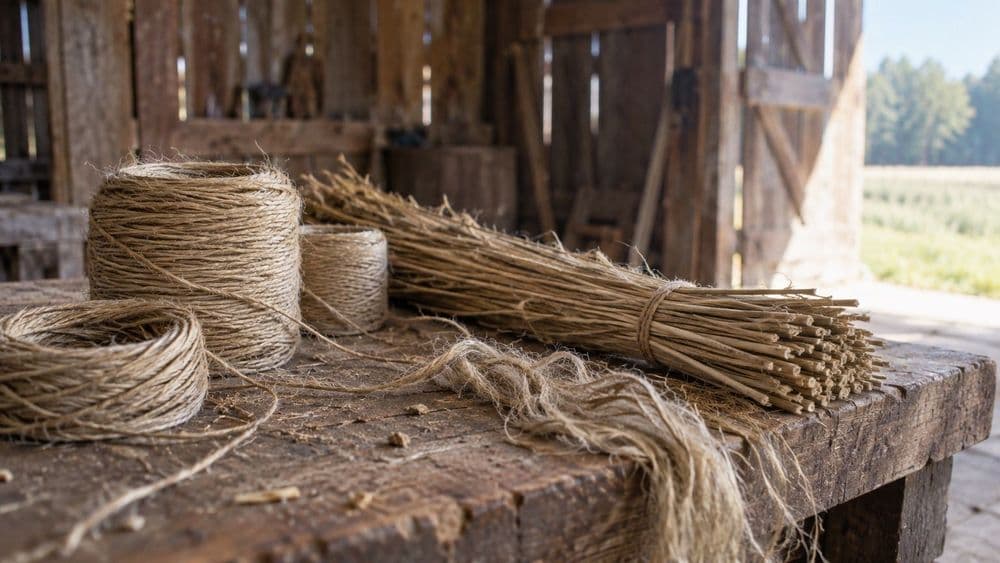
Hemp and marijuana are the same species, and federal law has drawn a line between them since 1937. The 1937 Act defined "marihuana" as all parts of Cannabis sativa L., but said the term "shall not include the mature stalks of such plant, fiber produced from such stalks, oil or cake made from the seeds of such plant" or "the sterilized seed of such plant which is incapable of germination." That carve-out survives, nearly word for word, in the current federal definition of marihuana at 21 U.S.C. 802(16).
The 2018 Farm Bill added a second exclusion: hemp, defined at 7 U.S.C. 1639o as cannabis with no more than 0.3% delta-9 THC on a dry weight basis. That is the line our guide to the legal difference between hemp and marijuana walks through. The definition is about to change again. Public Law 119-37, signed November 12, 2025, rewrites the federal definition of hemp effective November 12, 2026, with timing set by Public Law 119-103, signed September 2, 2026. Under that timing, as of October 16, 2026: from November 12, 2026 the new definition will apply only to products containing cannabinoids "not capable of being naturally produced" by the plant, and the rest, including the total-THC standard, will apply from December 11, 2026. The details live in our explainers on what the 2026 hemp definition change does and why part of it moved to December 11.
Why is weed still federally illegal in 2026?
Weed is not federally legal. The Controlled Substances Act still controls marijuana, and the only change to its scheduling so far came this spring. The DEA final rule published and effective April 28, 2026 (91 FR 22714) moved two narrow categories to Schedule III: marijuana in an FDA-approved drug product, and marijuana subject to a state medical marijuana license. The rule says the rest plainly: "any form of marijuana other than in an FDA-approved drug product or marijuana subject to a state medical marijuana license remains a schedule I controlled substance." Read with that sentence, marijuana sold in state adult-use markets stays in Schedule I. The rule also says it "does not affect the status of hemp", because hemp is excluded from the definition of marijuana.
The broader proposal to move all marijuana to Schedule III is still a proposal. As of October 16, 2026, no final rule on it has been published in the Federal Register, and petitions challenging the April rule were pending in federal court at our last check. Our explainer on the Schedule III ruling for medical marijuana tracks the order and the litigation, so we do not repeat it here. One concrete consequence: the rule says state medical licensees "will no longer be subject to the deduction disallowance" in the federal tax code (Section 280E), the rule behind much of the cash-heavy, under-banked economics of dispensaries. Schedule III changed a tax rule for medical licensees; when we checked the rule's text on October 16, 2026, we found no mention of banking.
So the one-line answer to "why is weed still federally illegal" is structural, not mysterious. Congress placed marijuana in Schedule I in 1970 as a preliminary step, Congress has not passed a law taking it out, and the administrative route has so far moved only the medical and FDA-approved categories.
What this history means for you today
Most practical confusion about cannabis law comes from the split this history created: states regulate one way, federal law another. A few consequences to keep in mind, as of October 16, 2026:
- A state law that allows marijuana does not make it legal under federal law. Since Raich (2005), federal law reaches even home-grown medical marijuana.
- Situations that run through federal agencies, such as immigration applications and air travel, turn on the federal status, not on your state's law.
- Federal Schedule III status in 2026 covers state-licensed medical marijuana and FDA-approved products only. Adult-use purchases are outside it.
- Hemp follows a different statute. Whether a hemp product is legal depends on the hemp definition and on state law, not on the marijuana schedules.
- Any claim that weed is legal in a certain number of states needs a year and a source. The count changes, and sources count different things.
For the specifics, see how federal marijuana law can affect an immigration case and what to know before you travel by air with cannabis. If you want the CBD side of this story in brief, our introduction to CBD includes a short history of how hemp extracts came back.
What the record still leaves open
A few honest limits on this history. The 1937 hearing transcripts quoted here come from a third-party reproduction, the Schaffer Library of Drug Policy, not from a Government Printing Office scan, and we have not compared them page by page with the printed volumes. October 1, 1937 and May 1, 1971 are our readings of the two laws' effective-date clauses, not dates printed in them. We could not find the El Paso ordinance. Historians still disagree on motive: Bonnie and Whitebread's 1970 account and Hall and Yeates's 2026 account read the same events differently, and David Musto's 1972 paper, "The Marihuana Tax Act of 1937" in the Archives of General Psychiatry, is a standard reference whose argument we have not characterized here because we could not read its full text. Finally, the 2026 status is a moving target, which is why every present-tense legal sentence above carries a date.
Frequently asked questions
Federal prohibition began in practice with the Marihuana Tax Act, signed August 2, 1937 and in force from October 1, 1937. It worked through registration and a $100-per-ounce tax on transfers to unregistered buyers rather than a declared ban. Marijuana became formally prohibited under the Controlled Substances Act, signed October 27, 1970, which placed it in Schedule I. Several states had restricted it from 1913 onward.
Congress, through the Marihuana Tax Act, which became law on August 2, 1937. The Treasury Department presented the bill, and Harry J. Anslinger of the Federal Bureau of Narcotics was its main enforcement witness. Historians disagree about how central Anslinger was: a 1970 legal history says the Bureau hoodwinked Congress, while a 2026 paper in Addiction says he first opposed federal prohibition and moved under pressure from state officials and his superiors. Many states had already acted before Congress did.
The record shows several ingredients: claims that marijuana caused crime and insanity, presented with little evidence (the AMA's witness said the case rested on newspaper stories); racist material in the hearing exhibits; beliefs carried from Mexico, which banned marijuana in 1920; and pressure from states and the Treasury. Historians disagree about which mattered most. The federal Shafer Commission wrote in 1972 that Congress acted 'without much attempt to learn the facts.' The Hearst and DuPont hemp plot and the Reefer Madness story are not supported by the record.
Under federal law, yes. No federal law restricted cannabis in the 1800s, and it was an official medicine in the US Pharmacopoeia from 1850 until 1942. The first federal law to name it, the Pure Food and Drugs Act of 1906, only required medicines to declare cannabis indica on the label. State restrictions began in 1913.
The Controlled Substances Act, signed October 27, 1970, listed marihuana in Schedule I, and the schedules took effect in 1971. A Supreme Court opinion later described the placement as a preliminary classification, pending studies. Since April 28, 2026, two narrow categories (state-licensed medical marijuana and FDA-approved marijuana drug products) are in Schedule III; all other marijuana remains in Schedule I.
No. As of October 16, 2026, marijuana is still a federally controlled substance. A DEA rule effective April 28, 2026 moved state-licensed medical marijuana and FDA-approved marijuana drug products to Schedule III, and all other marijuana, including adult-use marijuana sold under state law, remains in Schedule I. A broader rescheduling proposal had not become a final rule as of that date. This is general information, not legal advice.
Because federal law defines them separately. The 1937 Act already excluded mature stalks, fiber, seed oil and sterilized seed, and the 2018 Farm Bill excluded hemp, defined as cannabis with no more than 0.3% delta-9 THC on a dry weight basis, from the definition of marijuana. As of October 16, 2026, that definition is scheduled to be rewritten in two steps, on November 12 and December 11, 2026 (timing set by Public Law 119-103), with a total-THC standard arriving in the second step. State laws on hemp products vary.
No document supports that. The 1937 Act exempted hemp fiber and stalks, hemp companies testified openly, and a 2026 peer-reviewed history in Addiction lists the DuPont story as a popular misconception. The theory was popularized by Jack Herer's 1985 book The Emperor Wears No Clothes. Not documented is the accurate verdict; we have not seen evidence that proves a negative either way.
Where to go next: this history explains why marijuana and hemp sit under different federal rules. If your real question is about CBD, our guide to whether CBD is legal under federal and state law covers where it stands now, with the same dated sourcing.
Writing about hemp, wellness and the small rituals that keep us balanced.