Can You Smoke Weed After Getting a Tattoo? Law and Research
Before a tattoo is a law question: in 9 of the 10 state codes we could read, a studio may not tattoo a client who is, or appears to be, under the influence. After is an evidence question, and no human study has looked. The state table, the pain research and what to do.
Can you smoke weed after getting a tattoo, or before it to take the edge off? The question has two halves, and only one of them has a firm answer. Before and during your session, state health codes and the studio decide, and several codes are surprisingly specific. After your session, the honest answer is that nobody has studied it. Most pages on this topic blur the two halves and fill the gap with an uncited claim that weed thins your blood.
The short answer: do not smoke or take an edible before or during a tattoo. In 9 of the 10 state codes we could read at the source on October 17, 2026, a studio may not tattoo a client who is, or appears to be, under the influence, and Georgia also makes the client sign that they are not. None of those texts exempts legal or medical cannabis. After the session, no human study has tested whether cannabis changes how a tattoo heals, so there is no evidence-based waiting time. Follow your studio's written aftercare, keep smoke away from the fresh wound, and see a clinician for a fever, a rash or a tattoo that is not healing.
Can you smoke weed after getting a tattoo? One legal question, one evidence question
Tattooing is regulated mostly by states, not by the federal government. The FDA's tattoo safety page puts the split plainly: "While state and local authorities oversee the practice of tattooing, inks and pigments used in tattoos are subject to U.S. Food and Drug Administration oversight as cosmetics." That division shapes this article. The rules about who may be tattooed, and in what condition, live in state health codes, so the before-and-during half is a law question with written answers. The after half is a health question, and there the answer is a gap in the research, which we will show you rather than paper over.
It is a common situation. The FDA cites polling suggesting that about 30% of Americans, and 40% of those aged 18 to 34, have at least one tattoo. What follows is legal information, not legal advice. We read every code below on October 17, 2026; local rules and later amendments may add to it, and your studio can always be stricter than the law. For the bigger picture of how hemp and cannabis rules stack up between Washington and the states, see our guide to whether CBD is legal.
Which states bar tattooing a client who is high
We went to each state's own code or health department website and copied the sentence that governs clients who are drunk or high. The sources: for Texas, rule 229.406 in the DSHS tattoo and body piercing rules; for South Carolina, the state's tattooing statute, section 44-34-100; for Hawaii, the Department of Health's tattoo rules, chapter 11-17; for Virginia, the tattooing standards in 18VAC41-50-410; for Washington, the body art practice rules in WAC 246-145-015; for Minnesota, the body art statute, section 146B.07; for New Jersey, the body art operating rules in N.J.A.C. 8:27-4; for Georgia, the public health body art rules, chapter 511-3-8; for Oklahoma, a state health department copy of its body piercing and tattooing chapter; and for Florida, the tattoo statute, section 381.00787, together with Florida's tattoo rule chapter, 64E-28. The "Test" column is our own label for how each text is worded, not a term the codes use.
| State | Rule | What it says (verbatim) | Test (our label) | Penalty or note | Version |
|---|---|---|---|---|---|
| Texas | 25 TAC §229.406(f) | "No person may be tattooed or body pierced who appears to be under the influence of alcohol or drugs." | Appears | A violation of the Act or rules is a Class A misdemeanor (§229.412, with one listed exception), plus administrative penalties | Current DSHS rules PDF (Subchapter V), read Oct 17, 2026 |
| South Carolina | S.C. Code §44-34-100(C) | "Tattooing may not be performed upon a person impaired by drugs or alcohol." | Is (impaired) | Misdemeanor: fine up to $2,500, up to 1 year in prison, or both. An impaired client is "considered incapable of consenting" | Current code |
| Hawaii | HAR §11-17-7(a) | "It shall be unlawful to tattoo any person who is under the influence of intoxicating substances. These substances include but shall not be limited to alcohol, drugs, paints, and glues." | Is | Misdemeanor: fine up to $500, up to 1 year, or both; license and permit suspended for 1 year on conviction. The tattoo statute printed in the same file (HRS §321-379) also allows administrative penalties up to $10,000 per offense | Rule effective Sep 18, 1981 |
| Virginia | 18VAC41-50-410(C) | "No person may be tattooed or permanent cosmetic tattooed who appears to be under the influence of alcohol or drugs." | Appears | Licensing rule of the Board for Barbers and Cosmetology | Amended effective Jan 5, 2026 |
| Washington | WAC 246-145-015(1)(c) | Licensees "shall not perform procedures ... On a client who appears to be under the influence of alcohol or drugs" | Appears | The same rule bars the artist from working while under the influence | Effective Jul 1, 2010 |
| Minnesota | Minn. Stat. §146B.07, subd. 2(d) | "No technician shall perform body art procedures on any individual who appears to be under the influence of alcohol, controlled substances ... or hazardous substances" | Appears | Minnesota's drug schedules (§152.02) list marijuana; the artist also may not work under the influence | Current statute |
| New Jersey | N.J.A.C. 8:27-4.3(b) | "Operators/practitioners shall refuse service to any person who, in the opinion of the operator/practitioner, is under the influence of alcohol or drugs." | Artist's opinion | The same section bans smoking, eating and drinking by anyone in the work area | Effective Jul 18, 2022 |
| Georgia | Ga. Comp. R. & Regs. 511-3-8-.05(8) and 511-3-8-.08(2)(i) | "Body Art Studios and body artists shall refuse services to any person who appears to be under the influence of alcohol or drugs." The client application must also contain "A statement by the client attesting that he or she is not under the influence of alcohol or drugs" | Appears + signed statement | Artists may not work under the influence of drugs that cause drowsiness or other impairment. No one under 18 may be tattooed | Chapter effective Oct 6, 2023 |
| Oklahoma | OAC 310:233-3-2(f), as printed in a 2017 state copy | "A person shall not perform body piercing or tattoo upon another person if the other person is under the influence of alcohol or a controlled substance." | Is | Caveat: this is an unofficial state health department copy effective Oct 1, 2017. The rule has since been renumbered, and the official current text could not be read on Oct 17, 2026 | 2017 copy |
| Florida | Fla. Stat. §381.00787; ch. 64E-28, F.A.C. | No client-intoxication clause found in either text | None | Studio policy governs. The statute's client rules are about age: no tattoo under 16, and ages 16 and 17 need a parent present with notarized consent | Rule history: new Sep 5, 2012; DOH copy read Oct 17, 2026 |
Read the "Test" column and the rules split four ways. Appears: Texas, Virginia, Washington, Minnesota and Georgia turn on how you look to the artist when the session starts. There is no test, no number and no exception for feeling fine. Is: South Carolina, Hawaii and Oklahoma bar tattooing a client who actually is impaired or under the influence. Artist's opinion: New Jersey requires the operator to refuse service if, in their opinion, you are under the influence. Signed statement: Georgia adds a second layer on top of its "appears" rule: you attest on your application that you are not under the influence. Florida, the tenth state we read, has no such clause at all.
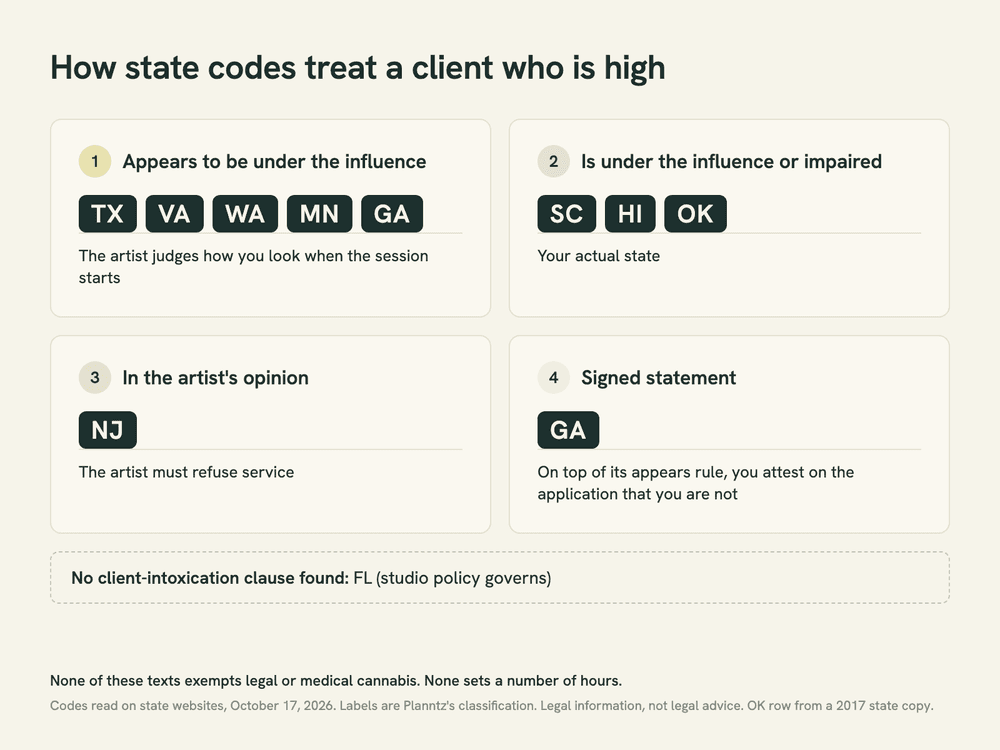
Two things are missing from all ten texts. None carves out legal or medical cannabis, so a medical card or a legal purchase does not change the sentence. And none sets a waiting time: there is no "12 hours" or "24 hours" in any of them. The rules ask about your state, or how your state looks, when the needle starts. If you want a sense of how long effects actually last, our breakdown of how long a weed high lasts covers smoking and edibles.
A note on coverage. On October 17, 2026 we tried to read 19 states' codes. Ten could be read on the state's own website that day, and those are the rows above. We left out the others (Michigan, Illinois, Ohio and Oregon among them) rather than print a rule we could not read at the source. A state missing from this table is not a state without a rule, so check your own state's health department or ask your studio.
Why studios refuse: consent, a clear head and the artist's license
South Carolina states the reason most directly. Its statute does not just bar the tattoo; it says why:
“A person impaired by drugs or alcohol is considered incapable of consenting to tattooing and incapable of understanding tattooing procedures and aftercare suggestions.”
That sentence answers a claim you will find on some tattoo pages: that tattooing someone who is drunk or high is legal because the client signs a waiver. In South Carolina an impaired client is treated as unable to consent at all, so a signature does not fix it, and 8 other states in our table write a clause on intoxicated clients into their codes too. The penalties fall on the studio side. Texas makes a rule violation a Class A misdemeanor. South Carolina allows a fine of up to $2,500, up to a year in prison, or both. Hawaii's rule allows a fine of up to $500, up to a year, or both, plus a one-year suspension of the license and permit on conviction, and the state's tattoo statute lets the health department add administrative penalties of up to $10,000 per offense. That is the context when an artist asks you to come back another day.
The rules cut the other way, too. Washington, Minnesota and Georgia bar the artist from working under the influence, so a clear head is expected on both sides of the needle. New Jersey prohibits smoking, eating or drinking by anyone in the work area, bathrooms and equipment cleaning room, and Florida's rules ban smoking where tattooing is performed, so lighting up at the studio is off the table there whatever you smoke. And the codes' focus on consent and on understanding aftercare assumes a client who can follow instructions and stay put for the length of the session. In Florida, where we found no client-intoxication clause, a studio can still turn you away as house policy. The same logic shows up in other procedures: the federal rule for plasma and blood donors also asks whether you appear to be under the influence.
Before your appointment: a checklist
- 1Arrive sober. In the states in our table, what counts is how you are, or how you look, when the session starts, and no rule gives you a number of hours.
- 2Skip the edible on the way. Edibles can take a long time to kick in, so one eaten before you leave home may be strongest while you are in the chair.
- 3List every prescription on the intake form, especially blood thinners. Minnesota's and Georgia's forms must ask about anticoagulants, and New Jersey's health history asks for a list of medications.
- 4Ask the studio how it handles clients who seem impaired, and whether you lose your deposit if you are rescheduled.
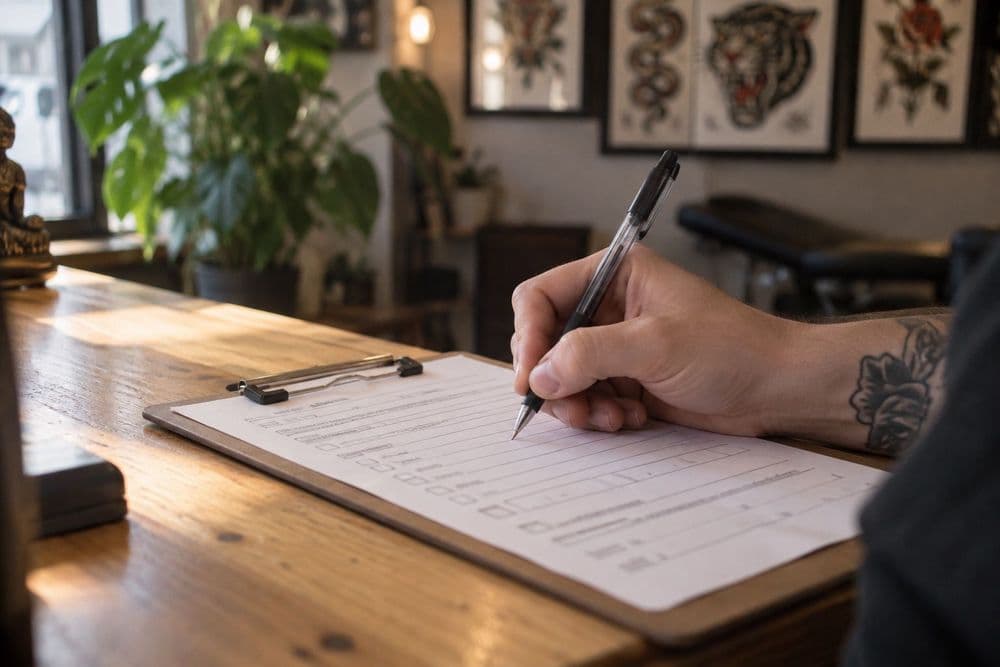
- 5Expect to sign a form. Georgia requires a written statement that you are not under the influence, on top of its rule against tattooing anyone who appears to be.
- 6Do not plan to smoke at the studio. New Jersey and Florida ban smoking in the work or tattooing area, and any studio can set the same house rule.
- 7Keep the written aftercare sheet. Texas, Minnesota and Georgia require studios to give you aftercare instructions.
Why the point about edibles? Swallowed THC is absorbed slowly and through the liver, which is why edibles take so long to kick in. An edible taken as a pre-appointment calmer can arrive partway through a long session, which is exactly when the codes above say you should not be under the influence.
Does weed make you bleed more during a tattoo?
Several pages that rank for this question say cannabis is a blood thinner that will make you bleed more, and some add that extra bleeding pushes out ink. None of them cites a study. We have gone through the human evidence on cannabinoids, platelets and clotting separately, and the short version is that "weed thins your blood" is not an established fact: our evidence review on whether CBD and THC thin your blood shows what has and has not been measured. We also found no study of cannabis and bleeding during a tattoo (more on that search below).
What does affect bleeding is something studios already ask about: prescription medicines that thin the blood or interfere with clotting. Minnesota's law requires the client disclosure form to ask about "any condition that requires the client to take medications such as anticoagulants that thin the blood or interfere with blood clotting." Georgia's required client evaluation asks about "medications such as aspirin or other anticoagulants." New Jersey's required health history includes "a list of medications." That is where honesty on the form does real work. If you are facing a procedure with anesthesia rather than a tattoo, the questions are different; see what to know about CBD before surgery.
Does weed make a tattoo hurt less? What the pain research found
Some people smoke before a session hoping it will take the edge off. The best summary of what cannabinoids do to pain in healthy people is a 2018 meta-analysis in JAMA Psychiatry by De Vita and colleagues, which pooled 18 placebo-controlled studies in 442 healthy adults. Researchers caused brief pain in the lab with methods such as cold water, heat and electrical stimulation, then compared cannabinoids with placebo. Almost all of the studies tested THC or drugs that mimic it: smoked cannabis, dronabinol, nabilone, THC extract or other synthetic cannabinoids. Only one used an extract that contained CBD, at a 2:1 ratio of THC to CBD.
The results were small and specific. Cannabinoids slightly raised the point at which pain began (pain threshold) and how long people could stand it (tolerance), and made the pain feel a little less unpleasant. Those effect sizes ran from about 0.19 to 0.29, which statisticians call small. They did not lower how intense the pain felt. In the authors' words, cannabinoids "may make experimental pain feel less unpleasant and more tolerable" but "may not reduce the intensity of experimental pain already being experienced."
Put plainly: in a lab, cannabinoids, mostly THC, made pain a bit more bearable without making it hurt less. Those were single doses in healthy volunteers, with lab pain rather than tattoo needles, and the review says nothing about bleeding, sitting still or healing. It is not a reason to get high before a session, and in the states in our table being high is what gets a session refused. It also tells you very little about CBD, which is a different molecule and is not intoxicating; our comparison of CBD and THC explains how they differ.
After the session: what anyone actually knows about cannabis and healing
Once the session is over, the law mostly steps back and the question becomes a health one. Here the honest answer is short: nobody has studied it. On October 17, 2026, a PubMed search pairing cannabis terms with tattoos returned 24 records. We read them one by one.
The 24 records are about other things. Most cover hepatitis and HIV among people in prison and people who use drugs, or surveys of who gets tattoos; the rest include one case series on a hemp-extract hair product and one paper on skin problems in synthetic cannabinoid addiction. Not one measures what cannabis does to a healing tattoo. That is an absence of evidence. It does not show that cannabis harms a new tattoo, and it does not show that cannabis is harmless to one.
You may read that smoking slows healing. That research is about tobacco. A 2012 review of 140 cohort studies in surgical patients compared tobacco smokers with nonsmokers after operations, which is a different exposure and a different kind of wound. No one has run the equivalent study for cannabis, so the honest answer about smoking weed after a tattoo is that it is unmeasured. Two practical points need no study. Smoke, ash and the hands that hold a joint or pipe are a hygiene issue around a fresh, open wound, not a pharmacology one. And edibles avoid smoke altogether, although there is no healing data on them either.
The real guide for the first weeks is the sheet your studio hands you, and in several states it is required. Texas requires written instructions that cover, for at least two weeks, minimizing sun exposure and discouraging swimming, and that tell you "to consult a health care practitioner at the first sign of infection or an allergic reaction." Minnesota requires studios to explain "the difference between normal skin or tissue irritation and infection." Georgia requires artists to "advise the client to consult a healthcare provider at the first sign of infection." Follow that sheet for the whole period it covers.
Once the skin has healed, the American Academy of Dermatology's guide to caring for tattooed skin adds long-run advice: a water-based lotion if the skin is dry, and no petroleum-based products, which "can cause the ink to fade." It recommends a broad-spectrum, water-resistant sunscreen of SPF 30 or higher, applied 15 minutes before you go out and reapplied at least every two hours, and no tanning beds. And it advises seeing a dermatologist for any reaction, whether it shows up right after the tattoo or years later. That page is about healed skin, not first-week wound care, so do not swap it in for your studio's instructions.
What about CBD cream on a new tattoo?
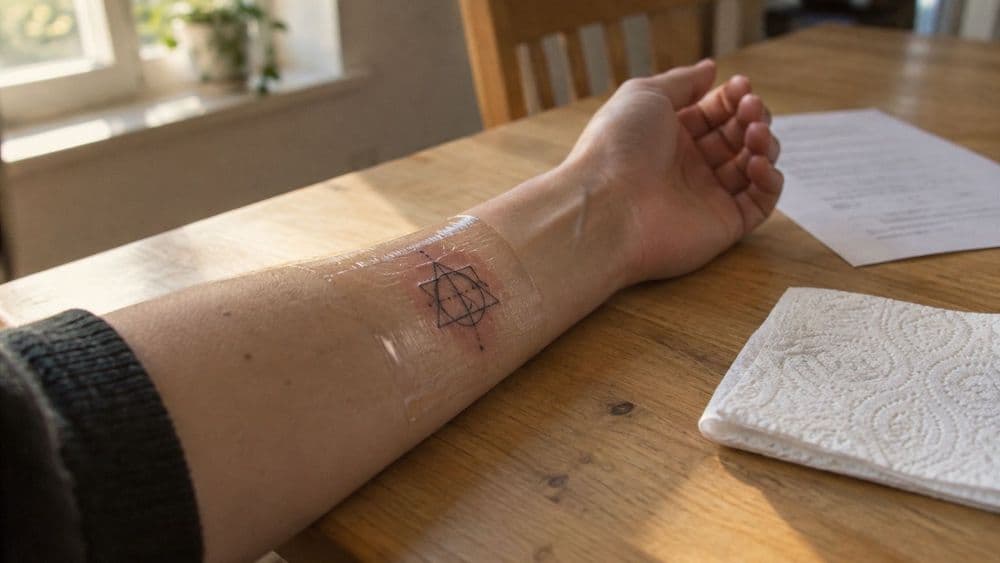
No study has tested CBD creams on fresh tattoos; the question falls inside the same empty PubMed search. Some pages that rank for this topic recommend cannabis lotions or CBD aftercare products anyway. A new tattoo is an open wound, so the safe default is what your artist's written aftercare says, and asking a clinician before you put anything else on it. Topical products can also cause skin reactions of their own, and our guide to CBD allergies and skin reactions covers what those look like. We are not recommending any topical for a new tattoo.
Signs a new tattoo needs a clinician
Some redness, swelling or warmth is normal after a tattoo, according to the FDA. Infection is the main thing to watch for, and the agency notes that it can come from the ink itself: "even unopened and sealed tattoo inks can harbor bacteria," and "An ink can be contaminated even if the container is sealed, or the label says the product is sterile." The FDA's signs to act on:
- The tattooed area does not seem to be healing
- You notice a rash on or around the tattoo
- You develop a fever, especially together with either sign above
- Severe signs: high fever, shaking, chills and sweats
What this page does not settle
- Ten states only. We could not read the other states' codes at the source on October 17, 2026, and we did not survey county or city rules.
- The Oklahoma row comes from a 2017 state health department copy; the rule has since been renumbered and the official current text was unavailable.
- The "Test" column is our label. A regulator or court could read a clause differently.
- No human study has measured how cannabis affects tattoo healing, bleeding or pain.
- The pain evidence is lab pain in healthy volunteers, with single doses and mostly THC.
- Codes change. Virginia's rule was amended as recently as January 2026.
Frequently asked questions
Do not. In 9 of the 10 state codes we could read on October 17, 2026, a studio may not tattoo a client who is, or appears to be, under the influence, and Georgia also makes the client sign that they are not. None of those texts exempts legal or medical cannabis. Arrive sober.
Yes. In New Jersey the rule requires refusal if, in the artist's opinion, you are under the influence. In Texas, Virginia, Washington, Minnesota and Georgia it turns on how you appear. In a state without a clause, such as Florida, a studio can still refuse as house policy.
In the 9 states in our table that have a clause, the rule binds the studio. Texas makes a violation a Class A misdemeanor; South Carolina allows a fine of up to $2,500 and up to a year in prison; Hawaii allows up to $500 and up to a year, plus a one-year license suspension. A waiver does not fix it in South Carolina, where an impaired person is considered incapable of consenting.
The claim that cannabis thins your blood is not established, and no study has measured bleeding during a tattoo in people who use cannabis. What matters is prescription blood thinners. List them on the intake form, and do not stop a prescribed medicine without talking to the prescriber.
No study gives a number. Nobody has measured cannabis and tattoo healing (PubMed, October 17, 2026), and the research on smoking and wound healing is about tobacco in surgical patients. Follow your studio's written aftercare, and keep smoke and ash away from the fresh wound as a hygiene choice.
No study has tested it. A fresh tattoo is an open wound. Use what the aftercare sheet says, and ask a clinician before adding anything else. Topical products can cause skin reactions of their own.
Before, the same rules apply as for smoking: the codes ask whether you are, or appear to be, under the influence, whatever the route. Edibles can also start late and peak during the session. After, edibles avoid smoke near the wound, but there is no healing data on them either.
Where to go next: the rules on this page are state rules, and cannabis law in the US is a patchwork of federal and state layers. Our explainer on how federal and state law treat CBD and cannabis walks through how those layers fit together. For the session itself, the summary is simple: arrive sober, be honest on the intake form, and follow your aftercare sheet.
Writing about hemp, wellness and the small rituals that keep us balanced.