FAFSA and Drug Convictions: What the Rule Says Now (2026)
Most search results still print a rule Congress repealed. Since the FAFSA Simplification Act, a drug conviction does not by itself cost you federal student aid. The timeline, the one court-ordered exception, and what state grants and campuses still do, as of October 2026.
If you have a drug conviction, including one for marijuana, and you are wondering whether it is worth filing the FAFSA, the FAFSA drug conviction rule most search results describe is out of date. Congress repealed the federal rule that cut off student aid after a drug conviction in December 2020, the Education Department switched it off in 2021, and the question has not been on the FAFSA since the 2023-24 form. This guide covers what changed and when, the one federal exception that survived, and the state, school and campus rules that work separately. It is current as of October 2026.
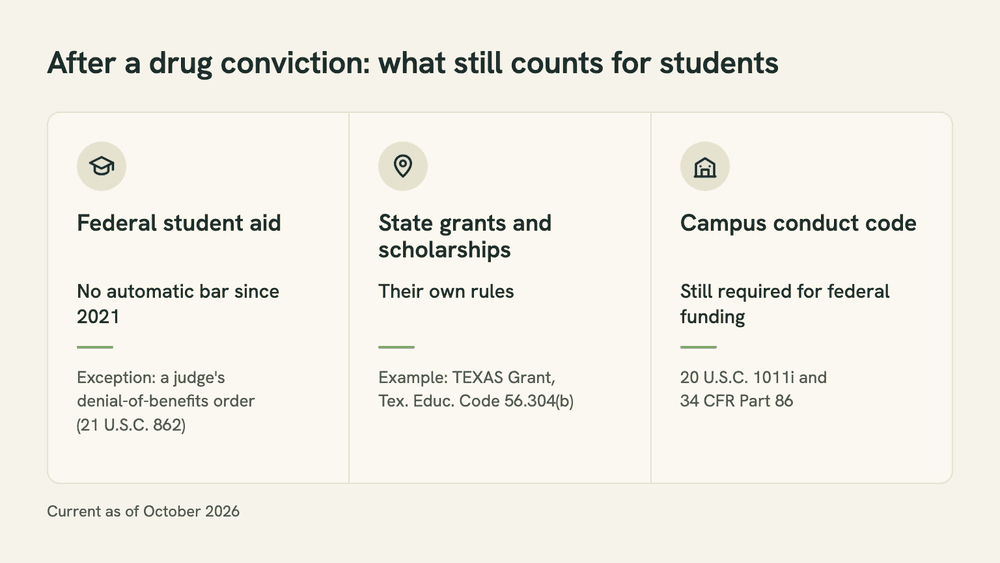
The short answer. As of October 2026, a drug conviction does not by itself make you ineligible for federal student aid, which means Pell Grants, federal student loans and federal work-study. The Education Department describes the change as the "elimination of the prohibition on receiving Title IV aid for students with drug-related convictions." (Title IV is the part of the Higher Education Act that covers federal student aid.) Three things still matter. A judge can order a denial of federal benefits as part of a drug sentence, and that order still blocks federal aid for the period it sets. State grants and school scholarships follow their own rules, and at least one state grant, in Texas, still has a drug-conviction bar. And your college can still discipline you for marijuana on campus, even in a state where it is legal.
Why search results still show the old FAFSA drug conviction rule
Search for this question and most of what you find is school PDFs and help pages that reproduce an old penalty chart: lose aid for 1 year, 2 years or indefinitely, and get it back early through a rehab program with two drug tests. Some of those pages were updated as recently as 2026 and still print the chart. Others are student newspaper articles from the early 2000s. The few pages that mention the change usually skip the statute, the dates and the exception. The rule was in force for more than 20 years, so it left a lot of paper behind. That matters for a practical reason: someone who believes a marijuana conviction disqualifies them may never file a FAFSA at all, and the FAFSA is the application for federal grants, loans and work-study.
What the old rule said
The old rule was section 484(r) of the Higher Education Act. In the 2020-21 FSA Handbook, the last edition to apply it in full, the Education Department wrote that "a federal or state drug conviction (but not a local or municipal conviction) can disqualify a student for Title IV funds." By then a conviction counted only if the offense happened during a period of enrollment when the student was receiving federal aid, and students reported it on the FAFSA (question 23c that year). The penalty depended on the type of offense and how many convictions the student had:
- Possession, first offense: ineligible for 1 year from the date of conviction.
- Possession, second offense: ineligible for 2 years.
- Possession, third or later offense: ineligible for an indefinite period.
- Sale, first offense: ineligible for 2 years. A conviction for conspiring to sell drugs counted as a sale conviction.
- Sale, second or later offense: ineligible for an indefinite period.
- Early return: completing a qualified drug rehab program that included two unannounced drug tests, or having the conviction reversed, set aside or removed from the record.
The rule dated from the Higher Education Amendments of 1998. Until 2006, it reached any student "convicted of any offense under any Federal or State law involving the possession or sale of a controlled substance." A 2006 amendment, recorded in the U.S. Code notes, narrowed it to offenses committed while the student was receiving federal aid. Its reach was real. In a 2005 report (GAO-05-238), the Government Accountability Office estimated that in the 2003-04 academic year about 41,000 applicants, 0.3% of all applicants, were disqualified from federal grants and loans because of drug convictions, a count that included people who left the question blank, which also disqualified them.
What changed, and when
Congress repealed the rule in the FAFSA Simplification Act, part of the Consolidated Appropriations Act, 2021 (Pub. L. 116-260), signed December 27, 2020. Section 702(n) of Division FF, Title VII, amended section 484 of the Higher Education Act "by striking subsections (n) and (r)." Subsection (r) was the drug-conviction rule. One trap if you look it up: today's 20 U.S.C. 1091(r) is a different, renumbered provision about data on students denied aid, not the old bar. The same law changed several other eligibility rules, including the Selective Service requirement, which the Education Department handled on the same timeline.
Those dates are why secondary sources disagree. The Act's general effective date was July 1, 2024 (a later spending law, Pub. L. 117-103, moved it from July 1, 2023), but the law let the Education Department switch off the drug-conviction rule earlier, and it did. The Department's Federal Register notice of June 17, 2021 set an effective date of June 17, 2021 and an implementation date of August 16, 2021. A few days earlier, Dear Colleague Letter GEN-21-04, dated June 11, 2021, explained the phase-out. For 2021-22, the drug question stayed on the FAFSA, but a conviction "will no longer impact a student's Title IV aid eligibility," and schools had to ignore the drug-conviction comment codes (53, 54, 56 and 58) on student records received on or after the implementation date. For 2022-23, schools still saw those codes but "must ignore and may not use" them "as a reason to deny Title IV aid." Starting with the 2023-24 FAFSA, the question was removed. The letter also said the Department would email 2021-22 applicants who had been found ineligible and direct them to their school's financial aid office.
Then vs now: the full comparison
This table puts the old rule next to the current one, topic by topic. The "before" column is the 2020-21 FSA Handbook, which is no longer in force. The "now" column is the statute and current guidance as of October 2026. The last four rows are the ones that the good news does not cover.
| Topic | Before (2020-21 FSA Handbook, no longer in force) | Now (as of October 2026) | Source |
|---|---|---|---|
| FAFSA drug question | Asked (question 23c in 2020-21) | Removed starting with the 2023-24 FAFSA; in 2021-22 and 2022-23 schools had to ignore the answer | GEN-21-04 (June 11, 2021) |
| Possession conviction, offense while receiving federal aid | Ineligible 1 year (first), 2 years (second), indefinitely (third or later) | No federal bar on its own | Pub. L. 116-260, Div. FF, sec. 702(n); FSA Student Eligibility assessment |
| Sale conviction (including conspiring to sell) | Ineligible 2 years (first), indefinitely (second or later) | No federal bar on its own | Pub. L. 116-260, Div. FF, sec. 702(n) |
| Getting eligibility back | Qualified rehab program with two unannounced drug tests, or conviction reversed, set aside or removed | Not needed for the old bar, which is gone | 2020-21 FSA Handbook; GEN-21-04 |
| Judge's denial-of-benefits order | Applied | Still applies for the period the judge sets; permanent by statute after a third distribution conviction; every FAFSA checked against a hold file (reject 19) | 21 U.S.C. 862; 2026-27 FSA Handbook, Vol. 1, Ch. 1 |
| State grants | Set by each state | Still set by each state. Example: TEXAS Grant bars felony and Texas Controlled Substances Act convictions unless 2 years have passed since sentence or probation, or the record was pardoned or expunged | Tex. Educ. Code 56.304(b), published text |
| School and private scholarships | Set by each school or donor | Still set by each school or donor; we found no federal rule that governs them | Scholarship terms; your aid office |
| Campus conduct code and housing | Drug-prevention program required for federal funding | Unchanged. Schools such as Ohio University bar all cannabis, including medical, on campus and in residence halls | 20 U.S.C. 1011i; 34 CFR 86.100 |
| Pell Grant while incarcerated | Not available (barred since 1994) | Available since July 1, 2023 through an approved prison education program; no Direct Loans while incarcerated | GEN-23-05; 87 FR 65426; 2026-27 FSA Handbook |
The one federal exception: a judge's denial-of-benefits order
The repeal removed the automatic bar. It did not touch a separate law that lets judges take federal benefits away as part of a drug sentence. Under 21 U.S.C. 862, part of the Anti-Drug Abuse Act of 1988, a federal or state court sentencing someone for a drug offense may, at its discretion, make them ineligible for "any or all Federal benefits," a term the statute defines to include "any grant, contract, loan, professional license, or commercial license provided by an agency of the United States" or paid for with federal appropriations. Federal student aid falls inside that definition. The limits depend on the offense. For a first possession conviction, the judge can impose up to 1 year of ineligibility, and can also or instead require a treatment program with periodic testing or community service; for a second or later possession conviction, up to 5 years. For a first distribution conviction, up to 5 years; for a second, up to 10 years. A third or later distribution conviction is the one case where the statute decides on its own: the person is "permanently ineligible for all Federal benefits." The period is suspended if the person completes a supervised drug rehabilitation program, is otherwise rehabilitated, or made a good-faith effort to get into a program that was unavailable or unaffordable. The law covers convictions after September 1, 1989.
This part is still enforced. The 2026-27 FSA Handbook says the Anti-Drug Abuse Act of 1988 "includes provisions that authorize federal and state judges to deny certain federal benefits, including federal student aid, to persons convicted of drug trafficking or possession." The FAFSA processing system keeps a hold file of people who received such a judgment, and "all applicants are checked against this file." A match produces a rejected application: reject code 19, with comment 009 or 055 on the FAFSA Submission Summary. The file starts in the courts. Judges report these orders to a Justice Department clearinghouse, and under a 2023 computer matching agreement between the Education and Justice Departments, the Education Department described matching applicants against the records of people denied federal student aid, using Social Security number, date of birth and the first two letters of the last name.
Judges have rarely used this sanction. In the same 2005 GAO report (GAO-05-238), courts had reported 8,298 offenders sanctioned under the Denial of Federal Benefits Program between 1990 and the second quarter of 2004, an average of fewer than 600 a year. In 2002, when there were more than 360,000 drug felony convictions nationwide, under 0.2% of convicted drug felons received it. Those are the most recent figures we found. Rare is not never: if the order is in your sentence, it applies to you, whatever the old or new FAFSA rule says.
How you would know if it applies to you
- It would be in your sentence. Apart from a third distribution conviction, the denial is a sentencing option a judge chooses, not an automatic result of a conviction.
- Your FAFSA would come back rejected. A match against the federal hold file produces reject code 19, with comment 009 or 055 on the FAFSA Submission Summary.
- If you are not sure what your sentence included, the court record or the lawyer who handled your case can tell you.
- An order runs for the period the judge set, and it is suspended if you complete a supervised drug rehabilitation program (21 U.S.C. 862(c)).

State grants and school scholarships follow their own rules
The FAFSA Simplification Act changed federal law only. State grant and loan programs, and scholarships run by colleges or private donors, set their own eligibility rules, and a state can keep a drug-conviction rule that Congress dropped. Texas is a dated example. As of October 2026, the published text of the Texas Education Code still says this about the TEXAS Grant:
“A person is not eligible to receive a TEXAS grant if the person has been convicted of a felony or an offense under Chapter 481, Health and Safety Code (Texas Controlled Substances Act), or under the law of another jurisdiction involving a controlled substance ... unless the person ... has: (1) received a certificate of discharge ... or completed a period of probation ordered by a court, and at least two years have elapsed from the date of the receipt or completion; or (2) been pardoned, had the record of the offense expunged from the person's record, or otherwise has been released from the resulting ineligibility.”
A marijuana possession conviction is an offense under Chapter 481 in Texas, so it falls inside this rule. Schools enforce it with paperwork: the University of North Texas aid office explains that all institutions "must collect and retain an eligibility statement from each person receiving a TEXAS Grant award" that they have never been convicted of a felony or a Chapter 481 offense, for initial and continuation awards alike. A 2021 bill proposed striking the drug clause, but the published amendment history shows no change after 2013, and we could not read the text on the official state site, so check with your school. State rules can also move. In Georgia, a 2025-26 House committee substitute for HB 206 would stop a conviction "based solely on the possession of marijuana for personal use" from making a student ineligible for certain state student loans. We could not confirm whether it became law as of October 2026.
School and private scholarships set their own terms. We did not find a published federal rule that governs them, or a dated, primary example of a school scholarship with a drug-conviction clause that we could cite. That is not evidence that none exist. Read each scholarship's written terms, and ask the aid office about anything in your aid package that is not federal.
Questions to ask your financial aid office
- Does any state grant, state loan or school scholarship in my package have a criminal-conviction or drug-conviction rule?
- If so, what does it cover: felonies only, or possession too? Federal or state convictions, or both?
- Is there a waiting period or a way back, such as finishing probation, a pardon or an expunction?
- Will I need to sign an eligibility statement or certification for any award, and what exactly does it ask?
- My FAFSA came back with reject code 19. What is the next step, and what documents do you need?
- I lost federal aid under the old drug-conviction rule. Should I file a new FAFSA now?
Why your campus can still discipline you for weed in a legal state
A college can discipline you for marijuana in a state where it is legal, and the reason is federal money. Section 120 of the Higher Education Act (20 U.S.C. 1011i) says no college may receive "funds or any other form of financial assistance under any Federal program, including participation in any federally funded or guaranteed student loan program," unless it runs a program to prevent drug and alcohol abuse. That program must give every student and employee, every year, written "standards of conduct that clearly prohibit, at a minimum, the unlawful possession, use, or distribution of illicit drugs and alcohol" on school property or at school activities, plus "a clear statement that the institution will impose sanctions," up to expulsion and referral for prosecution. The Education Department's rule, 34 CFR Part 86, implements the Drug-Free Schools and Communities Act Amendments of 1989, applies to every student taking a class for academic credit (other than continuing education units), and notes that a sanction may include completing a rehabilitation program. A school that fails to certify loses eligibility for federal funds. The statute does not name marijuana. Schools apply it to marijuana because federal law still treats cannabis as a controlled substance, as the next example spells out.
Ohio voters legalized adult use in 2023. Ohio University's cannabis FAQ answers the obvious question directly: "as required by federal law, the Ohio University policy on cannabis will not change. No matter your age, you cannot use or possess any form of cannabis, including recreational or medical cannabis, anywhere on Ohio University property or at University-sponsored activities." The policy covers all residence halls and university-leased apartments, and it applies to guests. The university's stated reasons are the Drug-Free Schools and Communities Act, the fact that "under federal law, cannabis is still considered a controlled substance," and the federal funding it receives for programs such as work-study and student financial aid.
What a campus sanction looks like varies by school. Under Ohio University's sanctioning guidelines for drug and alcohol offenses, a typical first-time sanction for marijuana use or possession is 6 to 9 months of disciplinary probation, an education module with a $25 fee, a minimum of 5 to 10 hours of community restitution and a reflective assignment; paraphernalia is treated the same way. Manufacturing, distributing or selling "will likely result in a minimum of one-year suspension with a strong possibility of expulsion," and repeat violations can bring heavier sanctions, including longer suspensions. Hearing officers can propose different sanctions, and other schools use their own scales. A campus sanction is a school disciplinary matter, not a criminal conviction, but a suspension means you are not enrolled while it lasts.
The April 2026 rescheduling order has not changed this. The final rule, published and effective April 28, 2026 (91 FR 22714), moved two categories to Schedule III: marijuana in an FDA-approved drug product, and marijuana subject to a state medical marijuana license. Everything else stays where it was: "any form of marijuana other than in an FDA-approved drug product or marijuana subject to a state medical marijuana license remains a schedule I controlled substance." Schedule III is still a schedule of controlled substances, and the order does not mention colleges, schools or students. Our explainer on the medical marijuana Schedule III ruling and the court fight over it covers the order itself. After it was issued, the Higher Education Center for Alcohol and Drug Misuse Prevention and Recovery at Ohio State told campuses to "consult with their legal affairs to determine immediate impacts to their existing campus drug policies." As of October 2026, we found no Education Department guidance changing the campus rules, and the Drug-Free Schools law itself has not changed.
A few related questions come up often. Hemp-derived CBD is a different legal category from marijuana under federal law, and our guide to the legal line between hemp and marijuana explains why. Campus policies are written by each school, though, and wording like "any form of cannabis" is broad, so whether a policy reaches hemp products is a question for your school. Off campus, a lease and federal housing rules can apply, which we cover in whether you can be evicted for smoking weed. A campus job brings employment rules, covered in whether you can be fired for failing a drug test. And if you are an international student, a drug conviction can raise separate questions; read how marijuana affects immigration status instead of relying on anything here.
Pell Grants if you are incarcerated
The same 2020 law reopened Pell Grants to people in prison for the first time since 1994. According to Dear Colleague Letter GEN-23-05, a confined or incarcerated student must enroll in an eligible prison education program to get a Pell Grant, and the final rule (87 FR 65426) took effect July 1, 2023. Under the current Handbook, the program must be at a public, private nonprofit or vocational school, not a for-profit one. The grant covers tuition and fees, books and supplies, and licensing costs, not living expenses, and incarcerated students remain ineligible for Direct Loans while they are incarcerated. Someone living in a halfway house or under home detention, or sentenced to serve only weekends, is not considered incarcerated under these rules.
What this page cannot tell you
This page explains the general federal rule and a few dated examples. It cannot see your case. In particular, it cannot tell you:
- Whether your sentence included a denial of federal benefits, and for how long. Your sentencing order says.
- Your state's grant and loan rules, or how a pending state bill turned out.
- Any one school's or donor's scholarship terms, housing contract or student conduct code.
- What an admissions, scholarship or housing application asks about criminal history. Those forms are separate from the FAFSA and vary.
- How expungement, sealing or a pardon works in your state, or whether it affects a state program's rule.
- Immigration consequences for students who are not U.S. citizens.
The people who can answer those questions are your school's financial aid office, the lawyer who handled your case, and a legal aid office or your school's student legal services, if it has one.
Frequently asked questions
No. The question was removed starting with the 2023-24 FAFSA. On the 2021-22 and 2022-23 forms it was still printed, but Education Department guidance (Dear Colleague Letter GEN-21-04) required schools to ignore the answer and the related comment codes and not use them to deny federal aid.
Under federal rules, not on its own. Since 2021, a drug conviction, including for marijuana, no longer makes a student ineligible for Title IV aid, which includes Pell Grants, and the old rule turned on convictions, not charges. The exception is a judge's order denying federal benefits under 21 U.S.C. 862 as part of a sentence. State grants can have their own rules: the TEXAS Grant, for example, still bars drug convictions unless two years have passed since the sentence or probation ended, or the record was pardoned or expunged.
Generally yes, because the old federal bar is gone for possession and sale convictions alike. The exceptions are a court's denial-of-benefits order, which covers federal loans for the period the judge set, and a third or later distribution conviction, which makes a person permanently ineligible for all federal benefits under 21 U.S.C. 862. People who are currently incarcerated cannot get Direct Loans while they are incarcerated.
Yes. The old rule no longer applies, so a past conviction is not a reason to skip the FAFSA. When the change took effect, the Education Department said it would email 2021-22 applicants who had been found ineligible and direct them to their school's financial aid office. File a current FAFSA and talk to the aid office. Whether anything can be done about aid from earlier years is a question for that office.
Yes. Federal law requires colleges that receive federal funds, including federal student loans, to give students written conduct standards that prohibit the unlawful possession, use or distribution of illicit drugs on campus, with sanctions up to and including expulsion. Because marijuana is still a federally controlled substance, schools in legal states keep their bans. At Ohio University, a first-time possession violation typically brings 6 to 9 months of disciplinary probation; selling usually means at least a one-year suspension.
Not so far. The April 2026 order moved marijuana under a state medical license, and FDA-approved marijuana drugs, to Schedule III, which is still a controlled-substance schedule. The order does not mention colleges or students, and as of October 2026 we found no Education Department guidance changing campus rules. Schools such as Ohio University bar medical cannabis on campus, including in residence halls. Check your own school's written policy.
The FAFSA no longer asks. Other forms are separate: college applications, scholarship applications, housing forms and some state grant paperwork, such as the TEXAS Grant eligibility statement, may ask about criminal history, and what they ask depends on the institution and the form. Answer every question truthfully. If you are not sure what a question covers, ask that office or a lawyer before you answer.
Where to go next. Student aid is one of several places where federal and state cannabis law reach people differently. For the broader picture of how those layers fit together for cannabis and hemp products, start with our guide to whether CBD is legal where you live.
Writing about hemp, wellness and the small rituals that keep us balanced.