Can Chickens Eat Hemp Seeds? The Feed Law and the Egg Data
Chickens can eat hemp seed, and since August 4, 2025 hemp seed meal has an official AAFCO definition for laying-hen feed, capped at 20% of the diet and 2 ppm total THC. Here is the dated record, the state split, and what egg tests could and could not detect.
Can chickens eat hemp seeds? Yes, and since August 4, 2025 one hemp ingredient has an official place in commercial hen feed. But "hemp" covers five different products, the feed definition covers only one of them, for one kind of bird, under strict THC and CBD limits, and each state still decides whether to accept it. Here is the actual record, what each product is, and what feeding studies found in the eggs, as of October 21, 2026.
If you searched this and found pages saying the US "has not approved" hemp feed, or that officials are "considering" it, those pages are not wrong so much as old. The approval came in steps across 2024 and 2025, and one FDA page still describes the world before the first vote. Below you get the dated record from the feed officials' own minutes, a product-by-product table, what three state programs actually say, the egg residue data with its detection limits, and a checklist for backyard flocks. Hemp seed is one of many things the crop is grown for; our overview of what hemp is used for, from fiber to food maps the rest. This page is about feed law and egg composition. It makes no claim about the health of hens or of the people who eat their eggs.
Hemp seed for chickens: which product are we talking about?
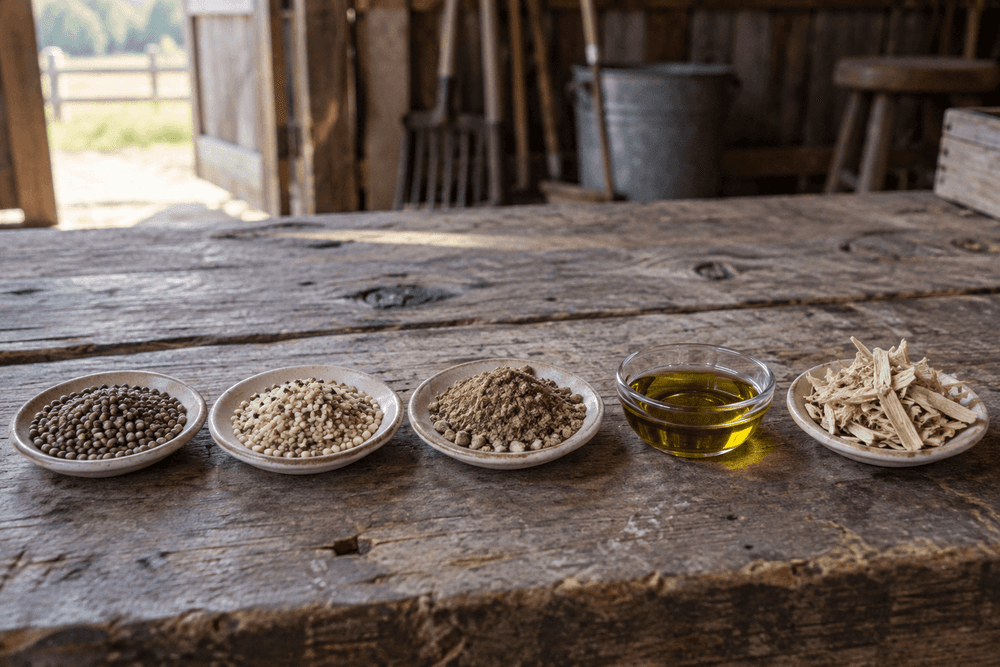
"Hemp" on a feed tag, on a bag of bird seed and on a bale of coop bedding means three different things. All of them come from Cannabis sativa, the same species as marijuana; US law separates the two by THC content, which our explainer on how hemp and marijuana differ walks through. For a chicken keeper or a feed buyer, five hemp products matter, and they sit in very different legal places. The protein and fat figures below come from a 2010 analysis of 30 Canadian hemp seed products for whole and hulled seed, and from the ingredient table of a 2021 US laying-hen trial for the pressed cake. Treat them as sample values: a different crop or press gives different numbers.
| Product | What it is | Typical protein / fat | Status in US commercial feed | What a backyard keeper should know |
|---|---|---|---|---|
| Whole hemp seed | The intact seed in its shell, sold as bird seed, as food or for planting | About 24% protein, 30% fat | Not covered by the AAFCO definition. Kentucky's 2023 policy allows non-viable seed for feeding wild birds | A fat-dense treat. Buy seed sold for birds or food, not planting seed |
| Hemp hearts (hulled seed) | The soft kernel with the shell removed, sold as human food | About 36% protein, 47% fat | A human food ingredient, not a feed definition | An expensive treat; the same treat limit applies |
| Hemp seed meal (cake) | What is left after the oil is pressed out mechanically, then ground | About 32% protein, 9% fat, 32% fiber | The only AAFCO-defined hemp ingredient: laying hens, up to 20% of the diet | You meet it as an ingredient in layer feed, where your state accepts it |
| Hemp seed oil | The oil pressed from the seed | Almost all fat, roughly 3 parts omega-6 to 1 part omega-3 | Not part of the AAFCO definition. Kentucky's 2023 policy allowed it at up to 12% of the diet | Rarely relevant for a backyard flock |
| Hemp bedding | Chopped hurd, the woody inner core of the stalk | Not a food | Not feed | Bedding goes on the coop floor; it is not part of the diet |
Two details explain the table. First, the meal is not just ground seed. Pressing removes most of the oil, so the cake ends up lower in fat and higher in protein and fiber than the seed it came from, which is why it fits a feed formula as a protein source. Second, the oil figure is the seed's own: a 2020 review of hemp seed composition puts linoleic acid, an omega-6 fat, at about 55% to 58% of the oil and alpha-linolenic acid (ALA), the plant omega-3, at about 12.6% to 19.6%. Hemp hearts, meanwhile, are regulated as human food. The company behind a 2018 GRAS notice for hulled hemp seed set its own limit of no more than 4 mg of THC, counting THCA, per kilogram of seed. That is one company's food specification, not a feed limit.
What the law actually says: AAFCO, FDA and the states
US feed law has three layers, and hemp had to clear all of them. Under federal law, any ingredient added to animal food needs either an FDA food additive approval or recognition as generally recognized as safe (GRAS). FDA also recognizes ingredients listed in the Official Publication of the Association of American Feed Control Officials (AAFCO), in coordination with state feed control officials, and that listing has been the practical route for most feed ingredients. AAFCO is not a government agency. It is an association of the officials who run state feed-control programs, and its definitions are a model each state chooses whether to write into its own feed law. For years, FDA's Center for Veterinary Medicine (CVM) reviewed proposed definitions under a formal agreement with AAFCO. In 2022, AAFCO noted that the use of hemp in animal feed remains under FDA and state feed programs, which is the short way of saying that legalizing the crop in the 2018 Farm Bill did not legalize it as feed.
| Date | What happened | Record |
|---|---|---|
| December 2018 | The Farm Bill takes hemp out of the federal drug law. Feed rules do not change | AAFCO news release, 2022 |
| January 2024 | AAFCO's Ingredient Definitions Committee approves a tentative definition for hemp seed meal in laying-hen diets, after an FDA scientific review | National Grain and Feed Association meeting report |
| August 7, 2024 | AAFCO members approve the tentative definition; it is listed provisionally | Trade press (AgNavigator, formerly AgTechNavigator) |
| October 1, 2024 | FDA's agreement with AAFCO expires and is not renewed | Federal Register, 89 FR 65368 |
| October 2024 | FDA finalizes its enforcement policy for AAFCO-listed ingredients (GFI #293) | FDA guidance |
| December 30, 2024 | Minnesota allows hemp seed meal in laying-hen feed | Minnesota Department of Agriculture |
| January 21, 2025 | The committee votes to move the definition to official | AAFCO committee minutes |
| August 4, 2025 | AAFCO members vote the definition official | AAFCO business meeting minutes |
| November 12 and December 11, 2026 | The new federal hemp definition will take effect in two steps; its hemp section does not mention feed | Public Laws 119-37 and 119-103 |
Read the record in order. In January 2024, after an FDA scientific review of the product's safety and utility, AAFCO's Ingredient Definitions Committee approved a tentative definition for hemp seed meal in laying-hen diets, according to the National Grain and Feed Association's meeting report. AAFCO's members approved that tentative definition at their August 2024 annual meeting; trade press reported it at the time as "final approval" and noted that feed regulators "are not obligated to accept it". It was not the final step. The committee's January 2025 minutes record a motion to "Move to Official: T71.5 Hemp Seed Meal Mechanical Extracted", and the minutes of AAFCO's August 4, 2025 business meeting close it out: "Board recommends acceptance. Minnesota moved. Montana seconded. Motion Carries." Tentative in 2024, official in August 2025.
FDA's part changed in the middle. A Federal Register notice from August 2024 confirmed that FDA's agreement with AAFCO would expire on October 1, 2024 and "will not be renewed". In October 2024, FDA finalized its guidance on AAFCO-defined ingredients, known as GFI #293: FDA generally does not intend to take enforcement action against ingredients listed in AAFCO's 2024 Official Publication, as long as they are used according to the definition's intended use, specifications and limitations. That policy is keyed to the 2024 book, and FDA has not published anything specific to hemp seed meal. So the accurate summary is this: FDA reviewed the product before the tentative vote, AAFCO defined it, and states adopt it. None of that is an FDA approval.
One more document explains why search results contradict each other. FDA's question-and-answer page on cannabis and cannabis-derived products, marked "content current as of" July 16, 2024, still says there are no ingredient definitions listed in the AAFCO Official Publication "for any substances derived from hemp", and that FDA has not received any GRAS notices for hemp-derived ingredients in animal food. That answer was written before the August 2024 and August 2025 votes, and it had not been updated when we read it on October 21, 2026.
Hemp seed meal for laying hens: the definition, line by line
This is the definition AAFCO's committee moved to official, word for word. It is short, and every clause narrows it:
“T71.5 Hemp Seed Meal Mechanical Extracted is the product obtained by grinding or milling the cake, which remains after most of the oil is removed from the seeds of Cannabis sativa L. by a mechanical extraction process. The ingredient must be labeled with guarantees for minimum crude protein and maximum crude fat on an as-fed basis. The meal shall contain no more than 20 ppm of total cannabidiol (Total CBD = CBD + (CBDA x 0.877)) and no more than 2 ppm of total tetrahydrocannabinol (Total THC = delta-9-THC + (THCA x 0.877)). It is used in diets of laying hens as a source of protein and fat at an inclusion of no more than 20% of the diet.”
Here is what each clause means in practice. Note the arithmetic in the fourth point: it is a ceiling we calculated from the definition, not a measurement of any real feed.
- Mechanical extraction only. The meal is the ground cake left after pressing. Meal made by solvent extraction is not what the definition describes.
- Labeled for nutrients. Each product must guarantee a minimum crude protein and a maximum crude fat on an as-fed basis, because pressing leaves a variable amount of oil behind.
- Total THC, not just delta-9. The formula, delta-9 THC plus THCA times 0.877, also counts the acid form that converts to THC with heat, using the same 0.877 conversion factor hemp labs use to report total THC.
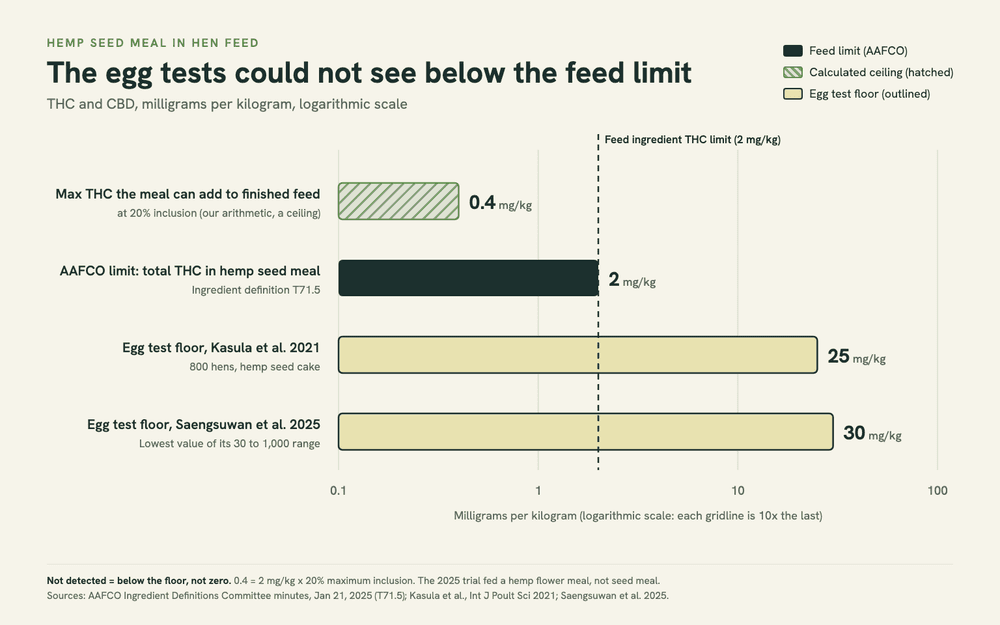
- 2 ppm is small. Two parts per million is 2 milligrams of total THC per kilogram of meal. At the 20% cap, the meal can add at most 0.4 mg of total THC per kilogram of finished feed (2 mg/kg times 0.20).
- Laying hens only. Broilers raised for meat, turkeys, ducks, cattle, pigs, horses and pets are outside this definition.
- Seed meal only. Whole seed, hulled seed, seed oil, flowers, leaves and extracts are not covered.
State by state: official does not mean allowed everywhere
An AAFCO definition does nothing on its own. A company can sell layer feed containing hemp seed meal in a state only if that state's feed-control program accepts the ingredient, and states move at different speeds and sometimes in different directions. No primary source we found lists every state's position, so we will not print a count. Here is what three state programs say in their own documents. On December 30, 2024, the Minnesota Department of Agriculture said it allows tentative ingredients in animal feed and pet food and would allow hemp seed meal in laying-hen feed at no more than 20% of the diet, under the 2 ppm THC and 20 ppm CBD standards; it added that full approval "may take a year or more" and that use could later expand to other animals. Colorado's feed program FAQ, an undated page we read on October 21, 2026, says: "Currently, the only approved hemp ingredient for commercial feed is hemp seed meal for use in layer diets." It warns that unapproved ingredients can make a feed "adulterated and not allowed for distribution in Colorado or other states". Kentucky went its own way before the AAFCO definition existed: its feed program's policy, dated September 26, 2023, allowed hempseed meal for layer, broiler and breeder chickens and for horses, and hempseed oil, based on company safety dossiers.
| State (document date) | Hemp ingredient allowed | Animals and limit | Basis |
|---|---|---|---|
| Minnesota (December 30, 2024) | Hemp seed meal | Laying hens, no more than 20% of the diet; 2 ppm THC, 20 ppm CBD | AAFCO tentative definition, which Minnesota allows |
| Colorado (undated, read October 21, 2026) | Hemp seed meal, described as the only approved hemp ingredient | Layer diets | Colorado has adopted AAFCO's ingredient list |
| Kentucky (September 26, 2023) | Hempseed meal; hempseed oil; non-viable seed for wild birds | Meal: layer, broiler and breeder chickens up to 30% of the diet, horses up to 20%. Oil: up to 12% | Company safety dossiers (self-affirmed GRAS); predates the AAFCO definition and may have been revised |
Notice how they disagree. Kentucky's policy covers broilers and horses; the AAFCO definition does not. Minnesota acted on the tentative definition; Colorado describes the meal as approved without a date on the page. If you make, sell or buy commercial feed, the only reliable answer is your own state's feed-control official, and AAFCO's website keeps a directory of them. If you keep a few hens at home, the backyard section below matters more to you than this table.
Does THC or CBD end up in the eggs?
Start with where cannabinoids live. FDA's Q&A page says that "the seeds of the plant do not naturally contain THC or CBD", and that hemp seed ingredients carry only trace amounts, picked up during harvesting and processing when the seeds touch other parts of the plant. The definition's answer to those traces is a ceiling, 2 ppm total THC, not zero. The next question is whether they reach the egg. In our October 2026 literature search we found two published feeding trials that tested eggs for cannabinoids directly; other recent hen trials measured yolk fats and egg quality but not cannabinoids:
| Study | Hens | Hemp product and dose | Egg test floor | Result |
|---|---|---|---|---|
| Kasula et al., 2021 (commercial farm, Pennsylvania) | 800 Bovans White, 30 weeks old | Hemp seed cake at 0%, 10%, 20% or 30% of the diet for 16 weeks | 0.0025%, or 25 mg/kg | Total THC and total CBD below the floor at weeks 8 and 16 |
| Saengsuwan et al., 2025 (Thailand) | 108 Lohmann Brown, 84 weeks old | Hemp flower (inflorescence) meal at 10% of the diet for 4 weeks | Quantification limit 0.003% to 0.10%, or 30 to 1,000 mg/kg | No CBD or THC found in eggs |
Both results are honest, and both say less than they sound. In the 2021 trial on 800 hens fed up to 30% hemp seed cake, cannabinoids in eggs were below the lab's reporting floor of 0.0025%, or 25 milligrams per kilogram. That floor is 12.5 times the 2 mg/kg THC ceiling of the meal itself, and far above the 0.4 mg/kg the meal could add to a finished feed at the 20% cap. So the result rules out large carry-over, not small amounts. The trial has other limits worth knowing: eggs were pooled into three composite samples per treatment, the lab method was built for plant material, the cake's own cannabinoid content was not reported, its top dose (30%) is above what the AAFCO definition allows, and its authors worked for egg-industry companies. The 2025 Thai trial tested a different by-product, meal made from hemp flowers left over after cannabinoid extraction, which the AAFCO definition does not cover. It found no CBD or THC in eggs after four weeks, using a method whose quantification floor started at 0.003%, or 30 mg/kg.
Why do regulators care at all, if the seed makes no THC? Because carry-over is real when the feed is the whole plant. In a 2022 German feeding study in dairy cows, cows fed silage made from whole industrial hemp plants passed about 0.20% of the delta-9 THC they ate into their milk, and the researchers' exposure scenarios exceeded the acute reference dose for people in several consumer groups. That was whole-plant hemp, leaves and flowers included, in cows and milk, not seed meal in hens and eggs. It shows why a 2 ppm ceiling exists, not what happens in an egg. European regulators made the same point in 2016: Commission Recommendation (EU) 2016/2115 says few data exist on delta-9 THC in food of animal origin or on how much transfers from feed, and it relies on the European Food Safety Authority's acute reference dose of 1 microgram of delta-9 THC per kilogram of body weight.
If drug testing is your real concern, the better-studied exposure is hemp seed food you eat directly. Our guide to hemp seed foods and drug tests covers what is known about seed-derived THC in people and why no seed product can guarantee a result.
What hemp seed changes in the egg, by the numbers
The best-studied effect of hemp in a hen's diet is on the fat in the yolk. Much of this work comes from a University of Manitoba group that fed hemp seed and hemp seed oil to small flocks for 12 weeks. In a 12-week trial in 48 Bovan White hens fed hemp seed at 10% or 20% of the diet, or hemp seed oil at 4%, 8% or 12%, total omega-3 fat in the yolk rose in step with the ALA in the diet. A second paper from the same group, on 48 hens put total yolk omega-3 at 15.3 mg per gram with 12% hemp oil, against 2.4 mg per gram in control eggs. In a later trial feeding up to 30% hemp seed or 9% hemp oil to 48 Lohmann LSL hens, yolks at the highest doses carried about 12 times the ALA of control eggs and 2 to 3 times the DHA, with the change visible within 4 weeks. Outside the lab, a 2025 Italian field trial on 1,800 Hy-Line Brown hens in aviary pens offered whole hemp seed as 10% of daily intake for 4 weeks and also measured more omega-3 in the yolk. These are measurements of what is in the egg, not evidence that the egg does anything for the hen or for you. The numbers, side by side:
- Total yolk omega-3: 15.3 mg per gram with 12% hemp oil, against 2.4 mg per gram in control eggs (48 hens, 12 weeks).
- ALA per yolk at the top hemp doses: 152 and 156 mg, about 12 times control (48 hens, 12 weeks).
- DHA per yolk at the top hemp doses: 41.3 and 43.6 mg, 2 to 3 times control (same trial).
- Yolk color: darker and more yellow, most at 20% hemp seed, with a yellowness score of 60.5 against 43.0 in control eggs.
- Taste: a trained panel of eight found no difference in aroma or flavor in the cooked eggs except sweetness.
- Whole seed as 10% of intake for 4 weeks (1,800 hens): 46% of tasters noticed a difference, with no preference either way.
Laying results are less tidy. A 2025 pooled analysis of 21 hen studies found yolk color and yolk omega-3 rose consistently, while effects on laying varied with dose and hen age, with inclusion above 10% in hens 25 weeks old or younger linked to slight reductions. A 2024 Turkish trial that replaced soybean meal with hemp seed meal saw fewer eggs at 12% meal. Products, doses and breeds differ from study to study, so treat any single number as that study's number. Also keep the fats straight: ALA is the plant omega-3, while EPA and DHA are the longer-chain forms found in fish. Our comparison of hemp hearts and chia seeds explains that difference for the seeds people eat.
Can chickens eat hemp seeds at home? A backyard checklist
The AAFCO definition governs commercial feed sold in a state, not what you hand-feed your own hens, and this page cannot tell you what your state allows on your own property. What the evidence and the feed programs do support is short. A veterinary hospital's guide to chicken diets says treats "should not comprise more than 10% of the daily intake from all food sources", and hemp seed counts toward that like scratch grain or kitchen scraps. Bird seed and hulled hearts are sold for eating; viable planting seed is a separate legal question, covered in our guide to whether cannabis seeds are legal to buy and own. Hemp bedding is made from hurd, the stalk's woody core, which a Congressional Research Service report on hemp lists among the crop's uses alongside animal bedding and papermaking. And one boundary applies to every flock: FDA's answer on adding THC or CBD to animal food or feed in interstate commerce is that it is a prohibited act, as our summary of what the FDA says about CBD explains. Put together:
- 1Keep hemp seed a treat, not the ration. All treats together stay under 10% of what a hen eats in a day, and a complete layer feed stays the base of the diet.
- 2Remember how rich it is. Whole hemp seed is about 30% fat and hemp hearts about 47%, so a small scoop carries a lot of energy without the balance of a layer feed. That is a nutrition fact, not a health claim.
- 3Buy seed sold for birds or for food, not seed sold for planting.
- 4If you sell eggs or mix feed for sale, your state's feed and egg rules apply to you. A bagged layer feed listing hemp seed meal is meant to be sold only where the state feed program accepts it.
- 5Leave CBD oil, hemp extracts and other cannabinoid products out of feed and water entirely.
- 6Treat hemp bedding as bedding. It is stalk material for the coop floor, not seed and not feed.
- 7When in doubt, ask a poultry veterinarian. That is also Colorado's advice to owners with questions about feeding hemp.
Does the 2026 federal hemp change touch chicken feed?
Congress rewrote the federal definition of hemp in Public Law 119-37, enacted November 12, 2025. Its hemp section is not in effect yet. With timing set by a later law, Public Law 119-103, it will start in two steps: on November 12, 2026 it will apply only to products containing cannabinoids the plant cannot naturally produce, and on December 11, 2026 the rest will take effect. The hemp section of the 2025 law never uses the word "feed". Once in effect, its text will file hemp grown for the "whole grain, oil, cake, nut, hull" of the seed under a new category, "industrial hemp", and its new limits on "hemp-derived cannabinoid products" will apply to products derived from hemp "other than industrial hemp" that contain cannabinoids and are intended for human or animal use. Seed cake is named in the industrial hemp category. On our reading of the text, the law does not change the feed rules: approval of hemp seed meal still runs through FDA, AAFCO and the states. What will change for every crop, once the law is fully in effect, is that the federal definition will count total THC, which matters to the farmers who grow the seed. No agency has issued guidance on this point, and this is not legal advice. Our explainer on the 2025 federal hemp law and its 2026 start dates covers the rest of the statute.
What is still unknown
A few honest gaps remain as of October 21, 2026. No published egg study we found tested for THC with a method sensitive enough to measure below the 2 ppm feed limit, so the amount in eggs from hens fed hemp seed meal at the 20% cap has been bounded, not measured. No AAFCO definition exists for broilers, turkeys, ducks or other livestock; industry groups have told trade press they are pursuing other species, but nothing beyond laying hens has been defined. FDA has not updated its July 2024 Q&A, and it has not said whether its enforcement policy for AAFCO's 2024 book reaches a definition made official in 2025. State positions can change, so a state page is only as current as its date. And the feeding studies measured yolk composition and laying, not the health of the hens or of the people who eat the eggs, which this page does not address.
Frequently asked questions
Yes, as a treat. Hemp hearts are hulled hemp seed sold as human food, at about 36% protein and 47% fat in one analysis, so they are costly and very rich. They count toward the under-10% treat limit like any other treat. They are not covered by the AAFCO feed definition, which names only hemp seed meal.
For laying hens, yes, where your state accepts it. AAFCO's members made the hemp seed meal definition official on August 4, 2025, for laying-hen diets at up to 20%, with no more than 2 ppm total THC and 20 ppm total CBD. Minnesota (in December 2024) and Colorado say they accept it for layer feed, and Kentucky's 2023 policy also covers broiler and breeder chickens. Check your state's feed-control program for anything you plan to sell.
The two trials we found that tested eggs reported no THC or CBD above their test floors, 25 mg/kg in one and 30 mg/kg in the other. Those floors are higher than the 2 ppm THC limit of the feed ingredient, so the data rule out large amounts, not traces. We found no study that measured what, if anything, is present below those floors, so a THC-free egg claim is not supported.
We found no study that tested this. What exists is residue data: cannabinoids in eggs below detection floors of 25 to 30 mg/kg. Our guide to hemp seed foods and drug tests covers what is known about seed-derived THC in people.
We make no health claim about any bedding. What we can say is what it is: hemp bedding is chopped hurd from the stalk's woody core, not seed and not feed. For questions about your own flock and coop, ask a poultry veterinarian.
Not under the AAFCO definition, which covers laying hens only. Kentucky's 2023 policy separately allowed hempseed meal for broiler and breeder chickens and for horses. Nothing has been defined for cattle, pigs, goats or sheep, and Colorado says hemp seed meal for layer diets is the only approved hemp ingredient for commercial feed there.
Hemp seed is sold as bird seed, and Kentucky's feed program says it allows non-viable hemp seed for feeding wild birds. Buy seed sold for birds or food rather than seed sold for planting; our guide to seed legality explains why viability matters.
Feed is one use of the hemp seed, and the seed is one part of the crop. To see how the same plant ends up as food, fiber and oil, and which rules apply to each, read our guide to everything the hemp crop is grown for.
Writing about hemp, wellness and the small rituals that keep us balanced.