Can You Be Allergic to CBD? What the Label Actually Says
Page one of this search says a reaction is never the CBD itself. The one cannabidiol label written by a regulator contraindicates cannabidiol by name, in its first line. Here is what those trials recorded, and the one document on a bottle that narrows it down.
Yes, in the sense that matters. The one cannabidiol medicine a federal regulator has approved is contraindicated in anyone with a history of hypersensitivity to cannabidiol itself, and the molecule is named first, before the other ingredients. Almost every page written about CBD allergy says the opposite: that a reaction is never the CBD and always something else in the bottle. That answer is half right, and the half it gets wrong is written on a drug label anyone can open.
What page one gets right about CBD allergy, and the half it gets wrong
Run this search and the first page converges on a single sentence: it is rarely the CBD itself, and reactions come from the other ingredients, the carrier oil, the terpenes, the preservatives or the flavoring. The second half of that sentence is true and useful. The first half is an assertion, and nobody sources it. We read the page-one results on August 11, 2026, and not one of them contains the word angioedema, or the word hypersensitivity, or any reference to the one document in which a regulator wrote down what cannabidiol did to people under a trial protocol. If cannabidiol as a molecule is new to you, what cannabidiol actually is is the background this page assumes.
That document is the prescribing information for EPIDIOLEX, the prescription cannabidiol oral solution first approved in the US in 2018. The full label is public, and we read SPL version 35, effective May 29, 2026. Section 4, CONTRAINDICATIONS, is one sentence long: "EPIDIOLEX is contraindicated in patients with a history of hypersensitivity to cannabidiol or any of the ingredients in the product." Read the order of it. Cannabidiol is named first, as its own contraindicating substance, and "any of the ingredients" follows as a separate category. A federal label does not list a molecule in its contraindications section as a courtesy.
Two limits belong in the same breath, and both come from the same label. First, section 5.4 states that "patients with known or suspected hypersensitivity to any ingredients of EPIDIOLEX were excluded from the clinical trials." The people most likely to react were screened out before enrollment, so this label establishes that a hypersensitivity reaction to cannabidiol can happen and cannot tell you how often it happens. Second, EPIDIOLEX is not a tincture. It is a prescription anti-seizure medicine at 100 mg/mL, given at 10 to 25 mg/kg/day in a vehicle of sesame seed oil and 7.9% w/v dehydrated alcohol, to patients who are almost all taking other antiseizure drugs. Nothing about its dose, its patients or its results transfers to a hemp product bought online. What does carry across is a documented fact about the molecule: a regulator wrote it into a contraindication.
What that label actually recorded
Section 5.4 is titled Hypersensitivity Reactions and it runs five sentences. The first two: "EPIDIOLEX can cause hypersensitivity reactions. Some subjects in the EPIDIOLEX clinical trials had pruritus, erythema, and angioedema requiring treatment, including corticosteroids and antihistamines." Pruritus is itching. Erythema is redness. Angioedema is deep swelling in the tissue under the skin, the kind that shows up in lips, eyelids, tongue or throat. It required treatment. That is a different weight of evidence from "some users report itching," because it came out of placebo-controlled trials with a written protocol and an adverse-event log. It is also evidence with a hole cut in it, and the hole sits in the same five sentences: the third one records that patients with known or suspected hypersensitivity to any ingredient were excluded from those trials.
We grepped the full de-tagged text of that label on August 11, 2026, counting every string occurrence in the whole document, Highlights and Medication Guide included. "Hypersensitiv" appears 10 times. "Angioedema" appears exactly once, in section 5.4. "Pruritus" once, "erythema" once, "sesame" four times, "rash" six times. "Anaphylaxis" appears zero times, and so does "urticaria." Both halves of that are worth holding at once: the label documents swelling serious enough to need corticosteroids, and it never reaches for the word anaphylaxis. The absence of a word from one drug label is not evidence about every person or every product.
| Trial program | Dose arm | Rash | Placebo arm | Population |
|---|---|---|---|---|
| Lennox-Gastaut and Dravet (Studies 1, 2, 3) | 10 mg/kg/day, N=75 | 7% | 3%, N=227 | Mean age 14 (range 2 to 48). All patients taking other antiseizure drugs. Up to 14 weeks. |
| Lennox-Gastaut and Dravet (Studies 1, 2, 3) | 20 mg/kg/day, N=238 | 13% | 3%, N=227 | Same three trials, same placebo column. |
| Tuberous sclerosis complex (Study 4) | 25 mg/kg/day, N=75 | 8% | 4%, N=76 | Mean age 14 (range 1 to 57). All but one patient taking other antiseizure drugs. Up to 16 weeks. |
| Tuberous sclerosis complex (Study 4) | 25 mg/kg/day, N=75 | Eosinophil count increased: 5% | 0%, N=76 | Same table, hematological changes. Eosinophils are the white cells that rise in allergic and parasitic responses. |
| Both programs | All arms | Reaction rate in people already known to react | Not measured | Anyone with known or suspected hypersensitivity to an ingredient was excluded before enrollment. |
Two more sentences sit in the same section, and they must not be merged. In the tuberous sclerosis trial, "the rate of discontinuation as a result of any adverse reaction was 11% for patients taking EPIDIOLEX 25 mg/kg/day and 3% for patients on placebo. The most frequent cause of discontinuation was rash (5%)." In the Lennox-Gastaut and Dravet trials, discontinuation ran 2.7%, 11.8% and 1.3%, and there the most frequent cause was transaminase elevation, a liver enzyme signal, not rash. Same drug, two trial programs, two different leading reasons for stopping. A page that averages them into one number is describing a study nobody ran. Both sets of percentages also carry the same two conditions as everything else in this label: the trials had already excluded anyone with a known or suspected hypersensitivity to an ingredient, and the patients were taking a prescription anti-seizure solution at 10 to 25 mg/kg/day alongside other antiseizure medicines.
That exclusion is the caveat that outranks all six percentages. A percentage from a screened population is a count of what someone recorded in a defined group of patients, not a risk you can carry over to yourself. We make the same argument at more length on why an adverse-event table is not an incidence rate, and on whether it is the cannabinoid or the carrier doing it.
Cannabidiol, carrier or flavor: which one are you asking about?
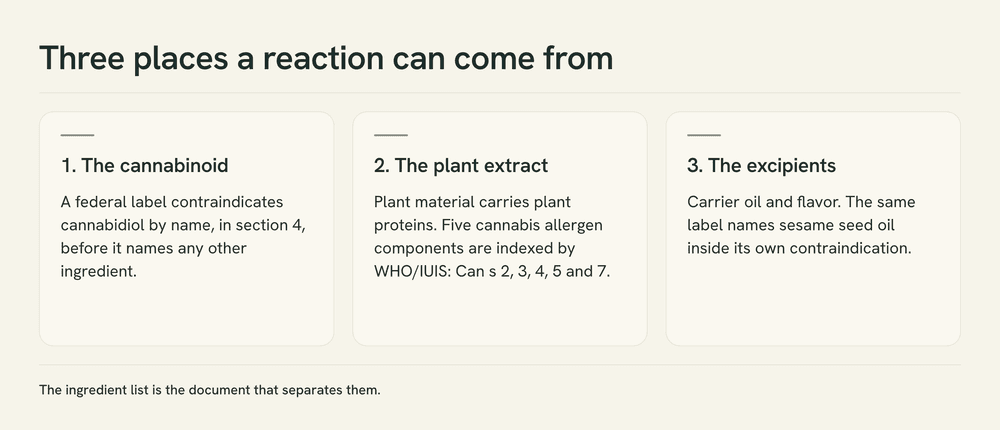
A tincture is at least three separable things in one bottle, and a reaction has to be attributed to one of them before anything sensible can be said. There is the cannabinoid itself. There is the rest of the plant extract it came with. And there are the excipients: the carrier oil that makes up most of the volume, and whatever the flavor line covers. Page one collapses the first into the third and stops. The useful version keeps all three apart.
Start with the cannabinoid, because that is the contested one. Classical food allergy is an immune response to proteins, in FDA's own words, and cannabidiol is a small molecule rather than a protein. Set against that, a federal label contraindicates it by name. Both statements are true and neither cancels the other: hypersensitivity is a broader category than IgE food allergy, and the label is reporting what happened in its trials rather than proposing a mechanism. What none of our searches surfaced, and this is the sharpest thing on the page, is a published human case report of cannabidiol causing anaphylaxis or angioedema outside those trials; the query strings, counts and dates are at the end of this article. The evidence that the molecule can do it is a label, not a literature.
Next, the extract. A hemp extract is plant material, and plant material carries plant proteins. That is the one place where a spectrum choice has an allergen consequence worth thinking about: a full-spectrum extract brings across more of the plant than a broad-spectrum one, and an isolate is the far end of that scale. How full spectrum, broad spectrum and isolate differ sets out what each one keeps. We have no measurement of residual protein content in consumer hemp extracts to point you at, so treat that as a difference in plant material rather than a ranking of risk.
Then the excipients, where page one is right and where the same label proves it. EPIDIOLEX's own inactive ingredients, from section 11, are dehydrated alcohol (7.9% w/v), sesame seed oil, strawberry flavor and sucralose. Sentence five of section 5.4 closes the loop: the product is contraindicated in patients with a prior hypersensitivity reaction to cannabidiol or any of the ingredients, "which includes sesame seed oil." Sesame is not a footnote in US law either. It became the ninth major food allergen through the FASTER Act, Public Law 117-11, approved April 23, 2021, and the statute's own clause is worth reading rather than the headline date: the amendment "shall apply to any food that is introduced or delivered for introduction into interstate commerce on or after January 1, 2023." It governs what enters commerce, not what was already on the shelf.
The carrier oil question, answered against the actual rules
Most CBD tinctures, ours included, are mostly carrier oil, and the most common carrier is fractionated coconut oil, sold as MCT. So the honest version of "is this safe with my nut allergy" starts with what the federal rules actually say, and they say two things people find surprising. The statutory definition at 21 U.S.C. 321(qq) lists nine major food allergens and then defines the allergenic ingredient as one "that contains protein derived from" one of them. The definition turns on protein. And it carves out, in its own text, "any highly refined oil derived from" one of the nine, plus anything made from such an oil. That is a labeling exemption, decided by Congress, and it is not a clinical finding that refined oils never cause reactions.
Now the correction, because the line everyone repeats is not what the current guidance says. FDA does not count coconut among the tree nuts it treats as major food allergens. Its final guidance on food allergen labeling, Edition 5, announced at 90 FR 1133 on January 7, 2025, states in its own Federal Register notice that it "revises the list of tree nuts that FDA considers as major food allergens," and the list it prints has 12 entries: almond, black walnut, Brazil nut, California walnut, cashew, filbert or hazelnut, heartnut or Japanese walnut, macadamia or bush nut, pecan, pine nut, pistachio, and English or Persian walnut. Coconut is not on it, and the word coconut does not appear anywhere in the document; we checked that against the full extracted text on August 11, 2026. FDA's stated criterion for the list is "a robust body of scientific evidence" supporting inclusion, and the guidance is stamped Contains Nonbinding Recommendations on every page.
Read that as what it is. A regulator revised a labeling list according to how much allergenicity evidence exists for each botanical entity. It is not a verdict that nobody reacts to coconut, and the numbers say plainly that people do. In a nationally representative US survey of 78,851 individuals, 0.39% (95% CI 0.33 to 0.45), roughly 1 in 260, met the study's criteria for convincing IgE-mediated coconut allergy; 0.43% of adults met those criteria against only 0.20% who reported a physician-confirmed diagnosis, and 40.1% of those with convincing coconut allergy held a current epinephrine prescription. The limits matter: it is self-report and parent-proxy report rather than challenge-confirmed diagnosis, the survey was fielded between October 2015 and September 2016, and its authors describe the measure as reporting symptoms consistent with allergy. It also says nothing at all about MCT oil.
Which leaves the question everyone actually wants answered: does a highly refined oil carry enough residual protein to matter? The published literature disagrees with itself, and both sides are worth naming. A 2017 probabilistic risk assessment modelled what happens when refined vegetable oils pick up residual peanut protein from shared production lines and reported that for all products examined, the predicted risk of objective allergic reactions in peanut-allergic users was extremely low, ranging from a high of 3 per 1,000 eating occasions on one model down to no reactions at all on another, and concluded that the health risk from that cross-contact is negligible. A 2008 analytical study using Western blot against the sera of sensitized children reported that IgE-responsive residual proteins were found in peanut oil extracts, and its authors concluded that refined seed oils would benefit from further toxicological study. Both are about peanut and seed oils. Neither is about coconut, and neither is about fractionated MCT. We could not find a published measurement of residual coconut protein in fractionated MCT at all; the search string and its date are at the end of this article. That is an absence of evidence in the indexed literature, not a finding in either direction, and anyone telling you otherwise is filling in the gap themselves. If you want the agency's wider posture on CBD as a category, the agency's broader position on CBD has its own page.
The 60-second ingredient panel check
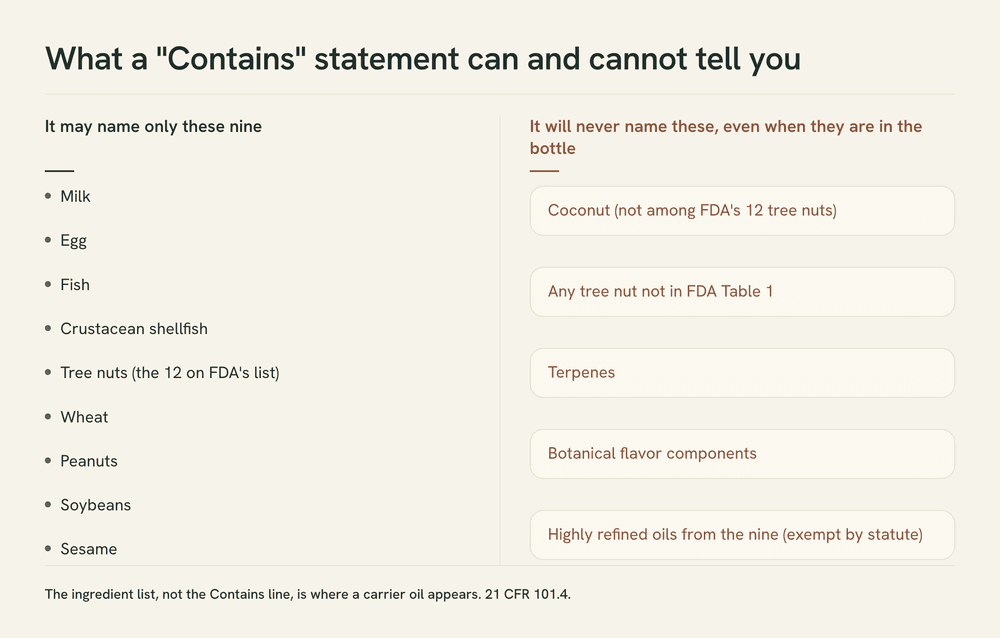
Here is the payload of everything above, and it is a skill rather than a fact. Because a coconut carrier can never legally appear in a "Contains" line, and because the allergen statute is written around protein and exempts refined oils, the only document that answers the ingredient question is the ingredient list. Run it in under a minute, on any brand, before you buy and again before you hand a bottle to a clinician. The full method, including the milligram figures and the panel layout, lives on our page about reading a CBD label line by line; here is the allergen-specific pass.
- 1Read the ingredient list, not the "Contains" line. FDA's guidance is explicit that a Contains statement declares major food allergens, so a coconut carrier, a terpene or a botanical will never show up there even when it is in the bottle.
- 2Find the oil and check its source. Under 21 CFR 101.4(b)(14) the source of every oil, however refined, has to be part of its common or usual name in the ingredient list: coconut oil, sesame seed oil, sunflower oil, not a bare "oil blend."
- 3Treat the flavor line as a category, not an ingredient. "Natural flavor" is a defined federal term and it is not obliged to name the plant it came from, so it is the line that most often needs a question to the brand.
- 4Write down the batch or lot number. Composition is a per-batch fact, and nobody can chase a reaction back to a bottle that cannot be identified afterwards.
- 5Photograph the panel and the batch number together. That photograph is what an allergist can actually work from at an appointment. A product page is marketing; the panel is the regulated document.
Step three deserves its own note, because it is where most panels go quiet. "Natural flavor" is defined at 21 CFR 101.22(a)(3) by its origin and its function, and the origin half of that definition is wide. It covers an essential oil, oleoresin, essence, extractive, protein hydrolysate or distillate carrying flavoring constituents derived from a spice, fruit or fruit juice, vegetable or vegetable juice, edible yeast, herb, bark, bud, root, leaf or similar plant material, and also from meat, seafood, poultry, eggs, dairy products, or fermentation products of any of those, "whose significant function in food is flavoring rather than nutritional." Read the animal-derived half of that list twice if you have a dairy, egg or seafood allergy. Nothing in the definition requires the panel to say which of those things the flavor came from. That is a fact about the rule, not an accusation against any brand, and it applies to our labels exactly as it applies to everyone else's. If a flavor component is the thing you need to rule out, the panel alone will not get you there and the brand has to answer.
Now run it on ours, since that is the only fair way to publish this. A Planntz tincture is 60 mL and its ingredient list has three lines: hemp extract, organic coconut MCT oil, and natural fruit flavor (the flavored bottles are Mango & Peach and Lemon & Raspberry; the Natural bottle has no third line). So the carrier is coconut, and the flavor line is a category, exactly as described above. Using the density and package weight printed on our own batch certificate, a bottle is about 56 g, roughly 41 g of which is coconut MCT, which works out to somewhere around 33 to 37 mg of carrier oil in a 0.05 mL drop across the four tinctures. Drop size varies with the dropper and with technique. And an amount is not a sensitivity: for an IgE-mediated allergy, a small number of milligrams is not automatically reassuring, and the search printed at the end of this article turns up no published measurement of how much coconut protein, if any, survives fractionation. What a certificate of analysis does cover is a separate skill, and the next paragraph is where it stops.
Is it the plant? What allergists know about cannabis allergy
There is a real, small, indexed literature on cannabis allergy, and page one never opens it. A 2024 clinical review in Current Allergy and Asthma Reports sets out the state of it: five Cannabis sativa components are indexed in the WHO/IUIS allergen database, namely Can s 2 (a profilin), Can s 3 (a non-specific lipid transfer protein), Can s 4, Can s 5 (the Bet v 1 homologue) and Can s 7 (a thaumatin-like protein). The predominant presentations, in the review's own words, are rhinoconjunctivitis and contact urticaria or angioedema, and the sentence that follows is the one worth carrying: cannabis allergy "can also present as a life-threatening condition." Cross-reactivity with fruits, vegetables, nuts and cereals is common. The review states plainly that the exact prevalence of cannabis allergy and its associated cross-reactive food syndromes remains unknown and is likely to be underestimated. Can s 3, the component most cannabis allergy is attributed to, was first described as a novel allergenic lipid transfer protein in 2007.
Now the limit that decides how much of this you should carry over, and it is the route of exposure. That entire literature is about Cannabis sativa the plant: smoking it, handling it at work, its pollen, touching it, and eating hemp seed. Not one study in it tested a swallowed CBD extract, and none of it was run on a consumer tincture. So it tells you that the plant is a documented allergen source with named components, which is genuinely useful if you react around cannabis or work with it. It does not tell you what happens when a refined oral extract in a coconut oil base is swallowed, because that is not the exposure any of these studies tested.
Hemp seed is a third story again, and it gets conflated with both of the others constantly. Anaphylaxis after eating hempseed is a published case report from 2003. Allergic contact dermatitis from hemp seed oil is a published case report from 2022. Two case reports are two people. A 2023 proteomics study identified vicilins and edestins as candidate hemp seed allergens and reported possible cross-reactivity with hazelnut, with an inhibition ELISA reducing IgE binding to hazelnut extract by roughly 25% to 30%. That work is in vitro, using sera rather than patients, and its own authors write that the clinical relevance of the cross-reactivity needs further investigation. It also concerns the seed, which is a different raw material: hemp seed oil is a different product from CBD oil, and the two show up under similar names on similar shelves.
What an allergist can and cannot test you for
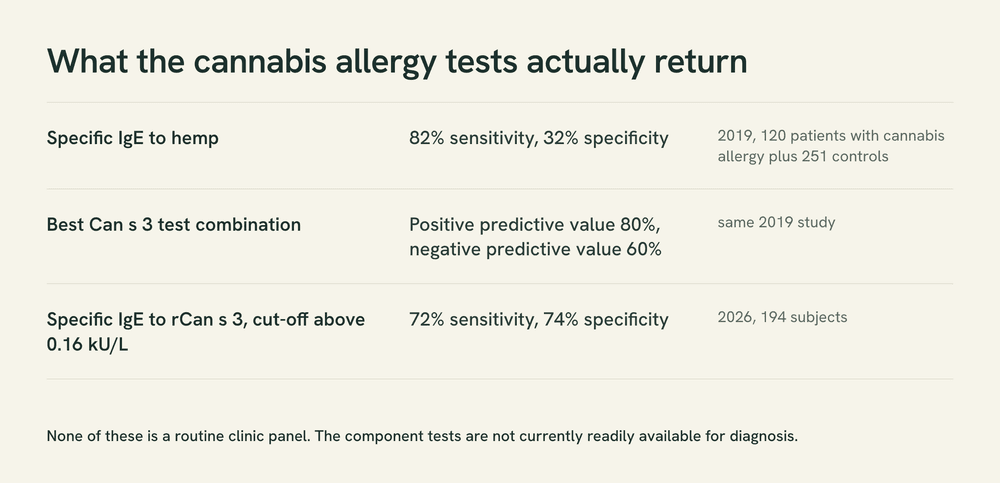
This is the part the symptom lists skip, and it is why this article does not tell you to go get tested and find out. A 2019 diagnostic-accuracy study in Belgium enrolled 120 patients with cannabis allergy alongside 62 healthy and 189 atopic controls. Among the patients who reported a likely anaphylactic reaction, up to 72% were sensitized to Can s 3. The best-performing test combination returned a positive predictive value of 80% and a negative predictive value of 60%, and specific IgE to hemp was 82% sensitive but only 32% specific. A test that is 32% specific flags a large share of people who do not have the thing it is testing for. That is not a test you self-administer conclusions from.
The threshold is not settled either. A 2026 study of 194 subjects, 104 cannabis-allergic patients with 20 healthy and 70 exposed atopic controls, put the clinically validated cut-off for specific IgE to recombinant Can s 3 at greater than 0.16 kU per liter, giving 72% sensitivity and 74% specificity, and its authors concluded that the validated cut-off may not always represent the most efficacious approach. The 2024 review adds the practical part: the component tests are not currently readily available for diagnosis. So the honest summary is that cannabis and hemp are not standard panel items, the assays that exist are mostly research tools, and the specialist, not the search result, decides what is worth running.
What you can do is make the appointment useful. An allergist works from exposure history and documents, and a reaction to a product is much easier to work with when the product is identifiable.
- The bottle itself, or a photograph of the complete ingredient panel with the batch or lot number in the same frame.
- Everything else you took, ate, drank or handled in the hours around the reaction, including other supplements, foods and topicals.
- The timeline: how long after the dose symptoms began, how long they lasted, and what, if anything, you took for them.
- Photographs of any skin reaction taken at the time. Rashes fade faster than appointment waiting lists.
- Your own allergy history, especially foods, pollens, latex and any previous reaction to a plant-derived product.
- The question of whether cannabis or hemp testing is available where you are, asked out loud, because in many clinics it is not.
When to stop, and when to call for help
The severity ladder here is not CBD-specific, which is exactly why it is worth stating in plain terms. FDA's own consumer page on food allergies describes reactions as varying "in severity from mild symptoms involving hives and lip swelling to severe, life-threatening symptoms, often called anaphylaxis, that may involve fatal respiratory problems and shock," and defines a food allergy as the body's immune system reacting to certain proteins in food. We read that page on August 11, 2026. Any of the following is the severe end, and it is an emergency services call, not a wait-and-see.
- Difficulty breathing, wheezing, a hoarse voice, or tightness in the throat or chest.
- Swelling of the face, lips, tongue or throat.
- Widespread hives, or hives together with faintness, dizziness, or repeated vomiting.
- Symptoms that are getting worse over minutes rather than settling.
- Any reaction that feels different in kind or worse in degree than anything you have had before.
For everything below that line, the non-emergency route is short and it is the same route a prescriber is given. Stop taking the product. Keep the bottle and the batch number rather than throwing them out. Tell a clinician, and take the panel with you. Do not restart to see whether it was really the CBD: the label's instruction to prescribers is to discontinue and not restart if hypersensitivity occurs, and a deliberate rechallenge is something that happens under supervision or not at all. One boundary worth drawing, because the two get confused: feeling awful after too large a serving is a different event with a different route, and taking too much at once, which is a different emergency covers it separately.
What would turn "some users report itching" into evidence
Anecdote is not a weaker form of evidence; it is a different thing entirely, and it is most of what exists on this question. Four things would upgrade it. A denominator, so a report becomes a rate. A placebo arm, so the rate can be compared against what happens with no drug at all. A supervised rechallenge, so the reaction can be tied to the substance rather than to the day. And a component-resolved test, so the culprit protein can be named. The EPIDIOLEX trials have the first two, which is the entire reason this article leans on a drug label rather than on a review site, and they still cannot produce a general rate, because the people most likely to react were excluded from them.
Here are the searches, so you can rerun them rather than take our word for it. All were run against the PubMed E-utilities on August 11, 2026, and each count comes with its counting rule. The query cannabidiol[tiab] AND (anaphylaxis[tiab] OR angioedema[tiab]) returns 3 records, all preclinical (two in mice, one in cultured canine cells), and not one is a human report of cannabidiol causing anaphylaxis or angioedema. The query "Can s 3"[tiab] returns 12 records; note that running it without the quotation marks inflates the count, because PubMed parses "Can s" as an author surname. The query hemp AND allergy AND IgE returns 41, but PubMed maps "hemp" onto the cannabis MeSH term, so that is a cannabis count and not a hemp-specific one. And (medium chain triglyceride[tiab] OR fractionated coconut oil[tiab]) AND (residual protein[tiab] OR allergen[tiab]) returns a single record, a 2014 year-in-review rather than a measurement. That last one is the carrier-oil question, and the answer is that the measurement is not there to find.
So the fair summary of the whole page: cannabidiol is documented as capable of causing a hypersensitivity reaction, by a regulator, in a contraindication, with angioedema recorded once in the same label. How often that happens is unknown, and the one dataset that could have told you deliberately excluded the people it would have happened to. The excipients are a documented source too, which is what page one is groping at. And the plant allergy literature, while real, is about a different route of exposure. If you want the broader picture of what shows up in the trial data, the side effects that show up in the trial data is the parent page for all of it.
There is no CBD-specific picture, and that is itself the answer. FDA describes food-allergic reactions as ranging from mild symptoms involving hives and lip swelling to severe, life-threatening symptoms, often called anaphylaxis, that may involve fatal respiratory problems and shock. The one controlled dataset specific to cannabidiol, the EPIDIOLEX trials, recorded pruritus (itching), erythema (redness) and angioedema (deep tissue swelling) that required treatment with corticosteroids and antihistamines. Two conditions travel with that: those trials had already excluded anyone with a known or suspected hypersensitivity to an ingredient, and they studied a prescription anti-seizure solution dosed by body weight in patients on other antiseizure medicines. So it shows what can happen, not how often. Difficulty breathing, throat or tongue swelling, or symptoms escalating over minutes go to emergency services, not to a search engine.
Both are documented, and the federal label is the reason we can say that instead of guessing. Section 4 contraindicates the product in patients with a history of hypersensitivity to cannabidiol or any of the ingredients, naming the molecule first and separately. Section 5.4 then spells out that the contraindication includes sesame seed oil, which is one of that product's excipients. So the popular answer, that it is never the CBD and always the carrier, is half right. Narrowing it for your own case is a job for the ingredient panel plus a clinician, not for a rule of thumb.
That is a question for the clinician who manages your allergy, with the ingredient panel in front of them, and we are not going to answer it for you. Three facts help you ask it well. FDA's January 2025 final guidance lists 12 tree nuts it considers major food allergens and coconut is not among them, which is a labeling decision about the strength of the evidence rather than a statement about your immune system. Coconut allergy is nevertheless real and indexed: about 1 in 260 people in a US survey of 78,851 reported symptoms consistent with IgE-mediated coconut allergy. And highly refined oils are carved out of the federal allergen definition by statute, which is again a labeling rule and not a clinical finding.
Rash is documented for prescription cannabidiol, with a placebo column, which is more than can be said for most claims in this category. In the Lennox-Gastaut and Dravet trials it was reported in 7% of patients at 10 mg/kg/day and 13% at 20 mg/kg/day against 3% on placebo. In the tuberous sclerosis trial it was 8% against 4%, and there rash was the single most frequent cause of discontinuation at 5%. Two limits travel with those numbers everywhere they go: people with known or suspected hypersensitivity were excluded from the trials, and this is a prescription anti-seizure solution dosed by body weight in patients taking other antiseizure medicines, so the percentages are not a rate for a consumer tincture.
Possibly the same allergen, definitely a different exposure. Cannabis sativa is a documented IgE allergen source with five components indexed by WHO/IUIS, and the usual presentations are rhinoconjunctivitis and contact urticaria or angioedema from smoking, handling, pollen and skin contact, with frequent cross-reactivity to fruits, vegetables, nuts and cereals. None of that literature tested a swallowed CBD extract. The tests are largely research assays: in a 2019 diagnostic study of 120 cannabis-allergic patients, specific IgE to hemp was 82% sensitive and only 32% specific. Take the question to an allergist rather than to a self-test.
No, and ours does not either. A certificate of analysis is a chemistry and safety report: cannabinoid potency, heavy metals, microbials, and depending on the panel, pesticides and residual solvents. The batch certificate we publish covers potency by UHPLC-DAD, four heavy metals by ICP-MS and six microbial tests, and it contains no protein test and no allergen test. That is a limit of the document type rather than a gap at one lab, and it means no lab report can rule a reaction in or out for you. The ingredient list is the document that speaks to allergens.
It depends on the product, and the panel is where you check rather than the marketing. As a reference point, the prescription cannabidiol solution states in its own Description section that it contains no ingredient made from a gluten-containing grain, naming wheat, barley and rye. Our own tinctures list three ingredients, hemp extract, organic coconut MCT oil and natural fruit flavor, and our own label copy carries a vegan, non-GMO, gluten-free, no artificial sweeteners note. For any other brand, read the ingredient list and any gluten statement on the label itself, and remember that a flavor line is a category that does not have to name its source plant.
Writing about hemp, wellness and the small rituals that keep us balanced.