Plants That Look Like Weed: 9 Lookalikes and How to Tell Them Apart
Is that plant by the fence weed? Most lookalikes fail one of four quick checks. Here are nine plants people mistake for cannabis, how each one gives itself away, and the three you should never taste.
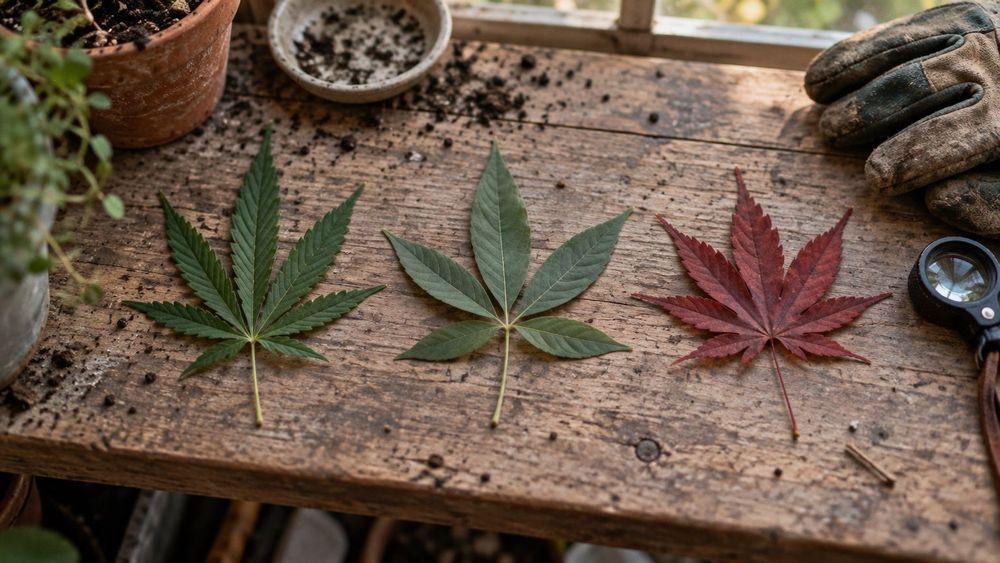
You spot a plant by a neighbor's fence, in a park or in a pot you just brought home from the garden center, and the leaves look a lot like the cannabis icon. What plant looks like weed but isn't? Quite a few: plants that look like weed turn up in yards, parks and nurseries all the time. Most of them give themselves away in under a minute once you know where to look: whether the leaf is made of separate leaflets or is one blade cut into lobes, whether every edge is toothed, whether the plant is a soft herb or something woody, and what its flowers look like.
The short answer: the most convincing lookalikes are chaste tree, spider flower (cleome) and Virginia creeper, because they really do have separate leaflets fanning out from one point, the way cannabis does. Kenaf, roselle, okra, Japanese maple, cassava and coral plant are the other six regulars on lookalike lists, and every one of them has a single leaf cut into lobes, which is the quickest tell of all. This guide gives you a four-feature key built from a University of Florida botanical guide, names each lookalike by species with the extension record behind it, flags the three that are poisonous, and explains why even a real cannabis plant can't be classed as hemp or marijuana by eye.
What a real cannabis leaf looks like
Start with the real thing. Botanists at the University of Florida's extension service (UF/IFAS), in a 2024 guide to cannabis plant identification and its look-alikes, describe the cannabis leaf as palmately compound: usually three to seven separate leaflets, sometimes up to eleven, all joined at the tip of one leaf stalk. Each leaflet is 3-18 cm (about 1 to 7 inches) long but only 0.3-3 cm wide, narrow with long-tapering tips, and its edges are coarsely toothed along both sides. Each one sits directly on that shared point with no stalk of its own, and has a clear midrib with side veins branching off it. The plant carrying those leaves is a soft-stemmed, upright, mostly hairy herb, from about 1 to 10 feet (0.3-3 m) tall.
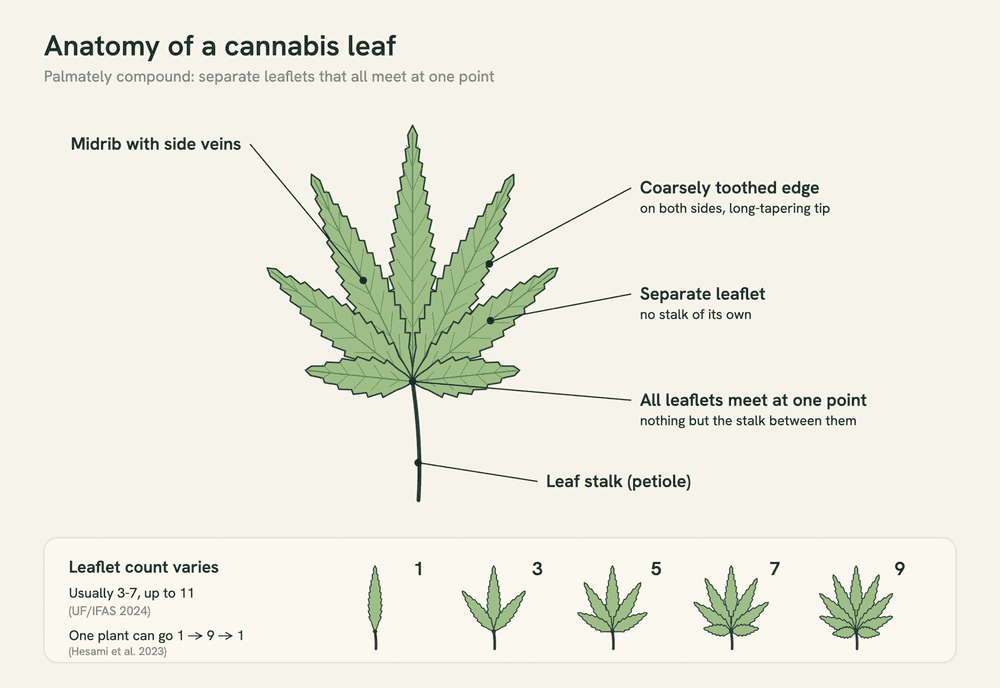
The famous seven-pointed icon is a real average, not a rule. Lyster Dewey, the USDA's fiber botanist, wrote in the 1913 Yearbook of the United States Department of Agriculture that hemp leaves are composed of 5 to 11 leaflets, usually 7. But the count changes along a single plant. In a 2023 study that followed one variety from seed to old age, 25 plants of one cultivar grown in a controlled growth chamber, the leaves went from a single leaflet to nine and back to one, and switched from paired to alternating at the twelfth node. So a seedling, or the top of a flowering plant, can show far fewer fingers than the icon. It also means leaf arrangement is not a useful test. You may read that cannabis leaves are always alternate on the stem; low on the plant they sit in opposite pairs, exactly like chaste tree and Japanese maple.
Flowers are the other half of the picture, and cannabis flowers are small and green, never showy. On male plants they hang in loose clusters up to about 7 inches (18 cm) long, whitish to yellow-green. On female plants they form shorter, tighter clusters in which each flower is wrapped in a tiny leaf-like bract 2-9 mm long. Our guide to male and female cannabis plants shows both side by side, and the cannabis plant anatomy explainer walks through the fan leaf, leaflets and bracts part by part. Keep the flowers in mind for everything below: several lookalikes carry big, colorful blooms that cannabis never has.
The four-feature check
UF/IFAS compared cannabis with 11 plants that share some of its features, such as serrated, palmately compound leaves, and concluded that "under careful scrutiny, differences do appear." The table below turns their comparison tables, plus NC State Extension's plant records, into four checks you run in order. For most plants, the first check is enough. Leaf arrangement is deliberately left out, for the reason above, and smell is a weaker bonus hint covered later.
| Check | Cannabis | Lookalikes that fail it |
|---|---|---|
| 1. Separate leaflets, or one leaf cut into lobes? | Separate, stalkless leaflets joined at one point (palmately compound) | Kenaf, roselle, okra, Japanese maple, cassava, coral plant: all one blade, lobed |
| 2. Is every leaflet regularly toothed along both edges? | Yes: coarsely toothed, with long-tapering tips | Chaste tree (mostly smooth-edged, gray underneath); Florida woodrose and mile-a-minute vines (smooth) |
| 3. Soft herb, woody shrub or tree, or climbing vine? | Soft, upright, hairy herb, roughly 1-10 ft tall | Chaste tree, Japanese maple, coral plant (woody); Virginia creeper and morning-glory vines (climb or twine) |
| 4. What do the flowers look like? | Small and green: loose hanging clusters (male) or tight, bract-wrapped clusters (female) | Kenaf, okra, roselle (big single hibiscus flowers); spider flower (pink or purple, spidery); chaste tree (lavender spikes); coral plant (coral-red clusters) |
| Bonus: smell | Resinous; skunky mainly when flowering | Chaste tree (menthol when bruised), spider flower (musky). A hint only, never proof |
One honest exception makes the key more useful, not less: spider flower passes the first three checks on its lower leaves most of the time. Its tells are a pair of small spines where each leaf joins the stem, single-blade leaves near the top of the plant, and its unmistakable flowers. More on it next.
The convincing ones: lookalikes with real leaflets
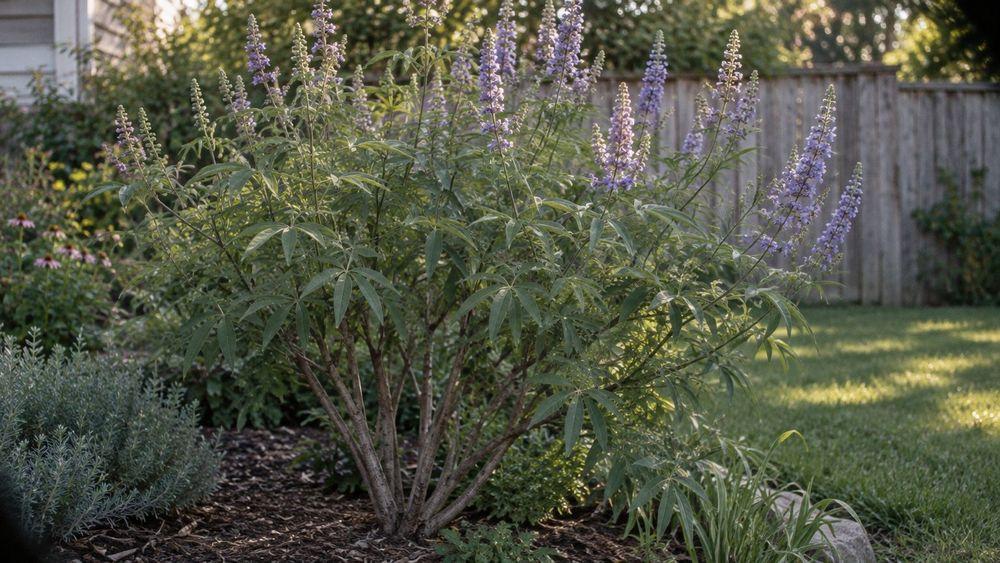
Chaste tree (Vitex agnus-castus) is the closest lookalike you'll find at a garden center, and the Missouri Botanical Garden's plant record lists "hemp tree" among its common names. It has the same hand of five to seven narrow, lance-shaped leaflets, each up to 6 inches long, and NC State Extension's profile counts up to nine. But it's a woody deciduous shrub or small tree, not a soft herb. NC State notes the leaflet undersides are gray and that the leaves give off a menthol fragrance when bruised. On the edges, the sources differ slightly: UF/IFAS lists the leaflets as not serrated, and NC State records the margins as entire to toothed, so expect mostly smooth edges rather than cannabis's regular saw teeth. From mid to late summer it carries loose spikes of lavender to pale violet flowers up to 12 inches long, which ends the question.
Spider flower (Cleome hassleriana, which NC State files as C. houtteana) is a true compound-leaf lookalike. NC State's spider flower record describes its lower and middle leaves as palmately compound with five to seven leaflets, 6 to 8 inches long, with hairs on both surfaces, and the plant has a musky odor that some people find offensive. Run your eye down the stem, though. There is a pair of small spines (spiny stipules) at the base of each leaf stalk, the leaves near the top are single, smaller blades, and the plant is sticky to the touch. The flowers settle it: pink, purple or occasionally white, with stamens about 3 inches long that give them their spidery look.
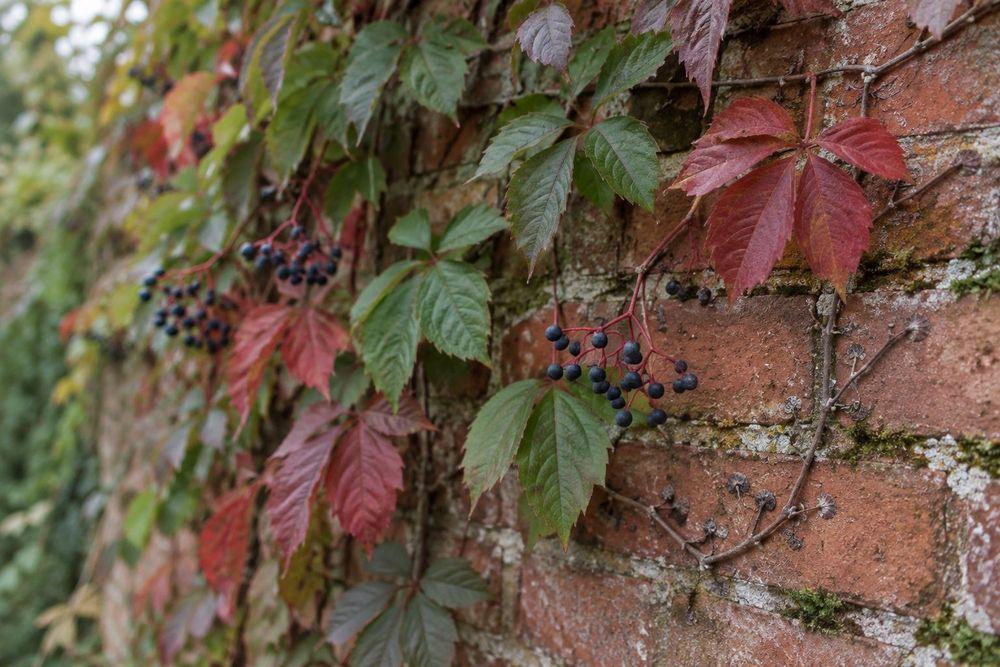
Virginia creeper (Parthenocissus quinquefolia) is the lookalike you're most likely to meet growing wild, because it's native across eastern North America. NC State Extension describes its leaves as palmately compound with usually five saw-toothed leaflets, each up to 6 inches long, so it passes the first two checks. It fails the third one badly: it's a woody vine that climbs 30 to 50 feet, holding on with tendrils that end in adhesive disks, little suction cups that stick to walls and bark. UF/IFAS adds that its leaflets are broad ovals rather than narrow blades. In fall it carries blue-black fleshy berries, which NC State rates as highly toxic if eaten (more on that below).
Six plants that look like weed but fail the first check
Kenaf (Hibiscus cannabinus) is the textbook lookalike, and its name makes the link explicit: its species name, cannabinus, comes from the Latin for hemp. In India it has been called deccan hemp, one of more than 129 common names listed in Purdue's NewCROP fact sheet on kenaf. It's a hibiscus grown for fiber. According to a USDA-ARS chapter on kenaf production, kenaf leaves are simple, with serrated edges, and the split-leaf varieties have deeply lobed leaves with 3, 5 or 7 lobes, which is where the resemblance comes from. But it's one leaf cut deep, not separate leaflets. Seedlings start with 3 to 10 plain, heart-shaped leaves before the first divided one appears, and there is a small nectar gland on the underside of the midrib. UF/IFAS adds that the teeth along the edges are irregular. Once it blooms, the flower ends the debate: light yellow or cream, 8 to 13 cm (about 3 to 5 inches) across, with a deep red or maroon center, borne one at a time.
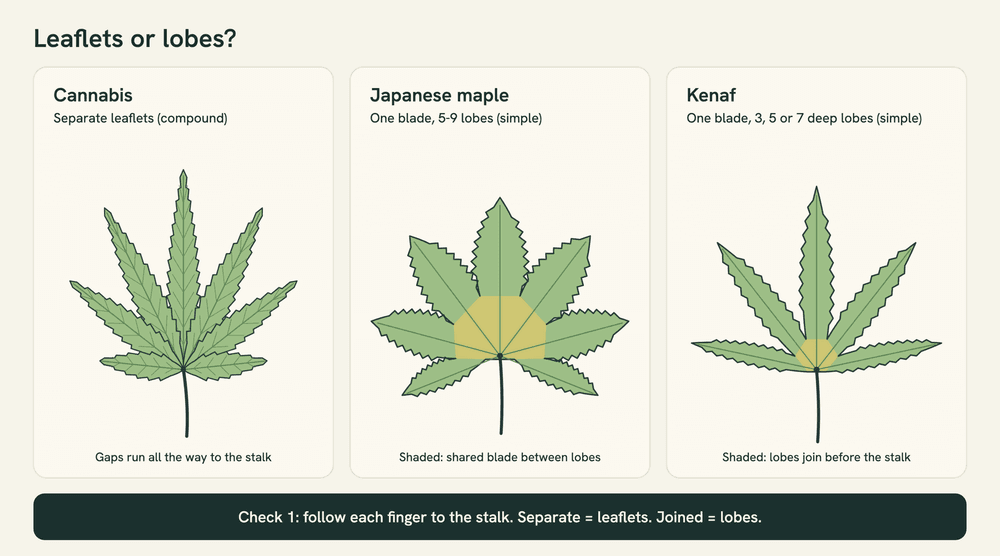
Kenaf's cousins in the mallow family repeat the trick. Roselle (Hibiscus sabdariffa), the hibiscus behind most hibiscus tea, has 3- to 7-lobed leaves, but UF/IFAS notes the lobes are broad and the leaf is not compound. Okra (Abelmoschus esculentus) has dark green, hairy leaves with five to seven lobes, per NC State's okra profile, and the same big hibiscus-like flower: 2 to 3 inches long, yellow with a purple center.
Japanese maple (Acer palmatum) has five to nine pointed, toothed fingers, and its species name even means shaped like a hand. NC State's Japanese maple record is explicit, though: the leaves are simple, 2 to 5 inches long, with five to nine lobes, most of them deeply cut. The lobes merge into one blade well before the leaf stalk, and the plant is a tree with woody twigs and small red-purple flowers. Cultivars range from broad lobes to very lacy, finely cut leaves, but every one is a single blade.
Cassava (Manihot esculenta) is a shrub up to about 10 feet with deeply lobed leaves, typically 3 to 7 parted, and NC State lists its leaf type as simple. Its flowers are inconspicuous, so the faster tell is the stem: a broken cassava stem bleeds milky sap, which cannabis does not. Coral plant (Jatropha multifida) has the most dramatic leaves of the group. The WHO's poisons information monograph on Jatropha multifida describes them as simple, palmately cut into 9 to 11 deep, narrow lobes, and up to a foot across. It's a shrub or small tree, commonly 3 to 7 feet tall, topped with clusters of small scarlet flowers that resemble a piece of coral.
Two more groups turn up in searches. In Florida, several morning-glory vines (hairy woodrose, mile-a-minute vine and noyau vine) have five-part or deeply lobed leaves, but they twine, their leaflets are smooth-edged, and their flowers are large and single. And sweetfern (Comptonia peregrina) appears on many lookalike lists even though NC State describes its leaves as simple, narrow and deeply notched: one strap-shaped leaf, not a hand of leaflets. If you remember one tell per plant from this section, make it these:
- Kenaf: one deeply lobed leaf, plain heart-shaped seedling leaves, and a big cream flower with a maroon center.
- Roselle: broad lobes on a single leaf, and large single flowers.
- Okra: hairy lobed leaves and a yellow hibiscus-like flower with a purple center.
- Japanese maple: lobes that merge into one blade, on a woody tree.
- Cassava: milky sap from a broken stem.
- Coral plant: 9 to 11 narrow lobes on a leaf up to a foot wide, and coral-red flower clusters.
Three lookalikes you should never taste
Three of the plants above are poisonous, which is a better reason than any to leave an unidentified plant alone. The WHO monograph treats every part of coral plant as toxic, the seeds most of all. Its main toxin, curcin, is a protein the monograph describes as similar to ricin, and it notes that children are more susceptible. The symptoms it describes begin with abdominal pain and a burning throat, followed by nausea, vomiting and diarrhea. Two Israeli emergency teams have published cases: two children hospitalized for five days with intractable vomiting after eating a large amount of the fruit, which the authors note attracts children by its shape and color, and four siblings with vomiting, diarrhea and pinpoint pupils. These are case reports, not a measure of how common poisoning is. Cassava roots are a staple food only after proper preparation and cooking: raw, NC State rates the roots and peelings highly toxic because of cyanogenic glycosides, compounds that can release cyanide. And Virginia creeper's blue-black berries carry a "High" poison severity rating from NC State, with a warning that eating the fruit may be fatal.
Smell as a second test, and its limits
Crushed cannabis has a smell most people recognize, but the famous skunk note is not present in every plant at every stage. An analysis of 13 cannabis cultivars in ACS Omega in 2021 traced the skunky smell mostly to one sulfur compound, 3-methyl-2-butene-1-thiol, and in the authors' small grow it was not detected until the seventh week of flowering. (The authors work for a company that holds related patents, and they measured flowers, not leaves.) So a young, leafy plant can smell green and resinous rather than skunky. Our explainer on why weed smells like skunk covers that chemistry in full.
Some lookalikes have strong smells of their own: chaste tree's bruised leaves smell of menthol, spider flower has a musky odor, and sweetfern is very fragrant when crushed. None of those is the cannabis smell. The overlap runs the other way with hops, cannabis's closest relative: in a study of three hop cultivars, myrcene, beta-caryophyllene and humulene were the main aroma compounds in all of them, and all three are familiar cannabis terpenes. Read how hops and weed are related and the difference between cannabinoids and terpenes for why some beers smell faintly of cannabis.
Smell is a hint, not proof, and it says nothing about strength. THC itself is nonvolatile and has no smell. In a 2018 PLOS One study of 61 cannabis buyers, smell-based potency ratings did not match the measured THC. And in a 2025 Oregon State sensory study, hemp-type (CBD) and THC-type flower had overlapping aroma profiles. Both studies were small, but they point the same way: your nose can suggest cannabis, not confirm it, and certainly not rate it.
When the mix-up reached the police
Lookalikes have stumped trained eyes too, and the best-known case is usually retold wrongly online. In early October 2014, a helicopter crew from the Governor's Task Force for Drug Suppression flagged plants at a retiree's home in Cartersville, Georgia (Bartow County), and deputies arrived with a K-9. The homeowner told reporters it was okra. The story went viral as police mistaking okra for pot, but the Georgia State Patrol said the plant it flagged was not the okra. Capt. Kermit Stokes told Patch the plant "had enough similar characteristics that the aircrew could not positively identify the plant from altitude," adding that he might have to get with a botanist and that "even cannabis has a lot of variation." He later told CBS News, "We've not been able to identify it as of yet." In the reports we found, the plant was never publicly identified.
The second case is told here as allegations, because we could not read the court file. In October 2017, police in Buffalo Township, Butler County, Pennsylvania, seized hibiscus plants from a couple in their 60s as suspected marijuana, acting on photos taken by an insurance agent. The couple were released without charge and later sued in Butler County Court. Their complaint, as quoted by Reason in November 2017, alleges the agent "intentionally photographed the flowering hibiscus plants in such a manner as not to reveal that they had flowers on them." A police report quoted in the same piece described "tall, green, leafy, suspected marijuana plants." We could not verify how the case ended. A Carnegie Museum botanist quoted in the same piece put the giveaway simply:
“The hibiscus flowers are large and brightly colored, compared to the small nothings that grow on marijuana plants.”
The lesson of both cases is the lesson of the key. Leaves seen from a distance, or in a photo cropped to hide the flowers, are the weakest evidence there is. Flowers, growth form and a close look at where the leaflets meet settle what a helicopter or a photo can't. If you want the legal side of how officers use sight and smell, see our explainer on whether the smell of weed is probable cause.
Even real cannabis can't be classed by looking
Suppose your plant passes all four checks: separate, toothed leaflets, a soft hairy herb, small green flowers. It is probably cannabis, which the USDA PLANTS database lists as an introduced annual herb in the lower 48 states. What its looks can't tell you is whether it's legal hemp or marijuana. USDA's economists wrote in a 2000 report on industrial hemp in the United States that the two are indistinguishable by appearance and that, short of chemical analysis of the THC content, there was no way to tell them apart. UF/IFAS says the same today: the legal definition requires a lab test of the THC level once a plant is identified as cannabis. Our hemp vs marijuana guide explains where that line sits, and the ditch weed explainer covers the feral hemp that still grows along Midwest roadsides, which is the real cannabis most people actually stumble on.
The reverse matters too. None of the nine lookalikes in this guide makes THC or CBD, so looking like cannabis and containing cannabinoids are separate questions. The short list of plants that share some of the chemistry, rather than the leaves, is in our guide to plants that contain cannabinoids.
Frequently asked questions
Chaste tree, spider flower (cleome) and Virginia creeper, because like cannabis they have separate leaflets fanning out from one point. Each one fails a later check: chaste tree is a woody shrub with mostly smooth, gray-backed leaflets and lavender flower spikes; spider flower has a pair of spines at each leaf base and spidery pink or purple flowers; Virginia creeper is a climbing vine with tendrils and broad leaflets.
At a glance, a little: it has five to nine pointed, toothed fingers. But NC State Extension classes the leaf as simple, meaning the fingers are lobes of one blade that merge before the leaf stalk, not separate leaflets. It is also a woody tree, while cannabis is a soft herb.
No. Kenaf (Hibiscus cannabinus) is a hibiscus in the mallow family, grown for fiber, and one of its many common names is deccan hemp. Its leaves are simple and deeply lobed, its flowers are large cream hibiscus blooms with a maroon center, and it does not make THC or CBD.
No. Cleome, or spider flower, belongs to a different plant family. Its lower leaves are compound with five to seven hairy leaflets, which is why it gets confused with cannabis, but it has a pair of small spines where each leaf joins the stem, single-blade leaves near the top, sticky stems and showy pink, purple or white flowers with long stamens.
Usually three to seven, and up to eleven, according to the University of Florida's 2024 identification guide. The USDA's 1913 description said 5 to 11, usually 7, which is where the icon comes from. The count also changes along a single plant: in a 2023 study the leaves went from one leaflet to nine and back to one as the plants aged, so a low count does not rule cannabis out.
No. None of the lookalikes in this guide makes THC or CBD, and several are poisonous: coral plant, raw cassava root and Virginia creeper berries. Never eat, smoke or brew an unidentified plant. If someone already has, call Poison Help at 1-800-222-1222 and keep a sample of the plant.
Most cannabis found growing wild in the US is feral hemp, often called ditch weed, on roadsides and field edges, especially in the Midwest. It looks like any cannabis plant: separate, toothed leaflets on a tall, soft herb with small green flowers. Its looks cannot tell you its THC content; only a lab test can.
If this page started as "is that weed?" and left you wondering what actually sets cannabis apart from its lookalikes, the honest answer is chemistry, not leaves. Our guide to what cannabinoids are is the place to start.
Writing about hemp, wellness and the small rituals that keep us balanced.