What Does a Weed Pen Look Like? 5 Types, and How to Tell THC From Nicotine
A weed pen is a small battery vaporizer for cannabis oil, wax or flower, and most look almost exactly like a nicotine vape. Here are the five common types, every THC-vs-nicotine tell rated by what it can prove, and what to do if you find one.
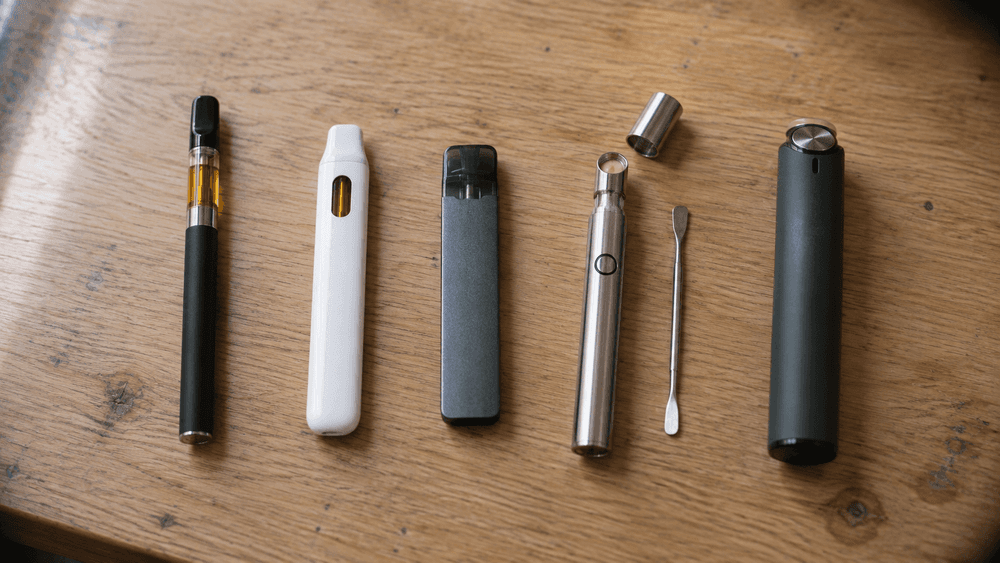
A weed pen is a small, battery-powered vaporizer for cannabis: it heats an oil, a wax or ground flower so you can inhale it without burning it. Most are the size of a marker or a USB stick, and most look almost exactly like a nicotine vape, because they are built from the same parts.
People ask what a weed pen looks like for two reasons. You may have heard the term and want to know what the thing actually is. Or you may have found a device in a car, a laundry pile or a teenager's backpack and want to know whether it holds nicotine or THC. The honest short answer to the second question is that no single look settles it. The package label is the best tell, because legal nicotine products and licensed cannabis products both carry required wording. The oil in the window is a fair tell. The shape, the threads and the brand name are the weakest. This guide walks through the five common types of weed pen, rates every popular tell by what it can and can't prove, and ends with what to do if you've found one.
What is a weed pen?
"Weed pen" is slang, not a product category. It covers any pocket-size vaporizer used for cannabis, and its parts are the same ones the National Institute on Drug Abuse lists for vaping devices: a cartridge, reservoir or pod that holds the material, a heating element (the atomizer), a power source, usually a rechargeable battery, and a mouthpiece. Press a button or draw on the mouthpiece and the battery heats the coil, which turns the contents into an aerosol you inhale. Nicotine e-cigarettes work the same way. The FDA's page on e-cigarettes and other electronic nicotine delivery systems notes that some "resemble pens or USB flash drives," that larger tank systems and mods look nothing like cigarettes, and that devices can be reusable or disposable. Cannabis devices come in the same range. If you want the battery half in detail, including button versus auto-draw and how a cartridge screws on, our guide to the 510 battery covers it.
“Regardless of their design and appearance, these devices generally operate in a similar manner and are made of similar components.”
That isn't just theory. In a 2014 survey of 3,847 Connecticut high-school students published in Pediatrics, 18% of those who had ever used an e-cigarette said they had used one to vaporize cannabis. The data are more than a decade old, come from one state and predate the pod era, but the point holds: the hardware doesn't tell you what was in it. A device sold for nicotine can end up holding cannabis, and a cannabis cartridge can sit on a battery that looks like any other vape.
What does a weed pen look like? The 5 common types
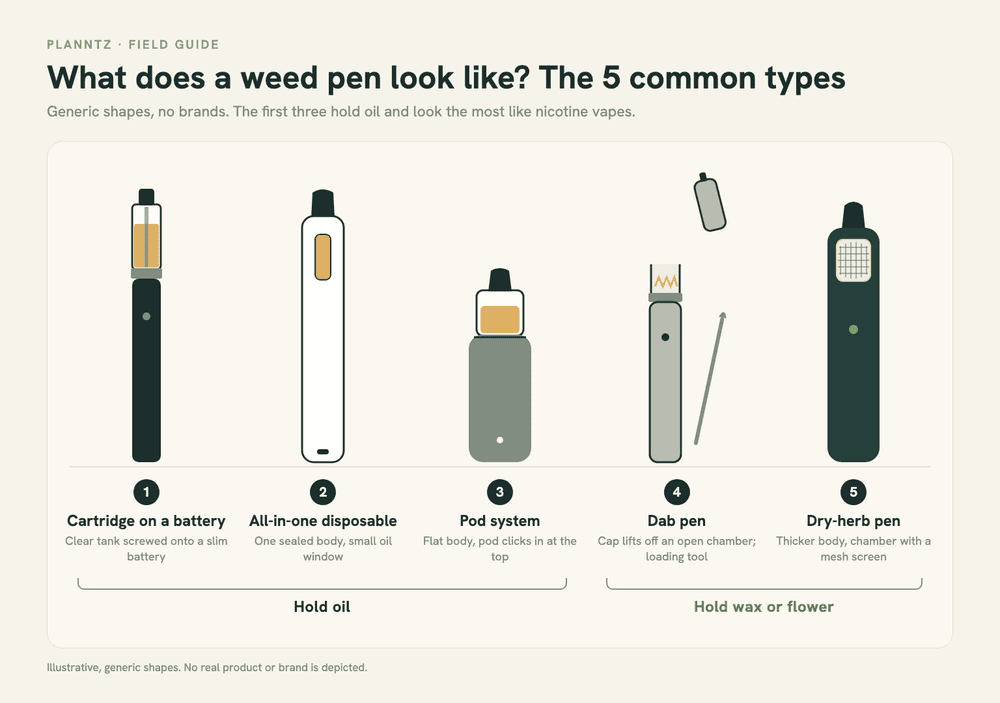
Almost every weed pen falls into one of five shapes. The first three hold an oil and look the most like nicotine vapes. The last two are built for solid material and look a little different once you open them. Here is what you'll see, what goes in each one and what people usually call it.
| Type | What you see | What goes in it | Usually called |
|---|---|---|---|
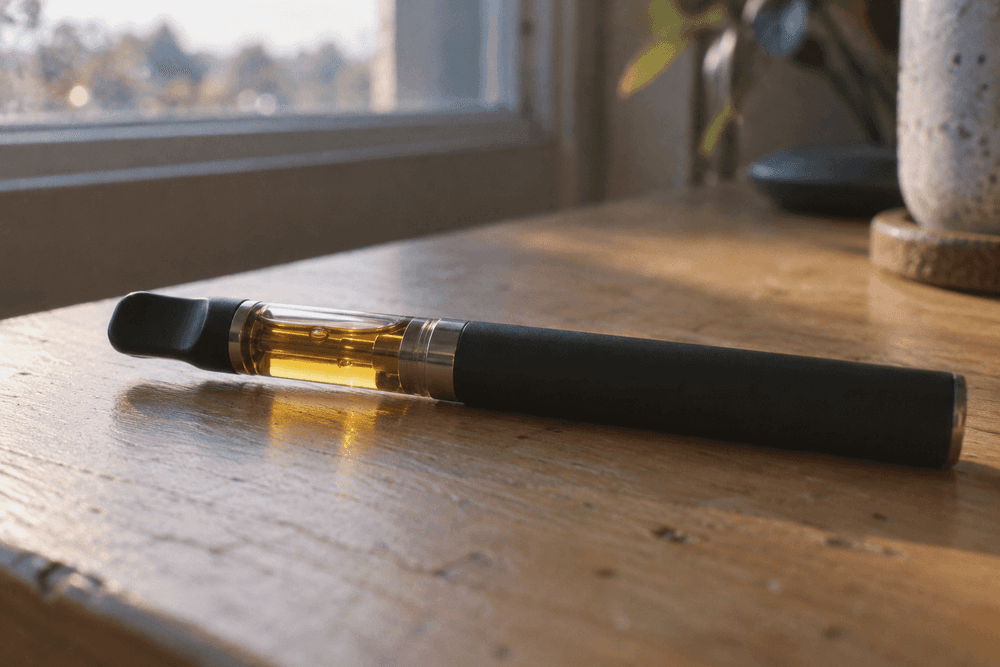
| Cartridge on a battery | A slim cylinder battery, often the size of a marker, with a short clear tank screwed on top. The oil shows through the tank walls, and the tank ends in a mouthpiece. | A pre-filled cartridge of cannabis oil, usually amber to gold | Cart, vape cart, 510 cart, weed pen |
| All-in-one disposable | One sealed body with no threads or removable parts, usually a small window showing the oil, often a charging port at the base | Cannabis oil sealed in at the factory; the whole device is thrown away when empty | Disposable, dispo, all-in-one |
| Pod system | A flat or oblong body, about the size of a USB stick or lighter, with a pod that clicks into the top. The same form as many nicotine pod vapes. | A pre-filled pod of cannabis oil, made to fit one maker's battery | Pod, pod vape |
| Dab pen | A pen-size battery with a cap or mouthpiece that lifts off to show an open chamber or a bare coil, with no pre-filled tank. Often comes with a small metal loading tool. | Wax, shatter or another cannabis concentrate, loaded by hand | Dab pen, wax pen, concentrate pen |
| Dry-herb pen | Usually thicker and heavier than an oil pen, with a small oven or chamber at one end, often behind a mesh screen | Ground cannabis flower | Dry-herb vape, herb pen, portable vaporizer |
A few notes on the table. The dab pen row is there so you can recognize one: a concentrate is an extract of the plant rather than the flower itself, and our comparison of dabs and flower explains what that changes. A dry-herb pen heats the plant material directly, with no extract involved; how that differs from lighting it is covered in dry-herb vaporizer vs smoking. And the list isn't closed. Larger box-shaped devices and tank systems exist for both nicotine and cannabis, and, as the FDA puts it, some of them bear little or no resemblance to a cigarette at all. If you're holding something bigger than a pen, it can still be either.
What does a THC vape look like up close?
Most THC vapes you'll come across are a cartridge on a battery or an all-in-one disposable, and both usually have a window. Look through it. Cannabis oil is usually amber to gold, though highly refined distillate can be pale and nearly clear, and it is thick: tip the device and an air bubble in the oil tends to creep rather than shoot to the top. Nicotine e-liquid, which the FDA describes as usually nicotine plus flavorings, propylene glycol and vegetable glycerin, is typically thinner and is often clear or lightly tinted. That contrast is real but rough, and the next section explains where it fails. For what's actually in a cartridge and how much THC a typical one holds, see how long a cart lasts.
The window is a fair tell. In two states, the hardware itself carries a better one. California's rules say a cannabis vape cartridge or integrated cannabis vaporizer must bear the state's universal symbol, at least a quarter inch by a quarter inch, engraved, printed or on a sticker (the current wording dates from an amendment effective November 7, 2022). Colorado's marijuana labeling rule sets the same quarter-inch minimum for its Universal Symbol on a vaporizer delivery device, and requires the container to say "Not approved by the FDA" and to list every ingredient, additives included. On the box, California requires a concentrate package without serving designations to state THC and CBD in milligrams per package. That's two states, not fifty. Other states write their own rules, and hemp-derived or illicit THC vapes sold outside state cannabis markets may carry none of this, so a missing symbol doesn't rule THC out.
Put together, here is what to check on a device in your hand, without opening, heating or inhaling anything:
- The window: thick amber-to-gold oil that moves slowly points toward cannabis; a thin, clear liquid points toward a nicotine e-liquid.
- The hardware: in California and Colorado, a licensed cartridge or all-in-one carries the state's cannabis symbol, at least a quarter inch square.
- The threads: a screw-on cart usually uses 510 threading, but 510 is a thread size, not a substance, and many nicotine devices use it too.
- The box, if there is one: a state cannabis symbol, a THC amount in milligrams, or the federal nicotine warning.
- The logo: brand names on carts and boxes are often copied, so treat a logo as a claim, not a fact.
THC vape vs nicotine vape: every tell, rated
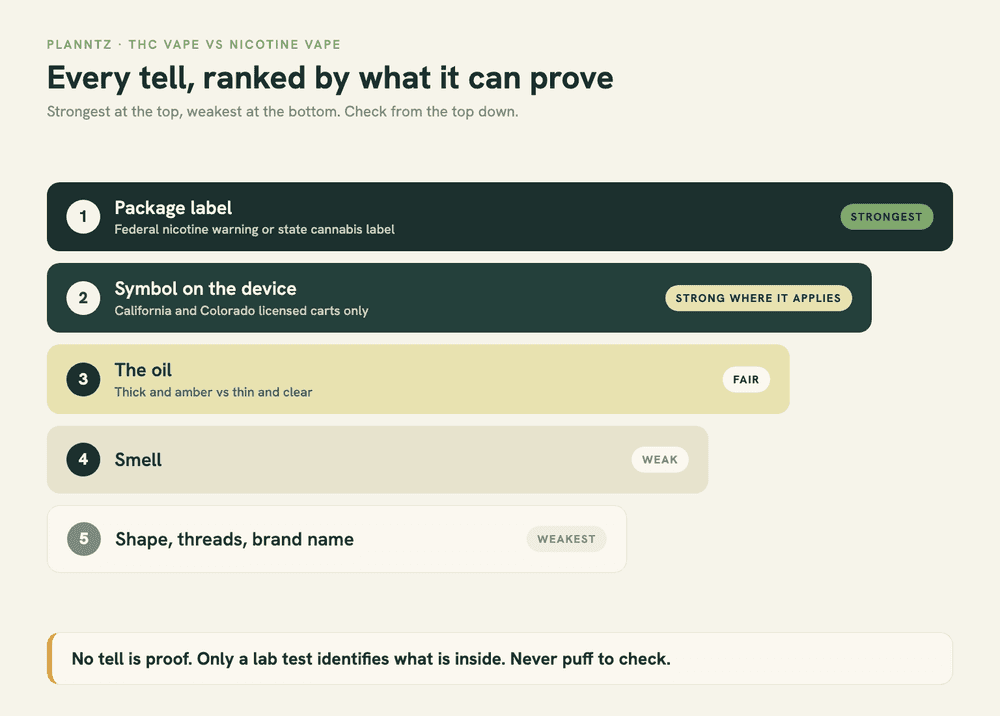
Vape-shop pages tend to list these tells as if each one settles the question. None does on its own, so the table below ranks them by what each can actually show. The strongest is the label, because a legal nicotine vape must carry one exact sentence under federal rule 21 CFR 1143.3: "WARNING: This product contains nicotine. Nicotine is an addictive chemical." It has to cover at least 30% of each of the package's two principal display panels, in type no smaller than 12 point. There is a catch you may run into: the warning belongs on the package, not the device, and if a package is too small for it, the rule lets it go on the carton or outer container, or on a tag fixed to the package, instead. So a loose pod or disposable out of its box can legitimately show no warning at all. (Tobacco products certified to FDA as containing no nicotine carry a different line: "This product is made from tobacco.")
The oil comes second, and its limits are well documented. Analyzing illicit cartridges in 2019, New York State's public-health laboratory noted that diluents such as glycerol, propylene glycol and MCT oil leave a cut product too thin to pass as pure cannabis oil. Thickeners were the workaround: the same team wrote that by eye it is "nearly impossible to distinguish" a cartridge of high-grade cannabis oil from one heavily cut with vitamin E acetate. Thin oil is a fair hint. Thick oil proves much less.
| Tell | Points to nicotine | Points to THC | What it can't prove | Strength |
|---|---|---|---|---|
| Package label | The federal nicotine warning on at least 30% of the two main panels | A state cannabis symbol, THC and CBD in mg; in Colorado, "Not approved by the FDA" and a full ingredient list | Boxes are counterfeited; a small nicotine package may move the warning to a carton or tag | Strongest |
| Symbol on the device | No federal device marking | In California and Colorado, the state symbol on the cart or all-in-one, at least 1/4 inch | Covers only those states' licensed products; a symbol can be copied | Strong where it applies |
| The oil | Thin, fast-moving liquid, often clear or lightly tinted | Thick, slow-moving oil, usually amber to gold | Cut THC oil can run thin; thickened oil looks pure; distillate can be pale | Fair |
| Smell | Sweet or fruity flavoring, sometimes menthol | An herbal, skunky or piney note | Flavored THC oils and terpene-flavored liquids blur the line; vapor smell fades fast | Weak |
| Shape and threads | Pens, pods and disposables are all common | Pens, pods and disposables are all common | Both kinds use the same parts and shapes; 510 threads fit either | Weakest |
| Brand name | A known nicotine brand | A known cannabis brand | Packaging and logos are copied | Weakest |
Two cautions about the bottom rows. A brand name on a cart is only as trustworthy as the packaging, and counterfeit cannabis packaging is common enough that we wrote a separate guide to spotting a fake cart. The contents can also be something else entirely. In 2025, UK researchers analyzed seven disposable vapes one person had bought as cannabis: all seven contained a synthetic cannabinoid and no other active drug, the devices closely resembled regulated vaping products, and nothing on the labeling or packaging gave it away. Seven devices from one buyer in another country is not a market survey, but it shows the ceiling on every tell in this table. As for smell, the cannabis note comes from volatile aroma compounds explained in why weed smells like skunk, and a vape's smell tends to be fainter and to fade faster than smoke's, which is why the nose is a weak judge here. A harsh, burnt smell usually says more about the hardware than the contents; why a cart tastes burnt covers that.
Why it matters which one it is
The two substances carry different risks and different rules. Nicotine's own warning label states the main one: it's addictive. Since December 20, 2019, federal law has barred retailers from selling any tobacco product, e-cigarettes included, to anyone under 21. THC is the main compound in cannabis that causes the high, a cart or disposable holds it as a concentrated oil, and THC or its breakdown products are what a cannabis drug test looks for. How much THC a typical cart holds is covered in the cart-lifespan guide linked above, so it isn't repeated here.
For context on young people, the 2025 Monitoring the Future survey, which surveyed 23,726 students in 270 schools between February and June 2025, found that 9% of 8th graders, 14% of 10th graders and 20% of 12th graders reported vaping nicotine in the past 12 months. For cannabis in any form, the past-12-month figures were 8%, 16% and 26%. NIDA's release does not break out how many students vaped cannabis, so it can't tell you what share of teens use a weed pen, and any page that gives you that number from this survey is guessing.
It also matters because of 2019. That year an outbreak of lung injury tied to vaping, which CDC named EVALI (e-cigarette or vaping product use-associated lung injury), reached 2,807 hospitalized cases or deaths, including 68 deaths, before CDC stopped collecting state data in February 2020. Of the 2,022 hospitalized patients who reported what they had used, 82% named THC-containing products and 33% said they had used only THC products, while 14% said they had used only nicotine products. CDC tied most cases to THC products from informal sources such as friends, family or dealers, called vitamin E acetate "strongly linked" to the outbreak, and said the evidence was not sufficient to rule out other chemicals. In a CDC-led study in the New England Journal of Medicine, investigators found vitamin E acetate in fluid washed from the lungs of 48 of 51 EVALI patients in 16 states and in none of 99 healthy comparison participants; the authors called it an association in a convenience sample. EVALI was tied mainly to THC products from informal sources, not to every THC pen, and the 14% who used only nicotine are a reminder it was never purely a cannabis story.
Found a vape? What to do
If you've found a device and don't know whose it is or what's in it, you don't need to identify it perfectly to handle it well. The EPA's guidance on disposing of e-cigarettes is written for nicotine devices, but a cannabis vape runs on the same kind of lithium battery, so the same logic applies. The FDA's tips on avoiding vape battery fires say incidents appear uncommon, but advise keeping vapes away from extreme temperatures and charging them on a clean, flat surface, never a couch or pillow; the 510 battery guide's safety section goes further. If the device belongs to a teenager, NIDA keeps a short set of conversation starters for parents, and SAMHSA's "Talk. They Hear You." campaign is another resource many parents use.
- 1Don't use it, and don't take a test puff. You can't know where a loose or unbranded cart came from or what is in it.
- 2Look for a box, label or sticker first: the federal nicotine warning, a state cannabis symbol, or a THC amount in milligrams.
- 3Check the window without opening anything. Note the color and how thick the oil looks, and treat it as a hint, not proof.
- 4Store it somewhere cool, dry and flat, away from heat and soft furniture, and don't charge it.
- 5To get rid of it, keep it out of the household trash and recycling, where a damaged lithium battery can start a fire. Take it to a household hazardous waste collection site.
- 6If it belongs to a teenager, aim for a conversation, not a search or a verdict about what's inside.
- 7If someone is unwell after vaping, get medical help first. Identifying the device can wait.

What no visual check can tell you
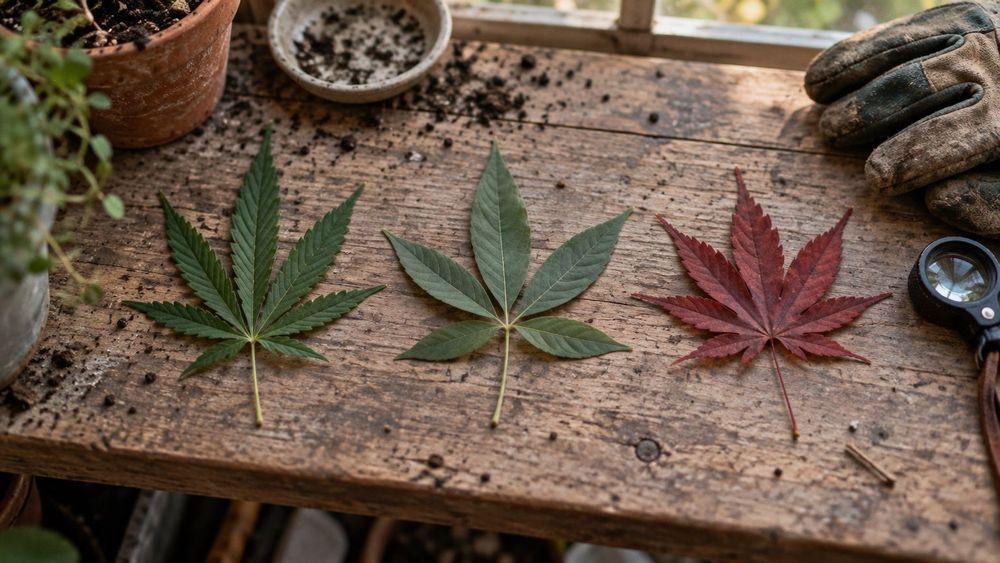
Every tell on this page has a ceiling. State symbols cover licensed products in the states that require them, while hemp-derived THC vapes and illicit products may be sold outside those systems with no state symbol at all. Boxes and logos can be copied. Cut oil can look exactly like pure oil, as New York's lab found, and a device can hold a drug that isn't cannabis, as the UK samples showed. Only a laboratory analysis identifies what is in a cartridge. Home test strips are sometimes offered as a shortcut; what they can and can't detect is covered in how to tell if weed is laced. And if your question started one step earlier, with a plant in the yard rather than a device in a drawer, the same lesson about looks applies in our guide to plants that look like weed.
Frequently asked questions
Usually one of two things: a slim battery with a short, clear cartridge screwed on top, or a one-piece disposable with a small window. Through the window you'll typically see thick oil, amber to gold, though refined distillate can be pale. In California and Colorado, a licensed cartridge or all-in-one must also carry the state's cannabis symbol on the device, at least a quarter inch square.
Not reliably. The package label is the best tell: legal nicotine products carry the federal warning "This product contains nicotine. Nicotine is an addictive chemical," and licensed cannabis products carry state labels. Thick amber oil points toward cannabis and thin clear liquid toward nicotine e-liquid, but cut oils fool the eye. The shape tells you almost nothing, because both kinds are built from the same parts. Only a lab test is proof.
About the size of a cartridge vape, but with no pre-filled tank. Lift the cap or mouthpiece and you'll see an open chamber or a bare coil where wax or another cannabis concentrate is loaded by hand, often with a small metal tool that comes with the pen.
Less than a joint, and the smell tends to fade faster. Some people notice an herbal or skunky note near the mouthpiece or in the room, but flavored THC oils and fruity nicotine liquids blur the difference, so smell is one of the weakest ways to identify a vape.
Usually amber to gold, and thick enough that an air bubble moves slowly when you tip the cart. Highly refined distillate can be pale or nearly clear, and some products are flavored or tinted, so color alone can't confirm what's inside.
The hardware is similar enough that people do it. In a 2014 survey of Connecticut high-school students, 18% of those who had ever used an e-cigarette said they had used one to vaporize cannabis. That's why the device alone can't tell you what was in it.
"Vape pen" is the general word for a pen-shaped vaporizer, and "weed pen" means one used for cannabis. They share the same parts (a tank or pod, a heating element, a battery and a mouthpiece). What differs is what's inside.
Not in the household trash or recycling: the EPA warns that a damaged lithium battery can start a fire. Take it to a household hazardous waste collection site, whatever was in it.
If what you found turns out to be a cannabis cart, the next useful question is whether it's genuine. Our walkthrough on how to tell if a cart is fake covers packaging, the oil and the 2019 investigations in depth. And if what you were really after is a non-intoxicating cannabis product you can check against a lab report, start with how to choose a CBD oil.
Writing about hemp, wellness and the small rituals that keep us balanced.