What Is a 510 Battery? Thread, Voltage Dial and Safety Rules
A 510 battery is the small lithium-ion power stick most cannabis carts screw into. What the number really refers to, what a voltage dial changes at a coil it cannot see, why "universal" is not a promise, and the FDA and FAA rules for charging and flying.

A 510 battery is the small, rechargeable lithium-ion power stick that most cannabis vape carts screw into. "510" names the screw thread that joins the two, and it is an industry convention, not a published standard. The battery sends power to a coil inside the cart. It cannot see that coil, test the oil or tell you whether it is being charged safely. The handling rules that matter come from FDA and FAA, not from the box.
If you searched what is a 510 battery or what is a 510 thread, you are probably holding one and wondering whether a cart will fit, what the dial on the bottom does, and whether it is fine to charge it by the bed or pack it for a flight. The pages that rank for those questions, as we read them in November 2026, are almost all written by companies that sell batteries or carts. They define the device, repeat the same explanation of the number, and end with a product. None we read checks that explanation against a document, and none gives the federal rules for charging one or taking it on a plane. This guide does both. It does not recommend a device, a brand or a setting, and it is not a guide to vaping. Planntz does not sell vape hardware or carts.
What is a 510 battery, and what is a 510 thread?
A 510 battery is a pen-shaped battery with a threaded metal collar on top. A cart, short for cartridge, is a small tank of oil with a heating coil at its base; it screws onto the collar, and when the battery fires, the coil heats the oil. "510" strictly names the thread, but people use it loosely for any battery that has one. It is easy to confuse with 710, which is "OIL" upside down and has nothing to do with the thread; our 710 and concentrate glossary covers that side of the vocabulary.
Almost every page that ranks repeats that 510 means a thread 5 millimeters wide with 10 threads. We could not find a document behind that. The closest technical record we found is a 2023 US patent for a push-on cartridge connector, granted March 28, 2023, whose background section describes the 510 thread as "10 threads at 0.5 mm per thread with an M7 threading." M7 is the metric label for a thread about 7 millimeters across. Read that way, "510" is closer to "10 threads at 0.5 mm" than to "5 mm." Two caveats keep this honest: a patent applicant's description is not a standard, and the company that filed this one sells a connector designed to replace the screw thread.
The number also matches one of the first mass-market e-cigarettes, Joyetech's Joye 510. The Joye 510 user manual tells owners to "screw the threaded side of the battery to the usb charger," the same habit many 510 pen batteries keep today. The manual never explains the number. Vendor histories say the connector was named after the product; we found no primary record that says so, so the accurate wording is that the thread shares its name with it.
| The claim | Where it comes from | What backs it |
|---|---|---|
| 5 mm diameter, 10 threads | Seller and dispensary guides on page one | No document cited by any of them |
| M7 thread (about 7 mm), 10 threads at 0.5 mm | US Patent 11,612,703, granted March 28, 2023 | A patent applicant's description, not a standard; the applicant sells a competing connector |
| The Joye 510 e-cigarette | Joyetech's own user manual | Confirms a product with that name; does not say why it was named or that the thread was named after it |
We also looked for a formal definition. A full-text search of Europe PMC on November 9, 2026 for "510 thread" and its variants returned 29 papers that use the term; none defines the number. ASTM has a subcommittee for cannabis devices (D37.08), but we found no published connector standard from it. So "510" is best read as an industry convention, not a published standard. That matters later on this page: when nobody publishes the spec, fit is something you check, not something you assume.
The parts: thread, center pin, cell and switch
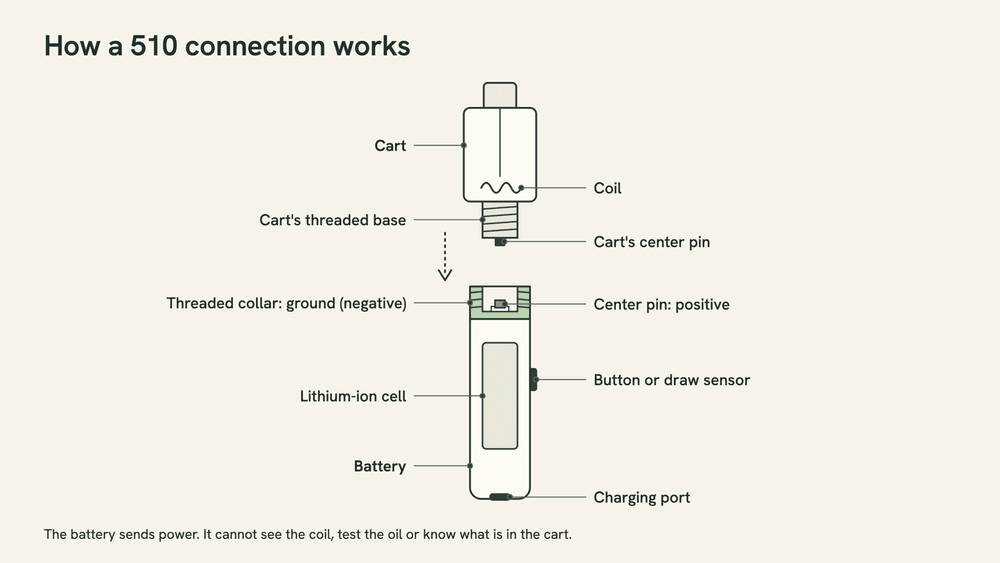
Strip away the casing and a 510 battery comes down to a handful of parts:
- Threaded collar: the metal ring the cart screws into. In the circuit it is the ground (negative) side, as the 2023 patent describes it.
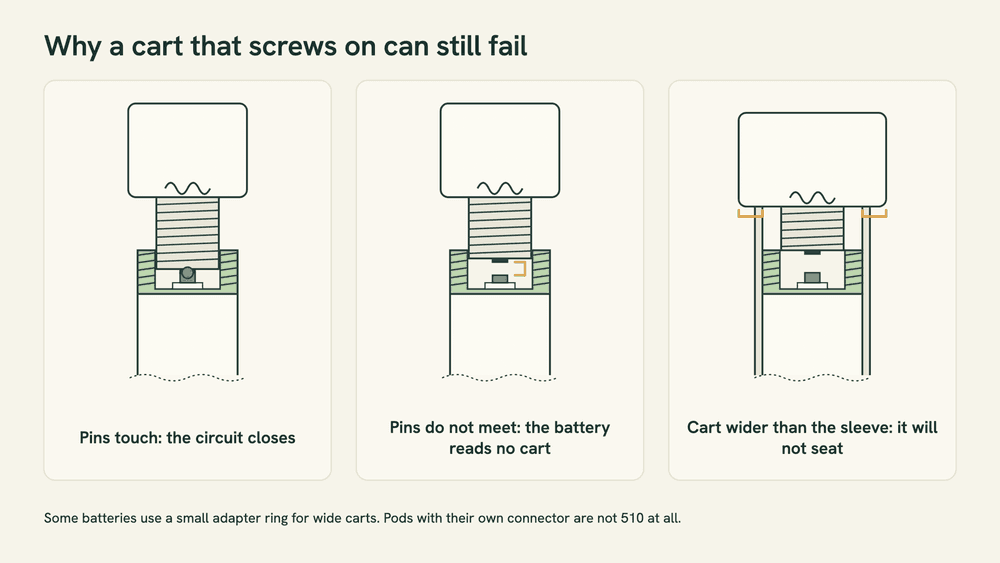
- Center pin: the small contact in the middle of the collar. It touches the cart's own pin and carries the positive side. If the two pins do not meet, the battery acts as if no cart is there.
- Lithium-ion cell: the rechargeable battery that fills most of the stick. This is the part the FDA and FAA rules below are about.
- Switch or sensor: a button you press, or a sensor that fires the coil when you inhale.
- Control board and light: the small circuit that handles power-on, cutoffs and the indicator light. What it actually protects against depends on the maker.
- Charging point: a USB port on the body or, on older designs, the thread itself, which screws into a small USB charger.
Two scientists at FDA's Center for Tobacco Products mapped this design in a 2014 review of e-cigarette patents and literature, written about nicotine e-cigarettes before cannabis carts were common. They described the heating cycle as "initiated by single or multiple sensor responses and/or the use of a button," with sensors that may be pressure, acoustic, touch and other types. They listed multi-click power-on, auto shutoff and short-circuit protection as features manufacturers advertised; the review did not test them. And they described the cell's best-known failure: poor design, low-quality materials, manufacturing defects and improper handling "can all contribute to a condition known as 'thermal runaway'," in which the battery heats itself to the point of fire or even explosion.
The same battery-handle idea shows up on other devices too. Electric versions of the concentrate straw in our guide to nectar collectors use a battery handle to heat a tip, and the same lithium-ion handling rules apply to them.
Button, auto-draw and the multi-click lock
510 batteries fire in one of two ways. An auto-draw (draw-activated) battery has a sensor that fires the coil when it detects you inhaling; there is nothing to press. A button battery fires only while you hold the button down. Most button batteries also need a set number of quick presses to switch on or off. Seller instructions often say five, but the count and the meaning of each sequence vary by maker, so the manual for your battery is the only reliable source. That on-off sequence is the 2014 FDA review's "multiple-button click-on feature," and it matters most when the battery is in a pocket or a bag.
| Type | How it fires | What can fire it by accident | How to keep it from firing in a bag |
|---|---|---|---|
| Button | You hold a button while you draw | The button getting pressed in a pocket or bag while the battery is switched on | Switch it off with the maker's click sequence; unscrew the cart; keep it in a protective case |
| Auto-draw | A sensor reacts to airflow when you inhale | Anything the sensor reads as a draw; some models have no separate off switch | Unscrew the cart from the battery; keep it in a protective case or cover |
| Either type | Not applicable | A loose battery touching keys, coins or other metal | Separate battery and cart; use a case, cover, safety latch or a lock that must be switched on before the button works |
The right-hand column is not our invention. FAA's PackSafe guidance on e-cigarettes and vaping devices, last updated April 13, 2026, lists these ways to prevent a heating element from firing by accident: removing the battery from the device, separating the battery from the heating coil, placing the device in a protective case, or using a protective cover, safety latch or locking device, including electronics that require the device to be powered on before the heating button works. For a 510 battery, unscrewing the cart is the simplest version of "separating the battery from the heating coil," because the coil lives in the cart.
The voltage dial: what it changes, and why we print no setting
Many 510 batteries have a dial at the base, or a click-through setting, that changes the voltage sent to the cart. Seller guides treat it as a flavor dial. The hardware fact is simpler: more electrical push through the same coil means more heat. The 2014 FDA review put it in one line, noting that variable-voltage units "introduced the ability to increase heating element temperature." What the battery does not know is the rest of the system. The cart maker chose the coil's metal and resistance and the oil it heats. The battery only chooses the push.
A 2022 lab study of 510 cartridge coil temperatures, written by engineers at PAX Labs, which sells a competing temperature-controlled device and funded the work, described that limit plainly: voltage-controlled batteries "apply a single voltage across the coils independent of 510 cartridge style, heating coil composition, and temperature without a feedback loop to control temperature." In other words, the dial sets a push, not a temperature, and two carts on the same setting can run at different heats. What that does at the coil, with the measured temperatures, is covered in our guide to why a cart tastes burnt; we do not repeat it here.
Power matters for a second reason: metal. The clearest measurement of power against metals comes from nicotine vaping, not cannabis carts, and that caveat matters. In a 2019 Columbia and Johns Hopkins study of metals in nicotine e-cigarette aerosol, metal levels from refillable "mod" devices climbed as the power setting went up, nickel by as much as 96-fold on one device between its low and intermediate settings, then leveled off for most metals. Open, refillable systems released more metal than closed ones. That was four e-cigarettes run on e-liquid by a machine, not a cannabis cart on a pen battery, and not every metal rose on every device.
For cannabis carts, the research points at the hardware itself. In a 2025 study by Canada's National Research Council and Health Canada, chemists examined six legal cannabis vape products from the Ontario Cannabis Store, five samples each. On one unused cart, the gold- and nickel-plated connector pin, the part that touches the battery, was already cracked, exposing a copper, lead and zinc alloy underneath. In the machine-made cannabis aerosol they found nickel and zinc particles in every sample, chromium in about 80%, and cobalt, lead and tin in half or fewer. The particle amounts were below what they could quantify, so this shows a source, not a dose. A 2021 study of 13 store-bought Washington carts, by researchers at a cannabis testing lab, likewise found chromium, copper and nickel moving from cart parts into the cannabis oil and vapor, and argued that regulated metal panels should go beyond arsenic, cadmium, mercury and lead.
Not every lab finds the same thing. CDC chemists who tested 50 devices from the 2019 lung-injury outbreak, nicotine and cannabis devices together, found metals in the cannabis-oil aerosols mostly below what their method could report, and only 5 of the 50 devices had detectable metals in their aerosol. The fair summary: cart hardware is a documented source of metal, how much reaches a person varies by hardware and is poorly measured, and we found no study measuring metals in cannabis-cart aerosol across battery settings. What can end up in the oil before it ever reaches a coil is covered in our guide to THC distillate.
Will any cart fit? What "universal" leaves out
"Universal" is a marketing word. Most 510 carts screw onto most 510 batteries because they share the thread, and the PAX Labs paper above calls it "a universal mating 510 thread design." But a thread that turns is only the first of several things that have to line up:
- Thread engagement: most carts thread on cleanly, but a poorly cut thread can cross-thread, bind or sit loose.
- Center-pin contact: the cart's pin has to touch the battery's pin. If it sits too high or too low, the battery reads no cart, or the connection cuts in and out.
- Diameter and shroud: some batteries hide the cart inside a sleeve. A wide cart may not fit, which is why some batteries use a small magnetic adapter ring that screws onto the cart.
- Airflow on auto-draw batteries: the sensor has to feel your draw, so a cart seated tight against a shroud can fail to fire.
- Pods are not 510: many pod systems use their own proprietary connector, and a 510 battery will not take them at all.
"It fits" is a mechanical fact, not a safety one. In the 510 market, the battery and the cart usually come from different companies; the 2023 patent describes "the proliferation of cartridge makers" alongside "independent battery makers." So no one has necessarily tested your pair together. Even Joyetech's original manual said, "We do not recommend using Joyetech electronic cigarettes and spare parts with Non Joyetech products," and FDA's battery tips, covered below, say to "only use batteries recommended for your device." How much oil a cart holds and how long it lasts is a separate question, answered in how long a cart lasts.
It is a lithium-ion battery: what the injury records show
Page-one guides mention the battery's chemistry, if at all, in passing. FDA's guidance on avoiding vape battery fires and explosions, content current as of April 12, 2024, is more careful: it says these incidents "appear uncommon," that "the exact causes of vape fires or explosions are not yet clear," and that "some evidence suggests that battery-related issues may be a cause." Every injury record below covers nicotine e-cigarettes or vaping devices in general, not cannabis carts specifically. None separates 510 cart batteries, so read the numbers as a picture of lithium-ion vaping devices, not of the battery in your hand.
Using the federal NEISS sample of emergency-room records, a 2019 analysis of US e-cigarette explosion and burn injuries estimated about 2,035 emergency visits from 2015 to 2017 (95% confidence interval 1,107 to 2,964). Those were vaping devices in general, mostly nicotine, and the authors called the figure conservative. A 2018 review of 164 published e-cigarette explosion cases found that 65% of the devices exploded in a pocket; burns were most often on the thigh, hand, genitals and face, and 48 people needed skin grafts. A ten-year series from one UK burn center, 47 patients with nicotine vaping-device burns from 2015 to 2025, found that 94% of injuries happened when the device was not in use, 81% in a trouser pocket; 36% were admitted to the hospital and 23% needed surgery. And in a German burn-center series of e-cigarette explosions, 13 of the 31 patients reached for follow-up said they had modified their device for longer battery life or more vapor.
The pattern in those e-cigarette records is why the official advice focuses on charging, pockets and loose batteries rather than on how the device is used. Case reports skew toward the worst injuries, and FDA still calls these events uncommon, so the point is not alarm. It is that a 510 battery holds the same kind of lithium-ion cell. The U.S. Fire Administration's e-cigarette fire safety flyer adds that these fires "can happen while they are being used, charged or transported."
Charging, carrying and flying: a five-point checklist
Every item below is drawn from FDA, FAA or EPA text, not from a seller. It describes how those agencies say to handle a lithium-ion vaping device. It does not make vaping risk-free, and it is not a recommendation to vape.
- 1Charger: FDA's tips say not to charge a vape with a phone or tablet charger, to follow the maker's instructions for use and care, and to use only batteries recommended for the device.
- 2Where and when: don't charge overnight. FDA says to charge on a clean, flat surface you can clearly see, away from anything that can easily catch fire, and not on a couch or pillow.
- 3Temperature: protect the battery from extreme temperatures, hot or cold, as FDA's tips put it.
- 4Pocket and bag: keep loose batteries in a case, away from metal objects such as keys or coins. Unscrew the cart or switch the battery off so it cannot fire by accident.
- 5Damage and flying: replace a battery that gets damaged or wet and dispose of it as hazardous waste. When flying, carry it on your person or in your carry-on, never in a checked bag, and never charge it on board.
The flying rule is federal regulation, not airline preference. Under 49 CFR 175.10(a)(19), vaping devices "must be carried on one's person or in carry-on baggage only," measures "must be taken to prevent unintentional activation of the heating element while on board the aircraft," recharging the device or its batteries on board "is not permitted," and a lithium-ion battery must not exceed 100 Wh.FAA's September 2025 notice on lithium batteries in baggage adds that if your bag is gate-checked, vaping devices must come out of it and stay with you, and that damaged, defective or recalled lithium batteries may not travel in carry-on or checked bags. Its rule of thumb: "When in doubt, leave it out." Airlines can add their own limits.
When a battery is swollen, cracked or simply done, EPA's guidance on disposing of e-cigarettes, updated January 30, 2026, says not to put them in household trash or recycling and to take them to a household hazardous waste collection site, because "lithium batteries can catch fire, especially when damaged." Local programs differ, so check what yours accepts. If a vape battery overheats, catches fire or explodes, FDA asks you to report it through its Safety Reporting Portal, linked from the FDA tips page above.
Our guide to flying with cannabis works through that separate legal question.
Counterfeit hardware, and what a battery cannot tell you
Counterfeit carts have their own guide: how to tell if a cart is fake walks through packaging, hardware and testing red flags. The battery side of that problem is simpler. A battery with no identifiable maker comes with no instructions, no stated protections you can check, and no one to recall it. And vaporizer batteries do get recalled: in September 2025 the Consumer Product Safety Commission recalled about 5,460 portable dry-herb vaporizers sold in the US because the internal lithium-ion battery could overheat, smoke or eject material.
The more important point runs the other way. A battery cannot test, filter or clean what is in a cart. Screwing a questionable cart onto a well-made battery changes nothing about what the oil contains. The only document that speaks to what is in the oil is its lab report, a certificate of analysis that lists cannabinoids and, on a complete panel, contaminants such as residual solvents, pesticides and heavy metals.
What we don't know
- No published standard defines the 510 connector. A Europe PMC full-text search on November 9, 2026 found 29 papers using the term and none defining it.
- No injury dataset we found separates 510 cart batteries from other vaping devices. Every series above covers nicotine or mixed devices.
- No study we found measures metals in cannabis-cart aerosol across battery settings.
- FDA says the exact causes of vape fires and explosions are not yet clear.
- Protections a battery lists, such as cutoffs and short-circuit protection, are maker claims. We found no independent testing of them for 510 batteries.
This page also stays away from a bigger question: how vaping compares with smoking. That comparison has its own evidence and its own caveats, and it lives in our guide to dry-herb vaporizers vs smoking.
510 battery questions, answered
It names the screw thread the cart attaches to. The popular explanation is a 5 mm thread with 10 threads, but we found no document behind it. A 2023 US patent describes the 510 thread as an M7 thread (about 7 mm) with 10 threads at 0.5 mm, and the number also matches an early e-cigarette, the Joye 510. We found no published standard that defines it: it is an industry convention.
Most 510 carts screw onto most 510 batteries, but fit is not guaranteed. The cart's center pin has to touch the battery's, a wide cart may not fit inside a battery's shroud without an adapter, and pods with their own connectors are not 510 at all. Fitting also is not the same as being designed or tested together; FDA's tips say to use only batteries recommended for your device.
An auto-draw battery has a sensor that fires the coil when you inhale. A button battery fires only while you press the button, and most switch on and off with a set number of quick presses that varies by maker. That off sequence, or unscrewing the cart, is how you keep either type from firing in a pocket or bag.
We don't give a number. A voltage battery applies its setting without knowing which coil it is powering or how hot that coil gets, so the same setting can mean different heat on different carts. If the cart maker gives instructions for its hardware, follow those. Our guide to why a cart tastes burnt explains what happens at the coil.
Blink codes are set by each manufacturer; there is no universal code. In the original Joye 510 manual, a light flashing during use meant the battery needed charging. Manuals commonly use blinks for low charge, a poor connection with the cart or a short-circuit cutoff, so check the manual for yours.
FDA's battery tips say not to charge a vape with a phone or tablet charger and to follow the maker's instructions for use and care. They also say not to charge it overnight, and to charge it on a clean, flat surface you can see, away from anything that catches fire easily.
Under 49 CFR 175.10(a)(19), yes, but only on your person or in your carry-on, never in a checked bag. You cannot charge it on board, and you have to keep it from firing by accident, for example by unscrewing the cart or using a case. If a bag is gate-checked, the device must come out and stay with you. Whether you may carry the cart's contents is a separate legal question.
Any lithium-ion battery can overheat in a failure called thermal runaway, which a 2014 FDA review linked to poor design, cheap materials, defects and misuse. FDA says vape fires and explosions appear uncommon and their exact causes are not yet clear. In published e-cigarette explosion case reports, about two in three happened in a pocket; none of that data isolates 510 cart batteries.
Close. "Vape pen" is a loose name for the battery and cart together; the 510 battery is the power half. Pod devices that look similar but use their own connector are not 510 batteries.
A battery can tell you when it needs charging. It cannot tell you what is in the cart. The lab report can, and our guide to reading a certificate of analysis shows what a complete one lists, from potency to heavy metals, and how to check that it belongs to the product in your hand.
Writing about hemp, wellness and the small rituals that keep us balanced.