What Is a Nectar Collector? How It Differs From a Dab Rig
A nectar collector is a straw-shaped dab device: the hot tip goes to the concentrate instead of the other way around. Where the name comes from, how it compares with a rig, what tip materials do and do not change, and what the label means.
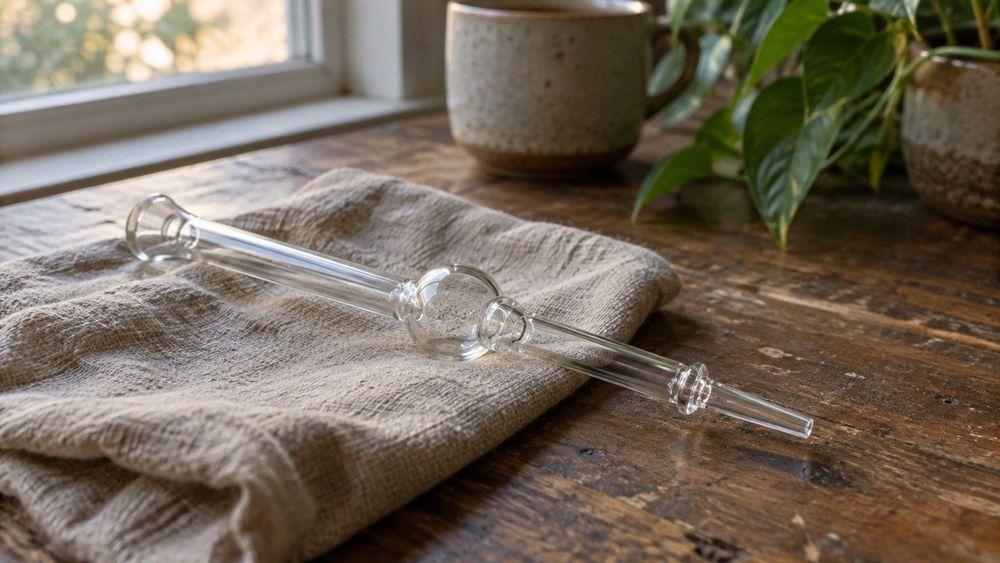
A nectar collector is a straw-shaped device for cannabis concentrates. Instead of dropping wax or oil onto a hot nail, as a dab rig does, you heat the tip of the straw and touch it to the concentrate. That changes the shape of the device, not what heat does to the concentrate. The variable that matters is how hot the tip gets, and with a torch there is no readout. We found no published study that has tested one.
People look up what is a nectar collector because the device is small, cheap and sold in nearly every smoke shop, usually next to the words "portable" and "no rig needed." The pages that rank for the question are almost all written by sellers. They name the parts, describe the torch routine and stop there. None we read in November 2026 cites a study, mentions that the name began as a registered trademark, or says what is and is not known about tip materials. This guide does. It does not teach you how to dab, and it does not publish a target temperature; the temperature section explains why.
What a nectar collector is, and where the name comes from
A nectar collector is a dab device shaped like a straw. One end is a heat-resistant tip, the other is a mouthpiece, and in between is a glass or silicone body that carries the vapor. The concentrate (wax, shatter, budder, rosin and the rest, which our 710 and concentrate glossary defines) sits in a small dish, and the hot tip goes to it. On a dab rig it works the other way around: the concentrate goes onto a hot surface called a nail. You will also see the same shape sold as a dab straw or a honey straw. "Dab straw" usually means a single tube; "nectar collector" usually means a modular piece with a removable tip and, on some models, a small water chamber.
The reason there are three names sits on the federal trademark register. The US Patent and Trademark Office record for NECTAR COLLECTOR shows the application was filed in January 2013, claims first use in commerce on February 15, 2013, and was registered on January 14, 2014 for "smoking pipes." The registration, held today by a Colorado company, was renewed in May 2024 and is listed as live. An earlier version of the goods description also covered "essential oil vaporizer pipes"; that wording was deleted, leaving smoking pipes. So "Nectar Collector" started as a brand, which is one reason many sellers call the same shape a "dab straw" or "honey straw." The record does not say who invented the form, and it says nothing about whether the name has become generic. We are reporting the registry, not offering a legal opinion.
The parts: tip, body, mouthpiece, and the electric version
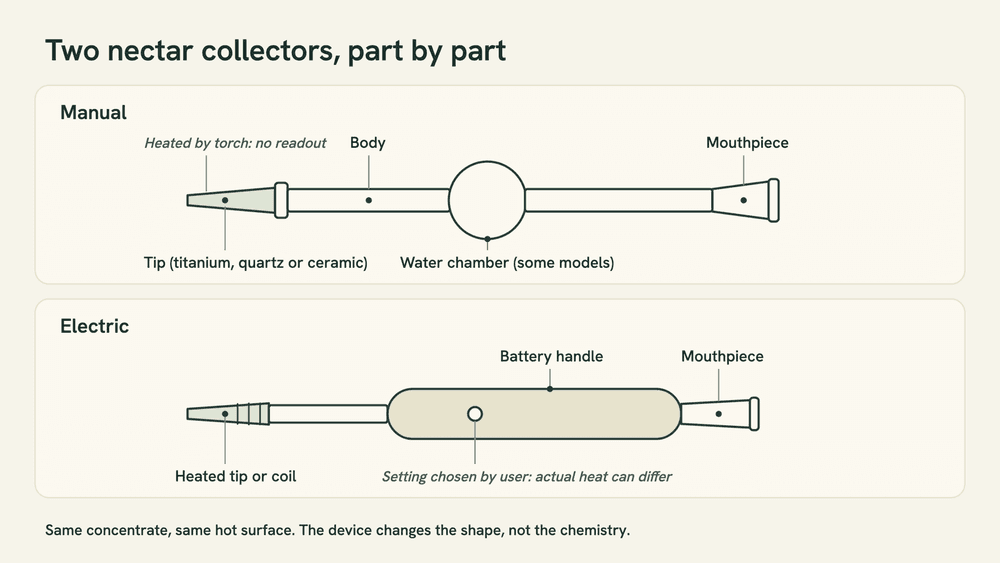
Every nectar collector, from a cheap glass straw to a battery unit, is built from the same few parts:
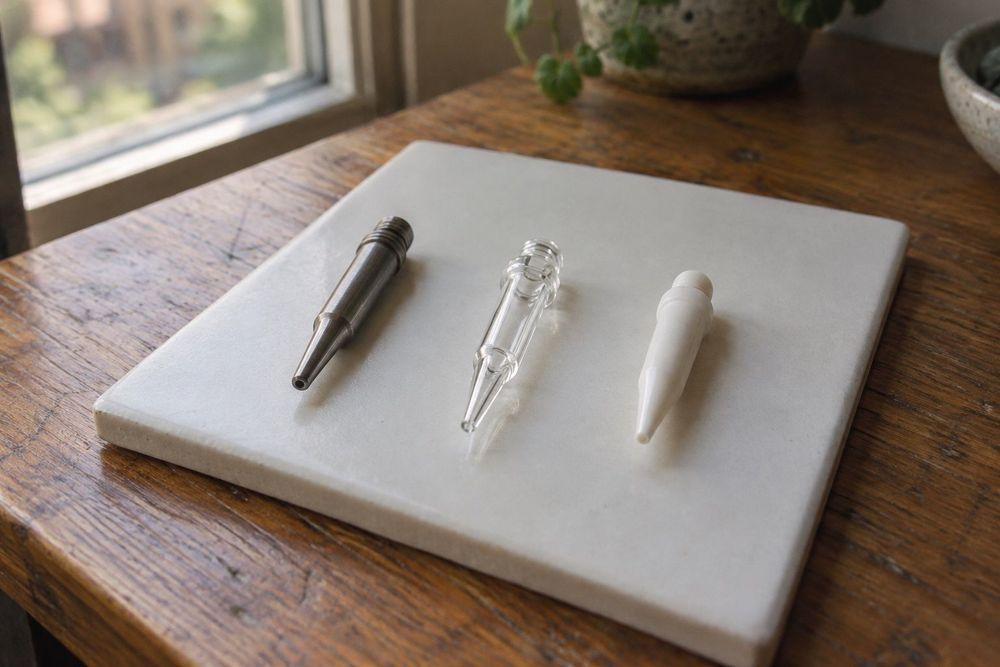
- Tip: the end that gets hot and touches the concentrate. It is usually titanium, quartz or ceramic, sometimes stainless steel. On modular models it screws or clips on, so it can be swapped.
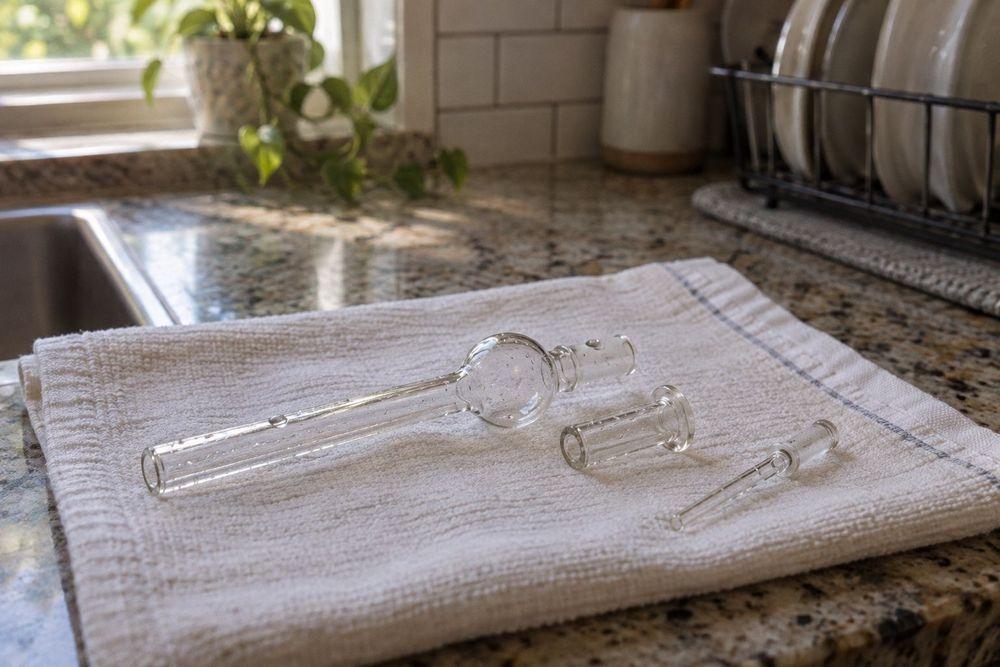
- Body: the tube between the tip and the mouthpiece, usually glass or silicone. Some models add a small water chamber the vapor passes through; we found no study measuring what that water changes.
- Mouthpiece: the end you draw from, either part of the body or a separate piece.
- Dish and clip: many kits include a small heat-resistant dish that holds the concentrate and a clip that holds the joints together.
- Electric version: a battery handle that heats a coil or tip in place of the torch-heated one, usually with a power or temperature setting. "Micro" nectar collectors are smaller versions of either design.
The split that matters is how the tip gets hot. A manual nectar collector is heated with a handheld butane torch, the kind sold for crème brûlée, and nothing on the device tells you how hot the tip is. An electric one heats its tip or coil from a battery to a setting you choose. That sounds like the fix, and partly it is, but as the sections below show, a setting and the heat actually reached are not always the same number. We found no published study of either design.
Nectar collector vs dab rig vs vape cart vs dry-herb vaporizer
The useful comparison is not looks or price but heat: what heats the material, whether you can see how hot it is, and what surface touches it. A dab rig is the closest relative. The same concentrate meets a hot surface, but the surface is a nail on a water pipe and the concentrate goes onto it in a single portion. Almost everything measured about the chemistry of hot-surface dabbing comes from rigs, which is why that row matters more than its size suggests.
| Device | Heat source | Temperature readout | What touches the material | What you load | Where we go deeper |
|---|---|---|---|---|---|
| Nectar collector, manual | Handheld torch heats the tip | None | The heated tip | Concentrate, taken from a dish | This page |
| Nectar collector, electric | Battery heats a coil or tip | A setting; actual heat can differ | The heated tip or coil | Concentrate | This page |
| Dab rig (torch-heated nail or e-nail) | Torch, or an electric controller on an e-nail | None with a torch; a setting with an e-nail | The nail, on a water pipe | A portion of concentrate placed on the nail | Dabs vs flower |
| Vape cartridge | Battery heats a coil inside the cartridge | None on voltage-only batteries; a setting on temperature-controlled devices | Coil and wick | Prefilled oil | Why does my cart taste burnt |
| Dry-herb vaporizer | Battery heats a chamber | A setting on most models | The chamber walls | Ground flower, not concentrate | Dry-herb vaporizer vs smoking |
Each of the other formats has its own guide. Our comparison of dabs and flower covers concentrates, their potency and what lab studies found in rig vapor. Cartridge coils and what makes them taste scorched are in why a cart tastes burnt, and if you are unsure whether a cartridge is genuine, see how to spot a counterfeit cart. Flower vaporizers, which heat the plant rather than an extract, are covered in dry-herb vaporizers vs smoking.
Why tip temperature is the whole story
With any concentrate device, what decides what you inhale is how hot the surface is when it meets the concentrate. The most detailed lab work on dabbing comes from a chemistry group at Portland State University, and its 2017 paper stated the problem plainly:
“Use of an electrically controlled nail ('e-nail') allows temperature control; but, more commonly, users heat the nail (made of titanium, ceramic, or quartz) with a crème brulee torch and have no temperature control.”
In that 2017 study of toxicant formation in dabbing, the researchers heated pure terpenes (the aroma compounds in cannabis) on a ceramic nail fitted to a small water pipe, drew the vapor with a smoking machine and watched the nail with a thermal camera. Over each 10-second draw the nail's temperature fell by 30 to 50 °C as air moved across it, so even a single hit does not happen at a single temperature. Their conclusion: "The difficulty users find in controlling the nail temperature put users at risk of exposing themselves to not only methacrolein but also benzene." The same group's 2019 follow-up, which vaporized THC on an electric nail, measured methacrolein and benzene from THC on its own, found that added terpenes led to higher levels of gas-phase products than THC alone, and noted that higher nail temperature "has been shown to linearly increase degradant formation." The measured amounts are in our guide to what heating a concentrate produces; we do not repeat them here.
Neither study tested a nectar collector. Both heated material on a nail and drew the vapor with a machine instead of a person, and the 2017 paper used terpenes instead of real concentrate. But the variable they identified, a hot surface with no readout, is exactly what a torch-heated tip has.
Electric collectors promise to solve that with a setting. The closest evidence on whether settings hold comes from cartridges. A 2022 thermography study of vape cartridge heating coils filmed three systems during a simulated puff: one that controls temperature and two that control only voltage. Coil temperature in the voltage-only devices scattered widely, with a standard deviation as large as about 96 °C, against under 10 °C for the temperature-controlled one, and the authors concluded that "voltage alone was a poor indicator of coil temperature." Even the temperature-controlled unit averaged only within 10% of its setting, usually a little under. Two caveats matter. The study was run and funded by a device maker, and the temperature-controlled unit it tested was the company's own. And it tested cartridges, not nectar collectors. It is still the best evidence we have that a heat setting and the heat actually reached are different things. For the temperatures at which cannabinoids vaporize and where heating turns into burning, see our guide to THC's boiling point.
Tip materials: titanium, quartz, ceramic and stainless steel
Product pages sell tips with adjectives. Sellers usually pitch quartz for flavor and titanium for durability, with ceramic somewhere in between. We found no study testing any of those claims. What the research record does hold is thin: the 2017 Portland State paper names titanium, ceramic and quartz as nail materials, and a 2019 forensic study by Swiss and German researchers describes butane hash oil "consumed by flash vaporization on a glowing titanium nail." Here is what is known and not known for each material.
| Material | Where you see it | What is known | What is not known |
|---|---|---|---|
| Titanium | Common on manual tips | Named as a nail material in lab studies of dabbing; heated until glowing in a forensic test rig | What a heated titanium tip releases; how it compares with quartz or ceramic |
| Quartz | Common on manual tips and dab straws | Named as a nail material in the 2017 study; like glass, it can crack or chip | No study of quartz tips or of the flavor claims made for them |
| Ceramic | Manual and some electric tips | The 2017 lab nail was ceramic | No study of ceramic nectar collector tips |
| Stainless steel | Some tips; heating coils in electric devices | Metal parts in heated cannabis vape devices can shed metal particles into the aerosol (cartridge studies) | Whether the same happens with any nectar collector tip |
| Glass or silicone body | The tube between tip and mouthpiece | Not the heated end on most designs | No emissions data for nectar collector bodies |
The one material question with real data comes from a neighboring device. Researchers from Health Canada and Canada's National Research Council analyzed six legal Canadian cannabis vape liquids, five samples each, along with machine-vaped aerosol. They found metal particles in the aerosol, nickel and zinc in every sample, chromium in most and cobalt, lead and tin in some, and called it "strong evidence that cannabis vape liquids are contaminated by the metal components of vaping devices." The particle counts were below the level they could quantify, and they measured no health outcome. A 2021 study of 13 Washington retail cartridges, by researchers at a cannabis testing lab, reached a similar conclusion for cartridges, also compared non-cartridge heating methods for flower and concentrate, and concluded that "the heating device itself is a source of metal contamination." The 2021 abstract does not name those other devices, so we cannot say whether a nectar collector was among them.
When we searched PubMed on November 7, 2026, it held no studies of nectar collectors, dab straws or honey straws, and none comparing titanium, quartz or ceramic tips. A search absence is not proof that nothing exists, since manufacturers may test privately and never publish. It does mean the material claims on product pages are not backed by published research.
Is a nectar collector safer or cleaner than a rig?
Not as far as anyone can show. It is the same concentrate meeting the same kind of hot surface, with the same unknown temperature when a torch is involved. What changes is the delivery: concentrate is taken up a little at a time from a dish instead of being placed on a nail in one portion. Whether that means more or less exposure in practice has never been measured. A smaller device is not a cleaner one, and "no water pipe" does not mean "no degradants."
One result in the 2019 Portland State paper can look like good news: the risk estimates it calculated from its gas-phase measurements came out far lower than those it calculated for cannabis smoke. Read the caveats first. The smoke figures came from the literature rather than the same experiment, the particulate phase was not measured, and the authors themselves pointed to "the dangers of the higher aerosol concentration of THC." That is not a safety finding, and it was not about nectar collectors. The federal summary is blunter:
“Dabbing can rapidly deliver large amounts of THC to the body, which increases the risk of negative side effects.”
That sentence comes from NIDA's cannabis research overview, and it applies to any dab device, straw or rig. How much stronger concentrates are than flower, and what that means for dependence, is covered in the dabs vs flower guide linked above. If a hit turns out to be too much, our guide to greening out explains what is happening and what helps.
Burns, torches and cleaning: the practical hazards
The documented burns linked to dabs come from making butane hash oil, not from using a device, and the dabs vs flower guide covers them. We found no published case series of burns from nectar collectors or dab torches (PubMed, November 7, 2026). That does not mean they do not happen: a torch-heated tip is still hot metal or quartz held close to your hand and face. Cleaning adds a second fire risk. Most guides clean nectar collectors by soaking the parts in isopropyl alcohol, and the NIOSH pocket guide for isopropyl alcohol lists it as a Class IB flammable liquid with a flash point of 53 °F, which means it gives off enough vapor to ignite at ordinary room temperature. These are the hazards worth knowing, and the first-aid box below follows the National Library of Medicine's MedlinePlus guidance on burns:
- A tip stays hot after the flame is gone. Set it down only on a heat-safe surface, never on fabric, plastic or skin, and keep the hot end pointed away from people.
- A butane torch is a pressurized, flammable fuel source. Keep it away from other heat and never refill it near a flame or a hot tip.
- Every part cleaned with isopropyl alcohol must be completely dry, inside and out, before any flame comes near it.
- Cracked or chipped quartz, glass or ceramic can fail when heated. Retire it.
- Keep the torch, the device and any concentrate out of reach of children and pets.
CBD concentrates and nectar collectors
Not every concentrate is THC. Hemp-derived CBD concentrates exist too, and a nectar collector heats them the same way, with the same unmeasured tip temperature. Our guide to where CBD concentrates fit explains what they are, and the older concentrates, hash and kief, are covered in what hash is and how it is made. Their legal status is moving. Congress rewrote the federal definition of hemp in 2025, and a law signed on September 2, 2026 split its start into two steps: November 12, 2026 for hemp products containing cannabinoids the plant cannot produce naturally, and December 11, 2026 for the rest. Our guide to whether CBD flower is legal tracks what that means and how states differ.
Planntz does not sell concentrates or devices, so there is nothing on this page for you to buy. If what you want is a measured amount of CBD rather than a hit of unknown size, that is what a labeled oil with a certificate of analysis is for, and our guide to choosing a CBD oil walks through reading the label and the lab report.
What the "for tobacco use only" label means
Federal law does not name nectar collectors. The paraphernalia statute, 21 U.S.C. 863, defines paraphernalia by what an item is "primarily intended or designed for," including inhaling marijuana, hashish or hashish oil, and its examples include "metal, wooden, acrylic, glass, stone, plastic, or ceramic pipes," "water pipes" and "electric pipes." The federal offense is selling or offering paraphernalia for sale, sending it by mail or across state lines, and importing or exporting it, with a penalty of up to three years in prison. In deciding what an item is, a court may weigh instructions, advertising, how the item is displayed for sale and "the existence and scope of legitimate uses."
The "for tobacco use only" or "for legal concentrates only" wording on the box points at the statute's exemption for items "traditionally intended for use with tobacco products, including any pipe, paper, or accessory." It describes how the item is sold; it does not decide what a court may conclude. Simple possession is mostly a matter of state law, and state paraphernalia laws differ a lot. Marijuana products remain controlled substances under federal law, and adult-use sales are legal only under state law, to adults 21 and over. Our one-hitter guide walks through section 863 and its tobacco exemption in more detail. This is general information as of November 2026, not legal advice.
What is still unknown
- No published study has tested a nectar collector, dab straw or honey straw (PubMed, November 7, 2026).
- No study we found compares titanium, quartz, ceramic or steel tips for emissions, flavor or durability.
- No published measurement we found shows how hot a torch-heated tip actually gets in real use, or how fast it cools.
- No study we found has measured the degradants a person inhales from any dab device. The dabbing chemistry comes from machines drawing vapor off heated nails.
Treat every figure on this page as a description of the research that exists, not as a prediction for the device in your hand.
Nectar collector questions, answered
They are the same family. A dab straw is usually a single tube with a heat-resistant tip, while "nectar collector" usually means a modular piece with a removable tip and sometimes a small water chamber. Honey straw is another seller name for the same idea. Nectar Collector began as a registered trademark for smoking pipes, which is part of why sellers use the other names.
A manual collector is heated with a torch and has no temperature readout at all. An electric one heats its tip or coil from a battery to a setting. A setting is more information than a torch gives you, but a 2022 cartridge study found that coil temperature in devices controlling only voltage scattered with a standard deviation of up to about 96 °C, so a setting is not a guarantee. We found no study comparing electric and torch nectar collectors, and there is no evidence that either is safer.
We do not publish a number. We found no study that has measured nectar collector tips. Lab work on hot nails found that degradants such as methacrolein and benzene form on the hot surface and increase as it gets hotter, and that a nail cools during a single draw. For the temperatures at which cannabinoids vaporize and where combustion begins, see our guide to THC's boiling point.
Some models have a small water chamber and many do not. We found no study measuring what the water changes in a nectar collector, so we make no claim that it filters or cools anything.
No. It is designed for concentrates and has no chamber for ground flower. If you want to heat flower without burning it, a dry-herb vaporizer is the device built for that; our dry-herb vaporizer vs smoking guide explains what it changes and what it does not.
A smaller version of the same design, manual or electric. Size changes how much it holds and how easy it is to carry, not the chemistry of heating a concentrate.
Most guides soak the parts in isopropyl alcohol, sometimes with coarse salt, then rinse with warm water. The safety point is the solvent: NIOSH lists isopropyl alcohol as a flammable liquid with a 53 °F flash point, so let the tip cool before cleaning and let every part dry completely before any flame comes near it.
Federal law does not name nectar collectors. 21 U.S.C. 863 defines paraphernalia by what an item is primarily intended or designed for and makes selling or shipping it a federal crime; it exempts items traditionally intended for tobacco, which is why the box often says "for tobacco use only." State laws vary widely. This is general information as of November 2026, not legal advice.
A nectar collector changes the shape of dabbing, not its chemistry. If the question behind your search is what a concentrate actually is, how much stronger it is than flower and what lab studies found in its vapor, the next step is our full side-by-side of dabs vs flower, the guide this page builds on.
Writing about hemp, wellness and the small rituals that keep us balanced.