What Is a One-Hitter? The Small Pipe Explained, From Bats and Chillums to Dugouts
A one-hitter is a small hand pipe for one or two puffs, often shaped like a cigarette and kept in a dugout. How it compares with a pipe, joint and vaporizer, what no study has measured, what the materials change, and why the label says for tobacco use only.
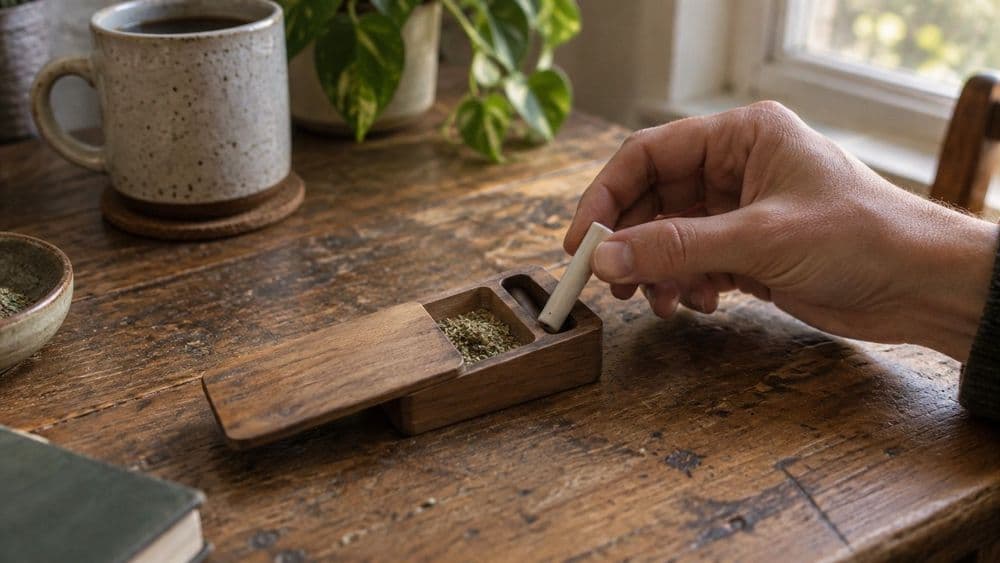
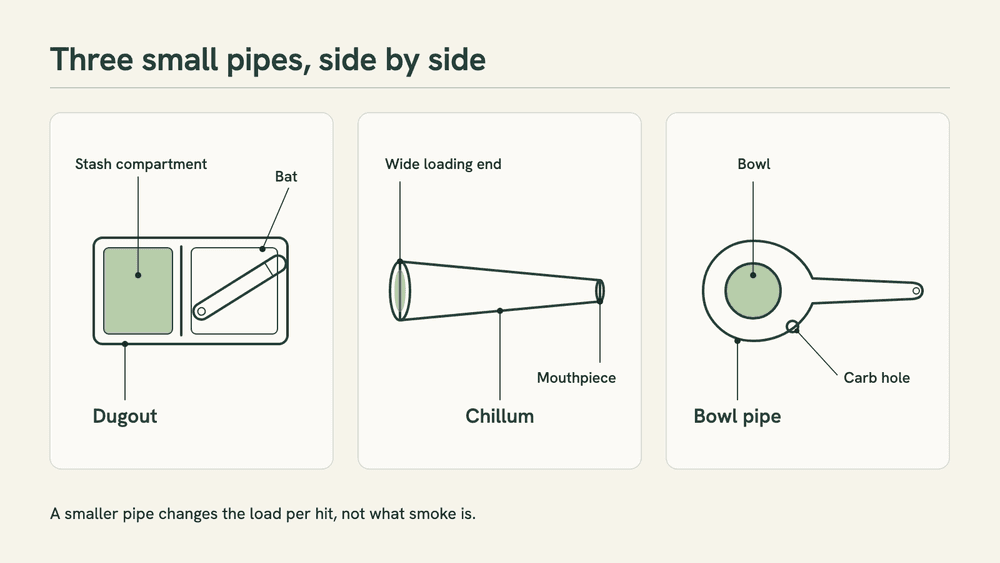
A one-hitter is a small hand pipe made to hold one or two puffs' worth of ground flower. The most common kind is a thin tube shaped like a cigarette, called a bat, kept in a two-compartment box called a dugout. A chillum is its open-ended cousin. A one-hitter changes how much you load per hit. It does not change what smoke is, and it only makes a session smaller if you take fewer hits.
If you searched what is a one hitter, you probably found product photos and two promises: "discreet" and "dose control." Most of those pages are written by sellers, and none we read puts a measured number or a study behind either word. This guide covers the parts they skip: how much a one-hitter actually holds (nobody has weighed one, and the figures in circulation disagree by up to 12 times), whether a smaller bowl means less smoke exposure, what the materials do and do not change, how to clean one, and why the box says "for tobacco use only." (In baseball, a one-hitter is a game in which a team gets a single hit. This page is about the pipe.)
What a one-hitter looks like: bat, chillum and dugout
A one-hitter is a straight, narrow pipe with a small opening at one end for the flower and a mouthpiece at the other. There is no deep bowl and usually no carb (the side hole on many hand pipes that you cover, then uncover to clear the smoke). Researchers describe it the same way. In a 2011 Columbia University study of how much cannabis people use per session, the pipe category explicitly "included water pipes (i.e., 'bongs'), small portable linear pipes (i.e., 'one-hitters' or 'bats'), and other variations." So a one-hitter is a pipe, just the smallest and simplest kind. These are the forms you will see:
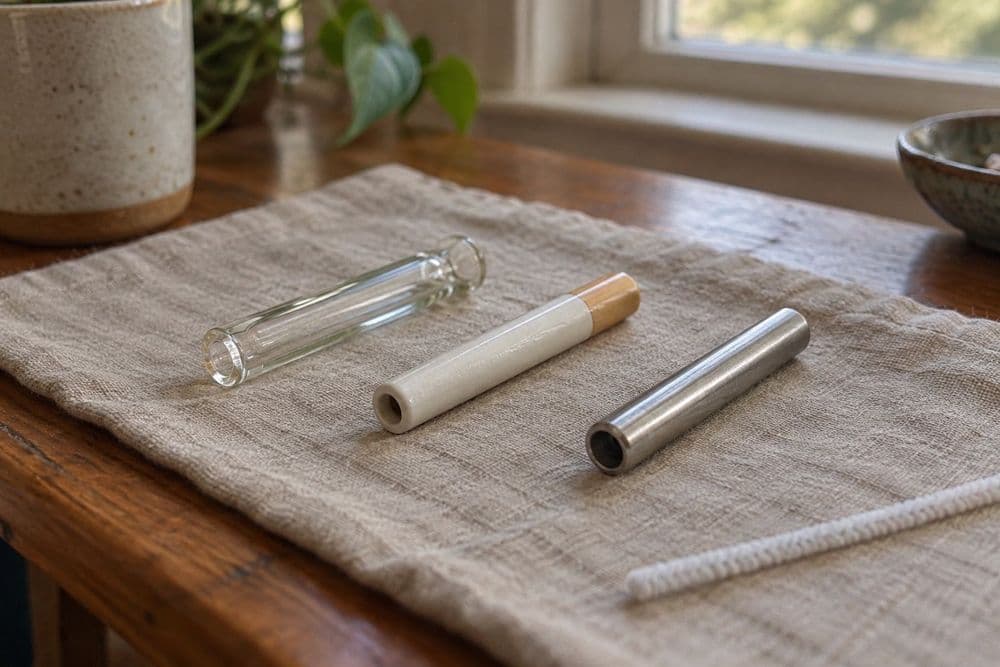
- Bat, or cigarette one-hitter: a thin tube of metal or ceramic, often painted to look like a cigarette. You push the open end into ground flower to load it.
- Chillum: a straight, conical pipe open at both ends, traditionally clay or stone. Large chillums hold far more than a bat; small glass ones are sold as one-hitters.
- Dugout: a box, usually wood, with two compartments, one for ground flower and one for the bat. Swivel and spring-loaded lids are common.
- Glass taster: a short glass tube, sometimes with a slight dip at the tip to hold the flower. Clear glass makes resin buildup easy to see.
- Steamroller: a wider glass tube with a carb hole. It is often sold beside chillums, but its bigger chamber and carb make it closer to a regular pipe.
The word chillum comes from Hindustani chilam, a conical pipe usually made of fired clay, according to Wiktionary's entry for chillum, which quotes the British Report of the Indian Hemp Drugs Commission of 1893-94. One-hitter as slang for a cannabis pipe built for a single inhalation is far newer; the dictionary's quotation comes from a 1996 novel. Sellers call the bat "discreet" because it looks like a cigarette from a few feet away. That describes the shape. It says nothing about the smoke, and it is not a reason to choose one.
One-hitter vs pipe vs joint vs blunt vs vaporizer
The useful comparison is not looks but load: how much flower each format takes per use, whether it burns the plant, and what else comes along. The Columbia study gives the only side-by-side self-reported amounts we know of. Its 251 participants, all adults in cannabis treatment trials, estimated their usual amount by weighing out oregano: about 0.97 g per blunt, 0.66 g per joint and 0.39 g per pipe session. Those are heavy users, and the pipe figure mixes bongs with one-hitters, so treat the numbers as a scale, not a norm. Every load in the table below is labeled with how we know it.
| Format | Typical load (and how we know) | Burns the plant? | What else you inhale | Cleanup | Where we go deeper |
|---|---|---|---|---|---|
| One-hitter (bat, chillum) | Not measured. Seller guides say about 25 mg of flower; Wikipedia says 0.1-0.3 g. Neither cites a source. | Yes | Smoke; whether painted or coated metal adds anything is unstudied | Often: the narrow tube clogs with resin | This page |
| Bowl hand pipe | Weighed: 0.19 g held 25 mg THC in a lab bowl (Spindle 2018). Self-report: 0.39 g per pipe session, bongs included (Mariani 2011) | Yes | Smoke | Regular: bowl and stem collect resin | Dry-herb vaporizer vs smoking |
| Joint | Self-report: 0.66 g (Mariani 2011); about 0.32 g in a separate estimate | Yes | Smoke plus burning paper | None, apart from the roach | Blunt vs joint; How many grams in an eighth |
| Blunt | Self-report: 0.97 g (Mariani 2011) | Yes | Smoke plus a tobacco-leaf wrapper | None | Blunt vs joint |
| Dry-herb vaporizer | Depends on the chamber | No, when used as designed: it heats the flower without lighting it | Vapor | Chamber and screen cleaning | Dry-herb vaporizer vs smoking |
The rolled formats each have their own guide. Our comparison of blunts and joints covers wrappers, tobacco and size, and the gram math behind the joint estimate is in how many grams are in an eighth. The row that matters most is the last one: a one-hitter is the smallest way to burn flower, but it still burns it.
How much does a one-hitter hold, and does it mean a smaller dose?
Seller guides put a one-hitter's load at about 25 milligrams of flower. Wikipedia says 0.1 to 0.3 grams, which is 100 to 300 milligrams. That is a 4 to 12 times spread, and neither figure cites a measurement. We searched PubMed on November 1, 2026 for "one-hitter" and "one hitter" in titles and abstracts and got zero records, so as of November 2026 we found no published study that weighs a one-hitter's load or measures how much THC one hit delivers. The honest answer is "a pinch, and it depends on the pipe and how hard you pack it."
The closest measured anchor comes from a 2018 Johns Hopkins trial comparing smoked and vaporized cannabis. There, a weighed pipe bowl of 0.19 grams of 13.4% THC flower contained 25 mg of THC, and that amount produced strong effects in adults who had used cannabis before; two of the 17 participants vomited at the 25 mg dose, one after smoking it and one after vaping it. Notice the units. The "25 milligrams" on a seller's page is flower. The 25 mg in the study is THC, and the bowl that held it weighed about seven and a half times more than 25 mg of flower. The two numbers look alike and are not the same thing. The trial used a standard lab pipe, not a one-hitter, and only 17 people, so it gives you scale, not a per-hit figure.
If you want to see what any pinch of flower contains, the arithmetic is simple: THC in the material (mg) = flower weight (g) x THC percentage as a decimal x 1,000. So 0.05 g of 15% flower contains 7.5 mg of THC, and 0.2 g of 20% flower contains 40 mg. That is THC sitting in the plant before you light it, not what reaches you, which is why we do not give a per-hit number for a one-hitter. Burning loses a lot. In smoking-machine tests by Swiss and German forensic researchers, lung availability ran from 12% for mixed cannabis material to about 19-27% for flower, with CBD behaving much like THC. A New Zealand machine study of joints found they delivered a mean of 12.6% of the THC available. Roughly an eighth to a quarter turns up in the smoke; the rest is burned or drifts off. No one has run that test on a one-hitter, and machines do not smoke like people, so do not multiply these into a dose.
The bigger point is about sessions, not hits. "Dose control" is true only in the narrow sense that each load is small. A dugout holds enough flower to reload many times, and reloading takes seconds, so what decides your total is how many times you dig the bat back in, not the size of the tip. Smoked cannabis is felt within minutes, and our guide to how long a weed high lasts explains the timeline that makes quick repeat loads easy to overdo. If that happens, our guide to greening out covers what it feels like and what helps.
Is a one-hitter healthier than a joint or a bong?
No study shows that it is, and the chemistry suggests why. Smoke is made by combustion, and combustion does not care about the size of the pipe. When Health Canada researchers machine-smoked cannabis and tobacco the same way, cannabis smoke carried up to 20 times the ammonia of tobacco smoke and 3 to 5 times the hydrogen cyanide, nitrogen oxides and some aromatic amines, along with known carcinogens. A smaller bowl makes less smoke per hit. It does not make different smoke. Our explainer on why weed makes you cough covers what that smoke does to the airways.
How you inhale matters as much as what you inhale from. In a 1988 New England Journal of Medicine study of 15 men, smoking marijuana delivered about three times as much tar as a similar tobacco cigarette, and the authors linked that to bigger puffs, deeper inhalation and breath-holds about four times longer. A 1995 lab study of puff size, with 7 people per experiment, found that larger puffs raised THC levels, carbon monoxide and the reported high together. Both are small and old, and both used joints, but the lesson carries over: a small pipe smoked with long, deep pulls is not a small exposure.
The chillum's history makes the same point. In a 2011 Indian study of 18 healthy smokers, one 15-minute round of tobacco from a chillum raised exhaled carbon monoxide by about 40 ppm, almost eight times the rise after a cigarette. That was tobacco in a traditional chillum smoked for 15 minutes, not cannabis in a glass one-hitter, but it shows that the size of the pipe is not the size of the exposure. Glass does not make smoke disappear either. In 60 controlled tests in a single room, a joint released fine particles at 3.5 times the rate of a commercial tobacco cigarette, and a glass hand pipe still released about 54% of the joint's particles; a bong released 67%. One smoker and one room is a narrow test, but it is real measurement. If smoke and odor in a shared home are your concern, our guide to clearing weed smell from a room works from the same particle data, and if you were wondering whether water helps, our hookah explainer explains why water does not make smoke safe.
There is one hazard specific to small, screenless tubes. Emergency physicians reviewing 407 epiglottitis cases in Rhode Island described four airway burns caused by inhaling hot debris, one from the lit tip of a joint and three from metal pieces in crack pipes. It is rare, all four recovered, and none involved a one-hitter, but most one-hitters have no screen, so a hard pull on a nearly spent tip can bring burning material with it. The only route that skips combustion is heating without lighting: the same Johns Hopkins trial found the same THC dose felt stronger vaporized than smoked, which matters if you switch. Our comparison of dry-herb vaporizers and smoking covers what vaporizing changes and what it does not.
Materials: glass, ceramic, wood, stone, metal and the painted cigarette
Product pages describe materials with adjectives: glass "tastes cleaner," metal is "durable." Here is what each material actually changes, and where the evidence stops. In practice the differences are mostly about heat, breakage and cleaning.
| Material | Why makers use it | What is known | What is not known |
|---|---|---|---|
| Glass | Easy to see resin and to clean; tolerates a lighter's heat | Breaks if dropped; thin tips can crack | We found no study comparing smoke from glass with other one-hitter materials |
| Ceramic | Heat-tolerant; easy to shape like a cigarette | Can chip; glazes vary in quality | No pipe-specific emissions data |
| Wood | Traditional for dugouts; light and cheap | Chars where flower burns against bare wood; soaks up liquids, so it cannot take an alcohol soak | No emissions data |
| Stone or soapstone | Traditional chillum material | Heavy; holds heat | No emissions data |
| Plain metal (brass, aluminum, steel) | Hard to break; cheap | Conducts heat along the tube toward your lips | No pipe-specific emissions data |
| Painted or anodized metal bat | Looks like a cigarette | Paint near the tip sits close to the flame | What the coating releases when heated: we found no study |
| Improvised plastic or foil | Whatever is at hand | Case reports link homemade plastic-bottle bongs to bleeding in the lungs | No data on foil |
The painted cigarette bat is the question readers ask most and the one with the thinnest answer. We searched PubMed on November 1, 2026 for studies combining pipes, smoking and paint, coatings or anodizing with emissions, fumes, exposure or heat, and separately for cannabis pipes and metal, aluminum or lead. None of the results measured what comes off a painted or coated metal one-hitter when it heats up. That is an unknown, not a finding of harm or of safety. Improvised plastic is different, because there are clinical reports. French doctors reviewing five cases of bleeding in the lungs found that all involved young men smoking from homemade plastic-bottle bongs, and heated plastic released compounds in their lab tests. It is a handful of case reports about bongs, not one-hitters, and the mechanism is a hypothesis, but it is a clear reason not to make a pipe out of plastic.
How to clean a one-hitter, and why not to share one
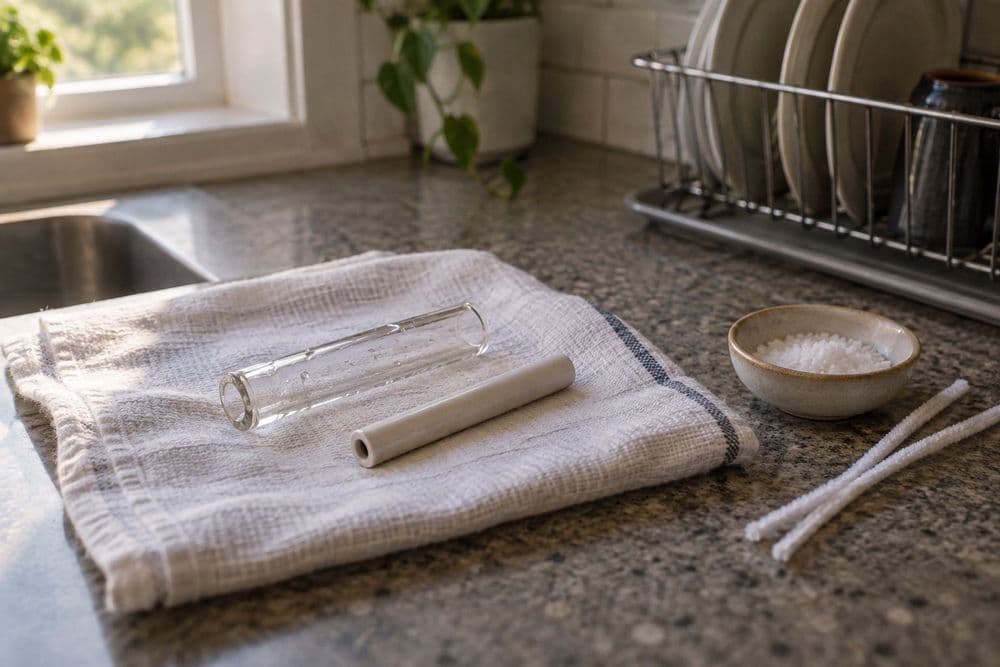
A one-hitter's narrow tube clogs with resin faster than a bowl pipe, and a clogged tube makes you pull harder. The method most guides describe is isopropyl alcohol and coarse salt. Nobody has studied pipe cleaning, but one safety fact is settled: PubChem's record for isopropyl alcohol classifies it as a highly flammable liquid and vapor. That shapes the last step below.
- 1Let the piece cool completely, then tap any ash out into a dish.
- 2Push a pipe cleaner through the tube to loosen resin. Work from the mouthpiece toward the tip so debris leaves through the loading end.
- 3For glass, ceramic or plain metal: put it in a sealable bag or jar with enough isopropyl alcohol to cover it (most guides use 70-90%) and a spoonful of coarse salt, then shake for a minute or two.
- 4If resin remains, let it soak for a while and shake again.
- 5Rinse thoroughly in warm water until no alcohol smell remains.
- 6Let it dry completely, inside and out, before it goes anywhere near a flame.
- 7Skip the alcohol soak for wood and painted pieces: wood absorbs it and it may lift paint. Use a pipe cleaner and a dry brush instead.
On sharing: a mouthpiece passed hand to hand passes saliva with it, and research on cannabis paraphernalia treats sharing as a risk factor for respiratory infections. Our guide to roach clips and sharing a joint covers that survey and the hygiene basics; the same logic applies to a one-hitter, which goes mouth to mouth even more directly.
Why the box says "for tobacco use only"
The label comes from federal law. The paraphernalia statute, 21 U.S.C. 863, defines drug paraphernalia as equipment "primarily intended or designed for use in" inhaling a controlled substance, and its list of examples starts with "metal, wooden, acrylic, glass, stone, plastic, or ceramic pipes with or without screens, permanent screens, hashish heads, or punctured metal bowls." Item (d)(11) names "chillums" outright. Then section (f) carves out two exemptions, and the second is the reason for the label on the box:
“This section shall not apply to any item that, in the normal lawful course of business, is imported, exported, transported, or sold through the mail or by any other means, and traditionally intended for use with tobacco products, including any pipe, paper, or accessory.”
The sticker describes how the item is sold. It does not settle what the item is. Under section 863(e), a court may weigh instructions and descriptive materials, advertising, "the manner in which the item is displayed for sale," whether the seller is a legitimate supplier such as a licensed tobacco dealer, and "the existence and scope of legitimate uses." The federal offense is selling or offering paraphernalia, sending it by mail or across state lines, and importing or exporting it, with a penalty of up to 3 years in prison; section (f)(1) also exempts people authorized by local, state or federal law to make, possess or distribute such items. Simple possession is largely a matter of state law, and state paraphernalia laws differ a lot. The same statute lists roach clips, which our guide to what a roach is covers. For hemp and CBD flower, the status of what goes in the pipe depends on the federal hemp definition, which is scheduled to change on November 12, 2026; our guide to whether CBD flower is legal tracks that change and state rules. This is general information as of November 2026, not legal advice.
What we still don't know about one-hitters
The gaps are bigger than the facts, and it is better to say so. No published study has weighed a one-hitter's load, so the 25 mg and 0.1-0.3 g figures remain claims. No study measures how much THC a single small hit delivers to a person; the machine recoveries above come from joints and smoking apparatus. No study compares the smoke from a one-hitter with the smoke from a joint or pipe in people, and none tests what painted or coated metal pipes release when heated. The closest human data come from small or old studies (17 people in the Johns Hopkins trial, 15 in the 1988 study), heavy users in treatment (the Columbia amounts), or tobacco (the chillum study). Treat every number on this page as scale and direction, not as a prediction for your own pipe.
One-hitter questions, answered
A chillum is a straight, conical pipe open at both ends, with no separate bowl: the flower sits in the wide end and you draw from the narrow end. The word comes from Hindustani chilam, and chillums were traditionally made of clay or stone. Small glass chillums are sold as one-hitters, while traditional ones can be much larger. Federal law names chillums specifically in its list of drug paraphernalia examples, 21 U.S.C. 863(d)(11), which is one reason they are usually labeled for tobacco use.
A dugout is a small box, usually wood, with two compartments: one holds ground flower and the other holds the bat. To load the bat you push its tip down into the flower compartment, which is where the name comes from. Most have a swivel or spring-loaded lid. A dugout makes reloading fast, which is worth remembering if you chose a one-hitter to use less.
Nobody has measured it. Seller guides say about 25 mg of flower and Wikipedia says 0.1 to 0.3 grams, and neither cites a source; a PubMed search in November 2026 found no study that weighs a one-hitter's load. For scale, a lab pipe bowl that held 25 mg of THC weighed 0.19 g in a 2018 Johns Hopkins trial. That is the key confusion: 25 mg of flower and 25 mg of THC are very different amounts.
Yes, it is a type of hand pipe: the smallest and simplest kind, usually a straight tube with no deep bowl and no carb hole. Researchers file it that way too. A 2011 Columbia study's pipe category explicitly included "small portable linear pipes (i.e., 'one-hitters' or 'bats')." Federal paraphernalia law also lists pipes by material rather than by size.
A one-hitter makes less smoke per hit, but the smoke is the same: cannabis smoke carries ammonia, hydrogen cyanide and other combustion products whatever it is burned in. Whether your total exposure is lower depends on how many times you reload and how deeply you inhale. A one-hitter does avoid burning rolling paper, but no study shows it is healthier than a joint or a bong.
Physically, yes; it burns any dried flower. The smoke is still smoke: in machine tests CBD reached the smoke at rates similar to THC, and the combustion products come along either way. Whether hemp flower is legal where you are depends on state law and on the federal hemp definition, which is scheduled to change on November 12, 2026, so check our guide to whether CBD flower is legal before you buy. If you want CBD without smoke at all, an oil or other non-inhaled format avoids combustion entirely.
It makes less smoke per hit, but small pipes are not smokeless. In 60 controlled tests in one room, a glass hand pipe released about 54% of the fine particles a joint did. Burnt cannabis smells the same whatever it is burned in; less of it simply means less smell per hit.
It depends on where you are and how the item is sold and used. Federally, 21 U.S.C. 863 makes it an offense to sell, mail, ship across state lines, import or export drug paraphernalia, and it exempts items traditionally intended for tobacco, which is why one-hitters carry tobacco-use labels. Simple possession is mostly governed by state law, and state rules vary widely. This is general information as of November 2026, not legal advice.
A one-hitter is a smaller way to burn flower, not a different way. If the question underneath your search is whether you can get away from smoke altogether, the next step is our side-by-side of dry-herb vaporizers and smoking, which explains what heating without burning changes and what it does not. And if what you actually want is CBD with no inhaling at all, our guide to choosing a CBD oil walks through reading the label and the lab report.
Writing about hemp, wellness and the small rituals that keep us balanced.