CBD Nasal Spray: What the Absorption Claims Rest On
CBD nasal sprays sell speed and absorption. As of October 27, 2026, we found no published study measuring what one puts into human blood, the spray people cite goes in the mouth, and the FDA called two of them unapproved drugs. Here is the label checklist.

Does a CBD nasal spray work better than oil? As of October 27, 2026, nobody can tell you, because no published study has measured how much CBD reaches a person's bloodstream from a CBD nasal spray. The one registered human trial we found (NCT03471559) was stopped and posted no results. The spray with real human data, Sativex, goes in the mouth, not the nose. And in the US, a CBD nasal spray cannot legally be a dietary supplement.
The pitch on most nasal spray boxes is the same: the lining of your nose is thin and full of blood vessels, so CBD sprayed there should skip your gut and liver, work in minutes and waste less. That is a hypothesis about a route, and for CBD no published study has tested it in people. This page sorts what has been measured (in pig tissue, rats, rabbits, dogs and mice) from what is assumed, explains the Sativex mix-up and the odd legal status of nasal sprays, and ends with a label checklist. If you are comparing ways to take CBD, our guide to how to take CBD oil covers the routes that do have human data. This page covers the one it leaves out.
What a CBD nasal spray is, and what is in the bottle
A CBD nasal spray is a small pump bottle that sends a fine mist of liquid into each nostril. The hard part is the CBD itself. CBD dissolves in oil, not water, and the inside of your nose is a moist surface lined with tiny hairs that keep sweeping material toward the throat. So every nasal spray needs a way to carry an oily molecule in a sprayable liquid: an emulsion of oil droplets held in water by emulsifiers, or a carrier molecule that wraps the CBD so it disperses in water. How those systems work, and what "nano" claims do and do not mean, is covered in our explainer on water-soluble CBD. The short version: "water-soluble" describes how a product is made, not how much CBD it contains or delivers.
One European CBD nasal spray's published ingredient list shows what that looks like in a real bottle. Grouped by job, it contains:
- Water and salt (aqua, sodium chloride): the base of most nasal sprays.
- A carrier oil (caprylic/capric triglyceride, an MCT oil) to hold the CBD.
- Emulsifiers (lecithin, polysorbate 80) that keep the oil and water mixed.
- Cannabidiol, the CBD itself.
- Pungent plant additives: capsaicin (the compound that makes chili peppers hot) and eucalyptus.
- Xylitol, a sugar alcohol.
- Preservatives and a pH adjuster: potassium sorbate, sodium benzoate and citric acid.
The amounts of CBD are small. That listing gives 50 mg of CBD in a 10 mL bottle and no figure per spray. RHINODOL CBD, one of the two sprays the FDA later wrote to, was "offered in 500 and 1000 mcg strengths," according to the agency's letter: 0.5 mg and 1 mg, without saying whether that is per spray or per dose. Keep those numbers in mind for the checklist at the end.
Does a nasal spray absorb faster? What animal and lab studies show
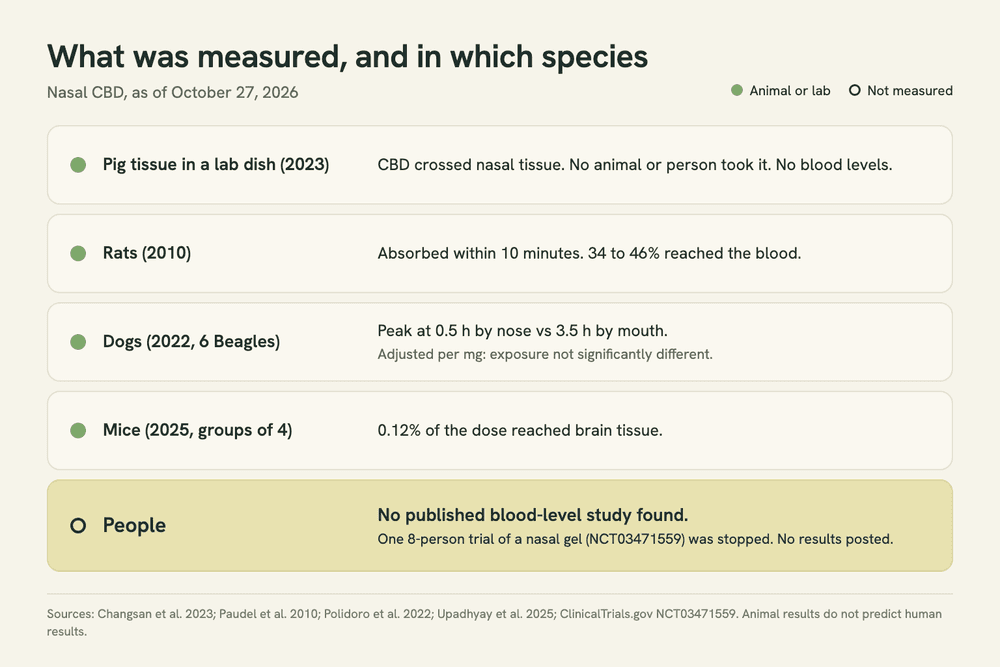
Start with the study that ranks first for this topic. A 2023 formulation study in the International Journal of Pharmaceutics built a CBD nasal spray from CBD wrapped in beta-cyclodextrin micelles, showed it stayed stable for six months at room temperature, and measured CBD crossing pieces of pig nasal tissue in a lab chamber at 4.8 micrograms per square centimeter per minute. It also found the spray was not toxic to cultured nasal cells at the concentrations tested. That is useful formulation work. No animal and no person took the spray, and nobody measured a blood level.
The first blood levels come from rodents. In a 2010 study in rats, CBD placed in the nose was absorbed within 10 minutes, with a bioavailability (the share of a dose that reaches the bloodstream) of 34 to 46% for most of the formulations tested. Adding absorption enhancers did not improve it. THC looks lower. In anesthetized rats given nasal THC, about 6 to 9% reached the blood, peaking after roughly 1.5 hours, and in conscious rabbits given a THC solution or gel it was about 13 to 15%. These are rodent and rabbit results, measured in lab setups rather than with consumer sprays, and as you will see below, rodent noses are built differently from ours.
The dog study is the one marketers like, so read it whole. In a 2022 crossover study in six healthy Beagles, CBD sprayed in the nose peaked in about 30 minutes, against 3.5 hours by mouth. But the nasal dose was 20 mg and the oral dose 100 mg, and when the researchers adjusted total exposure and peak level to the same 1 mg dose, the differences between nose and mouth were not statistically significant. The authors still concluded that "PO remains the most favorable route," PO meaning by mouth. Six dogs is a very small study, and one author worked for a CBD supplier. In dogs, then: sooner, but not more per milligram.
The other big promise is "nose-to-brain": the idea that a drug sprayed high in the nose travels along the nerves of smell straight into the brain. Even in a 2025 mouse study designed to test it, using a nanoformulation in groups of four animals, only 0.12% of the nasal CBD dose reached brain tissue, and the authors wrote that overall bioavailability remained low. A 2014 review of nose-to-brain delivery, whose lead author works for a nasal-device company, calls direct transport "still a matter of controversy" and says "definitive proof in man is lacking."
Anatomy is one reason animal results travel poorly. In people, the smell-sensing patch at the top of the nose, the proposed shortcut, covers about 10 square centimeters, roughly 10% of the nasal lining. In rats and mice it can be up to half, according to a 2022 review of nasal drug delivery that was sponsored and funded by the drug company AbbVie, which employs two of its three authors. Most of a human nose, about 150 square centimeters or 80 to 90% of the surface, is respiratory lining: the part that warms, moistens and filters the air you breathe.
The human study that has not been published
Here is the gap the product pages we read skip. As of October 27, 2026, we found no published study that measured CBD in human blood after a nasal spray, or after any nasal CBD product. We searched PubMed, Europe PMC and ClinicalTrials.gov and read every result title by title. They were reviews, lab and animal work, and human studies of other nasal drugs in which cannabis use was a side variable.
We did find one human trial. ClinicalTrials.gov record NCT03471559, sponsored by the Central Institute of Mental Health in Mannheim, Germany, and run at the University of Cologne, planned to compare an intranasal CBD gel with a 200 mg CBD capsule in a randomized crossover design, measuring peak blood level, time to peak and total exposure. It started in December 2018, enrolled eight people and was terminated. The registry's only explanation reads: "Two step study, step two was not feasible based on results from phase one." No results were posted, and we found no publication. It also tested a gel, not a spray. We do not know why step two was not feasible, and it would be wrong to guess.
Researchers in the field land in the same place. A 2026 review of nasal CBD formulations says there is "a dire need" for properly designed clinical trials to demonstrate the safety, pharmacokinetics (blood levels over time) and efficacy of the nasal CBD carriers it reviewed. Back in 2017, a Duke palliative-care physician told Vice that "a lot of the stuff about bioavailability and any drug tends to be kind of hype-y," and that absorption "can be varied depending on what's going on with your nose." Nine years later, nobody has published the measurement that would settle it.
Sativex is not a nasal spray
When a nasal spray page cites human data, it often points to Sativex (nabiximols), a prescription cannabis spray approved in the UK and some other countries. Each 100-microliter spray contains 2.7 mg of THC and 2.5 mg of CBD. But it does not go in the nose. The current UK prescribing information for Sativex, revised April 2, 2026, lists its form as "oromucosal spray, solution" and states:
“Sativex is for oromucosal use only.”
Oromucosal means the lining of the mouth: it is sprayed under the tongue or inside the cheek. Even this approved spray is not fast in the way nasal marketing implies. Its label says THC and CBD appear in the blood within 15 minutes, with THC peaking some 45 to 120 minutes after a dose, and that taking it with food raised THC's peak and total exposure 1.6-fold and 2.8-fold. That food effect fits the expert argument described below, that much of what is sprayed in the mouth ends up swallowed.
The human data on mouth sprays point the opposite way from the marketing. A 2024 meta-regression of 112 trial arms from 39 studies associated oromucosal dosing with lower peak and total blood levels than oral dosing, an association across studies rather than a head-to-head test. In a 2011 trial in nine cannabis smokers, there were no statistically significant differences in peak THC, time to peak or total exposure between the spray and swallowed THC. In a 2025 pilot crossover in 12 occasional users, a swallowed extract reached significantly higher peak THC and CBD levels than nabiximols; two of its authors list a cannabis company, Tilray, as their affiliation. One explanation, offered as expert opinion in 2019, is that saliva washes much of a mouth spray into the gut anyway.
Sativex is also not FDA-approved. The FDA lists four approved cannabinoid medicines: Epidiolex, Marinol, Syndros and Cesamet. Every one is taken by mouth, and no cannabinoid nasal spray is FDA-approved. If you want the same claim check run on another "fast" format, our look at CBD gum does it for chewing gum.
Why a nasal spray cannot be a dietary supplement
In the US, the definition of a dietary supplement starts with how you take it. The federal definition says a supplement "is intended for ingestion" in a form described in a second section of the same law: "tablet, capsule, powder, softgel, gelcap, or liquid form." A spray into the nose is not ingestion. So a CBD nasal spray could not be a supplement even before the FDA's separate position that CBD is excluded from supplements altogether, a history our guide to what the FDA says about CBD walks through.
When the FDA did write to nasal spray sellers, it did not call the products supplements. In a December 22, 2020 warning letter to New Leaf Pharmaceuticals about RHINODOL CBD, and a July 22, 2021 letter to MB Solutions (BioSpectrum CBD) about Nasadol, the agency treated the sprays as unapproved new drugs and as misbranded. Both letters quote the sellers' own health claims, which we do not repeat here. The 2021 letter also quotes Nasadol's speed pitch: "Works within 30 seconds," "Bypasses blood brain barrier in seconds" and a claim of improved bioavailability of CBD. A warning letter states the FDA's position; it is not a court finding, and these two date from 2020 and 2021.
In Europe, some CBD nasal sprays are sold as medical devices instead. One listing at an Austrian online pharmacy, the source of the ingredient list above, calls its spray a "registered medical device" (Registriertes Medizinprodukt), carries a dietary-supplement disclaimer on the same page, and never says how much CBD is in one spray. Under the EU medical device regulation (Regulation 2017/745), a device is a product whose principal intended action is not achieved by pharmacological, immunological or metabolic means: an odd category for a spray sold for its CBD. We did not verify the listing's registration in the EU database, and the product shows as currently unavailable.
Safety: what is known, and what nobody has measured
No published study has tracked the safety of CBD nasal sprays in people, so an honest safety section is about the route and the ingredients. The FDA put the same paragraph into both warning letters:
“These products are especially concerning from a public health perspective because intranasal drug products may be rapidly absorbed through the highly vascularized nasal mucosa directly into systemic blood circulation, where they may exert undesirable systemic effects such as increased heart rate or elevated blood pressure. If toxic substances are introduced directly into the nose, harmful local effects such as bleeding, ulceration, or nasal septal perforation may occur.”
Note the wording: "may," and "if toxic substances are introduced." This is the agency's concern about the nasal route in general, not a record of harm seen with CBD sprays. It is also a good reason not to improvise: a CBD oil made to be held under the tongue was not formulated for the inside of your nose.
Then read the ingredients. Many multi-dose nasal sprays use benzalkonium chloride as a preservative. A 2004 review of 18 studies on the preservative found conflicting reports of damage to the human nasal lining: of the 10 studies that reported harm, only 2 found significant differences, and both involved the decongestant oxymetazoline. The authors concluded that products containing it appear safe and well tolerated. The 2022 nasal-delivery review notes that, in animal tissue, it can slow the tiny hairs that clear the nose, in a dose- and time-dependent way. The same review adds that nasal formulations should sit between pH 4.5 and 6.5 to avoid irritation, and the human nasal lining averages about pH 6.3. Some CBD sprays also add pungent ingredients such as capsaicin or eucalyptus. None of this is a reason for alarm on its own. It means you should know what you are putting in your nose, and ask the seller for anything the label leaves out.
Changing the route does not change what CBD is. If CBD reaches your bloodstream, the drug interactions that come with it still apply, whether it arrived through your nose, mouth or gut. Our guide to CBD and medications explains which medicines share liver enzymes with CBD and what to ask a pharmacist.

THC nasal sprays: legal status, impairment and drug tests
The THC nasal sprays we found are sold inside state medical programs. In 2023, a Georgia medical dispensary began selling one at 5 mg of THC per spray and 1,500 mg per bottle (300 sprays, by the label math) for $120, to holders of a Georgia low-THC oil registry card only. No THC nasal spray is FDA-approved. Under federal law, marijuana remains a controlled substance: since an April 28, 2026 DEA final rule, marijuana in an FDA-approved drug or subject to a state medical marijuana license sits in Schedule III, and everything else stays in Schedule I. A THC spray delivers THC, the compound that causes impairment, so the same caution about driving applies as with any other THC product.
Hemp-derived THC sprays face a hard line soon. Under a 2025 federal law whose main hemp provisions take effect after December 11, 2026 (timing set by Public Law 119-103), a finished hemp product with more than 0.4 mg of total THC per container no longer counts as hemp. A spray with milligrams of THC in each actuation would be far above that line. Our guide to hemp-derived THC explains the change in full. None of this is legal advice.
For drug testing, the route does not matter. Under the federal workplace testing panels, a urine test screens for a THC breakdown product (delta-9-THC carboxylic acid) at 50 ng/mL and confirms at 15 ng/mL, whether the THC went in through your mouth, lungs or nose. In federally regulated testing, the DOT rule for medical review officers says use of a hemp product is not an accepted explanation for a positive marijuana result. A CBD spray that contains any THC carries that exposure like any other THC-containing product, so check the batch COA for total THC, and know that no product can guarantee a test result. Our CBD drug test guide covers the variables.
How the four routes compare
Here is the evidence side by side. The column that matters most is the third one: what has actually been measured in people. For oil held under the tongue, the closest human comparison is a 2024 crossover study in eight men, which found plasma CBD was not different whether the same oil was taken as drops under the tongue or swallowed in capsules.
| Route | Where it goes | Human blood-level data | US regulatory category |
|---|---|---|---|
| CBD nasal spray | Sprayed into the nose | None published. One 8-person trial of a nasal gel (NCT03471559) was stopped with no results posted | Cannot be a dietary supplement (not ingested); the FDA treated two as unapproved new drugs |
| Oromucosal spray (Sativex) | Sprayed under the tongue or inside the cheek | Yes: label data and small trials (9 and 12 people); a 2024 meta-regression linked mouth sprays to lower levels than swallowing | Prescription drug in some countries; not FDA-approved |
| Sublingual oil | Held under the tongue, then mostly swallowed | Some: in one 8-person study, drops and capsules gave similar levels | Sold as consumer CBD; the FDA says CBD is excluded from supplements |
| Swallowed oil, gummy or capsule | Gut, then liver | Many human studies, including the data behind the Epidiolex label | Epidiolex is an approved oral prescription drug; consumer products sit outside the supplement definition per the FDA |
If you buy one anyway: the spray label checklist
Planntz does not sell a nasal spray, so this checklist has no product attached. It is the list of questions we would want answered before putting any CBD product in our nose.
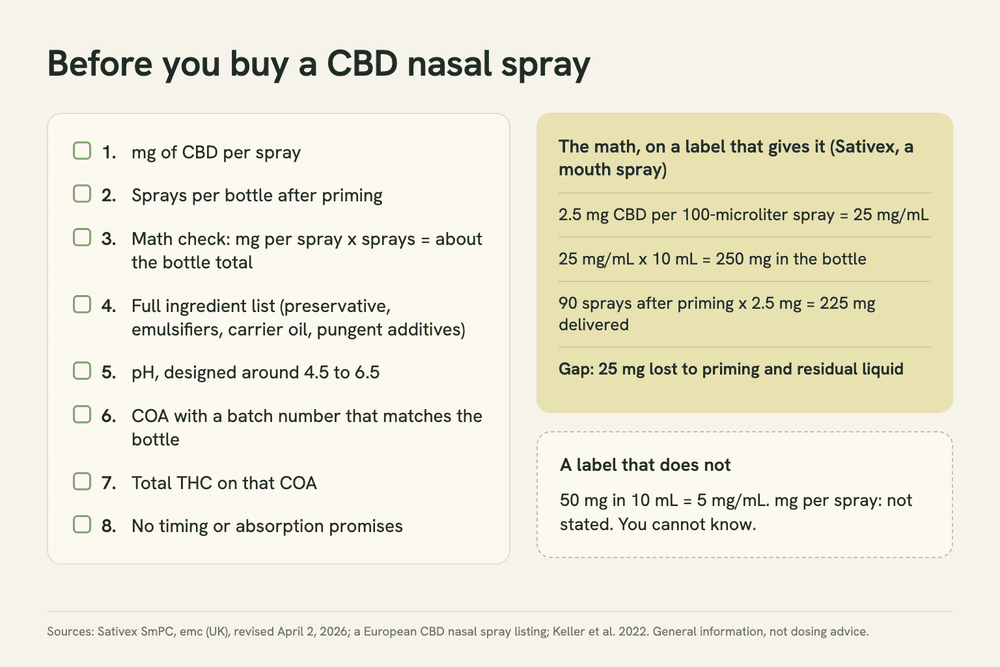
- 1CBD in mg per spray (per actuation). A bottle total alone cannot tell you what one spray delivers.
- 2The number of sprays per bottle after priming. Pumps waste a few sprays filling the chamber.
- 3The math check: mg per spray times the number of sprays should land close to the mg in the bottle.
- 4The full ingredient list: preservative (benzalkonium chloride, potassium sorbate, sodium benzoate), emulsifiers (polysorbate 80, lecithin), carrier oil, and pungent additives (capsaicin, eucalyptus, menthol).
- 5The pH, on the label or from the seller on request. Nasal formulations are designed around pH 4.5 to 6.5.
- 6A certificate of analysis (COA) whose batch number matches the bottle, with CBD stated per mL.
- 7Total THC on that COA, and the lab's limit of quantitation if the product claims to be THC-free.
- 8No timing or absorption promises. "Works within 30 seconds" and "bypasses blood brain barrier in seconds" are claims the FDA quoted in its 2021 warning letter.
Here is the math on a label that gives you everything you need, Sativex's. Each 100-microliter spray carries 2.5 mg of CBD, which works out to 25 mg/mL, so the 10 mL bottle holds 250 mg. The label promises up to 90 sprays after priming: 90 x 2.5 mg = 225 mg delivered. The missing 25 mg is the cost of priming and the liquid a pump cannot reach. Now try the European listing: 50 mg in 10 mL is 5 mg/mL. If its pump delivered 100 microliters like Sativex's, that would be about 0.5 mg per spray, but the listing does not say, so you cannot know. For comparison, a tincture label states mg per mL, so you can do the per-drop math (a 250 mg/mL oil works out to about 12.5 mg in a 0.05 mL drop, though drop size varies by dropper); many spray labels do not give the per-spray figure at all. Our guide to reading a CBD label covers the per-serving math for other formats, and how to read a certificate of analysis shows how to match a batch and find total THC.
CBD nasal spray: questions people ask
Nobody can say yet. As of October 27, 2026, no published study has measured how much CBD reaches a person's blood from a nasal spray, and none has tested an effect in people. The one registered human trial we found (NCT03471559, a nasal gel in eight people) was stopped and posted no results. In animals the picture is mixed: rats absorbed nasal CBD within 10 minutes, dogs peaked sooner but had similar exposure per mg to oral dosing, and in mice 0.12% of a dose reached the brain.
They have not been studied for safety in people. The FDA has warned that drugs sprayed into the nose may be rapidly absorbed into the bloodstream, and that toxic substances there may cause bleeding, ulceration or septal perforation. Check the full ingredient list, including preservatives such as benzalkonium chloride. Stop and see a clinician if you get nosebleeds, persistent burning or crusting, and remember that CBD's drug interactions apply whatever the route.
There is no human head-to-head study of a nasal spray against oil. The closest human data are for Sativex, a mouth spray, and they do not show a spray beating swallowing: a 2024 meta-regression associated mouth sprays with lower blood levels than oral dosing, and a 2011 trial found no significant difference. In six dogs, nasal CBD peaked sooner, but per mg its total exposure was not significantly different from oral. No one can honestly name a winner yet.
No. Its UK label lists it as an oromucosal spray and says it is for oromucosal use only: it is sprayed under the tongue or inside the cheek. It contains 2.7 mg of THC and 2.5 mg of CBD per spray, is a prescription medicine in some countries, and is not FDA-approved in the US.
Drug tests look for a THC breakdown product, not CBD, and the route does not change that. If the spray contains THC, that THC counts the same as THC from an oil or a gummy. Check the batch COA for total THC. No product can guarantee a test result, because trace amounts, how often you use it and the test's sensitivity all carry residual risk.
Only the label can tell you, and many do not. Sativex delivers 2.5 mg of CBD (with 2.7 mg of THC) per 100-microliter spray. RHINODOL CBD was offered in 500 and 1,000 mcg strengths, according to the FDA's letter. A European listing gives 50 mg per 10 mL bottle with no per-spray figure. If the label does not state mg per spray, you cannot know what one spray delivers.
No THC nasal spray is FDA-approved. Some are sold inside state medical programs: in 2023 a Georgia dispensary sold one at 5 mg of THC per spray, to registry cardholders only. For hemp-derived products, a federal cap of 0.4 mg of total THC per container applies to finished products after December 11, 2026, which a THC spray would far exceed. Rules vary by state, and this is not legal advice.
Planntz does not make a nasal spray. If you want to see what a batch-matched certificate of analysis looks like before you judge any CBD product, spray or not, browse our published lab results. For the full buying framework, from spectrum to concentration to COA, start with how to choose a CBD oil.
Writing about hemp, wellness and the small rituals that keep us balanced.