THC Boiling Point: Why Everyone Prints 157 °C, and What the Measurements Actually Say
THC does not have one boiling point: it has a number at a stated pressure. The 157 °C printed everywhere is a near-vacuum distillation figure. The two estimates at normal pressure, about 245 °C (2025) and about 417 °C (2017), disagree by about 170 degrees.
Search for the THC boiling point and you will find 157 °C (315 °F), 200 °C, 245 °C, 375 °C or a loose 315-390 °F, sometimes on the same page. They cannot all be right. The reason they differ is simpler than it looks: a boiling point only means something at a stated pressure, and most of these numbers were measured, or modeled, under very different conditions.
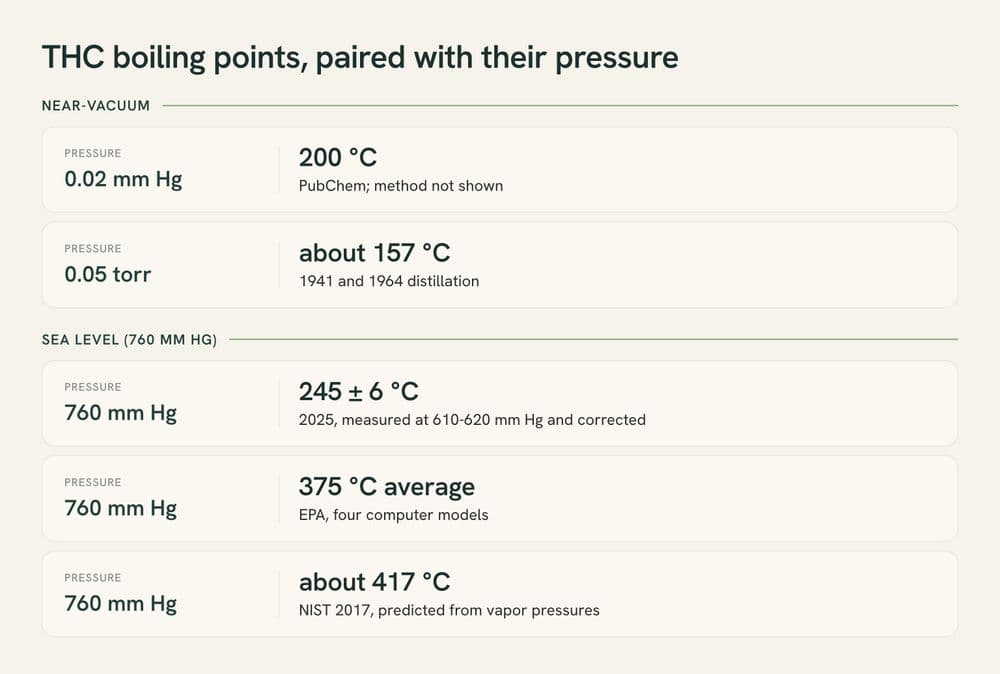
The short answer: THC has no single boiling point you can quote without a pressure. The 157 °C on most charts is a near-vacuum distillation temperature, recorded at about 0.05 torr. At sea-level pressure, the two estimates built on real measurements are about 245 °C, from a 2025 thermal-analysis study in the Journal of Cannabis Research, and about 417 °C, predicted from vapor pressures measured at the National Institute of Standards and Technology in 2017. They disagree by about 170 degrees. And THC turns into vapor, converts from its acid form and oxidizes well below either one.
Why a boiling point needs a pressure
A liquid boils when its vapor pressure, the push of its molecules escaping into the air, equals the pressure of the air pressing down on it. Lower the surrounding pressure and the liquid boils at a lower temperature. Water does this on a mountain: there is less air above it, so it boils below 100 °C. Chemists describe the link between the two with the Clausius-Clapeyron relation, and the practical upshot is that a boiling point is really a pair of numbers, a temperature and a pressure. Drop the pressure and the temperature falls with it, often by a lot for heavy, oily molecules like THC.
That matters here because the most-quoted THC numbers were taken at pressures far from the 760 millimeters of mercury (mm Hg, the same unit as torr) of air at sea level. The fractions below are our arithmetic:
Every THC boiling point you will see, traced
Six numbers circulate. One comes from PubChem, the US government's chemistry database, and one from the EPA's CompTox chemicals dashboard. The rest come from the chemists who first isolated THC, two modern lab studies, and consumer pages that cite nothing. We traced each one back to its source on October 31, 2026.
| Number | Pressure | How it was obtained | Source | Measured or predicted? |
|---|---|---|---|---|
| 157 °C (314.6 °F) | 0.05 torr (near-vacuum) | Temperature at which THC was distilled during its isolation | Adams et al. 1941; Gaoni and Mechoulam 1964, as quoted by Turovsky et al. 2025 | Recorded during distillation, at near-vacuum |
| 200 °C (392 °F) | 0.02 mm Hg (near-vacuum) | Reference-handbook entry; method not shown | PubChem CID 16078, citing the Merck Index (2013) and NTP (1992) | Handbook value, near-vacuum; method unknown |
| 245 ± 6 °C (473 °F) | Run at 610-620 mm Hg, corrected to 760 mm Hg | Thermal analysis (TGA and DSC) of a 98% THC concentrate, 3 runs per method | Turovsky et al., Journal of Cannabis Research, 2025 | Measured near normal pressure, then corrected |
| About 417 °C (783 °F) | 760 mm Hg | Extrapolated from vapor pressures measured at about 61-141 °C | Lovestead and Bruno (NIST), Forensic Chemistry, 2017 | Predicted from measurements |
| 374.6 °C average (range 328-407 °C) | 760 mm Hg | Average of four computer models | EPA CompTox dashboard | Predicted by models only |
| 315-390 °F (157-199 °C) | Not stated | Not stated | Consumer and seller pages | Unknown |
Read the pressure column first. The two smallest numbers are not sea-level boiling points at all; they belong to pressures thousands of times lower than the room you are sitting in. PubChem's THC record lists 200 °C at 0.02 mm Hg (from the Merck Index) and 392 °F at 0.02 mmHg (from a 1992 National Toxicology Program entry), which is the same figure twice. The EPA dashboard's 375 °C is an average of four models, at 328.0, 372.8, 390.4 and 407.2 °C, that disagree with each other by about 80 degrees, and the dashboard lists no measured value at all. Only two rows rest on laboratory measurements aimed at the sea-level value, and those two do not agree.
Where the chart everyone copies came from
Most cannabinoid boiling-point charts online (THC 157 °C, CBD 160-180 °C, CBN 185 °C, CBC 220 °C, delta-8 THC 175-178 °C, THCV under 220 °C) descend from a single table: Figure 1 of a 2001 review by John McPartland and Ethan Russo in the Journal of Cannabis Therapeutics (doi 10.1300/J175v01n03_08). Project CBD reprints it with that credit, and many sites copy it without one. The figure carries this footnote:
“Boiling/melting points (MP) recorded at atmospheric pressure (760 mmHg) unless otherwise noted; values obtained from various sources, primarily Buckingham, 1992; Guenther, 1948; Parry, 1918; and Mechoulam (personal communication, April 2001).”
None of the cannabinoid rows is marked as an exception. Yet at least two of them do not look like sea-level values. The 157 °C for THC matches the near-vacuum distillation temperature from the original isolation work. And PubChem's entry for CBN reads 365 °F at 0.05 mmHg, which is 185 °C: the exact number the chart gives CBN at atmospheric pressure. Matching numbers suggest a source rather than prove one, and the footnote names handbooks we could not check line by line. But the pattern supports a narrow conclusion: the most-copied cannabinoid chart labels at least two near-vacuum figures as sea-level boiling points.
The chemist who co-discovered THC described the near-vacuum figure plainly. In a 1982 review chapter on the chemistry of cannabis, Raphael Mechoulam wrote that cannabinoids "generally boil within the same temperature range (ca. 155 °C 0.05 mm)", which is why early chemists could not separate them by distillation. The original 1941 and 1964 papers (Adams et al., doi 10.1021/ja01853a052; Gaoni and Mechoulam, doi 10.1021/ja01062a046) were not open to us, so we rely on that chapter and on the 2025 paper's summary of them, which gives 157 °C at 0.05 torr.
The check we ran. If roughly 155-157 °C really is where THC boils at about 0.05 torr, modern vapor-pressure data should agree. They do. In gas-saturation measurements published by NIST chemists in January 2026, THC's vapor pressure at 151 °C was 7.833 pascals. Divide by 133.32 pascals per torr and you get about 0.06 torr, almost exactly the pressure at which the old chemists distilled it. The arithmetic is ours, and a distillation temperature is not a formal boiling-point measurement, but the conclusion holds: the old number is not wrong. It is the right answer to a different question.
The 2025 measurement, read carefully
The newest number comes from Turovsky and colleagues at Colorado College, published in December 2025. The team placed 3 to 15 milligram samples of a 98% THC concentrate in small pans with a pinhole lid and heated them at 5 to 10 °C per minute. One instrument, thermogravimetric analysis (TGA), watched the sample lose mass as it turned to vapor. The other, differential scanning calorimetry (DSC), watched the heat it absorbed. They ran this at the thin air pressure of Colorado Springs, about 610-620 mm Hg, and corrected the result to sea level with an empirical rule called the Sydney-Young equation. TGA gave 239.7 ± 1.6 °C and DSC gave 250.0 ± 9.0 °C, three runs each. Combined, in the authors' words, "the 95% confidence interval for THC normal boiling point was 245 ± 6 °C." That is about 473 °F, and it is the first direct measurement of THC boiling near normal pressure that we could find.
The study has real limits, and the authors print most of them:
- The sample was a 98% THC concentrate, not pure THC.
- Each method was run three times, so the error bars rest on six runs in total.
- The THC lost about 22% of its mass before it reached its boiling point, a reminder that it evaporates well below it.
- The correction from 0.81 atm to 1 atm is an empirical rule of thumb, not a direct reading at sea level.
- On two reference compounds, the method read boiling points a few degrees high: heptadecane at 302.8-305.4 °C against 288.50-301.85 °C, ethyl linoleate at 361.8 °C against 355.6 °C.
- The same instruments read heats of vaporization "systematically about 50% lower than expected", which the authors say needs further optimization.
- We found no independent replication as of October 31, 2026.
Who did the work matters, so here is the whole disclosure. Four of the six authors are at Colorado College. Two, Parco and Kachadourian, work for Schwazze Biosciences, a Colorado cannabis company based in Denver, and the paper credits them with study inception and design alongside Brasuel of the college. The Funding section reads: "Schwazze Biosciences provided cannabinoid samples. The Colorado College Department of Chemistry and Biochemistry provided non cannabinoid chemicals and consumables and access to instrumentation in support of undergraduate student research." And: "The authors declare no competing interests." In plain terms, a company supplied the samples and helped design the study, and a college supplied the instruments. The paper describes no cash grant.
Why 245 and 417 do not agree. The 2025 paper does not cite the 2017 NIST study. In that study, Lovestead and Bruno measured how readily THC evaporates between about 61 and 141 °C and, extending that curve, predicted a normal boiling point of 690.4 kelvin, about 417 °C, with an expanded uncertainty of 8%. That is a long extrapolation, nearly 280 degrees past the hottest data point, and the paper's two group-contribution estimation methods disagreed with each other by what the authors call "over 170 °C" (674.5 K versus 845.8 K). NIST's 2026 follow-up found the 2017 vapor pressures agreed best at lower temperatures and less well at higher ones. So each estimate has a weak point. The 2025 number rests on six runs of a concentrate and an empirical correction; the 2017 number rests on a projection far beyond its data. Both put THC's sea-level boiling point well above 200 °C. Beyond that, nobody has pinned it down.
What temperature does THC burn?
This is the other common way people ask, and the honest answer starts with what is missing: no study we found has measured a temperature at which THC itself catches fire. The EPA dashboard lists a predicted flash point, the temperature at which a vapor can ignite near a flame, of about 149-182 °C from two models. That is a prediction, and a flash point is not what happens inside a joint. The question the evidence can answer is a different one: where does THC go when the plant around it burns?
A 1978 model experiment in the UN Office on Drugs and Crime's Bulletin on Narcotics described it. The temperature in a burning cigarette rises so steeply that it "causes an efficient flash evaporation of the cannabinoids", and the authors measured the gas just behind the glowing zone at under 0.1% oxygen: hot, but nearly airless. Much of the THC evaporates ahead of the coal instead of burning. The authors gave that as the probable reason earlier work recovered about half of the cannabinoids unchanged in the smoke and the butt combined. What the coal does reach is destroyed: in earlier work the bulletin cites, cannabinoids sealed in a tube at 500 °C for 30 minutes could no longer be detected.
Half recovered is not half delivered. In a 2005 smoking-simulation study that started from THCA, the plant's acid form, "only about 30% of the spiked substance could be recovered as delta9-THC", and Mechoulam's 1982 chapter put the share of neutral cannabinoids that enter the body from smoking at about 20-25%, with the rest burned or lost. The burning plant material is its own subject, covered in our pieces on what ash color does and does not tell you and why smoke makes you cough.
Vaporizing works on the same physics from the other side: it heats plant material enough to evaporate THC without setting the plant on fire. In a small 2007 study of 18 hospital inpatients, blood THC levels were similar after vaporizing and smoking, while exhaled carbon monoxide was lower with vaporizing. That is a different exposure, not no exposure. The devices and the human studies belong to our vaporizer comparison, linked at the end of this page.
Five things that happen as THC heats
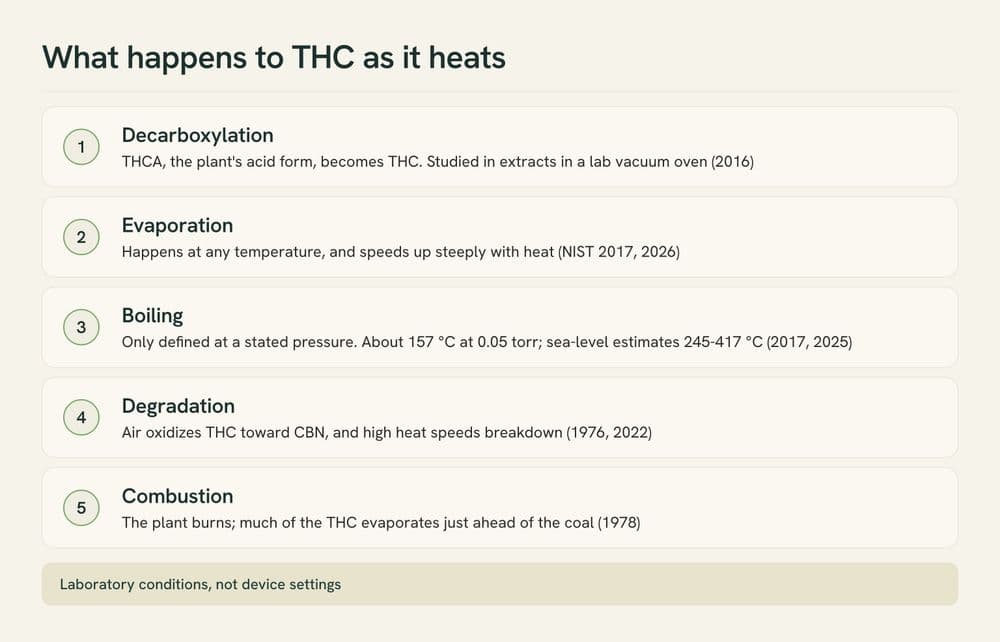
Most pages call all of these "the temperature". They are five separate events. They happen under different conditions, and only one of them is boiling.
1. Decarboxylation: the acid becomes THC
The living plant makes its THC mostly as THCA, an acid form, rather than as THC itself. Heat removes a carboxyl group and converts it, and this starts far below any boiling estimate. Mechoulam's chapter puts it at about 120-150 °C. In a 2016 kinetics study, extracts heated in a laboratory vacuum oven between 80 and 145 °C decarboxylated in a clean first-order reaction, THCA about twice as fast as the acid forms of CBD and CBG. In the authors' words, the reaction "was forthright with no side reactions or by-products." Those are lab conditions on extracts, not instructions. The acid chemistry itself is covered in our THCA and CBD comparison.
2. Evaporation: vapor long before boiling
Evaporation happens at any temperature; boiling is just the point where it takes over the whole liquid. At room temperature THC barely evaporates. The 2017 NIST paper predicted a vapor pressure of 0.0000257 pascals at 25 °C, which by our arithmetic is about four billion times below normal air pressure. Warm it and that climbs fast. NIST's 2026 measurements found THC's vapor pressure rising from 0.0459 pascals at 91 °C to 7.833 pascals at 151 °C, about 170-fold over 60 degrees. That is why THC becomes vapor well below any boiling estimate, and why the 2025 samples lost mass before they boiled.
3. Boiling: only meaningful at a stated pressure
Boiling is the point where THC's vapor pressure equals the pressure around it. At 0.05 torr that is roughly 155-157 °C. At sea level, the grounded estimates run from about 245 °C to about 417 °C. In open air, though, THC rarely gets the chance to boil cleanly, because the next event is already underway.
4. Degradation: heat plus air makes CBN
Mechoulam wrote: "Most cannabinoids are stable to heat in the absence of air." He noted that neutral cannabinoids can be distilled at up to 200 °C at reduced pressure. Oxygen changes the picture. A 1976 storage study of cannabis found: "Loss of tetrahydrocannabinol after exposure to light does not lead to an increase in cannabinol, but air oxidation in the dark does." High heat speeds breakdown. In a 2022 analysis of pure cannabinoid standards passed through a 300 °C gas-chromatograph inlet for seconds, "17.2% of Δ9-THC was degraded, producing CBN as a by-product." Seven of that paper's eight authors are affiliated with Phytoplant Research, a Spanish cannabinoid company. The study also detected delta-8 THC, but at a constant level the authors say may be contamination of their standard, so it does not show heat turning delta-9 THC into delta-8. For what that oxidation product is, see our explainer on CBN; for how air, light and time affect stored flower, see whether weed goes bad.
5. Combustion: the plant burns, mostly not the THC
Combustion is the plant material catching fire. As the burning section above shows, much of the THC flees just ahead of it, and what the coal reaches is destroyed. The heating coil inside a vape cartridge is a separate story, with its own temperatures and its own chemistry, covered in why a cart tastes burnt.
CBD, THCV and the other numbers on cannabinoid charts
CBD has the same problem, with less data. The 2001 chart gives it 160-180 °C (320-356 °F), with no pressure noted as an exception. The 350 °F figure that circulates for CBD, which we flagged as unattributed in our guide to how CBD oil tastes, falls inside that range, and no source we found attaches a pressure to it. As of October 31, 2026, PubChem's CBD record lists no boiling point at all. The only grounded figure is the 2017 NIST prediction from measured vapor pressures: 695.1 kelvin, about 422 °C, a few degrees above its THC prediction. That is a projection, not a measurement.
THCV appears on the chart as "< 220" °C. The 2025 study measured it too, at 378 ± 4 °C (about 712 °F) corrected to normal pressure, but that sample was 84% THCV and 16% CBV, another cannabinoid, so the number belongs to a concentrate, and the authors note an artifact at about 200 °C in one THCV trace that they could not explain. PubChem's THCV record has no boiling point either. THCV is a propyl analogue of THC, as the 2001 review describes it: the same core with a shorter side chain, three carbons instead of five. In a family of closely related molecules, the smaller member usually boils lower, so a reading 133 degrees above the same lab's THC figure is a surprise. That is our reading of general chemistry, not a finding, and it does not make 378 °C wrong. One impure sample and no replication we could find make it provisional. For what THCV is and how it differs, see THCV versus CBD.
What is still unknown
- No independent lab has repeated the 2025 measurement, as far as we could find on October 31, 2026.
- Nobody has explained the gap of about 170 degrees between the 2025 estimate (245 °C) and the 2017 NIST prediction (about 417 °C).
- No one has published a boiling point for pure THC measured directly at sea-level pressure.
- THC may break down while it heats. NIST notes that at higher temperatures, thermal degradation of the sample can cause large systematic errors, which is part of why this number is hard to get.
- PubChem's 200 °C is listed at 0.02 mm Hg, a lower pressure than the 157 °C figure. Lower pressure should mean a lower boiling temperature, so the two do not fit together, and the record does not show how 200 °C was obtained.
- No study we found has measured an ignition temperature for THC itself.
Frequently asked questions
Only under a near-vacuum. 157 °C is the temperature at which chemists distilled THC at about 0.05 torr, roughly one fifteen-thousandth of normal air pressure. At sea-level pressure, the two estimates based on real measurements are about 245 °C, from a 2025 thermal-analysis study, and about 417 °C, a 2017 NIST prediction from vapor pressures. They disagree, and neither has been repeated.
There is no single evaporation temperature, because evaporation happens at any temperature. At room temperature it is extremely slow: NIST predicts a vapor pressure at 25 °C about four billion times below normal air pressure. Between 91 and 151 °C, NIST measured THC's vapor pressure rising about 170-fold. Evaporation is not boiling, which is why THC becomes vapor well below its boiling point.
It depends on the temperature, the time and the air. Without air, cannabinoids survive a lot: Mechoulam described distilling them at up to 200 °C under reduced pressure. With air, THC oxidizes toward CBN over time. At 300 °C, a few seconds in a lab instrument degraded 17.2% of pure THC, with CBN as a by-product. In a tube sealed and held at 500 °C for 30 minutes, none remained detectable.
No one has measured it at normal pressure, as far as we could find. Charts list 160-180 °C without a pressure, the popular 350 °F figure has no stated source, and PubChem listed no boiling point for CBD as of October 31, 2026. A 2017 NIST study predicted about 422 °C from measured vapor pressures, which is a projection, not a measurement.
Three reasons. The numbers were taken at very different pressures, from near-vacuum to sea level. Most charts copy one 2001 table whose footnote labels its values as atmospheric, even where they match near-vacuum figures. And some pages print computer-model predictions, such as the EPA dashboard's 375 °C average, as if they were measurements.
Not by boiling it off. Water boils at 100 °C at sea level, far below any THC boiling estimate, and THC barely dissolves in water: PubChem lists about 2.8 milligrams per liter at 23 °C. Boiling plant material in plain water mostly cooks the plant. Our hemp tea guide covers what actually ends up in a cup.
THC's boiling point turns out to be less a fact than a measurement problem, and a good lesson in reading any number: ask what pressure, what method and who measured it. For where THC sits among the plant's other compounds, start with our overview of cannabinoids. For what vaporizing changes in practice, read how a dry herb vaporizer compares with smoking. And if your question was really about water, our hemp tea guide covers what reaches the cup.
Writing about hemp, wellness and the small rituals that keep us balanced.