Plants That Contain Cannabinoids: Which Ones Really Do
Cannabis is not the only plant that makes cannabinoids. A South African daisy relative and Radula liverworts make true ones; black pepper, echinacea and kava make non-cannabinoid molecules that bind the same receptors. Chocolate's share is trace at best.
Cannabis gets all the credit, but it is not the only living thing whose chemistry overlaps with your endocannabinoid system. The plants that contain cannabinoids, or something close to them, fall into three very different groups. A few unrelated plants really do make cannabinoids. A larger group makes molecules that touch cannabinoid receptors without being cannabinoids at all. And a couple of foods carry trace amounts of the body's own cannabinoid signals. Most lists online lump all of this together. This page sorts it out.
The short answer: a South African daisy relative (Helichrysum umbraculigerum) makes true, cannabis-type cannabinoids, and Radula liverworts make a THC-like one. A Siberian rhododendron makes a close chemical cousin, and reports from a tropical tree in cannabis's own family, Trema, are disputed. Black pepper, echinacea, kava and carrots make molecules that bind cannabinoid receptors in lab tests but are not cannabinoids by structure. Cacao and black truffles (a fungus) carry anandamide-type fats in trace amounts. None of them is a source of CBD.
What plants have cannabinoids? It depends on the definition
Part of the confusion is that the word has two meanings. Chemists use "cannabinoid" for a specific family of molecules from cannabis: the terpenophenolic compounds such as THC, CBD and CBGA (a terpenophenolic is a molecule built from a terpene piece joined to a phenol ring). A 2010 review in the British Journal of Pharmacology by Jürg Gertsch, Roger Pertwee and Vincenzo Di Marzo widened "phytocannabinoid" to any plant compound that acts directly on cannabinoid receptors, looks like a cannabinoid, or both. If you want the cannabis side of the family tree first, start with our guide to what cannabinoids are.
The two receptors in play are CB1, concentrated in the brain and the one behind THC's high, and CB2, found mostly on immune cells. Our endocannabinoid system explainer covers how they work. The 2010 review drew a second line between plant molecules. Some bind these receptors directly, with high affinity "in the lower nM range" (nanomolar: the lower the number, the tighter the grip). Others only change how fast the body makes or breaks down its own cannabinoids, anandamide and 2-AG. Those are indirect actors, and they are a different thing from a cannabinoid.
“At present, the only phytocannabinoid that has been discovered to also exist in plants other than Cannabis is β-caryophyllene.”
That was the expert verdict in 2010: one molecule outside cannabis, and it was a terpene best known from black pepper. Two discoveries since then changed the list. In 2018 a Swiss team worked out how a liverwort molecule acts on CB1, and in 2023 an Israeli team showed that a daisy relative builds cannabinoids with machinery it evolved on its own. So the honest answer to "what plants have cannabinoids" depends on which definition you use, and on the year of the source you are reading.
To keep the two meanings apart, this page sorts the plants into three groups. The sorting is ours, not the 2010 review's. Group 1 makes molecules that are cannabinoids by chemical structure. Group 2 makes molecules that bind cannabinoid receptors but are not built like cannabinoids; some of them still count as phytocannabinoids under the broad 2010 definition, which is exactly why the word causes trouble. Group 3 is foods that carry the body's own type of cannabinoid, the endocannabinoids, rather than plant ones.
Plants that contain cannabinoids: the three groups at a glance
Every binding number below comes from cells or purified receptors in a lab, with the assay named. Ki (the inhibition constant) measures how tightly a molecule binds: lower means tighter. Numbers from different labs and assays are not perfectly comparable, and none of them describes what happens in a person who eats the plant.
| Plant | Compound | Group | Receptor binding (assay) | Evidence type | What it does not mean |
|---|---|---|---|---|---|
| Helichrysum umbraculigerum (daisy family, South Africa) | Cannabis-type cannabinoids, e.g. 4.3% CBGA | 1: cannabinoid by structure | Not measured in the 2023 paper | Plant genomics and chemistry | The paper's example is CBGA, not CBD; no human or animal data |
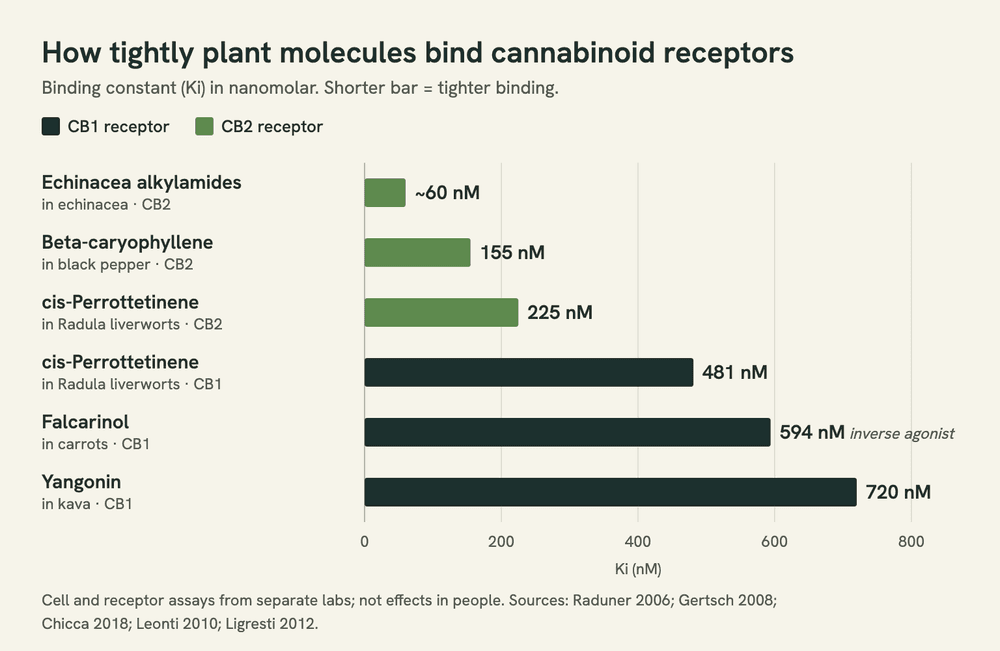
| Radula liverworts | Perrottetinene (cis-PET), THC-like | 1: cannabinoid by structure | CB1 Ki 481 nM, CB2 Ki 225 nM (human receptors, cell assays) | Cell assays plus injected mice, lab-made material | No human data; about 10x less potent than THC at CB1 in cells |
| Rhododendron dauricum | Daurichromenic acid | 1: cannabinoid-like cousin | None reported | Plant enzyme biochemistry | Not shown to act on cannabinoid receptors |
| Trema orientalis, T. micranthum (cannabis family) | THC, CBD, CBN reported | 1: disputed | None reported | Plant chemistry; labs disagree | Parts per billion where quantified; not independently confirmed |
| Black pepper, oregano, cinnamon | Beta-caryophyllene (a terpene) | 2: receptor-active | CB2 Ki 155 nM (human CB2 in HEK293 cells); selective for CB2 | Cell assays | Not CBD; does not target CB1, the receptor behind THC's high |
| Echinacea | Alkylamides A1 and A2 | 2: receptor-active | CB2 Ki about 60 nM, CB1 above 1,500 nM (receptor binding assays) | Cell assays | Contains no CBD; binding in a dish is not an effect |
| Kava | Yangonin | 2: receptor-active | CB1 Ki 0.72 µM (720 nM), CB2 above 10 µM (human recombinant receptors) | Cell assays | Only 1 of 5 kavalactones tested bound; nothing measured in people |
| Carrots, parsley, celery, ginseng | Falcarinol | 2: receptor-active, a blocker | CB1 Ki 594 nM, covalent inverse agonist (CB1 in CHO cells) | Cell assays | Pushes CB1 the opposite way to THC |
| Cacao | Anandamide and related N-acylethanolamines | 3: endocannabinoid-type | No binding constant; its two most abundant N-acylethanolamines do not activate brain cannabinoid receptors (1996 authors' 1998 reply) | Food chemistry; oral dosing in mice | Anandamide no more than trace; too little for a cannabis-like effect |
| Black truffle (a fungus, not a plant) | Anandamide | 3: endocannabinoid-type | No binding data; the truffle itself does not express the main endocannabinoid receptors | Fungal molecular biology; LC-MS measurement | No amount given in the study abstract; no effect measured in people who eat truffles |
Plants that make true cannabinoids
Helichrysum umbraculigerum, a South African daisy relative
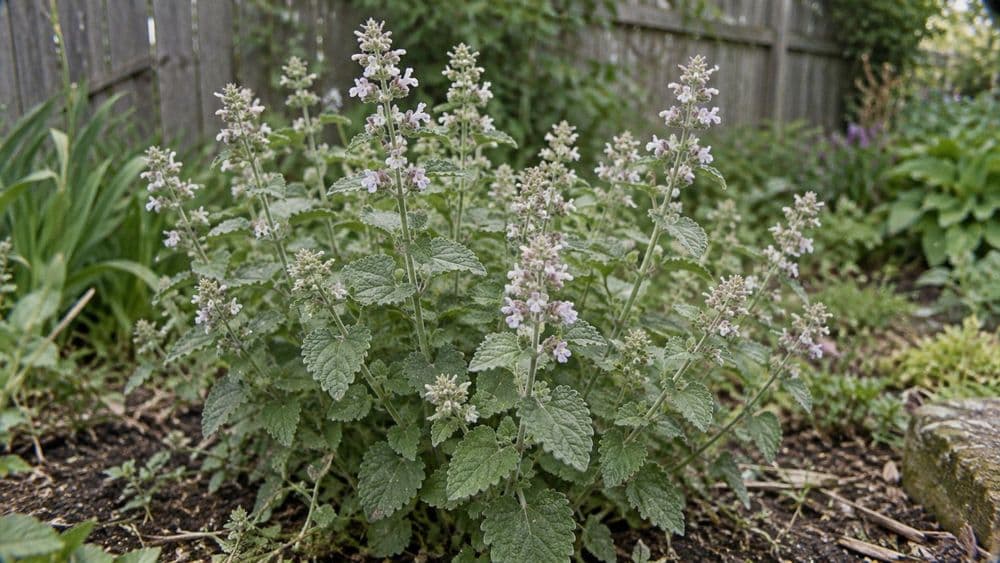
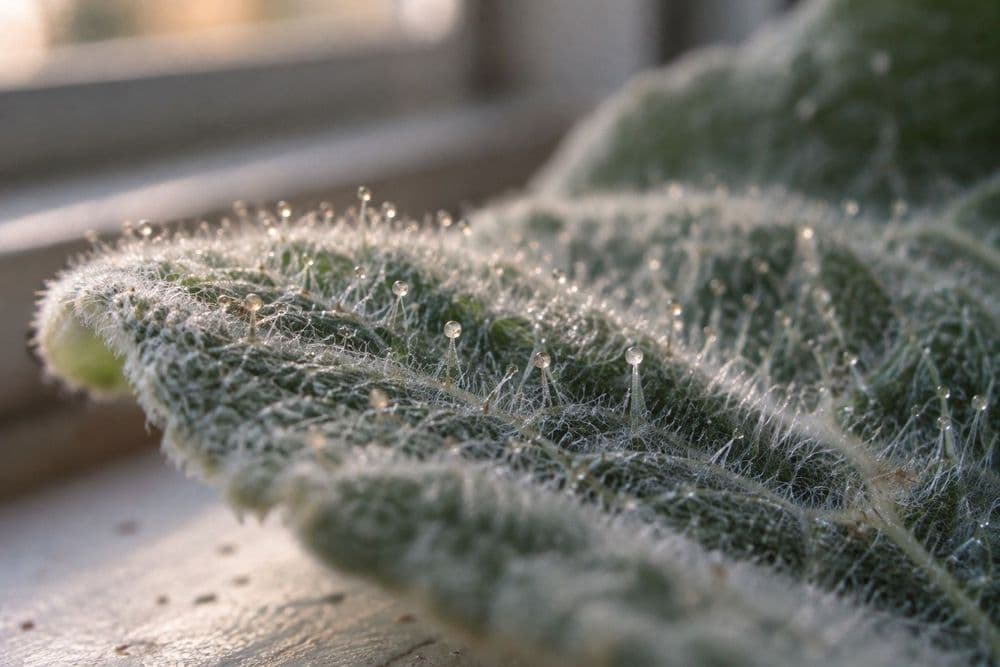
The clearest case is Helichrysum umbraculigerum, a woolly shrub in the daisy family (Asteraceae) that is not related to cannabis. In 2023 a Weizmann Institute team reported in Nature Plants that this Helichrysum makes cannabis-type cannabinoids, giving 4.3% cannabigerolic acid (CBGA) as an example. CBGA is the same starting molecule that cannabis converts into THCA, CBDA and CBCA, which our explainer on CBGA, the precursor cannabinoid walks through step by step.
Two details make this paper worth knowing. The first is location: cannabis concentrates its cannabinoids in the resin glands of its flowers, while this shrub keeps them in glandular hairs on its leaves. The second is ancestry. Reading its genome, the team concluded that the pathway evolved in parallel, meaning the daisy relative reached cannabinoids by its own route instead of inheriting the ability from an ancestor it shares with cannabis. The team also reported previously unknown cannabinoid metabolites, whose activity at the receptors the paper does not describe. What the paper does not include is any human or animal data. It is plant chemistry.
Radula liverworts and perrottetinene
Next comes a plant most people would walk past without noticing. Radula is a genus of liverworts, small, flat, moss-like plants; one species, Radula marginata, grows in New Zealand and Tasmania. These liverworts contain perrottetinene (PET), a molecule built much like THC but with a different side group. In a 2018 Science Advances study of perrottetinene, a team from Bern and ETH Zurich made the molecule from scratch in the lab and tested it.
In cell assays using human receptors, the natural form, cis-PET, bound CB1 with a Ki of 481 nM and CB2 with a Ki of 225 nM. At CB1 it was about 10 times less potent than THC (an EC50 of 406 nM versus 43 nM; EC50 is the concentration that produces half the maximum response). Injected into mice at 50 mg/kg, it produced the set of four THC-like signs researchers use as a CB1 fingerprint, and those signs depended on CB1. The authors note that Radula preparations are sold online as a cannabinoid-like "legal high" even though pharmacological data had been lacking. Keep the limits in view: that is mouse data with lab-made material, nobody has measured what the plant itself does in people, and this page does not cover sourcing or legal status.
Rhododendron dauricum, a cannabinoid cousin
A third lineage is a Siberian rhododendron, Rhododendron dauricum. Its leaves carry daurichromenic acid, made in tiny scales on the leaf surface. A 2017 Plant Physiology study of the enzyme that builds it found that its reaction mechanism partly resembles the enzymes cannabis uses to make cannabinoids, and that the finished molecule carries a ring similar to the one in CBCA. It is a cousin rather than a twin. It is built on a farnesyl chain of 15 carbons, where cannabis cannabinoids use a 10-carbon geranyl chain, and no receptor data were reported for it.
The disputed case: Trema, cannabis's tropical cousin
Trema is a genus of fast-growing tropical trees in Cannabaceae, the same plant family as cannabis and hops. It is the plant behind most "another plant makes CBD" headlines, and the primary papers disagree. In a 2021 PeerJ analysis of Trema orientalis flowers from Thailand, a team found CBN in all nine samples, THC in four and CBD in two, using GC-MS (gas chromatography with mass spectrometry, a method that heats the sample). The paper's units differ between its methods and its results table, so we do not repeat its concentrations.
In 2024 a Brazilian team using high-resolution mass spectrometry reported CBD in Trema micranthum leaf extract at 4.43 billionths of a gram per gram, about four parts per billion, measured per gram of extract rather than per gram of dried leaf. Its leaf THC value fell below the method's own limit of quantification, so it is not a firm number. The same year, a second Brazilian group tested the same species and could not confirm any cannabinoids: its color screening test lit up, but more selective methods did not, and the authors warned against "false-positive claims." The two studies used different samples and instruments, so they do not cancel each other out. They disagree, and the question is open. Since then, the lab behind the positive result has reported 26 cannabinoids in the species using a mass-spectrometry profiling system it developed. That is a follow-up from the same group, not an independent confirmation, and the dispute stands until another lab repeats it.
Hops make a useful contrast. They are cannabis's closest well-known relative, and they make no cannabinoids; the genes that build THC and CBD arose on the cannabis branch. The full family tree is in are hops and weed related. So within the same plant family, hops have been checked and make none, while Trema remains disputed.
Plants whose molecules touch cannabinoid receptors
The second group is bigger and easier to find in a kitchen. These plants make molecules that bind cannabinoid receptors in lab tests but are not built like cannabinoids. Each entry below is a binding result from cells or purified receptors, with the assay named.
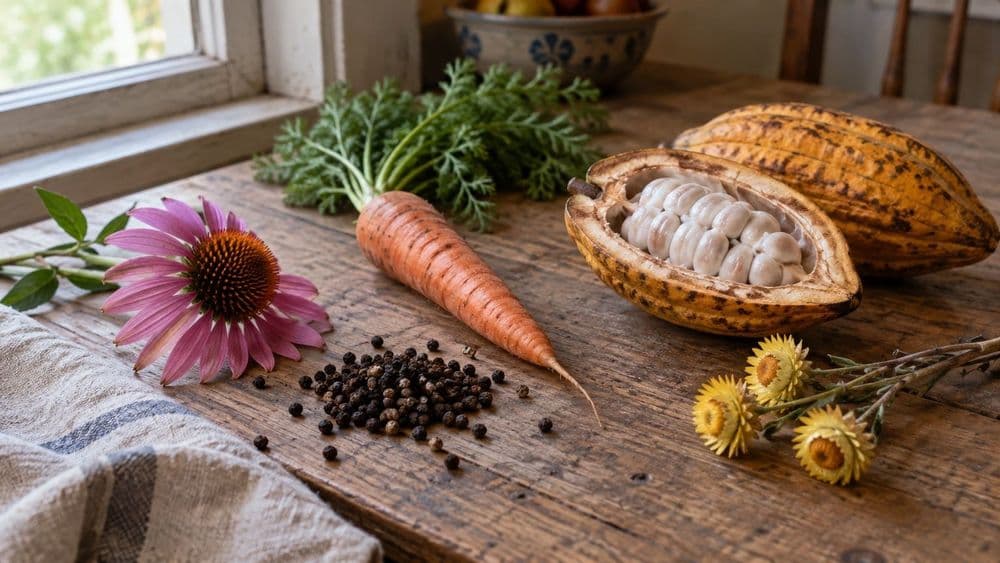
Black pepper, oregano and cinnamon: beta-caryophyllene. This is the case that made "dietary cannabinoid" a phrase. A 2008 PNAS paper that called beta-caryophyllene a dietary cannabinoid found it binds the human CB2 receptor in HEK293 cells with a Ki of 155 nM and switches it on, while staying selective for CB2 over CB1. The authors estimated people eat 10-200 mg a day of it in ordinary food; that is an estimate, not a measurement. Chemically it is a terpene, which is why our comparison of cannabinoids and terpenes files it there. A 2020 study that screened common cannabis terpenes at both receptors found no support for them acting at CB1 or CB2, with one hedge: a possible weak interaction of beta-caryophyllene with CB2.
Echinacea: alkylamides. The tingly alkylamides in echinacea are a cleaner example. A 2006 receptor-binding study of echinacea alkylamides measured two of them binding CB2 at about 60 nM, more tightly than anandamide, the body's own cannabinoid, managed in the same experiments (CB2 Ki above 200 nM), while barely touching CB1 (above 1,500 nM). Echinacea contains no CBD, and a binding number in a dish is not an effect in a person.
Kava: yangonin. Of five natural kavalactones tested in a 2012 study of kavalactones at cannabinoid receptors, only yangonin bound the human CB1 receptor, at a Ki of 0.72 µM (720 nM), with CB2 above 10 µM. That is far weaker than the low-nanomolar binding the 2010 review used to define a direct ligand. Whether it matters in people is unmeasured. Our guide to combining CBD and kava covers what is known about using the two together.
Carrots, parsley, celery and ginseng: falcarinol. Carrots point the other way. In a 2010 study of falcarinol at the CB1 receptor, this molecule latched permanently onto CB1 in cell assays (Ki 594 nM) and pushed it in the opposite direction to THC, which makes it a covalent inverse agonist. The falcarinol tested was purified from a different plant, and the paper gives no amounts for carrots. A carrot is not a cannabinoid, and it is certainly not a THC-like one.
Green tea, turmeric and grapes show up on many of these lists too. The 2010 review checked them: an early paper claiming strong binding by tea catechins was retracted, and the reviewers' own tests found binding "only at high µM concentrations," micromolar rather than nanomolar. The same review closed on a warning that applies to this whole group: "clinical evidence is lacking." A tight binding constant in a dish tells you a molecule fits the receptor. It does not tell you that eating the plant delivers enough of it to matter.
Chocolate, truffles and the body's own cannabinoids
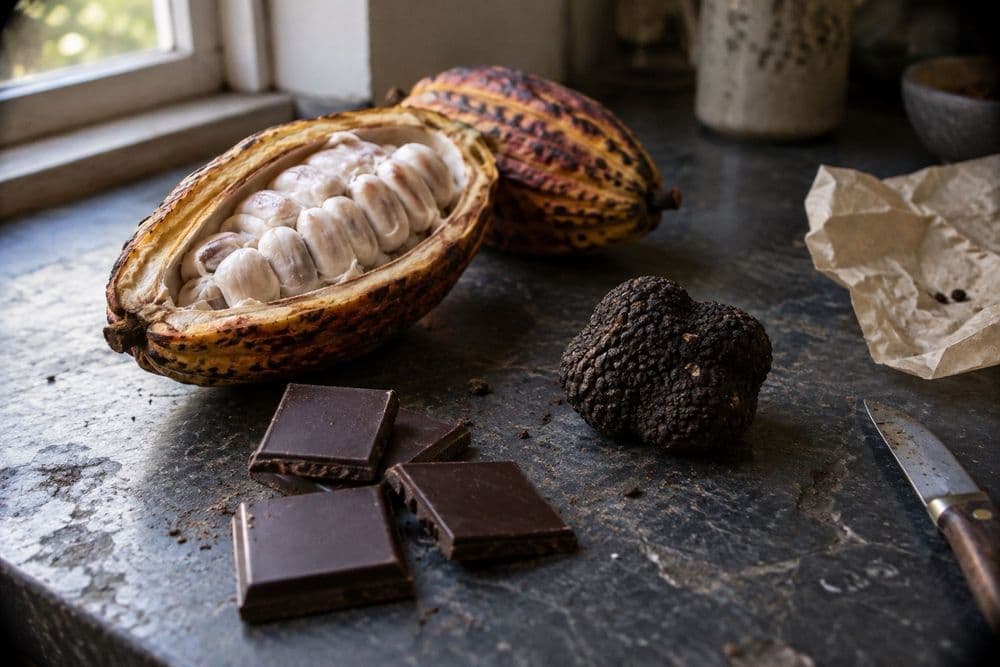
The third group is the one that made headlines. In 1996 a letter in Nature on brain cannabinoids in chocolate reported anandamide, the body's own cannabinoid signal, plus related fats called N-acylethanolamines, in chocolate. Two years later a team including Raphael Mechoulam measured cocoa and found "no or very little anandamide" (below 0.003 µg per gram of cocoa powder), with levels of the related fats similar to soybeans, hazelnuts and oatmeal. They concluded it was "not sufficient to produce cannabis-like effects in mammals." Even the 1996 authors, in their 1998 reply, wrote that chocolate's N-acylethanolamines "do not activate brain cannabinoid receptors." The full chocolate story, including what that means for edibles, is in our THC chocolate guide.
Black truffles are not plants, they are fungi, but they belong here because a 2015 study of black truffles found anandamide in Tuber melanosporum, along with most of the enzymes that make and break it down. It did not find the main receptors anandamide acts on, and 2-AG, the other major endocannabinoid, was below the detection limit. The authors' hypothesis is that anandamide may help attract the animals that dig truffles up and spread their spores. The abstract gives no amount, and no one has measured whether a truffle-sized serving does anything to the person eating it.
Palmitoylethanolamide, another fat in the same chemical family that the body makes and some foods contain, is not a phytocannabinoid and has its own page: what PEA is and what trials show.
Myths, checked
"Chocolate gets you high because of anandamide." False. The 1998 measurement found no or very little anandamide in cocoa, too little for any cannabis-like effect, and even the original 1996 authors agreed its related fats do not activate brain cannabinoid receptors.
"Black pepper is a cannabinoid, so it works like CBD." No. Beta-caryophyllene is a terpene that binds CB2 in cell assays. It is not CBD, it is selective for CB2 over CB1, and nothing about it has been shown to act like CBD in people. Whether pepper changes a high is a separate food-folklore question, covered in our piece on mango, pepper and weed.
"Echinacea is a natural CBD." No. Echinacea contains no CBD. Its alkylamides bind CB2 in receptor assays, which is a lab measurement, not an effect.
"There is a legal THC plant." Not shown. The THC-like liverwort molecule's data come from cell assays and injected mice using lab-made material. Nothing has been measured in people, and this page does not cover sourcing or legal status.
"Hops contain CBD." No. Hops are cannabis's relative, but they make no cannabinoids.
Why none of these plants is a CBD source
It is tempting to read "this plant contains cannabinoids" as "this plant could replace hemp." The numbers say otherwise. Here is the arithmetic on the only CBD-positive report with a quantified figure outside cannabis, using a round 25 mg as an illustration, not a dose recommendation.
The math: 4.43 ng is 0.00443 µg, and 25,000 µg divided by 0.00443 µg per gram is about 5.6 million grams, roughly five and a half metric tonnes of leaf extract. Because the figure is per gram of extract, the amount of leaf needed would be larger still. And that is the optimistic case: another lab could not find any CBD in the same species at all. The other plants on this page do not get you closer. Helichrysum's documented example cannabinoid is CBGA, not CBD. The Group 2 and Group 3 molecules are not CBD or THC in any form. If you want to see where CBGA, CBN and the rest sit next to CBD and THC, our guide to major and minor cannabinoids lays out the family.
What is still unknown
Human data. We found no human study of any Group 1 molecule from these plants. The perrottetinene work is cell assays and injected mice.
Helichrysum's new molecules. The 2023 paper reported previously unknown cannabinoid metabolites, but did not describe their activity at cannabinoid receptors.
Trema. One lab reports parts-per-billion CBD and, in a follow-up, 26 cannabinoids; another lab could not confirm any. Independent replication would settle it.
Amounts in real servings. For most Group 2 and Group 3 foods, nobody has published how much of the active molecule a normal serving delivers or whether it reaches the receptors.
Effects. A binding constant in a dish is not an effect in a person. As the 2010 review put it, "clinical evidence is lacking."
Frequently asked questions
By chemical structure, Helichrysum umbraculigerum (a South African daisy relative) makes cannabis-type cannabinoids such as CBGA, and Radula liverworts make perrottetinene, a THC-like cannabinoid. Rhododendron dauricum makes a close cousin, daurichromenic acid. Reports of THC and CBD in Trema trees are disputed between labs. Black pepper, echinacea, kava and carrots make molecules that bind cannabinoid receptors in lab tests without being cannabinoids by structure.
Trace at most. A 1996 letter reported anandamide in chocolate, but a 1998 measurement found "no or very little anandamide" in cocoa and concluded the amounts were "not sufficient to produce cannabis-like effects in mammals." Our THC chocolate guide covers the edible side of the question.
It depends on the definition. Its aroma molecule beta-caryophyllene binds the CB2 receptor in cell assays (Ki 155 nM), and a 2008 paper called it a "dietary cannabinoid" on that functional basis. Chemically it is a terpene, not a cannabinoid. It is not CBD, it is selective for CB2 over CB1, and no cannabinoid effect has been shown in people.
No. Echinacea contains no CBD. Two of its alkylamides bind the CB2 receptor in lab assays at about 60 nM, but that is a different molecule and a lab measurement, not an effect in a person.
The one THC-like plant molecule with receptor data, perrottetinene from Radula liverworts, was tested in cell assays and in injected mice using lab-made material, where it was about 10 times less potent than THC at CB1 in cells. Nobody has measured what the plant does in people. This page does not give sourcing or legal information about liverwort preparations.
No. Helichrysum's documented example cannabinoid is CBGA. The one CBD-positive Trema report measured about four parts per billion in leaf extract, which works out to roughly 5.6 tonnes of extract per 25 mg, and a second lab could not confirm any CBD in the same species.
Keep reading the Cannabinoid Atlas. This page covers the plants outside cannabis. For the cannabis cannabinoids themselves, how they are defined, made and grouped from CBGA to THC and CBD, head back to the Cannabinoid Atlas hub.
Writing about hemp, wellness and the small rituals that keep us balanced.