Palmitoylethanolamide (PEA): What It Is and What Trials Show
PEA is a fat-derived molecule your body makes, a chemical sibling of anandamide that barely touches CB1 or CB2. Here is what it binds, what the human trials measured and their limits, why it sells as a supplement when CBD can't, and what is still unknown.
Palmitoylethanolamide, usually shortened to PEA, is a fat-derived molecule your body makes on demand and a close chemical sibling of anandamide. But it is not a cannabinoid in the receptor sense: in cell tests it barely touches CB1 or CB2, and animal work points mainly to a different receptor, PPAR-alpha. Human trials are mostly small studies in patients, with mixed quality. In the US it is sold as a dietary supplement, and FDA has not evaluated it.
If you met PEA on a supplement shelf or in a forum thread, it was probably wearing one of two labels: "endocannabinoid" or "pain supplement". Neither holds up well once you read the primary papers. Below you get the chemical family PEA belongs to, the binding numbers that settle the cannabinoid question, the separate "entourage" idea attached to PEA, an evidence ledger of what the human trials measured (with their size, their disagreement and their manufacturer ties), what a national food-safety agency concluded, and why PEA can be sold as a supplement when CBD cannot. If the endocannabinoid system is new to you, start with how the endocannabinoid system works, which covers anandamide, its receptors and the enzymes that clear it. This page explains a molecule and its evidence. It is not medical advice, and Planntz does not sell PEA.
What palmitoylethanolamide is
Chemically, PEA is the amide of palmitic acid (a common saturated fatty acid, named after palm oil) and ethanolamine, a small molecule that also forms the head of anandamide. According to a 2016 critical review in the British Journal of Clinical Pharmacology, PEA was identified in the 1950s as an anti-inflammatory factor in chicken egg yolk, and in mammals it "is produced on demand from the lipid bilayer and is ubiquitous." In plain terms: PEA is a fat-derived molecule your cells build from their own membranes when they need it, the same way they make anandamide.
Your body also has to clear it. A 2005 enzyme study using recombinant human enzymes found that NAAA (N-acylethanolamine-hydrolyzing acid amidase) breaks down several molecules in this family, with PEA "as the most reactive substrate." FAAH, the same enzyme that clears anandamide, also breaks it down. That shared enzyme matters later, because it is the basis of one of PEA's proposed indirect effects.
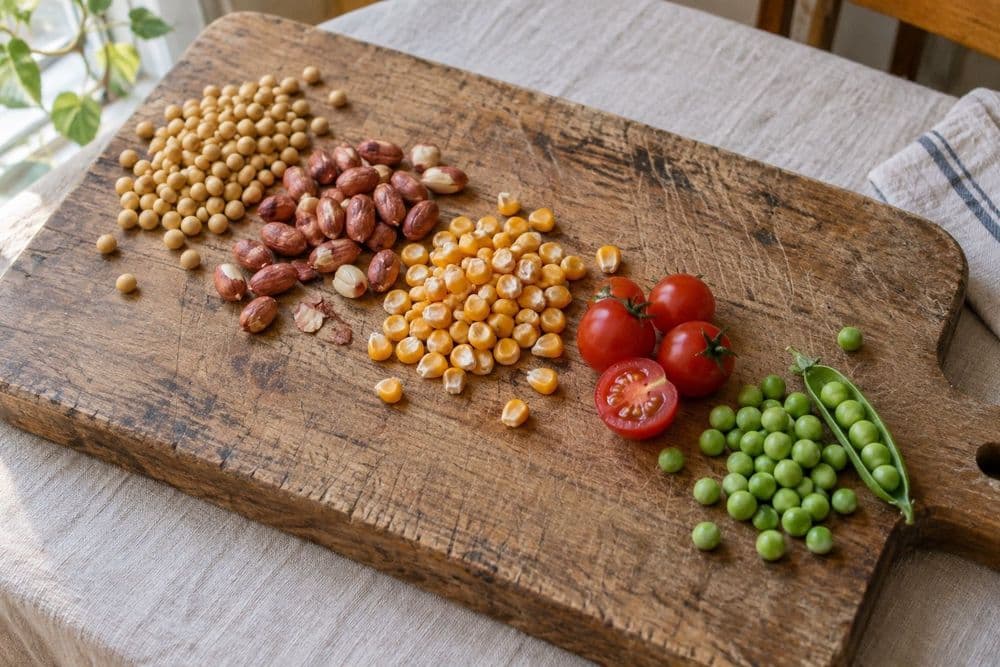
One clarification saves a lot of confusion: PEA has nothing to do with pea protein. The three letters are an abbreviation, not a vegetable. Garden peas do contain trace PEA, about 100 nanograms per gram, but so do many foods, as the food table further down shows.
Is PEA a cannabinoid?
A cannabinoid, in the receptor sense, is a molecule that acts at CB1 or CB2, the two receptors that THC and anandamide use. (Our guide to what counts as a cannabinoid covers the wider definition.) PEA fails that test. In a 1999 binding study using rat spleen and cells engineered to carry the human receptors, PEA was at best a weak ligand, did not recognize human CB1 or CB2 in the engineered cells, and the authors concluded "it seems unlikely" that PEA is a natural activator of CB2.
Then where does it act? Two leads stand out. A 2007 cell study from AstraZeneca researchers found PEA active at GPR55, an orphan receptor, at concentrations thousands of times lower than any it needed at CB1 or CB2 in the same assay. Other labs have not settled that result: a 2017 pharmacology review, whose first author works for Epitech Group, an Italian PEA manufacturer, calls GPR55 activation "still controversial." The clearest mechanism comes from a 2005 mouse study in Molecular Pharmacology. PEA activated PPAR-alpha, a nuclear receptor that switches genes on and off, in vitro (half-maximal effect at 3.1 micromolar), and its anti-swelling effect in two induced-inflammation models vanished in mice bred without PPAR-alpha. That is an animal finding about paw and ear swelling, not evidence about people.
| Molecule | Chemical class | Main targets in lab and animal studies | Made on demand by the body? | Where we cover it |
|---|---|---|---|---|
| Anandamide (AEA) | N-acylethanolamine with an arachidonic acid tail | CB1 and CB2; also TRPV1 | Yes | Our endocannabinoid system guide |
| 2-AG | Monoacylglycerol (a glycerol ester, not an ethanolamine) | CB1 and CB2 | Yes | Our endocannabinoid system guide |
| PEA | N-acylethanolamine with a palmitic acid tail | PPAR-alpha; reported GPR55 (contested); indirect effects on TRPV1 and on anandamide signaling; barely binds CB1 or CB2 | Yes | This page |
| OEA | N-acylethanolamine with an oleic acid tail | PPAR-alpha; does not activate cannabinoid receptors (rodent studies) | Yes | This page, one paragraph below |
| DHEA and EPEA | N-acylethanolamines with omega-3 tails | Covered separately | Depends on omega-3 fats in the diet | Our CBD and omega-3 guide |
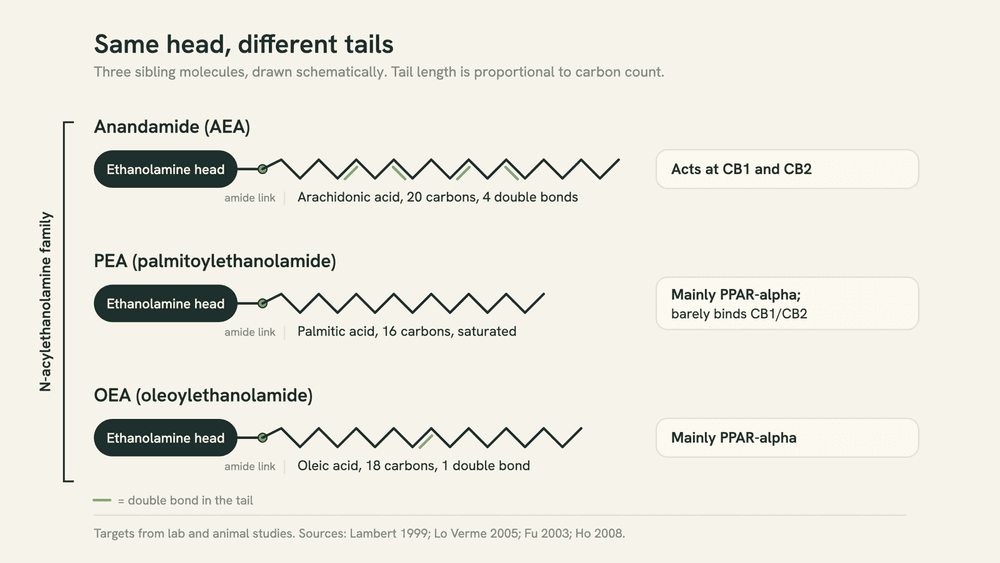
So why do some supplement labels and even some papers call PEA an endocannabinoid? Partly family resemblance: anandamide, PEA and OEA share the same ethanolamine head and differ only in their fatty-acid tail, and a 2008 rat-artery study notes that anandamide "is co-synthesized" with PEA and OEA. They are siblings, made by the same machinery. Partly the indirect effects described in the next section. Endocannabinoid-like is the honest label: same chemical family, same breakdown enzyme, different receptors. The omega-3 members of the family are their own story, told in our guide to CBD and omega-3. And PEA does not belong in the plant vocabulary of major and minor cannabinoids, which sorts phytocannabinoids, compounds made by the cannabis plant. PEA is a lipid our own bodies make, and it is also present in small amounts in plant seeds and many foods.
The entourage idea behind PEA (not the one you have read about)
If PEA does not hit cannabinoid receptors directly, how could it touch the endocannabinoid system at all? The proposed answer is an entourage effect: PEA might help anandamide work harder. Three lab findings support the idea. In a 2001 study in rat brain tissue and cell lines, PEA slowed FAAH's breakdown of anandamide at around 10 micromolar, which is one proposed way it could leave more anandamide around. In a 2002 study in cells carrying the human TRPV1 receptor, PEA produced a response of its own and made anandamide's signal stronger, and that boost did not track with the enzyme effect, so there may be more than one route. And the 2008 rat-artery study, which put the word entourage in its title, found that PEA and OEA strengthened anandamide's relaxing effect on small arteries through TRPV1, at ratios similar to those found in the arteries themselves.
Notice what the three have in common: test tubes, cells and rat tissue, at micromolar concentrations. None of them measured whether a PEA supplement changes anandamide signaling in a living person.
We tell the 1998 story, and how it grew into the plant-extract claim, in where the entourage effect actually comes from.
PEA's closest sibling deserves a paragraph of its own. Oleoylethanolamide (OEA) carries an oleic acid tail, the main fatty acid in olive oil, and it also skips the cannabinoid receptors. A 2001 Nature paper reported that "OEA does not activate cannabinoid receptors" and that food deprivation "markedly reduces OEA biosynthesis in the small intestine" of rats. Follow-up work in rodents, published in 2003, tied OEA's effect on feeding to PPAR-alpha, the same receptor that dominates the PEA story. In rats, OEA behaves like a fullness signal from the gut. Whether that means anything for appetite or weight in people is a separate question, and this page does not answer it.
What the human trials actually measured
Here is the part sales pages skip. Most PEA trials enrolled people with a specific condition, most often a pain condition, not healthy adults. A PubMed search on October 22, 2026 for PEA systematic reviews and meta-analyses returned 38 records. The ledger below covers the ones that matter most, described as what they are: trials in people with particular conditions that measured particular outcomes, usually a pain score.
The ledger draws on five sources: a 2017 meta-analysis in Pain Physician, an early pooled analysis of pain trials; a 2023 meta-analysis in Nutrients limited to double-blind trials, the strictest of the pooled analyses here; a 2025 meta-analysis in Nutrition Reviews, the largest recent pooled analysis we found; a 2025 systematic review of every randomized PEA trial across all conditions; and a 2016 double-blind trial in spinal cord injury, one of the better-run single studies.
| Study | Design and size | Who was studied | What was measured and reported | Stated limits and ties |
|---|---|---|---|---|
| Artukoglu et al., 2017 | Meta-analysis: 10 randomized trials (786 people on PEA, 512 controls), 8 pooled | People with assorted acute or chronic pain conditions | Pain scores on visual scales: lower with PEA than with an inactive control | Authors: a relatively small number of trials across many conditions; trial quality and side-effect reporting often poor. 2 of 5 authors at Therapix Biosciences |
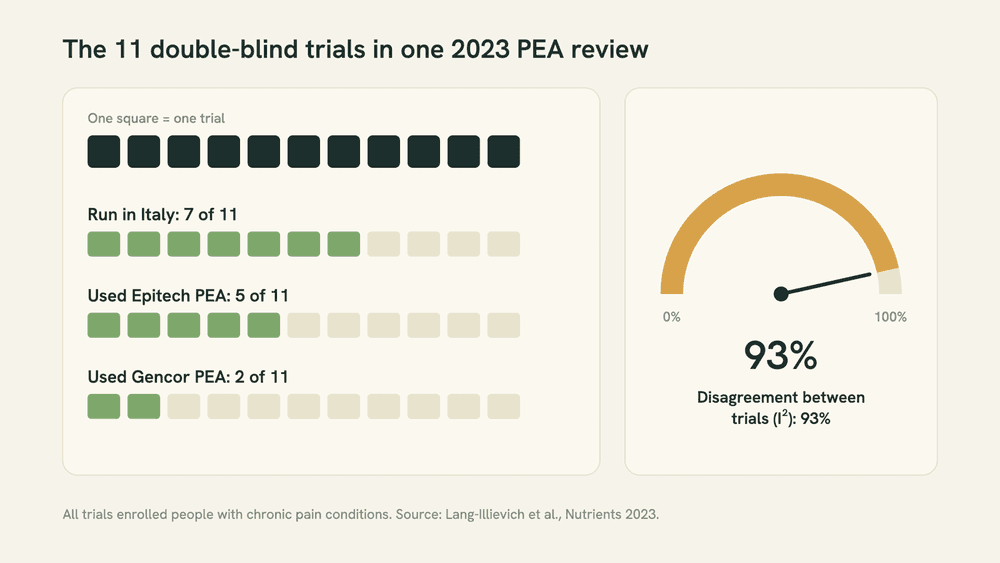
| Lang-Illievich et al., 2023 | Meta-analysis: 11 double-blind randomized trials, about 770 patients, published 2011 to 2022 | Chronic pain of 11 kinds, from carpal tunnel syndrome to knee osteoarthritis and painful periods | Pain scores: pooled result lower with PEA. The trials used 300 to 1,200 mg a day | Heterogeneity I² = 93%. 7 of 11 trials Italian; 5 used Epitech PEA, 2 used Gencor PEA (one company-funded). The review itself had no external funding |
| Viña and López-Moreno, 2025 | Meta-analysis: 18 randomized trials, about 1,200 patients | People with chronic pain | Pain scores: same direction as the two above | Full text paywalled; heterogeneity not reported in the abstract we read |
| Bortoletto et al., 2025 | Systematic review of 47 randomized trials, no single pooled number | Neuropsychiatric, neurological, somatic and visceral conditions | The most consistent results were in pain and general-wellbeing measures | Conditions too varied to pool. One author consults for GW Pharma, outside this work |
| Andresen et al., 2016 | Double-blind randomized trial, multicenter (Denmark), 73 people, 12 weeks | Nerve pain after spinal cord injury | Pain intensity: no difference from placebo (P = 0.46); no more side effects than placebo | One condition. Ultramicronized PEA supplied by Epitech |
Read the ledger across, not just down. The pooled analyses lean the same way, but the strictest one, with only double-blind trials and independent authors, found the trials so different from one another that I², the statistic for disagreement between studies, sat at 93%. When disagreement is that high, a single pooled number averages together different conditions, doses, durations and comparison groups, and hides more than it shows. Seven of those eleven trials were run in Italy. Five used PEA from Epitech Group, the Italian maker of the Normast brand, and two used PEA from Gencor, the maker of Levagen. An earlier analysis from the manufacturer's side, a 2016 pooled-data paper with two Epitech authors, combined 12 studies, seven of them open-label with no comparison group at all. None of this means the results are wrong. It means human evidence comes mostly from small trials in specific patient groups, with mixed quality and a narrow set of suppliers.
The most useful single trial for calibrating expectations is a negative one. In 73 people with nerve pain after spinal cord injury, ultramicronized PEA added to their usual care for 12 weeks produced no difference in pain intensity from placebo, and it was not associated with more side effects than placebo. It was double-blind, multicenter and reasonably sized for this field, and it sits inside the 2023 pool that still came out positive overall. That is exactly the kind of result a vendor summary leaves out.
What these trials cannot tell you
- Whether PEA does anything in healthy people. The trials enrolled patients with specific conditions.
- Long-term effects. A 2016 review found too few patients treated beyond 60 days to rule out side effects rarer than 1 in 100.
- Which product. Many trials used one of two branded ingredients, so results may not transfer to other powders or to blends.
- How PEA compares with established treatments. The pooled trials compared it with placebo or an inactive control, not head to head.
- What amount, if any, makes sense for you. The trials used 300 to 1,200 mg a day on different schedules, and that range is a research fact, not a recommendation.
Side effects and what is still unknown
Side-effect reporting in these trials was thin, which is itself a finding. In the 2023 review, six trials reported no side effects, three found no difference from placebo, and one described a "very low incidence of mild and transient gastrointestinal symptoms." WebMD's pharmacist-written monograph on PEA lists upset stomach as the most common complaint. The 2016 critical review put numbers on how far the data reach: for treatment up to 49 days, the trials argue against a serious adverse reaction in 1 of every 200 people or more, but for treatment beyond 60 days there are too few patients to rule out problems rarer than 1 in 100. We found no NIH Office of Dietary Supplements fact sheet on PEA.
Animal toxicology is reassuring as far as it goes. In standard rat and cell tests published in 2017, sponsored by Prismic Pharmaceuticals, researchers reported no genetic toxicity and no toxic effect over 90 days even at the highest dose they tried, 1,000 mg per kg of body weight a day. That also means they never found where trouble starts, and Danish assessors later questioned whether one of the gene tests was valid for a powder that did not dissolve. Denmark's national food institute (DTU) leaned on that rat study when the Danish food agency asked it to assess PEA supplements, first in a 2018 memo and again in a 2023 memo (both in Danish). Applying a 200-fold safety factor to the rat data, it could not rule out a risk above about 350 mg a day for a 70 kg adult. That is a precautionary calculation from rat data by one agency, not a finding of harm and not a dose recommendation. DTU also noted that the human studies submitted to it had enrolled only patients, so they could not inform a supplement meant for healthy people.
The rat pregnancy study is a 2021 prenatal toxicity test at up to 1,000 mg/kg during gestation. It did not look at offspring fertility, and DTU's own 2023 literature search found no study that did. The practical habit for checking any supplement against your medicines is the same one we lay out in how CBD interacts with medications: bring the full list, supplements included, to your pharmacist.
How much PEA is in food?
| Food | PEA, nanograms per gram fresh weight | PEA per 100 g (our conversion) |
|---|---|---|
| Soy lecithin (a food additive) | 950,000 | about 95 mg |
| Soybeans | 6,700 | about 0.67 mg |
| Peanuts | 3,730 | about 0.37 mg |
| Corn | 200 | about 0.02 mg |
| Black-eyed peas | 138 | about 0.014 mg |
| Tomatoes | 100 | about 0.01 mg |
| Garden peas | 100 | about 0.01 mg |
| Common beans | 53.5 | about 0.005 mg |
| Cow's milk | 0.25 | about 0.000025 mg |
| Egg yolk | Where PEA was first isolated; not quantified in this table | Not measured here |
Most of these figures come from seed and food lipid analyses such as a 2005 Phytochemistry study of seeds, compiled in the 2017 review. Few samples were measured per food, so treat them as orders of magnitude. Denmark's assessors did the math for a 600 mg daily serving: matching it from ordinary food would take about 90 kg of soybeans, 161 kg of peanuts, 3,000 kg of corn or 6,000 kg of tomatoes. For context, the trials in the ledger used 300 to 1,200 mg a day. A supplement serving is not a small top-up to what you already eat at dinner: the amounts are hundreds of times apart or more.
Why PEA can be sold as a supplement and CBD can't
Start with how supplements work in the US. FDA's questions and answers on dietary supplements put it plainly: "Under DSHEA, FDA does not have the authority to approve dietary supplements before they are marketed." A company marketing a new dietary ingredient generally has to notify FDA at least 75 days before it goes on sale, but a notice is not an approval. Supplements reach shelves without FDA approval, and FDA steps in after the fact.
CBD hit a rule PEA never did. The federal definition of a dietary supplement, in 21 U.S.C. 321(ff)(3)(B), excludes a substance that was approved as a drug, or publicly studied as one in substantial clinical trials, before it was marketed as a food or supplement. CBD became the active ingredient of Epidiolex, a prescription medicine approved in 2018, and FDA's page on cannabis and CBD states that THC and CBD products "are excluded from the dietary supplement definition." No PEA drug is approved in the US, so the approved-drug half of that rule does not reach PEA. The long version of the CBD side is in what the FDA says about CBD.
So what does FDA have on file for PEA? When we searched on October 22, 2026, FDA's GRAS Notice Inventory had no entry for palmitoylethanolamide, and FDA's directory of select dietary supplement ingredients did not list it, while it does list CBD among substances excluded from the supplement definition. A GRAS claim on a PEA ingredient can therefore only be a company's own conclusion, reached by experts it chose, that the ingredient is safe for its intended use; that is not an FDA review. The 2023 Danish memo shows how far apart the two kinds of review can land: the applicant submitted a 2019 US GRAS document judging 1,200 mg a day safe for adults over 20, while the Danish assessors, working from the same rat study, could not rule out a risk at 600 mg. WebMD's monograph sums up the status: "The FDA has not reviewed PEA for safety and effectiveness."
Other countries draw the line elsewhere. In Italy, PEA products such as Normast have been marketed as foods for special medical purposes, a category that sits between food and medicine; the 2016 Epitech-coauthored analysis used exactly that phrase in its title. In Denmark, as above, the national food institute was asked twice to assess PEA added to supplements: in 2018 it said it was not possible to conclude whether 1,200 mg a day could raise a health concern, and in 2023 it said a risk could not be excluded for a product supplying 600 mg a day.
PEA vs CBD: different molecules, different rules
People compare the two because both get linked to the endocannabinoid system and both sit near each other on wellness shelves. They are not interchangeable, and this is not a ranking. CBD, the plant cannabinoid, comes from cannabis; PEA is a lipid your own body makes. Different molecules, different targets, different rules. The table has no "which works better" column on purpose: this page explains two molecules, it does not rank them as treatments.
| Question | PEA (palmitoylethanolamide) | CBD (cannabidiol) |
|---|---|---|
| What it is | A fatty-acid amide in the N-acylethanolamine family | A phytocannabinoid made by the cannabis plant |
| Where it comes from | Made by your body on demand; trace amounts in foods such as soybeans and peanuts | Extracted from hemp or cannabis plants |
| Relationship to CB1 and CB2 | Barely binds either in cell tests; acts mainly through PPAR-alpha in animal studies | Not a CB1 activator; in a cell study it dampened CB1 signaling instead (a negative allosteric modulator) |
| US route to market | Sold as a dietary supplement; FDA has not evaluated it | Excluded from the dietary supplement definition, per FDA |
| Approved US drug | None | Epidiolex (2018), a prescription CBD medicine |
| What the human evidence consists of | Mostly small trials in patients with pain conditions, with high disagreement between trials | Prescription-drug trials behind Epidiolex, plus smaller studies of varying quality in other areas |
| Known safety signals | Mostly mild stomach upset in trials; long-term use, pregnancy and interactions unstudied | FDA says CBD can cause liver injury (first identified in the Epidiolex review) and can affect how other drugs work |
Two cells in the CBD column carry their own sources. At CB1, a 2015 cell study in the British Journal of Pharmacology found that CBD acted as a negative allosteric modulator, dampening the receptor's response rather than switching it on. On safety, FDA's consumer update on cannabis-derived products says "CBD can cause liver injury" and that it "can affect how other drugs you are taking work". The agency first identified the liver risk while reviewing Epidiolex, a prescription drug taken at much higher doses than a typical retail serving.
There is one measured link between them, and it runs from CBD to PEA. In a 2024 study of 75 healthy volunteers, a single 800 mg dose of CBD, far above a typical retail serving and in the range of prescription doses, nudged blood PEA up by about 40%; 600 mg did not. Combined with 20 mg of THC, 800 mg of CBD raised it about 1.8-fold. That is a lab marker after one dose, not a benefit, and the authors have ties to Endosane Pharmaceuticals. Our PubMed search on October 22, 2026 found no published trial of the two taken together by mouth. The nearest misses: a 2019 trial in volunteers gave PEA or CBD in separate groups, in an aspirin-based lab model of gut leakiness, and reported that each reduced a permeability marker, which is a model, not a disease outcome. And a 2021 set of patch-test studies of topical products containing both, all from one manufacturer, checked only for irritation and allergic reactions on healthy skin and found none.
How to read a PEA label
If you are looking at a PEA product, the useful checks are the same ones you would run on any supplement, and most carry over from reading a CBD label. The core idea, that a label claim means little without a batch test from an independent lab, is laid out in what third-party tested really means.
- 1Find the mg per serving, not just per capsule. A serving is often more than one capsule.
- 2Read micronized and ultramicronized as particle-size claims. They describe how finely the powder is milled, not how strong it is.
- 3Check what else is in it. Blends with luteolin, polydatin or other actives are different products, so a trial of one does not describe the other.
- 4Note the named ingredient. A brand such as Levagen or Normast tells you the supplier, not the result.
- 5Ask for a batch certificate of analysis from an ISO/IEC 17025-accredited lab, with identity, potency and contaminant results that match your lot number.
- 6Treat disease claims as a red flag. A supplement label that says it treats pain, nerve damage or any disease is making a claim supplements are not allowed to make.
On the milling point: in the 2017 rat safety study the ingredient, labeled microPEA, had particles of 0.5 to 10 micrometers, while one ingredient DTU reviewed in 2018 had a median particle size of 138 micrometers. WebMD notes that the body may absorb micronized PEA better than the PEA in food, but as of the 2016 critical review there were "no head-to-head clinical comparisons of unmicronized vs. micronized formulations." So the word on the label describes a manufacturing step, not a proven difference in what reaches you. And if drug testing is part of your decision, it helps to know what a 10-panel drug test actually screens for (see the FAQ below).
Frequently asked questions
Not in the receptor sense. In cell studies PEA barely binds CB1 or CB2, the receptors that define classic cannabinoids. It belongs to the same chemical family as anandamide, one of the body's own cannabinoids, and is broken down by the same enzyme, FAAH, which is why researchers call it endocannabinoid-like. Animal research points mainly to PPAR-alpha as its receptor.
No. PEA stands for palmitoylethanolamide, a fat-derived molecule. Pea protein is a protein extracted from peas. Garden peas contain only trace PEA, about 100 nanograms per gram.
We found no study that tested this: a PubMed search on October 22, 2026 for PEA and drug testing returned no records, so there is no evidence either way. Standard drug panels look for THC metabolites and specific drug classes, and PEA is not one of the substances they target. The practical risk with any supplement is what else is in the product, which is why a batch test matters. No one can guarantee a drug-test result.
No published trial has tested PEA and CBD taken together by mouth, based on our PubMed search on October 22, 2026. The closest studies are a 2019 trial that gave PEA or CBD to separate groups of volunteers, and a 2021 study of topical products containing both, which looked only at irritation and allergic reactions on healthy skin. A high single dose of CBD raised blood PEA in one 2024 study, but that says nothing about the effects or safety of combining them. Ask a pharmacist, especially if you take prescription medicines.
Soy lecithin, soybeans and peanuts have the highest measured amounts among common foods, with much smaller amounts in corn, tomatoes, peas and beans. Egg yolk is where PEA was first isolated in the 1950s. The amounts are tiny: Denmark's food institute calculated that matching a 600 mg supplement serving would take about 90 kg of soybeans or 161 kg of peanuts.
They are siblings with different tails and different targets. Both are N-acylethanolamines made by the same machinery and both are broken down by FAAH. Anandamide activates CB1 and CB2. PEA barely binds them and, in animal studies, works mainly through PPAR-alpha. In lab tests PEA may also boost anandamide's own signal, but that has not been shown in people.
It is not known. There are no human pregnancy studies. One rat study found no harm to fetal development, but possible effects on the fertility of male offspring have not been tested, and it is not known whether PEA taken as a supplement passes into breast milk. Talk to your clinician before taking any supplement while pregnant or breastfeeding.
PEA is a good example of why the word endocannabinoid on a label deserves a second look. The molecule is real, made by your own cells and genuinely interesting to researchers, but the receptor data, the trial ledger and the regulatory record each tell a narrower story than the marketing does. To see where PEA fits in the bigger system it is so often filed under, read our guide to the endocannabinoid system, from receptors to the enzymes that clear them.
Writing about hemp, wellness and the small rituals that keep us balanced.