Mango and Weed: Does Eating a Mango Make You Higher?
Mangoes do contain myrcene, and the same skunky sulfur molecule as cannabis. But we found no study of mango and cannabis in people, and the chain behind the trick breaks in three places. Here is the chemistry, the arithmetic and the likeliest explanation.
Mango and weed have a long reputation as a pair: eating a mango before you smoke is one of cannabis culture's best-known tricks. The fruit's myrcene, the story goes, makes the high hit harder, faster or longer. It is a fair thing to wonder about, because part of the chemistry is real: mangoes do contain myrcene, and they even share a skunky sulfur compound with cannabis. What the pages that rank for this question do not do is check each link of the story against a source. This one does.
Does mango make you higher? There is no evidence that it does. A PubMed search we ran on October 14, 2026 found no study that gave people mango and cannabis, and no controlled human study of myrcene with THC. In cell studies, myrcene did not switch on the cannabinoid receptors CB1 and CB2 and did not change how THC acted on them. The claim that myrcene helps THC cross the blood-brain barrier traces back to a textbook chapter, not an experiment. The surprise is the arithmetic: a whole mango's entire load of aroma compounds lands in the same range as the terpenes in a gram of flower, so the usual rebuttal, that a mango holds far too little myrcene to matter, is weaker than it sounds. The trick fails on mechanism and on the missing human test, not on quantity. Expectation is the likeliest reason it seems to work.
Where the mango myth comes from
The version most people have heard went viral in 2014, when a story built on a claim from Marijuana.com spread across news sites, including a FreshPlaza article headlined "Mangoes might enhance THC absorption", picked up from Raw Story. It claimed that a mango or a mango smoothie eaten 90 minutes before smoking would make the high stronger, because myrcene lets THC cross the blood-brain barrier faster, and that it could halve the roughly seven seconds the article said THC takes to reach the brain. For which mangoes to buy, it pointed to a cannabis strain book. It did not cite a study. Even the lab scientist quoted in it was cautious.
“In many cases we are just starting to do this research.”
More than a decade later, the story still rests on two load-bearing claims: mangoes are rich in myrcene, and myrcene opens a door for THC into the brain. The details around them have drifted. The waiting time is the clearest example. Pages ranking today say 45 minutes, 60 minutes, 60 to 90 minutes or 90 minutes, and none points to a study for its number. A timing rule that changes every time it is retold is folklore, and we will not add a number of our own. The myrcene figures drift too: page one quotes both 0.09 mg per kg and 0.86 mg per mango, and we could not find a primary source for either.
What is actually in a mango
When food chemists rebuilt the smell of a ripe Haden mango from pure compounds in 2016, they measured 34 odorants and found 24 present above the level a human nose can detect. The strongest included fruity esters such as ethyl 2-methylbutanoate. To recreate the aroma convincingly, they needed 15 molecules. Beta-myrcene, which smells resinous or "terpeny", was one. So was a sulfur compound, 3-methyl-2-butene-1-thiol. The paper's full text is paywalled and its summary gives no concentration for myrcene, so we cannot tell you how much a Haden mango holds, only that it is there above its odor threshold. Three of the four authors worked for Mars, the food company, which has an interest in fruit flavor, not cannabis.
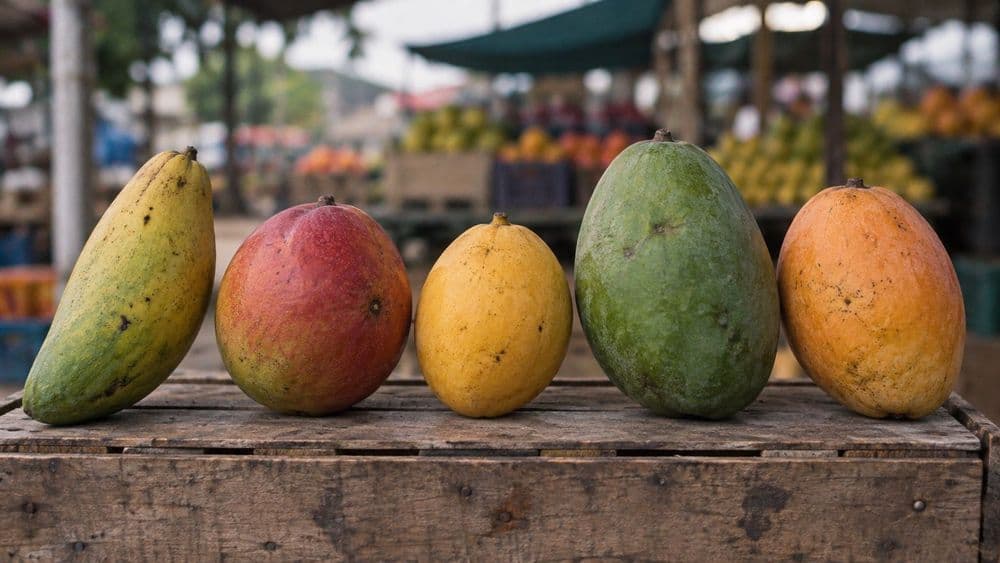
Variety matters more than any single number. A 2017 survey of 25 mango varieties grown side by side in one orchard in southern China found 127 volatile compounds, and beta-myrcene showed up as a named compound in only three. In one variety, 'Xiaofei', it made up 59% of the fruit's aroma volatiles. In 'Tommy Atkins' it was about 1%, and in a Cuban variety about 0.5%. Those are shares of the aroma mix, not milligrams, and they come from one orchard in one season. An earlier analysis of 20 mango varieties by Havana researchers found 372 compounds and 18 to 123 mg of volatiles in every kilogram of fruit, with delta-3-carene, limonene or terpinolene leading in most varieties, not myrcene. Delta-3-carene led in 10 of the 20, including Haden, Keitt and Kent.
- Mangoes do contain myrcene, but not every variety, and not in a predictable amount.
- In most varieties tested, other terpenes lead the aroma.
- We found no accessible study that gives a reliable milligrams-of-myrcene-per-mango figure for the varieties sold in US stores.
The most interesting finding is that sulfur compound. 3-Methyl-2-butene-1-thiol is the same molecule that a 2021 analysis of 13 cannabis cultivars identified as the primary odorant behind cannabis's skunk note, which our explainer on why weed smells like skunk covers in depth. (The mango paper lists it under its formal name, 3-methylbut-2-ene-1-thiol.) It may be part of why mango and cannabis seem to belong together. It says nothing about what either does in your body. The cannabis analysis came from a company whose authors had filed patents in the area, and the mango measurement covers one variety. In cannabis, terpenes and these thiols are made in the resin glands on the flower, the trichomes, and terpenes are not the only plant chemistry beyond cannabinoids: cannabis flavonoids are another family entirely.
The arithmetic: a mango vs a gram of flower
Here is the calculation the top results skip, using only sourced numbers. USDA FoodData Central puts the edible part of one raw mango at about 336 grams. Multiply that by the 2005 study's 18 to 123 mg of volatiles per kilogram, and a whole mango carries somewhere around 6 to 41 mg of all its aroma compounds combined. That is a ceiling for myrcene, not a measurement of it: myrcene is one of dozens of compounds, and in most varieties not the main one.
Now the flower side. In a survey of nearly 90,000 commercial cannabis lab samples from six US states, a single terpene rarely topped 0.5% of flower by weight, which is about 5 mg per gram, and all terpenes together averaged about 2%, around 20 mg per gram. So the whole aroma load of an unusually fragrant mango sits in the same range as the total terpenes in a gram of average flower. The claim that a mango holds far too little myrcene to matter does not hold up as neatly as it sounds.
The comparison that matters for the sedation story is a different one. The mouse experiments behind myrcene's sleepy reputation injected 100 or 200 mg of myrcene per kg of body weight, with no THC involved. The mice showed muscle relaxation at those high doses, and 200 mg/kg made barbiturate-induced sleep last about 2.6 times longer. Even the smaller dose, converted to a 70 kg adult the way FDA's guidance on first doses in human trials scales animal doses (divide the mouse dose by 12.3), comes to roughly 14 times the total aroma content of the most fragrant mango in the 2005 range, and it was injected, not eaten. Scaling across species is a convention for setting cautious trial doses, not a prediction of effects, so read that ratio as the size of a gap, nothing more.
| Quantity | Value | Source |
|---|---|---|
| Edible flesh of one raw mango | About 336 g | USDA FoodData Central |
| All aroma compounds per kg of mango | 18-123 mg | Pino 2005, 20 varieties |
| All aroma compounds in one whole mango | About 6-41 mg (myrcene is a fraction) | 336 g x 18-123 mg/kg |
| Myrcene's share of mango aroma volatiles | Not named in 22 of 25 varieties; about 0.5%, 1% and 59% in the other 3 | Li 2017 |
| One terpene in 1 g of flower (typical upper end) | About 5 mg (0.5%) | Smith 2022 |
| All terpenes in 1 g of average US flower | About 20 mg (2%) | Smith 2022 |
| Smaller mouse sedation-study dose (100 mg/kg, injected), scaled to a 70 kg adult | Roughly 14 times a whole mango's aroma ceiling | do Vale 2002; FDA conversion (divide by 12.3) |
The point of the arithmetic is not that mangoes are potent. It is that quantity is not where the myth breaks. It breaks on mechanism, and on the fact that we could find no test of it in people.
Does mango make you higher? Five links that would all have to hold
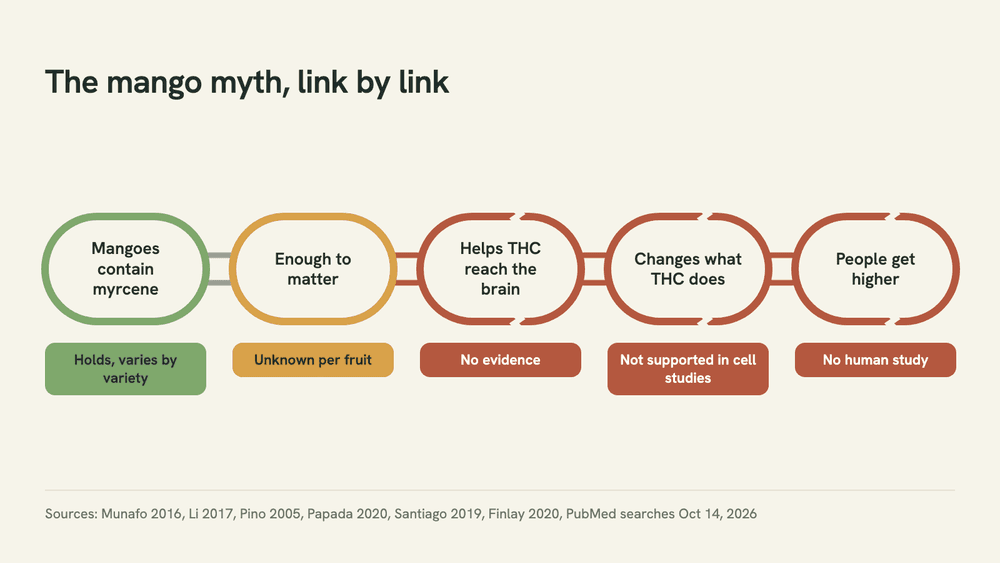
For a mango to make your high stronger, five separate things would all have to be true. A chain is only as strong as its weakest link, so here is each one, with the best source we found and what that source actually shows.
| Link in the chain | Best source | What it actually shows | Verdict |
|---|---|---|---|
| 1. Mangoes contain myrcene | Munafo 2016; Li 2017; Pino 2005 | Yes, depending on variety: one of 15 key aroma compounds in Haden; a named compound in 3 of 25 varieties, at 0.5% to 59% of volatiles; not the leading terpene in most of Pino's 20 | Holds, with large variation |
| 2. There is enough to matter | Pino 2005; USDA; Smith 2022; do Vale 2002 | A whole mango holds about 6-41 mg of all aroma compounds, the same range as a gram of flower's terpenes, and far below the doses used in mouse sedation studies | Unknown per fruit; not absurd, not large |
| 3. Myrcene reaches the brain and helps THC get there | Papada 2020; Madyastha 1987; Surendran 2021 | Swallowed myrcene reaches human blood. We found no study showing it helps THC cross the blood-brain barrier; the claim traces to a textbook chapter | Absorbed: yes. Helps THC: no evidence |
| 4. Myrcene changes what THC does | Santiago 2019; Finlay 2020; Alayoubi 2025 | In cell studies, myrcene did not activate CB1 or CB2 and did not change THC's signaling at them | Not supported (cell studies) |
| 5. People get higher | PubMed searches, October 14, 2026 | We found no study that gave people mango and cannabis, and no controlled human study of myrcene with THC | No evidence |
Does myrcene change what THC does?
Start with the part that holds. Myrcene you swallow does get absorbed. In a 2020 study of 10 healthy men who each swallowed 1 mL of mastic gum oil, an oil in which myrcene made up about 8.5% of the measured profile, myrcene showed up in their blood. The study measured blood, not brain, included only men, used an oil rather than a fruit and involved no cannabis. In rats, the liver turns swallowed myrcene into other compounds, mainly hydroxylated forms that leave in urine, so what reaches the blood after eating is not simply what was in the food.
Then the link that matters most. THC produces its high mainly by acting on the CB1 receptor in the brain. In a 2019 cell study titled "Absence of Entourage", six common cannabis terpenes, myrcene among them, did not switch on the CB1 or CB2 receptor and did not change how THC acted on them: the THC response measured at CB1 was 59% in control cells and 55% with the terpenes added, essentially unchanged. A 2020 New Zealand study reached the same answer from a different angle: myrcene and four other terpenes did not change how THC or CBD bound to or acted at cannabinoid receptors. Both are cell experiments that test one part of the picture, and the 2019 authors note that other signaling pathways remain possible. Our guide to the entourage effect weighs the wider evidence on terpenes and cannabinoids working together.
A 2025 UCLA mouse study adds a twist. It injected myrcene at 1 to 200 mg/kg and saw no slowing of movement and no drop in body temperature, and in cell tests myrcene neither switched on CB1 nor changed how other compounds acted on it. That is one animal study, but it cuts against both halves of the folk story at once: the sedation and the receptor boost. The myrcene-and-sedation question has its own full audit in our explainer on what couch-lock is and where the myrcene idea came from.
Finally, the blood-brain barrier, the mechanism the whole mango trick depends on. Trace the line back and it lands in a 2021 review of myrcene whose own authors write that there is "limited robust data supporting this claim", and whose only citation for it is a 2016 chapter in a nutraceuticals textbook, not an experiment. Two of the review's authors worked for a drinks company that uses myrcene-containing plants in its products. A PubMed search we ran on October 14, 2026, for myrcene and the blood-brain barrier returned 0 records. So the problem is not that a study found a small effect. It is that we could not find a study that looked.
Why some people swear by mango and weed
If the chemistry does not support it, why do so many people say it works? The likeliest explanation is expectation. In a balanced-placebo study of 20 cannabis smokers, researchers told each person either that their joint contained THC or that it did not, and separately gave them either a 2.8% THC cigarette or a placebo one. What people were told had large effects on how potent, strong and satisfying they rated the cigarette, and even on how they smoked it. It was a small pilot in young adults and says nothing about mango specifically, but it shows how much belief shapes how strong cannabis feels.
Real-world data point the same way. In a 2023 Arizona study where 101 regular users rated their high in real time over two weeks, strains listed online as myrcene-dominant were not among those the authors reported as feeling different. The terpene profiles came from a strain website, not lab tests, so treat that as a weak signal. Meanwhile, plenty else changes on mango night: the ritual, the setting, the strain, how much you smoke and how fast, and what else you ate. Add a fruit that shares cannabis's skunk molecule and smells like it belongs, and the pairing feels right before you have started.
Mango is not the only food with this reputation. Black pepper comes up as a way to come down rather than get higher, which the safety notes below touch on. Chocolate's story starts with a 1996 report of anandamide in cocoa that later measurements largely failed to confirm, and our look at THC chocolate and what that cocoa study really found unpacks it. We found no human study showing that either food intensifies a high.
Safety notes that actually matter
A mango is food, and eating one is not dangerous in itself. The risk in this myth is what people do to test it, so here is what is worth knowing.
- Do not take more THC to see whether the mango is working. Adding extra hits or another edible is the classic route to a too-high, unpleasant experience.
- Edibles run on their own slow schedule. We found no study showing a mango changes it, and redosing while you wait is a common edible mistake.
- If poison ivy gives you a rash, handle mango peel with care, or let someone else cut the fruit.
- Cannabis is for adults 21 and over where it is legal. Do not drive after using it.
Edible THC is absorbed through the gut and processed by the liver before it reaches the rest of your body, which is why edibles take so long to kick in. If you have already had more than you meant to, our guide to greening out explains what is happening and where the black pepper story fits.
The peel warning is real, if uncommon. Mango belongs to the same plant family as poison ivy, and its skin carries similar irritants. A 2021 review of mango contact dermatitis found 37 published patients, 26 of them from countries where poison ivy or poison oak is common, and noted that the rash can appear on someone's first contact with mango if they are already sensitized to those plants. In patch tests, compounds from mango cross-reacted with urushiol, the poison ivy irritant, in 5 of 6 urushiol-sensitive people. The review calls mango rash rare.
What is still unknown
- How much myrcene the mango varieties sold in US stores hold per fruit. We found no accessible study that measures it.
- Whether myrcene at food levels changes anything about THC in people. We found no controlled human study that gave myrcene with THC.
- Whether myrcene reaches the human brain at all. A PubMed search on October 14, 2026 returned no study of myrcene and the blood-brain barrier.
- Whether the concentrations used in cell studies reflect what actually reaches receptors in a person, a point researchers still dispute.
A real test would not be hard to design: a blinded crossover in which the same adults use the same cannabis on two days, once after a mango smoothie and once after a look-alike smoothie with no mango, without knowing which is which. Until someone runs it, the honest answer is that the mango trick is untested in people, and the evidence we do have points away from it.
Frequently asked questions
There is no evidence for any interval, so we do not give one. The waiting times quoted online contradict each other and none comes from a study. We found no human study of mango and cannabis at any timing, so any number you read is folklore.
We found no study that has tested it. Edible THC is absorbed through the gut and processed by the liver on its own slow schedule, and the mango story's blood-brain barrier mechanism has no evidence even for smoking. If an edible feels slow, waiting it out is safer than taking more.
There is no evidence that it does. CBD is not intoxicating, and the 2020 New Zealand cell study found myrcene did not change how CBD bound at cannabinoid receptors either. The mango taste in some CBD oils, including Planntz's Mango & Peach tinctures, is added flavoring and is there for taste only.
The sedation evidence comes from mice injected with 100 to 200 mg/kg, and a 2025 mouse study saw no slowing of movement at doses up to 200 mg/kg. Controlled human data are lacking. Our couch-lock explainer takes the myrcene sedation story apart in detail.
It is a natural part of many foods' aroma, mango included. In 2018 FDA removed the synthetic version from its food additive regulations, a legal step under the Delaney Clause triggered by high-dose animal data, while stating that the substances do not pose a risk to public health under the conditions of their intended use. The action did not affect foods containing natural myrcene. None of that makes myrcene a health product.
We found no human study showing either one intensifies a high. Black pepper and its terpene caryophyllene come up as a way to come down after too much THC, which our greening-out guide covers. Chocolate's reputation rests on a 1996 report of anandamide in cocoa that later measurements largely failed to confirm, which our THC chocolate guide examines.
Myrcene is one terpene among many, and terpenes and cannabinoids do very different jobs, in the plant and in a product. For the bigger picture, including how terpenes show up on a lab report, read our guide to what terpenes do and do not do next to cannabinoids.
Writing about hemp, wellness and the small rituals that keep us balanced.