
Cannabinoids vs Terpenes: What Each One Actually Does (and What Your COA Shows)
Cannabinoids and terpenes come from the same building blocks and split at one enzymatic step. Here is what each actually does, the three claims the top results get wrong, and why your certificate lists thirteen cannabinoids to the milligram and not one terpene.
Cannabinoids and terpenes are built from the same five-carbon isoprene units, and they part company at a single enzymatic step. After that, cannabinoids keep a phenolic ring that lets them dock at receptors, and terpenes stay small, light and volatile, which is why you can smell one class through the neck of a bottle and not the other. That same difference is why your certificate of analysis lists thirteen cannabinoids to the milligram and not a single terpene.
The one-line answer: cannabinoids are the molecules a laboratory is required to measure, terpenes are the molecules you can smell, and quite a lot of what gets published about the pair is either imprecise or flatly wrong. Three claims in particular repeat across the pages that rank for this question. Cannabinoids are unique to cannabis (they are not). Terpenes do not interact with the endocannabinoid system (loose in both directions, and the studies that tested it carved out an exception by name). Terpenes work better in combination because of the entourage effect (asserted everywhere, with no dose and no concentration argument). We take them one at a time, and then we do the thing none of the pages we read for this article on August 24, 2026 does: connect the distinction to the lab report you can actually open.
The short answer, and the word doing all the work
Start with the chemistry, because the chemistry is where the two categories come from. A 2016 critical inventory in Natural Product Reports opens with a sentence worth reading twice: cannabis is 'a prolific, but not exclusive, producer of a diverse group of isoprenylated resorcinyl polyketides collectively known as phytocannabinoids'. Unpacked, a cannabinoid is a molecule carrying a resorcinol ring, the phenolic part, with an isoprenoid tail attached. A terpene is the tail without the ring: chains of five-carbon isoprene units, ten carbons for a monoterpene like limonene, fifteen for a sesquiterpene like beta-caryophyllene. The ring is what makes a cannabinoid a cannabinoid, and it is also what gives the class its receptor affinity.
Now the interesting part, and the reason the search results get tangled. That same review says the plant's modular biosynthesis makes 'the definition of phytocannabinoid elusive from a structural standpoint', and proposes a biogenetic definition instead. So two definitions are in live circulation: a structural one (does the molecule have the cannabinoid scaffold) and a functional one (does it act at a cannabinoid receptor). Under the second, a sesquiterpene can be called a cannabinoid, and in 2008 a paper in PNAS did exactly that, titling itself 'Beta-caryophyllene is a dietary cannabinoid'. The categories are ours. The plant does not sort its molecules into our boxes. If you want the family tree on the cannabinoid side, our atlas of the cannabinoid family keeps that half; this page takes the terpene half and the boundary between them.
| Property | Cannabinoids | Terpenes |
|---|---|---|
| Core structure | A resorcinol ring plus an isoprenoid tail | Isoprene units only: C10 monoterpenes, C15 sesquiterpenes |
| Can you smell it | No. They are effectively non-volatile at room temperature | Yes. This is the aroma fraction of the plant |
| Named examples | CBD, CBDA, CBG, CBN, CBDV, THCV, delta-9-THC | Myrcene, limonene, alpha-pinene, beta-caryophyllene, alpha-humulene, ocimene |
| How many in cannabis | The structural inventory is contested and open; our certificates report 13 individually | Described as more than 100 different molecules in a 2018 analytical paper |
| Measured how | Potency panel by UHPLC-DAD or LC-MS, reported in mg/g, mg/mL or mg per package | A separate terpene panel by headspace GC-MS, reported as a percentage and in mg/g or mg/mL |
| In California's testing rule | Item 1 of 9, unconditional, with a quantitation floor of 1.0 mg/g | Item 9 of 9, and the only one written as conditional |
| On a Planntz certificate | Yes: 16 potency rows, 13 individual cannabinoids plus 3 calculated totals | No. Zero terpene rows across all 12 live certificates |
| What it survives | Relatively stable. Potency changes slowly and mostly with temperature | Volatile. Measurable losses within months under every storage condition tested |
Where the two split: one branch point, two destinations
Both classes begin in the same place. The plant makes five-carbon isoprenoid units and links them into geranyl pyrophosphate, a ten-carbon chain. From there the path forks. Hand geranyl pyrophosphate to a terpene synthase and you get a monoterpene: limonene, myrcene, pinene. Attach it instead to olivetolic acid, a small phenolic molecule, and you get cannabigerolic acid, which a 2023 synthetic biology paper describes as 'the common substrate to multiple cannabinoid synthases'. Everything downstream, CBDA and THCA and CBCA, descends from that one acid. We have a whole page on the acid every other cannabinoid starts as if you want the enzymology. The short version for this article: a terpene is what happens when the isoprenoid chain never meets the phenolic ring.
On the terpene side, cannabis uses an ordinary plant enzyme family. A 2017 study in PLOS ONE characterized nine terpene synthases from the hemp variety 'Finola' and reported that their products 'collectively comprise most of the terpenes of Finola resin', naming beta-myrcene, (E)-beta-ocimene, limonene, alpha-pinene, beta-caryophyllene and alpha-humulene. The transcripts were most highly expressed in trichomes, the same resin glands that hold the cannabinoids. Two of that paper's authors declared industry relationships, which is worth knowing and does not change the enzymology: one was CEO and president of a cannabis biotechnology company, and another had been a consultant and adviser to a cannabis firm. Note also the scope: that is one hemp cultivar, not a description of every plant.
And the terpene machinery is not a cannabis specialty at all. A 2011 review of the plant terpene synthase family counted the genes across sequenced genomes and found essentially the same toolkit everywhere it looked. This is the part that makes the marketing framing collapse: a terpene is not a cannabis molecule that happens to smell nice. It is a plant molecule, full stop, and cannabis makes its own subset the way a lemon tree or a pine makes its own.
- The moss Physcomitrella patens carries 1 terpene synthase gene.
- The spikemoss Selaginella moellendorffii carries 18.
- Model flowering plants and conifers carry between 40 and 152.
- Thousands of terpenes have been found across the plant kingdom, and each species makes only a small fraction of that total.
- Cannabis terpenes have been described as more than 100 different molecules. The tidier figures that circulate around this topic, 150 in cannabis or 30,000 in nature, do not come with a source we could trace to a paper.
Correction 1: cannabinoids are not unique to cannabis
Some version of 'cannabinoids are found only in cannabis' appears on most of the pages that rank for this comparison. It was already shaky when the 2016 inventory called cannabis a prolific but not exclusive producer. It stopped being defensible in 2023, when a paper in Nature Plants reported parallel evolution of cannabinoid biosynthesis in Helichrysum umbraculigerum, an Asteraceae species unrelated to Cannabis sativa. It produces cannabis-type cannabinoids, including 4.3% cannabigerolic acid, and it stores them in glandular trichomes on its leaves rather than in flowers. The orthology analysis showed the pathway arose independently. That 4.3% is the leaf chemistry of a research plant and should never be read as a cannabis figure or a supply story.
The second counterexample is stranger. Liverworts of the genus Radula contain a bibenzyl called (-)-cis-perrottetinene, which structurally resembles delta-9-THC. In 2018 a team writing in Science Advances synthesized both isomers and gave them to mice: the molecules crossed into the brain and produced hypothermia, catalepsy, reduced movement and analgesia in a CB1-dependent way. Their conclusion was that this illustrates convergent evolution of bioactive cannabinoids in the plant kingdom. Two things travel with that result. The tested material was made by total synthesis, not extracted from a plant, and the animals were mice. This is botany and nothing else: not a sourcing suggestion, not a legality statement, and not a claim about anything you can buy.
Correction 2: the terpenes-do-not-touch-the-ECS line, and the one real exception
This is the claim worth getting exactly right, because the precise version is more interesting than the vague one everybody publishes. In 2020, a group put five common cannabis terpenes, myrcene, alpha-pinene, beta-pinene, beta-caryophyllene and limonene, alone and in mixtures, through radioligand binding and functional assays at CB1 and CB2, and also tested whether they changed what THC, CBD or the endocannabinoid 2-AG did at those receptors. The paper is titled 'Terpenoids From Cannabis Do Not Mediate an Entourage Effect by Acting at Cannabinoid Receptors', and its conclusion reads: 'With the possible exception of a weak interaction of beta-caryophyllene with CB2, no data were produced to support the hypothesis that any of the five terpenes tested (either alone or in mixtures) have direct interactions with CB1 or CB2'. Read that clause again. The negative result carves out its own exception. A separate laboratory reported the same direction in 2019, testing six of the most common cannabis terpenoids individually at up to 30 to 100 micromolar, and at 10 micromolar each in combination, against THC's functional activity at human CB1 and CB2. None of the six activated either receptor or modulated what THC did there, and the authors concluded that if a phytocannabinoid-terpenoid entourage effect exists, it is not at the CB1 or CB2 receptor level. Both studies are cell culture, and the terpenes in the 2020 work were tested at 10 micromolar against THC at 1 micromolar.
The exception has a number attached to it. That 2008 PNAS paper reported that (E)-beta-caryophyllene selectively binds the CB2 receptor with a Ki of 155 plus or minus 4 nanomolar and behaves as a functional CB2 agonist, and it points out in the same breath that the molecule is a common constituent of the essential oils of numerous spice and food plants. That is why black pepper and cloves keep appearing in terpene explainers. Two limits belong in the same sentence as the number. A binding constant is a measurement made in a dish, not an effect a person feels, and the paper's animal work was mice dosed at 5 mg/kg by mouth in an inflammation model with a genetic CB2 knockout control. Stated as narrowly as the evidence allows: among the plant terpenes actually found in cannabis, beta-caryophyllene is the one with a measured binding constant at a cannabinoid receptor. Nothing stronger than that is available, and any page that tells you more has stopped citing.
A 2025 paper makes the point better than an argument could. Researchers gave myrcene to mice in neuropathic pain models at 1 to 200 mg/kg by intraperitoneal injection and saw mechanical nociceptive thresholds rise dose-dependently, with greater potency in females, and a CB1 antagonist inhibited the effect. In the same paper's cell assay, myrcene did not directly activate CB1 and did not alter CB1 activity triggered either by a CB1 agonist or by endocannabinoids. So: behavior that depended on a receptor, from a molecule that never touched it. The same study also reported a conditioned place aversion to myrcene in female pain mice, which is not what a terpene marketing page would predict. That dose range, for a 70 kg adult, would span grams of a single terpene delivered by injection, so it transfers to a swallowed tincture in no way at all. If you want the receptors themselves rather than what binds them, we keep how CB1 and CB2 actually work on its own page.
Correction 3: the entourage line, and the arithmetic nobody publishes
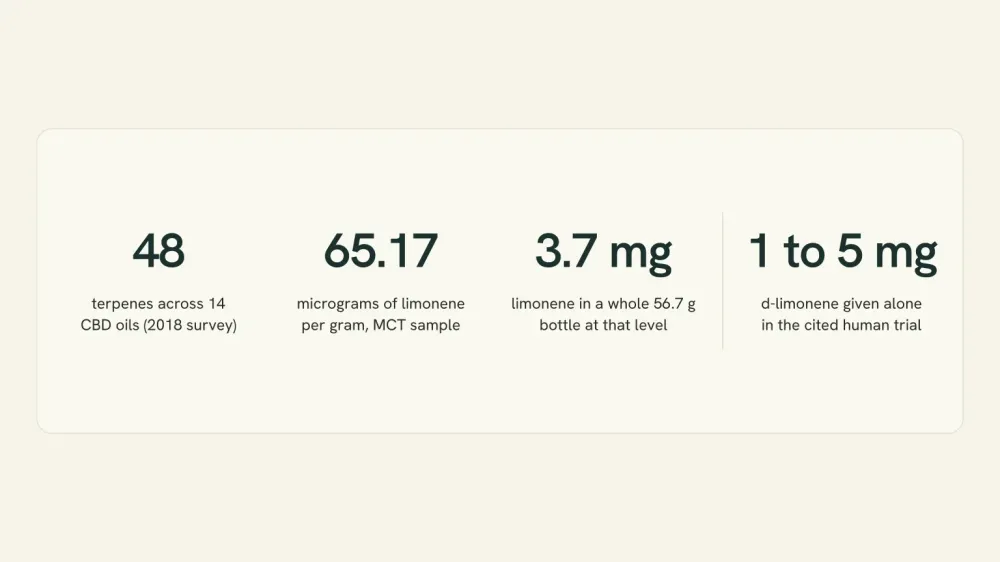
The consumer pages we read for this comparison all say that terpenes and cannabinoids work better together, and not one of them prints a number. Here is the number. A 2018 analysis in Molecules measured 14 commercial European CBD oils and found up to 110 volatile compounds per product, including 48 terpenes. One sample in that set happened to use an MCT carrier, the same kind of carrier we use: its cannabinoid table gives 42,352 micrograms per gram of CBD, and its volatile-profile table gives 65.17 micrograms per gram of limonene and 419.53 of beta-myrcene. Apply that limonene level to a bottle the size of ours. Our certificates print the package weight in their own header, 56.7 g, so the arithmetic is 56.7 multiplied by 65.17, which is 3,695 micrograms, or 3.7 mg of limonene in the entire bottle. Now set that against the human trial this category usually points to. It inhaled vaporized d-limonene at 1 mg or 5 mg on its own, and at 15 mg only in a session where it was given alongside THC. So the entire bottle, at that concentration, lands between the two doses that trial gave on their own, and you would have to swallow all 60 mL to get there. A single 0.05 mL drop weighs about 0.0467 g at our certificate's printed density of 0.934 g/mL, which works out to about 0.003 mg of limonene. Matching even the smaller of those two doses, 1 mg, would take something like 330 drops in one sitting.
Three assumptions are doing work there and all three should be printed. The terpene figures come from 14 European products bought in 2018, not from a Planntz bottle. The terpenes in that study were measured by headspace solid-phase microextraction and reported as internal-standard equivalents while the cannabinoids were measured on a different instrument, so the ratio is an order of magnitude, not a precise multiple. And the route differs: that trial vaporized limonene, and a tincture is swallowed. The most important limit is ours. Our own certificates contain no terpene panel, so we cannot tell you what is in our bottles, which is precisely why the calculation borrows somebody else's product. Coming at it from the other direction gives the same picture: a 2025 randomized crossover in 19 adults dosed alpha-pinene at 0.5 mg and 5 mg, which its methods describe as the mean and maximum amounts in 1 gram of cannabis flower across 107 samples and 29 cultivars, and at a higher 15 mg, alongside 30 mg of THC. Co-administration did not mitigate THC-induced memory impairment or significantly alter the other acute subjective, cognitive or physiological effects measured, a result the authors call 'inconsistent with some cannabis industry claims and speculation by some cannabis researchers'.
That is one paragraph of adjudication and it is all this page gets, because the question is bigger than it looks: 'the entourage effect' names at least three different claims, and they need separate verdicts. We work through them, including the tension that the dish experiments used concentrations far above the blood levels the hypothesis actually proposes, on our page on the entourage effect. One thing this section is emphatically not: an argument for or against a spectrum. Spectrum describes what was left in during processing, and what each spectrum actually contains is a different question from what terpenes do. If anything, the arithmetic above cuts against using terpene content as a buying argument in either direction.
Why the smell changes before the potency does
If you have opened an older bottle and thought the aroma had gone flat while the label still said 250 mg/mL, this is the reason. A 12-month storage study published in Frontiers in Plant Science tracked 93 terpenoids and ran a comprehensive analysis on 37 major ones. The authors' summary: terpenoid concentrations were found to decrease rapidly under all storage conditions. Alpha-pinene and beta-caryophyllene fell significantly between the start of the study and the four-month mark, for every treatment and every temperature tested (p < 0.0005). Counterintuitively, freezing was not protective. For alpha-pinene, storage at -80 C and -30 C came out worse than storage at 4 C or 25 C. The material was cannabis inflorescences and extracts dissolved in DMSO, ethanol or olive oil, kept in the dark, so treat the direction as reliable and the exact numbers as somebody else's product.
The cannabinoid side of the same study behaved differently, and the vehicle mattered. THCA in inflorescences fell about 33% after a year at 25 C. In the extracts dissolved in olive oil it fell 18% at 4 C and 24% at 25 C while neutral THC rose 108% and 150%, which is decarboxylation rather than destruction; in the extracts dissolved in DMSO or ethanol, far more of it converted over the same year. That is the asymmetry worth holding onto: the cannabinoid figures move between two forms of the same molecule and depend on what the extract is sitting in, while the terpenoids simply went down under every condition tested. The physical reason for the split is easy to picture. A 2021 study steam-distilled CBD-hemp biomass and reported that distillation extracted the terpenes while the cannabinoids remained in the distilled material, which afterwards carried 3.4 to 9 times more CBD than undistilled biomass. Electron microscopy showed the resin glands largely intact, so the terpenes had evaporated through the trichome membrane while the cannabinoids stayed inside. Steam distillation is not what happens in your cupboard, and the study never claimed it was, but it isolates the property that matters here: one class leaves and the other stays.
- Aroma is the first thing to change, and it changes before the potency figure on the certificate does.
- A flatter smell after a year is expected chemistry, not evidence that the cannabinoids have gone anywhere.
- Heat and air do the damage. A closed cupboard away from the stove beats a windowsill or a shelf in a steamy bathroom.
- Freezing is not an obvious upgrade. In the storage study above, the coldest conditions were the worst ones for alpha-pinene.
- If you want to know how much cannabinoid is left, the potency panel is the number that answers that. Smell answers a different question.
Shelf life proper, best-before dates, and how to judge whether an older bottle is still worth taking are their own subject, and we cover them in what actually happens when CBD oil gets old. The mechanism above is the part that belongs here, because it is the clearest everyday demonstration of the whole cannabinoid-versus-terpene distinction: you can perceive one class changing with your nose, and you cannot perceive the other changing at all.
What your COA actually shows (and what it will never show)
Here is the connection none of the pages we read makes. Cannabinoids are on your certificate because a regulator requires them. Terpenes are not, and the clearest published example we found is California's cannabis regulations. Section 15714(b) of Title 4 of the California Code of Regulations lists nine things a licensed laboratory shall test each representative sample for: cannabinoids, foreign material, heavy metals, microbial impurities, mycotoxins, moisture content and water activity, residual pesticides, residual solvents and processing chemicals, and, ninth, 'If applicable, terpenoids'. Eight unconditional items, one conditional one, and everybody can see which. The terpenoid section itself opens with the same qualifier: 'If requested, the licensed laboratory shall analyze at minimum 0.5 grams of the representative sample...'. The cannabinoid section next door opens with no such condition, and it goes further: the laboratory shall analyze at minimum 0.5 grams, and shall establish a limit of quantitation of 1.0 mg/g or lower for every cannabinoid analyzed and reported. Same regulation, same page, one word of difference, and that word is the whole story.
Two caveats, because scope matters more than the quotation. That rule covers California state-licensed cannabis, not hemp-derived CBD sold nationally, so it does not bind your tincture and it is not federal law. What it does do is show you, in a regulator's own words, how the industry treats the two classes: cannabinoid content is a compliance number that somebody has to produce, and terpene content is an optional composition test that somebody has to ask for and pay for. That single distinction explains almost every confusing thing about terpene marketing, including why the profiles you see on brand pages so often arrive as a colored wheel rather than as a document.
| Panel | What it answers | In 4 CCR 15714(b) | On a Planntz certificate |
|---|---|---|---|
| Cannabinoid potency | How much of each cannabinoid is in the product | Item 1 of 9, unconditional, with a 1.0 mg/g quantitation floor | Yes. 16 rows by UHPLC-DAD: 13 individual cannabinoids plus 3 calculated totals |
| Heavy metals | Is there arsenic, cadmium, lead or mercury above the limit | Item 3 of 9, unconditional | Yes. 4 analytes by ICP-MS, limits in micrograms per gram |
| Microbial impurities | Is there bacterial or fungal contamination | Item 4 of 9, unconditional | Yes. 6 tests |
| Mycotoxins | Are fungal toxins present | Item 5 of 9, unconditional | No |
| Residual pesticides | Was the crop treated, and does residue remain | Item 7 of 9, unconditional | No |
| Residual solvents | Is extraction solvent left in the product | Item 8 of 9, unconditional | No |
| Terpenoid profile | Which aroma compounds are present, and how much | Item 9 of 9, and the only one written as conditional | No. Zero terpene rows on any of the 12 |
So, flatly, and with no marketing in it. Every Planntz certificate of analysis published at our lab results page reports cannabinoid potency by UHPLC-DAD across sixteen rows, thirteen individual cannabinoids plus three calculated totals, four heavy metals by ICP-MS, and six microbial tests, batch by batch, with the laboratory's license number and a public verification link printed on the page. What they do not include is a pesticide panel, a residual-solvent panel, a mycotoxin panel or a terpene panel. We counted that across all twelve live certificates on August 24, 2026, and the batch summary box on each report prints exactly three lines: potency tested, metals pass, microbial pass. The report itself is where that scope is fixed, so open the PDF for your batch and count the panels for yourself.
To make it concrete, here is one of them. Broad Spectrum Mango & Peach, batch 260320, produced April 1, 2026, tested by Infinite Chemical Analysis Labs in San Diego under license C8-0000047-LIC: package size 56.7 g, density 0.934 g/mL, Total CBD 16,300 mg per package, which the same row prints as 269 mg/mL and 28.8%. That is a batch reading above the 250 mg/mL on the label, which is what a certificate is for: it reports the batch in front of the instrument, not the promise on the box. Total THC 0.000 mg per package. The minor cannabinoids are reported to the milligram: CBG 145 mg, CBN 31.0 mg, CBDV 65.2 mg, THCV 17.7 mg. Read that back slowly. The certificate can tell you there are 31.0 mg of CBN and 145 mg of CBG in the bottle, to three significant figures, and it cannot tell you whether there is any myrcene in there at all. That is the whole article in one document. Reading a certificate section by section is its own skill, and we walk through it in how to read a COA line by line.
One more thing that 2018 survey found, because it decides which panel is worth caring about. In 9 of the 14 oils tested, the measured CBD differed notably from the declared amount. The panel a regulator actually asks for is the one that catches that. The optional one would not have caught any of it, because a terpene result has nothing to be measured against. Counting the panels before you read a single number is the method we recommend on every page that touches lab reports, and what third-party tested actually means carries the full version, including which claims a certificate can and cannot support.
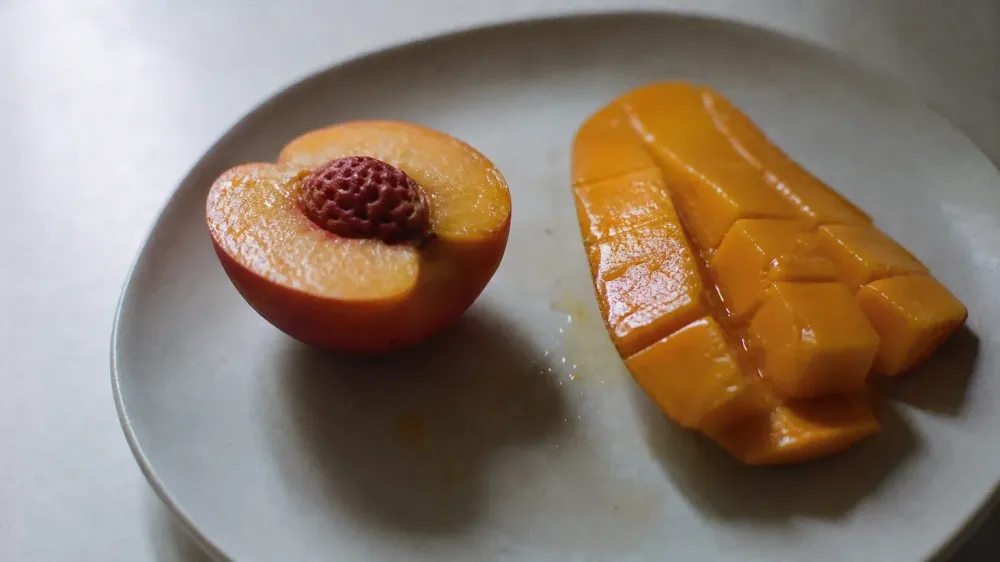
Then why does the bottle taste of mango and peach?
Here is a fact that reorganizes the entire category. The molecules terpene marketing sells as actives are, in federal food law, flavorings. Limonene, in its d-, l- and dl- forms, and linalool are listed by name in 21 CFR 182.60, FDA's roster of synthetic flavoring substances generally recognized as safe. Beta-caryophyllene, alpha-pinene, beta-pinene, alpha- and gamma-terpinene, terpinolene and alpha-terpineol sit one section over, at 21 CFR 172.515, whose preamble permits such substances in food when they are used in 'the minimum quantity required to produce their intended effect'. Note what that is and what it is not: a food-additive status, not a verdict on any dose, any route or any benefit. And note the elegant part. The same beta-caryophyllene is on FDA's flavoring list and in a PNAS paper with a binding constant, simultaneously. One molecule, two filing cabinets, and the plant had no say in either.
So what are you actually tasting? The flavoring. Planntz tinctures are 60 mL of coconut MCT oil in Mango & Peach, Lemon & Raspberry and Natural, and the fruit in the first two comes from added flavor, not from the plant's terpene profile. Under 21 CFR 101.22, 'natural flavor' is defined by function, a substance whose significant function in food is flavoring rather than nutritional, and the rule does not oblige a label to name which plant the flavor came from. Hemp itself does have a measured smell, and it is not only terpenes: a 2025 study in the Journal of Agricultural and Food Chemistry identified 52 odor-active compounds across six CBD-rich cultivars, 38 of them reported in dried hemp for the first time, and alongside alpha-pinene, myrcene and linalool it found sulfur compounds among the most odor-potent. That was dried flower, not a bottled oil, so do not transfer the list onto a tincture. If you want the full account of why a tincture tastes the way it does, we keep what CBD oil tastes like as its own page.
How to read a terpene claim in sixty seconds
Nothing above tells you not to care about terpenes. It tells you what kind of claim you are looking at when a brand makes one. Six checks, in the order that saves the most time, and the fifth is the one that catches a cited study doing less work than it appears to. If you want the worked example of that check, the registry record for a two-arm formulation trial is a good one to open and count.
- 1Ask whether there is a terpene certificate at all. A 'terpene profile' rendered as a wheel graphic with no downloadable lab report is a design asset, not a measurement.
- 2If there is a report, check the units. Real terpene results are reported as a percentage and in mg/g or mg/mL. A share of the terpene fraction tells you nothing about how much is actually there.
- 3Watch for a feeling attached to a molecule. A named terpene credited with a named mood or state is a claim about people, so ask whether people were involved. If it is a cell assay or a mouse study, the page has changed the subject.
- 4Look for a dose in milligrams. If no milligram figure appears anywhere, there is nothing to check, nothing to compare and nothing to reproduce.
- 5If a study is cited, open the registry record and count the arms. Ask whether the comparator differs from the test product only by the ingredient being credited. If it differs by two things, the study cannot tell you which one did the work.
- 6Then check your own bottle. If the aroma no longer matches what you bought, that is the volatile fraction leaving on schedule. The potency number is the one that tells you how much cannabinoid is left.
Not under the structural definition. Cannabinoids are isoprenylated resorcinyl polyketides, meaning they carry a phenolic ring with an isoprenoid tail, and terpenes are the isoprenoid part on its own: ten carbons for a monoterpene, fifteen for a sesquiterpene. But the boundary is genuinely untidy, and the 2016 critical inventory of phytocannabinoids says so out loud, calling the structural definition elusive and proposing a biogenetic one instead. That is how a 2008 PNAS paper could title itself 'Beta-caryophyllene is a dietary cannabinoid' about a sesquiterpene: it was using a functional definition, based on what the molecule does at a receptor rather than on how it is built.
No terpene found in cannabis has been shown to produce intoxication in a controlled human study. In the trial usually cited on this subject, vaporized d-limonene given on its own, at 1 mg and at 5 mg, produced outcomes that did not differ from placebo. That trial's 15 mg dose was only ever given alongside THC, and what that combined session showed is a separate question that our entourage effect article takes apart. None of it is the same as saying terpenes have no effects at all, which would overstate the evidence in the other direction. It means intoxication is not one of them, and that the honest position on everything else is that human data are thin.
Yes, measurably, and the amount varies enormously between products. A 2018 analysis of 14 commercial European CBD oils found up to 110 volatile compounds per product, including 48 terpenes. Beta-myrcene measured 9.14 micrograms per gram in one olive-oil product and 419.53 in the MCT-carrier one, and a hemp-seed-oil sample in the same set carried enough limonene that the authors singled it out for an extremely high amount of terpenes compared with all other samples. Those are other companies' products from 2018. We cannot tell you our own figure, because our certificates do not include a terpene panel.
Because a terpene panel is a separate, optional, extra-cost test that somebody has to request. California's testing regulation lists nine categories a licensed laboratory must run, and the only conditional entry of the nine reads 'If applicable, terpenoids'; the terpenoid section itself opens 'If requested'. It is a composition panel, not a safety panel, so nothing on it can fail. Planntz certificates report cannabinoid potency across sixteen rows, four heavy metals and six microbial tests, and no terpene panel, no pesticide panel, no residual-solvent panel and no mycotoxin panel. The panels worth counting for safety are heavy metals, microbials and, where the supply chain warrants it, pesticides and solvents.
Beta-caryophyllene, and the reason is a measurement rather than a marketing decision. A 2008 PNAS paper reported it binding the CB2 receptor with a Ki of 155 plus or minus 4 nanomolar and acting as a functional CB2 agonist. Among the plant terpenes actually found in cannabis, it is the one with a measured binding constant at a cannabinoid receptor. The neat part is that the very same molecule is on FDA's list of permitted flavoring substances at 21 CFR 172.515. A binding constant is a laboratory measurement, not an effect a person feels, and it licenses no claim about any product.
That is the entourage question, and it hides at least three different claims that need separate verdicts. The short version from this page is the arithmetic: at the terpene concentration measured in an MCT-carrier CBD oil in 2018, a bottle the size of ours would carry about 3.7 mg of limonene in total, against the 1 mg and 5 mg doses that the human trial usually cited gave on their own in a single session, and about 0.003 mg in one drop. Meanwhile the cell studies that tested terpenes at cannabinoid receptors used concentrations far above the blood levels the hypothesis proposes. Those two facts pull in opposite directions, and our entourage effect article works through them properly.
The honest answer is a regulatory one, not a pharmacological one. Several of the terpenes that appear in cannabis are listed by FDA as flavoring substances permitted in food: limonene and linalool at 21 CFR 182.60, and beta-caryophyllene, the pinenes, the terpinenes, terpinolene and alpha-terpineol at 21 CFR 172.515, on the condition that they are used in the minimum quantity required to produce their intended effect. That is food-additive status at flavoring quantities. It is not a safety verdict on a concentrated dose, on a different route such as inhalation, or on any supplement claim, and it is not an efficacy statement about anything.
If you take one thing from this page, make it the document rather than the chemistry. The distinction between cannabinoids and terpenes is real and it is interesting, and it is also the reason the number you can verify and the number you can smell are two different things. A certificate answers the first question to three significant figures and does not attempt the second. Everything else in this category is somebody's inference. Open the report for the batch you actually own, count the panels, and read the potency rows: reading a certificate line by line takes about two minutes once you know where to look.
Read the certificate for the batch you have
Every Planntz batch has a third-party certificate of analysis with its potency, heavy metals and microbial results, the laboratory's license number and a public verification link. No terpene panel, and no pesticide or residual-solvent panel either.
See our lab resultsWriting about hemp, wellness and the small rituals that keep us balanced.