CBD and Omega-3: Your Endocannabinoids Run on an Omega-6
Page one says omega-3 builds your endocannabinoids and helps you absorb more CBD. Anandamide is built on arachidonic acid, an omega-6, and the one experiment that tested the absorption claim head to head found the omega-3 oils delivered less CBD.
Search for CBD and omega-3 and you will read three things very quickly. That your body builds its own cannabinoids out of the omega-3 in fish oil. That taking the two together helps you absorb more CBD. And, from a different page in the same set of results, that combining them thins your blood. The first claim is off by one fatty-acid family. The second has been tested against a control oil exactly once in the literature our search reached, in mice, and it went the other way. The third is a category error twice over. Here is what the chemistry, the human studies and two FDA documents actually say, with every search we ran printed so you can re-run it.
The short version, up front. Anandamide and 2-AG, the two molecules people mean when they say endocannabinoids, are built on arachidonic acid, a twenty-carbon omega-6 chain. Omega-3 fats do make their own ethanolamides, DHEA and EPEA, and those are real molecules with a real literature, but they are not anandamide and they are not 2-AG. In the two human studies that fed people omega-3 and measured this chemistry, the omega-3 molecule moved and the two everyone actually means did not. And our search on 26 August 2026 found no human trial of CBD taken with an oral omega-3 supplement, in either direction. Nobody selling you the combination has the study, because the study has not been run.
Your endocannabinoids are built on an omega-6
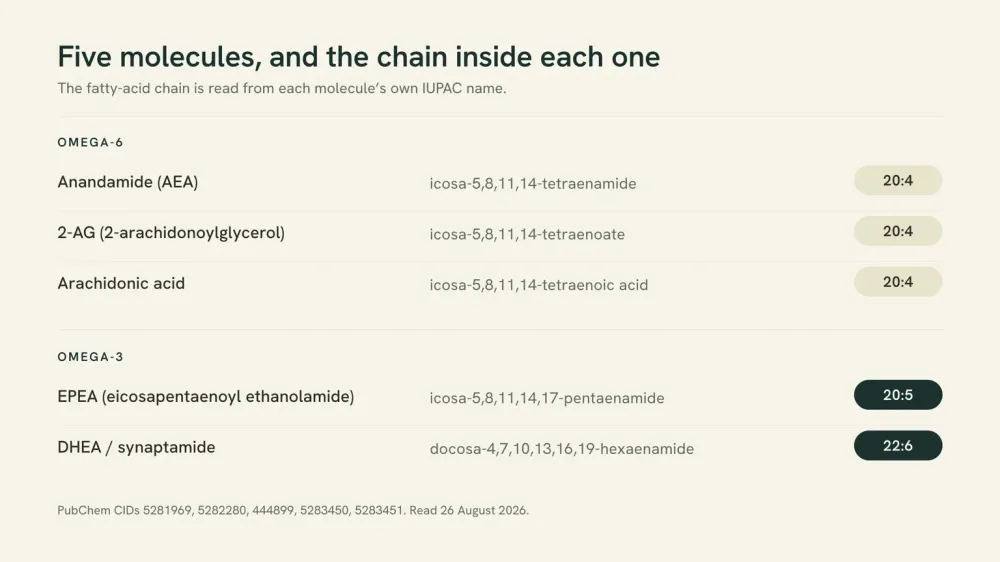
Read the names side by side and the question answers itself. PubChem, the NIH's chemical database, catalogues anandamide as (5Z,8Z,11Z,14Z)-N-(2-hydroxyethyl)icosa-5,8,11,14-tetraenamide, and 2-AG as 1,3-dihydroxypropan-2-yl (5Z,8Z,11Z,14Z)-icosa-5,8,11,14-tetraenoate. Ignore the punctuation and both names carry the same fragment: icosa, meaning twenty carbons, and tetraene, meaning four double bonds, sitting at positions 5, 8, 11 and 14. That fragment is not an accident of nomenclature. It is a fatty acid with a name of its own, arachidonic acid, C20H32O2, molecular weight 304.5, which the same database files under the synonym arachidonic acid (20:4, n-6). The n-6 is the whole point. It is an omega-6.
| Molecule | PubChem CID | The chain inside its IUPAC name | Chain carbons : double bonds | Family |
|---|---|---|---|---|
| Anandamide (AEA) | 5281969 | icosa-5,8,11,14-tetraenamide | 20 : 4 | Omega-6 |
| 2-AG (2-arachidonoylglycerol) | 5282280 | icosa-5,8,11,14-tetraenoate | 20 : 4 | Omega-6 |
| Arachidonic acid | 444899 | icosa-5,8,11,14-tetraenoic acid | 20 : 4 | Omega-6, listed as 20:4, n-6 |
| EPEA (eicosapentaenoyl ethanolamide) | 5283450 | icosa-5,8,11,14,17-pentaenamide | 20 : 5 | Omega-3 |
| DHEA, also called synaptamide | 5283451 | docosa-4,7,10,13,16,19-hexaenamide | 22 : 6 | Omega-3 |
The omega number is not a brand, it is a subtraction, and you can do it from the table above. Chemists number a fatty acid's carbons from the acid end, which is where those IUPAC positions come from, while the omega name counts from the opposite end. So take the total carbons in the chain and subtract the position of the last double bond. Anandamide: 20 carbons, last double bond at 14, and 20 minus 14 is 6. Omega-6. EPEA: 20 carbons, last double bond at 17, and 20 minus 17 is 3. Omega-3. DHEA: 22 carbons, last at 19, and 22 minus 19 is 3. Omega-3 again. Now look at what separates the first from the fourth. EPEA is anandamide's chain with one more double bond, at carbon seventeen: C22H35NO2 against C22H37NO2, a difference of two hydrogens. Those formulas count 22 carbons rather than 20 because the ethanolamine head bolted onto the chain brings two of its own, so the chain inside both molecules is still the twenty-carbon one the table lists. That single extra bond is what moves the molecule from one fatty-acid family to the other. It is a different molecule, and calling it anandamide is like calling a sibling by the wrong name. What those molecules do once they exist is the subject of our full explainer on the endocannabinoid system, which names both and, honestly, declines to source the omega-3 claim you keep reading, because it could not find the citation. This page is the sentence underneath that one: the precursor, printed.
What actually happens when people eat more omega-3
This is the part nobody selling either product has looked up, and it is the strongest evidence on the page, because both studies are in people. Start with the one that measured 2-AG. In a four-week controlled study, overweight and obese adults took 2 grams a day of krill oil (309 mg of EPA plus DHA), or menhaden oil (390 mg of EPA plus DHA), or olive oil. Krill oil significantly lowered plasma 2-AG, and only in the participants with obesity; the other two oils did not move it at all. The authors' own explanation is the whole argument of this article in one clause: the decrease was most likely caused by the replacement of 2-AG's ultimate precursor, arachidonic acid, with omega-3 fats. That is a small study, four weeks long, measuring plasma rather than tissue, and nobody in it took cannabidiol. It also points in the opposite direction from the story you were told.
The second study asked the question even more directly. A 12-week randomized controlled feeding trial in 62 healthy pre-menopausal women, all with a body mass index around 30, put participants on one of three controlled diets and measured the endocannabinoids in plasma. On the diet high in EPA and DHA, the omega-3 ethanolamide DHA-EA was 35% higher (p = 0.013), and no other diet moved it. Anandamide and 2-AG showed no differences between diets. Plasma arachidonic acid showed no between-group differences either. Anandamide did rise about 14% within two of the arms, both of them low in linoleic acid, but that is a within-arm change rather than a between-diet difference, so it is not an omega-3 effect and we are not reporting it as one. Put the two studies together and the honest summary is short: feeding people omega-3 raises the omega-3 molecule and leaves the two molecules everyone actually means alone. That is a measurement, not a benefit and not a harm.
The omega-3 endocannabinoids are real, and they are not anandamide
None of this means the omega-3 side is invented. It means it has its own names. A 2017 paper in PNAS describes what it calls the omega-3 endocannabinoids, naming docosahexaenoyl ethanolamide (DHEA) and eicosapentaenoyl ethanolamide (EPEA) explicitly and reporting a class of metabolites derived from them. That work is rat tissue, a microglial cell line and a recombinant human enzyme, so it is about what those molecules are, not about what any product does in a person. Here is the useful part, and it costs you thirty seconds to check: that PNAS paper is one of the papers the supplement pages on this search actually cite. The citation is real and correctly named. Open it and it turns out to name the omega-3 molecules by their own names, and to treat them as a class distinct from anandamide, which is a good deal narrower than the sentence it is being used to support.
Another paper those pages cite is a 2012 mouse study of what happens when omega-3 is taken away. Mice fed a long-term omega-3 deficient diet showed less DHA in the brain and impaired cannabinoid receptor signalling. That is a deficiency experiment: removing something and seeing a change is not evidence that adding more produces the reverse, the animals were mice, and the compound tested was a synthetic cannabinoid agonist rather than CBD. Two other records are worth knowing about for scale. A 2025 paper in Molecular Psychiatry applied EPEA and DHEA to a line of human hippocampal cells at 300 and 700 picomolar and measured what happened to the cells: that is cell culture, nobody in it took cannabidiol or a supplement, and it tells you the molecules are being investigated and nothing more. And the one result on this search that is not a shop is a 2022 review asking whether CBD and omega-3 might act through the same family of nuclear receptors, whose own language is careful: it remains unclear, it raises the possibility. It is a hypothesis. It did not measure anybody.
Does omega-3 increase CBD absorption?
The claim has been tested once, directly, and it went the other way. In 2025 a research group gave mice cannabidiol at 5 mg per kilogram, alongside THC at 1 mg per kilogram, dissolved in one of three oils: plain sesame oil, a mixed EPA and DHA oil, or a DHA-enriched oil. The animals were fasted for six hours, dosed once by oral gavage, and six tissues were collected at one, two and three hours and measured by mass spectrometry. The paper's finding is blunt: sesame oil produced a significantly greater concentration of CBD across all tissues and all times compared with the omega-3 oils, and the two omega-3 oils did not differ from each other in any tissue at any timepoint. Three of the six tissues are below.
| Tissue and time after the dose | Sesame oil | EPA and DHA oil | DHA-enriched oil |
|---|---|---|---|
| Heart, 1 hour | 103.4 +/- 25.6 | 24.2 +/- 7.8 | 15.8 +/- 5.6 |
| Brain, 2 hours | 30.3 +/- 11.3 | 8.3 +/- 4.2 | 11.1 +/- 11.8 |
| Adipose tissue, 3 hours | 205.8 +/- 120.7 | 50.4 +/- 34.0 | 29.0 +/- 18.7 |
Every caveat in that study matters and we are printing them all. These are mice, male mice only, which the authors name as a limitation. It is a single acute dose, and it is a concentration sitting in a tissue, which is a measurement rather than an effect anyone felt. The endpoint is a tissue concentration rather than a blood profile over time, the variability is wide, and the omega-3 oils were donated by an omega-3 manufacturer, while the funding came from two Canadian research agencies and the authors declare no competing interests. It is one experiment in animals and it does not tell you what a capsule does next to a tincture. It is also the only one that asked the question directly: narrowing the same PubMed search to pharmacokinetics, bioavailability or absorption on 26 August 2026 returns two records, and the other is an in vitro formulation paper. The answer this one gave was no. A second mouse study points the same way from the inside: researchers who gave fish oil and then oral cannabidiol to mice reported that fish oil did not alter phytocannabinoid levels in the serum or in the colon, while reducing endocannabinoid levels in the same animals, which is the same direction the human krill oil study found. If you want the arithmetic behind absorption claims generally, including what a multiplier does and does not mean, that lives on our breakdown of water-soluble and nanoemulsion CBD, which owns that question.
Fifty-five grams of fat, or one
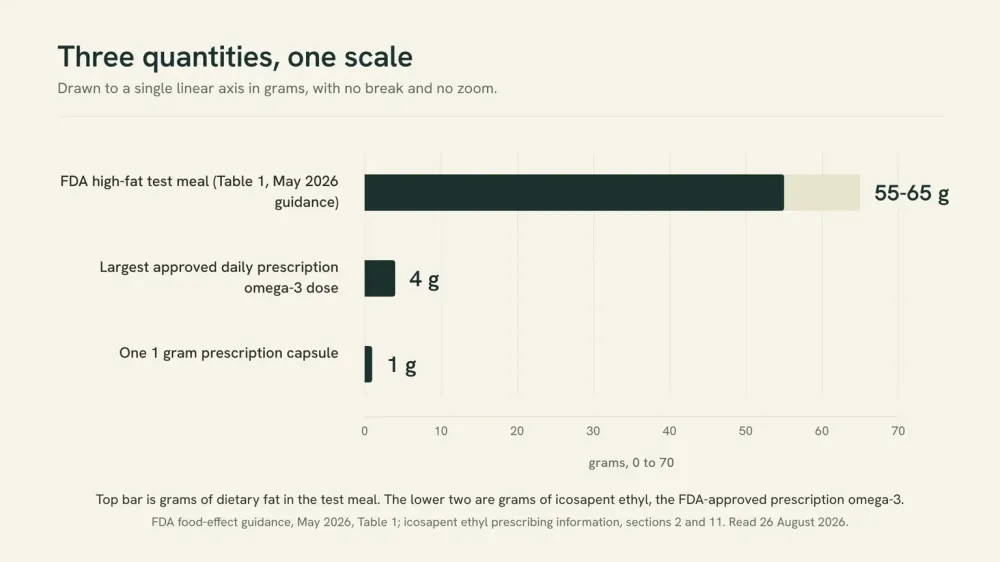
There is a real effect underneath the absorption claim, and it belongs to food, not to fish oil. CBD is fat-loving, and swallowed CBD does behave differently when it arrives with fat. The question nobody asks is how much fat. The FDA's guidance on food-effect studies, revised in May 2026, defines the standard high-fat test meal in its Table 1: 800 to 1,000 total calories, of which 500 to 600 come from fat, which the same table states in grams as 55 to 65. Appendix 1 spells the breakfast out: two eggs fried in butter, two strips of bacon, two slices of toast with butter, four ounces of hash brown potatoes and eight ounces of whole milk. That is the meal that produces a food effect in a drug trial, and what that effect actually measured for CBD is the subject of our page on taking CBD with food, which owns the numbers and which we are deliberately not reprinting here.
Now put a capsule next to that breakfast. The largest daily omega-3 dose the FDA has approved in a prescription product is 4 grams a day: the prescribing information for icosapent ethyl states it as either four 0.5 gram capsules twice daily or two 1 gram capsules twice daily with food, and states the capsule mass in grams in its description section. Retail softgels are not that drug, and this page says nothing about what that drug is for. It is simply the largest omega-3 quantity a US label authorizes, so it is the fairest possible comparison. Four grams against 55 to 65 grams of fat is between about a fourteenth and a sixteenth of the load. One gram is between about a fifty-fifth and a sixty-fifth. A multiplier measured on a breakfast does not survive the trip into a capsule, because the thing that was measured was the fat, and the fat is not there.
Four questions before you believe any take-it-with-X claim
The CBD aisle runs on pairings. Take it with black pepper, take it with turmeric, take it with a fat, take it with fish oil. Some of those have real experiments behind them and some have a sentence someone wrote once. Four questions separate them, and none of them requires a chemistry degree.
- 1Species and route. Was this a person swallowing something, or an animal dosed by gavage, or cells in a dish? A result in mice is a reason to run the human study, not a substitute for it.
- 2Grams. How much of the added thing produced the effect, and how much is in what you are being told to take? If the effect came from tens of grams of fat and the recommendation is a one-gram capsule, the scale does not carry over.
- 3The comparator. More than what? An absorption claim with no control arm is not a measurement, it is an impression. Ask what the other group got.
- 4What was measured. A concentration in tissue, a curve of blood levels over time, or something a person actually noticed? Those are three different claims, and pages swap them silently.
Run those four questions against the omega-3 absorption claim and it fails on all four at once: mice, a gram against a breakfast, no human comparator, and a tissue concentration standing in for an experience. Run them against the pepper-and-turmeric version of the same pairing and you get a different, more interesting answer, which we work through on our page about CBD and turmeric, where the piperine research and its own citation-checking test live.
"They both thin your blood" is two mistakes in one sentence
Take the halves separately. Whether cannabidiol thins blood is a question we have already answered at length, and the short version is that blood thinner is a pharmacological category with a definition, and CBD does not meet it; the platelet literature and the trauma cohorts are worked through on our article on whether CBD thins your blood and we are not restating its studies here. The omega-3 half is this page's to establish, and the biggest test of it is a randomized trial. OPERA randomized 1,516 people having cardiac surgery to fish oil or placebo, at 8 to 10 grams a day of EPA and DHA for two to five days before the operation and 2 grams a day afterwards. Major bleeding happened in 92 patients, 6.1% overall, and the fish oil group did not bleed more: an odds ratio of 0.81 with a confidence interval from 0.53 to 1.24. They received fewer units of blood, 1.61 against 1.92. The authors wrote that their findings support reconsidering current recommendations to stop fish oil before cardiac surgery. That is heart surgery patients at a dose far above a retail capsule, and it is a safety observation, not advice.
Two smaller human studies point the same way, with smaller claims attached. Twelve healthy volunteers took 2,520 mg of supplementary omega-3 a day for ten days and no measure of platelet aggregation or coagulation moved on any of the three instruments used. And in 28 spinal fusion patients matched to controls, mean estimated blood loss was 697 mL against 771 mL, p = 0.36. That second one has a real hole in it that we are not going to paper over: it is retrospective and matched rather than randomized, it is 28 patients, and those patients had stopped their supplement an average of 5.2 days before surgery, with a range of one to ten days, which weakens exactly the comparison it is being used to make.
And yet the FDA-approved label carries a bleeding section, with numbers, and both things are true at once. Section 5.3 of the icosapent ethyl prescribing information says the drug is associated with an increased risk of bleeding and gives the trial data: in 8,179 patients, 482 (12%) on the drug had a bleeding event against 404 (10%) on placebo, with serious bleeding in 111 (3%) against 85 (2%), and more bleeding in people also taking aspirin, clopidogrel or warfarin. That is 4 grams a day of a prescription medicine in people who mostly had established cardiovascular disease, many of them on antithrombotic drugs already. The same label also carries a warning about atrial fibrillation, which is a fact about that drug and not a subject this page develops. Two sections later, on drug interactions, the same document says something the alarmed version of this claim never quotes.
“The prolongation of bleeding time reported in those studies has not exceeded normal limits and did not produce clinically significant bleeding episodes.”
The review literature lands in the same two-part place. A 2014 review in the British Journal of Nutrition, written by omega-3 researchers, states that omega-3 fatty acid treatment had no effect on the risk of clinically significant bleeding in either monotherapy or combination settings, and that the authors found no support for discontinuing it before invasive procedures. It is a narrative review rather than a systematic one, it is twelve years old, and its authors work in the field. So: the bleeding worry has been tested repeatedly in people and the results are more reassuring than the folklore, and a prescription label still asks prescribers to monitor people who are also on anticoagulants. If that last sentence describes you, the relevant page is our guide for people taking anticoagulants and antiplatelet drugs, and the relevant conversation is with the person who prescribed them.
What our search for CBD and omega-3 found on 26 August 2026
Superlatives deserve a query attached, so here is ours, and it takes a minute to re-run. We searched PubMed for cannabidiol AND (omega-3 OR "fish oil") and got 39 records. Narrowing it to cannabidiol AND (omega-3 OR "fish oil") AND (randomized controlled trial[pt] OR clinical trial[pt]) returns exactly two: a vitamin D trial in older adults that happens to match on a keyword, and a cannabidiol crossover trial whose only omega-3 content is one speculative sentence in its discussion about the placebo. Neither gave anybody CBD together with an omega-3 supplement. Of the 39 records in the wider set, five put both substances into the same experiment: three mouse studies, one rat study, and one human study of a face cream.
- The 2025 mouse carrier study above (PMID 40597281), which dissolved CBD in an omega-3 oil or in sesame oil and measured six tissues.
- A 2021 mouse colitis study (PMID 32996187) that gave fish oil and then oral cannabidiol. Its inflammation results are a disease model in animals and are not the subject of this page; its measurement of cannabinoid levels is.
- A 2020 mouse colitis study (PMID 33162890) that co-administered fish oil and cannabidiol. Again a disease model in animals, and again not a result this page reports.
- A 2025 rat study (PMID 40414709) that combined a CBD-rich cannabis oil with omega-3 in a nerve-injury model. Rats and a pain model are outside what this page will report on.
- A 2023 clinical evaluation in 33 people (PMID 37264742) of a topical anti-aging cream containing EPA and cannabidiol, applied to the face for up to 56 days.
So the honest sentence is this one. Our search on 26 August 2026 found no human trial of CBD taken with an oral omega-3 supplement. A face cream is not a capsule and skin is not a stomach, but that 2023 cosmetic study is the one human record in which a person received both substances, so it belongs in the count and we are not going to hide it to make the sentence cleaner. In everything those two queries return, nobody has swallowed both under measurement. That cuts both ways: there is no evidence the pairing does anything useful, and there is no trial showing it causes harm either. Absence of a study is absence of a study. If one appears after this date, it will show up in the same search.
CBD oil and fish oil are not two versions of the same thing
A surprising share of this search is people asking which of the two is better, which is a question with no answer because they are not alternatives. One is an extract of hemp carrying cannabinoids, sold as a dietary or wellness product. The other is an oil pressed from fish or grown from algae, carrying two long-chain fatty acids, and in one case it is an FDA-approved prescription drug. Different source, different molecules, different regulatory category, different aisle. This blog does not publish what fish oil is for. The one place the two topics genuinely touch is hemp seed oil, which is pressed from the seeds rather than the flower, carries no meaningful CBD, and has a fatty-acid profile of its own, worked out on our comparison of hemp seed oil and CBD oil. One more thing worth saying plainly: none of this is a drug-interaction question in the usual sense. The liver-enzyme framework behind most CBD interaction warnings is set out on our guide to CBD and medications, and nobody is proposing, or has measured, either substance as an inhibitor of the other's metabolism. The claim on page one is about absorption and about biosynthesis, and both of those have been addressed above.
What we will and will not tell you
For the record on our own side: Planntz tinctures are carried in coconut MCT oil, a medium-chain fat that contains no EPA and no DHA. We are not going to tell you that makes it better or worse than any other base oil, because the only direct comparison anyone has published is in mice and it did not test MCT. Here is the rest of what this page will not do. It will not give you a dose, a ratio or a timing rule, because none exists to give and because every amount belongs on our guide to working out a CBD dose rather than in an article about a pairing nobody has studied. It will not tell you the combination is safe, because that would be a claim about an experiment that has not happened. And it will not tell you to start or stop anything. What it will tell you is what has been measured, in whom, at what dose, and where the measurement stops. If you are earlier in this than the fatty-acid question suggests, start with what CBD actually is and, for the practical side, how to build a first routine.
Our search on 26 August 2026 found no human trial of CBD taken with an oral omega-3 supplement, so nobody can tell you what the combination does, and we are not going to tell you to take it or to avoid it. What can be said is narrower. Neither is a prescription anticoagulant. The largest randomized test of the bleeding worry, in 1,516 cardiac surgery patients taking 8 to 10 grams a day of EPA and DHA before their operation, found no increase in major bleeding, with an odds ratio of 0.81. And the FDA-approved label for the prescription omega-3 medicine still carries a bleeding section with its own numbers, at 4 grams a day in people who mostly had cardiovascular disease. If you take an anticoagulant or an antiplatelet drug, have a bleeding disorder, or have surgery scheduled, that is a conversation with your clinician rather than with a search result.
Nobody has measured it in a person. The one experiment in our 26 August 2026 search that compared an omega-3 oil against an ordinary oil as the vehicle for CBD is a 2025 mouse study, and the omega-3 oils delivered significantly less CBD than plain sesame oil, in every tissue, at every timepoint. A second mouse study that gave fish oil and then cannabidiol reported that fish oil did not alter phytocannabinoid levels in the serum or the colon. The idea underneath the claim is real, in that CBD is fat-loving and travels better with fat. The scale is the problem: the food effect the claim borrows from was produced by a test meal carrying 55 to 65 grams of fat, and the largest capsule on the FDA-approved prescription omega-3 label holds one gram.
Not the two that the word usually refers to. Anandamide and 2-AG are built on arachidonic acid, a twenty-carbon chain with four double bonds that PubChem itself files under the synonym arachidonic acid (20:4, n-6). Omega-3 fats do have their own ethanolamides, DHEA, also called synaptamide, and EPEA, and a 2017 PNAS paper describes them as a class in their own right, in rat tissue and cell lines. EPEA differs from anandamide by a single double bond, two hydrogens in the molecular formula. It is a different molecule with a different name, and the scientific literature keeps them apart even where the marketing does not.
Blood thinner is a drug category with a definition, and neither substance meets it. Our separate article on whether CBD thins your blood works through the platelet literature and the trauma cohorts and concludes that it does not. On the omega-3 side the picture has two halves that are both true. A randomized trial in 1,516 cardiac surgery patients found no increase in major bleeding, with an odds ratio of 0.81 and a confidence interval from 0.53 to 1.24. And the FDA-approved prescription omega-3 label reports that 12% of 8,179 patients on the drug had a bleeding event against 10% on placebo, with more bleeding in people also taking aspirin, clopidogrel or warfarin. Those are different populations at very different doses, and neither result is permission for anything.
The question compares two things that are not alternatives, so it has no answer. One is an extract of hemp carrying cannabinoids; the other is an oil from fish or algae carrying two long-chain fatty acids, one version of which is a prescription drug. Different source, different molecules, different regulatory category. This blog does not publish what fish oil is for. If you are trying to work out where the two subjects genuinely overlap, it is hemp seed oil, which comes from hemp seeds, carries no meaningful CBD, and has a fatty-acid profile of its own that we cover separately.
That is a different question, it has a real literature behind it, and we have a whole page on it. The only thing worth adding here is what high fat means in a study. The FDA's guidance defines the standard high-fat test meal as 800 to 1,000 calories with 55 to 65 grams of fat, and its appendix spells the breakfast out: two eggs fried in butter, two strips of bacon, two slices of buttered toast, four ounces of hash browns and eight ounces of whole milk. That is the condition the measurement came from, and it is not a fish-oil capsule. We are not publishing a timing rule or an amount here; our food and dosage pages handle those.
If you came here because a page told you the two should never be combined, the more useful next read is the one that takes that claim apart properly: what the platelet and trauma evidence actually shows about CBD and clotting. If you came here because a page told you the pairing would help you absorb more, you now know the one experiment our search found that tested it, the species it was run in, and which direction it pointed.
Writing about hemp, wellness and the small rituals that keep us balanced.