Dabs vs Flower: Twice the Blood THC, and What Else Changes
A dab is not a stronger joint. In the one study that compared them, concentrate users had about twice the blood THC yet similar impairment. Here is the arithmetic, what heating a concentrate produces, and what nobody has measured yet.
Dabs vs flower is usually framed as a contest: which is stronger, which hits harder, which lasts longer. Almost every page that ranks for the question sells rigs, packaging or concentrates, and the ones we read name no study. Here is the version with the studies in it. A dab is not simply a stronger joint. It is a different material, heated a different way, with a different set of unknowns, and the research that does exist says something more interesting than "stronger".
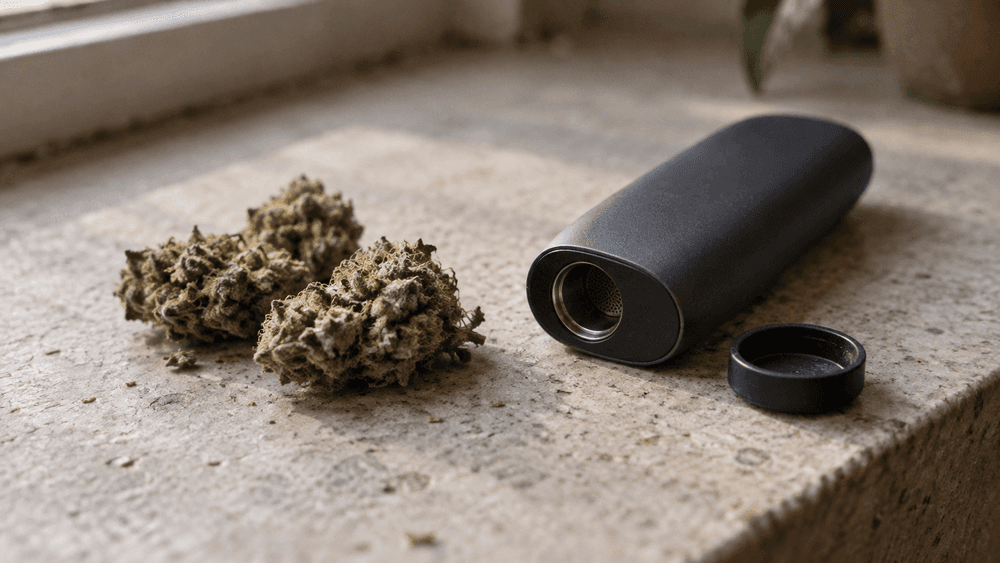
The short answer. The National Institute on Drug Abuse defines dabbing as smoking or vaporizing highly concentrated extracts, often called wax or shatter, and notes that it can rapidly deliver large amounts of THC. That speed, more than the percentage on the label, is what separates a dab from a joint, and the five points below sum up what the research has and has not measured. This page is written for adults 21 and over. Planntz makes hemp CBD tinctures, not dispensary flower or concentrates, so we have nothing to sell you on either side of this comparison.
| Flower (joint, pipe, blunt) | Dab (concentrate) | |
|---|---|---|
| THC in the material | Commonly above 10% in today's dispensary flower; NIDA notes some exceeds 40% | 23.7-75.9% in 57 California samples tested in 2012-13; over half of frequent users in a 2018 survey typically used 80% or more |
| How it is heated | Burned (or vaporized in a dry-herb device) | A small amount is heated on a hot surface and inhaled |
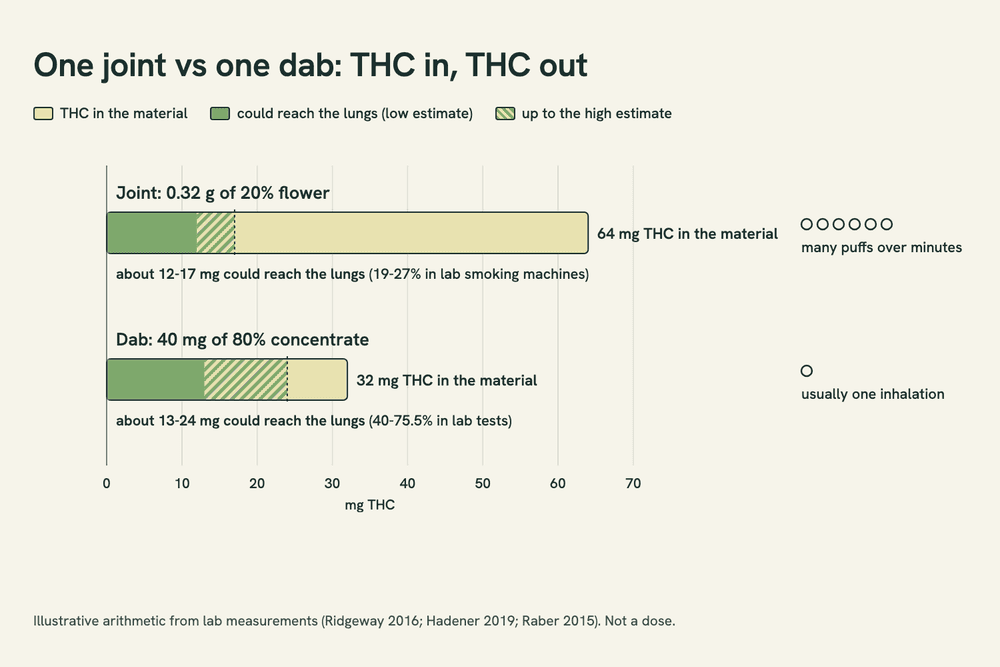
| THC within reach of the lungs, illustrative | About 12-17 mg from a 0.32 g joint of 20% flower | About 13-24 mg from a 40 mg dab of 80% concentrate |
| How fast you take it in | Many puffs over several minutes | Usually one inhalation |
| The one controlled comparison | Lower blood THC | About twice the blood THC, similar measured impairment at 1 hour |
| Main open question | Long-term smoke effects: better studied, still debated | What repeated hot-surface heating does to the lungs: never studied over time |
This is the third format comparison on this site. Between a blunt and a joint, the difference is the wrap and what burning it adds. Switching from flower to a concentrate changes something bigger: the material itself, how much THC arrives at once, and which questions about your health are still open.
What are dabs?
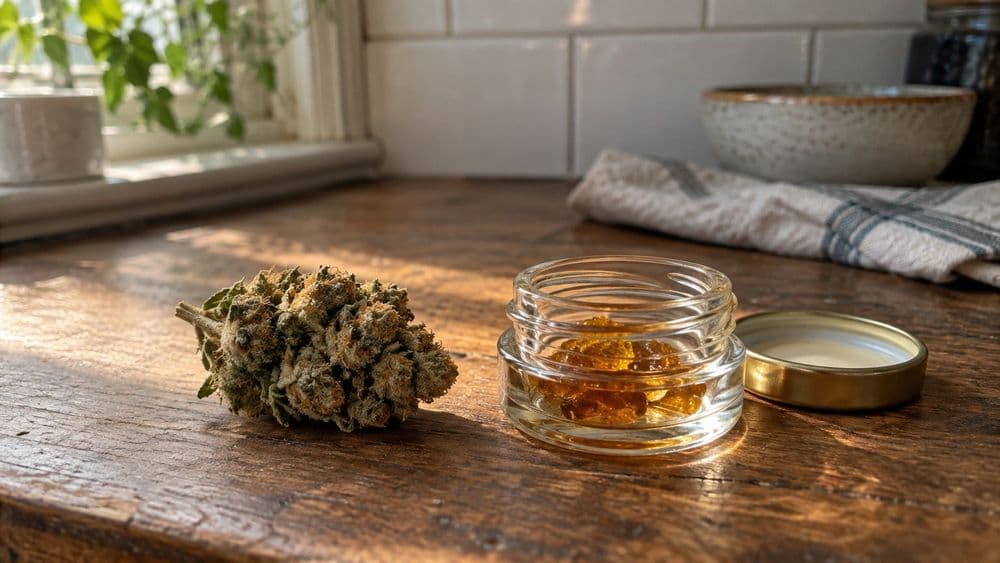
A dab is a small amount of cannabis concentrate that is heated on a hot surface and inhaled. A concentrate is what you get when the cannabinoid-rich resin is separated from the rest of the plant. That resin is made by trichomes, the tiny glands on the flower where cannabinoids are actually produced, so a concentrate is, in effect, the contents of those glands with most of the leaf and stem left behind. It is not a niche habit among regular users. In a 2018 national web survey of 4,077 cannabis users, 58% had tried dabs and 36.5% used them at least monthly, and regular dab use was tied mostly to curiosity and experimentation rather than to the positive effects people rated higher for flower.
The names on a dispensary menu describe one of two things: the texture of the finished extract, or the way it was made. A 2025 review of concentrate chemistry from Portland State University defines rosin as "a solventless extract obtained through mechanical compression (heat and pressure)," and butane hash oil (BHO) as an extract "produced via hydrocarbon (butane) extraction techniques." The same review notes that some concentrates keep the plant's broader range of compounds, while others consist mainly of purified THC mixed back with commercial terpene blends. Terpenes are the aroma compounds that give cannabis its smell.
| Name | What the name describes | What it does not tell you |
|---|---|---|
| Shatter | Texture: hard, glassy and brittle | How it was made, or what else is in it |
| Wax, budder | Texture: soft, waxy or creamy | How it was made, or what else is in it |
| BHO (butane hash oil) | Method: extracted with butane or another hydrocarbon solvent | The texture, or whether any solvent is left in it |
| Rosin | Method: solventless, made with heat and pressure | What happens to it once it is heated for inhaling |
| Live resin | Trade term: an extract made from plant frozen at harvest instead of dried; it describes the starting material, not the solvent | There is no peer-reviewed definition, so it says nothing about quality |
| Distillate | Mostly purified THC, often with terpenes added back | Which terpenes were added, or whether other THC isomers are present |
Rosin's main selling point is true in one narrow sense: no solvent is used, so residual solvent is not a question. The broader claim is marketing. A 2018 analysis of more than 8,000 tweets found rosin widely promoted as a safer, solventless option, and 44.2% of the coded tweets were media posts doing exactly that. The authors noted that the claim was advertising, and that the research had not caught up. Live resin has even less behind it: a PubMed search of titles and abstracts for the phrase returned no results on October 1, 2026, so treat it as a trade name. Distillate is its own story, including what gets added back to it and what labs have found in it, and our THC distillate guide covers that in detail.
Dabs vs flower in milligrams: how much THC is in a dab?
Most pages say a rice-grain dab equals one or two joints and never show the math. Here it is, with each input taken from a measurement. For the joint: a 2016 analysis of more than 10,000 cannabis purchases reported by people arrested in the US estimated that the average joint holds 0.32 g of cannabis. For the dab: 40 mg, the dab size a 2017 Portland State lab study of dabbing chemistry assumed as typical. That is an assumption, not a survey of what people actually use.
Then the part most pages skip: how much of the THC in the material actually makes it into what you inhale. In a Swiss lab test using smoking and dabbing machines, about three quarters (75.5%) of a concentrate's THC made it into the vapor, against roughly a fifth to a quarter (19-27%) for flower in a smoking machine. An earlier analysis of 57 California concentrates put the dabbing figure lower, at up to 40% of the theoretically available THC. So estimates range from up to 40% to about 75%, depending on the setup. For the THC content, we use 20% for flower and 80% for concentrate as round, illustrative figures. How a label percentage turns into milligrams, and how far labels can be trusted, is covered in our guide to whether THC percentage matters.
| Flower joint | One dab | |
|---|---|---|
| Material | 0.32 g = 320 mg | 40 mg |
| THC in the material | 320 mg x 20% = 64 mg | 40 mg x 80% = 32 mg |
| Share reaching smoke or vapor in lab machines | 19-27% | 40-75.5% |
| THC that could reach the lungs | About 12-17 mg | About 13-24 mg |
| Taken in | Many puffs over minutes | Usually one inhalation |
On these numbers, a single dab and a whole joint land in the same range. So the folk rule that one small dab equals a joint is not far off, but for a reason most pages miss. The joint actually holds twice as much THC as the dab; it just loses most of it to burning and to smoke that drifts away. The concentrate loses less. The real difference is speed and packaging: a joint's worth of THC arrives in one breath instead of being spread over several minutes, which leaves you less room to stop partway.
Are dabs stronger than flower? What the one comparison found
Per gram, concentrates carry far more THC. Per session, the picture is more interesting. In the one study that put flower and concentrate users side by side, published in JAMA Psychiatry in 2020, concentrate users ended up with roughly twice the THC in their blood, yet felt about as high and performed about the same on memory and balance tests an hour later. They also arrived with more THC already on board, so tolerance is the likeliest reason, not a gentler product. The full figures, including the strengths each group used, are in the THC percentage guide linked above.
Two design details matter. The 121 regular users chose their own type of product (55 flower, 66 concentrate), so the groups were already different before the study began, which the authors list as a limitation. Within each group, people were randomly assigned a lower- or higher-strength version and used as much as they chose, with measurements in a mobile lab before use, right after and an hour later. Measurements stopped there.
“Differences in short-term subjective and neurobehavioral impairments did not track specifically with strength.”
That finding cuts both ways. "Stronger" showed up in the blood, not in the tests, but the same authors wrote that THC exposure "was much higher in concentrate users, prompting concern about long-term clinical and neurobehavioral implications." Tolerance is also the thread running through what users report. In a 2014 online survey of 357 people, using dabs "created no more problems or accidents than using flower cannabis," but it did lead to higher tolerance and withdrawal, as the participants themselves defined those terms. And one hour is a short window: how long a weed high lasts has been measured for smoked and eaten cannabis, but nobody has measured how long a concentrate high lasts past that first hour.
What heating a concentrate produces
This is the question the top-ranking pages skip. The 2017 Portland State study linked above heated the aroma compounds found in concentrates (pure terpenes such as myrcene, limonene and linalool, plus a commercial terpene mix) on a heated ceramic surface attached to a water pipe and a smoking machine. It caught methacrolein, an airway irritant, and benzene, a known carcinogen, in the vapor. Levels climbed as the surface got hotter. In the myrcene model, methacrolein reached 185 parts per billion per modeled 40 mg dab at the hottest setting, against 131 at a cooler one, and benzene appeared only in the hottest range tested, at an estimated 17 ng per dab. The authors concluded that dabbing may deliver significant amounts of toxic breakdown compounds, noted that users find it hard to control the surface temperature, and said their own figures were likely underestimates. It measured chemistry, not anyone's lungs.
Those first experiments used pure terpenes, not real concentrate, which left an obvious question: does THC itself do this? A 2019 follow-up from the same lab found that THC on its own breaks down into similar compounds, and that adding terpenes raised the levels. Measured against published figures for cannabis smoke, the gases came out lower, but the authors stopped short of calling dabbing safer: they measured only the gas phase, not the particles, took the smoke figures from other papers rather than testing smoke side by side, and flagged the much higher THC load in the vapor. One author also disclosed fees from a company seeking to develop medical cannabis.
Read these studies for what they are. Temperature was a variable they measured, not a setting they validated, and neither study set a level at which inhaling is harmless. What exists in people is thin. A 2024 systematic review of cardiovascular and respiratory effects by route of use concluded that the evidence is too limited to rank smoking, vaping, eating and dabbing against each other. For dabbing specifically, what exists is case reports, such as a 25-year-old with a decade of butane hash oil use admitted with lung injury that looked like pneumonia and improved on steroids. One case cannot tell you how common that is. Vaporizing flower is a separate question with its own evidence, covered in our comparison of dry-herb vaporizers and smoking, and what smoked cannabis does to your airways is far better studied, although none of those lung studies tested dabbing.
What else can be in a concentrate
THC and terpenes are not the only things in the jar. The best-known measurement comes from the same 57 California samples behind the 40% delivery figure. They were submitted by medical cannabis users between December 2012 and February 2013, 48 of them solvent-based and nine of them hash. No residual solvent could be detected in 28.1% of the samples, which means roughly seven in ten had at least one, and every hash sample was clean. Isopentane was the most common, in 29.8%, which the authors put down to an impurity in hardware-store liquid gas. Read the caveat before the number: the paper states that "the analysis of pesticides and residual solvents was qualitative and not quantitative," so detected does not mean over a limit. It also predates today's state testing rules, and this page does not describe how those rules perform.
- Residual solvents: detected in roughly seven in ten of 57 California concentrates in 2012-13, measured qualitatively, so the amounts are unknown. Hash samples had none.
- Additives: the 2025 Portland State review notes that some concentrates have contained hazardous additives such as pine rosin, and cannabinoid acetates, which it lists as precursors of ketene.
- Lab-made THC isomers: FDA testing has found synthetic THC isomers in dab and vape samples.
- Label accuracy: in the published audits, concentrate labels have tended to match lab results more closely than flower labels.
- "Clean" or solventless claims: they settle the solvent question only. They say nothing about what heating the concentrate produces.
Pine rosin, despite the name, is not cannabis rosin: it is a resin from pine trees. The FDA's isomer findings and the label audits each have their own page, the THC distillate and THC percentage guides linked above, so we do not reprint them here.
Dependence and mental-health signals
Most of what is known here is about potency in general, not concentrates in particular. A 2022 systematic review of 20 studies in The Lancet Psychiatry found higher-potency cannabis associated with more psychosis and more cannabis use disorder; results for depression and anxiety were mixed, and none of the studies could prove cause. A 2019 European case-control study of 901 people with a first psychotic episode and 1,237 controls, across 11 sites, found daily use of cannabis with 10% THC or more associated with nearly five times the odds of a first psychotic episode (odds ratio 4.8). Note the threshold: 10% is ordinary for today's dispensary flower, and the study did not look at concentrates specifically.
The concentrate-specific studies are smaller surveys. A 2018 survey across five legal states found that frequent concentrate users reported more signs of cannabis use disorder than people who never used concentrates, but looked similar on other health and work measures; over half of them typically used concentrates of at least 80% THC. Among college students, more frequent use of butane hash oil went with more physical dependence even after accounting for how often they used cannabis overall. Neither design can tell which came first: people who are already dependent may seek out concentrates, or concentrates may deepen dependence. And not every dataset agrees. In a survey of more than 55,000 people, the group defined by concentrate use did not stand out on dependence, though it reported more mental-health diagnoses.
| Study | Design and who | Finding | What it cannot show |
|---|---|---|---|
| Petrilli 2022 | Systematic review of 20 observational studies | Higher potency associated with psychosis and cannabis use disorder; mixed for depression and anxiety | Cause; potency was defined differently in each study, mostly not concentrate-specific |
| Di Forti 2019 | Case-control, 901 first-episode psychosis patients, 1,237 controls, Europe and Brazil | Daily use of cannabis of 10% THC or more: odds ratio 4.8 for psychotic disorder | Cause; 10% is ordinary flower, not a concentrate threshold |
| Bidwell 2018 | Online survey, 191 users in five legal states | Frequent concentrate users reported more cannabis use disorder symptoms | Which came first; small, self-selected sample |
| Meier 2017 | Survey of 821 college students, 273 past-year users | More frequent butane hash oil use linked to physical dependence (risk ratio 1.2) after adjustment | Which came first; one university |
| Loflin 2014 | Online survey, 357 self-selected users | No more problems or accidents overall, but more self-reported tolerance and withdrawal with dabs | Tolerance and withdrawal were self-defined |
| Craft 2020 | Global Drug Survey, 55,240 past-year users | Concentrate-use groups did not show strong dependence links, but reported more mental-health diagnoses | Cause; web sample, one point in time |
| Pierre 2016 | Two case reports | Psychosis emerging after use of cannabis wax | Anything about how often this happens |
What the pattern supports is narrow but consistent: more THC, more often, goes with more dependence symptoms and more psychosis, and concentrates are one of the fastest ways to take in a lot of THC. If you are trying to judge your own use, our pages on whether CBD is addictive, and what the evidence shows and what a tolerance break does, according to brain scans go further. If a single large dose is the worry, read what too much THC at once does, and when to get help. Two groups get one clear line each from the National Institute on Drug Abuse: the American College of Obstetricians and Gynecologists recommends that obstetrician-gynecologists counsel women against using cannabis while trying to get pregnant, during pregnancy and while breastfeeding, and cannabis use at a young age has been linked to psychosis and to developing cannabis use disorder later in life.

Burns: the hazard is in making it
The most severe injuries tied to concentrates in the medical literature are not from using them. They come from making butane hash oil at home, where the solvent can ignite. A Colorado burn center admitted 29 people burned while making butane hash oil between 2008 and 2014: none before medical cannabis was liberalized, and 12 in 2014 alone. Their median burn covered 10% of the body, 6 needed a breathing tube and 19 needed skin grafts. A Northern California burn center treated 101 people for butane hash oil burns between 2007 and 2014; 93.1% were men, burns covered an average of 26.8% of the body, the average hospital stay was 27.1 days, and three died. Both series come from single centers, and both describe manufacture, not use.
Where CBD concentrates fit
CBD comes in concentrated forms too, mainly CBD distillate, which is a material state rather than a grade, and CBD isolate, sold as 99% pure. How the CBD is pulled from the plant in the first place, with CO2 or ethanol, is covered in our comparison of CBD extraction methods. The heating question does not disappear because the cannabinoid changes. The 2025 Portland State review notes that THC and CBD share a ring structure similar to that of limonene, one of the terpenes from the 2017 study, and that in control tests CBN, which lacks it, produced significantly fewer and different breakdown compounds than THC and CBD. No study has followed people who inhale CBD concentrates over time. Planntz tinctures are 60 mL oral oils in an MCT carrier, meant to be swallowed, not heated or inhaled.
What is still unknown
Researchers flagged the gap early, in a 2015 commentary calling for research on dabbing butane hash oil. Six years later, a 2021 review of cannabis concentrate research still concluded that "causal, controlled and representative research on the effects of cannabis concentrates is currently limited," and listed effects on lung function among the questions to study. Even recent surveys do not isolate dabbing: a 2026 survey of nearly 3,500 Oklahoma adults grouped dabbing with edibles, drinks and lotions as "non-combustible" use, so it says nothing about dabbing alone.
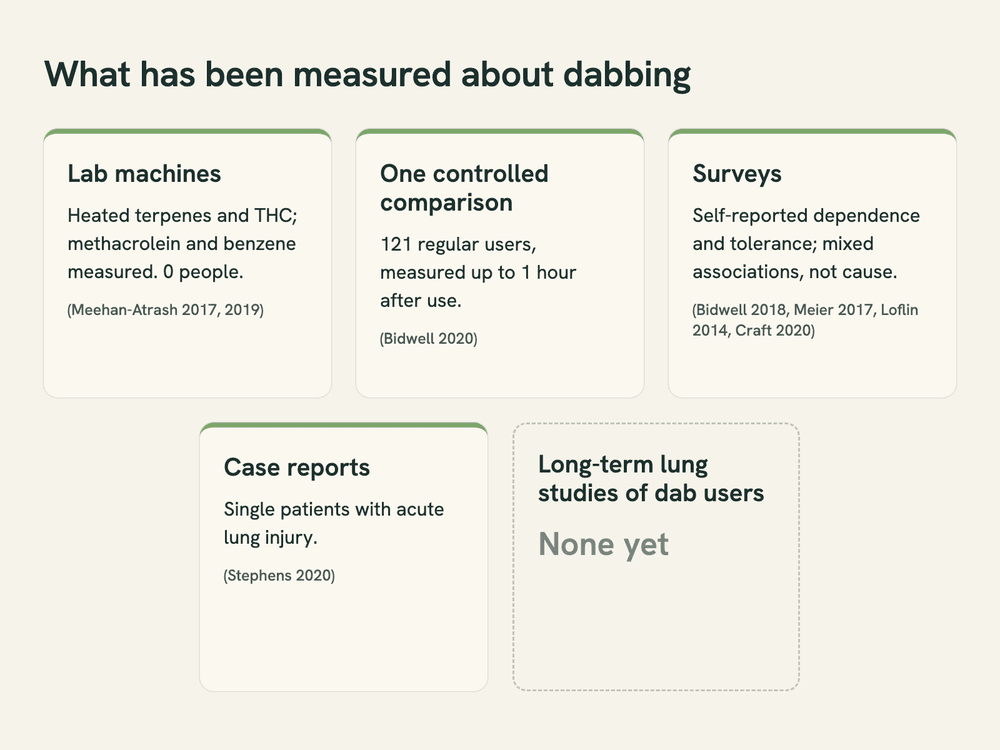
- No study has followed the lungs of people who dab over months or years.
- The heating chemistry comes from machine tests by one lab group, using pure terpenes or THC, and measured the gas phase only.
- Surface temperature varies from person to person and device to device, and the 2017 authors noted that users find it hard to control.
- The only controlled comparison of flower and concentrate users stopped at one hour and did not randomize people to a product type.
- The solvent data come from the 2012-13 California market; legal-market concentrates change faster than studies are published.
- The dependence and psychosis evidence is observational, and most of it measures potency, not concentrates.
When to talk to a clinician
None of this replaces medical advice, and the case reports above are rare. Still, some signs are worth taking to a doctor promptly rather than waiting to see if they pass.
- Shortness of breath, chest pain, a cough with fever or low oxygen after dabbing. Severe or sudden symptoms need emergency care.
- Paranoia, hallucinations or beliefs that others find strange, during use or afterward.
- Losing control over how much or how often you use, or withdrawal symptoms when you stop.
- You are pregnant, trying to conceive or breastfeeding.
Frequently asked questions
Per gram, by a wide margin. In 57 California concentrates tested in 2012-13, THC ranged from 23.7% to 75.9% (apart from one CBD-dominant sample), and in a 2018 survey over half of frequent concentrate users said they typically used concentrates of at least 80% THC. Dispensary flower commonly sits above 10%. Per session, the one comparison of regular users found about twice the blood THC in concentrate users but similar impairment on tests an hour later. Those users arrived with more THC already on board, so tolerance is the likeliest explanation; it does not mean concentrates are gentler.
On lab delivery figures, about one. A 40 mg dab of 80% concentrate holds 32 mg of THC, and lab tests recovered 40% to 75.5% of it, about 13-24 mg. A 0.32 g joint of 20% flower holds 64 mg, but smoking machines recovered only 19-27%, about 12-17 mg. The ranges overlap. The difference is that the dab arrives in one breath. Dab sizes and strengths vary widely, so treat this as arithmetic, not a dose.
Nobody knows yet, because no study has followed dab users' lungs over time. Lab studies show that heating terpenes and THC on a hot surface produces methacrolein, an airway irritant, and benzene, a carcinogen, with levels rising as the surface gets hotter. One lab estimate put gas-phase toxicants below published figures for cannabis smoke, but it did not measure particles and the authors flagged the higher THC load. Case reports of acute lung injury after dabbing exist. The honest answer is neither safer nor worse: unmeasured.
Several surveys link frequent concentrate use with more dependence symptoms: a 2018 five-state survey, a 2017 college study that adjusted for overall frequency of use, and a 2014 survey in which dab users reported more tolerance and withdrawal. A 2022 systematic review links higher-potency cannabis with cannabis use disorder. But a survey of more than 55,000 people found no strong dependence signal for concentrate users. All of these are observational, so none shows that concentrates cause dependence rather than attract people who are already dependent.
Shatter and wax are texture names: glassy and brittle versus soft and waxy. Rosin and butane hash oil are method names: rosin is made with heat and pressure and no solvent, while butane hash oil is extracted with butane or another hydrocarbon. Live resin is a trade term for an extract made from plant frozen at harvest instead of dried, with no peer-reviewed definition. None of these names is a quality grade or tells you the THC content.
Rosin is made without solvents, so residual solvent is not a question for it, which is a real difference from butane hash oil. But heating it still raises the same chemistry question: lab studies found that THC itself, not only added terpenes, breaks down into similar compounds when heated. A 2018 study of more than 8,000 tweets found rosin widely marketed as safer and solventless, and the authors noted that research had not caught up with the claim.
CBD distillate and isolate exist, and people do heat them. The same heating question applies: a 2025 review notes that CBD shares a ring structure with THC, and that CBN, which lacks it, produced significantly fewer breakdown compounds in control tests. No study has followed people who inhale CBD concentrates. Planntz tinctures are oral oils, meant to be swallowed, not heated or inhaled.
Where to go next. The single most useful skill for comparing flower and concentrates is turning a percentage on a label into milligrams, and knowing how far to trust that label. Start with how THC percentage translates into milligrams, and what label audits found, then read what gets added back to THC distillate and what labs found in it.
Writing about hemp, wellness and the small rituals that keep us balanced.