CBD Isolate: What 99% Pure Means, and What the Rest Is
CBD isolate is the one cannabinoid material a specification can describe completely. Which standards actually exist for cannabidiol, what the only proposed US purity numbers say, what the rest of the powder is made of, and why a certificate reading ND is not a zero.
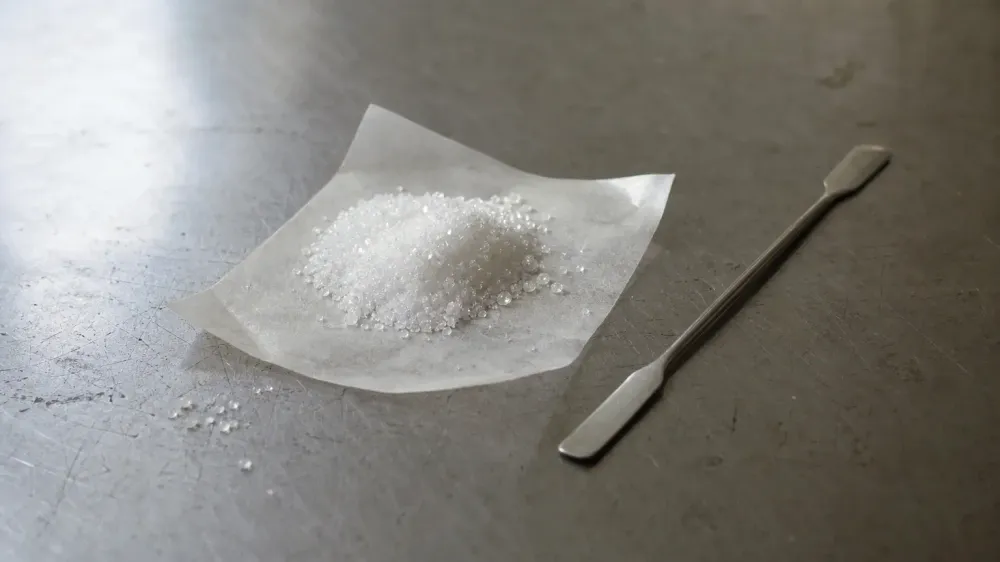
CBD isolate is one compound. Not a blend, not an extract, not a grade: a single molecule crystallized out of everything it grew up with, and the only cannabinoid material you can put on a scale and describe completely with a specification. Which raises a question almost nobody asks. Whose specification, and what does it actually say?
The short version, up front. Isolate is purified cannabidiol, sold as a white powder, and the number attached to it on nearly every product page is 99%. We went looking for the document behind that number. A pharmacopoeial standard for cannabidiol as a substance does exist, it is European, and it has been in force since July 1, 2024, but its figures sit behind a subscription and we could not read them. The United States has no official standard at all. It has a draft, and that draft has been a draft since January 2022. The draft's proposed assay is 98.0 to 102.0%, its ceiling on total impurities is 2.0%, and its line on delta-9-THC is a limit of 0.10%, not a requirement of zero. Nobody with standard-setting authority has written down 99%, and no public standard defines the marketing word isolate at all.
What CBD isolate actually is
Start with the material, because it is unusually easy to define. Cannabidiol is one compound with one formula, and the clearest published description of it sits somewhere most buying guides never look: section 11 of an FDA-approved drug label. The DESCRIPTION section of the Epidiolex labeling on DailyMed states that cannabidiol is a white to pale yellow crystalline solid, insoluble in water and soluble in organic solvents, with the empirical formula C21H30O2 and a molecular weight of 314.46. That is the whole material identity in one sentence. Two things to be clear about: Epidiolex is a prescription medicine and we are citing exactly one thing from its label, the physical chemistry of the substance, with no dose, no indication and no efficacy attached. Nothing about a consumer hemp powder follows from a drug approval, and how a prescription cannabidiol medicine differs from a hemp supplement is its own comparison.
That single property, one compound rather than a mixture, is what makes isolate behave differently from everything else on the shelf. A tincture is a mixture diluted into a carrier oil, so it is sold by volume and described in milligrams per milliliter, which is why the rest of the category is sold by volume instead. A gram of isolate is a gram of one thing, so it can be dosed by weight, and that is the reason it exists as a commercial material at all: you can put a measured mass of it into a gummy, a capsule or a beverage and know what you put in, without carrying an extract's color, taste or aroma along with it. Odor and flavor in a hemp product come from the terpene fraction, and crystallization leaves that behind. None of which makes the solid simple. Even the crystal has more than one known form: a 2024 commentary in Cannabis and Cannabinoid Research puts into perspective the discovery of cannabidiol crystal polymorph Form 2, meaning the same molecule can pack into more than one arrangement. For the plain-English version of what cannabidiol is before any of this happens to it, see where cannabidiol sits among the cannabinoids.
Where the powder comes from, and where this page stops
The chain that ends in a white powder has four named stages, and this page owns only the last one.
- 1Extraction. A solvent pulls a crude, everything-included oil out of the biomass.
- 2Winterization. Chilling and filtering drop out the waxes and lipids that came with it.
- 3Distillation. A vacuum still sorts the mixture by volatility and leaves a thick, high-cannabinoid oil.
- 4Chromatography and crystallization. One compound is separated out of that mixture and grown into a solid, then dried under vacuum to drive off the solvent it was grown from.
What that last step looks like at scale is documented: in a 2025 scale-up published in ACS Agricultural Science and Technology, the chromatography output crystallized as 183 grams of yellowish crystals, which were then redissolved in the minimum amount of hot n-hexane and allowed to recrystallize at room temperature, giving 155 grams of white ones. The whiteness is a processing outcome, not a purity certificate. After that the crystals went under high vacuum, 0.1 millibar at 40 degrees Celsius, specifically to eliminate any trace of the solvent they had just been grown from. That is one laboratory's optimized protocol rather than a description of how any commercial isolate is made, and the steps before it belong elsewhere: how CBD is extracted, method by method and the distillate stage that comes immediately before this one.
We went looking for the document that defines 99% pure
Here is the state of the search results. Read the pages ranking for this term on August 23, 2026 and you are given two different purity floors for the same material, 95% on one result and 99% on another, and neither one carries a citation. Nobody names the document that sets the number. Nobody explains what the remainder is. So we went and looked for the document, and the answer turns out to be more interesting than either figure.
A pharmacopoeial standard for cannabidiol as a substance does exist, and almost nobody writing about isolate seems to know it. The European Pharmacopoeia Commission adopted a monograph titled Cannabidiol at its 176th session in June 2023. It was published in Ph. Eur. Supplement 11.5 in January 2024 and came into force on July 1, 2024, and its definition was tightened during drafting from the earlier wording, isolated from natural sources, to the final wording: CBD is isolated from the Cannabis sativa L. plant. All of that reaches you through the ECA Academy's report of the adoption, a pharmaceutical industry body, because the adopted text sits behind the EDQM's subscription. We did not read the monograph. Neither can you, for free. So we are not going to quote a European purity figure, and you should be careful with anyone who does. Note also what that standard governs: a drug substance in Europe, not a hemp supplement in the United States.
The United States has no equivalent in force. USP, the body that writes the official standards for medicines sold here, describes its own cannabidiol text on its cannabis page in the present tense as a proposal: this proposed monograph aims to provide specifications for highly purified Cannabidiol (CBD) from Cannabis sativa. Proposed. The draft first appeared in Pharmacopeial Forum 48(1) in January 2022 with a comment deadline of March 31, 2022, was revised in PF 50(3) in 2024, and was revised again in PF 51(3) in 2025 with a comment deadline of July 31, 2025. When we checked on August 23, 2026, it was still a draft, four and a half years after it first appeared. The correct verb is therefore never requires. USP proposes.
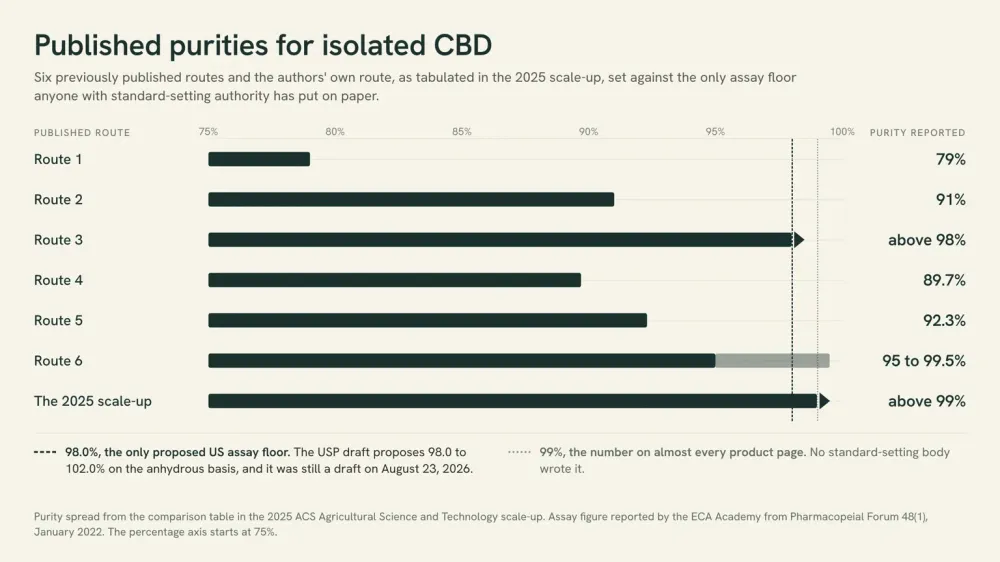
The draft's numbers are worth reading anyway, because they are the only US figures anyone with standard-setting authority has put on paper. Pharmacopeial Forum is not open access either, so the table below comes secondhand, from the ECA Academy's reading of the January 2022 draft dated January 19, 2022, with the later revisions reported in a follow-up from the same body. Treat every figure in it the way we do: proposed, secondhand, and dated.
| Parameter | What the USP draft proposes | Why it matters |
|---|---|---|
| Assay (CBD content) | 98.0% to 102.0% of CBD, calculated on the anhydrous basis | The only US purity floor anyone has proposed. It is 98.0%, not 99% |
| Cannabinol (CBN) | Maximum 0.15% | CBN forms from THC with time and heat, so it reports on the starting material and its history |
| Delta-9-THC | Maximum 0.10% | A ceiling, not a requirement of zero. On one gram that is up to 1.0 mg in a fully compliant material |
| Delta-8-THC | Not detected | The one line in the table written as an absence rather than as a number |
| Any individual unspecified impurity | Maximum 0.10% | Anything the method sees that the monograph has not named |
| Total unspecified impurities | Maximum 0.50%, added in the 2025 revision | The same 2025 draft also excludes synthetically derived CBD from its scope |
| Total impurities | Maximum 2.0% | The complement of the assay floor, and the real answer to what the rest of the powder is |
| Residual solvents | Controlled by reference to USP general chapter 467 | A separate test with its own instrument, aimed at the solvents the crystals were grown from |
| Elemental impurities | Controlled by reference to USP general chapter 232 | The heavy metals question, which no purification step measures on its own |
Three things fall out of that table, and they are the reason this article exists. First: the only proposed US purity floor is 98.0%. Not 99%, not 99.9%. Those are seller conventions, and the peer-reviewed literature agrees that isolated CBD is a range rather than a number: the same 2025 scale-up prints a comparison table of previously published routes to isolated CBD with purities of 79%, 91%, above 98%, 89.7%, 92.3% and 95 to 99.5%, against above 99% for the authors' own route, confirmed by gas chromatography at an external forensic laboratory. Second: the only specification for purified cannabidiol whose numbers we can actually read does not require zero THC. It sets a limit. Delta-9-THC, maximum 0.10%. Do the arithmetic on the draft limit and that is up to 1.0 mg of delta-9-THC per gram in a material that fully complies. That is a calculation on a proposed ceiling, not a measurement of any product, and it still does more damage to the sales phrase "contains no THC" than any opinion could. Third: neither document defines the word isolate. The European monograph is titled Cannabidiol. The US draft is for highly purified cannabidiol. There is a public standard for the molecule and there is still no public standard for the word on the label, which is why the only number that applies to a specific jar is the number on that jar's certificate. If those columns are unfamiliar, start with reading that certificate line by line.
So what is the other 2 percent?
This is the question the whole category skips, and the proposed specification answers it directly. If the assay floor is 98.0% and total impurities are capped at 2.0%, then the remainder is not a mystery. It is a list, and the list is the impurity half of the table above: cannabinol, delta-9-THC, delta-8-THC, unspecified organic impurities, residual solvents and elemental impurities.
Look at which half of that list is doing the work. Only three of those six are cannabinoids, and the last two point at hazards a purity percentage cannot see. That is not an accident of drafting. The last step in making isolate is a crystallization, and crystals have to be grown out of a solvent, which is exactly why the 2025 scale-up parked its white crystals under vacuum at 40 degrees Celsius to drive off the hexane they had just been grown from. A residual-solvent panel is not an optional line on an isolate certificate. It is the line the process itself points at. The general principle, that purification is not the same thing as purity, is worked through at the distillate stage and isolate is its endpoint rather than its exception. And the separate question of who ran the test and whether they are independent has its own answer.
The arithmetic: what a purity percentage is worth per gram
Percentages are hard to feel. Milligrams are not, and isolate is the one form where you can convert straight between them, because a gram of powder is a gram of one substance. One gram at a 99.5% assay contains 995 mg of cannabidiol. The same gram at 95% contains 950 mg. That is a 45 mg difference on a single gram, from two numbers that look almost identical on a product page. Run the same arithmetic on the draft's THC ceiling and 0.10% of one gram is 1.0 mg. Again: that is arithmetic on a proposed limit, not a measurement of anything you can buy.
Now convert in the other direction, because a specification is only useful if you can move between it and a label you actually hold. A Planntz tincture is 60 mL at 250 mg/mL, which is 15,000 mg of CBD in the bottle and roughly 12.5 mg per drop at a typical 0.05 mL drop, across about 1,200 drops. To supply 15,000 mg of cannabidiol out of a 99.5% powder you would need 15,000 divided by 0.995, which is 15,075 mg, or about 15 grams of powder. That is a unit conversion and nothing else. Planntz tinctures are whole-plant full-spectrum and broad-spectrum oils, we do not sell isolate, and we are not describing our own manufacturing here. The conversion is on the page so you can read a powder specification and a dropper label in the same units. Drop size varies by dropper and technique, and the per-drop half of this is worked through properly with the dropper math; turning milligrams into a fair comparison between two brands is cost per milligram, which is a different calculation again.
THC-free is a measurement claim, not a product claim
This is where page one falls apart, and it falls apart inside a single article. One of the leading health results for this term states plainly that isolate "contains no THC". Further down the same page, the same article warns readers about products labeled "THC-free". We read both sentences on the live page on August 23, 2026, and we are quoting the second one exactly, without naming the publisher, because the problem is the claim rather than the company:
“may still contain enough THC that a person could fail a urine toxicity test”
Both sentences cannot be load-bearing. Two facts settle which one to keep. The first is already above: the one specification for purified cannabidiol whose numbers we can read sets delta-9-THC at a maximum of 0.10% rather than requiring zero, and a limit is not an absence. The second is what a certificate actually reports. ND does not mean zero. It means the method did not see the analyte above a floor that is printed right beside it, and that floor belongs to the instrument, not to the jar. You can watch all three possible answers appear on one document. The rows below are from our own Broad Spectrum Mango & Peach certificate, batch 260320, which we can print numbers from because it is ours.
| Row on the certificate | What it reads | Detection limit / quantitation limit | What that actually means |
|---|---|---|---|
| CBD | 269 mg/mL (16,300 mg per package, 28.8% by mass) | 0.0347 / 0.172 mg/mL | A quantity. Measured, quantified, and you can multiply it |
| Lead (heavy metals panel) | < LOQ | 0.00100 / 0.00400 micrograms per gram | Seen, but present in an amount too small for the method to put a number on |
| Delta-9-THC | ND | 0.0460 / 0.172 mg/mL | Not detected above the floor printed beside it. A statement about the method, not a count of molecules |
| Delta-8-THC | ND | 0.0278 / 0.172 mg/mL | The same reading, a different analyte and a different floor |
| THCA | ND | 0.0632 / 0.190 mg/mL | The same reading again, for the acid form |
| Total THC | ND | Not printed (calculated row) | A calculation from the rows above it, so it carries no limits of its own |
Read the lead row and the THC rows together and you have the entire argument in one document. Lead is present. The method saw it and could not put a number on it, so the certificate says so honestly: below the quantitation limit. Delta-9-THC was not seen above its own printed floor, so the certificate says ND. Those are two different sentences, and neither of them is the sentence zero. We are not going to convert that detection floor into an implied quantity in a bottle either, because multiplying a limit the method could see by a volume manufactures a number where a measurement found none. The honest version stays qualitative: the certificate tells you what the method could see and reports that it did not see it. That is a real answer, and it is not the same answer as none. The definitions of ND, LOD and LOQ are laid out in our walkthrough of a certificate of analysis. If your question is really about a workplace screen, no product can guarantee a drug test outcome, and what a non-detect does and does not mean for a workplace screen is covered on its own page. A purity claim with no document behind it, meanwhile, is one of the signals worth treating as red flags.

Isolate versus full spectrum is a question about evidence grade
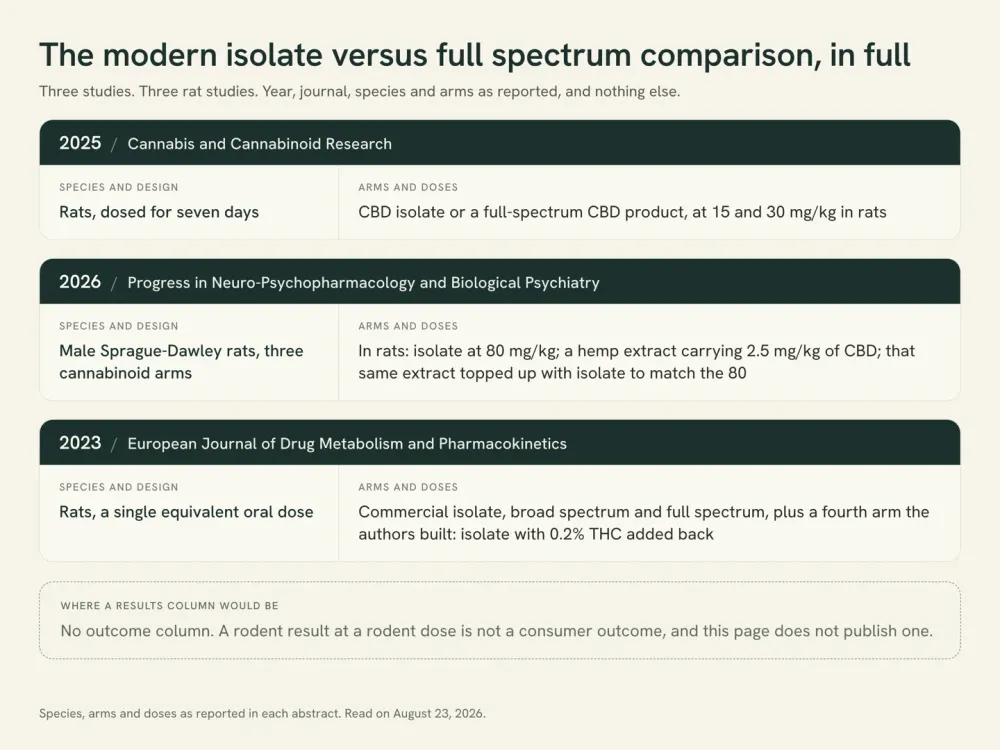
This is the comparison everyone actually wants settled, so here is what the evidence is made of in 2026. The best modern head-to-head is a 2025 study in Cannabis and Cannabinoid Research that gave rats a CBD isolate or a full-spectrum CBD product for seven days at 15 and 30 milligrams per kilogram and compared behavioral outcomes. The two materials did not behave the same. Now read the authors before you read the headline. Their own background section says investigations in this area remain limited, and states the proposition being tested as a conditional: that full-spectrum extracts might provide greater efficacy than isolates. Might, in rats, at a rodent dose that is not a serving of anything and has no human equivalent on this page.
A year later, a different laboratory ran a cleaner version of the same comparison. A 2026 study in Progress in Neuro-Psychopharmacology and Biological Psychiatry used male Sprague-Dawley rats and three cannabinoid arms: a CBD isolate at 80 milligrams per kilogram, a hemp extract carrying 2.5 milligrams per kilogram of CBD plus other phytocannabinoids, and that same extract topped up with isolate to match the 80. The three arms did not perform identically. Few studies tested this, its authors write, and their own conclusion is phrased as a suggestion, that the combination may be more effective. And there is one rodent experiment that isolates the variable outright. A 2023 pharmacokinetic comparison in the European Journal of Drug Metabolism and Pharmacokinetics dosed rats with a commercially available isolate, a broad-spectrum and a full-spectrum product at a single equivalent oral dose, then added a fourth arm the authors built themselves: CBD isolate with 0.2% THC isolate stirred back in. The oral bioavailability of CBD was higher when it was given as the full-spectrum product, and the authors report no difference in bioavailability between that commercial full-spectrum formulation and their own isolate-plus-THC preparation. Whatever the difference was, it tracked a cannabinoid you can name and measure, not an unspecified plant halo. All three studies are rats, and you have now read two of the three telling you, in their own words, that the question is under-tested.
And the experiment the whole category is quoting, when you follow the chain back, is older and smaller than the argument built on it. It is a 2015 mouse experiment in Pharmacology and Pharmacy in which the measured response to purified CBD rose and then fell as the dose increased, a bell-shaped curve, while the response to a CBD-enriched plant extract kept rising across the range tested. It is a real experiment and it is worth knowing about. It is also mice, one plant clone, one laboratory, published in 2015 in a journal that a PubMed title search does not find at all, which we checked on August 23, 2026. That is the evidence grade under the most repeated claim in this category. None of which makes the distinction trivial: a 2020 review in the Journal of Dietary Supplements argued that a whole botanical extract and an isolated single compound are genuinely different objects for policy, safety and scientific purposes, and we read that one at abstract level only. But whether the mixture does more than the molecule in a person is a question with its own page, and our entourage effect article, which takes the question on with the human evidence attached, is where it belongs. We are not going to tell you that full spectrum beats isolate, and we sell full spectrum. Which of the three suits you is a buying decision rather than a scientific verdict, and the practical differences between full spectrum, broad spectrum and isolate as a buying decision are set out separately.
One date to know: November 12, 2026
One forward-looking note, deliberately short, because another page owns it in full. From November 12, 2026 the federal hemp definition changes, and the operative test moves toward a quantifiable amount of total THC per container rather than a percentage of dry weight, which is a test that a single-compound powder is unusually easy to argue about in either direction. The statute, the section numbers and the thresholds are all set out in our guide to the November 2026 hemp law change, and we are not going to predict how it gets enforced.
What this page cannot tell you
Honest limits, because an article whose whole argument is check the document should hold itself to that rule. We did not read the European monograph: its text is behind a subscription, so every European fact here is a date and a title reported by a third party, and not one of them is a number. The US figures are a draft, they reach you secondhand from an industry body's reading of Pharmacopeial Forum, and a draft that has survived three publication cycles without becoming official may yet change again. Both documents are drug-substance standards in any case, so neither one governs a consumer hemp powder sold as a supplement. The comparison literature is rodent: four of the studies on this page are animal work, one of them is mice from 2015, and none of them was designed to tell a shopper anything. We did not test an isolate ourselves, we do not sell isolate, and the certificate we printed rows from is one of our own tinctures rather than a powder. What we could not find, reading on August 23, 2026, is any survey measuring what the isolate actually on the market assays at. That absence is the real state of the evidence, and it is exactly why the batch document beats the category number.
How to read an isolate certificate in sixty seconds
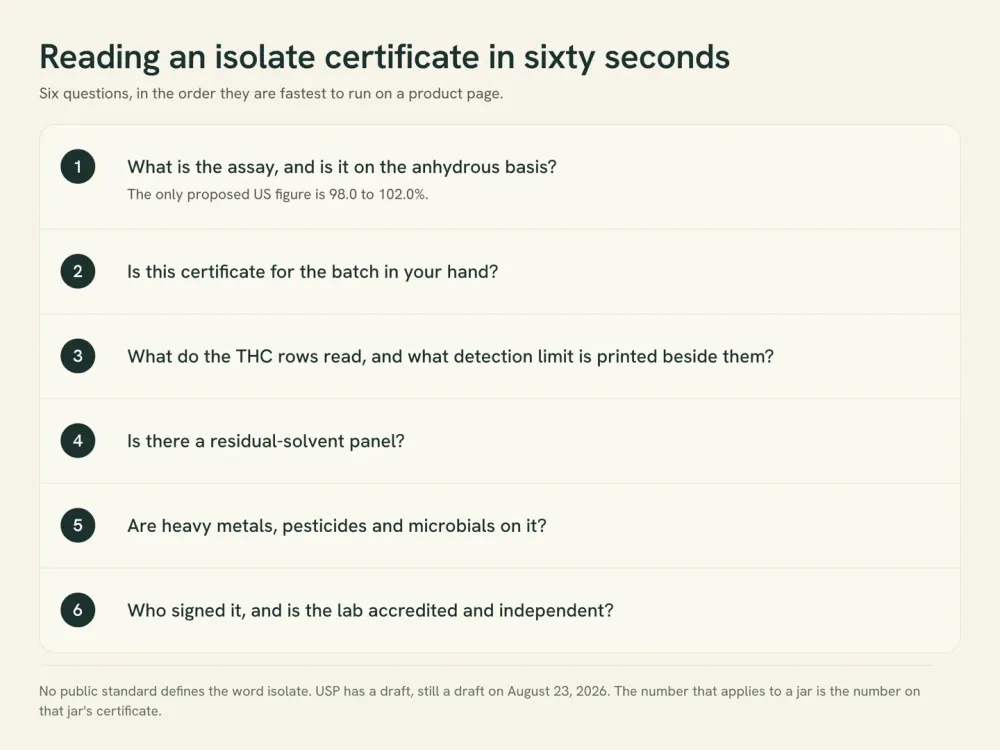
- 1Find the assay and compare it to a document, not a slogan. The only proposed US figure is 98.0 to 102.0% on the anhydrous basis. If the page says 99.9% and the certificate is silent, the page is a description, not a measurement.
- 2Check that the certificate is for the batch in your hand. A report for a different lot is a document about a different pile of powder, however good its numbers look.
- 3Read the THC rows and the number printed beside them. ND with a detection limit next to it is a real answer. THC-free with nothing next to it is not.
- 4Look for a residual-solvent panel. Crystals are grown out of a solvent and then dried under vacuum to remove it, so this is the test the manufacturing route itself points at.
- 5Look for heavy metals, pesticides and microbials. A purity percentage for one compound says nothing about what else survived the route, and a purification step is not a contaminant filter.
- 6Check who signed it, and whether the lab is accredited and independent. An in-house result and a third-party result are different documents even when they carry the same number.
Those six are the isolate-specific slice of a larger decision. The full version, which puts strength, spectrum, carrier oil and price in one frame, is how to choose a CBD oil. And the sixth item has a page of its own, because independence is the part of a certificate that is easiest to fake and hardest to check: see what third-party tested actually means.
Frequently asked questions
Answer that on the specification rather than on the adjective, because THC-free and 0% THC have no legal definition. The only specification for purified cannabidiol whose numbers we can read, the USP proposed monograph, sets delta-9-THC at a maximum of 0.10% rather than requiring zero, which on one gram is up to 1.0 mg in a fully compliant material. And a certificate that reads ND is telling you the method did not see the analyte above a floor printed beside it, not that the jar contains none. So the honest answer is a question: what does the THC row on that batch's certificate read, and what limit is next to it? No product can guarantee a drug test outcome.
Sometimes, and no public standard makes it a requirement. The only proposed US assay is 98.0 to 102.0% on the anhydrous basis, with total impurities capped at 2.0%, and it was still a draft when we checked on August 23, 2026. The peer-reviewed literature on isolated CBD reports purities of 79%, 91%, above 98%, 89.7%, 92.3% and 95 to 99.5% depending on the route used. Nobody with standard-setting authority ever wrote 99%. The number that applies to a specific jar is the number on that jar's certificate, and if there is no certificate there is no number.
Distillate is a refined mixture and isolate is a crystallized single compound. They are consecutive stages of the same chain: distillation sorts the extract by volatility and leaves a thick, high-cannabinoid oil, and a chromatography and crystallization step then pulls one compound out of that oil as a solid. Our article on CBD distillate covers the stage before this one, including why refining a material is not the same thing as testing it.
No product can guarantee a drug test outcome, and this page does not publish one. What a certificate reports is a non-detect at a stated limit, which is a statement about the method rather than about the container, and the proposed US specification for purified cannabidiol sets a THC limit rather than requiring zero. Our article on CBD and drug testing covers the screening side in full, including cutoffs and residual risk.
Very little of either, which is much of the reason it exists. The label for Epidiolex, an FDA-approved prescription medicine, describes cannabidiol as a white to pale yellow crystalline solid, and the odor and flavor of a hemp product come mostly from the terpene fraction, which crystallization leaves behind. That is also why isolate is used in foods and beverages where an extract's flavor would be a problem. What a full-spectrum oil actually tastes like, and why, has its own article.
No. The label for the prescription medicine Epidiolex states that cannabidiol is insoluble in water and soluble in organic solvents. Products that appear to mix cleanly into a drink have been formulated to do that, usually through an emulsion, and that formulation step is a separate piece of engineering with its own trade-offs. Our article on water-soluble CBD covers the mechanism and every absorption claim attached to it.
If you take one habit from this page, take this one: when a product page gives you a number, go and find the document behind it. Ours are published batch by batch, and you can open every batch certificate we publish without an account or an email address. And if you are still choosing between the three tiers rather than reading a specification, start with the three-way decision and come back to the arithmetic afterwards.
Read the certificate before the copy
Planntz tinctures are whole-plant full-spectrum and broad-spectrum oils, 60 mL at 250 mg/mL, and every batch ships with a public certificate of analysis you can open before you buy.
See the tincturesWriting about hemp, wellness and the small rituals that keep us balanced.