Microdosing CBD: The Word, the Schedule, the Arithmetic
Microdosing CBD comes with a number attached: 3 to 6 mg every few hours. Nobody sources it. We check the word against the FDA's definition, the ICH ceiling and the psychedelic research that coined it, then add up page one's own schedule and find the day never gets smaller.
Ask what microdosing CBD means and you get a number back, usually 3 to 6 mg every 2 to 3 hours. The same figures turn up page after page, phrased almost identically, as though everyone were reading off the same chart. There is no chart. There is not even a settled definition of the word, and when you add up the schedule those pages publish, it does not do the thing the word says it does.
The short answer, up front. Microdosing is a real and measured behavior: in a nationally representative survey of 1,523 US adults, 9.4% said they had microdosed cannabis at some point. But the word was borrowed, and everywhere it has a published definition, from the FDA's drug-development guidance to the psychedelic research that made it popular, it means the same structural thing: a fraction of a dose large enough to produce an effect somebody can detect. CBD has no agreed detectable dose to take a fraction of. That is why nobody can tell you what a CBD microdose is, why the amounts on page one disagree with each other by tenfold, and why this article publishes none of its own. If what you actually want is an amount, that question lives on our guide to how much CBD to take, and the plain definition of the compound lives on what CBD is.
How many people microdose, and what they actually microdose
Start with the demand, because it is real and it has been counted. In 2026 the American Journal of Preventive Medicine published a cross-sectional survey of microdosing prevalence among US adults, run on the Ipsos KnowledgePanel: 1,523 adults, fielded in October and November 2023, with survey weights applied so the estimates stand in for the national population. It asked about four substances. Lifetime microdosing was reported by 9.4% of adults for cannabis (95% confidence interval 8.0 to 10.7, about 24.1 million people), 5.3% for psilocybin, 4.8% for LSD and 2.2% for MDMA. The stated reasons split by substance: cannabis was microdosed primarily for medical purposes (41.2%, confidence interval 33.3 to 49.5), while psilocybin (66.6%), LSD (59.2%) and MDMA (86.0%) were more often microdosed for recreational reasons. It is a self-report survey with lifetime recall, so no product, amount or route was verified. What it measures well is how many people say they do this, and why.
Now the detail that reframes the entire search result. The four substances that survey asked about are cannabis, psilocybin, LSD and MDMA. CBD is not one of them. The instrument is called the Characterizing the Epidemiology of Cannabidiol Use Survey, which is the only reason the paper surfaces in a literature search for microdosing and cannabidiol at all, and it is the same national panel behind the first-month figures in what people actually report when they start taking CBD. So the best available measurement of microdosing appetite in the United States contains no measurement of microdosing CBD. That is not a criticism of the paper. It is the shape of the whole subject in one sentence: a large appetite, and nothing underneath it.
Where the word comes from, and what it means there
The word is not vague everywhere. It is vague here. In medicine, microdose is a defined technical term with a number attached, and it has had one since January 2006, when the FDA's Center for Drug Evaluation and Research published its guidance on exploratory investigational new drug studies. Page 9 defines it: "A microdose is defined as less than 1/100th of the dose of a test substance calculated (based on animal data) to yield a pharmacologic effect of the test substance with a maximum dose of [at most] 100 [micrograms]." The bracketed words replace a less-than-or-equal sign and the micro symbol in the original; nothing else is changed. The same page states what such a study is for: a microdose study is run to evaluate pharmacokinetics or to image a specific target, and in the guidance's own words such studies "are designed not to induce pharmacologic effects." Read that twice. In its home discipline, a microdose is defined by the fact that it is expected to do nothing.
The same ceiling appears in the international rulebook. ICH M3(R2), the international guideline on nonclinical safety studies, reached its Step 4 version on June 11, 2009, and at that step was recommended for adoption to the regulatory bodies of the European Union, Japan and the United States. Section 7.1, headed Microdose Trials, sets out two approaches. The first "would involve not more than a total dose of 100 [micrograms] that can be administered as a single dose or divided doses in any subject." The second involves "[no more than] 5 administrations of a maximum of 100 [micrograms] per administration (a total of 500 [micrograms] per subject)." As in the FDA quotation, the brackets replace the micro symbol and a less-than-or-equal sign; nothing else is changed. Notice the plainest property of both definitions: the ceiling is not smallness in spirit. It is a number, and the number is in micrograms.
One limit, stated in the same breath, because it matters and because it is the sentence most likely to be misread. Both of those documents govern investigational drug development, meaning how a sponsor may give a new molecule to a human being for the first time. Neither governs dietary supplements or hemp products. No seller is legally obliged to use the word this way on a wellness blog, the FDA has not ruled on microdosing CBD, and nothing here says anyone is breaking a rule. The point is purely definitional: the word has a technical meaning in medicine, that meaning is anchored to a pharmacologic threshold, and it is not the meaning being used on the pages that rank for it.
| Where the word is defined | What a microdose is there | How often | What it is a fraction of |
|---|---|---|---|
| FDA, Exploratory IND Studies guidance, January 2006 (investigational drugs) | Under 1/100th of the pharmacologically active dose, ceiling 100 micrograms | Studies are designed not to induce pharmacologic effects | A dose calculated from animal data to produce a pharmacologic effect |
| ICH M3(R2), section 7.1, June 2009 (recommended for adoption in the US, EU and Japan) | A total dose of 100 micrograms, or no more than 5 administrations of at most 100 micrograms each | Single or divided doses inside one trial | The same pharmacologic threshold |
| Psychedelic research (Szigeti and colleagues, eLife, 2021) | Roughly 10% to 20% of a typical full dose | One to three times per week | A full recreational dose of the same drug |
| The 2026 US prevalence survey's own definition | Typically between one fifth and one twentieth of a recreational dose | Not specified | A recreational dose |
| Pages ranking for microdosing CBD, read August 28, 2026 | 1 mg to 10 mg, no source named | Two to five times a day | Not stated anywhere |
Line those up and one structural thing is true of all four published definitions and false of the fifth row. Each definition is a ratio, and the denominator is a dose that reliably does something. A pharmacologic effect, in the FDA's phrasing. A full dose, in the research phrasing. A recreational dose, in the survey's. The numerator is deliberately below it. Take away the denominator and there is no fraction left to compute, only an adjective. That is the entire problem with the phrase, and it takes about ninety seconds to see once the definitions are next to each other, which is why we put them next to each other.
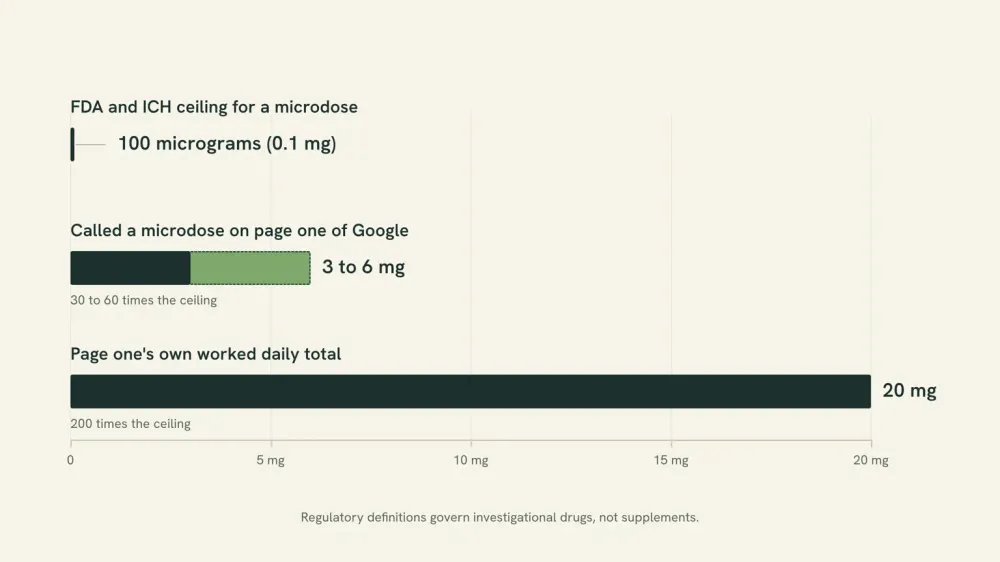
Why the definition of a microdose cannot transfer to CBD
A sub-perceptual fraction needs a perceptible dose to be a fraction of. That is the sentence the whole category is missing, and CBD is exactly the substance where it fails. There is no agreed amount of CBD at which a healthy adult reliably notices anything, which is not a rhetorical flourish: it is why this blog publishes an entire page on how to tell whether CBD is doing anything for you and another on what people actually report feeling, if anything. With psilocybin or LSD there is a full dose whose effects are unmistakable, so a tenth of it is a meaningful quantity. With CBD there is no unmistakable dose to divide, so a tenth of it is a number divided by an unknown.
You can watch the arithmetic collapse in a single line. Take page one's own smallest figure, 1 mg, and ask the question the definitions ask: one hundredth of what? Nobody on those pages states the reference dose, because nobody has one to state. The FDA's definition would require a dose "calculated (based on animal data) to yield a pharmacologic effect" and then a hundredth of it. The research definition would require a full dose and then a tenth. Neither denominator exists for consumer CBD, so neither fraction can be evaluated, and what gets published instead is a number that sounds modest.
Here is the part that surprised us: the word is unstable even at home. The team behind a large self-blinded study of psychedelic microdosing wrote, in the introduction to a 2021 citizen-science trial published in eLife, that microdosing "does not have a universally agreed upon definition, and inconsistencies exist in substance, dose, frequency, and duration of use." They still offered a working one, "the frequent use (one to three times per week) of low doses of psychedelics (10-20% of a typical 'full' dose)", because their field at least has a full dose to take a tenth of. Note which way the borrowing runs, too. That paper's plain-language summary proposes its method be applied next to "cannabidiol (CBD) oils, nootropics and nutrition." In the microdosing literature, CBD appears as something that ought to be tested this way, not as something that has been.
What microdosing CBD pages actually publish, added up
Time for the part nobody on page one does. Everything quoted below was captured from results ranking on the first page of Google for microdosing CBD when we read them on August 28, 2026. We are not naming the sites, because the problem is the unsourced claim rather than the seller, and you can reproduce the search in a browser in ten seconds. One typographic note: several of these ranges print with an en-dash in the original and are reproduced here with a plain hyphen. Nothing else is changed.
“On average, this comes to 3-6mg per microdose, taken every 2-3 hours during a 12-hour day.”
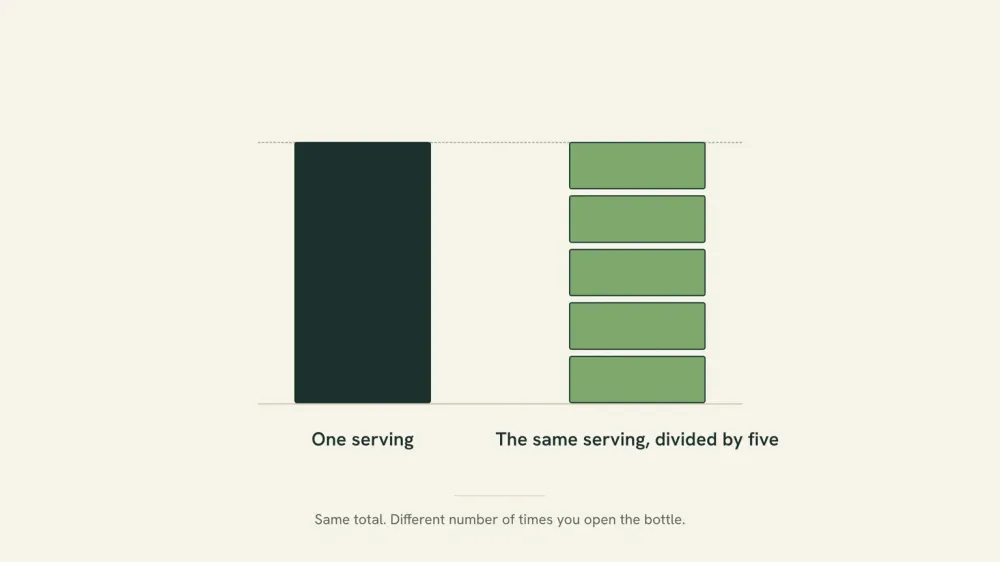
Add it up, which that page does not. Three to six milligrams every two to three hours across twelve hours is four to six servings, so the day comes to roughly 12 mg to 36 mg. The same page prints its own formula, "Daily dosage / 5 = amount per microdose", and its own worked example: "If you normally take 20mg of CBD in the morning, microdosing means dividing this into five 4mg doses taken throughout a 12-hour period." Five times 4 mg is 20 mg. That is the number the sentence started with. By the page's own arithmetic, the practice does not reduce the amount of CBD you take in a day; it changes how many times you open the bottle. The word micro is describing the piece, not the day, and the page never prints the subtraction that would show you that.
| What is claimed | The number the page prints | What the arithmetic says |
|---|---|---|
| Microdosing means taking less CBD | Formula: daily dosage divided by 5. Worked example: five doses of 4 mg | Five times 4 mg is 20 mg, the same daily amount the same page says you were taking before you started. Division is not reduction |
| There is such a thing as a microdose amount | 1 mg to 10 mg per dose across page one; daily totals presented as 5, 10, 20 and 50 mg | A tenfold spread in the daily total, for a single word, on a single page of search results |
| It qualifies as a microdose | 3 to 6 mg, which is 3,000 to 6,000 micrograms | 30 to 60 times the 100 microgram ceiling FDA and ICH both set. The 20 mg day is 200 times the ICH single-dose ceiling |
| It follows the microdosing research | Four to six doses a day on its own interval, five on its own worked example | The research definition is one to three times a week. Page one's schedule is 28 to 42 times a week, at least nine times more often |
And one more thing, in the page's own words. Its protocol has a third step headed "Adjust Your Dosage as Needed", and the instruction underneath reads: "If symptoms persist, increase each microdose slightly." A method sold as taking less carries, as its own first remedy, taking more. We are not saying that is wrong advice. We are saying that a method whose troubleshooting step contradicts its premise is not a method, and the page does not notice.
Could you even measure a CBD microdose?
Set the evidence aside for a moment and ask a purely physical question: can a person actually put 4 mg of CBD oil under their tongue? The same page that publishes the schedule publishes the measuring instruction, and the instruction misses its own target. It reads: "One full dropper of CBD oil = about 30mg. If you need 4mg, fill the dropper about 1/5 of the way." One fifth of 30 mg is 6 mg. The instruction overshoots the amount it is telling you to measure by 50%, inside a single sentence, and nothing else on the page catches it.
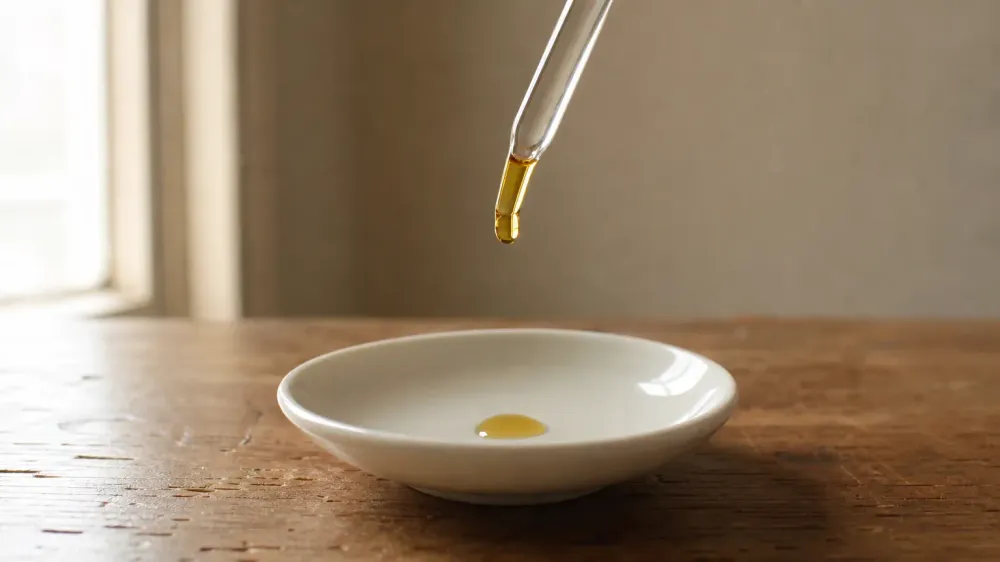
On a real bottle it gets harder rather than easier, and you can check this against whatever is in your cupboard. Planntz tinctures are 60 mL. The Broad Spectrum and Full Spectrum CBD bottles are 250 mg/mL, which is 15,000 mg per bottle, and a standard dropper delivers roughly 0.05 mL per drop, so a drop carries about 12.5 mg of CBD. A 4 mg unit is therefore about one third of a single drop. On the CBD + CBG bottle, at 150 mg/mL of CBD, a drop carries about 7.5 mg, so 4 mg is a bit over half a drop. Drop size varies with the dropper, the temperature of the oil and how you squeeze, and that variation is the point rather than a footnote: the unit in the schedule is smaller than the smallest amount the delivery device can reliably produce. The per-drop arithmetic for any concentration is worked through separately, and where to find the milligrams per milliliter in the first place is a page of its own.
Less is more: what that claim actually rests on
Underneath every microdosing page sits one idea: that a smaller amount of CBD might do more than a larger one. That idea is not invented. It has a source, and the source is worth naming precisely. It traces to a 2015 paper titled Overcoming the Bell-Shaped Dose-Response of Cannabidiol by Using Cannabis Extract Enriched in Cannabidiol, published in the journal Pharmacology & Pharmacy. It is a study in female Sabra mice, dosed in milligrams per kilogram of body weight, given by injection into the abdominal cavity or by mouth. It reported that purified CBD produced a bell-shaped dose-response, the measured response rising and then falling as the dose increased, while a CBD-enriched Cannabis sativa extract gave "a clear correlation between the ... responses and the dose, with increasing responses upon increasing doses." There is no honest way to turn a milligram-per-kilogram injected mouse dose into a number of drops for a person, and we are not going to try.
There is a second fact about that paper that changes how much weight it can carry, and checking it takes about a minute. It is not in PubMed. Three searches, all run on August 28, 2026: a title search for the paper returns 0 records; a journal-field search for Pharmacology & Pharmacy returns 2 records in total and neither of them is this paper; an author search for its first author combined with cannabidiol returns 16 records spanning 2000 to 2023, none of which is this one. That is a statement about indexing rather than about honesty. The journal is not indexed for MEDLINE, so the paper never enters the database most people search. It matters because the central claim of an entire consumer category rests on one preclinical result that is one search away from being unfindable, and because you can verify all three counts yourself at pubmed.ncbi.nlm.nih.gov.
The human evidence for a non-monotonic dose-response, which is the technical name for a curve that rises and then comes back down, is two small trials from one research group. In a 2017 trial published in Frontiers in Pharmacology, 60 healthy volunteers aged 18 to 35 were randomized into five arms of 12: placebo, an active comparator medicine, and single oral doses of 100 mg, 300 mg and 900 mg of CBD, with one volunteer withdrawing so that 59 completed. Only the 300 mg arm separated from placebo on the study's outcome measure; 100 mg and 900 mg did not. A 2019 trial in the Brazilian Journal of Psychiatry found the same shape in 57 healthy men given placebo or a single oral dose of 150 mg, 300 mg or 600 mg, with 12 to 15 people per arm: again, only the 300 mg arm separated from placebo. Read those milligram figures for exactly what they are. They are single acute doses of pharmaceutical-grade CBD, given once, to healthy volunteers in a laboratory, by one group in one country, with a dozen or so people in each arm. They are not serving sizes, they are not recommendations, and nothing on this page suggests you take any of them.
| Study | Species and sample | Doses tested | What it showed | What it cannot show |
|---|---|---|---|---|
| Gallily, Yekhtin and Hanus 2015, Pharmacology & Pharmacy | Preclinical: female Sabra mice | Milligrams per kilogram of body weight, by injection into the abdominal cavity or by mouth | A bell-shaped dose-response for purified CBD; a rising one for a CBD-enriched extract | Any milligram amount for a person. Not indexed in PubMed, so most readers never find it |
| Zuardi and colleagues 2017, Frontiers in Pharmacology | Human: 60 healthy adults aged 18 to 35 randomized 12 per arm, 59 completed | Placebo, an active comparator, and single oral doses of 100, 300 and 900 mg | Only the 300 mg arm separated from placebo on the study's outcome measure | Anything about repeated dosing, consumer products, or amounts below 100 mg |
| Linares and colleagues 2019, Brazilian Journal of Psychiatry | Human: 57 healthy men, 12 to 15 per arm | Placebo and single oral doses of 150, 300 and 600 mg | The same shape: only the 300 mg arm separated from placebo | The same limits. CBD was supplied free by a pharmaceutical company and four authors co-invented a licensed CBD patent |
Now hold the two halves of this article next to each other, because this is the finding that took the longest to see and is the easiest to check. The lowest amount ever tested in that human literature is 100 mg. The range page one most often calls a microdose is 3 to 6 mg. The studies being used to argue that less CBD can do more than more CBD do not contain the range the argument is being used to sell, and they sit 17 to 33 times above it. The 2019 authors are also considerably more careful than their popularizers: their stated conclusion is that "optimal therapeutic doses of CBD should be rigorously determined so that research findings can be adequately translated into clinical practice." That is a request for research, not a schedule. And the disclosure belongs here, because it is printed in the paper itself: the CBD used in that trial was supplied free by a pharmaceutical company, and four of its authors are co-inventors on a fluorinated-CBD patent licensed by their university.
The claim that it keeps your levels steady
The second thing page one claims for the schedule is pharmacological: "This approach helps maintain steady CBD levels in the body and offers more consistent wellness benefits." Split that sentence in half, because the halves are very different. The first half is a testable statement about pharmacokinetics, and the human multiple-dose data that would settle it were published in 2018 in CNS Drugs by Taylor and colleagues; our guide to when in the day to take CBD, and whether splitting a serving changes anything measurable works through what those data do and do not support, and how long CBD takes to do anything at all covers the onset half of the premise. We are not going to re-derive any of it here. The second half of the sentence, "more consistent wellness benefits", is not a pharmacokinetic statement at all. It is a benefit claim with nothing attached to it, and it is the half that sells.
What is missing from the whole category is the comparison itself. We went looking for a published human study comparing a split CBD schedule against a single serving of a consumer CBD product, on any outcome, and did not find one. That is not the same statement as "no research exists", and the difference matters, so the next section prints the searches instead of asserting the conclusion. Run them yourself if you like; they take under a minute each.
What a literature search actually returns
Two queries, both run on PubMed on August 28, 2026, both reproducible at pubmed.ncbi.nlm.nih.gov. The first is the direct one: microdosing cannabidiol. It returns 2 records. PubMed expands that query itself, to ("microdose"[All Fields] OR "microdoses"[All Fields] OR "microdosing"[All Fields]) AND ("cannabidiol"[All Fields] OR "cannabidiolic"[All Fields]), so it is a broad match rather than a narrow one. Neither of the two records is a study of microdosing CBD, and the reason each one matched is the most useful thing on this page.
| Record | What it is | Why it matched the query |
|---|---|---|
| Yang and colleagues 2026, American Journal of Preventive Medicine | Cross-sectional prevalence survey of cannabis, psilocybin, LSD and MDMA in 1,523 US adults | The survey instrument is named the Characterizing the Epidemiology of Cannabidiol Use Survey. CBD itself was not one of the substances asked about |
| Szigeti and colleagues 2021, eLife | Self-blinded citizen-science trial of psychedelic microdosing, 191 completers | Its plain-language summary lists cannabidiol (CBD) oils as one of the phenomena the method should be applied to next |
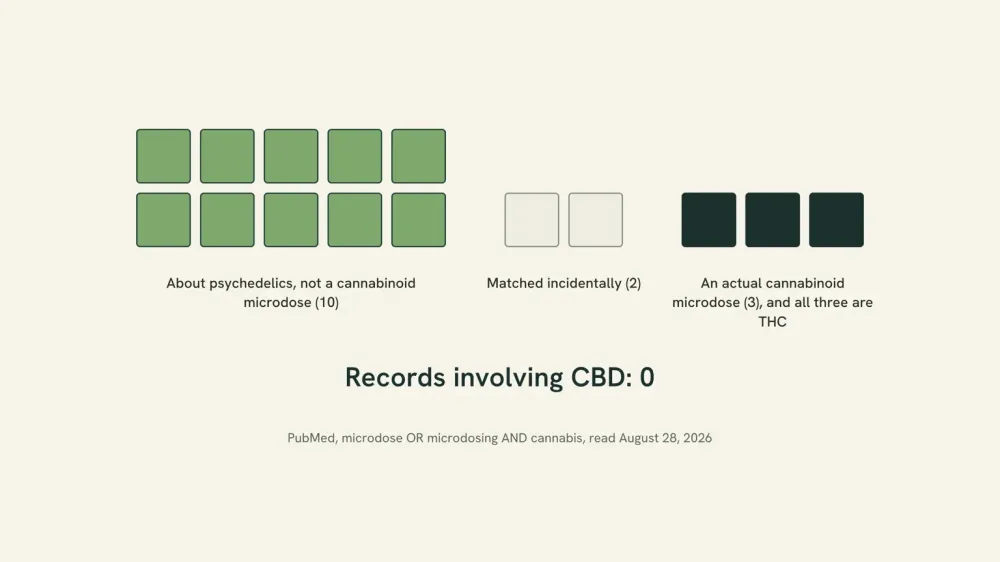
The second query is broader: microdose or microdosing, combined with cannabis. It returns 15 records on the same date. Reading the titles one by one: ten are about psychedelics rather than a cannabinoid microdose; two matched incidentally, a cannabinoid review and a population cohort study that are not about microdosing at all; and three involve an actual cannabinoid microdose. All three of those are THC, not CBD: a formulation-chemistry paper describing a solid THC nanoformulation, a study in mice, and a single-patient case report. None of the 15 is a controlled human trial of a cannabinoid microdose, and none of the 15 involves CBD. That is the honest state of the evidence on August 28, 2026, printed as a count rather than as a sweeping claim, so that anyone can check whether it has changed.
Page one's own citations tell the same story from the other end, and they deserve a fair reading rather than a dismissal. It would be easy to write that none of those pages cites anything. That is not true. Two of the ranking results do cite something. One names the 2015 mouse paper above. The other names a 2005 study published in Nature, which is a mouse study of THC rather than CBD, and whose abstract reports oral THC at "1 mg kg(-1) per day". The page citing it restates that as a single milligram a day. Dropping the "per kilogram" converts a dose scaled to body weight in a mouse into a flat number for a person, and those are not the same quantity in any sense. One of the ranking pages also carries a physician reviewer byline, which is worth knowing: a medical review line and a checkable citation are different things, and the second is the one you can audit.
There is one further reason the personal testimony under all of this is hard to read, and it comes from the microdosing field itself rather than from us. In a 2023 re-analysis published in Scientific Reports, the team behind that self-blinded trial modeled what happens when blinding is weak and expectations are positive. They call the result activated expectancy bias, which "can inflate estimates of treatment effects and create false positive findings." The dataset they re-examined is their own 2021 trial, whose abstract had already reported that "the placebo group also improved and no significant between-groups differences were observed". The small differences that did survive there are the ones the 2023 paper set out to test, and once its correction was applied most of them were no longer significant. That is a finding about study design, not a claim about any substance. It lands here for one narrow reason: "I split my serving up and I felt better" is precisely the kind of observation that method was built to interrogate, and how to run a self-check that is actually worth something is where we deal with that properly. For completeness, those authors declare advisory roles and equity in psychedelic companies in the paper, and argue against the efficacy reading anyway.
How to audit any dosing schedule you read
This page is not going to hand you a protocol, so here is what it can hand you instead: the five checks used above, in a form you can run on any dosing schedule you find, for CBD or for anything else. Four of the five are arithmetic and need no sources at all. The fifth needs a browser tab.
- 1It gives you an interval but never a daily total. Add the doses up yourself. If the total lands on an ordinary serving, the schedule changed the timing, not the amount.
- 2Its own formula preserves the daily amount. A daily dose divided by five is division. Division is not reduction, and a page that prints the formula has already told you so.
- 3It names no study, or names one you cannot open. A claim you cannot check is a preference. Two minutes at pubmed.ncbi.nlm.nih.gov settles which one you are reading.
- 4Its unit is smaller than one drop of the product it is written for. Find the milligrams per milliliter on the label, divide by the roughly 20 drops in a milliliter, and see whether the instruction is physically measurable.
- 5Its troubleshooting step is take more. A method sold as taking less should not have escalation as its first remedy.
What this page will not tell you, and where those answers live
You probably arrived here wanting a number, and you are not getting one, so it is fair to say exactly why and exactly where the real question is answered. The other phrasing people search is how to microdose CBD, and the honest answer to that one is that there is no published method to describe: splitting a serving across the day is not forbidden and it is not a protocol, it is a personal experiment, and this page has nothing verified to hand you about how to run it. How much CBD to take is answered, with the evidence and its limits, in our dosage guide. When in the day, and whether splitting changes anything you could measure, is the timing guide. How many milligrams are in the drop in front of you is the per-drop calculator. Whether anything actually changed for you is the self-assessment page, which is the discipline that would have to be applied before anybody could answer this question at all. And if you are in your first month, what to expect when you start is a more useful page than this one. If you take prescription medicines, the prior question is not how to divide a serving but whether CBD belongs in your routine at all.
In practice the phrase means taking small amounts of CBD several times a day instead of one serving. What it does not have is a definition. Read the pages that publish it and the amount ranges from 1 mg to 10 mg per dose and from 5 mg to 50 mg per day, a tenfold spread for a single word. Two of the pages we read do cite a study, but both cited studies are mouse experiments dosed in milligrams per kilogram of animal, so neither contains a milligram figure for a person, and no page attaches a source to the number it publishes. The word itself was borrowed from research on other substances, where a microdose is defined as a fraction of a dose that produces an effect somebody can detect. CBD has no agreed detectable dose, so there is nothing for the fraction to be a fraction of.
There is no number here, on purpose, because nobody can give you one honestly. On the first page of search results the figure is anywhere from 1 mg to 10 mg per dose, with daily totals from 5 mg to 50 mg, and not one of those pages attaches a source to the figure it publishes. In drug development, where the word does have a definition, the FDA's exploratory IND guidance and the international ICH M3(R2) guideline both cap a microdose at 100 micrograms. The smallest figure page one calls a microdose, 1 mg, is ten times that ceiling, and the 3 to 6 mg those pages quote most often is 30 to 60 times it. Those definitions govern investigational drugs rather than supplements, so nobody is breaking a rule; they simply show the word is not being used with its published meaning. If your real question is how much CBD to take, that is answered on our dosage guide, and it is a conversation for a clinician if you take other medicines.
No, and the difference is the whole problem. In psychedelic research a microdose is roughly 10% to 20% of a full dose, taken one to three times a week, at a level that does not produce the drug's characteristic effects. Both halves of that definition depend on there being a dose you can detect and a rhythm anchored to the week. CBD microdosing pages have neither: no detectable reference dose to take a fraction of, and up to five doses a day rather than one to three a week. Nothing in this answer says anything about what psychedelics do or do not do; it is a statement about how the word is defined.
One page ranking for the term states that the approach helps maintain steady CBD levels in the body. It names no source for that. The human multiple-dose pharmacokinetic data that would settle the question were published in 2018, and our guide to when to take CBD works through what they do and do not support. Separately, we could not find a published human study comparing a split CBD schedule against a single serving of a consumer CBD product on any outcome. A PubMed search for microdosing cannabidiol on August 28, 2026 returned two records, and neither one tests it.
The idea has a source and the source is thinner than the claim. It traces to a 2015 study in mice, published in a journal PubMed does not index, that reported a bell-shaped dose-response for purified CBD. In humans, two small trials of 60 and 57 healthy volunteers found a similar inverted-U shape, in which the middle dose arm separated from placebo and the highest did not. The lowest arms in those two trials were 100 mg and 150 mg, given once, in a laboratory, as single acute doses of pharmaceutical-grade CBD rather than as serving sizes. So that literature does not contain the range page one calls microdosing, and none of it is a schedule.
With difficulty, and the pages recommending it do not agree with themselves. One says a full dropper is about 30 mg and that 4 mg is about one fifth of a dropper; one fifth of 30 mg is 6 mg. On a 250 mg/mL tincture a standard drop of roughly 0.05 mL carries about 12.5 mg, so 4 mg is around a third of one drop, and drop size varies with the dropper, the oil temperature and your technique. Our per-drop calculator does this arithmetic for any concentration and any bottle.
Not in any form you could act on, and here is the search rather than the assertion. A PubMed query for microdosing cannabidiol on that date returns two records. One is a national survey of cannabis, psilocybin, LSD and MDMA that matched only because the survey instrument is named after cannabidiol; the other is a psychedelic trial whose plain-language summary mentions CBD oils once, as something the method should be applied to next. A broader query for microdose or microdosing with cannabis returns 15 records on the same date, of which three involve a cannabinoid microdose, and all three are THC: a formulation-chemistry paper, a study in mice and a single-patient case report.
Writing about hemp, wellness and the small rituals that keep us balanced.