CBD per Drop Calculator: mg/mL and Bottle Strength
Calculate CBD concentration from a bottle label, including mg per mL, labeled serving, and estimated drop. Every formula stays visible, and no result is a dose recommendation.
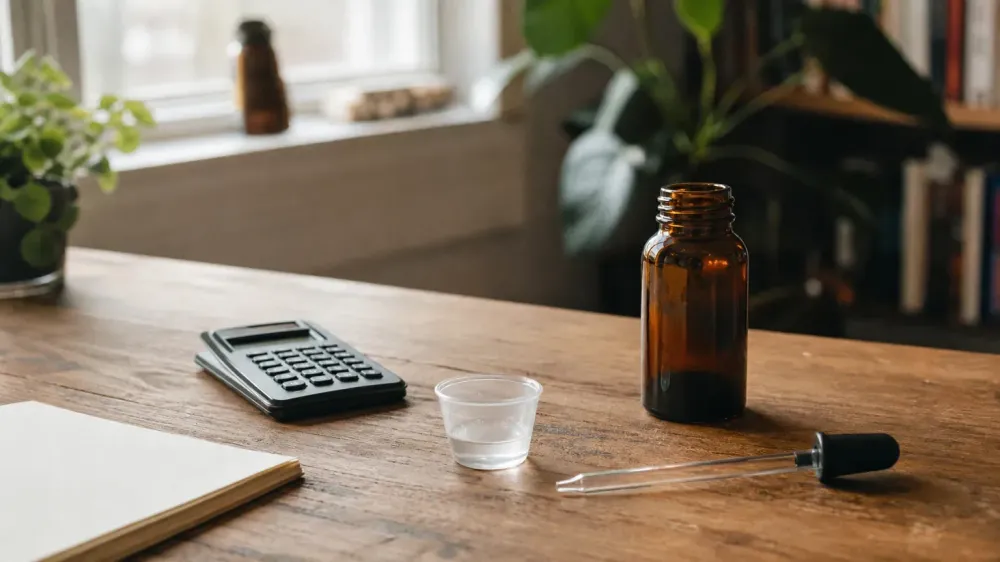
A CBD per drop calculator needs two numbers to start: the total CBD claimed for the bottle and the bottle's liquid volume. Divide milligrams by milliliters to get concentration. From there, you can calculate a labeled serving or estimate a drop, as long as you keep the units and the uncertainty visible.
The math is simple. The labels are not always simple. A large “1,500 mg” may describe all the CBD in the bottle, while a smaller panel lists 50 mg per 1 mL serving. A pipette may have clear graduations or no marks at all. Those details decide which calculation is defensible.
This guide is deliberately a strength calculator, not a dosage quiz. It does not ask for body weight, a condition, a desired effect, or a daily target. The FDA's consumer CBD update says unapproved consumer CBD products have not been evaluated to determine a proper dosage. Converting a label is useful. Turning that conversion into individualized health advice is a different question.
CBD per drop calculator: the four equations
| Output | Equation | What it means |
|---|---|---|
| CBD concentration | total labeled CBD mg / bottle mL | claimed CBD milligrams in 1 mL |
| CBD per labeled serving | mg/mL x serving mL | claimed CBD in the volume defined on the label |
| Estimated CBD per drop | mg/mL / measured drops per mL | an estimate tied to that liquid, dropper, and technique |
| Optional price per mg | product price / total labeled CBD mg | cost comparison only, not a quality score |
Start with the bottle, not a generic potency chart
Before reaching for a calculator, copy the product's own words and units. You are looking for up to four inputs: total CBD in the container, total liquid volume, the label's serving volume, and any statement about dropper volume or drops per serving. Do not substitute “total hemp extract,” “total cannabinoids,” or a blend total for CBD unless the label clearly says that number is CBD.
- 1Find the total **CBD** claim in milligrams. Confirm that it describes the whole bottle, not one serving or all cannabinoids combined.
- 2Find the net liquid volume in **mL**. A 1 fl oz bottle is often labeled about 30 mL, but use the printed metric volume rather than converting when it is available.
- 3Find the labeled serving volume, such as 0.5 mL or 1 mL. Treat “one dropperful” as incomplete unless the label or marked device defines its volume.
- 4Look for graduations on the pipette. Marks at 0.25, 0.5, 0.75, and 1 mL provide a volume input that does not depend on counting individual drops.
Calculate mg/mL before servings or drops
Concentration is the anchor because it separates the amount of CBD from the amount of liquid. For a bottle labeled 1,500 mg CBD in 30 mL, divide 1,500 mg by 30 mL. The result is 50 mg/mL. A 15 mL bottle labeled 750 mg CBD has the same 50 mg/mL concentration. The bottles have different totals, but the liquid strength is the same.
This is why “high strength” cannot be read from the front number alone. A 3,000 mg claim in 120 mL equals 25 mg/mL. A 1,500 mg claim in 30 mL equals 50 mg/mL. The first bottle contains more CBD overall; the second is twice as concentrated. Bottle total answers “how much is in the container?” Concentration answers “how much is claimed in each milliliter?”
Then calculate the labeled serving
Once you have mg/mL, multiply by the serving volume printed on the label. At 50 mg/mL, a 0.25 mL labeled serving contains 12.5 mg by label math. A 0.5 mL serving contains 25 mg, and a 1 mL serving contains 50 mg. The concentration stays fixed; only the selected volume changes.
Why CBD per drop is an estimate
A drop is not a fixed metric unit. A controlled 2017 study of 192 glaucoma medication bottles found that bottle design and orientation changed the number of drops produced per mL. Those were ophthalmic medicines, not CBD oils, so their numeric range should not be copied into a CBD calculator. The study supports only the narrower lesson that device design and orientation can affect drop output.
The common shortcut of 20 drops per mL can be a placeholder when the manufacturer gives no better information, but it must remain labeled as an assumption. If 50 mg/mL is divided by an assumed 20 drops/mL, the result is an estimated 2.5 mg/drop. If the same dropper actually produces 25 drops/mL, the estimate becomes 2 mg/drop. The concentration did not change. The assumed drop volume did.
Measure drops per mL with the product's own dropper
If individual drops matter and the label does not define them, you can improve the estimate without guessing a universal number. Use the actual bottle, liquid, and pipette. Work over a clean container so you do not return handled liquid to the bottle.
- 1Draw liquid to a clear **1 mL** mark. If the supplied pipette has no reliable graduation, use a clean calibrated device appropriate for measuring liquid volume instead of assuming the bulb's full squeeze equals 1 mL.
- 2Hold the dropper at a consistent angle and count the drops dispensed from that measured 1 mL. Do not let the tip touch your mouth, skin, or another surface.
- 3Repeat the count two more times with the same technique and calculate the average. If the counts differ widely, mL markings are the more defensible way to describe volume.
- 4Enter that average as measured drops per mL. Divide mg/mL by the average and label the result **estimated mg per drop**.
FDA guidance for calibrated devices packaged with OTC liquid drugs says the device's units should match the labeled liquid units and be clearly marked. That guidance applies to OTC drugs, not to consumer CBD tinctures. It still illustrates a sound measurement principle: when a product supplies readable mL graduations that match its label, use them before translating volume into drops.
Three worked bottle-strength examples
| Bottle claim | Concentration | Labeled serving | Estimated drop |
|---|---|---|---|
| 600 mg CBD in 30 mL | 20 mg/mL | 10 mg per 0.5 mL | 1 mg at 20 measured drops/mL |
| 1,500 mg CBD in 30 mL | 50 mg/mL | 25 mg per 0.5 mL | 2 mg at 25 measured drops/mL |
| 3,000 mg CBD in 60 mL | 50 mg/mL | 37.5 mg per 0.75 mL | about 2.27 mg at 22 measured drops/mL |
Rounding deserves restraint. Keep full precision through the calculation, then display mg/mL to one or two decimal places when needed. For per-drop estimates, more than two decimals often looks more certain than the drop measurement deserves. A result of 2.272727 mg/drop can be displayed as approximately 2.27 mg/drop, with the measured 22 drops/mL shown beside it.
Do not convert a percentage until the label defines it
Some oils display a percentage instead of, or alongside, milligrams. A familiar shortcut says that 5% equals 50 mg/mL. That conversion is valid only when 5% means 5 grams per 100 mL, a weight/volume definition. If the percentage is weight/weight, volume/volume, total extract, or a blend percentage, the same shortcut can be wrong because density and the named substance matter.
Look for the basis in the label, specification, or manufacturer documentation. If it clearly states 5% w/v CBD, then 5 g per 100 mL equals 5,000 mg per 100 mL, or 50 mg/mL. If the basis is missing, do not reverse-engineer a precise mg/mL result from the percent alone. Ask for a CBD-specific value in mg/mL or total CBD mg and bottle mL. Ambiguity is an input problem, not something extra decimal places can solve.
Cross-check label math with the batch COA
The calculator answers, “What does this label claim?” A certificate of analysis can answer a separate question: “What did a laboratory report for this batch?” Match the product name, lot or batch number, report date, and units before comparing values. If a COA reports CBD in mg/mL, multiply that value by the bottle's mL to estimate the batch result for the container. If it reports mg/g or percent by weight, do not treat that as mg/mL without the required density information.
The need for that distinction is not theoretical. A 2024 analytical study tested one sample each from 202 US retail products purchased in 2021, including 100 tinctures. Using a 90%-110% band around the package claim, 149 of 202 products fell outside that band. The sample was not random, one unit per product cannot measure batch variation, and the work was sponsored by Jazz Pharmaceuticals with funder involvement. It does not establish that 74% of today's market, or any specific product, is mislabeled. It does show why arithmetic based on a package should not be described as laboratory verification.
A COA also has boundaries. It is a report for a tested sample and date, not a measurement of every drop in your opened bottle months later. If you are deciding what age, heat, air, or handling may have done after purchase, use our bottle-specific shelf-life and storage guide.
Common calculation mistakes and how to fix them
- **Using total extract as total CBD.** Fix it by finding a CBD-specific milligram claim or a batch result with clear units.
- **Treating the bottle total as one serving.** Fix it by dividing total CBD mg by bottle mL before doing anything else.
- **Assuming a full squeeze is 1 mL.** Fix it by using the pipette's printed mL line or product documentation.
- **Hard-coding 20 drops/mL as exact.** Fix it by labeling it an assumption or measuring the product's own average drops per mL.
- **Converting every percentage with x10.** Fix it by confirming that the percentage is CBD weight/volume before converting.
- **Mixing mg and mL.** Milligrams describe mass; milliliters describe volume. They become comparable only through concentration such as mg/mL.
- **Rounding each step.** Keep the calculator's full internal precision and round only the displayed result.
What this calculator cannot decide
Concentration math cannot decide whether a product is appropriate for you, how often to use it, or whether a particular amount is safe. It cannot account for medications, pregnancy, breastfeeding, liver concerns, an adverse reaction, or a child's exposure. It also cannot turn consumer CBD into an FDA-approved treatment or transfer evidence from a prescription CBD drug to a retail tincture.
If a label is unclear, contact the manufacturer for the exact CBD claim, bottle volume, serving volume, dropper calibration, and matching batch report. For a health or medication decision, ask a qualified clinician or pharmacist instead of adding that decision to the calculator. If someone may have taken too much or is unwell, use appropriate medical or poison-control help.
Questions about CBD bottle math
Divide total labeled CBD mg by bottle mL, then divide mg/mL by measured drops per mL. A result based on a generic drop-count assumption is only an estimate.
No. Use a printed 1 mL graduation or manufacturer documentation. A full bulb squeeze and the 1 mL line are not guaranteed to describe the same volume.
It often describes the container total, but labels vary. Confirm whether the number means total CBD, CBD per serving, total cannabinoids, or total extract.
Only when the label defines the basis. If 5% means 5 g CBD per 100 mL, it equals 50 mg/mL. A weight/weight, extract, or undefined percentage cannot use that shortcut safely.
Use the label for the manufacturer's claim and a matching batch COA as a separate cross-check. Match the lot and units; mg/g cannot be compared directly with mg/mL.
No. It tells you how much CBD the label claims for a defined volume. This calculator does not recommend an amount, frequency, or health use.
Keep the result attached to its assumptions
A useful calculator result is not just “2 mg per drop.” It is “2 mg per drop, estimated from a 50 mg/mL label claim and 25 measured drops/mL.” That sentence preserves the inputs, the equation, and the uncertainty. It also makes the result easy to update when a new bottle, dropper, batch report, or serving volume changes the facts.
Writing about hemp, wellness and the small rituals that keep us balanced.