CBD Extraction Methods: CO2 vs Ethanol, Honestly Compared
CBD extraction methods, compared without a sales pitch: every page that ranks for this question picks a winner, and the winner is usually whatever the author sells. Here is what CO2 and ethanol actually do, what one lab measured on the same hemp, and what you can verify.
Search for CBD extraction methods and almost every page that ranks declares a winner. Read the footer and the winner is usually whatever the author sells. Here is the version nobody selling equipment writes: what each method physically does, what one laboratory measured when it ran three of them on the same hemp, and the single extraction-related thing a buyer can actually verify.
The short answer is that there is no winner. CO2 and ethanol are good at different things, and their trade-offs run in opposite directions: the method that pulls more material out of the plant is usually the less selective one. A contract manufacturer that runs ethanol lines will tell you ethanol is "the purest available method". A company that sells supercritical CO2 systems will tell you CO2 wins on every factor except capital equipment cost. Both are describing their own inventory. If you want the wider buying framework, it lives in our buyer's checklist for choosing CBD oil, and this page is the long version of one line in it.
Why hemp has to be extracted at all
Cannabinoids are made in resin, inside the glandular trichomes that cover the flower, and they are lipophilic: they dissolve in fats, alcohols and pressurized gases, and not in water. That is the whole reason extraction exists. You cannot steep hemp like tea and get a concentrated oil out the other side. Something has to dissolve the resin, carry it away from the plant material, and then leave again.
There is a second problem, and it happens either before or after the solvent ever touches the plant. Hemp does not make much CBD. It makes cannabidiolic acid, CBDA, and heat converts the acid into the neutral form in a step called decarboxylation. In a 2025 scale-up published in ACS Agricultural Science and Technology, the flower was decarboxylated at 80 °C for 24 hours before extraction, and the authors report complete conversion of CBDA to CBD "although a negligible loss was observed". In a 2024 comparison in Plants that ran three methods on the same hemp, the CO2 extract was decarboxylated afterwards instead, at 95 °C for one hour. Two papers, two schedules, and neither is the way it is done. Hold on to that, because it comes back later as the reason the best comparison in the literature is harder to read than it looks.
- Dissolve the resin. Cannabinoids are fat-soluble, so the candidates are fats, alcohols and pressurized gases, never water.
- Be selective. Pull the cannabinoids and the aroma compounds; leave the chlorophyll, waxes and pigment behind.
- Leave cleanly. Whatever dissolved the resin has to come back out, by evaporation, by vacuum, or by a change of phase.
- Yield and selectivity pull against each other. A solvent that takes more out of the plant usually takes more of everything, including what you did not want.
Supercritical CO2: what the word actually means
Supercritical is not a marketing word, it is a defined physical state. Carbon dioxide has a critical point, and the NIST Chemistry WebBook lists a measured value of 304.18 kelvin and 73.80 bar, with stated uncertainties of 0.04 kelvin and 0.15 bar. That is 31.03 °C and roughly 1,070 psi. Past that point CO2 stops behaving as either a gas or a liquid: it keeps enough density to dissolve things and enough diffusivity to move through packed plant material. Drop the pressure afterwards and it turns back into a gas and walks away, which is the single most attractive property it has.
The critical point is a floor, not a recipe, and published extractions run well above it. The 2025 scale-up used 250 bar at 40 °C with a CO2 flow of 25 kg/h for three hours and no co-solvent, taking CBD from 4.5% w/w in the hemp to 30.8% w/w in the crude extract. The 2024 comparison ran 413 bar at 55 °C for 35 minutes. Both of those are supercritical CO2. They are not the same process, and neither one is an industry standard, because there is not one. When a label says CO2 extracted, it is naming a solvent state, not a set of conditions.
The fair case for CO2 is worth stating in its own literature's words. A 2021 review in the Journal of Chromatography B credits supercritical fluid extraction with "selective extraction, short processing time", low running cost, low environmental impact and, because the solvent turns from fluid to vapor on the way out, "leaving a solvent free product". Read that last phrase precisely: it describes the extraction step. It is not a statement about a finished bottle, which is a different object with several more process steps behind it. A second 2021 review, in Phytochemical Analysis, lands on the sentence that undercuts every ranking: irrespective of the extraction method, temperature, time and pressure all play a vital role in the overall yield.
Ethanol: the workhorse of the industry
Ethanol is the workhorse, and the reason is unglamorous: it is food-grade, it works at ordinary pressure, and the equipment costs a fraction of a supercritical rig. A narrative review in the Journal of Cannabis Research concludes that "solvent extraction is the most common method for cannabis plants". How the alcohol touches the plant then matters more than most people expect. The two classical modes are maceration, where the material sits in the solvent, and percolation, where the solvent flows through a packed bed. A 2022 bench experiment in Frontiers in Pharmacology ran both in 95% ethanol and measured the result by GC-FID, and the timing is half the finding: each percolation run took about an hour and recovered 80.1% of the total CBD in the biomass, while maceration reached 63.5% at its two-week time point. The authors deliberately mimicked typical herbal home extractions rather than an industrial column, and ran duplicate independent extractions with triplicate analyses, so read those figures as a clean demonstration of the principle rather than a plant-scale benchmark.
Cold ethanol is the other variable that ends up on labels. A 2022 optimization study in Molecules compared -20 °C, -40 °C and room temperature at a 1:15 plant-to-ethanol ratio for 10 minutes. Yields came out at 18.2, 19.7 and 18.5 grams per 100 grams of dry matter in that order, and the terpene content of the -20 °C extract was 54.1% lower than the -40 °C extract. Three caveats travel with those numbers and all three matter: the material was THC-type cannabis rather than hemp, the extraction efficiencies are reported for THCA and not for CBD, and the authors' own principal component analysis found no statistically significant difference between the three temperatures. Cold is a real lever. It is not the lever the marketing implies.
- Cheap and scalable. Ethanol works at ordinary pressure, so the equipment is simpler and the capital cost is lower than a supercritical system.
- High yield, lower selectivity. In the 2024 three-way comparison, the authors note that pigments from the plant material come along too, "limiting the selectivity" of the ethanol extract.
- Cold slows the co-extraction of waxes and chlorophyll, and it also costs aroma compounds. You are choosing which loss you prefer.
- The ethanol still has to come off afterwards, under vacuum and heat. That removal is its own process step, and it is the step a residual-solvent test would measure.
Hydrocarbon, steam and the kitchen methods
Butane and propane dissolve cannabinoid resin very efficiently at low temperature, and they are used mostly for inhalable concentrates rather than for oral tinctures. It is also the one branch of the subject where the safety literature is about the process itself: the 2015 concentrate paper cited later on this page discusses explosions from unregulated home attempts, which is why hydrocarbon extraction is an industrial operation and not a hobby. We are not going to describe how any of it is done, at any level of detail. The relevant fact for a buyer is narrower: hydrocarbon extraction exists, it is common in concentrate production, and its residues are a large part of why solvent panels were written in the first place.
One recent finding is worth carrying across. A 2026 analytical study in ACS Omega ran n-butane extractions of two cannabis varieties from -46 °C to -9 °C and tracked what changed. Long-chain n-alkanes, C22 to C31, rose systematically with extraction temperature while total cannabinoids and the quantified aroma compounds stayed relatively constant, and running colder gave up to roughly 3-fold reductions in that carryover. Be precise about two things here. This is inhalable concentrate from marijuana cultivars, not an oral hemp tincture, and those alkanes are the plant's own epicuticular wax, not residual butane. Confusing plant wax with solvent residue is one of the easiest ways to misread a lab report. The transferable point is smaller and more useful: process temperature is a control variable, and wax is the reason the step called winterization exists at all.
Steam distillation and hydrodistillation belong to the essential-oil tradition and behave that way. In the 2024 three-way comparison, hydrodistillation produced the most varied and abundant terpenes and the least extract by mass, 0.08% to 1.1% of the biomass. Oil infusion, where plant material is warmed in olive or coconut oil, is the oldest method of all and the only one where the solvent is meant to stay in the finished product. It also lands at a much lower concentration than a modern tincture, because nothing is removed at the end to concentrate what is left.
CBD extraction methods, head to head on the same hemp
Here is the study the marketing pages never cite. In 2024, a group publishing in Plants took a single CBD- and CBG-dominant Cannabis sativa L. inflorescence and ran three commercial-style processes on it: supercritical CO2, ethanol and hydrodistillation. Terpenes were measured by GC-MS and cannabinoids by LC-MS/MS. The work was funded by USDA NIFA and a Penn State research agreement, and the authors declare no competing interests, which is already a different starting position from a page written by someone who sells one of the three. Their conclusion is that the process "can play a large role in product composition and potential biological effects".
| Method | Extract yield | Cannabinoids | Terpenes |
|---|---|---|---|
| Supercritical CO2 | 1.3-1.8% of biomass | Most variety and abundance; CBD 12.8-20.6 mg/g | Minimal variety |
| Ethanol | 22-24% of biomass | Most acidic forms; CBDA 3.2-4.1 mg/g | Minor levels |
| Hydrodistillation | 0.08-1.1% of biomass | Not reported as the cannabinoid-rich arm | Most variety and abundance; beta-caryophyllene 25-42 mg/g |
Now the caveats, because they are what make that table honest. First, the concentrations are per gram of extract, not per gram of plant: the paper's supplementary table caption reads "Mean concentration of identified cannabinoids ± SD (mg/g) in sample extract". They are also this study's extracts, not typical commercial concentrate potencies, so do not carry them over to a bottle on a shelf. Second, and this is the one that changes the interpretation: only the CO2 arm was decarboxylated, at 95 °C for one hour. The authors flag it themselves, writing that "One distinct difference between the processes of the super critical CO2 and solvent (ethanol) extractions is the added step in the CO2 extraction of decarboxylating the extract." So "ethanol keeps the acids" is partly a description of process design rather than a property of the solvent. Third, this is one cultivar in one laboratory, with three biological replicates, and the hydrodistillation arm ran on duplicate or single replicates because of how little material it produced.
A separate comparison makes the general point from another direction. A 2018 study in Planta Medica measured six cannabis chemovars grown in Washington State as flower and again as supercritical CO2 concentrate, using validated HPLC-DAD for seven cannabinoids and GC-MS for 42 terpenes. Cannabinoid potency rose by a factor of 3.2 for delta-9 THC and 4.0 for CBD, but nothing scaled uniformly: monoterpenes were lost in the process while sesquiterpenes rose by factors between 4.2 and 8.9. The authors conclude that the concentrate "may have a significantly different chemotypic fingerprint from that of cannabis flower". Read it as state-legal marijuana flower, not hemp and not a tincture, and read it as corrected, since the paper carries a published erratum. Its one transferable lesson: concentrating an extract does not concentrate everything by the same factor.
Why "CO2 extracted" is not the end of the story
The extraction step is where the marketing stops and the process keeps going. The 2025 scale-up is the clearest published example of the full route: decarboxylation, supercritical CO2, winterization, C18 reverse-phase silica filtration, silica gel chromatography and selective crystallization, run at 100 to 600 grams per step and ending at better than 99% purity with a 52% overall CBD yield. That protocol makes pure CBD crystals rather than a consumer tincture, and its choice of solvents is a laboratory optimization that says nothing about what any brand uses. What it demonstrates is the shape of the thing: extraction is the first move, not the whole game.
Winterization is the step that pulls out the waxes and lipids that came along with the cannabinoids. The extract is dissolved, chilled until the waxes drop out of solution, then filtered; in the 2025 protocol it was held at -18 °C for 24 hours before filtering. A 2015 paper on cannabis concentrates in the Journal of Toxicological Sciences describes the trade practice in one line, saying winterization is performed "offline by re-dissolving the extract in ethanol and then freezing", and noting that more advanced operations "employ vacuum ovens to remove additional residual solvents". So an oil can be CO2 extracted and still have met ethanol later in the chain. That is not an accusation. It is how the process is documented in the literature.
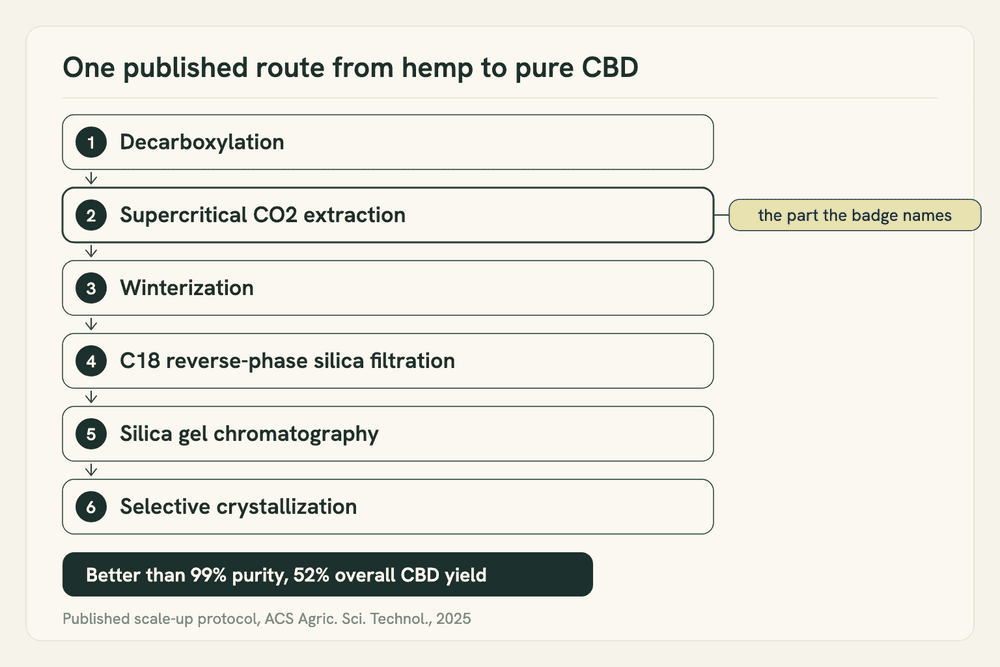
The converse matters just as much, because it is the half that gets left out when someone is selling CO2. Ethanol extraction is not a black mark. The ethanol is removed afterwards, the same way the CO2 is, and in both cases the buyer's question is identical: did anyone measure? This is also where the spectrum question is settled, by the way. Extraction gives you a crude extract; whether it ends up as full spectrum, broad spectrum or isolate is decided by the steps that follow, including winterization, distillation, chromatographic removal of THC and crystallization.
The residual-solvent panel, and the actual numbers
A residual-solvent test is not exotic. A sample is warmed in a sealed vial and the vapor above it is injected into a gas chromatograph, a technique called headspace GC, with either flame ionization detection or mass spectrometry on the other end. A 2026 critical review in Cannabis and Cannabinoid Research records exactly those as the methods used across state programs. The test answers one narrow question: which solvents are present in this sample, and at what concentration.
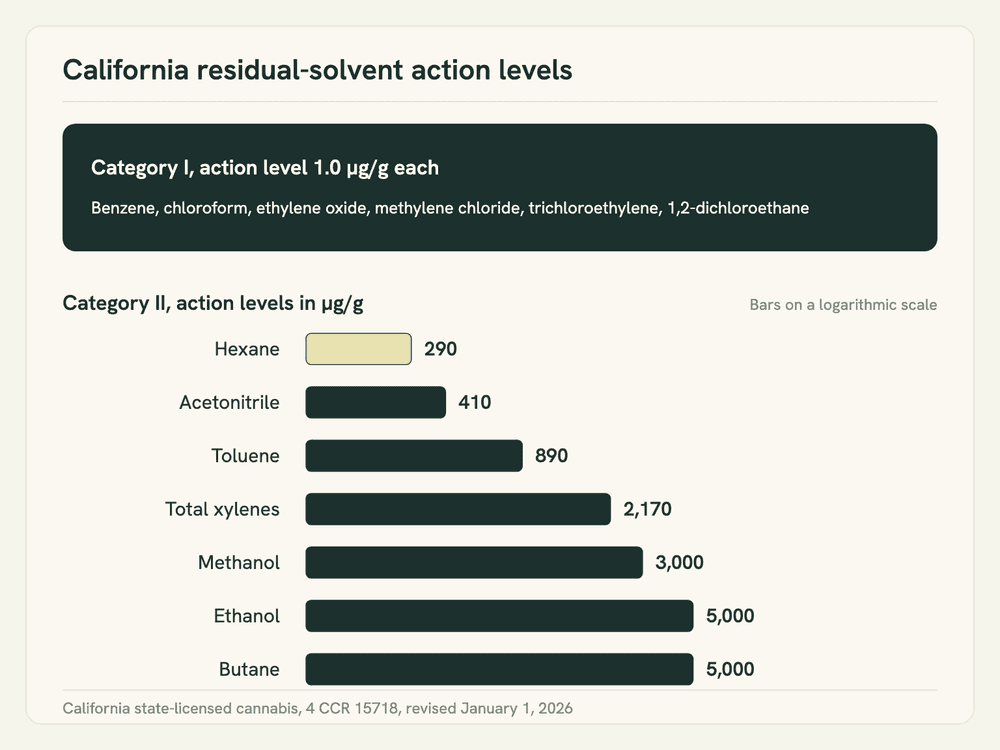
California publishes the numbers, and reading them is the fastest education available on this topic. Under its cannabis regulations as revised on January 1, 2026, a laboratory analyzes at least 0.25 grams, reports in micrograms per gram and marks pass or fail, and a failing batch "shall not be released for retail sale". The action levels are per analyte rather than a single number, and they are not close to each other.
| Category | Solvent | Action level (µg/g) |
|---|---|---|
| Category I | Benzene, chloroform, ethylene oxide, methylene chloride, trichloroethylene, 1,2-dichloroethane | 1.0 each |
| Category II | Hexane | 290 |
| Category II | Acetonitrile | 410 |
| Category II | Toluene | 890 |
| Category II | Total xylenes | 2,170 |
| Category II | Methanol | 3,000 |
| Category II | Ethanol, butane, propane, acetone, heptane, pentane, ethyl acetate, ethyl ether, isopropyl alcohol | 5,000 each |
Those limits are not improvised. Five of California's Category II numbers are identical, digit for digit, to the pharmaceutical residual-solvent guideline ICH Q3C(R8), which sets acetonitrile at 410, hexane at 290, methanol at 3,000, toluene at 890 and xylene at 2,170 parts per million. The 5,000 default comes from the same document's Class 3, described there as "solvents with low toxic potential to man" with permitted daily exposures of "50 mg or more per day". Two details are worth having. California is stricter than the pharmaceutical standard on benzene, at 1.0 against 2 ppm, and on 1,2-dichloroethane, at 1.0 against 5. And butane and propane appear in none of that guideline's three solvent classes, because they are not pharmaceutical solvents, so the 5,000 they get in California is a state applying the low-toxicity default rather than a medicine limit being borrowed. That side-by-side is our own comparison of two primary documents, and the pharmaceutical guideline governs medicines, not hemp products.
There is one more wrinkle, and it is a strange one. The same California rule states that the ethanol action level "does not apply to cannabis products that are tinctures", while the regulations define a tincture as cannabis extract "dissolved in alcohol, glycerin, or vegetable oils". By that definition, a hemp extract carried in coconut MCT oil is a tincture by form, which is a longer story about what the word tincture still means. So in the strictest cannabis testing regime in the country, an ethanol number on a tincture is not a pass-or-fail line at all. And all of it binds state-licensed cannabis in California, not hemp CBD sold nationally, which leads directly to the next problem.
Who actually has to run that panel
Almost nobody, is the short version, and the detail is worth having precisely. California's hemp statute, section 111925 of the Health and Safety Code, as amended effective January 1, 2026, requires that raw hemp extract be tested for cannabinoid content before it goes into a product, that the testing be done by an independent laboratory, and that the manufacturer be able to prove the total THC cap. It names no contaminant panel and no residual solvent. Federal rules aim somewhere else entirely: USDA's hemp regulation samples the crop within 30 days of harvest, which is a THC compliance test on a field, not a contaminant test on a bottle. The 2026 review quoted above describes the wider picture as "wide variability in allowable limits, analyte lists, and method validation requirements" between states. We are not going to tell you that no state requires the panel, because that is a superlative over 50 jurisdictions nobody has searched. What is fair to say is that for a finished hemp CBD product, a residual-solvent panel is mostly voluntary.
Somebody did go and measure, once, in a market that had no rules at all. The 2015 concentrate study cited above screened 57 samples submitted by California medical cannabis users between December 2012 and February 2013, 48 of them solvent-based concentrates and nine dry or water-based hash. Its Results section states that "No residual solvents could be detected in 28.1% of the total sample group", which means roughly seven in ten of the 57 had at least one detected. Every hash sample was free of residual solvents. Isopentane was the most frequently detected, in 29.8% of the group, and the authors attribute that to an impurity in the liquid gas used for extraction, which concentrates as the more volatile hydrocarbons evaporate.
The paper's discussion characterizes its concentrate group, the 48 solvent-based samples, with "the high detection rate of residual solvents (83.3%)". That is the authors' own figure, and the paper does not state the denominator behind it, so we print it as theirs and do no arithmetic on it. Then read the line that governs all of those numbers: the study's methods state that "The analysis of pesticides and residual solvents was qualitative and not quantitative." No concentration was measured, so detected does not mean above a limit and does not mean unsafe. Everything in that survey is also inhaled dab concentrate from the 2012 to 2013 California medical market, before any state testing regime existed, submitted by users who were already suspicious enough to pay for a test. None of it is hemp, none of it is CBD, none of it is a bottle you swallow, and nothing in it says that a consumer CBD tincture has been found contaminated.
What our own lab report does and does not cover
There is a problem with the advice this article is about to give you, and it lands on us. Planntz publishes a lab report for every batch, and that report carries three panels: cannabinoid potency, heavy metals and microbials. It does not carry a residual-solvent panel. Run this article's own test on our certificate of analysis and the honest result is not "clean" and not "passed". It is unanswered. On the Broad Spectrum Mango & Peach report for batch 260320, produced on April 1, 2026, you will find potency, metals and microbial results, and nothing else. The laboratory that runs our batches, Infinite Chemical Analysis Labs, holds PJLA accreditation number 95560 to ISO/IEC 17025:2017 and its accredited scope includes residual solvents by GC/MS, so the capability is there; the panel was not ordered. No federal rule and no California hemp statute requires it on a finished hemp product, which explains the gap without fixing it. So the move is the same for us as for anyone else. If solvent data matters to your decision, ask for a residual-solvent report on the batch you are buying, in writing, and read what comes back.
You will find the short version of this advice in our own buyer's checklist, which tells you to make sure the residual-solvent panel comes back clean. That advice quietly assumes the panel is there. Check that it is first. The same discipline is why what third-party tested actually covers was written the way it was: the phrase describes who ran the test, not how much was tested. And if you want the mechanics of finding a report and matching it to your bottle, how to read a lab report in five minutes walks through it panel by panel.
Six checks you can run before you buy
None of this needs a chemistry background. It needs you to read the document instead of the label, and to know which column to look at. If you want the numbers on the front of the bottle decoded as well, what the label numbers actually mean covers that side of it.
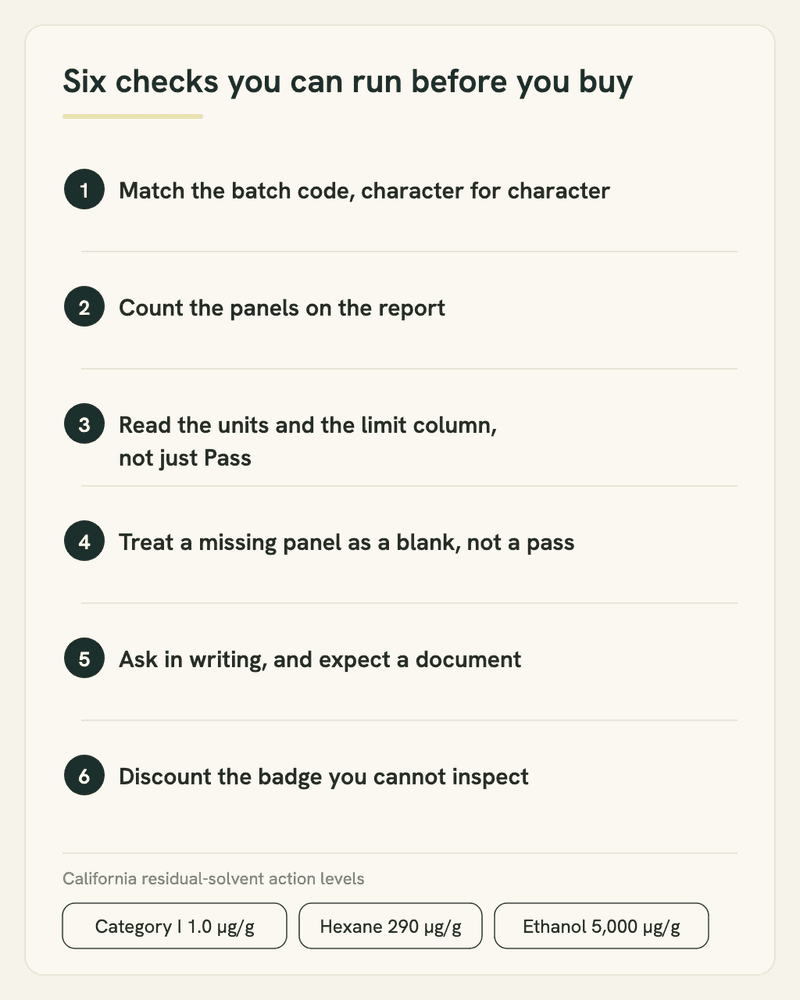
- 1Find the batch report, not the brand's report. Match the lot code printed on your bottle to the code on the certificate of analysis, character for character. A report for a different batch is a brochure.
- 2Count the panels. Potency, THC, heavy metals, pesticides, residual solvents, microbials. The word tested only covers what is printed on the page in front of you.
- 3If there is a residual-solvent panel, read the units and the limit column, not just the word Pass. Results come in micrograms per gram, and the limits differ per analyte: 1.0 for Category I solvents, 290 for hexane, 5,000 for ethanol.
- 4Treat a blank as a blank. A panel that is not on the report is a question nobody answered, and no result is not a clean result.
- 5Ask two questions in writing: which extraction method, and can you send the residual-solvent report for this batch. Note whether the answer arrives as a document or as an adjective.
- 6Discount the badge. CO2 extracted, clean extraction and purest method are claims about a step you cannot inspect. Weigh them at roughly zero next to a report you can read.
The honest limits of everything above
Here is what this article cannot tell you, stated plainly. No human study shows that the extraction method changes what CBD does in a person. Everything above is chemistry: what came out of the plant, in what proportion, measured in a laboratory. The step from a different chemical fingerprint to a different experience is one the evidence does not take, and we are not going to take it for you.
The comparative work is also thinner than it looks. The three-way comparison is one cultivar in one laboratory. The cold-ethanol study is a single THC-type cultivar whose own statistics found no significant difference between temperatures, and its efficiencies are reported for THCA rather than CBD. The concentrate survey is qualitative, more than a decade old, and about a product category nobody swallows. The narrative review of the field says the quiet part out loud, that "more research is needed for some of the drying and extraction methods", and being narrative rather than systematic, there is no pooled data behind it. And then the practical limit that outlasts all of them: you cannot audit a method claim from outside the building, and neither can anyone else. That is why this page ends at a document instead of a recommendation.
Common questions about CBD extraction methods
No published head-to-head supports a universal winner. They are good at different things. In the 2024 three-way comparison on one hemp cultivar, ethanol pulled 22 to 24 percent of the biomass into the extract while supercritical CO2 pulled 1.3 to 1.8 percent, and the CO2 extract was the more cannabinoid-dense of the two. Yield and selectivity are opposite virtues, so the honest answer is that they trade off. It also helps to notice who is answering: across the pages that rank for this question, the recommended method matched the author's own equipment or service every time.
It means the CO2 itself does not stay behind, because it leaves as a gas when the pressure drops. It does not mean nothing else touched the oil. Published protocols run winterization, filtration and chromatography after the CO2 step, and winterization is classically done by re-dissolving the extract in ethanol and then freezing it. A method claim describes one step of a longer chain.
Ethanol is removed afterwards, usually under vacuum and heat. Where residual-solvent limits exist, ethanol sits in the least restricted class: California's action level for state-licensed cannabis is 5,000 micrograms per gram, and the same rule says that limit does not apply to tinctures at all. What you cannot do is confirm any of it for your own bottle without a residual-solvent report for that batch.
Mostly you cannot. A certificate of analysis does not state the extraction method; it reports what the laboratory measured. A residual-solvent panel is an inference at best, and a good result on it means nothing above the reporting limit was detected, not that the product was made a particular way. The practical move is to ask the brand in writing and see whether the answer arrives as a document or as an adjective.
No. Extraction produces a crude extract. The spectrum is decided by what happens next: winterization, distillation, chromatographic removal of THC, crystallization. One published scale-up reached better than 99 percent pure CBD crystals at a 52 percent overall yield, and every step after the extraction itself was doing that work.
It is the step that removes waxes and lipids that came out of the plant along with the cannabinoids. The extract is dissolved, chilled so the waxes fall out of solution, then filtered; in one 2025 protocol it was held at -18 degrees Celsius for 24 hours before filtering. It matters here because it is the clearest example of extraction being one step among several, each with its own solvent.
On its own, no, because it is a claim about a step you cannot audit and it carries no measurement with it. What you can audit is a batch-specific lab report and the list of panels printed on it. Pay for the document, not the badge.
If you want to run those six checks on us, the reports are published. Every batch ships with a third-party certificate of analysis listing the panels it carries, and every bottle in the catalog states its cannabinoid content in mg and mg/mL. You will find potency, heavy metals and microbials on those reports, and no residual-solvent panel. That is the honest state of it, and it is exactly what you should be checking on everyone else.
Read the batch reports
Every Planntz batch has a third-party lab report covering cannabinoid potency, heavy metals and microbials. Check the batch code against your bottle and read the panels for yourself.
See the lab resultsWriting about hemp, wellness and the small rituals that keep us balanced.