CBD Cost per Mg and per Serving: Are You Overpaying?
Cost per milligram is one division, and it flips which bottle looks expensive: $40 for 500 mg is $0.08 per mg, $80 for 15,000 mg is $0.0053. Here is how to run it per milligram, per milliliter and per serving, then run it again on the batch lab report.
CBD cost per mg is one division, and it routinely reverses which bottle looks expensive. A $40 bottle holding 500 mg works out to $0.08 per milligram. An $80 bottle holding 15,000 mg works out to $0.0053. Here is how to run that number on any bottle, and then run it again on the batch lab report, where it tends to move in a direction the price guides do not mention.
The formula is price divided by the total milligrams of the cannabinoid you actually want: $80 divided by 15,000 mg of CBD is $0.00533 per milligram. Two refinements make it usable, price divided by milliliters and price divided by the number of servings in the bottle. Then do the whole thing a second time, dividing by the Total CBD figure on the batch certificate of analysis instead of the number printed on the front of the bottle. That second pass is the part almost every price guide skips, and for oils and tinctures it usually comes out lower than the label version, not higher.
What CBD cost per mg actually measures
Cost per milligram answers exactly one question: how much are you paying for the active ingredient, with bottle size, flavor and packaging stripped out. The two figures you need are usually the two printed largest on the bottle, the price and the total milligrams, and almost nobody divides one by the other in the aisle.
This page does the dollars. The milligram side of the arithmetic, how many milligrams sit in a milliliter and roughly how many in a drop, is worked out in our per-drop calculator, and where the total milligram figure lives in the first place is covered in how to read a CBD label. Price is one criterion among several, so if you are choosing a bottle from scratch, start with the full buyer's checklist and come back here for the math.
| The division | What it answers | Where it misleads |
|---|---|---|
| Price / total mg of actives | Cost per milligram: the only figure that compares bottles of different sizes | Says nothing about which cannabinoid you counted, or whether that milligram figure was ever measured |
| Price / mL | Cost per milliliter: what you pay for liquid, which catches a big bottle of weak oil | Ranks a 20 mg/mL oil and a 250 mg/mL oil as if they were the same product |
| Price / servings in the bottle | Cost per serving, as you would actually take it | Depends on a serving size you choose, so two people get two different answers for the same bottle |
Per milliliter flatters a large, weak bottle, and per serving changes with the person. Per milligram is the one figure that is a property of the bottle alone, which is why it goes first.
The three prices of one bottle, worked on a real one
Take the Planntz Broad Spectrum tincture: 60 mL, 250 mg/mL, 15,000 mg of CBD, $80. Per milligram that is $80 divided by 15,000, or $0.00533. Per milliliter it is $80 divided by 60, or $1.33. If your routine is 25 mg, the bottle holds 600 of them, and $80 divided by 600 is $0.133 a serving.
Those three figures reconcile, which is how you know none of them is a marketing number. At roughly 0.05 mL per drop, a 60 mL bottle gives about 1,200 drops, so $80 divided by 1,200 is about $0.067 per drop, and $0.067 divided by 12.5 mg of CBD per drop returns $0.0053 per milligram again. Drop size shifts with the dropper and with how you squeeze, so treat the per-drop figure as an estimate and the per-milliliter figure as arithmetic. Serving size is a separate decision with its own page: see deciding the serving you would actually take.
| If your routine is | Servings in the bottle | Cost per serving | One bottle lasts, once daily |
|---|---|---|---|
| 10 mg | 1,500 | $0.053 | about 4 years |
| 20 mg | 750 | $0.107 | about 2 years |
| 25 mg | 600 | $0.133 | about 1 year 8 months |
| 50 mg | 300 | $0.267 | about 10 months |
One row in that table deserves a pause. At 10 mg a day, a 15,000 mg bottle is a four-year supply, and no tincture is a four-year product. Cost per milligram only counts the milligrams you actually use, which is the failure mode the last section of this article is about.
Why the cheaper bottle is usually the expensive one
Here is the inversion in one table. Every bottle in it is illustrative and anonymous, and the top and bottom rows are the same pair our buying guide already uses.
| Illustrative bottle | Cost per labeled mg | Times more per mg | Servings at 25 mg |
|---|---|---|---|
| $40 for 500 mg | $0.0800 | 15.0x | 20 |
| $40 for 1,000 mg | $0.0400 | 7.5x | 40 |
| $50 for 1,500 mg | $0.0333 | 6.25x | 60 |
| $60 for 3,000 mg | $0.0200 | 3.75x | 120 |
| $80 for 15,000 mg | $0.00533 | 1x, the reference | 600 |
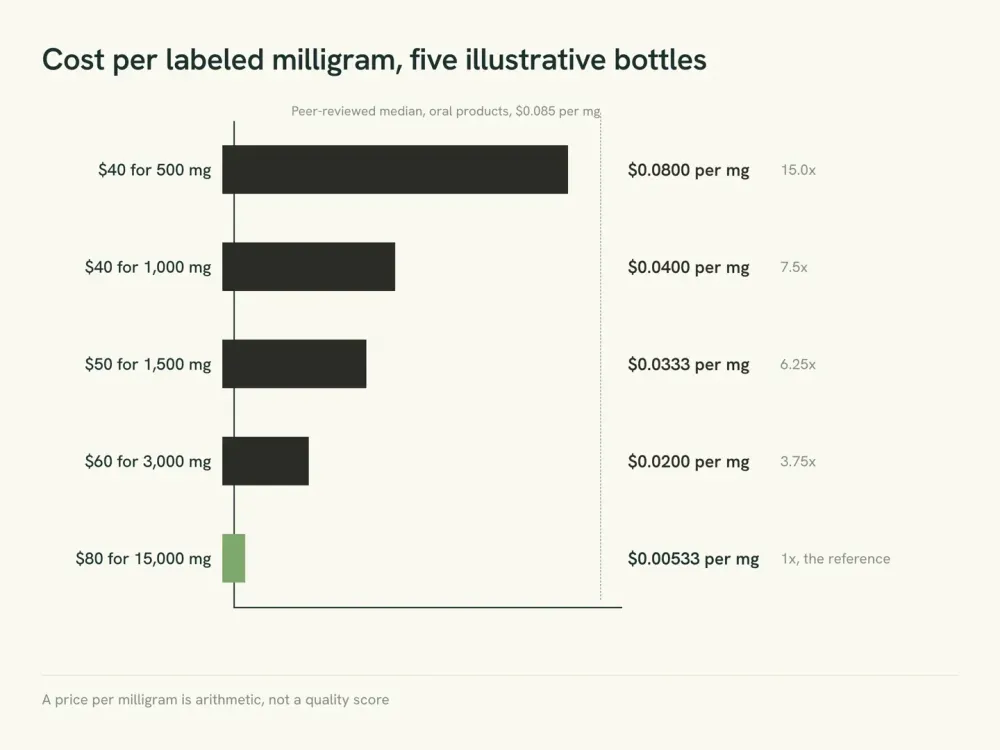
The mechanism behind that ladder is boring and checkable. A bottle, a cap, a dropper, a carton, a label, a shipping box and a card transaction cost about the same whether the oil inside is 20 mg/mL or 250 mg/mL. Those fixed costs get spread across whatever milligrams are in the bottle, so at 500 mg they land on very few milligrams and at 15,000 mg they land on a great many. Concentration is the only lever that moves cost per milligram at a fixed bottle size, which is how a bottle that costs twice as much can be a fifteenth of the price per milligram.
Most shoppers never see the far end of that ladder, because most of what is on sale sits at the near end. In a 2022 audit of retail CBD prices across the ten most populous cities in North Carolina, researchers catalogued 118 products from three randomly selected retailers per city, 117 of them with a usable concentration figure, and found 71 of those 117 (61%) claimed under 1,000 mg in total and 101 of 117 (86%) claimed under 1,500 mg. Small bottles are the market's default, and small bottles are where the per-milligram price goes up. The limits matter: one state, one year, three retailers per city, prices as advertised on websites, and milligrams as claimed on the label rather than measured in a lab.
What the market actually charges
That same audit is the only peer-reviewed measurement of US retail CBD prices we could find, and it normalized every product to a 300 mg reference amount. For oral products, meaning oils, tinctures and supplements, the median came out at $25.48 per 300 mg, which is about $0.085 per milligram, with a 95% confidence interval of $18 to $30 per 300 mg, so roughly $0.060 to $0.100 per milligram. Edibles sat at a $26 median, topicals at $30 and inhalables at $15.33, and the differences between categories were not statistically significant.
Why 300 mg? The researchers picked it as a yardstick because it sits near the low end of the doses used in the pharmaceutical-CBD epilepsy and anxiety trials they cite. Those are prescription-grade amounts studied in patient populations, and 300 mg is not a serving suggestion for a hemp tincture. It exists in that paper to make prices comparable, and nothing else. Sellers and comparison tools publish their own bands, generally $0.05 to $0.20 per milligram as normal, with one widely used calculator grading anything under about $0.077 per milligram a bargain and anything above about $0.167 pricey. Those bands are a consensus rather than a measurement. Their one genuine use is that they bracket the peer-reviewed figure, which suggests the vendor range is roughly honest.
| Reference point | Cost per mg | What it actually is |
|---|---|---|
| Peer-reviewed median, oral products | about $0.085 | $25.48 per 300 mg for the oral products in a 2022 audit of retailer websites in 10 North Carolina cities, using label milligrams |
| Vendor and calculator bands | $0.05 to $0.20 | Price tiers published by sellers and comparison tools. Not a study, not a measurement |
| Planntz Broad Spectrum, by the label | $0.00533 | $80 divided by the 15,000 mg of CBD printed on the bottle |
| Planntz Broad Spectrum, by the lab | $0.00491 | $80 divided by the 16,300 mg Total CBD measured on batch 260320 |
Cost per verified milligram: divide by the lab number
The milligram figure on a label is a claim. The milligram figure on the batch certificate of analysis is a measurement of the specific run of oil in your hand. Dividing by the second one is the only version of this calculation a laboratory has checked. The method is four steps: find the batch or lot number on the bottle, open the report carrying that exact number, find the potency line that reads Total CBD in milligrams per package, and divide the price by it. If you have never opened one, our walkthrough of a batch lab report shows which lines carry weight and which are boilerplate.
Worked on a real batch: the Planntz Broad Spectrum Mango report for batch 260320 prints Total CBD as 16,300 mg per package, which it also expresses as 28.8% of a package size the same header gives as 56.7 g. So the verified figure is $80 divided by 16,300, or $0.00491 per milligram, against $0.00533 by the label. That is about 8% cheaper than the label arithmetic suggested, and the 8% is in the buyer's direction.
| Batch | Labeled | COA Total CBD | $ per labeled mg | $ per verified mg |
|---|---|---|---|---|
| Broad Spectrum Mango 260320 | 15,000 mg CBD | 16,300 mg | $0.00533 | $0.00491 |
| Broad Spectrum Natural 260319 | 15,000 mg CBD | 16,600 mg | $0.00533 | $0.00482 |
| Broad Spectrum Lemon 260321 | 15,000 mg CBD | 16,000 mg | $0.00533 | $0.00500 |
| CBD + CBN Mango 260311 | 12,000 mg actives | 12,790 mg (8,680 CBD + 4,110 CBN) | $0.00733 | $0.00688 |
The price guides that do raise the certificate frame it as a downside risk, as though the measured number were bound to come in lower. For oils and tinctures the published data says the opposite is more common. The FDA's July 2020 Report to Congress on the current cannabidiol marketplace completed cannabinoid testing on 147 products. Of the 82 tinctures and oils in that sample, 56 stated a specific CBD amount, and the agency's own table splits them three ways: 25 landed within 20% of the label, 25 came in above 120% of it, and only 6 fell below 80%. The FDA says of its own numbers that "these preliminary data are from a limited sample size and cannot be used to draw conclusions about the marketplace", and its tolerance band is looser than the others below, plus or minus 20% rather than 10%.
Three independent lab surveys point the same way. A 2024 analysis of 202 US CBD products, sponsored by Jazz Pharmaceuticals with compensated authors, found 149 of 202 (74%) more than 10% away from their labeled potency, and among the 100 tinctures specifically, 53 measured above 110% of the label, 29 landed inside 90-110% and 18 came in below 90%. Gummies ran the other way in that same dataset and were significantly more likely than tinctures, topicals or vapes to fall below their labeled potency. A 2022 LC-MS/MS analysis of 80 hemp-derived products available to residents of central Kentucky found 43 of the 80 inside a 10% band, 25 above it and 12 below. And the 2017 JAMA research letter that started this whole conversation, covering 84 products from 31 online sellers, reported 36 (42.9%) holding more CBD than the label claimed, 22 (26.2%) holding less and 26 (31.0%) accurate.
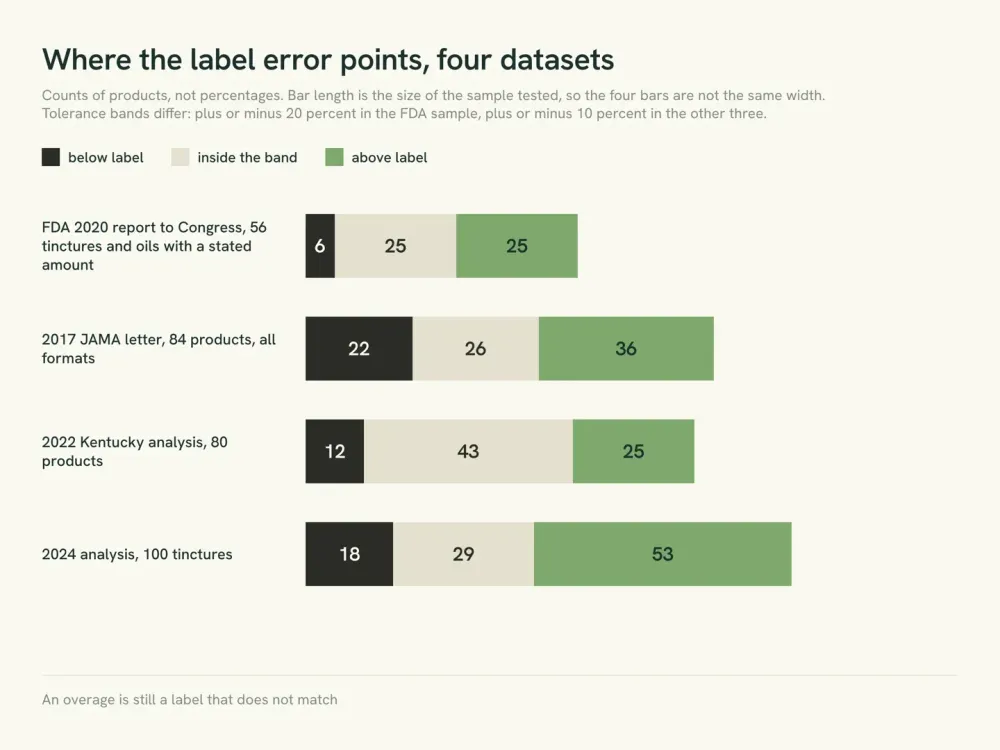
Four datasets, two tolerance bands, four separate samples of the market, and the same direction each time: where the label was wrong, more products held more CBD than the label claimed than held less. Two of the four break tinctures and oils out on their own, and it holds there too. None of that makes an overage good news. A label that does not match is a label that does not match. Accuracy and direction are also two different questions: the same 2017 sample that found oils to be its most accurately labeled category, at 45%, found the products it filed separately as tinctures only 25% accurate. None of these studies tested a Planntz batch, and the only way to learn which side your own bottle falls on is to read its own report. One trap when you compare two reports: CBD and Total CBD are different lines. Planntz reports print the rule they use, Total CBD = CBD + (CBDA x 0.877), and the FDA sampling study used the same definition. If one report quotes raw CBD and the other quotes Total CBD, you are dividing your dollars by two different quantities. For the general picture, the FDA's consumer update on products containing cannabis or cannabis-derived compounds says the agency has tested the cannabinoid content of some CBD products and that "many were found to not contain the levels of CBD they claimed".
Four things that legitimately change the price
Not every price difference is padding. Four of them are real, and each one changes either the arithmetic or what you actually receive, which is what makes them checkable rather than persuasive.
- Concentration and bottle size. The lever from the ladder above, and the only one of the four that is pure arithmetic rather than a judgment call.
- What is in it besides CBD. A second cannabinoid at gram scale changes what you are counting. Planntz CBD + CBN is $88 for 8,000 mg CBD plus 4,000 mg CBN: $0.0073 per milligram of actives, or $0.011 per milligram of CBD.
- How much testing each batch gets. A potency-only report costs less to produce than potency plus heavy metals, pesticides, residual solvents and microbials, run on every batch rather than once a year.
- The format. Cost per milligram is comparable within a format, not across formats. Gummies, capsules, vapes and topicals differ in manufacturing, in label accuracy and in how much of the arithmetic the label even gives you.
Both of the CBD + CBN figures above are true, and only one of them can be set beside a CBD-only bottle, which is why you have to declare what you counted before you compare anything. Two of the four drivers also deserve a footnote. On composition, what full spectrum, broad spectrum and isolate actually contain is both a real cost difference and a real difference in what you receive. On testing, almost none of it is legally required on a finished bottle: the federal hemp rule at 7 CFR 990.3 aims at the crop, which has to be sampled within 30 days of harvest and, since the end of 2022, tested by a DEA-registered laboratory. Nothing in that rule covers the tincture on the shelf. So a brand running a full panel on every batch is paying for something optional, and that cost is real, but the phrase on the carton is not the evidence. The useful question is what the panel actually covered, which is the subject of what third-party tested does and does not guarantee.
What does not earn a higher cost per milligram: a heavier box, a word like artisan or small-batch printed on a carton, a larger marketing budget, or an unsourced story about extraction equipment. If a seller cannot tell you the milligrams, the format and what the batch panel covered, the price has not been explained. It has been asserted.
Price is not a quality signal, and here is the evidence
This is where most cost guides go wrong, and the correction is not a hedge, it is a fact about the literature. The three label-accuracy surveys read for this article, the 2024 analysis of 202 products, the 2022 Kentucky analysis of 80 and the 2017 JAMA letter, did not record what any of the products cost. The 2024 paper describes its own basket only as spanning a range of price points. So none of the three can tell you whether paying more buys a more accurate label, and none of them supports the opposite either. What the North Carolina price audit did find was a statistically significant positive correlation between how much CBD a product claimed and what it cost (P < 0.001), which means total price tracks total content. That is a different sentence from price tracking quality, and it is the only one the data will carry.
The verified number has a tolerance of its own, too. In the first exercise of the NIST Cannabis Laboratory Quality Assurance Program, 116 laboratories were sent identical hemp oils; on one of those oils, 31 of the 68 labs that reported CBD (46%) landed outside NIST's range of tolerance. That program is deliberately educational and anonymized and issues no pass or fail grade, so it is not an accusation against any laboratory. It is a measurement of how far two accredited labs can land apart on the same oil. Our own report shows the smaller version of the same thing: batch 260320 prints its potency as 28.8% of package weight with an uncertainty of plus or minus 0.285 percentage points, which against the printed 56.7 g package works out to roughly plus or minus 162 mg of CBD. That moves the cost per milligram between $0.00486 and $0.00496, a spread of about a hundredth of a cent, while the difference between dividing by the label and dividing by the lab number on the same bottle is roughly four times wider.
The three-bottle worksheet
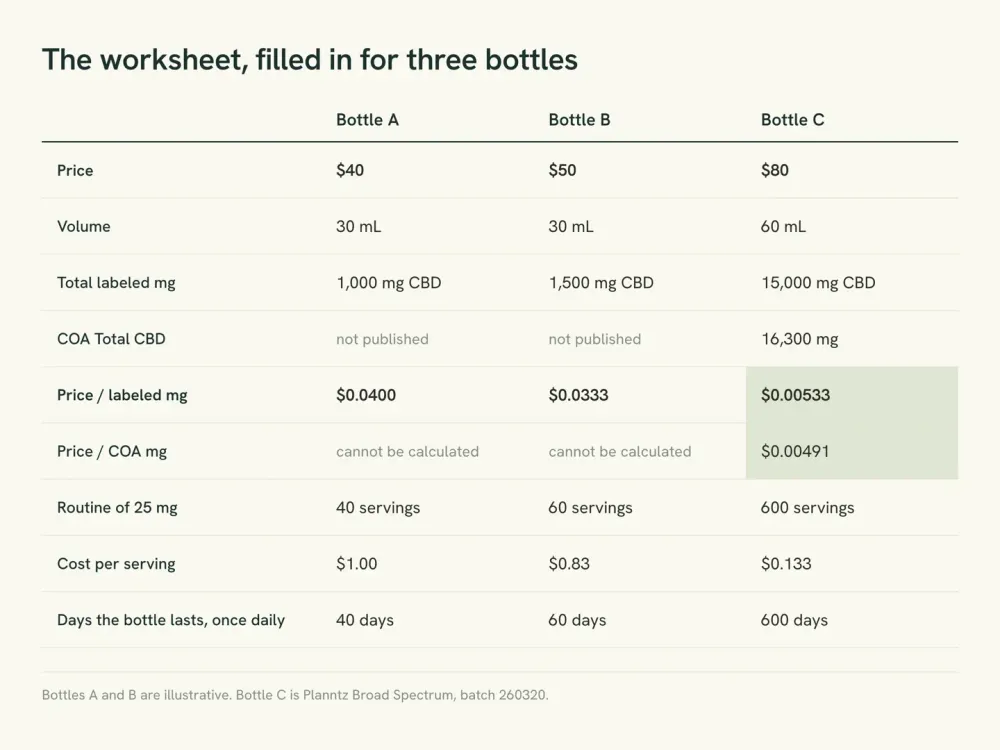
Here is the whole method as something you can run in a notepad against three bottles you are genuinely considering. It takes about five minutes, and every input is either printed on the bottle or printed on a lab report.
- 1Write down the price and the total milligrams from the label, and note which cannabinoid those milligrams belong to. If the label says hemp extract rather than CBD, the CBD content is unknown from the label alone.
- 2Divide price by total milligrams. That is your cost per labeled milligram. Keep four or five decimal places, because at these scales rounding to the nearest cent erases the entire comparison.
- 3Divide price by milliliters. This is the row that exposes a large bottle of weak oil that looked like a bargain on the shelf.
- 4Open the batch report for that exact lot number, find Total CBD in milligrams per package, and divide the price by it instead. That is your cost per verified milligram, and it is the only figure a lab has checked.
- 5Decide the routine you would honestly keep to, in milligrams, and divide total milligrams by it to get the number of servings. Price divided by servings is your cost per serving.
- 6Divide servings by how often you would take one to get days per bottle, then sanity-check that figure against the date printed on the bottle. Milligrams you never use are not cheap. They are unused.
| Row to fill | Bottle A | Bottle B | Bottle C |
|---|---|---|---|
| Price | |||
| Volume in mL | |||
| Total labeled mg, and of which cannabinoid | |||
| COA Total CBD, mg per package | |||
| Price / labeled mg | |||
| Price / COA mg | |||
| Your routine, in mg | |||
| Cost per serving | |||
| Days the bottle lasts |
Cheap per milligram and still the wrong bottle
The metric has failure modes, and honest use of it means naming them. Two of the five below have their own pages: whether the oil lasts as long as the milligrams do, and what changes when you are comparing an oil against gummies instead of two oils.
- No batch-specific report to verify against. Your cost per milligram is then a claim divided by a price, and the four label surveys above are exactly why that gap matters.
- A serving size on the label you would never actually take. Cost per serving is only real if the serving is, so use your own number rather than the brand's.
- More milligrams than you can use before the date printed on the bottle. Milligrams that sit in a cupboard past that date cost you full price and deliver nothing.
- A cross-format comparison treated as like-for-like. Gummies were the format most likely to measure below labeled potency in the 2024 analysis, and vaporizer liquids were the worst-labeled category in the 2017 sample.
- A total cannabinoids figure standing in for the cannabinoid you want. Add the named rows yourself: on our CBD + CBG batch 260314 the two named actives, 9,640 mg CBD and 6,290 mg CBG, come to 15,930 mg, and that is the sum we divided by.
Run the arithmetic, run it again on the lab report, then check the worksheet's last three rows against your own habits. A bottle that survives all three passes is not hiding a trick. It just has a bigger figure in the denominator.
Frequently asked questions
Good only means something relative to the same format and the same counted cannabinoid, so start with reference points rather than a verdict. The median oral product in the 2022 North Carolina retail audit was $25.48 per 300 mg, about $0.085 per milligram, using advertised prices and label milligrams in one state. Sellers and comparison tools publish $0.05 to $0.20 per milligram as the normal range. Planntz Broad Spectrum is $0.00533 per labeled milligram and $0.00491 per verified milligram on batch 260320. Use those as anchors, then compare like with like: an oil against an oil, CBD milligrams against CBD milligrams, and a lab figure against a lab figure.
Divide the price by the total milligrams of the cannabinoid you care about. $80 divided by 15,000 mg is $0.0053 per milligram; $40 divided by 1,000 mg is $0.04. Then add the two refinements: price divided by milliliters ($80 divided by 60 mL is $1.33), which catches a large bottle of weak oil, and price divided by the number of servings, which is the only figure that reflects your own routine. Keep the decimal places, because at these scales rounding to cents deletes the comparison you were trying to make.
Both, in that order. The label figure is a claim, and while you are browsing it is the only number you have. The Total CBD line on the batch certificate is a measurement of the oil in your hand, and once you own the bottle it is the number worth dividing by. In four separate datasets published between 2017 and 2024, mislabeled tinctures were more often over-filled than short-filled: 25 above 120% of label against 6 below 80% in the FDA's tincture and oil column, 53 above 110% against 18 below 90% among 100 tinctures in the 2024 analysis, 25 high against 12 low in the 2022 Kentucky analysis, and 36 high against 22 low across all formats in 2017. If there is no batch-specific report at all, the per-milligram figure cannot be verified in either direction, which is its own answer about the bottle.
Usually it is not that CBD is expensive. It is that the bottle is small. In the 2022 North Carolina audit, 71 of 117 products claimed under 1,000 mg in total, and a bottle, cap, dropper, carton, label and shipping box cost about the same whether the oil inside is weak or strong, so those fixed costs land on very few milligrams. The drivers that hold up are concentration and bottle size, what else is in the extract, how much testing each batch receives, and the format. Widely repeated stories about extraction equipment prices and destroyed crops are not sourced to anything you can check.
No, because the denominator is milligrams, not milliliters. A 60 mL bottle at 20 mg/mL holds 1,200 mg; a 60 mL bottle at 250 mg/mL holds 15,000 mg. Same glass, 12.5 times the milligrams. A bigger bottle only lowers cost per milligram if the concentration comes with it, which is why cost per milliliter and cost per milligram sometimes disagree about the same two bottles. There is a ceiling in the other direction too: a bottle holding more milligrams than you will get through before the date printed on it is not cheaper per milligram used.
Price on its own tells you nothing about quality in either direction. None of the three label-accuracy surveys cited on this page recorded what the products cost, so none of them supports cheap means bad, and none supports expensive means accurate. What you can check is whether the arithmetic is real and whether a batch report backs it: concentration times volume should equal the total milligrams claimed, so a 60 mL bottle claiming 15,000 mg is 250 mg/mL, and the batch report should show a potency figure near that. When both hold up, a low cost per milligram is simply a bigger number underneath the division.
If you would rather run this on our numbers than take them from us, every batch we sell publishes its own third-party certificate of analysis with the Total CBD milligrams per package printed on it, and they are all collected on our lab results page. Find the batch you are holding, divide $80 by the figure on its report, and you will have your own answer instead of ours.
Run the math on a real batch report
Every Planntz batch publishes a third-party certificate of analysis with its measured Total CBD in milligrams per package, so you can work out the cost per verified milligram yourself.
See the lab resultsWriting about hemp, wellness and the small rituals that keep us balanced.