What Is Hash? Kief, Flower and What the Potency Data Shows
Hash is the plant's resin glands, separated and usually pressed. Here is what potency monitors in Europe and the US measured, what happened to its CBD, how it differs from kief and butane hash oil, and why color is not a test.
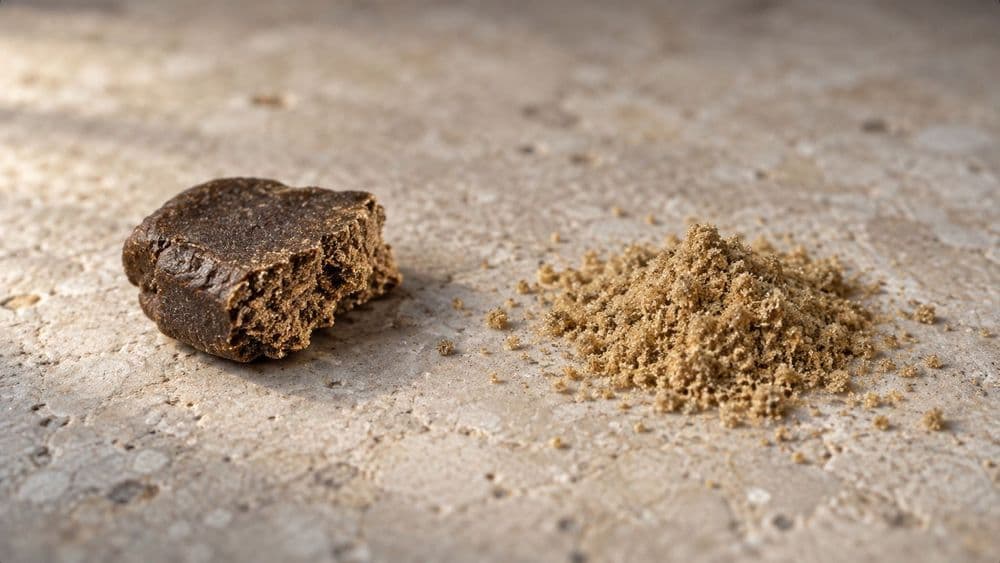
Hash is one of the oldest cannabis preparations there is: the plant's sticky resin glands, separated from most of the leaf and flower and usually pressed into a block or ball. Nearly every page that explains it says hash is much stronger than weed. Few back that with a measured, sourced number. This one does, using the potency monitors that actually test it.
What is hash? Hash, short for hashish, is concentrated cannabis resin. The UN's manual for drug-testing labs describes it as the plant's resin glands collected so that most recognizable plant material is gone, sold as a loose or pressed sticky powder that still carries some fine plant matter. In European monitoring since 2016, average hash has ranged from about 17% to 27% THC depending on the country and year, with one striking exception: in England's 2016 police seizures, hash averaged 6.3%, below the local flower. Under US federal law, resin is named inside the legal definition of marijuana. A note on who is writing: Planntz is a hemp company, and we do not make or sell hash, kief or any resin product, so nothing here is a buying recommendation. This page is for adults 21 and over, where cannabis is legal.
What is hash made of?
Hash starts in the trichomes, the tiny resin glands that coat cannabis flowers and the small leaves around them. Those glands are where the plant makes and stores its cannabinoids and terpenes. Our explainer on what trichomes are and how they work covers the biology, and our map of the cannabis plant shows which part ends up in which preparation. Hash is what you get when that resin is separated from most of the rest of the plant and gathered into a mass.
The definitions from the people who test hash are more specific than most of what you will read. The University of Mississippi lab that runs the US potency monitoring program describes hashish as "a concentrated resin cake or ball produced from pressed kief, the detached tricomes and fine material that falls off the cannabis flowers and leaves" (the misspelling is in the original). It adds that hash "varies in color from black to golden brown depending on the purity and variety of cultivar it was obtained from." The UN manual makes a point worth holding on to: hash is not pure resin. "In addition to the secretions, it consists of finer plant material," which is one reason two pieces that look alike can test very differently.
Most of the world's hash has come from two old traditions, and the UN manual describes both. Around the Mediterranean, dried plants are sieved and the resin powder is pressed into slabs. In South Asia, resin is rubbed by hand from the flowering tops of living plants. That hand-rubbed kind is the one often called charas, and a 2024 forensic analysis of hand-rubbed hash from the Indian Himalayas calls the method "the ancient technique" of the region. We name the traditions so the words make sense. This page does not describe how hash is made.
Kief vs hash: what is the difference?
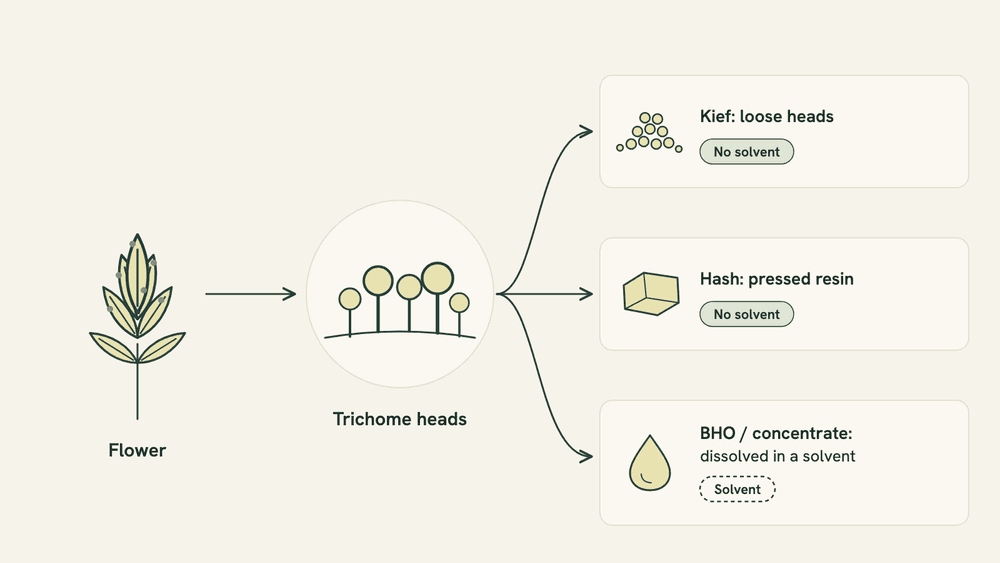
Kief and hash are made of the same thing at different stages. Kief is the loose, sandy mass of trichome heads that have broken off the flower. Hash, in the US program's own glossary, is that kief pressed into a cake or ball. Pressing changes the form, from a powder to a solid that holds together. What decides the potency is what was collected in the first place: how much resin, from which plants, and how much fine plant material came along with it.
Because kief is mostly resin heads, it is more concentrated than the flower it came from. A 2021 technical report from one Oregon facility measured sifted trichome material from four chemovars at 36.7% to 60.7% total cannabinoids, against 11.5% to 29.6% in the source flower, roughly 1.9 to 5.1 times as concentrated. The lead author had filed a patent application on the method studied, and the data come from a single facility, so read them as one lab's numbers. They also come from a different kind of sample than the seized and coffeeshop hash in the monitors below, so you cannot set the two side by side and call it a kief-versus-hash potency comparison. None of the studies we used measured kief and hash made from the same plants.
| Form | What it is | How it is separated (concept only) | Measured THC we can cite | Solvent? | What a lab report adds |
|---|---|---|---|---|---|
| Flower | Dried female flowers | Not separated | 7.9% mean, US seized plant material, 1995-2014; 15.6-17.4%, Dutch coffeeshop flower, 2024-25 | No | THC and THCA, CBD, moisture, contaminant panels |
| Kief | Loose trichome heads that fell or were knocked off the flower | Detached, not pressed | 36.7-60.7% total cannabinoids, one Oregon facility, author held a patent application (2021) | No | Same panels; potency depends on how much plant matter came with it |
| Hash | Trichome resin, loose or pressed, with some fine plant matter | Sieved, hand-rubbed or water-separated, then usually pressed | Monitor means of about 6-27% THC (see the potency table below); about 40% total THC in Himalayan charas | No | THC and CBD, since traditional hash can carry both |
| Butane hash oil (BHO) | A hydrocarbon solvent extract, now filed by the US program as cannabis concentrate | Dissolved out of the plant with a solvent | 34.3% mean, US seized hash oil, 1995-2014; 55.7% mean for US seized concentrate in 2017 | Yes | Add a residual-solvent panel |
Hash vs weed: is hash stronger?
Usually, per gram, but not always, and the spread is the real story. In the US program's data, across 814 hashish samples seized by the DEA between 1995 and 2014, mean THC was 21.8%, against 7.9% for 37,606 samples of seized plant material. In the Netherlands, the Trimbos Institute's annual THC monitor has bought and tested coffeeshop cannabis every year since 1999. Its 2024-25 round, from 49 randomly chosen coffeeshops, found imported hash averaging 23.0% THC and Dutch-made hash 23.7%, against 15.6% to 17.4% for Dutch-grown flower. The monitor's summary starts from the textbook view: "Traditionally, hashish contains more THC than cannabis flower, because hashish is a concentrated product of cannabis."
Then there is England. In a 2016 survey of cannabis seized by police in five areas of England, resin averaged 6.3% THC, while sinsemilla, the seedless high-THC flower, had a median of 14.2%. Resin had also become rarer there. The lead authors were employed by GW Pharmaceuticals, a cannabinoid drug company, which the paper discloses. The lesson is simple: hash is a category, not a potency level.
The long-run trend does point one way. Pooling 12 monitoring studies from seven countries, a 2021 meta-analysis of cannabis potency over time found resin THC rose about 0.57 percentage points a year between 1975 and 2017, roughly twice the rate for herbal cannabis (0.29 points a year). Within any one market, though, the range is huge. The US hashish average came with a standard deviation of 18 points, almost as large as the mean itself. Hand-rubbed Himalayan hash in the 2024 study held about 26% delta-9 THC and 15% THCA, which the authors combine as about 40% total THC across 58 samples, with an average gap of 27 points between the weakest and strongest samples from the same region. If you want to know what a THC percentage means in milligrams, and how far a label figure can be trusted, see our guide to whether THC percentage matters.
What the potency monitors measured
The table below puts the sources side by side, one row each. Besides the US, Dutch, English and Himalayan figures above, it draws on an analysis of national data from 30 European countries for 2006 to 2016, co-written with staff of the EU drug agency, which found average resin THC in Europe roughly doubled over that decade, with a marked rise after 2011 that the authors call "consistent with the emergence of new resin production techniques"; 25 years of French police-lab results; more than 1,000 hash samples seized in southern Rome between 2015 and 2022; and a 12-month study of 60 street samples in Madrid that we come back to in the section on color.
| Where and when | Sample | Hash THC | Flower THC (same source) | Hash CBD | Source |
|---|---|---|---|---|---|
| US, 1995-2014 | 814 hashish samples seized by the DEA | 21.8% mean (SD 18.2) | 7.9% (seized plant material) | Generally under 5% | ElSohly et al. 2016 |
| Europe (EU-28, Norway, Turkey), 2006 to 2016 | National monitoring data | 8.1% to 17.2% | 5.0% to 10.2% | Not reported | Freeman et al. 2019 |
| France, 2009 to mid-2016 | Police lab results | 10% to 23% | 7% to 13% | Not reported | Dujourdy and Besacier 2017 |
| England, 2016 | 460 analyzed police seizures | 6.3% mean | 14.2% (sinsemilla median) | 2.3% mean | Potter et al. 2018 (authors employed by GW Pharmaceuticals) |
| Southern Rome, 2015 to 2022 | More than 1,000 seized samples | 13.7% to 27.1% | Not reported | Not reported | Vernich et al. 2023 |
| Madrid, 12 months (published online 2021) | 60 street samples | 21.3% mean (range 6.6-33.0%) | Not reported | 5.0% mean | Santos-Alvarez et al. 2023 |
| Netherlands, 2024-25 round | 59 imported and 6 Dutch-made samples from 49 coffeeshops | 23.0% imported; 23.7% Dutch-made | 15.6-17.4% (Dutch-grown flower) | Median 1.5% imported (2.7% in 2024); 1.0% Dutch-made | Trimbos Institute 2026 |
| Northwest Himalayas, India (published 2024) | 58 hand-rubbed samples | 26% delta-9 THC and 15% THCA, about 40% total THC | Not reported | 70% of samples THC-dominant | Chauhan et al. 2024 |
| Pooled trend, 7 countries, 1975-2017 | 17,371 resin samples | +0.57 points a year | +0.29 points a year | No detectable change (1992-2017) | Freeman et al. 2021 |
The CBD side of hash
None of the top-ranking explainers we read in October 2026 covers this part of the story. Traditional hash was not only a THC product. According to the 2019 European analysis, resin made from the mixed landrace plants of traditional production, such as Morocco's kif crops, tended to have modest THC with roughly equal levels of CBD, the cannabinoid that does not cause a high. England's resin in 2005 fit that pattern, with approximately equal amounts of THC and CBD. In the US seizures, hashish was the preparation that still carried CBD, generally under 5%, while hash oil carried CBN instead, which the authors read as hash being made from plants with both THC and CBD. And a decade of Dutch coffeeshop testing, 2005 to 2015, found imported hash was the only category with a relatively high ratio of CBD to THC: a median of 0.42 parts CBD per part THC.
What happened next depends on which data you look at. The 2021 meta-analysis, pooling 11,382 resin samples from six studies between 1992 and 2017, found no clear change in resin CBD: 0.03 points a year, with a confidence interval running from -0.11 to 0.18. So the long pooled record is flat. The newest national data from two countries point down. England's 2016 resin had significantly lower CBD (2.3%) than its resin in 2005. In the Netherlands, median CBD in imported hash fell from 2.7% in the 2024 round to 1.5% in 2025, which the Trimbos researchers say is likely explained by a continued shift from traditional production methods to high-THC, low-CBD plants. They add that the downward CBD trend in imported hash began well before their lab changed methods in 2023. The 2019 European analysis points the same way, noting reports that Moroccan production has moved away from traditional kif crops toward THC-dominant strains. The fair summary is flat in the long pooled record and falling in the newest data, not a decline lasting decades.
“"Modern" (high THC, low CBD) and "traditional" (high THC and high CBD) types of imported hashish can no longer be distinguished reliably by product name.”
That matters for anyone reading a menu or a label. For most of hash's history, CBD was the main compositional difference between hash and flower. Today a name like "Moroccan" or "traditional" tells you less than it used to, and only a test of that batch shows whether any CBD is there. The same logic applies to the hemp-sold "CBD hash" you may see online: concentrating resin concentrates every cannabinoid in it, THC included, so a hemp claim on that kind of item stands or falls on a lab report for that exact batch. The legal section below explains where the hemp line sits.
Hash, rosin and butane hash oil: what the names mean
The word "hash" turns up in the names of things that are not hash at all. The big one is butane hash oil, or BHO. As a 2025 review of cannabis concentrates puts it, "'rosin' refers to a solventless extract obtained through mechanical compression (heat and pressure), whereas butane hash oil (BHO) is produced via hydrocarbon (butane) extraction techniques." In other words, BHO is made by dissolving the resin out with a solvent, and hash is resin separated without one. The US potency program reflects this: its 2019 review of US and European potency data classifies samples as "hashish, and hash oil (now referred to as cannabis concentrate)", and reports that this category grew from 0.5% to 4.7% of US seizures between 2008 and 2017 while its mean THC rose from 6.7% to 55.7%. The "hash" in BHO is a leftover name, not a description. For shatter, wax, live resin and the rest of the solvent family, see our comparison of dabs and flower.
- Kief: loose trichome heads that came off the flower. Not pressed, no solvent.
- Hash (hashish, charas): trichome resin separated without a solvent and usually pressed into a block, ball or slab.
- Water or "bubble" hash: resin heads separated from the plant with water instead of by sieving or rubbing. Still hash, still no solvent.
- Rosin: an extract pressed out with heat and pressure. No solvent.
- Butane hash oil (BHO): a solvent extract made with butane or another hydrocarbon. Not hash, despite the name.
One small study gets cited a lot here, so it is worth reading carefully. In a 2015 survey of 57 cannabis concentrates submitted for testing in California, 48 solvent-based samples and 9 hash samples, the authors reported that "all of the hash group samples where free of residual solvents" (the typo is theirs). That is what you would expect from something made without a solvent. But these were nine self-submitted samples from 2012 and 2013, tested qualitatively before state regulation. They cannot tell you anything about the piece in front of you, and they say nothing about whether hash is cleaner or safer than flower or anything else. Our guide to how CBD is extracted puts the same study in context.
Color, texture and smell: what they can and cannot tell you
Hash is judged by its look more than almost anything else: dark or blond, hard or soft, sticky or dry. The Madrid study tested that against the lab. The researchers bought 60 street samples, five a month for 12 months, graded each by eye and by hand, and measured THC by liquid chromatography. Average THC was 21.3% (range 6.6% to 33.0%) and average CBD 5.0%, and 76.7% of the samples were over 15% THC. The 11 samples that were sticky, highly elastic and light brown at the same time averaged 28.7% THC, against 19.2% for the other 49. So far, so intuitive. But the authors also found that "a high percentage of samples with dry texture, zero or medium elasticity and dark or medium brown colour presented high or medium potency." Their conclusion: "only those samples with very high potency can be directly associated with certain organoleptic characteristics." In plain terms, looks flagged some very strong hash and could not rule any out.
Other sources point the same way. The US program's glossary ties hash color to "purity and variety", not to strength. The Dutch monitor found "no correlation between THC content and price could be demonstrated for hashish", so a higher price was not a reliable sign of more THC. In the Rome seizures, some of the strongest samples, above 24% THC and in a few cases above 40%, were ones with an unusual shape and color. None of the sources we used found that smell, color or texture can confirm what a piece contains.
The bigger problem is what you cannot detect at all. When Danish forensic chemists re-screened six years of seized cannabis from eastern Denmark, covering 2018 to 2023, they found semi-synthetic cannabinoids such as HHC in 20% of hashish samples. Positives rose from the third quarter of 2022, and HHC was the most common. The study reports detection, not amounts, and Denmark scheduled HHC in May 2023, which shapes the trend. Our explainer on whether HHC gets you high covers what that compound is.
What actually tells you what is in it
- 1A batch-specific lab report (certificate of analysis) from an independent lab, with a batch number that matches what you have.
- 2A cannabinoid panel that reports THC and CBD, ideally with the acid forms THCA and CBDA, so you can see total THC.
- 3A testing date, since THC slowly breaks down into CBN as resin ages.
- 4The lab's name and accreditation, so you can check that the lab exists and is independent of the seller.
- 5Contaminant panels: pesticides, heavy metals and microbials, plus residual solvents for anything that may have involved a solvent.
This is the same checklist logic we use in our guide to choosing a CBD oil: the number on the report, not the look of the thing in your hand, is the measurement. Our five-minute walkthrough of a certificate of analysis shows how to check each line, including how THCA is counted in total THC.
Is hash legal?
Under federal law, hash is not a gray area. The Controlled Substances Act's definition of marihuana, 21 U.S.C. 802(16), covers "all parts of the plant Cannabis sativa L., whether growing or not; the seeds thereof; the resin extracted from any part of such plant; and every compound, manufacture, salt, derivative, mixture, or preparation of such plant, its seeds or resin." The word resin is in the definition itself. The same section excludes hemp, which 7 U.S.C. 1639o defines, through November 11, 2026, as cannabis with no more than 0.3% delta-9 THC on a dry-weight basis. That definition is set to change on November 12, 2026. Our guide to hemp-derived THC walks through the dates and the total-THC math, and our explainer on hemp versus marijuana covers where the line falls. Every hash measurement in this article sits far above the 0.3% line.
The federal schedule has also become more complicated. Since April 28, 2026, a DEA final rule has placed two narrow categories of marijuana in Schedule III: marijuana in an FDA-approved drug product, and marijuana subject to a state medical marijuana license. The rule states that any other form of marijuana "remains a schedule I controlled substance." As of October 13, 2026, no broader rescheduling rule had been issued. Outside those two categories, hash remains a Schedule I substance under federal law, whatever your state allows. State laws differ widely and this page does not map them; where adult use is legal, it is for adults 21 and over.
Internationally, hash has its own name in the treaty that underpins drug law. The 1961 UN Single Convention on Narcotic Drugs defines cannabis as "the flowering or fruiting tops of the cannabis plant (excluding the seeds and leaves when not accompanied by the tops) from which the resin has not been extracted," and cannabis resin, separately, as "the separated resin, whether crude or purified, obtained from the cannabis plant." In December 2020 the UN Commission on Narcotic Drugs voted 27 to 25, with one abstention, to delete cannabis and cannabis resin from Schedule IV, the treaty's strictest list. Both stayed in Schedule I and "thus remain subject to all levels of control," so nothing became legal.
Safety notes: more THC per gram, older pieces, unseen additions
If hash usually carries more THC per gram than flower, the obvious risk is getting more THC than you expected. Our guide to greening out covers what too much THC looks like and when to get help. Longer-term questions are less settled. A 2025 systematic review of 42 studies on higher-potency cannabis found the link with problem cannabis use "suggestive" and rated the overall certainty of the evidence "very low"; one author had received study drug from Canopy Growth, which the review discloses. An earlier 2022 review of 20 observational studies found that use of higher-potency cannabis, relative to lower-potency cannabis, was associated with an increased risk of psychosis and cannabis use disorder, while evidence varied for depression and anxiety. These are associations from mostly observational research; they cannot show that potency causes those outcomes.
Hash also changes with age. THC slowly breaks down into CBN with exposure to air, and the US seizure data found hashish carrying CBN at roughly 2% to 5%. A 2025 study of 150 seized Moroccan resin samples stored for up to eight years found THC falling and CBN rising over time; its individual figures do not fully reconcile, so read it for direction only. Our guide to whether weed goes bad covers storage and degradation in detail. And for drug testing, hash is simply THC: a standard screen looks for a THC metabolite whatever form the cannabis took, as our explainer on the 10-panel drug test describes.
What is still unknown
- What hash in licensed US dispensaries measures. Almost all the data here come from police seizures or Dutch coffeeshop purchases.
- How comparable the monitors are. Methods differ by country and year, and the Dutch monitor changed method in 2023.
- How widespread the CBD decline is. The pooled record to 2017 is flat; the drop shows in newer data from England and the Netherlands.
- How well a buyer can judge hash by sight or feel, beyond one study of 60 samples from Madrid.
- How common adulteration is outside eastern Denmark, and how much semi-synthetic cannabinoid the positive samples held.
- Whether solvent-free means contaminant-free. The only data are nine California hash samples from 2012-13, tested qualitatively.
Frequently asked questions
Usually per gram, but not always. US seizures from 1995 to 2014 averaged 21.8% THC for hashish against 7.9% for plant material, and Dutch coffeeshop hash in 2024-25 averaged about 23% against 15.6% to 17.4% for Dutch-grown flower. But England's 2016 seized resin averaged 6.3%, below its sinsemilla median of 14.2%. Only a lab result tells you about a given piece.
It usually comes as a brown, black or golden-brown block, ball or slab, or as a loose sticky powder. The US potency program says its color varies from black to golden brown depending on purity and the plant variety. Appearance is not a potency test: in a Madrid study of 60 samples, many dry, dark pieces were strong.
Kief is the loose trichome heads that have come off the flower. Hash is resin gathered into a solid, usually by pressing, and it still carries some fine plant material. Think of kief as the raw material and hash as the pressed form; the potency of either depends on what was collected, not on the pressing.
No. BHO is a solvent extract made with butane or another hydrocarbon, while hash is resin separated without a solvent. The US potency program now files what it used to call hash oil under cannabis concentrate. Our comparison of dabs and flower covers BHO and the other solvent concentrates.
Charas is a traditional name for hand-rubbed hash from South Asia, made from the resin of living plants rather than sieved from dried ones. In a 2024 study of 58 hand-rubbed samples from the Indian Himalayas, average total THC was about 40%, with a 27-point gap between the weakest and strongest samples from the same region.
Federally, the definition of marijuana in 21 U.S.C. 802(16) names "the resin extracted from any part of such plant." Since April 28, 2026, only marijuana in FDA-approved drugs or under a state medical marijuana license is Schedule III; as of October 13, 2026, everything else remains Schedule I. State laws differ, and states that allow adult use set the age at 21.
It changes. THC slowly breaks down into CBN with exposure to air, and studies of seized hash have found CBN rising and THC falling as samples aged. We do not give a shelf life, because the studies do not support a single number. Our guide to whether weed goes bad covers storage.
Hemp-sold "CBD hash" exists, but concentrating resin concentrates THC too, so only a lab report for that batch shows where it sits against the federal hemp limit. Hash itself is THC, and a standard drug screen looks for a THC metabolite whatever form the cannabis took.
Hash is old, but the questions to ask about it are the ones you would ask of anything made from cannabis or hemp: how much THC, how much CBD, and what else is in there. Color, texture, origin and price cannot answer them. A lab report can, and our guide to reading a certificate of analysis shows you how.
Writing about hemp, wellness and the small rituals that keep us balanced.