What Is a Doobie? The Word's History, From 1967 to the Band
A doobie is a joint: cannabis rolled in paper. The word meant the drug itself in 1967, no dictionary knows where it came from, and the Doobie Brothers borrowed it from biker friends. Here is what the record can actually date.

A doobie is a joint: cannabis rolled in paper and smoked. The word is American slang from the late 1960s, it is older than the band that made it famous, and no dictionary knows where it came from. Below is what the records can actually date, which origin stories hold up, and where "doobie" sits in the longer family of joint slang.
If you searched what is a doobie, the short answer is above, and most pages stop there. The ones that rank for it, as we read them in November 2026, are two glossary entries, a one-line dictionary definition and several thin question-and-answer pages. None shows when the word first appears in print, none checks the popular origin stories against a dictionary, and none puts doobie next to its relatives with dates. This page does all three, using a historical slang dictionary that prints its sources, the band's own account of its name and a 125-page Drug Enforcement Administration reference. It is a vocabulary page: it has no rolling instructions and nothing about how to use cannabis.
What is a doobie? The meaning, then and now
Today a doobie is a rolled cannabis cigarette, the same object as a joint. Merriam-Webster defines it as slang for "a marijuana cigarette : joint," dates its first known use to 1967 and calls its origin unknown. Dictionary.com, which carries the Random House Unabridged entry, agrees on the meaning and gives only a range: "First recorded in 1965-70; origin unknown."
The more useful record is Green's Dictionary of Slang, a historical dictionary that lists each sense of a word with dated quotations. It splits doobie into senses with different dates. The oldest dated example in Green's is from a 1967 book, J.B. Williams's Narcotics and Hallucinogens, and there the word means the drug itself, not a rolled cigarette. The sense most people mean today shows up in print four years later, in E.E. Landy's 1971 Underground Dictionary: "duby [...] Marijuana cigarette." A 1972 glossary of Black urban slang has "Dubee a marijuana cigarette," and another 1972 book records the phrase "do a dooby," which it dates to 1970.
- Spellings Green's records: doob, doober, dubbe, dube, dubee and duby.
- Doobious: stoned from smoking marijuana, in 1986 campus slang.
- Doobage: marijuana, cited from 1988.
- Dooby: in 1971-72 Texas prison slang, an ordinary cigarette butt with no cannabis in it.
- The Doobie Brothers: marijuana, in New Zealand prison slang recorded in 2001 (the band section explains the loop).
So is a doobie different from a joint? No. It is the same object under a different word. The differences people do argue about, such as a cigar wrapper or tobacco mixed in, are what separate a joint from a blunt or a spliff, and our side-by-side of blunts, joints and spliffs covers them. The paper is its own subject, covered in what rolling papers are made of.
Where the word comes from: what the dictionaries can date
Every dictionary we could read says the same thing about where doobie came from: nobody knows. Merriam-Webster says "origin unknown." So does Random House. Green's is the only one that offers leads, and it hedges both: "ety. unknown; poss. same as doobie n.2; note Hindi दूब (dūb) grass (though not recorded as drug use)." That second entry, doobie n.2 in Green's, is a separate word meaning "an unimportant, worthless or stupid person," traced to the Scots dobie, "a dull, stupid fellow." Its only example is from 1980 ("Be a good doobie and don't ask too many questions"), which is later than the cannabis word, so it cannot show which came first. We did not consult the Oxford English Dictionary, which is paywalled, so this page makes no claim about what it says.
| Story | Where it's told | What the record shows | Verdict |
|---|---|---|---|
| From the Hindi word dūb, "grass" | A note in Green's Dictionary of Slang | Green's itself adds that dūb was never recorded as a drug word | Possible, no supporting citation |
| From the Scots dobie, "a dull fellow," via the insult "doobie" | A note in Green's Dictionary of Slang | The insult's only citation is from 1980, after the cannabis sense | Possible, no supporting citation |
| From Mr. Do-Bee on the children's TV show Romper Room | Glossary websites | No dictionary or dated source links the two | Folk story |
| From the word "dubious" | Glossary websites | No citation anywhere we looked | Folk story |
| Named after the Doobie Brothers | Common assumption | The word is cited from 1967; the band took the name in 1969 or 1970 | False |
| Coined by the Gypsy Jokers motorcycle club | Retellings of the band's story | Patrick Simmons says the bikers used the word, not that they invented it | Not supported |
A grading like this is the honest answer to "why is it called a doobie?" Slang is spoken before it is printed, and short words with no paper trail rarely get a confirmed origin. When a page gives you a confident origin for doobie, look for a dated source behind it. If there isn't one, it is a story.

The Doobie Brothers and how the word went mainstream
The band question has a first-person answer. In an April 2025 interview with the Chico News & Review, "A 'Doobie' by any other name", co-founder Patrick Simmons placed the moment "sometime I think in the early Summer" of 1969, soon after he started playing with Tom Johnston and John Hartman. A venue in the Santa Cruz Mountains, the Chateau Liberte, phoned to ask what name to print on the ads for a paid gig. A housemate joked that the band should call itself the Doobie Brothers, and Johnston told the caller, "We're The Doobie Brothers." Simmons is just as clear about which came first:
“At that time our biker friends, the Gypsy Jokers and others were calling joints 'doobies' and we had picked it up as our own preference for the terminology.”
Nobody in the band loved the name. In quotes collected by American Songwriter in a 2023 piece on the band's name, Johnston said in 2015, "I thought The Doobie Brothers was a dumb name that we would just use until we thought of something better," and Simmons said in 2013, "I didn't think it was a good name at the time." Accounts differ on who made the suggestion: some name a friend and musician, Keith Rosen, others "a guy who lived in the house." In a 2015 Relix interview, Simmons remembered the band's reply as "That's really stupid. Let's do it."
The dates differ a little too. Reference works usually say the band formed in San Jose in 1970; Simmons remembers the name arriving in 1969. Either way, it came after the 1967 citation. The self-titled debut came out in April 1971 and did not chart. The breakthrough was Toulouse Street in July 1972, with "Listen to the Music," and the band was inducted into the Rock and Roll Hall of Fame in 2020. That success probably put the word in front of many readers who had never heard it, and the book data further down is consistent with that, though it cannot prove it. By 2001 the name had come full circle: a thesis on New Zealand prison slang, cited in Green's, recorded "the Doobie Brothers" as a word for marijuana.
Doobie, joint, reefer, spliff: the slang family by decade
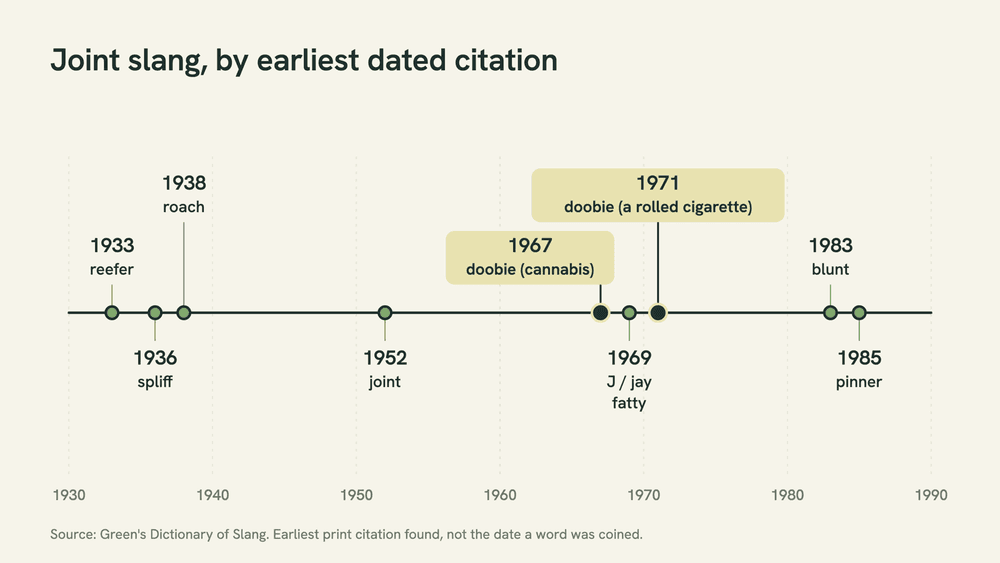
Doobie belongs to a family of words for the rolled cannabis cigarette and its leftover end, and each arrived in a different era. The table lists the earliest dated citation Green's Dictionary of Slang has found for each, with the source it quotes. Read every date as "in print by," not "invented in": spoken slang comes first. Two entries worth opening are reefer, cited from a 1933 Bessie Smith song, and joint, whose cannabis sense Green's cites from a 1952 novel.
| Term | What it means | Earliest dated citation | Source quoted in Green's |
|---|---|---|---|
| reefer | A marijuana cigarette | 1933 | Bessie Smith, "Gimme a Pigfoot": "Gimme a reefer and a gang of gin." |
| spliff | A marijuana or hashish cigarette; originally West Indian | 1936 | Daily Gleaner, Kingston, Jamaica, 3 October |
| roach | The unsmoked end of a marijuana cigarette | 1938 | Cab Calloway, Hi De Ho: "butt of a partially smoked reefer cigaret" |
| joint | A marijuana or hashish cigarette | 1952 (describing 1948) | G. Mandel, Flee the Angry Strangers: "You got a couple of joints to take along?" |
| doobie | Cannabis; later, a cannabis cigarette | 1967 (cannabis); 1971 (cigarette) | J.B. Williams, Narcotics and Hallucinogens; E.E. Landy, Underground Dictionary |
| J / jay | Short for joint | 1969 | Current Slang (published 1970) |
| fatty | A marijuana cigarette, especially a thick one | 1969 | R.R. Lingeman, Drugs from A to Z (1970): "A thickly rolled marijuana cigarette." |
| blunt | Cannabis rolled in a cigar wrapper | 1983 | Quoted in J. Breslin (1985): "I smoke White Owl blunts. That's the new thing." |
| pinner | A very thin joint | 1985 | Jennifer Blowdryer, Modern English |
Three waves show up. The jazz-era words came first: reefer, spliff and roach are all in print in the 1930s. Doobie, J and fatty reach print within a few years of each other, between 1967 and 1971. Blunt and pinner are 1980s words. Joint is the odd one: in Green's it meant an opium or injecting outfit from 1935 before it meant a cannabis cigarette, and the Online Etymology Dictionary, as quoted on Wikipedia, dates the cannabis sense to 1938, which we could not confirm. The leftover end of any of these has its own word, explained in our guide to what a roach is; newer vocabulary for oils and concentrates lives in what 710 means; and the name of the plant itself has a separate history, told in why cannabis is called marijuana.
What Google Books shows about doobie, and what it can't
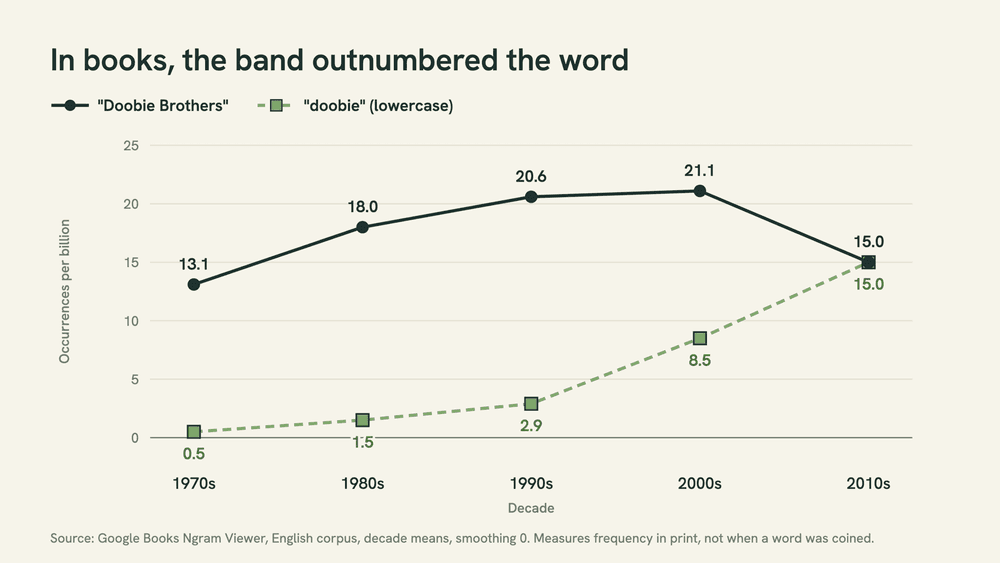
The Google Books Ngram Viewer counts how often a word appears in a large corpus of scanned books. We pulled the English corpus from 1940 to 2022, case-sensitive and unsmoothed, and averaged it by decade. Lowercase "doobie" is rare until the 1980s and then roughly doubles each decade: about 0.2 occurrences per billion words in the 1960s, 0.5 in the 1970s, 1.5 in the 1980s, 2.9 in the 1990s, 8.5 in the 2000s and 15.0 in the 2010s, peaking in 2011.
The surprise is the band. "Doobie Brothers" ran at about 13.1, 18.0, 20.6 and 21.1 per billion across the 1970s, 1980s, 1990s and 2000s, while the lowercase word stayed below 9. (Google measures a one-word term against all one-word strings and a two-word name against all two-word strings, which is how its own viewer plots them side by side.) For about 40 years, books mentioned the band more often than the word it was named after; the two only drew level in the 2010s, at about 15 each. We did not chart joint or reefer. Joint also means a carpentry joint, a knee or a joint account, and reefer also names a refrigerated ship and a jacket, so most of their curves are not about cannabis at all.
Why a drug agency keeps a slang list
In July 2018 the DEA's Houston Division published "Slang Terms and Code Words: A Reference for Law Enforcement Personnel" (report DEA-HOU-DIR-022-18). It describes itself as "a ready reference for law enforcement personnel who are confronted with hundreds of slang terms and code words," compiled "from a variety of law enforcement and open sources." The DEA's own site blocks automated readers, so we read the copy of the 2018 DEA slang report hosted by the University of Maryland's NDEWS project. The May 2017 first edition was 7 pages long; a year later the report ran to 125. Here is what it says about this vocabulary:
- "Doobie" is listed under Marijuana, the drug, in both the 2017 and 2018 editions.
- The 2018 marijuana list runs to 353 names by our count, up from 300 in 2017. Fattie, reefer, spliff, Mary Jane and 420 are on it.
- "Joint" and "blunt" are not on the marijuana list.
- "Roach" appears only as a name for flunitrazepam (Rohypnol), not for the end of a joint.
- "CBD" and "CBD Oil" are filed under "Marijuana Concentrates/Hash Oil."
- "Terp" and "Terpenes" appear on the marijuana list.
The last three items show what kind of document this is. A slang list records words investigators reported hearing. It has no dates, cites no source for any single term and is not a dictionary. It is also not a legal classification: a 2018 police reference that files "CBD" under marijuana concentrates says nothing about how federal or state law treats hemp-derived CBD, which our guide to whether CBD is legal covers. The honest reason to know a word like doobie is that it shows up in documents written about people, such as police reports, court and probation records and drug-education material, not only in songs.
How much is in a doobie, and does the word change anything?
A doobie is a joint, so it holds the same amount. The only data-based estimate we found, a 2016 Drug and Alcohol Dependence paper by Greg Ridgeway and Beau Kilmer (free working-paper version from the University of Pennsylvania), puts the average joint at about 0.32 grams, inferred from 10,628 arrestee purchase records from 2000 to 2010 rather than weighed; how many grams are in an eighth walks through the full math. Calling it a doobie doesn't change how the law treats what's inside it. That depends on the plant's THC content and on where you are, and the backstory of that line starts with when cannabis was first made illegal in the US. A drug test doesn't care about the word either: it looks for THC metabolites, not for what you called the joint, as our explainer on CBD and drug testing lays out.
What we still don't know
No dictionary we read has an etymology for doobie. The earliest citation in Green's, from 1967, shows only a book title and a year, with no quoted line, so we cannot see how the word was used there. Merriam-Webster's 1967 date and Green's may rest on the same early record, which makes 1967 one data point, not two. We did not consult the Oxford English Dictionary. Spoken slang usually reaches print later, so the word may be older than 1967, but no record shows by how much. And Simmons's account of 1969 is a memory recorded 56 years later, which he hedges himself with "I think." Treat every date on this page as "by this year," and treat any confident origin story as unconfirmed until someone finds an earlier dated source.
A doobie is a marijuana cigarette, the same thing as a joint. Its oldest dated use, from a 1967 book, meant cannabis itself; the rolled-cigarette sense is in print by 1971, according to Green's Dictionary of Slang. Merriam-Webster also dates the word to 1967.
Yes. It is the same object under a different name. Joint is the older word, cited in its cannabis sense from 1952 in Green's, while doobie is a late-1960s word. A blunt (cannabis in a cigar wrapper) and a spliff (often cannabis mixed with tobacco) are different things.
No one knows. Merriam-Webster and Random House both say "origin unknown." Green's Dictionary of Slang offers two cautious leads, the Hindi dūb ("grass") and the Scots dobie ("a dull fellow"), and supports neither with a citation. The Romper Room and "dubious" stories have no source at all.
Yes, and the word came first. Co-founder Patrick Simmons said in a 2025 interview that biker friends were already calling joints "doobies" when the band took the name, which he places in the summer of 1969. The word is cited in print from 1967.
The earliest dated citation is from 1967. Random House gives a range, first recorded in 1965-70. Because spoken slang usually reaches print later, the word may be somewhat older, but no record shows it.
Yes. The DEA's Houston Division lists "doobie" under marijuana in its 2017 and 2018 slang references for law enforcement. "Joint" is not on that list. The list is a record of what investigators reported hearing, not a dictionary and not a legal classification.
Doobie is one late-1960s word in a much longer story. The plant's own name is older and stranger, and the history of the word "marijuana" traces how it entered English and, from there, American law.
Writing about hemp, wellness and the small rituals that keep us balanced.