Male vs Female Weed Plants: How to Tell, and Why It Matters
Cannabis is one of the few crops with X and Y chromosomes. Here is how male, female and hermaphrodite plants differ, what male plants actually contain, how feminized seed works, and why pollen starts fights between hemp and marijuana farms.
Search "male vs female weed plant" and you get the same checklist on page after page: pollen sacs on males, white hairs on females, and not a single citation. The plant behind that checklist is more interesting. Cannabis is one of the few crops with X and Y chromosomes, a female can be pushed into making pollen, and the plant's sex decides where its cannabinoids end up.
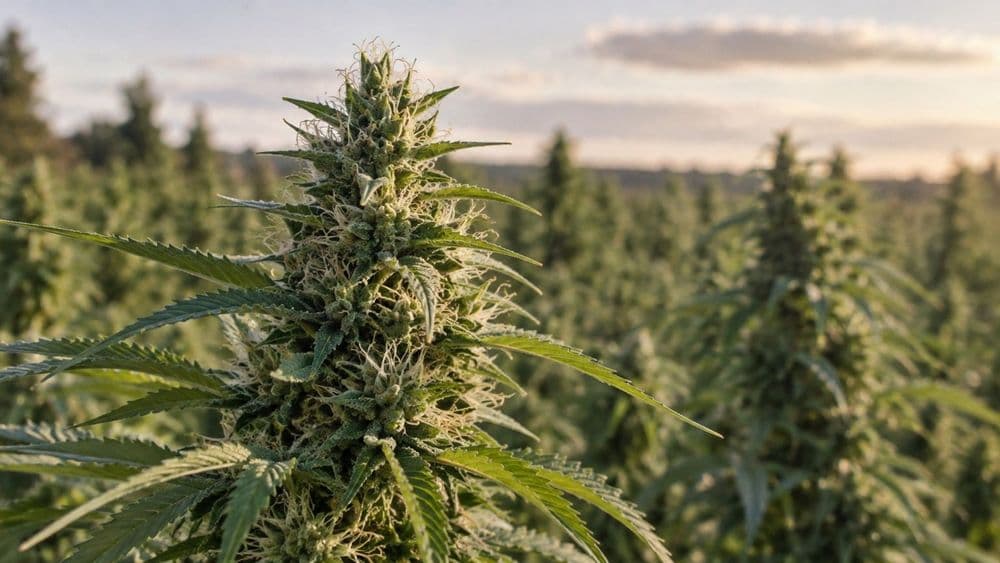
The short answer: female cannabis plants make the flowers sold as buds, small green bracts with two white hairs (stigmas) that catch pollen, and those flowers are where the resin glands crowd together. Male plants make clusters of pollen sacs (anthers) that split open and shed pollen on the wind. Until the first flowers appear, the two look the same. Growers care because an unpollinated female flower stays seedless and carries far more of the plant's cannabinoids, which are made in the tiny glands described in our guide to trichomes. This page is plant biology for adults 21+, not a grow guide. It covers the genetics, the measurements and the hemp-farm disputes, with every study linked, and it gives no cultivation or breeding instructions.
Cannabis has X and Y chromosomes, almost like people
Most crop plants carry male and female parts on the same plant, often inside the same flower. Cannabis is different. It is dioecious, a botanist's word for a species whose individual plants are usually either male or female. Under the microscope, a 2014 cytogenetics study showed that a cannabis cell holds 18 ordinary chromosomes plus one sex pair: two X chromosomes in a female, an X and a Y in a male, much like people. The X turned out to be the largest chromosome in the set, and the Y is larger than any of the ordinary ones.
Genetics then filled in the detail. A 2020 genetics study that followed one cannabis family, two parents and 10 offspring, traced more than 500 genes to the sex chromosomes and found a Y that has lost much of its original content. The authors suggested cannabis may carry one of the oldest sex-chromosome systems known in plants. The biggest update came in 2026. A US-led team that assembled the X and Y chromosomes of cannabis and hop, published in Nature Communications, reported that the two plants share the same XY pair, which arose before their lineages split around 36 million years ago. The paper also recalls that a century ago, cannabis and hop sex chromosomes were among the first identified in any flowering plant. Today the male-specific part of the Y is "highly degenerated", and the authors found "no clear sex-determining genes" on it.
So where is the switch? The same paper points to the X. A copy of a gene in the plant's ethylene pathway (ethylene is a plant hormone), sitting on the X chromosome, is the authors' candidate for what tells a flower bud to develop as female. That is the reverse of the human pattern, where a gene on the Y triggers male development. The paper also notes that cannabis and hop plants with extra X copies (XXY or XXXY) commonly produce female flowers or carry both sexes, whereas an XXY person develops as male. Two cautions apply. The gene is a candidate: the journal's own editorial summary calls it "a candidate for sex-determination", and we found no experiment in the paper that switched it off to confirm its role. And some authors have commercial ties: two co-founded a genotyping company and two founded a hybrid hemp seed company.
The X and Y are not the whole story either. A Dutch study of 123 hemp lines, grown in three environments and scanned at about 600,000 genetic markers, found eight regions of the genome tied to flowering traits: six to flowering time and two to sex determination. Those two regions made male flowers on female plants more or less likely. That matters for hemp varieties bred to carry both sexes on one plant, and it helps explain why some plants drift away from their genetic sex, a theme that returns below with hermaphrodites.
How to tell male and female weed plants apart
Before it flowers, a young male looks like a young female. A 2023 study that scanned hemp plants with hyperspectral cameras put it plainly: males and females are "visually indistinguishable during early growth." The plant itself already knows, though. An Irish team comparing gene activity in young male and female hemp plants found sex-biased gene expression "already established at very early vegetative stages", well before any flower forms.
The first visible clue comes from a handful of single flowers. Long before the plant bursts into bud, it makes a few flowers where the leaves meet the stem. Botanists call them solitary flowers; growers call them pre-flowers. Researchers studying how medical cannabis begins to flower found that these single flowers and their bracts form at the stem nodes even under long days, and that their appearance depends on the plant's age rather than on day length. A 2023 study of one cultivar found them at roughly the 7th to 12th node. These first flowers are where a plant's sex becomes visible. The descriptions below follow a 2020 Canadian microscopy study of commercial cannabis flowers, which photographed every stage with light and electron microscopes.
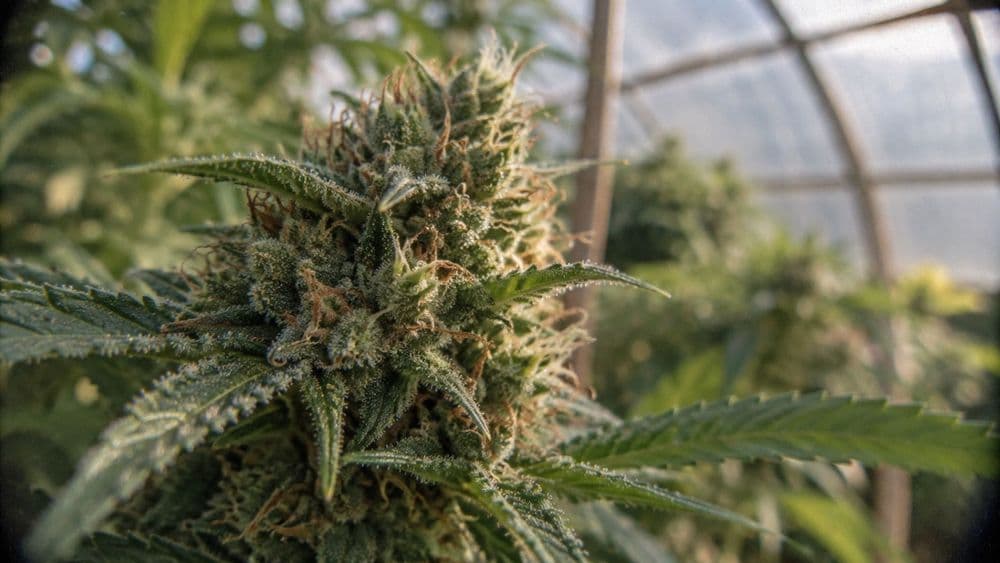
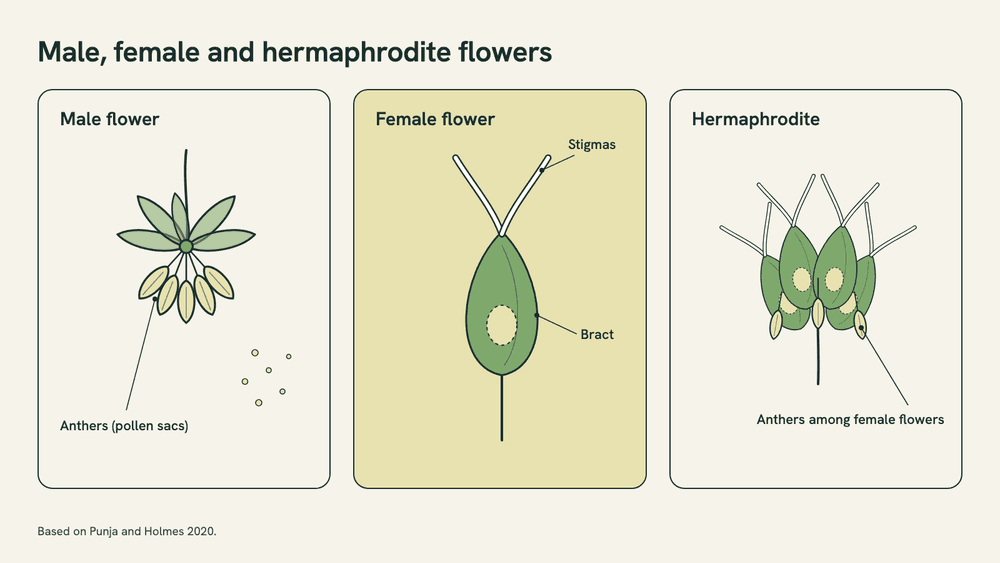
- Female flower: a small green bract wrapped around an ovary, with two white hair-like stigmas sticking out to catch pollen. The stigmas split into two at the tips.
- Maturing female flower: the stigmas shrivel and turn brown to red, while the ovary and bracts swell and become coated in silvery-white resin glands.
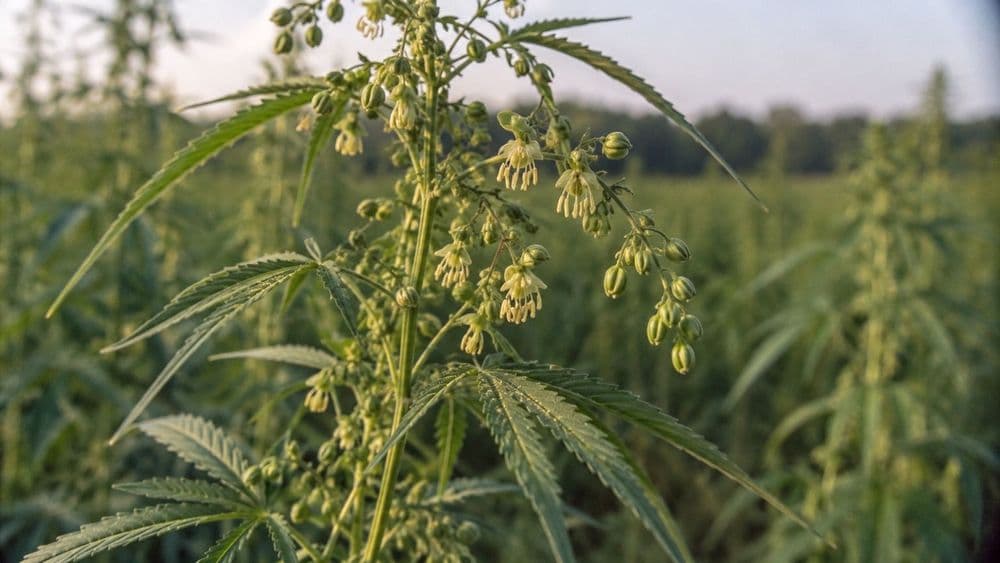
- Male flower: a small rounded bud that opens to reveal a cluster of hanging anthers (pollen sacs), which split open to release pollen.
- Hermaphrodite: a genetically female plant with anthers growing among or inside its female flowers. The anthers and pollen look like those of a normal male.
- Height and leaf shape: growers often say males are taller and thinner. We found no primary study backing this as a reliable test, and the studies above say looks are unreliable before flowering.
Labs no longer need to wait for flowers at all. A 2025 test that reads the XX or XY pattern from a leaf in a single PCR reaction was right on more than 500 samples across 14 hemp cultivars; its authors note that "it is not possible to phenotypically distinguish male and female plants before flowering." The hyperspectral study above classified sex without error once plants were flowering, but only 60% to 87% correctly from young leaves. At commercial scale, one lab's DNA test for a male marker screened 8,200 leaf samples, 3,156 of them from males, with better than 98.5% accuracy. The authors worked for the company offering the test, which is worth knowing when you read the number.
Male, female, hermie, feminized: the comparison table
Four words get mixed up constantly. Male and female describe a plant's chromosomes. Hermie describes what a plant does: it makes flowers that do not match its chromosomes. Feminized describes how a seed was made. Here they are side by side, with monoecious hemp added, because it is the type of hemp bred to break the one-sex-per-plant rule.
| Plant | Genetic sex | Flowers it makes | Sheds pollen? | Seeds | What it means for a crop |
|---|---|---|---|---|---|
| Male | XY | Male flowers only (anthers) | Yes, about 100 million grains per plant by one widely cited estimate | Makes none itself; fertilizes females | The pollen source in breeding; kept out of bud crops |
| Female | XX | Female flowers only (bracts and stigmas) | No | Only if pollinated; seed from a male cross splits about 1:1 male to female | The bud crop; kept unpollinated, it stays seedless (sinsemilla) |
| Hermaphrodite (hermie) | XX in the studies cited here | Female flowers plus some male flowers or anthers | Yes, and the pollen can be viable | Self-pollinated seeds were all genetically female | Unplanned seeds in the buds; seen on 5% to 10% of plants in one commercial study |
| Feminized seed | XX: made with pollen from a female induced to make male flowers | Female flowers expected | Not unless the plant itself turns hermie | Not applicable: it is the seed | A mostly female crop, not a guaranteed one |
| Monoecious hemp | Not explained by XX vs XY alone; other genome regions affect stability | Male and female flowers on the same plant | Yes | Pollinates itself and sets seed | Used where seed or fiber is the goal rather than flower |
The first column is the one to remember. A plant grown from feminized seed is still a genetic female, so it can still produce male flowers under the same pressures as any other female. And a hermie's pollen carries no Y, which is exactly why breeders use induced hermaphrodites to make feminized seed in the first place, as the section on hermies explains.
Why buds come from female plants
The resin glands that make cannabinoids crowd onto the bracts of female flowers, and male flowers carry far fewer. That is the core reason the crop is female. The flowering study above describes glandular trichomes as highly abundant mainly on female inflorescences, the clustered flower heads, and a 2026 comparison of male and female hemp flowers says the same. The cannabinoid pathway runs inside those glands, starting from CBGA, the precursor the plant converts into THCA or CBDA. More glands means more of that chemistry per gram of flower.
Commercial marijuana growers act on this. The Canadian microscopy team describes the standard practice in one sentence:
“In commercial production, marijuana plants are all genetically female; male plants are destroyed as seed formation reduces flower quality.”
Pollination is the second reason. In a 2021 Israeli plant study, pollinating two cannabis varieties so they set seed substantially lowered the concentration of nearly every cannabinoid, whichever male did the pollinating. That is the logic behind sinsemilla, Spanish for "without seed": keep pollen away, and the female flowers put their effort into resin instead of seeds. Seeds in a bag are also a useful quality signal, and our guide to what good weed looks like covers them as a buying cue.
Do male weed plants have THC or CBD?
Yes, male plants make cannabinoids, just much less of the main one. A 2026 comparison of male and female flowers from one Chinese hemp cultivar measured six cannabinoids by HPLC, a standard lab method. CBD, the dominant cannabinoid in that hemp, was 16.88 times higher in the female flowers than in the male ones. The paper's abstract describes this as female "cannabinoid levels" overall, but its results tie the 16.88 figure to CBD. The detail most guides miss is that not every compound followed the pattern. CBDV, CBN and THC were also higher in the female flowers, but CBDA and THCV measured significantly higher in the males.
Read those numbers with their limits. It was one hemp cultivar with three samples per sex, and the flowers were dried at 85 °C, heat that converts part of the acid forms (CBDA, THCA) into the neutral ones (CBD, THC). So the split between CBDA and CBD in that study may partly reflect processing, not only biology; our explainer on THCA versus CBD covers how acid and neutral forms relate. An earlier study of wild Hungarian hemp also found CBD in extracts of male flowers, so "males have zero cannabinoids" is a myth too. Its figures are percentages of an extract from one wild population, not of dried flower, so they cannot be lined up against the 2026 numbers.
You will also see grow-shop tables that give male plants a fixed THC percentage range next to a much higher range for females. We looked for the measurement behind those figures and did not find one. The honest answer is the one above: a measured CBD gap of about 17 to 1 in a single cultivar, with two minor compounds running the other way.
What is a hermie? Hermaphrodites and feminized seeds
A plant's chromosomes are fixed, but the flowers it makes are not. A 2026 review of hermaphroditism in cannabis describes sex expression as "highly plastic": genes set the default, and hormones, chemicals and stress can push a genetic female to make some male flowers. A plant like that is a hermaphrodite, or "hermie" in grower slang. According to a 2026 review of the hormones behind cannabis sex, published online ahead of print, ethylene is the hinge. Block it, as silver compounds do, and a genetic female can make male flowers; add a compound that releases ethylene, and a genetic male can make female ones. That fits the 2026 genome paper's candidate switch, which sits in the ethylene pathway.
How common are hermies? In the Canadian study of commercial indoor crops, stray male anthers appeared inside female flowers on 5% to 10% of the plants examined, from about the fourth week of flowering. The anthers and pollen looked like normal male ones. Seeds from those self-pollinated flowers grew into genetic females only, with 90% to 95% germination, because a female has no Y chromosome to pass on. Seeds from an ordinary male and female cross split roughly 1:1.
That is the whole biology of feminized seed. The 2026 review notes that induced hermaphrodites "produce pollen lacking a Y chromosome" and are widely used to generate feminized seed, and that silver thiosulfate remains the most effective tool for inducing them. Researchers have documented what happens. Slovenian researchers working with high-CBD plants in 2021 coaxed selected females into making fertile male flowers, up to 379 per plant across 23 treatments they compared, and bred offspring whose CBD-to-THC ratio averaged about 21 to 1, up from about 8 to 1 in the starting population. In a 2024 Korean test, three cultivars responded very differently to the same male-flower treatment, a reminder that sex expression depends on genetics, and the induced pollen was more than 65% viable. An Argentine team watched the switch happen under the microscope in one cultivar: about a week after treatment, male flower buds were forming on genetically female shoots, by about three weeks male structures dominated the shoot tip, and 54% of the induced pollen was viable.
Pollen from a female pushed into making it is not the same as pollen from a male. In a 2023 Canadian experiment on one cannabis population, true males shed 223% more pollen in total than masculinized females, more than three times as much, although flower for flower the amount was the same. Pollen viability was 200% higher in males, and in females that turned cosexual (making both flower types) under drought, than in chemically induced ones.
Hermies attract plenty of folklore. Here is how four common beliefs hold up against the sources above:
- "A tiny light leak flips a female." A 2024 study cited in the 2026 review found no significant link between low-intensity light leaks and male flowers.
- "Stress causes hermies." Partly. The review links day length, temperature, water and nutrients to sex instability, citing a 1954 report of male flowers on 25% to 45% of females under very short days, but how much each matters is unsettled.
- "Feminized means 100% female." No. Feminized seed is mostly female, not guaranteed female; males and hermaphrodites still turn up.
- "A hermie's seeds can be male." Not if the hermie is a genetic female that pollinated itself: those seeds were all genetically female in the Canadian study.
On the third point, the authors of the 2021 Israeli pollination study write in passing that around 5% to 10% of plants from feminized seed can still be male. That is their statement, not something their experiment measured, and we found no peer-reviewed survey of off-type rates in commercial seed lots.
Pollen on the move: why hemp and marijuana farms collide
Cannabis pollen travels on the wind, and there is a lot of it. Hemp pollen grains are about 30 micrometers across. Figures the authors of a 2024 Virginia Tech pollen-dispersal study cite from earlier work put a single male flower at up to 350,000 grains and a single male plant at about 100 million. Their own model, which simulated pollen moving across the continental US from July to November, found that about 70% of pollen settled in the nearest distance band and the amount fell to 1% within 3 km. Pollen stayed closer at night and spread wider during the day, and deposition rose from summer into autumn.
The long tail is the problem. Recommended buffers between fields run 1 to 5 km, yet the same paper cites reports of cross-pollination at up to 20 km and even 48 to 96 km, and back-trajectory studies suggesting cannabis pollen crossed more than 200 km from North Africa to Spain. It costs real money: the authors cite a 2022 Colorado survey that put growers' losses from cross-pollination at $12,000 to millions of dollars, and an Oregon lawsuit alleging more than $8 million in damages. Keep in mind that this is a model plus figures gathered from other reports, not pollen tracked across real farms.
Why would a hemp farm and a marijuana farm care about each other's pollen? They grow the same species. The federal line between them is a THC limit, not a different plant, and our explainer on how hemp and marijuana differ covers where that line sits and how its measurement is changing. A marijuana grower wants seedless flower, so hemp pollen drifting in is a loss. A hemp grower fears the reverse. Drift is mostly an outdoor problem, one of many ways the growing environment shapes a crop, as our comparison of indoor and outdoor weed explains.
What does stray marijuana pollen actually do to a hemp crop? A 2022 perspective from Colorado State University Pueblo argues that the common fear runs the wrong way. In the authors' words, "The altered genetics will only begin to appear in the seeds resulting from the cross-pollination, not in the pollinated female hemp plant." Pollen changes the next generation, carried in the seed, not the THC of the plant it lands on. The causes of "hot" hemp they list are different: environmental stress, seed that carries high-THC gene variants, and seed saved from a crop that marijuana pollen had already reached. A perspective is an argument built on existing research rather than new data, but the genetics it rests on are standard.
What plant sex means for a CBD bottle
A hemp extract is made from plant material, and the sex of the plants behind it is not printed on any label. For a finished product, it is also not the most useful question. Everything above explains why female flowers carry most of a plant's cannabinoids, but only a lab test tells you how much CBD, THC and everything else actually made it into the bottle in your hand. Here is what to check on a batch certificate of analysis (COA):
- 1A batch number on the COA that matches the batch number on your bottle.
- 2Total CBD, in mg per mL and mg per bottle, so you can check it against the label.
- 3The THC result, including total THC, which counts THCA as well as delta-9 THC.
- 4The minor cannabinoids, such as CBG, CBN, CBDV and THCV, if the product is sold as broad or full spectrum.
- 5The name of the independent lab and the date the batch was tested.
As one example, Planntz's Broad Spectrum and Full Spectrum CBD tinctures list 250 mg/mL of CBD, which is 15,000 mg in a 60 mL bottle, and each batch has a public third-party COA. That document, not the history of the field, is the measurement that answers what is inside. If you have never read one, our walkthrough on reading a COA line by line shows what to look at first.
What is still unknown
- Whether the X-linked ethylene gene really is the sex switch. The 2026 paper identifies it as the likely trigger; we found no experiment that switched it off to confirm it.
- How much each kind of stress triggers hermies in real crops. The 2026 review describes associations, and the light-leak belief did not hold up at low intensity.
- How large the male-female cannabinoid gap is across varieties. The measured comparison covers one hemp cultivar with three samples per sex.
- How far pollen really travels between farms. The US-wide figures come from a model plus distances other reports cite, not from tracking pollen across real fields.
- How often feminized seed produces males or hermies in commercial lots. We found no peer-reviewed survey of off-type rates.
- How the many sex-linked genes fit together. The 2020 Dutch and 2025 Irish studies name candidate regions and genes, not a finished mechanism.
Frequently asked questions
Look at the first single flowers that form where leaves meet the stem. A female flower is a small green bract with two white stigmas sticking out; a male flower is a rounded bud that opens into hanging pollen sacs. Before those flowers appear, males and females look the same, a 2023 hyperspectral study found. Labs can test a leaf much earlier: a 2025 single-PCR test was right on more than 500 hemp samples.
Some, but less than females. In a 2026 comparison of one hemp cultivar, THC was higher in female flowers and CBD, the main cannabinoid there, was 16.88 times higher. Two minor compounds, CBDA and THCV, measured higher in the males. That study used three samples per sex, so treat it as one data point, not a rule for every plant.
Its chromosomes do not change: it stays XX. But it can make male flowers. A 2026 review calls cannabis sex expression highly plastic, with hormones, certain chemicals and some stresses able to shift it. A female that makes male flowers is called a hermaphrodite, or hermie.
A hermie is a genetic female carrying some male flowers or anthers. A Canadian study of commercial crops found them on 5% to 10% of plants. When a hermie pollinates itself, the seeds are all genetically female, because a female has no Y chromosome to pass on through its pollen.
No. Feminized seed is made with pollen from a female induced to make male flowers, so it carries no Y and most plants grow female. Males and hermaphrodites still turn up, and we found no peer-reviewed survey of how often that happens in commercial seed.
Not the pollinated plants themselves, according to a 2022 perspective from Colorado State University Pueblo: the new genetics show up in the seeds, not in the plant the pollen lands on. The risk is seed saved from that crop. Pollen can travel several kilometers, which is why that risk is real for the next season.
Sinsemilla is Spanish for without seed. It means cannabis flower from female plants kept away from pollen, so the flowers never set seed. A 2021 study found that pollination lowered the concentration of nearly every cannabinoid in the flower.
An autoflower is a plant that starts flowering with age rather than in response to shorter days, a trait linked to Cannabis ruderalis ancestry. It is a separate trait from sex: an autoflower is male or female like any other cannabis plant.
Plant sex explains where cannabinoids come from; a lab report tells you what made it into the bottle. You can see the third-party lab results for every Planntz batch and check the numbers for yourself.
Writing about hemp, wellness and the small rituals that keep us balanced.