CBC vs CBD: What Cannabichromene Actually Is, and What Our Certificate Says About It
Four PubMed clinical-trial records name cannabichromene and not one gave it on its own. Here is what each study actually gave people, where the claim that CBC absorbs better than CBD comes from, and what the CBC row reads on our twelve certificates.
Most people who search for CBC vs CBD arrive holding a claim somebody else made: that cannabichromene absorbs better, works harder on inflammation, or is the quiet cannabinoid that outperforms the famous one. Those sentences sit on almost every page ranking for this comparison, and almost none of them carry a citation you can open. This page does three different things. It defines cannabichromene precisely, it opens every human study that names it and says what each one actually gave people, and it prints the CBC row from our own laboratory certificates, including the part where that row reads non-detected.
Here is the short answer, up front. CBC and CBD start at the same place in the plant and stop being comparable almost immediately. CBD has one approved prescription drug behind it. CBC has no completed trial of its own. A PubMed search for cannabichromene AND clinical trial[pt], run on August 28, 2026, returns four records, and reading all four shows that not one of them gave CBC by itself. On the trial registry, exactly one study has ever proposed to, and it never enrolled anybody. And on the twelve batch certificates we publish, cannabichromene has its own row, and on all twelve that row reads ND, meaning it was not detected at the quantitation limit that certificate prints. If you came here to find out whether the hemp oil in your cabinet is quietly delivering CBC, our answer is no, and we would rather print the row than let you assume otherwise.
What cannabichromene actually is
Cannabichromene is a phytocannabinoid, one of the compounds the plant builds in its resin glands. It has been in the chemical literature since 1966, when Gaoni and Mechoulam worked out its structure by NMR spectroscopy, a fact recorded in a 2021 review of minor cannabinoid pharmacology that supplies several of the honest limits further down this page. The plant reaches CBC the same way it reaches CBD, by starting from CBGA and then branching. For CBC the branch runs through cannabichromenic acid, made by a dedicated enzyme, cannabichromenic acid synthase, which was purified and characterized in 1998 (Morimoto and colleagues, Phytochemistry, doi 10.1016/s0031-9422(98)00278-7); they reported that the enzyme converts cannabigerolic acid to cannabichromenic acid by direct dehydrogenation, without a hydroxylation step. We are not going to re-derive that pathway here, because the acid the whole cannabinoid family starts as has a page of its own, and so does the wider family tree these names belong to.
There is a chemistry wrinkle here that no comparison page mentions, and it matters more than most of the receptor talk. THC and CBD occur in the plant as a single mirror-image form. CBC does not. A 2023 chiral analysis in the Journal of Natural Products found that cannabichromene occurs in cannabis as a scalemate, a mixture of both mirror-image forms whose composition is, in the authors' words, strain-dependent in terms of both enantiomeric excess and enantiomeric dominance. The same paper notes that CBC is a noncrystalline compound whose chirality was not significantly affected by standard conditions of isolation and purification, which means the mixture survives being turned into an ingredient. Their closing line on the point is a request rather than a finding: the biological profile of both enantiomers of CBC should be investigated independently. That work has not been published. So when a label says CBC, it is naming a mixture whose two halves have never been tested separately in anything.
CBC vs CBD, side by side
| What is being compared | CBC (cannabichromene) | CBD (cannabidiol) |
|---|---|---|
| Where it comes from in the plant | The CBGA branch, through cannabichromenic acid, made by a dedicated enzyme purified in 1998. | The same CBGA precursor, down a different branch of the same fork. |
| Mirror-image forms | A mixture of both, in proportions that depend on the strain, and the compound does not crystallize (2023 chiral analysis). | A single form. The 2023 paper names THC and CBD as the contrast case. |
| Completed trials giving it on its own | None found. Four PubMed clinical-trial records name it, and in each one it arrived inside a multi-cannabinoid product. | Yes, including the trials behind an approved prescription drug. |
| FDA-approved drug product with it as an active ingredient | None. A Drugs@FDA search on August 28, 2026 returns no match. | One record: application NDA 210365, Epidiolex, a purified form of the drug substance CBD. |
| What that approval covers | Not applicable. | Seizures associated with Lennox-Gastaut syndrome or Dravet syndrome in patients 1 year and older, and separately with tuberous sclerosis complex. |
| Receptor evidence | Four preclinical papers, four different answers, all of them in cells or in mice. | Not this page's subject. Noted only because the 2011 channel screen names CBD, and not CBC, among the human TRPV1 activators. |
| Intoxicating | Not established as intoxicating. The one blinded human study that varied CBC five-fold found no change on any outcome measure. | Not intoxicating. |
| Named analyte on the Planntz potency panel | Yes, one of 13 cannabinoids the method looks for. | Yes. |
| Result on our 12 published batches | ND on all 12. On batch 260320 the quantitation limit printed beside the row is 0.341 mg/mL. | Quantified on all 12. Batch 260320 reads 16,300 mg per package, 269 mg/mL. |
Read that table down the middle and the honest comparison appears on its own: these two molecules are not on the same evidentiary footing, and no amount of careful writing puts them there. We are not saying CBC is weaker, less useful or less interesting than CBD. We are saying nobody has measured it on its own in a person, so there is nothing to rank. One row deserves a correction on the way past, because the page that ranked first for this comparison when we read the results on August 28, 2026 opens by stating that CBD is FDA-approved to treat epilepsy. FDA's own page on cannabis-derived products says it approved one cannabis-derived drug, Epidiolex, which contains a purified form of the drug substance CBD, for the treatment of seizures associated with Lennox-Gastaut syndrome or Dravet syndrome in patients 1 year of age and older, and separately for seizures associated with tuberous sclerosis complex. One drug, three named conditions, seizures rather than epilepsy in general, and a prescription medicine rather than a supplement. Searching the Drugs@FDA data on August 28, 2026 for products with cannabichromene as an active ingredient returns nothing at all; the same search for cannabidiol returns a single record, application NDA 210365. What that approval does and does not cover is worked through properly on our reading of the Epidiolex label.
The four clinical trials that name CBC, and what each one gave people
Here is the search, so you can run it yourself. On August 28, 2026, a PubMed query for cannabichromene AND clinical trial[pt] returned four records. For context, on the same day the bare term cannabichromene returned 329 records and cannabichromene AND humans[mh] returned 93. Counts move, which is why the date is printed. What does not move is the reading rule: a record that mentions a molecule is not a trial of that molecule. So we opened all four and wrote down what each one actually put in front of a participant.
In order of size. A 2024 trial in the Journal of the American Nutrition Association randomized 1,793 adults with sleep disturbance to one of six capsule products for four weeks, and CBC appeared there as 5 mg added on top of 15 mg of CBD and 15 mg of CBN. A 2026 study in Clinical Therapeutics recruited 276 people with fibromyalgia, rheumatoid arthritis or knee and hip osteoarthritis and randomized them to one of three capsule compositions for 12 weeks, with CBC sitting at 3 mg inside a capsule that also held 10 mg of THCA, 10 mg of CBDA and 5 mg of CBG. A 2022 pharmacokinetic pilot in the European Journal of Clinical Pharmacology gave 43 people an oral oil containing 20 mg of CBD, 0.9 mg of THC and 1.1 mg of CBC per milliliter, every 12 hours for seven days. And a 2005 study in Behavioural Pharmacology (PMID 16148455) had 23 healthy marijuana users smoke cigarettes across four blinded sessions in which CBC was varied between 0.1% and 0.5% of the plant material. Four records, four designs, and in every one of them CBC arrived bundled with at least one other cannabinoid.
| Record | What participants actually received | Where CBC sat in it |
|---|---|---|
| Saleska and colleagues, 2024 (PMID 37162192) | 1,793 adults with sleep disturbance randomized to one of six capsule products for 4 weeks. Every arm received an active product; there was no placebo arm. | 5 mg added on top of 15 mg CBD and 15 mg CBN. |
| Kruger and colleagues, 2026 (PMID 42140793) | 276 people with fibromyalgia, rheumatoid arthritis or knee and hip osteoarthritis randomized to one of three capsule compositions for 12 weeks; 168 completed. No placebo arm. | 3 mg inside a capsule with 10 mg THCA, 10 mg CBDA and 5 mg CBG (n = 57). |
| Peters and colleagues, 2022 (PMID 34664109) | 43 people took an oral oil every 12 hours for 7 days across five arms. The oil held 20 mg CBD, 0.9 mg THC and 1.1 mg CBC per mL. | 1.1 mg per mL of a three-cannabinoid oil, measured in blood as a secondary analysis of a pilot. |
| Ilan and colleagues, 2005 (PMID 16148455) | 23 healthy marijuana users smoked cigarettes in four blinded sessions: THC at 1.8% or 3.6%, CBC at 0.1% or 0.5%, CBD at 0.2% or 1.0%. | A concentration inside whole marijuana, varied five-fold, with THC present throughout. |
One of those four is far more decision-relevant than the rest, and it is a null result. In the 1,793-person sleep trial the authors report no significant differences in effect between 15 mg of CBD isolate and formulations containing 15 mg of CBD and 15 mg of CBN, alone or in combination with 5 mg of cannabichromene, and they write that the addition of low doses of CBN and CBC may not improve the effect of formulations containing CBD or melatonin isolate. Read that carefully in both directions. It is the largest human dataset that contains CBC at all, and adding CBC changed nothing measurable against CBD on its own, at that amount, on that questionnaire, over four weeks. It is also a trial in which every arm received an active product and none received placebo, so improvement within any arm cannot be read as a drug effect either. One amount, one form, one outcome measure. The same trial is read from the other side, for what it says about CBN, on our comparison of CBN and CBD.
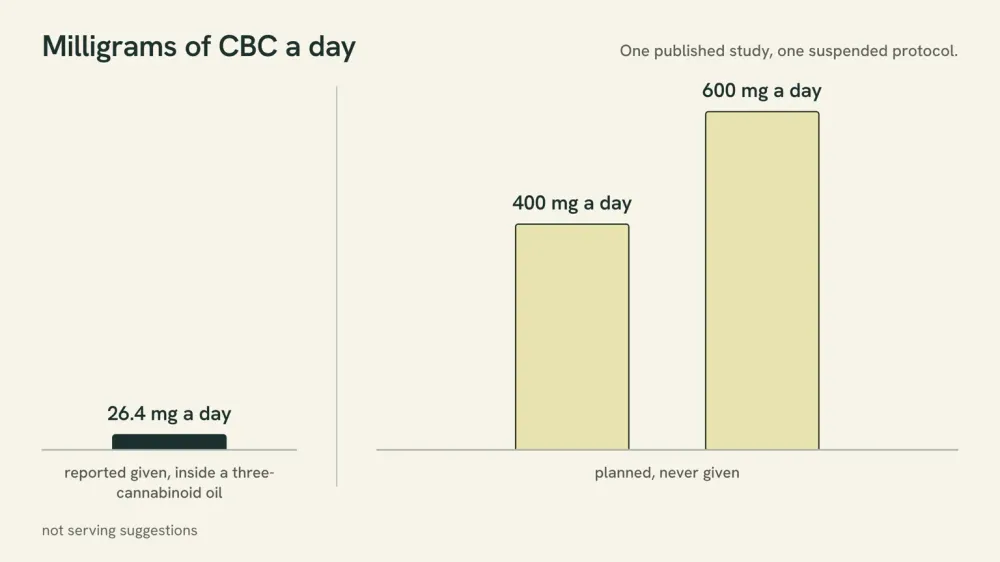
The trial registry tells the same story from a different angle. A query of ClinicalTrials.gov for cannabichromene on August 28, 2026 returned five records. In one, a capsule fixes 5 mg of THC, 5 mg of CBD and 5 mg of CBC together. In another, an oral solution pairs CBC with THC. A third describes a CBG and CBD hemp oil that also contains small amounts of cannabichromene. In a fourth, CBC is not an intervention at all: it is one of ten cannabinoids on an assay panel. That leaves exactly one record that would give CBC on its own, and that study, a 25-person phase 1/2 protocol in rheumatoid arthritis, is listed as suspended. It planned 400 mg or 600 mg of CBC a day. It has posted no results, and nobody was ever enrolled.
Where the claim that CBC absorbs better than CBD comes from
This is the most repeated claim in the whole comparison, and unlike most of page one it does carry a citation. That same top-ranking page says CBC may absorb more efficiently than CBD under the same conditions, and the word after that phrase is a link labeled source, pointing at the 2022 pilot described above. We opened it. The citation is real and the reading is backwards. In that study CBC was never given under the same conditions as CBD. It was given in the same spoonful. Forty-three people were randomized to 120, 240, 360 or 480 mg of CBD a day, or to placebo, taken as an oil containing 20 mg of CBD, 0.9 mg of THC and 1.1 mg of CBC per milliliter. That works out to 6.6, 13.2, 19.8 or 26.4 mg of CBC a day, always alongside the CBD and the THC. There was no CBC-only arm and no CBD-only arm.
What the authors actually found is worth stating precisely, because it is genuinely interesting. Across the four active dose arms, the dose of CBD was 18 times higher than the dose of CBC, and yet CBD's exposure in blood was only 6.6 to 9.8 times higher than CBC's. Peak concentrations rose 1.3 to 1.8 fold for each doubling of the dose, and time to peak ranged from 1.6 to 4.3 hours. Those ratios are ranges across four arms, not one arm's result. And the authors' own conclusion keeps two qualifiers that the marketing version drops: CBC may have preferential absorption over CBD and THC when administered together. Administered together is exactly the condition that makes this not a head-to-head. Nobody in that study swallowed CBC by itself and nobody swallowed CBD by itself, so the experiment that would rank the two molecules has not been run. The paper opens by noting that CBC's acute post-dose pharmacokinetics had not been examined in humans before it, and it describes itself as a pilot and a secondary analysis.
Now put two published numbers side by side, because the arithmetic is short and nobody does it. The largest daily amount of CBC that any published human study reports giving a person is 26.4 mg, the top arm of that 2022 pilot, and it arrived bundled with CBD and THC in the same oil. The one protocol that planned to give CBC on its own specified 400 mg or 600 mg a day. 400 divided by 26.4 is 15.2 and 600 divided by 26.4 is 22.7, so that protocol planned to give roughly 15 to 23 times more CBC than has ever been reported in a published human study. Both inputs are published figures; the division is ours. And neither figure is a serving suggestion: one came bundled with two other cannabinoids, and the other belongs to a study that never enrolled a participant. This page publishes no amounts at all, and if amounts are what you came for, how CBD quantities are actually worked out is the right page.
What our own certificates say about CBC
We can only speak for our own bottles, so here is what they say. Every Planntz tincture ships with a batch certificate from Infinite Chemical Analysis Labs in San Diego, run by UHPLC with diode-array detection against a package size of 56.7 g. The potency panel names 13 cannabinoids: CBC, CBD, CBDA, CBDV, CBG, CBGA, CBL, CBN, CBT, delta-8 THC, delta-9 THC, THCA and THCV. Cannabichromene is not a molecule we skip. It has its own row on every certificate we publish. On all twelve batch certificates currently published, that row reads ND.
| Certificate | CBC row | CBC limits beside it (LOD / LOQ) | What the same page did report |
|---|---|---|---|
| Broad Spectrum, Mango and Peach, batch 260320 | ND | 0.114 / 0.341 mg/mL | CBD 16,300 mg/pkg (269 mg/mL), CBG 145, CBDV 65.2, CBN 31.0, THCV 17.7 mg/pkg |
| Full Spectrum CBD, Mango and Peach, batch 260310 | ND | 0.118 / 0.353 mg/mL | CBD 15,900 mg/pkg (267 mg/mL), CBT 107, CBDV 75.4, delta-9 THC 136 mg/pkg (0.239%) |
| The other ten published batches | ND on all ten | Printed per batch: in mg/mL on ten of the twelve certificates and in mg/g on the other two | CBDV quantified on all 12 batches; CBT quantified on 9 of the 12 |
ND is the part that gets misread, in both directions. It does not mean zero, and it does not mean the laboratory failed to look. It means the compound was not detected at the quantitation limit that certificate prints on the same line, which is a statement about the instrument's floor as much as about the jar. And the floor is not the same for every row. On batch 260320 the quantitation limit for cannabichromene is 0.341 mg/mL while CBDV's, on the same page, is 0.172, so CBC has to clear roughly twice as much material before the instrument will report a number for it. On batch 260310 the same pair reads 0.353 and 0.179. The floor also moves from certificate to certificate: on batch 260314 the cannabichromene limit reads 0.217 mg/mL, and two of the twelve certificates print that column in mg/g rather than mg/mL. That is why the honest way to state this is the pair printed on the certificate you are holding, not one number for all twelve. It is a property of the method rather than a verdict on the molecule, and how a lab report states what it did not find is a whole skill of its own.
So is the panel simply blind to small cannabinoids? No, and the same twelve certificates show it. Cannabitriol, another minor cannabinoid, is quantified on nine of those twelve batches, from 57.3 to 111 mg per package, and reads ND on the three broad-spectrum batches. CBDV is quantified on all twelve, at 65.2 mg per package on batch 260320 and 75.4 on batch 260310. CBL, like CBC, reads ND on all twelve. The instrument finds minor cannabinoids when they are there. On these batches it does not find this one, and we are not going to explain that away by guessing at a process, because an ND row tells you what was measured and nothing about how the oil was made. Which leads to the sentence most of this search result will not write: if you are shopping for cannabichromene, our tinctures are not where you will find it.
So where would the CBC in a CBC product come from?
Start with how little of it the plant makes. An analysis of 89,923 commercial cannabis flower samples, published in PLoS One in 2022, put the point plainly: there are numerous CBC-related genes and the laboratories still observe very low levels of CBC, which the authors read as the CBCA synthase possibly not being selective for CBC production. Two caveats travel with that sentence. Those are adult-use cannabis flower samples measured by dry weight across six US states, not hemp extract in a bottle. And the dataset itself belongs to our page on what separates a major cannabinoid from a minor one, which treats it in full. What it establishes here is narrow and useful: the genes being present is not the same thing as the compound being present.
That is why a concentrated CBC generally does not come from an ordinary hemp extract. The 2021 review cited earlier lists the routes actually in use for minor cannabinoids: extraction and isolation, semi-synthesis or full synthesis, microbial engineering in yeast, E. coli or algae, and selective breeding of varieties rich in CBG, CBC, THCV and CBDV. Remember also that CBC is noncrystalline, so there is no CBC isolate powder in the sense there is for CBD. Published refining chemistry moves it around too: in a 2025 study in the Journal of Chromatography A, a centrifugal partition chromatography step aimed at removing THC recovered 97.06% of the cannabichromene in what the authors call the residual fraction rather than in the purified product. That is one laboratory process in one paper and not a description of anyone's product, ours included: our full-spectrum batches are not put through THC remediation at all, and their CBC row reads ND just the same. If the words full spectrum, broad spectrum and isolate are the part you want unpacked, the spectrum taxonomy has its own page.
Before you buy anything sold as a CBC product
- 1Find the potency panel and look for a CBC row. If the certificate does not list cannabichromene as an analyte at all, that document cannot tell you whether CBC is in there. It can only tell you what the laboratory was asked to look for.
- 2If the row says ND, read the limit of detection and limit of quantitation printed beside it. ND means not detected at that number, not zero, and the number is different on different certificates and different rows.
- 3Check the batch code on the certificate against the batch code on the bottle. A certificate for a different batch is a certificate about a different jar, however good the numbers on it look.
- 4Check the units. Certificates print mg per package, mg/mL and mg/g, and the three are not interchangeable. A big number in one unit can be a small number in another.
- 5Ask where the CBC came from. A hemp extract that naturally reached a gram-scale CBC figure is not what the plant-chemistry literature describes, and concentrated minor cannabinoids generally arrive by breeding, synthesis or fermentation.
- 6Treat any claim that CBC is stronger, better absorbed or more effective than CBD as a claim about a study you can open. There is no completed head-to-head, so the citation, if there is one, is about something else.
The receptor story is four different stories
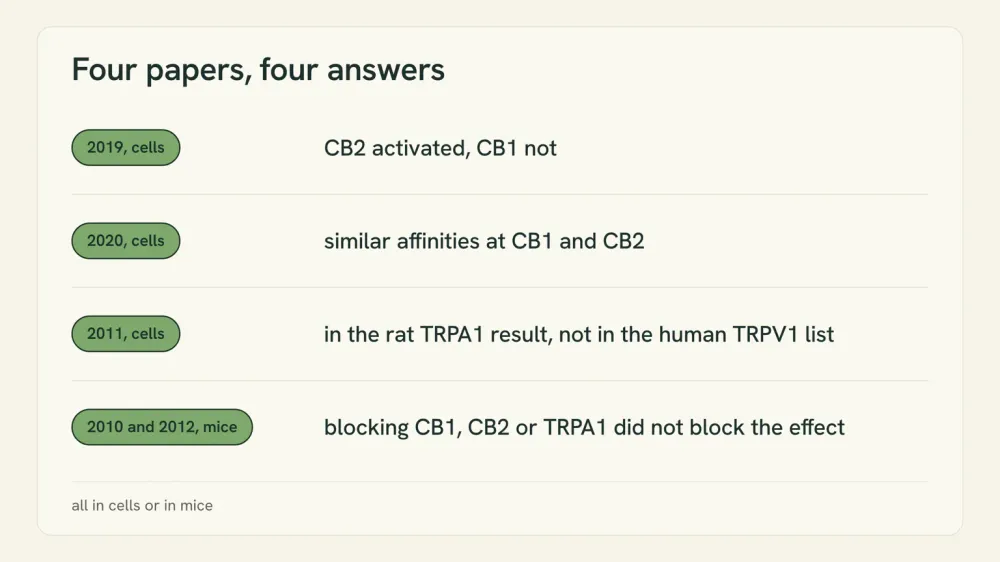
Page one usually compresses CBC's pharmacology into one confident sentence. The published record does not support one sentence. In 2019, a study in the British Journal of Pharmacology reported that CBC activated CB2 and not CB1 in mouse pituitary cells engineered to carry the human receptors, describing CBC as a selective CB2 receptor agonist with higher efficacy than tetrahydrocannabinol in hyperpolarizing those cells. That last clause is an assay result about the electrical state of a cell line, and it is not a statement that CBC is stronger than THC in a person. In 2020, a Scientific Reports paper screening eight phytocannabinoids at human CB1 and CB2 in a different cell line reported CBC binding at both receptors. The 2021 review sets the two papers side by side, reads that second result as similar affinities for CB1 and CB2, and introduces it with the words in contrast to these results. Two cell studies, two answers.
The TRP claim is where the search results go furthest past their own source. Several pages say CBC binds TRPV1 and TRPA1 and then step straight from receptor binding to usefulness in inflammatory disease. The paper that line traces back to is a 2011 screen of eleven cannabinoids against TRPV1, TRPV2, TRPM8 and TRPA1, and its own sentences do not say that. The compounds it reports as stimulating and desensitizing human TRPV1 are CBD, CBG, CBGV and THCV. CBC is not among them. CBC turns up in the rat TRPA1 result, as one of three potent agonists and desensitizers, and it turns up again in a negative: all non-acid cannabinoids except CBC and CBN activated rat TRPV2. Then two mouse studies complicate even that. In a 2010 study in Drug and Alcohol Dependence, a CB1 blocker did not block what CBC did and a CB2 blocker did not block it either, and the authors write that the underlying mechanism did not involve CB1 or CB2 receptors. In a 2012 study in the British Journal of Pharmacology, the effect of CBC was not modified by cannabinoid or TRPA1 receptor antagonists. Four papers, four answers, every one of them in cells or in mice, and none of them measuring anything in a person.
The most recent entry does not rank them either. A 2026 study in cultured mouse dorsal root ganglion neurons (Rabl and colleagues, Journal of Pharmacology and Experimental Therapeutics, PMID 42139799) reported that CBD and CBG activated the widest range of neuron sizes, while CBN and CBC activated predominantly larger sensory neurons. Different, not better, and in mouse tissue at concentrations no oral product produces. That paper is also read on the same question asked of CBG and CBN. If your next thought is that these molecules might do something in combination that none of them does alone, that is a real hypothesis with a real literature and it has its own page here: what the entourage idea does and does not have behind it.
“Much of our current knowledge of the medicinal benefits of minor cannabinoids has come from subjective and anecdotal patient reporting, rather than through rigorous clinical trials.”
What nobody has measured
- No completed trial has given cannabichromene to a person on its own, at any amount, for any duration. Every human record we opened had it bundled with at least one other cannabinoid.
- There is no head-to-head pharmacokinetic comparison of CBC and CBD. The one human study that measured both gave both, in the same oil, at the same time, to everyone.
- The two mirror-image forms of CBC that occur in the plant have never been studied separately, in a person or otherwise. The 2023 paper that described the mixture asked for that work and it has not been published.
- There is no published human data on any consumer CBC product. The abundance figures we cite come from adult-use cannabis flower measured by dry weight, not from a hemp tincture.
- The mechanism is unresolved. Four preclinical papers give four different answers about which receptors are involved, and in two of them blocking the candidate receptors did not stop what CBC was doing.
- Nothing on this page is an amount to take. Every milligram figure here describes either what a study gave or what a certificate measured, and neither of those is a serving.
CBC vs CBD: frequently asked questions
Cannabichromene is not established as intoxicating, and the human evidence on the point is thin but consistent. In a 2005 blinded study, 23 healthy marijuana users smoked cigarettes across four sessions in which the CBC concentration was varied five-fold, from 0.1% to 0.5%, and the authors report that varying the concentrations of CBC and CBD did not change subjects' responses on any of the outcome measures. Two limits travel with that. THC was present in every one of those cigarettes, and 0.1% to 0.5% of plant material is a narrow range, so it is evidence about CBC in that preparation rather than about a concentrated CBC product. Separately, a 2021 pharmacology review states that as of that date none of the minor cannabinoids had been clinically demonstrated to act as psychotropic drugs.
There is no measurement behind the word stronger. No completed trial has given a person CBC on its own, so there is no result to set against anything CBD has done, in either direction. The papers usually quoted for CBC's potency are cell assays: a 2019 study describes higher efficacy than THC in hyperpolarizing a line of mouse pituitary cells engineered to carry human receptors, which is a statement about that assay and not about a person. We are not going to rank the two molecules, because ranking them would require an experiment nobody has run.
No. Cannabichromene has its own row on every certificate we publish, and on all twelve currently published batches that row reads ND, meaning non-detected at the quantitation limit printed beside it. On the Broad Spectrum Mango and Peach batch 260320 that limit is 0.341 mg/mL, and on the Full Spectrum CBD Mango and Peach batch 260310 it is 0.353 mg/mL. ND is not the same as zero, but it is not a trace amount we are quietly counting either: it is the laboratory saying it looked and did not find the compound above that number.
Because a potency panel is a list of what the method looks for, not a list of what it found. Our panel names 13 cannabinoids and prints a result for every one of them, including the ones that come back ND. Printing the non-detects is what makes the detected numbers mean anything: a report that shows only hits cannot tell you whether the laboratory tested for the compound you care about and did not find it, or never tested for it at all.
In practice that is the only way CBC has ever been studied in people, bundled with other cannabinoids. The closest thing to an answer is the 1,793-person sleep trial, where adding 5 mg of CBC to a capsule containing CBD and CBN produced no significant difference in effect against 15 mg of CBD isolate on its own. That was one amount, one outcome measure, four weeks, and a trial with no placebo arm, so it is a comparison rather than a verdict. We publish no serving amounts on this page. The broader question of whether cannabinoids do more in combination than they do alone has its own page on this site, linked in the receptor section above.
Not at the moment. A ClinicalTrials.gov search on August 28, 2026 returned five records mentioning cannabichromene, and exactly one of them would give CBC on its own: a phase 1/2 study in rheumatoid arthritis with 25 participants planned, at 400 mg or 600 mg a day. Its status is suspended, and its own reason-stopped field says the study was put on clinical hold with the FDA prior to beginning enrollment due to insufficient preclinical evidence. That is the sponsor's own filing on its own registry record, last updated in July 2025. No results were posted and nobody was enrolled. It is not an FDA statement about the molecule and not a safety finding.
If there is one habit worth taking from this page, it is reading the row instead of the headline. Every certificate we publish is posted in full at our lab results page, batch by batch, with the non-detects printed beside the detected numbers and the quantitation limit printed beside both. Open the one that matches the code on your bottle, find the line you are curious about, and read the number next to it. That works on our documents and it works on everybody else's.
Writing about hemp, wellness and the small rituals that keep us balanced.