Working Out High: More Enjoyment, No Performance Boost
Cannabis users rated their runs more enjoyable after using it, but none of the exercise studies we reviewed found a performance boost, and inhaled THC cut cycling power and raised heart rate. Here is what each study measured and who was in it.
Working out high is a real habit for plenty of cannabis users, and many of them say it makes the workout better. The two lines that get quoted about it, that cannabis makes exercise more fun and that runners were 31 seconds per mile slower, come from two different University of Colorado Boulder studies, and only the first held up statistically. Here is what those studies and a set of cycling trials actually measured: enjoyment went up, performance did not improve, and heart rate rose in the smoked or vaped cannabis studies that measured it.
This page is an evidence review, not advice. It will not tell you whether to exercise after using cannabis, how much to use or how long to wait, because none of the studies below was designed to answer those questions for you. If THC and CBD are still fuzzy terms, our plain-English comparison of CBD and THC sorts out the difference first. One disclosure before the evidence: Planntz sells a tablet that contains delta-9 THC alongside CBD, and nothing on this page is a recommendation to use it, or any cannabis product, before exercise.
Working out high: the short answer
Controlled human studies that put people on a bike or treadmill after cannabis are few, most of them small and many of them decades old. Read together, they still answer the main questions fairly clearly. Cannabis users rated their runs more enjoyable. Nothing measured made anyone faster or stronger: THC cannabis that was smoked or vaped lowered power in a cycling time trial, and none of the reviews of the older studies concluded that cannabis improves performance. Heart rate was higher before or during exercise in the inhaled-cannabis studies that measured it. And each study enrolled a narrow group of people, which limits what any of it can tell you about yourself.
Two CU Boulder studies that get quoted as one
The first, published in Cannabis and Cannabinoid Research, is the real-world one. In a 2024 crossover study of runners in their everyday setting, 49 cannabis users aged 21 to 49 ran once after using legal-market cannabis and once without it, averaging just under 4 miles a run, and each chose their own product, form and amount. On cannabis runs they reported more positive mood, enjoyment, tranquility and runner's-high symptoms, and also more dissociation, while perceived exertion did not differ (p=0.33). How high people felt, and whether their product was THC-heavy, made little difference to how the run felt. Every rating was a self-report from a runner who knew which run was which.
The second, published in Sports Medicine, moved the question indoors. In the treadmill crossover study, 42 regular users aged 21 to 39 ran for 30 minutes at a moderate pace on two visits: once sober, and once after using a legal-market flower that was either THC-dominant or CBD-dominant. According to the university's announcement of the results, the volunteers already ran while using cannabis, and because federal law prohibits possessing or distributing marijuana on college campuses, they used it at home before a mobile lab brought them in. The same test was rated more enjoyable (p<0.001) and more effortful (p=0.04) on the cannabis day. The table below sets the two studies side by side.
| What we compared | Real-world running study (2024) | Treadmill crossover study (2024) |
|---|---|---|
| Journal | Cannabis and Cannabinoid Research | Sports Medicine |
| Setting | Participants' own runs, outside a lab | 30 minutes on a treadmill in a lab, after using cannabis at home |
| Who | 49 cannabis users aged 21 to 49 (mean 30.8), 61.5% men | 42 regular users aged 21 to 39 (mean 30.8); the university says they already ran while using cannabis |
| Cannabis | Legal-market product and form chosen by each runner, amount self-chosen | Legal-market flower, assigned THC-dominant or CBD-dominant, amount self-chosen |
| Comparison | One run after cannabis, one run without | One session sober, one after cannabis |
| Placebo | None | None |
| Pace | About 31 seconds per mile slower on the cannabis run, not statistically significant (p=0.12) | Same moderate pace on both visits, so no pace result |
| Perceived exertion | No difference between runs (p=0.33) | Higher on the cannabis day (p=0.04) |
| Enjoyment and mood | Higher positive mood, enjoyment and tranquility; lower negative mood | Higher positive mood and enjoyment (both p<0.001) |
| Runner's-high symptoms | Higher on the cannabis run (p<0.001) | Higher on the cannabis day (p<0.001) |
| Self-rated pain | Rated lower after the cannabis run (p=0.03); self-report, unblinded | Very low on both days, no difference (p=0.45) |
| THC-heavy versus CBD-heavy | Product form, cannabinoid content and how high people felt were largely unrelated to how the run felt | Bigger enjoyment gap and smaller exertion gap in the CBD-dominant flower group (both p=0.02) |
“Participants in the THC group also reported that the same intensity of running felt significantly harder during the cannabis run than the sober run.”
That is the university's summary, not the paper's wording. The abstract reports more exertion on the cannabis day overall, with a smaller gap in the CBD-dominant group, and the real-world study found no exertion difference at all, so "it felt harder" belongs to the treadmill study only. The same release tells athletes considering cannabis that "it can come with risks", naming "dizziness and loss of balance". The treadmill study came from the University of Colorado Boulder's Department of Psychology and Neuroscience, and Europe PMC's record for it lists a National Science Foundation grant and a university cannabis-research award.
Who was in these studies, and why it limits what they mean
Surveys suggest the habit is widespread among the users who answer them. In a 2019 online survey of 605 cannabis users in legal states, most of them Colorado residents recruited through Facebook ads, 81.7% said they used cannabis close to exercise, which the survey defined as within an hour before and/or four hours after. Most of those co-users said cannabis made exercise more enjoyable, and about half said it made them more motivated. That is what people believe about their own habit, not a measurement. It also explains the shape of the research: the CU Boulder volunteers were cannabis users who chose their own products and amounts, nobody got a placebo, and everyone knew which session was the cannabis one. Researchers in this group have written that federal scheduling generally prevents true random assignment in legal-market cannabis research, which is part of why these studies rely on products participants buy themselves. So the two CU Boulder studies cannot tell you:
- What exercise after cannabis will feel like if you do not already use cannabis, or do not already work out this way.
- What a specific product or amount will do. Participants chose their own amounts; researchers did not set them.
- Whether the results hold for older adults, beginners, competitive athletes or anyone with a health condition.
- Anything about repeated use over months, since each person was tested on single days.
- How much of the mood result came from expectation, because there was no placebo to compare against.
The treadmill study's authors say as much themselves. They write that research using diverse samples, exercise types and methods, such as placebo-controlled trials, is needed to establish whether the findings generalize. That is a request for future work, not a finding, and it is the right frame for everything above.
Performance: what the bike labs measured
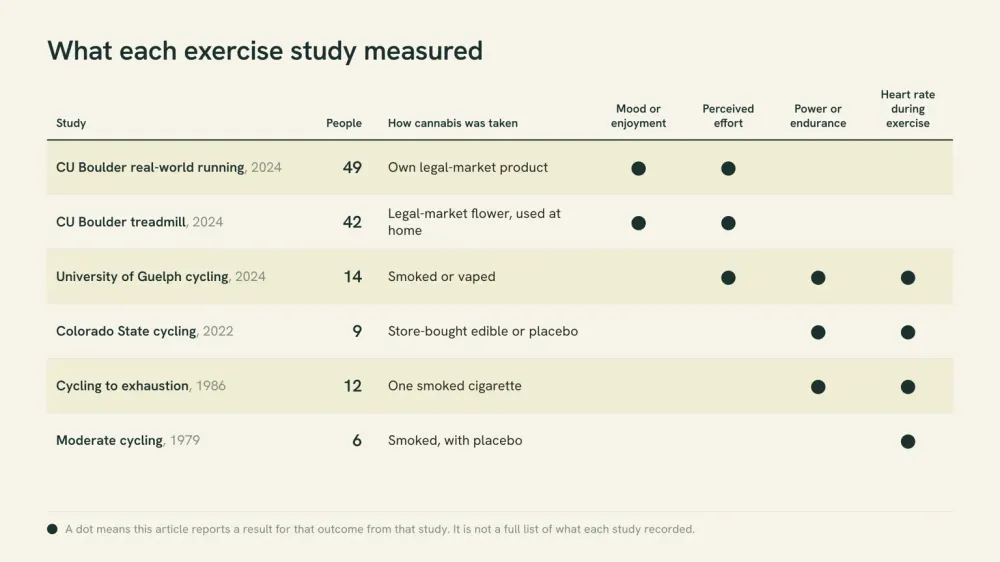
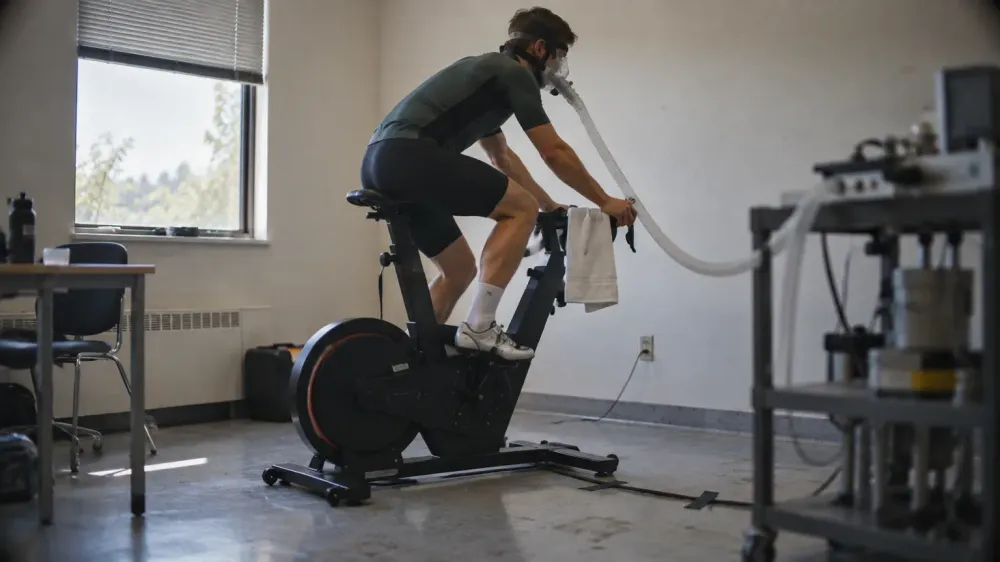
The mood studies did not test performance, so for that you have to go to the cycling labs. A 2024 crossover study at the University of Guelph, published in the Journal of Applied Physiology, had 14 participants (9 men, 5 women) ride a maximal-effort 20-minute time trial under four conditions: after smoking THC-predominant cannabis, after vaping it, after vaping CBD-predominant cannabis, and with nothing. Average power was significantly lower in both THC conditions than in the control or CBD condition. Oxygen uptake and perceived exertion at maximal effort were similar across conditions, so riders did not rate the effort as harder; they produced less power. Whether the THC cannabis was smoked or vaped made little difference. The limits are real: 14 people, a semi-randomized order, and an abstract that does not report the participants' cannabis history, the THC percentages or the size of the power drop, so we do not print a number for it.
Edibles are far less studied. In a 2022 Colorado State University study, nine fit, regular cannabis users ate a store-bought 10 mg THC edible or a placebo fruit snack before cycling tests: graded stages with heart rate recorded, then a 20-minute power test and a sprint. Twenty-minute power and sprint power did not change, and the authors described the edible as neither ergogenic nor ergolytic, meaning it neither helped nor hurt measurable output. Hold that result loosely. Eight of the nine were men, every participant correctly identified which snack was the edible, and the authors calculate that detecting a difference as small as the one they saw would take about 162 people. The 10 mg is a design fact about one study, not a guide to anything.
The older work lines up with Guelph. In a 1986 study in Medicine and Science in Sports and Exercise, 12 healthy young adults rode a bike to exhaustion with and without first smoking a 1.7% THC cigarette. After smoking, the test ended about a minute sooner on average, 15.1 minutes instead of 16.1. One cigarette smoked in a 1986 lab is a limited guide to what people use today, which is why the newer trials matter.
| Study | Who | Cannabis | Task | Performance result | Main limit |
|---|---|---|---|---|---|
| University of Guelph, 2024 | 14 participants (9 men, 5 women) | Smoked THC-predominant, vaped THC-predominant, vaped CBD-predominant, or none | Maximal-effort 20-minute cycling time trial | Average power significantly lower after both THC conditions than after control or CBD | Semi-randomized; abstract gives no cannabis history, THC percentages or size of the drop |
| Colorado State University, 2022 | 9 fit regular users (8 men, 1 woman) | Store-bought 10 mg THC edible or placebo snack | Graded cycling, 20-minute power test, sprint | No significant change in 20-minute or sprint power | Every participant identified the edible; small sample |
| Renaud and Cormier, 1986 | 12 healthy young adults | One smoked cigarette, 1.7% THC | Progressive cycling to exhaustion | Test ended about 1 minute sooner (16.1 to 15.1 minutes) | 1986; one low-potency cigarette; small |
| Kennedy systematic review, 2017 | 15 published studies | Mostly older studies of smoked cannabis | Aerobic and strength protocols | None showed better aerobic performance; strength probably reduced | Old, small studies; single author |
What the reviews concluded
A 2017 systematic review in the Journal of Science and Medicine in Sport found only 15 published studies that paired THC with a formal exercise protocol. None showed better aerobic performance, strength was probably reduced, and some participants could not finish the exercise protocol because of adverse reactions. Its conclusion was that THC does not enhance aerobic exercise or strength. A 2021 systematic and umbrella review, built from 8 original studies and 10 earlier reviews found in a search run in September 2019, went further and called cannabis before exercise ergolytic, meaning performance-lowering. It described a reduced ability to sustain effort and lower work capacity, higher heart rate, breathing rate and oxygen demand on the heart, and more postural sway, a measure of balance. Its authors concluded that "cannabis consumption prior to exercise should be avoided in order to maximize performance in sports." Both reviews rest mostly on small, older studies of smoked cannabis, and the 2021 review's search predates the Guelph and Colorado State trials. Those newer trials did not overturn it: one found less power, the other found no change.
Two other reviews were more cautious about what the evidence can settle. A 2018 systematic review in the Clinical Journal of Sport Medicine found three trials that met its criteria and concluded that, because the number and quality of studies was low, the effects on athletic performance remain unclear. A 2021 review in Sports Medicine, co-written by two of the Guelph time-trial authors, described whole cannabis and THC as generally showing null or detrimental effects on strength and aerobic exercise; of its five authors, one reports funding from Naturecan and the other four declare no relevant conflicts. None of the four reviews concluded that cannabis improves exercise performance.
Heart rate: the signal that keeps showing up
Heart rate is the result that recurs across the exercise studies, and it has been measured, not just reasoned about. In a small 1979 double-blind study of six men who used cannabis chronically, heart rate after smoking cannabis averaged 34% higher than control at rest, 18% higher during 15 minutes of moderate cycling, and up to 50% higher during recovery, while placebo cannabis had no effect. In the 1986 study, heart rate before the ride rose from about 94 to about 119 beats a minute after smoking and stayed higher up to 80% of maximum effort. In the 2024 Guelph trial, heart rate during submaximal cycling was higher after both smoked and vaped THC cannabis than after control or vaped CBD-predominant cannabis. All three are studies of inhaled cannabis.
The edible study is the exception, and it is not a reassuring one. Heart rate during its graded cycling stages was not significantly different after the edible, but in a sample of nine, "not significant" is not the same as "no effect". Outside exercise, our report on a 2026 randomized crossover trial covers 18 healthy adults whose heart rate rose after oral THC, with and without CBD, in a study built around a breathing-resistance task rather than exercise. For what CBD on its own does and does not do to a pulse, our review of the CBD and heart rate evidence holds the details. Exercise raises heart rate by design, so working out high adds a second heart-rate load on top of the first, and the inhaled studies above are measurements of exactly that.
The group this matters most for is people with heart disease, and the evidence there is old but hard to ignore. In a 1975 study of ten patients with angina, which is chest pain caused by reduced blood flow to the heart, one cannabis cigarette cut the exercise time before chest pain arrived by half. It is a small, decades-old study, and it tested people who already had heart disease, which is exactly why it matters for anyone in that group.
Smoked, vaped or eaten: the route changes the question
Route matters for two reasons. In the Guelph trial, THC cannabis changed the exercise response largely independently of whether it was smoked or vaped, so swapping one inhaled method for another did not change the performance picture. Eating THC is a different exposure: it passes through the liver before reaching the rest of the body, and the liver converts part of it into 11-hydroxy-THC, so the blood carries a different mix of THC and metabolite. Our explainer on 11-hydroxy-THC and how the route changes that mix walks through the numbers. This page does not give a waiting time between using cannabis and exercising, because no study here tested one, and a time window would amount to dosing advice.
Exercise does not appear to clear THC from the blood, either. In a 2013 study of 14 regular cannabis users, plasma THC went up slightly, not down, after 35 minutes of stationary cycling, and the rise tracked body mass index, which the authors suggest reflects THC released from fat stores. The 2017 review describes these exercise-related rises as very small, under 1 ng/mL. Neither measured impairment, so the finding does not mean a workout makes anyone higher, and it gives no support to the idea that a workout sobers you up.
The CBD-dominant results are not a CBD recommendation
Two studies included a CBD-heavy condition, and it is easy to read too much into both. In the treadmill study, the enjoyment gap was bigger and the exertion gap smaller in people assigned the CBD-dominant flower (both p=0.02). That product was cannabis flower bought at a dispensary, not a CBD oil, and the abstract does not report how much THC it contained. In the Guelph trial, vaped cannabis described as devoid of THC and primarily containing CBD had little physiological effect on the exercise response or on performance. Neither result shows that CBD improves a workout, and neither tested a CBD isolate or oil. Trials that gave CBD on its own around exercise are a separate body of work, reviewed in our recovery guide linked at the end of this page. Whether the body's own endocannabinoids drive the runner's high is a separate and still unsettled question, and our guide to the endocannabinoid system covers what has been measured.
When the lab evidence does not apply to you
The modern studies above describe mostly young adults running or cycling, in a lab or in their own everyday setting. If any of the following is true for you, they describe someone else.
- You compete in a sport that drug-tests. Anti-doping and league rules are a separate question that no workout study answers.
- You have a heart condition or high blood pressure, or you have ever had chest pain with exertion. In a 1975 study of patients with angina, chest pain arrived in half the usual time after smoking cannabis.
- You take prescription medication. That is a question for your pharmacist or prescriber, and none of these studies was designed to answer it.
- Your training depends on balance or heavy loads. Reviews report more postural sway and probably reduced strength, and no study we found tested heavy lifting after cannabis.
- You run or ride near traffic, or drive to and from the gym. Feeling fine is not a measurement of impairment.
- You do not use cannabis regularly. Both CU Boulder studies and the edible study enrolled cannabis users, so they do not describe a first or occasional experience.
- You are under 21. Adult-use cannabis laws in US states apply to adults 21 and older, and both CU Boulder studies enrolled only adults 21 and up.
Three of those deserve a pointer. Competitive sport has its own rulebook, and our guide to cannabinoids and sports drug rules keeps anti-doping and league policies in one place; a workout study cannot tell you how a test will go. Roads are the second: our page on cannabinoids, impairment and driving explains why feeling fine does not settle what a test or a per se law will say. The third is your heart. The American Heart Association's 2020 scientific statement on cannabis concluded that few of its possible benefits are cardiovascular, while many of its concerning health implications involve cardiovascular disease, possibly depending on how it is taken.
What has not been measured yet
Here is the honest edge of the evidence, as of our PubMed searches on September 13, 2026. We found no trial that tested exercise after cannabis in people with heart disease using today's products; the heart-patient studies we found date from the 1970s and involved smoked cannabis. We found no controlled study of heavy weight training, contact sport or exercise in heat after cannabis, no placebo-controlled trial of legal-market products and running, and no study of what repeated workouts after cannabis do over months. Women are underrepresented: 8 of the 9 people in the edible study were men, and 61.5% of the real-world runners were men. Older adults are barely studied here at all. A 2026 observational study of 234 adults aged 60 and older linked higher blood THC after an edible to a larger heart-rate rise, but it measured people sitting down, not exercising, and its authors note that causal conclusions cannot be made.
The research does not give a single yes or no for everyone, and this page does not give you one. What it shows: cannabis users rated runs more enjoyable; THC cannabis that was smoked or vaped lowered cycling power and raised heart rate during exercise; none of the performance studies here found better performance; and in a 1975 study, people with angina reached chest pain in half the usual time after smoking cannabis. If you have a heart condition, compete in a tested sport, train with heavy loads or exercise near traffic, the checklist above explains why the lab results do not transfer to you.
Not in the studies that measured it. In the CU Boulder treadmill study, 42 regular users running at the same moderate pace on both visits rated the cannabis session as more effortful (p=0.04), even though they also found it more enjoyable. In the real-world study of 49 runners, perceived effort did not differ (p=0.33), and runners were about 31 seconds per mile slower on the cannabis run, a gap the authors report was not statistically significant (p=0.12). More fun and easier are not the same thing.
None of the studies we reviewed found an improvement. A 2017 systematic review found 15 studies pairing THC with an exercise protocol, and none showed better aerobic performance. In a 2024 trial, 14 participants produced significantly less average power in a 20-minute cycling time trial after smoked or vaped THC cannabis. In a 2022 trial, a THC edible produced no measurable change in 9 fit regular users. A 2021 umbrella review described cannabis before exercise as ergolytic, meaning performance-lowering.
Nothing in these studies shows that exercise clears THC's effects faster. A 2013 study of 14 regular users found plasma THC went up slightly, not down, after 35 minutes of cycling, and a 2017 review described exercise-related rises as very small, under 1 ng/mL. Neither study measured impairment, so neither can tell you whether you are impaired. Feeling clearer after a workout is not a test.
The two studies with a CBD-heavy condition did not test CBD on its own. In the treadmill study, people assigned CBD-dominant flower had a bigger enjoyment gap and a smaller exertion gap than people assigned THC-dominant flower, but the abstract does not report how much THC that flower contained. In the Guelph cycling trial, vaped CBD-predominant cannabis had little effect on the exercise response or performance, while the THC conditions lowered power. Neither result is a reason to use CBD before exercise. Trials of CBD alone are reviewed in our CBD for recovery guide.
A workout is not a way to change a test result. The 2017 review found exercise raised blood THC only very slightly, and a 2013 study found it went up rather than down. Anti-doping bodies and sports leagues set their own rules and thresholds, which our CBD in sports guide covers, and no product or routine can guarantee a drug-test result.
These studies do not give a single risk number, but the heart-rate signal recurs. Heart rate was higher before or during exercise after smoked cannabis in studies from 1979 and 1986, and after smoked or vaped THC cannabis in a 2024 trial. The American Heart Association's 2020 statement concluded that few of cannabis's possible benefits are cardiovascular, while many of its concerning health implications involve cardiovascular disease, and in a 1975 study people with angina reached chest pain in half the usual time. Chest pain or pressure, fainting, or a racing or irregular heartbeat during exercise means stop and get emergency care.
If what you really want is evidence on training and recovery without THC in the picture, the next page to read is our review of the human trials on CBD and exercise recovery. It covers the CBD-only exercise studies, the difference between soreness and recovery, and what those trials did and did not show.
Writing about hemp, wellness and the small rituals that keep us balanced.