Does Weed Kill Gains? The Evidence, Question by Question
We could not find a controlled study that settles whether weed kills gains, so this page grades what has been measured instead: testosterone, whether hormones predict gains, next-day strength, sleep, the munchies and hemp protein.
Does weed kill gains? The honest answer starts with an admission: we could not find a single controlled study that gave people THC during a training program and then measured whether their muscles grew. So the question splits into smaller ones that researchers have actually measured: testosterone, whether hormone differences predict gains, strength the day after, sleep and appetite. Each one has a different quality of answer, and this page grades them one at a time.
The short version is in the box below, and the detail, study by study, follows it. This page is written for adults 21 and over, and it is an evidence review, not training or medical advice: it gives no dose and no timing rule. One disclosure before the evidence: Planntz sells a tablet that contains delta-9 THC, and nothing on this page is a suggestion to use it, or any cannabis product, around training.
Does weed kill gains? What has actually been measured
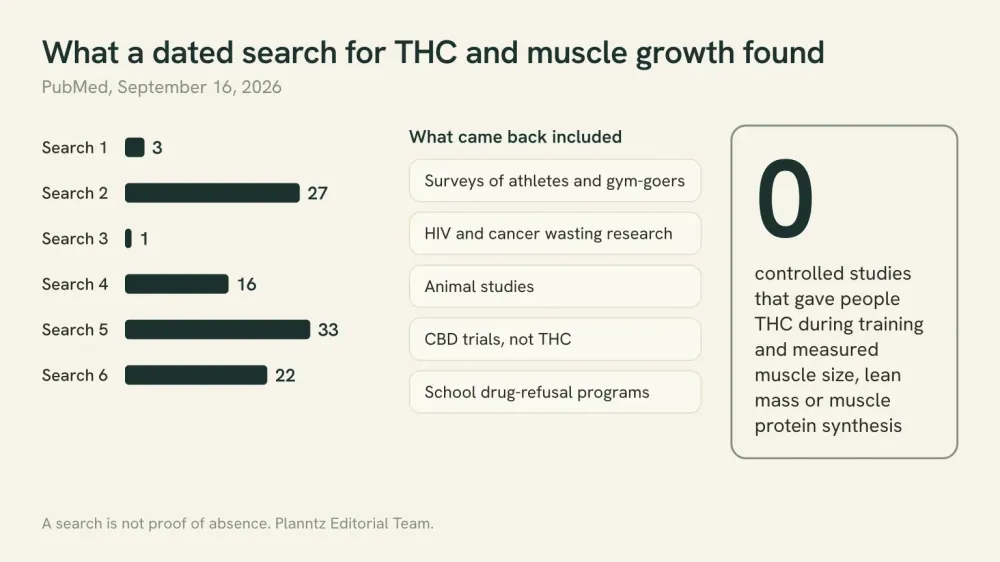
Start with the study that would settle the question: adults assigned to THC or a placebo, training for several months, with muscle size or lean mass measured before and after. When we searched PubMed on September 16, 2026, we did not find a single controlled study that gave people THC or cannabis during a training program and then measured muscle size, lean mass or muscle protein synthesis. We ran six searches, which returned 3, 27, 1, 16, 33 and 22 records, and we read every title. What came back included surveys of athletes and gym-goers, research on HIV and cancer wasting, animal studies, trials of CBD rather than THC, and six school programs in which "resistance training" meant teaching students to refuse drugs. A search is not proof that no such study exists, and PubMed is one index. But the gap is real enough that anyone telling you weed definitely does, or definitely does not, kill gains is going past the data.
Reviews run into the same wall. A 2024 umbrella review of performance-enhancing drugs, which gathered systematic reviews on steroids, growth hormone, creatine, EPO and cannabis, found enough evidence to rate cannabis on performance (no benefit, and possibly more weakness) but not enough to say anything about body mass or recovery. The closest thing to muscle data in users comes from snapshots rather than experiments. Two small studies from the University of Northern Colorado compared physically active cannabis users with non-users at a single point in time and found no difference in body composition. In the 2023 study of 24 female athletes, strength did not differ either, but users produced less power early in a 30-second sprint test; the earlier 2020 study enrolled 30 men and women. Studies that size cannot rule a small effect in or out. And a 2025 University of Texas at Dallas study even found cannabis users scoring higher on grip strength than non-users, a gap its authors attributed to unusually low scores in their non-using comparison group.
| The question | Best evidence we found | What it shows | What it cannot tell you |
|---|---|---|---|
| Does THC change muscle growth over a training program? | None: no controlled study found in a dated PubMed search | Unmeasured | Anything about gains, in either direction |
| Do users carry less muscle than non-users? | Two small snapshot studies of active adults (30 and 24 people) | No difference in body composition | Cause, or a small effect |
| Does cannabis lower testosterone? | Population surveys, a meta-analysis, a genetic analysis, insurance records and cell work | The studies disagree; several found users the same or higher | Dose, timing, or what years of heavy use do |
| Would a hormone difference change gains? | 12-week training studies in 49 and 56 young men, no cannabis | Normal hormone variation did not predict gains | What happens in men with clinically low testosterone |
| Is strength lower the next day? | One non-randomized study of 28 adults, handgrip and balance | Peak grip unchanged; slower force development at 6 and 12 hours | Anything about lifting, training or muscle size |
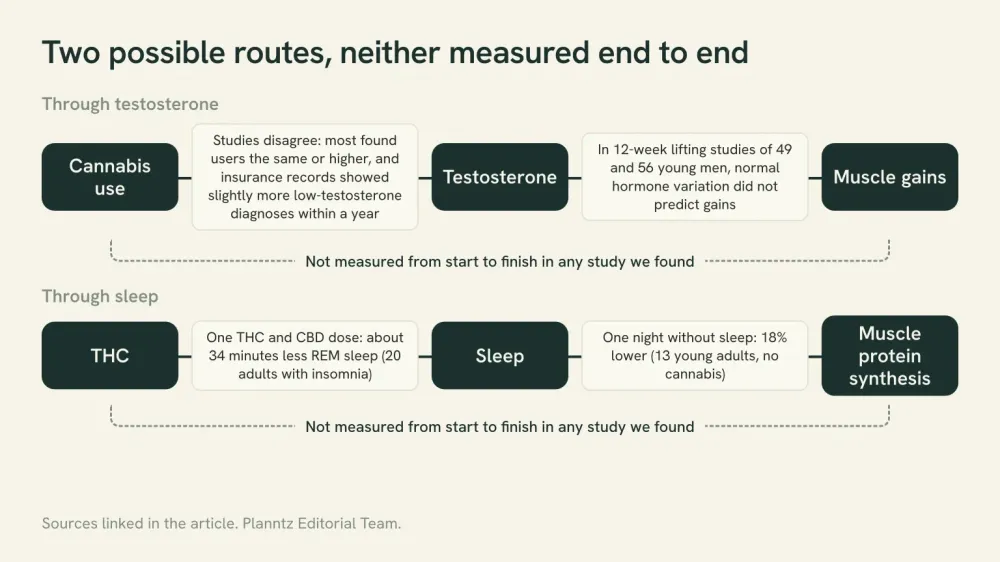
| Could sleep be the link? | Sleep-loss studies without cannabis, plus separate THC sleep studies | Sleep loss slows muscle protein synthesis; THC's effects on sleep are mixed | Whether THC slows muscle building through sleep |
| Do the munchies help you bulk? | One residential lab study of 6 men, 1988 | About 40% more calories, mostly from sweet snacks | Protein intake or body composition |
Does smoking weed lower testosterone?
This is where most pages make their boldest claim, usually without a source. The human studies use very different designs, and they do not point the same way. In US government survey data on 1,577 men, testosterone was the same in men who had ever used marijuana and men who never had (3.69 vs 3.70 ng/mL), and it ran higher, not lower, in men who had used more recently. A 2015 study of 1,215 Danish men aged 18 to 28 found marijuana smokers had higher testosterone, within the same range as cigarette smokers. A 2021 meta-analysis pooling hormone data on 4,787 men found no significant testosterone difference between cannabis users and non-users, and its authors say plainly that the studies are too limited and mixed to exclude an effect. The Danish study's sperm findings are a separate question, and our page on what has and has not been measured about cannabinoids and fertility covers them.
A Swiss research group that profiled 70 steroid hormones in 47 young men who used cannabis and 47 who did not found testosterone, DHT and androstenedione higher in the users, with use confirmed by THC biomarkers as well as by what the men reported. The same Swiss group then put THC on hormone-producing cells in a dish to see whether it could explain the higher testosterone, and in the dish THC lowered androgen production. Their own conclusion is that THC directly stimulating testosterone is not the explanation. Read those two papers as one research programme, not as two independent results: the hormone profiling used serum samples from the group's earlier study, and the cell work used a cancer cell line, not people. The same group also notes that the only paper they cite as reporting a significant testosterone drop in cannabis users dates back to 1974, compared 20 users with 20 controls, and lacked control for key confounding factors.
Two newer designs try to get around the problem that people who use cannabis differ from people who do not in many other ways. A 2024 genetic analysis, which uses inherited variants linked to cannabis use as a stand-in for a randomized trial (a method called Mendelian randomization), found no evidence that cannabis use causally changes bioavailable testosterone, estradiol, FSH or LH. That design has its own assumptions, and it cannot see dose or timing. A 2025 analysis of US health-insurance records compared about 29,000 men with a diagnosis of cannabis abuse or dependence with matched men without one. Testosterone-deficiency diagnoses were more common between three months and a year later (0.2% vs 0.1%), but not at three to five years, and the difference was not significant in men under 40. Those men had a dependence diagnosis, which is not the same as occasional use, and diagnosis codes are a rough stand-in for measured hormones. Finally, the Association of Ringside Physicians, in a 2024 position statement on combat sports, says chronic use can reduce testosterone, which is a reasonable caution from clinicians and also sits awkwardly next to the population data above.
| Study | Design | Who | Direction | Main limit |
|---|---|---|---|---|
| Thistle and colleagues, 2017 | US national survey (NHANES) | 1,577 men | No difference ever vs never; higher with more recent use | Self-reported use; one blood draw |
| Gundersen and colleagues, 2015 | Cross-sectional | 1,215 Danish men aged 18 to 28 | Higher in marijuana smokers | Self-reported use; a snapshot in time |
| Belladelli and colleagues, 2021 | Meta-analysis of 9 studies | 4,787 men with hormone data | No significant difference | Limited, mixed studies; authors cannot exclude an effect |
| Galmiche and colleagues, 2026 | Cross-sectional, 70 steroid hormones | 47 young Swiss men who used cannabis, 47 who did not | Testosterone, DHT and androstenedione higher in users | Single time point; same research programme as the cell study |
| Zhang and colleagues, 2024 | Mendelian randomization (genetic) | Genetic summary data, replicated in FinnGen and UK Biobank | No causal effect on bioavailable testosterone | Relies on the method's assumptions; cannot see dose or timing |
| Davis and colleagues, 2025 | Matched insurance records | About 29,000 men per group, with or without a cannabis abuse or dependence diagnosis | More low-testosterone diagnoses at 3 months to 1 year (0.2% vs 0.1%); not at 3 to 5 years; not significant in men under 40 | Diagnosis codes; dependence, not casual use |
| Zufferey and colleagues, 2026 | Cell culture | Human adrenal cancer cells in a dish | THC and CBD lowered androgen production | Cells, not people, and not testis tissue |
| Association of Ringside Physicians, 2024 | Position statement | Expert consensus | States chronic use can reduce testosterone | Opinion, not new data |
“However, we cannot exclude an effect of cannabis because of the limited and heterogeneous studies.”
So does smoking weed lower testosterone? On the human evidence gathered here, that has not been shown. Population studies found users the same or higher, a meta-analysis found no significant difference, a genetic analysis found no causal effect, and the one signal of more low-testosterone diagnoses was small, short-lived and not significant in men under 40. That is not proof of no effect either. Each design has a blind spot, and the population studies here rest on a single blood sample per person, which cannot capture how hormones move through the day or across months of use.
Would a testosterone difference even show up in your gains?
Suppose a real difference did exist. Would you see it in your training log? Research on lifters suggests that ordinary hormone variation is a weaker lever than a lot of gym advice assumes. At McMaster University, 49 trained young men lifted for 12 weeks while researchers measured their hormones and their muscle. How much testosterone and growth hormone rose after a session did not predict who gained the most strength or size. A follow-up analysis on the same men looked at resting hormone levels too. None consistently predicted gains; the amount of androgen receptor inside the muscle did. An earlier study of 56 young men found the same pattern over 12 weeks: post-exercise free testosterone, growth hormone and IGF-1 did not track gains in lean mass or leg-press strength.
That does not mean testosterone is irrelevant to muscle. The effect that is beyond dispute comes from injected, far-above-normal amounts: in a 1996 trial (Bhasin and colleagues, New England Journal of Medicine, doi:10.1056/NEJM199607043350101), men given high-dose weekly testosterone injections as part of the trial gained about 6 kg of fat-free mass in 10 weeks of training. The differences reported in the cannabis studies are nowhere near that scale, and the McMaster findings apply to young men whose levels sat in the normal range. Clinically low testosterone is a different situation. If you think it applies to you, that is a question for a clinician with a blood test, not a guess from an article.
What about strength the next day?
What happens if you train while high is a separate question, and our review of working out high covers those acute studies, including heart rate and cycling power. The next-day question is newer. In a 2026 Memorial University of Newfoundland study, 15 frequent users, meaning people who had used cannabis at least three times a week for six months, smoked one pre-roll and were compared with 13 people who did not smoke. Everyone did handgrip, balance and reaction-time tests before, then at 1, 6 and 12 hours. Their maximum grip strength did not change at any point, and neither did muscle activity at peak force.
What did change was more subtle. Rate of force development, meaning how quickly you can build force in the first fraction of a second, was slower at 6 and 12 hours in all four of the time windows measured, and in the longest window it was actually faster at 1 hour before dropping. At 12 hours, the smokers held a grip at 40% of their maximum for about 27 seconds less than the non-smokers. By then their self-rated high, marked on a line scored from 0 to 100, averaged 2.8, down from 53 at 1 hour and no longer significantly different from before they smoked. Force at that moderate grip was also less steady at 1 and 6 hours, one of four balance tests was shorter at 1, 6 and 12 hours, heart rate was higher at 1 and 6 hours, and reaction time did not change. Blood THC was no longer significantly different from baseline by 6 hours.
The limits matter as much as the findings. The groups were not randomized: they were formed by use history, and the authors flag the difference in cannabis use between the groups as a limitation. The tests were a hand dynamometer and a balance stand rather than a barbell, only 28 people took part, one product and one route were used, and part of the funding came from the company that supplied the cannabis. It is a signal about neuromuscular speed and endurance in frequent users. It is not a measurement of anyone's training or gains, and it does not tell you how long to wait before a session.
Sleep: the most plausible link, and still untested with cannabis
Sleep is where the cannabis question and the muscle question actually meet. In a 2021 crossover study of 13 young adults, one night without any sleep cut muscle protein synthesis the next afternoon by 18% and testosterone by 24%, while cortisol rose 21%. That was a whole night of no sleep, not a shorter night, and nobody in it used cannabis. Partial sleep loss points the same way. Across five nights of four hours in bed, 24 young men in a 2020 Australian study built new muscle protein more slowly than men sleeping eight hours, unless they also did interval training. Again, no cannabis was involved.
What THC does to sleep is its own evidence base, and it is mixed. In a small pilot trial of 20 adults with insomnia disorder, one oral THC-and-CBD dose cut REM sleep by about 34 minutes and total sleep by about 25 minutes against placebo, and it did not help them fall asleep faster. Those were people with a sleep disorder, not healthy lifters, on one night. Sleep also got worse after heavy users stopped: in an inpatient study of 18 heavy users who had reported sleep problems during earlier attempts to stop, total sleep, sleep efficiency and REM sleep all declined across the first 13 nights without cannabis. Our guide to what THC does to your sleep stages separates a single night, nightly use and stopping, and our page on tolerance breaks and what the brain-scan studies show covers pausing regular use. Put the two bodies of research side by side and you have a plausible route, not a result. No study we found measured sleep and muscle protein synthesis in people using cannabis, so "THC cuts REM sleep, therefore THC cuts muscle growth" is a guess dressed as a fact.
Do the munchies help you bulk?
The bulking argument goes like this: weed makes you hungry, and you need a calorie surplus to grow. A lab study that actually counted what people ate says the extra calories went somewhere else. In a 1988 Johns Hopkins study, six men living in a residential lab ate about 40% more calories on days they smoked marijuana, and almost all of it came from extra snacks, mostly sweet ones like candy bars, rather than bigger meals. The munchies, in a setting where someone counted, added sweet snacks, not protein. Six men smoking lab cigarettes in the 1980s is a thin base, and none of them were training, so treat this as a description of what the extra eating looked like, not a verdict on bulking. Our page on cannabinoids and appetite covers the THC and CBD appetite evidence in more depth.
Hemp protein is not weed
Search for hemp and resistance training and you will find trials that sound like they answer the weed question. They do not, because they tested food made from hemp seeds, not cannabinoids. The FDA puts it plainly on its own page about cannabis-derived products: "Hemp seeds are the seeds of the Cannabis sativa plant. The seeds of the plant do not naturally contain THC or CBD." The same paragraph adds the part most pages drop: the hemp seed ingredients the agency reviewed "contain only trace amounts of THC and CBD, which the seeds may pick up during harvesting and processing when they are in contact with other parts of the plant."
A 2024 Canadian trial gave trained adults 60 g a day of hemp powder, supplying 40 g of protein, or a soy powder matched for protein and calories, during eight weeks of lifting. Muscle thickness at the upper arm rose with hemp in the women and with soy in the men, and the trial's registry record describes it as a study of hemp protein supplementation. That is a protein-powder comparison. It tells you nothing about smoking weed. Similarly, an Iranian trial of 48 sedentary men found testosterone rose over eight weeks of interval training whether they took 2 g a day of hemp seed powder or a placebo. The training did it. If you want the chemistry behind why seed products and cannabinoid extracts are different things, our comparison of hemp seed oil and CBD oil lays it out.
Does weed help recovery?
Plenty of people who lift and use cannabis believe it helps. In a 2023 Kent State survey of 111 people who both exercise and use cannabis, 87% said THC helped their recovery, and 93% said the same about CBD. That is what users believe, measured once in a self-selected group, and the authors themselves say more data are needed. The 2024 umbrella review, looking at the controlled evidence, found too little to judge cannabis and recovery at all. A belief that common is worth taking seriously as a research question, but it is not an answer. The CBD side has actual trials with soreness and strength outcomes, and their results are null or mixed; our review of what human studies measure on CBD and exercise recovery walks through them.
What you can actually track
None of this gives you a rule, but it does tell you where to look if you already use cannabis and want an honest picture of how your training is going. These are observations, not a test of cannabis, and one person's log cannot prove cause any better than a snapshot study can.
- Keep a training log with your top sets, reps and loads, and judge progress over 8 to 12 weeks, the length of the training studies above, rather than session by session.
- Note how long you actually slept and how rested you feel on waking. Sleep loss is the one route on this page with measured effects on muscle protein building.
- Look at where your calories come from, not just how many. The extra eating in the 1988 lab study was snacks, not meals with protein.
- Pay attention to fast, explosive work and long holds, not only your heaviest single lift. Speed of force and endurance holds changed in the 2026 grip study while maximum grip did not.
- If you compete in a tested sport, check your governing body's cannabis rules before anything else.
- If you notice you are using more than you intended, or cannot cut back, treat that as the observation that matters most.
For tested athletes, our guide to what WADA, USADA and the NCAA actually say covers the THC thresholds and why, under strict liability, what is in the sample is what counts, not when or why you used.
What is still unknown
Here is the edge of the evidence as of our reading on September 16, 2026. The headline question is open, for the reason the first section set out. Dose, route and frequency are unmapped: smoking, vaping and edibles have not been compared for any training outcome that we found. The human testosterone studies in the table are all in men, and women are underrepresented in the muscle and performance studies on this page, which, apart from the all-female 2023 Northern Colorado study, enrolled men only or a mix. The population hormone data mostly rest on one blood sample per person. The next-day data come from one non-randomized study of grip and balance, not lifting. And the sleep route, while plausible, has not been measured end to end in people who use cannabis.
Questions people ask about weed and gains
Nobody can say from direct evidence yet, as far as we could find. When we searched PubMed on September 16, 2026, we did not find a controlled study that gave people THC during a training program and measured muscle size, lean mass or muscle protein synthesis. The nearby evidence is mixed: testosterone studies disagree, one small study found slower force development up to 12 hours after smoking with maximum grip unchanged, and sleep loss slows muscle protein synthesis in studies that did not involve cannabis. That is not the same as saying weed has no effect on gains.
The human studies do not show a consistent drop. US survey data on 1,577 men and a study of 1,215 Danish men found users the same or higher, a Swiss study found higher androgens in users, and a 2021 meta-analysis of 4,787 men found no significant difference. A genetic analysis found no causal effect on bioavailable testosterone. Insurance records linked a cannabis abuse or dependence diagnosis to slightly more low-testosterone diagnoses within a year (0.2% vs 0.1%), but not later, and not significantly in men under 40. If you have symptoms such as low sex drive or unusual fatigue, a clinician can check with a blood test.
It has not been measured. We found no study comparing muscle growth in people who used cannabis after training with people who did not, and there is no evidence-based waiting period. The most plausible route is sleep: one night without sleep cut next-day muscle protein synthesis by 18% in a 2021 study, and five nights of four hours in bed slowed it in a 2020 study, but neither involved cannabis. What THC does to sleep is itself mixed, and it differs between one night, nightly use and stopping.
Many users think so: in a 2023 survey of 111 people who exercise and use cannabis, 87% said THC helped their recovery. But that is belief, not a measured outcome, and a 2024 umbrella review of performance-enhancing drugs found the evidence on cannabis and recovery insufficient to judge. Trials of CBD with soreness and strength outcomes exist, and their results are null or mixed.
Not in the way the idea suggests. In a 1988 Johns Hopkins residential lab study, six men ate about 40% more calories on days they smoked marijuana, but almost all of the extra came from snacks, mostly sweet ones, rather than bigger meals. The study was tiny and old, and the men were not training, but the extra calories it counted came mostly from sweet snacks, not protein-rich meals.
No. The FDA states that hemp seeds do not naturally contain THC or CBD, and that hemp seed ingredients carry only trace amounts picked up during harvesting and processing. The hemp training trials tested food: a 2024 trial compared 60 g a day of hemp protein powder with soy protein during eight weeks of lifting, and a 2024 Iranian trial found testosterone rose with interval training whether or not the men took hemp seed powder. Neither tells you anything about THC.
Daily use has not been studied against training outcomes, so there is no evidence-based answer either way. What has been measured is narrower. Frequent users in a 2026 study showed slower force development and a shorter grip hold up to 12 hours after smoking, and heavy users who stopped slept worse across 13 nights in an inpatient sleep study. If you find you cannot cut back, or you are using more than you mean to, that is worth raising with a clinician.
If your real question is what happens when you train while high, rather than what happens over months of training, the next page to read is our review of what working out high does to enjoyment, heart rate and performance. It covers the acute exercise studies this page only points to.
Writing about hemp, wellness and the small rituals that keep us balanced.