How to Cut Back on Weed: What the Lower-Risk Guidelines Say
Cutting back is a different goal from quitting. Here is what the 2022 Lower-Risk Cannabis Use Guidelines recommend, how to count what you use in milligrams, the four levers that matter, what stepping down can feel like, and when to get help.

If you use THC most days and want to cut back on weed without stopping, that is a legitimate goal, and the main public-health guidelines for adults who use cannabis are built around it. The short version: count what you use in milligrams, not hits. Change one thing at a time: how often, how strong, how you take it, or when. Know that a big step down from heavy daily use can bring withdrawal-type symptoms for a while. And if your own attempts keep failing, that is the signal to get help.
Most advice on how to smoke less weed stops at "use less" without saying less of what, or how you would know. This guide fills that gap with the one instrument written for exactly this job, the Lower-Risk Cannabis Use Guidelines, plus a simple way to count your own use and an honest label on every habit showing how much evidence stands behind it. It is not a quit program and it does not hand you a target number. It is written for adults who use cannabis non-medically. If you use cannabis for a medical reason, plan any change with your clinician.
Cutting back, a tolerance break and quitting are different goals
These three get blurred together, but they ask different things of you. A tolerance break is a pause: you stop for a set stretch, often so your response to THC can reset, and then decide what comes next. Our guide to taking a tolerance break covers the pause and the biology behind it. Quitting means stopping with no plan to return. Cutting back, the subject of this page, means you keep using but use less, less often, or in a lower-risk way. It also helps to be clear about which compound you are counting. THC is the intoxicating cannabinoid in cannabis and CBD is not, a difference laid out in our explainer on what CBD is and how it differs from THC. Everything below is about THC.
| Goal | What changes | Where it is covered |
|---|---|---|
| Cutting back | You keep using, but less often, at lower potency, by a lower-risk route or at better times | This page |
| Tolerance break | You stop completely for a set period, then reassess | Our tolerance break guide |
| Quitting | You stop with no plan to resume | A clinician or the SAMHSA National Helpline can help you plan it |
What the Lower-Risk Cannabis Use Guidelines actually say
The Lower-Risk Cannabis Use Guidelines (LRCUG) are the closest thing to an evidence-graded rulebook for adults who use cannabis non-medically. An international team of 11 researchers published the current version as a 2022 evidence and recommendations update in the International Journal of Drug Policy, replacing a 2017 edition in the American Journal of Public Health. The update has 12 recommendations and 3 general precautions, each graded for how strong the evidence behind it is, on a scale that runs Conclusive, Substantial, Moderate, Limited and None. "Substantial" means supportive findings from good-quality studies with few or no opposing findings. "Limited" means fair-quality studies or mixed findings that mostly point the same way. The authors excluded anyone who had taken cannabis-industry money in the previous two years. The guidelines start from a blunt premise:
“There is no universally safe level of cannabis use; thus, the only reliable way to avoid any risk for harm from using cannabis is to abstain.”
That is the honest frame for cutting back. It does not make any amount safe. But the same precaution goes on to say that "reducing relevant risk-factors can help reduce the likelihood of such harms", and it carries the top grade, Conclusive. The table below turns the recommendations that apply to an adult who already uses into plain language, with the grade as published. The guidelines call their readers PWUC, short for people who use cannabis.
| What the guideline recommends | Evidence grade | Go deeper |
|---|---|---|
| Frequency: avoid daily or near-daily use and binges. The guideline's own example of lower-risk use is "use only on 1 or 2 days per week, on weekends only" | Substantial (Rec 5) | The four levers, below |
| Potency: choose cannabis products with lower total THC or a high CBD-to-THC ratio, and pick products that tell you their potency. CBD does not cancel THC's harms | Substantial to Moderate (Rec 2) | Does THC percentage matter? |
| Route: avoid smoking. Vaping cuts toxins compared with smoking but may carry other contaminants; dabbing extracts can cause acute adverse effects; edibles can lead to over-consumption. No route is categorically safe | Substantial to Moderate (Rec 3) | Dry herb vaporizer vs smoking |
| Inhalation: avoid deep inhalation and long breath-holding | Limited (Rec 4) | Habits table, below |
| Products: where circumstances allow, use legal, quality-controlled products | Limited (Rec 6) | Count it first, below |
| Thinking feels foggy: consider pausing or substantially reducing frequency or potency | Limited (Rec 7) | FAQ, below |
| Driving: do not drive impaired. Inhaled use may impair driving skills for about 6-8 hours and edibles for 8-12 hours, but times vary | Substantial to Moderate (Rec 8) | CBD and driving |
| Pregnancy, trying to conceive or breastfeeding: abstain | Limited (Rec 9) | Cannabinoids, pregnancy and breastfeeding |
| Mixing with alcohol, tobacco, other drugs or medications: minimize it | Moderate to Limited (Rec 10) | Crossfaded |
| Higher-risk groups: a personal or family history of psychosis, mood or substance use disorders, heart risk, older age. Women may develop problems such as dependence faster | Moderate to Limited (Rec 11) | Talk to a clinician |
| Stacked risks: frequent, intensive use of high-potency products substantially increases risk | Substantial to Limited (Rec 12) | The four levers, below |
| Synthetic cannabinoids: avoid them | Limited (2017 Rec 4; outside the 2022 scope) | K2 vs weed |
Three rows deserve a direct word. If you are pregnant, trying to conceive or breastfeeding, the guidelines advise abstaining, and our page on cannabinoids during pregnancy and breastfeeding explains the evidence. Swapping some weed for alcohol is not the lower-risk move it can look like: Recommendation 10 says co-use "should be minimized", and our pieces on what happens when you mix alcohol and cannabis and the California sober approach cover why. And the synthetic-cannabinoid row comes from the 2017 edition, which told people to avoid these products outright because of "markedly more acute and severe adverse health effects", including deaths. The 2022 update left synthetics out of its scope rather than reversing that advice. Our comparison of K2 and natural cannabis has the detail.
If most of the table looks familiar but your habits do not match it, you are in the majority. In a 2018 survey of more than 27,000 people in Canada and the US, 88.8% of current cannabis consumers missed at least one guideline. The most common misses were smoking at least half of what they used (69.8%) and choosing high-THC products (44.9%), followed by daily or near-daily use (32.2%) and driving after use (26.1%); 5.9% reported using synthetic cannabis. Those answers were self-reported in an online panel. A 2026 analysis of survey answers from 27,236 students at four Canadian universities found a similar pattern in that group: choosing lower-strength products had the lowest adherence (29.0%), followed by not smoking (36.7%). In both surveys, potency and smoke were where the most room to change sat.
Count it first: turn what you use into milligrams
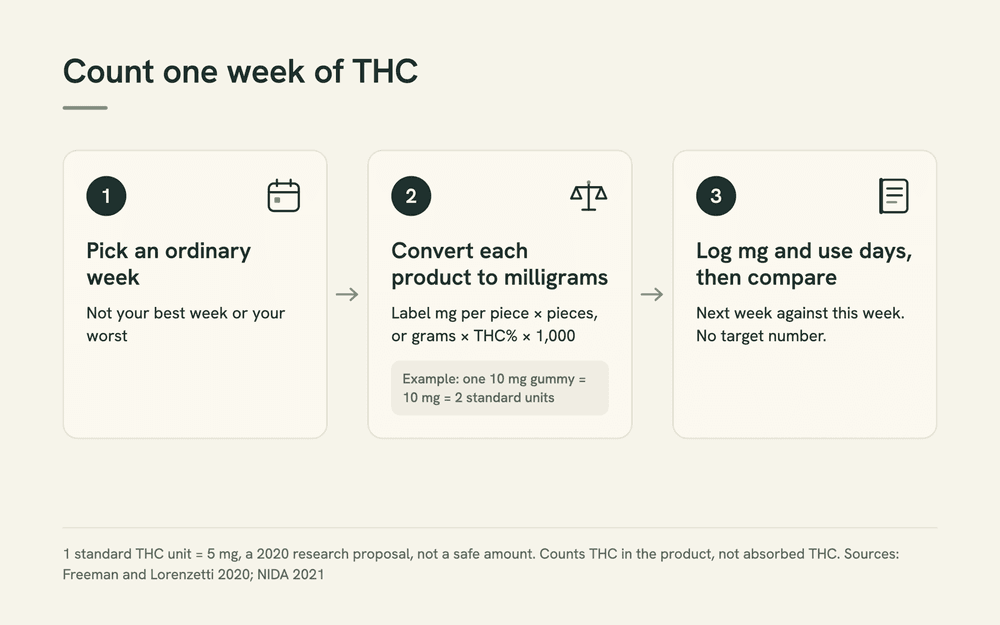
"Smoke less" fails as advice because nobody knows what less is measured in. Hits vary in size, joints vary in weight, and a gram of flower and a gram of cart oil hold very different amounts of THC. Milligrams of THC are the one unit that works across flower, vapes and edibles. In 2020, two researchers writing in the journal Addiction proposed a "standard THC unit" of 5 mg "for all cannabis products and methods of administration", and pointed out that the Lower-Risk Cannabis Use Guidelines "currently lack recommendations based on quantity of use". It is a proposal, not a regulation and not a safe amount. In 2021, NIDA adopted the 5 mg unit for reporting in the research it funds, and its FAQ is explicit that the unit does not "indicate safety or endorse any specific amount as advisable". By that count a 10 mg gummy is 2 standard THC units, the same math our breakdown of a 10 mg edible walks through.
Fill in the worksheet below for one ordinary week, not your best week or your worst. Flower labels in the US usually report total THC as a percentage, and our explainer on what THC percentage does and does not tell you explains how to read it. For flower, multiply grams by the THC percentage written as a decimal, then by 1,000. An eighth is 3.5 g (see how many grams are in an eighth), so an eighth at 20% total THC holds about 700 mg of THC in the product.
| What you use | How to get milligrams of THC | Example (illustrative only) | Standard THC units (5 mg) |
|---|---|---|---|
| Edible or gummy | mg of THC per piece on the label × pieces | One 10 mg gummy = 10 mg | 2 |
| Flower | grams × total THC% as a decimal × 1,000 | 0.5 g at 20% total THC = 100 mg in the flower | 20 in the product |
| Vape cart or concentrate | grams used × THC% as a decimal × 1,000; estimate grams from how many days a cart lasts | 1 g cart at 85% THC lasting 7 days = about 121 mg per day in the product | About 24 per day in the product |
| Your week | Add up a typical week, plus the number of days you used | Your own baseline, no example needed | No target number |
One honest caveat about the math. The totals describe the THC in the product, not what reaches your blood. A NIDA scientist's review of how the body handles THC put the systemic availability of smoked THC at roughly 8% to 24%, depending strongly on the person's experience, and oral bioavailability at 4% to 20%. That is why 20 units of flower are not 20 units in your body, and why you should not compare a flower number with a gummy number as if they were the same dose.
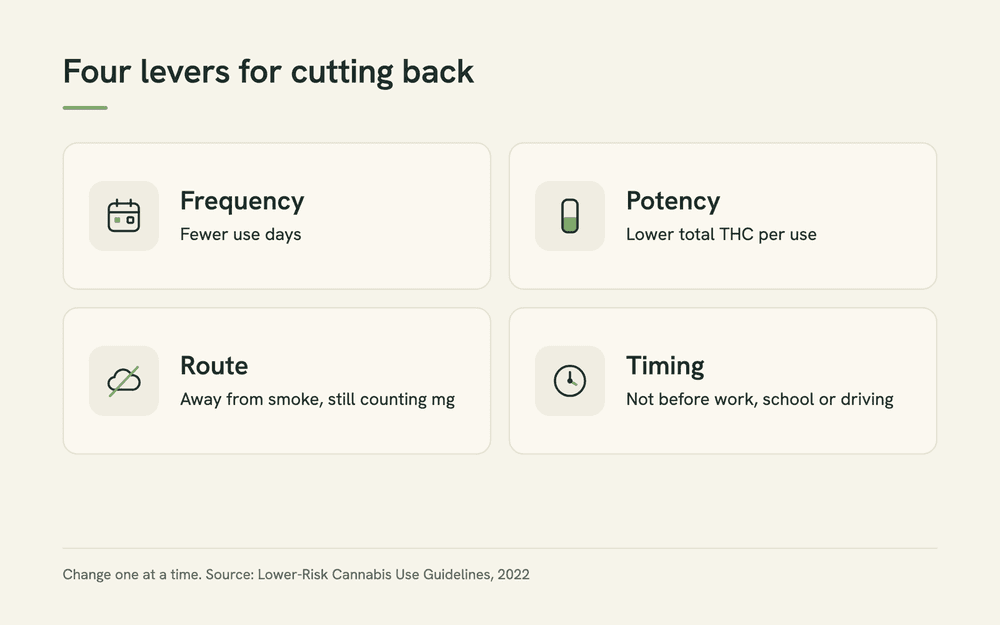
How to cut back on weed with four levers: frequency, potency, route and timing
Once you have a baseline, the guidelines point to four things you can change. You do not need to change them all at once. Picking one and sticking with it for a few weeks makes it easier to see whether the numbers move. Recommendation 12 explains why any single lever matters: "combining frequent, intensive use of high-potency cannabis products" substantially increases risk, so loosening even one of those factors changes the combination the guideline flags.
Frequency: fewer use days
Recommendation 5, graded Substantial, says PWUC "should refrain from frequent (e.g., daily or near-daily) or intensive (e.g., binging) cannabis use". It goes on: "Ideally, PWUC should limit their cannabis consumption to occasional or infrequent use (e.g., use only on 1 or 2 days per week, on weekends only)." That is the guideline's own illustration of lower-risk use, not a personal target, and the evidence behind it links risk with frequent use rather than identifying a safe number of days. Frequency is often the easiest lever to track, because a use day is easy to count. Put it on the worksheet next to your milligrams.
Potency: lower total THC per use
Recommendation 2 says PWUC "should use 'low-potency' cannabis products, i.e., cannabis products with ideally lower total THC content, or a high CBD/THC content ratio", and should choose products that list their composition and potency "so that they can better regulate their cannabis exposure". Two cautions sit in the same recommendation. The ratio refers to the composition of the cannabis product itself, and "CBD use does not attenuate all of THC's adverse outcomes"; CBD may even add some impairment, such as effects relevant to driving. So adding a separate CBD product is not a way to offset THC. Lower potency works on the worksheet the same way fewer days do: fewer milligrams per session.
Route: moving away from smoke
Recommendation 3 asks PWUC to "refrain from cannabis 'smoking'" for lung health, notes that vaporizing "substantially reduces the levels of toxin exposure compared with smoking but may involve other harmful contaminants", and warns that "there is no categorically 'safe' route". Our comparison of dry herb vaporizers and smoking goes through the trade-offs. Keep one distinction in mind: switching away from smoking is a lung-protection step, not automatically a cut-back. A vape or a gummy can deliver as much THC or more, so keep counting milligrams after you switch. Edibles carry their own trap. The guideline says they "can lead to over-consumption", and the slow onset explained in why edibles take so long to kick in is part of why: people take more before the first serving has landed.
Timing and setting: when you use
Recommendation 8 says inhaled use "generally may impair essential driving skills for about 6 - 8 hours" and edibles "for 8 - 12 hours, but these times can vary", and that impairment roughly doubles the risk of a crash. Those hours are not a safe-to-drive window. Our guide to cannabinoids and driving covers why timing is unreliable. Timing also works as a cut-back lever on its own: keeping use out of the morning, out of the workday and out of the car shrinks the hours that THC fills. Whether it also lowers your milligrams is something the worksheet will show you.
Habits that make the levers stick, and how much evidence each has
Most cut-back lists online mix guideline items with tips nobody has tested, and present them all with the same confidence. The table below labels each habit by what stands behind it. Guideline means it appears in the Lower-Risk Cannabis Use Guidelines with the grade shown. Studied (survey link) means it is one of the protective strategies measured in a 2016 survey study, where people who reported using more of these strategies also reported less use; that is a correlation, not a test. Common practice, untested means people recommend it but no study we found has tested it. Untested does not mean useless. It means you are running the experiment yourself, which is another reason to keep counting.
| Habit | Evidence behind it | Lever it supports |
|---|---|---|
| Set use-free days or limit use to weekends | Guideline (Rec 5, Substantial); also a studied strategy | Frequency |
| Choose labeled products with lower total THC | Guideline (Rec 2, Substantial to Moderate; Rec 6, Limited) | Potency |
| Skip deep inhalation and long breath-holds | Guideline (Rec 4, Limited) | Route |
| Never use before driving | Guideline (Rec 8, Substantial to Moderate) | Timing |
| Avoid using before work or school | Studied (survey link, not tested) | Timing |
| Delay your first use of the day | Studied (survey link, not tested) | Timing |
| Avoid using to cope with sadness or low mood | Studied (survey link, not tested) | Timing and setting |
| Track what you spend on cannabis | Studied (survey link, not tested) | Counting |
| Keep a written log of milligrams and use days | Common practice, untested | Counting |
| Buy smaller amounts and do not keep a stockpile at home | Common practice, untested | Frequency |
| Pre-portion servings before a session | Common practice, untested | Potency and amount |
| Wait 10-30 minutes after an urge before deciding | Common practice, untested | Frequency |
| Do not match other people's pace | Common practice, untested | Amount |
The studied rows come from a 2016 study of 210 college students that built a scale of protective strategies for marijuana use. Items such as "Avoid using marijuana early in the day" and "Keep track of your costs to get an accurate picture of how much you spend" were part of a composite that was "negatively associated with marijuana use and consequences". It was small, limited to students and measured at one point in time, so it shows which habits travel with lower use, not that any habit causes it. For edibles specifically, smaller servings and patience before taking more are the same habits our guide to greening out and how to avoid it covers for preventing an over-consumption episode.
What stepping down can feel like
Here is the part most cut-back guides leave out. You do not have to quit to feel the change. NIDA's cannabis research summary says "a person may have withdrawal symptoms after stopping or significantly decreasing heavy or long-term cannabis use, even if they don't have cannabis use disorder." The symptoms it lists include irritability, anger, feeling nervous or anxious, restlessness, decreased appetite, depression, insomnia, strange or unsettling dreams, headaches, sweating, abdominal pain and tremor. NIDA also cites one estimate that 12.1% of people who frequently use cannabis experience cannabis withdrawal.
Those figures come from a 2020 meta-analysis of withdrawal in JAMA Network Open covering 23,518 participants. The headline 47% is driven by clinical samples: in outpatient treatment it was 54%, and in population-based samples, which look more like the general public, it was 17%. Daily use was associated with higher prevalence. The studies varied enormously from one another, and they measured people who stopped, not people stepping down. The authors still wrote that clinicians should "support individuals who are reducing their use".
On timing, a small 2003 study that followed 18 people through a full stop found that "onset typically occurred between Days 1-3, peak effects between Days 2-6, and most effects lasted 4-14 days." That was measured when people stopped completely; a gradual step-down has not been studied the same way, so treat it as context, not a forecast. If sleep or mood is what you notice, our explainers on how THC affects sleep and why weed can change how you feel emotionally give the background. This page describes these changes; it does not tell you how to treat them. NIDA notes there are currently no FDA-approved medications for cannabis use disorder or for medically assisted withdrawal. If symptoms are hard to manage, talk to a clinician.
Is the discomfort worth anything? One data point, with its limits stated. In a 2017 analysis of 302 adults in a cannabis treatment trial, those whose use went down, not necessarily to zero, reported larger improvements in anxiety, depression and sleep-quality scores over 12 weeks than those whose use went up; quality of life did not differ. These were treatment-seeking adults with cannabis use disorder, and the analysis shows an association, not that cutting back caused the change. It is still one of the few studies that looks at reduction rather than abstinence alone.

When cutting back on your own is not enough
If you are trying to cut back on your own, the guidelines name the point where that is not enough. General Precaution B, graded Substantial, describes cannabis use disorder as marked by "cannabis craving, withdrawal, neglect of essential obligations, and limited capacity to control or reduce cannabis use", and says people with these problems, "particularly if their own attempts to control or substantially reduce their cannabis use fail, should seek professional assessment and care." One of NIDA's use-disorder signs reads, word for word, "Persistent desire or unsuccessful efforts to cut down or control". You can read the full list of NIDA's use-disorder signs in our tolerance break guide. NIDA also reports that behavioral approaches, including cognitive behavioral therapy, motivational enhancement therapy and contingency management, "can be effective in treating cannabis use disorder". Asking for that kind of help is not a failed cut-back. It is the next step the guidelines themselves recommend. To find services near you, search FindTreatment.gov.
What the evidence does not tell you
- There is no proven safe level of use. The guidelines' authors write that there is "no robust evidence to quantify thresholds for cannabis (THC) potency or THC/CBD ratios that may allow consumers to reliably reduce risks."
- The 5 mg standard THC unit is a counting proposal used in research. It is not a labeling rule, a safe dose or a daily allowance.
- Worksheet totals count the THC in the product. How much reaches your blood varies widely by route and by person.
- The withdrawal figures and timelines come mostly from people who stopped completely. How a gradual step-down feels has not been measured the same way.
- Most everyday habits are either untested or studied only as a correlation in one survey of 210 college students.
- The guidelines are expert consensus built on a review of the evidence, not a clinical trial, and they were written for non-medical use. If you use cannabis for a medical reason, change your use with your clinician.
- This page is general information, not medical advice.
Frequently asked questions
Start by counting one ordinary week in milligrams of THC and use days. Then change one lever at a time: fewer use days, lower-potency products, a route other than smoking (while still counting milligrams) or keeping use out of the morning and workday. Delaying your first use of the day and tracking what you spend are habits that, in one survey, went along with lower use. Compare each week with the last rather than chasing a number.
Both are legitimate goals, and the guidelines do not prescribe a schedule for either. Recommendation 7 names both options side by side, "temporarily suspending or substantially reducing" use, and notes that some thinking-related effects "may at least partially reverse after relatively short periods (e.g., several days to weeks) of abstinence or very substantial reductions". If you want a full pause, a tolerance break is the better fit. If your attempts either way keep failing, General Precaution B says to seek a professional assessment.
You might. NIDA says withdrawal symptoms can follow "stopping or significantly decreasing heavy or long-term cannabis use", even without a use disorder. A 2020 meta-analysis found withdrawal in 17% of regular users in population samples and 47% across all studies, with higher rates in treatment settings and with daily use. In a small study of people who stopped completely, symptoms usually started in days 1-3 and mostly faded within 4-14 days. If symptoms are hard to manage, talk to a clinician.
For your lungs, the guidelines treat moving away from smoke as a lower-risk step. For THC, not necessarily: a vape or an edible can deliver as much THC or more, and the guidelines warn that edibles can lead to over-consumption because they take longer to take effect. Keep counting milligrams after you switch to see whether you are actually using less.
The guidelines say there is no universally safe level of cannabis use, and they advise against daily or near-daily use (graded Substantial). Their own example of lower-risk frequency is "use only on 1 or 2 days per week, on weekends only", which is an illustration, not a personal limit. They also say there is no robust evidence for a potency threshold that reliably reduces risk. The 5 mg standard THC unit helps you count, but it is not a line between safe and unsafe.
That has not been shown. One small 2020 trial gave 82 adults with cannabis use disorder high-dose pharmaceutical-grade CBD (200, 400 or 800 mg) alongside counseling while they tried to quit, and the 400 mg group averaged about half an extra abstinent day per week compared with placebo. It was an early-phase study, CBD is not approved for this, and it does not show that a CBD product helps anyone cut back. The guidelines also note that CBD does not cancel THC's adverse effects.
That question belongs to a tolerance break, a full pause rather than a reduction. Our tolerance break guide covers how tolerance builds and what is known about how it resets. Cutting back can still help in a practical way: fewer use days and lower-potency products are both on the guidelines' list of lower-risk changes.
Replacing one substance with another is not a lower-risk plan under the guidelines. Recommendation 10 says co-use of cannabis with alcohol, tobacco or other drugs should be minimized, because combining them raises risk, and cannabinoids can interact with some medications. If you take prescription medicines, ask a clinician or pharmacist before changing your use of either.
Cutting back works best as an experiment you can measure: count a normal week, change one lever, and compare. If you find that a full pause is what you actually want, our guide on how a tolerance break works and how to plan one is the next read. And if you need support at any point, the SAMHSA National Helpline is 1-800-662-HELP (4357).
Writing about hemp, wellness and the small rituals that keep us balanced.