Cannabis and Sperm Meta-Analysis: Shape Differed, Count Did Not
A meta-analysis of 18 studies, indexed November 11, 2026, found men who smoked cannabis had slightly lower normal sperm morphology and higher SHBG. Count, motility, testosterone, FSH and LH showed no significant difference. It shows an association, not a cause.

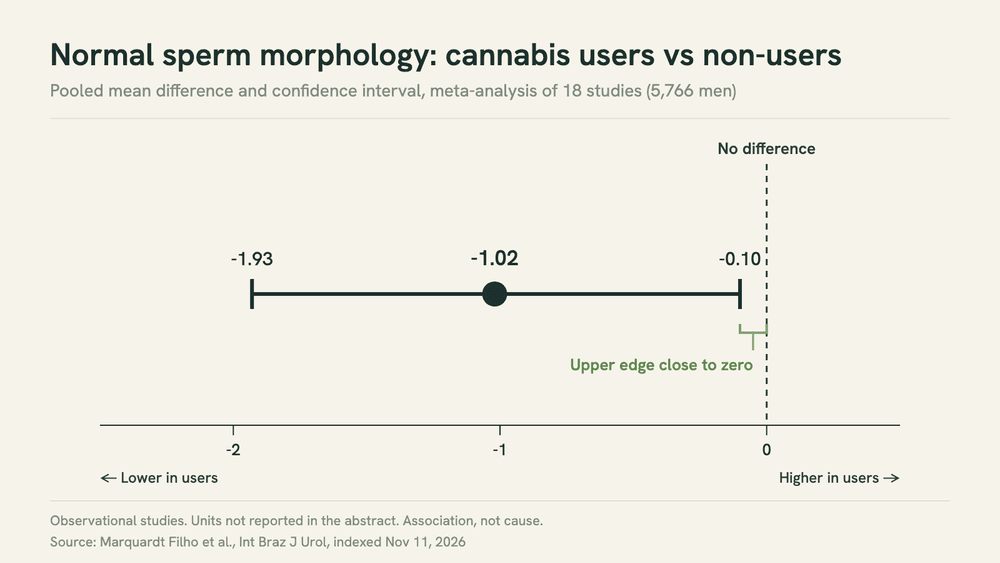
A meta-analysis indexed on PubMed on November 11, 2026 pooled studies comparing men who smoked cannabis with men who did not, 18 of them for semen. Of six semen measures, one differed: cannabis users had slightly lower normal sperm morphology, the share of sperm with a normal shape. Count, concentration, volume and motility showed no significant difference, and testosterone, FSH and LH did not differ. SHBG, a protein that binds sex hormones in the blood, was higher in users. Every study was observational, and the authors write that causality could not be established.
What the meta-analysis did
The paper is a systematic review and meta-analysis on cannabis and male reproductive parameters, by first author Marquardt Filho, senior author Jorge Hallak and colleagues at Pontifical Catholic University of Rio Grande do Sul (PUC-RS) in Porto Alegre, the University of São Paulo and its medical school hospital, the Federal University of Amapá and the São Paulo andrology group Androscience. It was indexed on PubMed on November 11, 2026, ahead of the International Brazilian Journal of Urology's January-February 2027 issue. The authors declared no conflicts of interest. The protocol was registered in advance on PROSPERO, the international registry for systematic reviews, as CRD420251132635.
Two terms do the work here. A systematic review searches for every study that meets criteria set in advance, so the authors cannot pick only the ones they like. A meta-analysis then combines those studies' results into one pooled estimate, giving more weight to larger and more precise studies. This team searched PubMed, Embase and the Cochrane Library in August and September 2025, pooled the data with random-effects models (which assume the true difference may vary from study to study) and followed the PRISMA reporting guidelines.
The men in the semen analyses averaged 36.5 years old, and those in the hormone analyses 37.4. The abstract describes every cannabis user in the pooled studies the same way: men who reported smoking more than one joint a week in the preceding months. That is the only exposure detail it gives. It is self-reported, it is smoked cannabis, and the abstract does not separate a man who smokes twice a week from one who smokes twice a day.
One limit applies to everything below. The full text is not online yet: the paper's DOI (10.1590/S1677-5538.IBJU.2026.0723) did not resolve when we checked on November 12, and the journal's ahead-of-print page did not list it. This report rests on the published abstract. So we cannot tell you which 18 studies were included, how many men in each were users, what units the pooled differences are in, or how much the studies disagreed with each other. The abstract says that disagreement (statistical heterogeneity) was assessed, but does not report it.
Cannabis and sperm: the result, measure by measure
Most coverage of cannabis and sperm collapses into one question: does it hurt or not? The pooled data answer a more specific question, one measure at a time. Here is every outcome the abstract reports, in cannabis users compared with non-users.
| Measure | Type | Result in users vs non-users |
|---|---|---|
| Normal sperm morphology | Semen | Lower: MD -1.02 (-1.93 to -0.10); held in studies strictly following WHO criteria |
| Sperm concentration | Semen | No significant difference |
| Total sperm count | Semen | No significant difference |
| Ejaculate volume | Semen | No significant difference |
| Progressive motility | Semen | No significant difference |
| Total motility | Semen | No significant difference |
| Testosterone | Hormone | No difference |
| FSH (follicle-stimulating hormone) | Hormone | No difference |
| LH (luteinizing hormone) | Hormone | No difference |
| SHBG (sex hormone-binding globulin) | Hormone | Higher: MD 3.90 (1.67 to 6.13) |
The morphology result is the headline, and it is a narrow one. Most labs report morphology as the percentage of sperm with a normal shape, so a pooled difference of -1.02 most likely means about one point lower in users. The confidence interval runs from -1.93 to -0.10. Its upper edge sits close to zero, which means the data are consistent with a difference of nearly two points or barely any. The authors report that the gap persisted when they kept only studies that strictly followed World Health Organization criteria for assessing semen, which makes one obvious explanation less likely: that the difference came from labs grading shape in inconsistent ways.
On hormones, the pooled data showed no difference in testosterone or in FSH and LH, the two pituitary hormones that signal the testes. That fits our look at what weed does and does not do to testosterone and training. It also matches a Mendelian randomization study in the International Journal of Impotence Research, a genetic design that found no causal effect of cannabis use on bioavailable testosterone, FSH or LH; that study did not look at SHBG. SHBG was the one hormone measure that was higher in users. The abstract does not report free testosterone, so it cannot say whether the SHBG difference matters for anything downstream, and we will not guess. Our explainer on whether weed raises estrogen in men covers other hormone findings in men who use cannabis.
What sperm morphology is, and what one point means
Morphology is one line on a standard semen analysis. A lab technician stains a sample, looks at sperm under a microscope and classifies each one as normally shaped or not, using strict criteria set out in the WHO laboratory manual for examining human semen. The result is reported as the percentage of normal forms, and under strict criteria the percentages involved are small, as the reference values below show.
How small is shown by a 2021 analysis of semen results collected for the WHO manual, co-authored by WHO staff, which drew on more than 3,500 men from twelve countries on five continents. Its 5th-centile values, the level below which the lowest 5% of results fall, were 16 million sperm per mL for concentration, 30% for progressive motility (42% for total motility) and 4% normal forms for morphology. The authors were explicit that these values do not represent distinct limits between fertile and subfertile men. If the 2026 pooled difference is in percentage points, as morphology usually is, one point sits on a scale where that reference value is 4%. That is why a small-looking number is worth reporting, and also why it is not, on its own, a diagnosis of anything.
The 2026 morphology signal also has a precedent. In a 2014 UK case-referent study from 14 fertility clinics, researchers compared 318 men with under 4% normal forms against 1,652 men above that line. Among men aged 30 or under, cannabis use in the previous three months was linked to roughly twice the odds of poor morphology (odds ratio 1.94, 95% CI 1.05 to 3.60). Yet the same authors summarized their results by writing that common lifestyle choices make little contribution to the risk of poor sperm morphology. A real association can still be a small one.
How this compares with the 2021 meta-analysis
This is not the first pooled look at the question. A 2021 meta-analysis in Andrology, from researchers at Stanford, San Raffaele in Milan and Copenhagen, combined 9 studies covering 4,014 men with semen data and 4,787 with hormone data. It reported semen results as a single composite (any abnormal parameter) rather than measure by measure, so the two papers line up only partly.
| Measure | 2021 meta-analysis | 2026 meta-analysis | Do they agree? |
|---|---|---|---|
| Any abnormal semen parameter | RR 1.159 (0.840 to 1.599), no significant difference | Not pooled this way | Different method |
| Concentration and total count | Not reported separately | No significant difference | Consistent with the 2021 null composite |
| Normal morphology | Not reported separately | Lower in users, MD -1.02 (-1.93 to -0.10) | New signal |
| Testosterone | SMD -0.139 (-0.413 to 0.134), no significant difference | No difference | Agree |
| FSH | Lower in users, SMD -0.142 (-0.243 to -0.0425), P = 0.005 | No difference | Disagree |
| LH | SMD -0.318 (-0.810 to 0.175), no significant difference | No difference | Agree |
| SHBG | Not reported | Higher in users, MD 3.90 (1.67 to 6.13) | New |
The 2021 abstract also contains a number that is easy to misread. Among the 1,158 cannabis users, 44.9% had impaired semen parameters, compared with 24.5% of the 2,856 non-users. Read alone, that looks like nearly double the rate. But those are raw percentages pooled across different studies, with different populations and labs. When the authors combined the studies properly, weighting each one, the relative risk was 1.159 with a confidence interval running from 0.840 to 1.599, which crosses 1 and was not statistically significant. The raw gap is not a finding. The 2021 authors concluded that their data did not suggest clinically significant associations, while adding that they could not exclude an effect because the studies were limited and heterogeneous.
Why would the two analyses differ on FSH and find morphology only now? Several reasons are plausible, and the abstract does not let us choose between them: the 2026 analysis includes twice as many studies, its search ran through 2025, it pooled each semen measure separately instead of using one composite, and it tested the morphology result in a WHO-criteria subset. Without the full text, we cannot say which of these, if any, explains the change.
Why the headlines have pointed both ways
If you have searched this before, you have probably seen two opposite headlines. One comes from a 2015 Danish study of 1,215 young men aged 18 to 28: those who reported smoking cannabis more than once a week had 28% lower sperm concentration and 29% lower total sperm count, and higher testosterone. It was cross-sectional (a single snapshot) and relied on self-report. Our guide to CBD, THC and fertility walks through that study's confidence intervals and why its numbers are often misquoted.
The other headline comes from a 2019 Harvard study of 662 men at a fertility center, with 1,143 semen samples. Men who had ever smoked cannabis had higher average sperm concentration than men who never had: 62.7 million per mL against 45.4 million. The authors wrote that their findings were not consistent with a deleterious effect, and cautioned that chance findings could not be excluded because of the many comparisons they ran. It studied men already seeking fertility care, which may not reflect everyone.
Single studies of this kind can point in opposite directions because they sample different men, measure use differently and adjust for different factors. Pooling is meant to smooth that out, and the 2026 pool found no significant difference in concentration or count in either direction. We cannot tell from the abstract whether either of these studies is among the 18 it included.

What did not change
A new pooled estimate is news. It does not settle the question, and several things stand exactly where they were. The biggest is that there is still no randomized human evidence on cannabis and semen quality. The one randomized trial we found registered to test THC in cannabis on men's reproductive function, with placebo, 20 mg and 40 mg THC arms, was withdrawn in 2026 before it enrolled anyone. Its investigator wrote that FDA had not approved the study, so it could not begin.
- Causality is not established. Every included study was observational, and the authors say so in their conclusion.
- The exposure was self-reported smoking of more than one joint a week. The abstract reports no comparison by amount or frequency beyond that.
- Edibles, vapes, concentrates and CBD products were not part of the exposure the abstract describes.
- A lower average in a group of men says nothing about any one man's sperm or fertility.
- Morphology is one measure among several, and the WHO reference values are not a fertile or infertile line.
- The paper did not study stopping cannabis, or how long any difference might last.
- No federal or state law changed because of this paper.
On CBD in particular: the exposure here was smoked cannabis, which delivers THC along with other compounds, not a CBD oil or gummy. Our side-by-side of how CBD and THC differ explains why the two cannot be swapped in a finding like this. The human data that do exist for CBD and male reproductive hormones, including a 28-day FDA trial, are covered in our evergreen guide to what has and has not been measured for CBD and fertility. For a sense of what a randomized smoked-cannabis study looks like when one does run, see our report on a recent placebo-controlled trial of smoked THC.
If you are being evaluated for fertility
The authors do not tell anyone to stop or keep using cannabis, and neither do we. Their practical point is narrower: cannabis use is a lifestyle factor that belongs in the history when a man is being evaluated for subfertility, particularly when morphology is abnormal or the cause of infertility is unexplained. In plain terms, if you are going through a fertility work-up, tell the clinician about your cannabis use, how you use it and how often, so it can be weighed with everything else.
“Although causality could not be established, cannabis should be considered a potential lifestyle factor, particularly in cases of abnormal sperm morphology or unexplained infertility.”
They also call for further studies on sperm function, meaning how well sperm actually work, to clarify any effects on testicular function and fertilizing capacity. Shape and count are what a standard semen analysis measures; whether sperm can fertilize an egg is a separate question that none of the pooled measures answers directly. When the full text is published, we will check it for the included studies, the heterogeneity values and the units, and update this page if they change the picture.
Frequently asked questions
In the 2026 pool of 18 studies, there was no significant difference in sperm concentration or total count between men who smoked cannabis and men who did not. Single studies have pointed both ways: a 2015 Danish study found lower counts in men who smoked more than once a week, while a 2019 Harvard fertility-clinic study found higher concentrations in men who had ever smoked. No significant difference is not proof of no effect.
Men who smoked cannabis had slightly lower normal sperm morphology in the 2026 meta-analysis, about one point, and the gap held in studies that followed WHO criteria. It is an association from observational studies, not a proven cause, and the confidence interval's upper edge is close to zero.
Neither pooled analysis found a testosterone difference: not the 2021 meta-analysis of 9 studies, and not the 2026 analysis covering 21,066 men. The 2026 analysis did find higher SHBG, a protein that binds sex hormones in the blood, in users. It did not report free testosterone.
Labs report morphology as the percentage of sperm that are normally shaped under strict criteria. In data collected for the WHO manual, the 5th-centile value was 4% normal forms. Its authors stressed that reference values like this do not separate fertile from subfertile men.
No. Every cannabis user in this meta-analysis reported smoking more than one joint a week. CBD products were not studied, and nothing in the paper can be applied to them.
This paper did not study stopping or timing, so it cannot answer that. Its authors say cannabis use should be part of the lifestyle assessment when a man is evaluated for subfertility. That decision belongs with your clinician, who can weigh it against your own results and history.
Not one with results that we could find. The one randomized trial we found registered on ClinicalTrials.gov to test THC in cannabis on men's reproductive function was withdrawn in 2026 with no one enrolled; its investigator wrote that FDA had not approved the study.
If your question is less about smoked cannabis and more about CBD while trying to conceive, the next read is our guide to CBD and fertility, which separates the human CBD data from the marijuana studies that usually get mixed into it.
Writing about hemp, wellness and the small rituals that keep us balanced.