Adding Mindfulness to an Online Cannabis Program: What a 301-Person Trial Found
A Swiss trial of 301 frequent cannabis users tested mindfulness added to an automated online CBT program. At 6 months it was associated with about half as many reported use days as CBT alone, but only 95 people were measured and we found no English version.

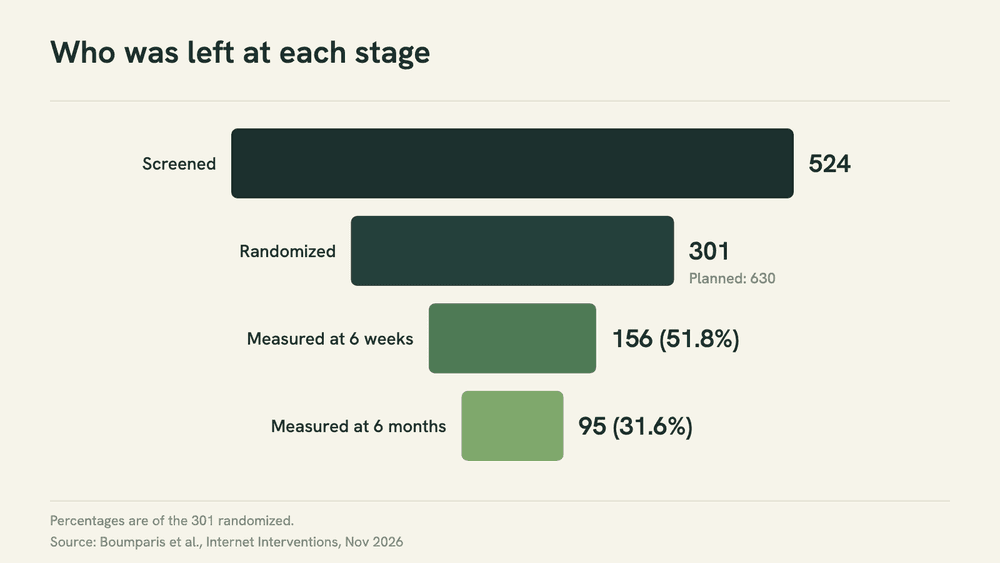
A Swiss randomized trial of 301 adults who used cannabis at least weekly found that adding mindfulness practice to a fully automated online program for cutting back on cannabis was associated with fewer reported use days six months later than the same program without it. At 6 weeks the two versions looked the same. By 6 months, only the mindfulness version still differed from a waitlist. The catch is the denominator: only 95 of the 301 people were measured at six months, and the authors themselves say the result should be interpreted cautiously.
The question this trial tests is not whether online programs can help people cut back for a few weeks. They often can. It is whether the change lasts. A 2019 meta-analysis of digital cannabis interventions found that treatment-focused programs produced a small effect right after the program (g = 0.12, pooled from 17 comparisons with 3,813 participants) that was no longer statistically significant at follow-up. That matters because most people with a cannabis problem never get formal treatment: in a national US survey analysis from 2022 data, only 16.5% of adults who met criteria for cannabis use disorder had received any substance use treatment. Self-help is what most people actually use, so whether it holds up past the first few weeks is a practical question.
What the Zurich team published on November 3
The paper is a three-arm randomized trial on the added value of mindfulness in a digital cannabis intervention, by Nikolaos Boumparis, Michael Schaub and colleagues at the Swiss Research Institute for Public Health and Addiction (ISGF) at the University of Zurich. It appeared online in the journal Internet Interventions on November 3, 2026 and was indexed on PubMed on November 13. The Swiss National Science Foundation funded it and, per the paper, had no role in the design or analysis. The authors declare no competing interests. The trial was registered in advance as ISRCTN14971662 on September 9, 2021, and its protocol was published in BMC Psychiatry in 2022, so the main outcome was fixed before the data came in.
Recruitment ran from September 2021 to January 2024 through the program's public websites, canreduce.ch and canreduce.at, with online ads, newspapers and help portals. The program itself, CANreduce, was developed by the same institute together with Arud, a Zurich addiction medicine center. That is normal for a first trial of a program, and it is also a reason independent replication matters.
- Who could join: adults 18 or older who had used cannabis at least weekly in the past 30 days, were fluent in German and had internet with audio and video.
- Who was excluded: people already in treatment for cannabis use, on medication for a psychiatric disorder, with a history of psychosis, schizophrenia or bipolar I disorder, or reporting any current suicidal thoughts at screening.
- Who took part: 301 people, randomized by computer to mindfulness plus CBT (109), CBT only (94) or waitlist (98). The average age was about 31 and 57.8% were men.
- How much they used: on average, cannabis on about 26 of the previous 30 days at the start.
The exclusions are large and worth noticing. Of 524 people screened, 139 (26.5%) were turned away because their suicidal-ideation score was above zero, and 90 because they were taking psychiatric medication (some people met more than one exclusion). The authors acknowledge that the resulting sample may not represent the broader population of cannabis users seeking help. If you are dealing with low mood, take that seriously: the people most like you may not have been in this study.
What adding mindfulness meant in this program
Both active versions ran for 6 weeks with 8 modules, a dashboard, a consumption diary, an activity planner, fictional peer stories and an animated avatar coach. Both were fully automated: no human therapist was involved at any point. The waitlist group got brief feedback on cannabis risks, a harm-reduction page and emergency contacts, and was free to use any other service it found. Here is how the three arms differed.
| Arm | People | What they got |
|---|---|---|
| Mindfulness CANreduce | 109 | 6 weeks, 8 CBT modules on motivation, triggers, craving and relapse prevention, each with added audio mindfulness practices and practice tracking |
| Standard CANreduce | 94 | 6 weeks, 8 modules of CBT and motivational interviewing only; similar text length, no audio, text-only coach |
| Waitlist | 98 | Brief feedback on risks, a harm-reduction page, emergency contacts, any other help they chose; offered the mindfulness program after 6 months |
CBT here means cognitive behavioral therapy techniques in self-help form: setting goals, spotting triggers, planning for high-risk moments. The mindfulness layer was adapted from Mindfulness-Based Relapse Prevention, a group program first developed for substance use, and was delivered as audio files that stayed available after the 6 weeks: mindful breathing, a body scan, urge surfing, a short breathing-space exercise called SOBER, mountain and walking meditations, lovingkindness and self-compassion practices, and an exercise in recognizing thoughts as thoughts rather than instructions. Urge surfing is the one most specific to cutting back. It asks you to notice a craving as a wave of body sensations and thoughts that rises, peaks and passes, without acting on it.
The numbers, time point by time point
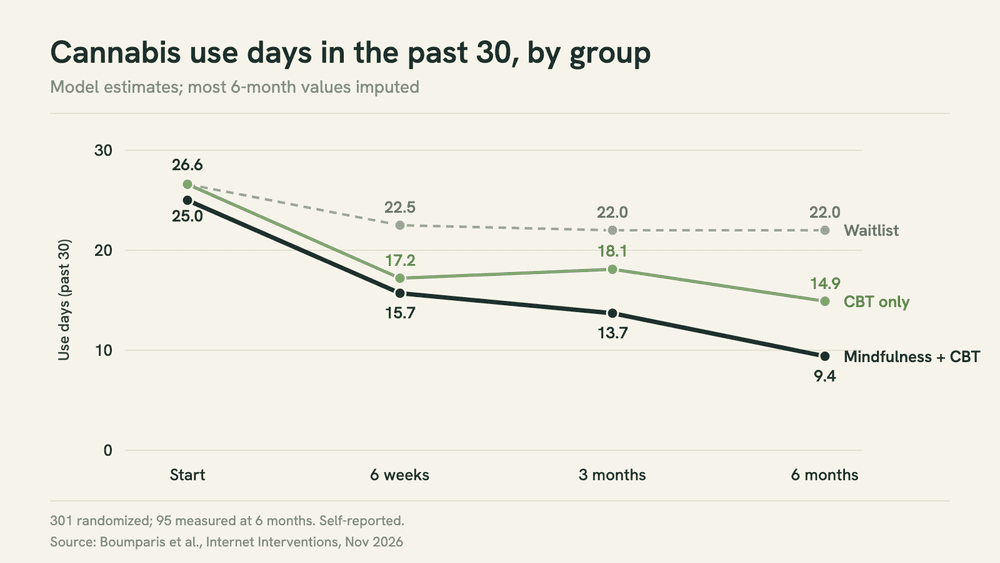
| Arm | Start | 6 weeks | 3 months | 6 months |
|---|---|---|---|---|
| Mindfulness + CBT | 25.0 | 15.7 | 13.7 | 9.4 |
| CBT only | 26.6 | 17.2 | 18.1 | 14.9 |
| Waitlist | 26.6 | 22.5 | 22.0 | 22.0 |
The paper reports its comparisons as incidence rate ratios (IRRs). An IRR of 0.50 means one group reported half as many use days as the other, after the model adjusts for where each group started. Do not divide the means in the table to make your own ratio: 9.4 divided by 14.9 is 0.63, not the paper's 0.52, because the model accounts for baseline use and for the many people who reported zero days. Here is what the full paper reports, in plain terms.
- At 6 weeks: both programs reported fewer use days than the waitlist (mindfulness IRR 0.76, 95% CI 0.64 to 0.90; CBT only IRR 0.80, 0.67 to 0.95). The two programs did not differ from each other.
- At 3 months: the mindfulness group still differed from the waitlist (IRR 0.73) and was slightly lower than CBT only (IRR 0.82, 0.68 to 0.99). CBT only no longer differed significantly from the waitlist.
- At 6 months, the main endpoint: the mindfulness group reported about half as many use days as the waitlist (IRR 0.46, 0.38 to 0.56) and as CBT only (IRR 0.52, 0.43 to 0.64). CBT only versus waitlist was IRR 0.88 (0.73 to 1.06), not significant.
- Between 3 and 6 months, only the mindfulness group showed a further drop that was statistically significant (p < 0.001).
The secondary outcomes add texture. Both programs, not only the mindfulness one, beat the waitlist on a problem-use questionnaire (the CUDIT-R) and on a dependence-severity score, and on those the two programs did not differ from each other. Reported joints in the past week were lowest in the mindfulness group. On depression and anxiety symptom questionnaires (PHQ-9 and GAD-7), the mindfulness group scored lower than CBT only by about 1.5 points (1.49 and 1.61). For scale, participants' average starting depression score was about 11 on a 0 to 27 questionnaire, so a 1.5-point gap is modest, and it comes from a sample that excluded anyone on psychiatric medication.
Two smaller findings are worth knowing. In the imputed analysis, the mindfulness group's alcohol score rose slightly compared with the waitlist (0.57 points), though not when only measured participants were counted, and every group stayed in a low-risk range. The authors raise possible substitution, meaning drinking a bit more while using less cannabis, and call for future trials to track it. And at 6 weeks, 24 of 156 people who answered (15.4%) reported at least one negative effect they attributed to the program, such as increased anxiety, low mood, lower motivation or physical complaints. Of the 12 who described it, 7 said it had improved, 5 said it was unchanged and none said it had worsened.
Why only 95 people tell the six-month story
Dropout is the central fact of this trial. 156 people (51.8%) completed the 6-week survey and 95 (31.6%) completed the 6-month survey, even with payments of 20 Swiss francs at 3 months and 30 at 6 months. To keep every randomized person in the analysis, the team filled in the missing answers by multiple imputation: a statistical method that estimates what non-responders probably reported, based on what they and similar people said earlier. It assumes the reason someone dropped out is explained by data the study already has. The paper notes this assumption cannot be verified, and that dropout driven by unobserved factors such as relapse or dissatisfaction cannot be excluded.
The team checked the result two ways. Counting only the people actually measured at 6 months, the mindfulness group still reported fewer use days, but the gap shrank: IRR 0.69 (0.53 to 0.90) versus CBT only, about a third fewer use days rather than half, and IRR 0.58 (0.45 to 0.74) versus the waitlist. A tipping-point test asked how wrong the imputation would have to be to erase the result. The answer: mindfulness-arm dropouts would have to have used cannabis on average 12 or more extra days a month beyond what was imputed for the difference from CBT only to disappear. That is reassuring but not decisive, since relapse after dropping out is exactly the scenario no one can see.
The engagement numbers are striking. Among participants with usage logs, the median person completed 28.8% of the modules and 18% never opened one. In the mindfulness arm, 36 of 94 people (38.3%) logged even one formal mindfulness practice, and those who did logged a median of 5 practices over 4 days. Listening to the audio was not logged, so real practice may have been higher, but low recorded practice makes it harder to attribute the difference to the practice itself. Module completion was not linked to 6-month use days either, though people who finished all 8 modules were far more likely to answer the 6-month survey (67% versus 9%), which muddies that comparison. If you want a general framework for weighing one trial like this, our guide to reading the evidence behind cannabinoid claims walks through why a single result rarely travels on its own.
“Its superiority may partly reflect greater intervention exposure rather than mindfulness content itself. A dismantling design with an attention-matched comparator is needed to isolate the specific contribution of mindfulness practice.”
How this fits with earlier CANreduce trials and other mindfulness studies
CANreduce has been tested in randomized trials before, and both earlier Swiss trials stopped at 3 months. In the original 2015 trial of 308 users, the self-help program alone did not beat the waitlist at 3 months; it did only when brief chat counseling was added, and only 38.0% of participants completed follow-up. The 2021 CANreduce 2.0 trial of 775 users added automated adherence-focused guidance and found a reduction in use days at 3 months versus internet as usual (d = 0.60 for one version), but it stopped at 3 months, so it could not test whether the change lasted. A wider view comes from a 2024 meta-analysis of 19 trials in young adults, which found digital programs reduced use by about 6.8 days a month at 3 months versus controls, in samples that excluded people with a substance use disorder.
| Study | People | What was tested | Longest follow-up | Result |
|---|---|---|---|---|
| CANreduce, 2015 | 308 | Self-help, with or without brief chat | 3 months | Self-help alone no different from waitlist; with chat, fewer use days |
| CANreduce 2.0, 2021 | 775 | Self-help with automated guidance | 3 months | Fewer use days for one guided version |
| Mindfulness CANreduce, 2026 | 301 | CBT plus mindfulness vs CBT only vs waitlist | 6 months | Mindfulness version lower at 6 months; CBT-only edge faded |
| Melbourne trial, 2025 | 66 | Brief standalone online mindfulness vs relaxation vs monitoring | About 16 days of practice | No effect on use days, quantity or craving |
| Microrandomized trial, 2025 | 53 | In-the-moment mindfulness or distraction messages during cravings | 4 weeks | No reduction in craving at the next check |
The counterweight matters. A 2025 double-blind trial in Melbourne gave 66 adults with cannabis use disorder who had tried to cut down a brief online mindfulness program, about 16 days long, and compared it with relaxation training or monitoring only. It found no effect on use days, amount or craving. A 2025 microrandomized trial of 53 young adults sent mindfulness or distraction messages when people reported a craving, and neither reduced craving at the next check compared with a simple thank-you message.
These results are not necessarily in conflict. The null trials tested short, standalone mindfulness over 2 to 4 weeks, one against an active relaxation comparator. The Zurich trial layered mindfulness onto a structured 6-week CBT program, and its difference from the CBT-only version was small at 3 months and widened by 6. That is a difference in dose and design, not proof in either direction. A fair reading today: mindfulness on its own, briefly, has not looked useful for cutting back; mindfulness added to a fuller program is promising and unconfirmed.
What did not change
- The outcome is self-reported cannabis use days in the past 30. It is not a quit rate, not a biochemical test and not a diagnosis.
- It is one trial, under-recruited, run by the program's developers, and not yet independently replicated.
- The participants were German-speaking adults in Switzerland, Germany and Austria, not in treatment, not on psychiatric medication and without current suicidal thoughts.
- No English or US version of CANreduce is publicly available that we could find: canreduce.ch is German-only, and the site does not say which version is live today.
- The trial involved no CBD, no cannabis product and no medication, and says nothing about substitution.
- Nothing in US guidance changed because of this paper, and the SAMHSA National Helpline number is the same.
On CBD in particular: nothing in this trial can be read as a case for swapping THC products for CBD ones, and we do not make that case. If you want to understand why frequent THC use can become hard to cut back while CBD is a different question, our explainer on whether CBD is addictive and why THC is different covers it.
If you are trying to cut back now
You cannot sign up for this program in English, and we will not point you to a version you cannot use. What you can take from the trial is its structure, which overlaps with what already has evidence behind it. Our evergreen guide to practical ways to cut back on weed covers the levers in detail. If your goal is a full pause rather than less use, planning a tolerance break is a different plan with different expectations. A short checklist drawn from how this trial was built:
- 1Decide what you are aiming for: fewer days a week, a set number of days off, a break, or stopping. Each is a different plan.
- 2Track use days, the same measure this trial used. A paper calendar or notes app works. A diary was part of both programs.
- 3Plan for months 3 to 6, not just the first few weeks. In this trial, the CBT-only group's edge over the waitlist was no longer significant by 3 months.
- 4Watch your drinking while you cut back. The mindfulness group's alcohol score crept up slightly in one analysis.
- 5If it is not working after real effort, or you feel worse, get support rather than trying harder alone.
The helpline number above is the one listed on the National Institute on Drug Abuse cannabis page, alongside the 988 Suicide and Crisis Lifeline. NIDA also points to FindTreatment.gov, the federal search tool for treatment programs near you.
Questions readers are asking
The evidence is mixed. This 2026 trial found that adding mindfulness to an online CBT program was associated with fewer reported use days at 6 months than the CBT program alone. A smaller 2025 trial of a brief, standalone online mindfulness course found no effect. The fair summary is promising and unconfirmed, and possibly dependent on being part of a fuller program.
Meta-analyses find real but modest short-term reductions in use days, and a 2019 analysis of treatment-focused programs found the effect was no longer significant at follow-up. That is why this trial stands out: one version held a difference at 6 months. It still needs to be repeated with more people who stay in the study.
It is a practice from Mindfulness-Based Relapse Prevention. Instead of fighting a craving or giving in to it, you notice it as a wave of body sensations and thoughts that rises, peaks and passes. It was one of the audio exercises in the mindfulness version of this program.
Not that we could find. The public site, canreduce.ch, is in German only, and its English address returned an error when we checked in November 2026. The site also does not say whether the mindfulness version tested here is the one currently live.
The trial measured cannabis use days, not quitting. By the model's estimate, the mindfulness group went from about 25 use days a month to about 9 at 6 months, but most of those 6-month values were imputed because only 95 of 301 people answered.
No. The trial involved no CBD, no cannabis product and no medication. It tested a self-help program and nothing else.
The next step is the same as it was before this paper: pick a clear goal, track your days, and use our step-by-step guide to cutting back on cannabis to build the plan. If you want support from a person, call the SAMHSA National Helpline at 1-800-662-4357. For another newsroom report built the same way, on what a result does and does not mean, see our coverage of the Cochrane review on cannabis and insomnia.
Writing about hemp, wellness and the small rituals that keep us balanced.