A Pilot Trial Gave Knee-Replacement Patients Prescription CBD. It Missed Its Main Goal.
On October 22, 2026, The Journal of Pain published a triple-blind pilot trial of prescription CBD in 36 knee-replacement patients. Neither dose significantly changed 72-hour opioid use. A post hoc signal at 400 mg needs a larger trial; 800 mg brought more side effects.
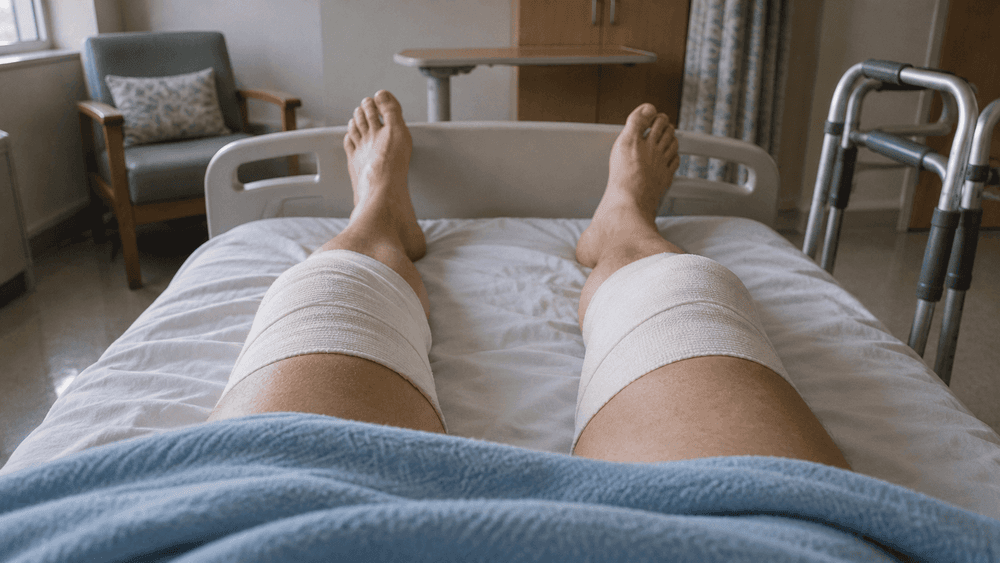
On October 22, 2026, The Journal of Pain published a triple-blind pilot trial from Hospital for Special Surgery in New York that gave prescription CBD to 36 adults having both knees replaced. On its main measure, opioid use over the first 72 hours, neither the 400 mg arm nor the 800 mg arm differed significantly from placebo. A post hoc test in this pilot favored the 400 mg arm. The 800 mg arm had more side effects and no opioid saving.
What the trial did
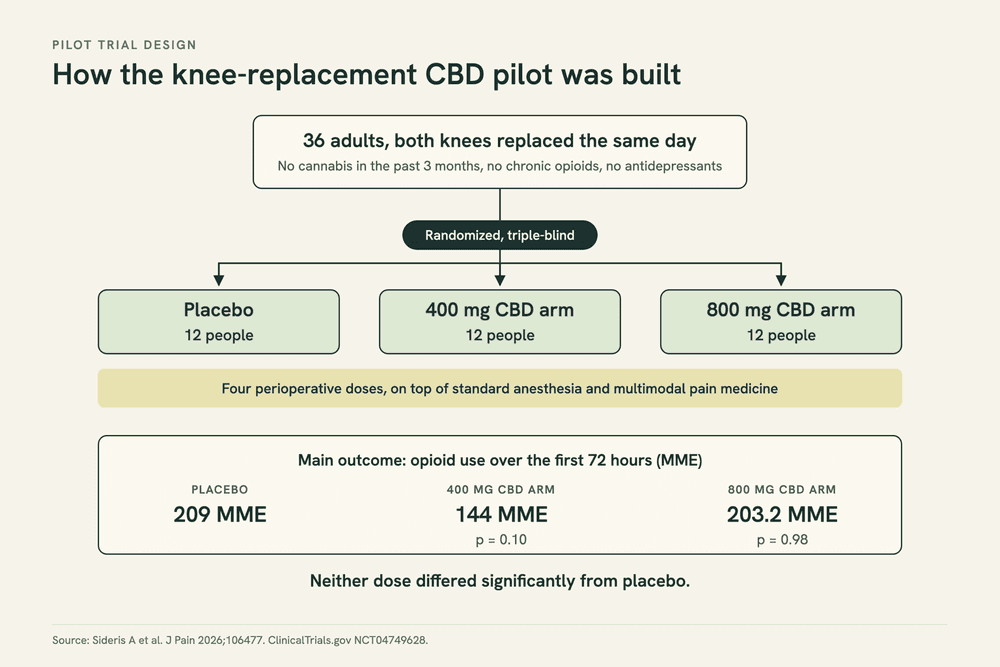
The paper is titled Effects of cannabidiol (CBD) oral solution in patients undergoing bilateral total knee arthroplasty: a randomized, controlled, parallel, triple blind, pilot study. It was published online ahead of print in The Journal of Pain on October 22, 2026, by Sideris and colleagues at Hospital for Special Surgery and Weill Cornell Medicine in New York (doi 10.1016/j.jpain.2026.106477). Two words in that title shape everything that follows. Triple-blind means the patients, the investigators and the people assessing outcomes were all meant to be unaware of who got what. Pilot means a small first trial, built to see whether a larger one is worth running and how to design it, not to settle the question. The drug was not a retail CBD oil. The team used Epidiolex, the prescription cannabidiol oral solution whose FDA label covers seizures associated with Lennox-Gastaut syndrome, Dravet syndrome or tuberous sclerosis complex in patients 1 year and older. Giving it around knee surgery is off-label, which the authors state in their abstract. The 36 patients were randomized to four perioperative doses (given around the time of surgery) of placebo, CBD in a 400 mg arm, or CBD in an 800 mg arm, 12 people per group. Everyone received standardized anesthesia and multimodal analgesia, a planned combination of pain medicines from different classes that is standard after joint replacement. CBD was added on top of that plan, not in place of it.
The registry's eligibility rules describe a narrow group. Participants were 18 to 75 and having both knees replaced in one operation, a bilateral total knee arthroplasty. People were excluded if, among other reasons, they had used cannabis or any cannabinoid in the past 3 months or hemp seed or hemp oil in the past 30 days, had taken opioids for more than 3 months, took an SSRI or SNRI antidepressant, had a major psychiatric illness or a history of substance use, had epilepsy or an autoimmune disease, took valproate or clobazam, were rated ASA class 3 or higher (the anesthesia scale's marker for severe systemic disease), or were planned for general anesthesia. Average age in each arm was 60 to 61, and average weight was 86 to 92 kg. In plain terms, these were healthy-for-surgery adults with no recent cannabis use, no chronic opioids and no antidepressants. That is who this result can speak to.
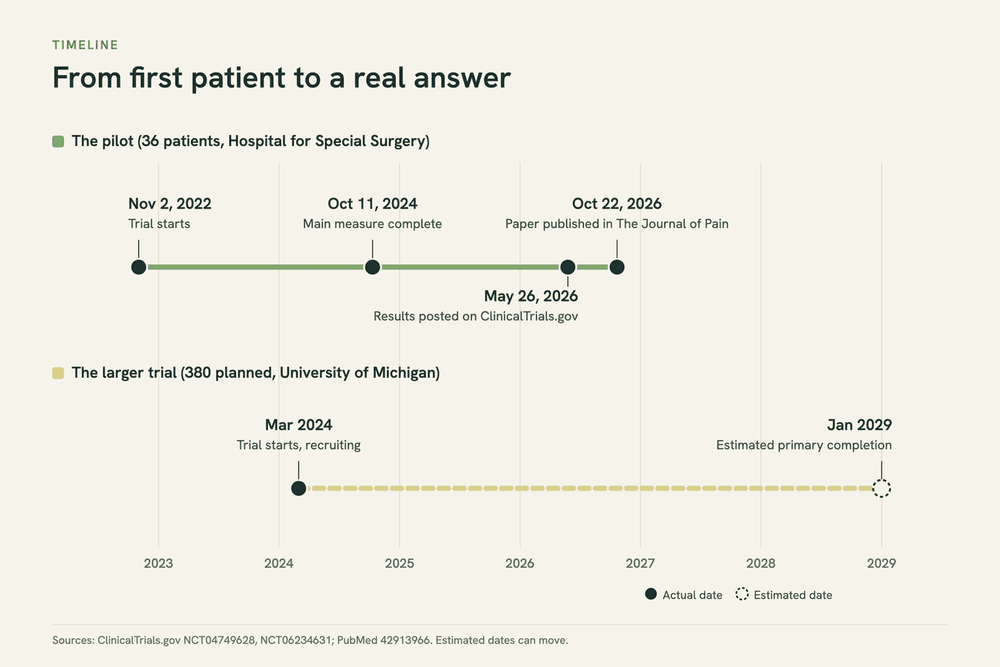
The trial was registered in advance as NCT04749628. It started on November 2, 2022, and finished collecting its primary outcome on October 11, 2024. Its results on ClinicalTrials.gov were first posted on May 26, 2026, so the arm-by-arm numbers have been public for five months; the peer-reviewed paper and its statistical tests are what is new. A note on how we read it: the full text sits behind the publisher's paywall and was not reachable to us, so this report rests on the PubMed abstract and the registry results. The registry posts no statistical tests, so every p-value on this page comes from the paper. We compared every figure that appears in both and found no numeric discrepancy, only differences of emphasis, which we point out where they matter.
What it found, outcome by outcome
The primary outcome, chosen before the trial began, was cumulative opioid use over the first 72 hours after surgery, measured in MME (morphine milligram equivalents, a way to put different opioids on one scale). The table puts it first, then the post hoc test, then the secondary outcomes the registry reports. Each row is labelled, because the label decides how much weight a number can carry. A primary result is the trial's planned test. A secondary result is something else the trial measured. A post hoc result comes from an analysis chosen after the data were in.
| Measure | Type | Placebo (12) | 400 mg arm (12) | 800 mg arm (12) |
|---|---|---|---|---|
| Opioid use over 72 hours, mean MME (SD) | Primary | 209.0 (72.6) | 144.0 (77.1), p = 0.10 vs placebo | 203.2 (88.5), p = 0.98 vs placebo |
| Same comparison, re-tested after the fact | Post hoc | Reference | p = 0.04 vs placebo | Not reported |
| Needed rescue hydromorphone (by vein or under the skin) | Secondary | 10 of 12 | 4 of 12 | 11 of 12 |
| Average pain at rest on day 3, median (0 to 10 scale) | Secondary | 6.0 | 3.0 | 5.0 |
| Meloxicam (an NSAID), day of surgery to day 3, mean mg | Secondary | 13.1 | 17.5 | 21.9 |
| Ketorolac (an NSAID), day of surgery to day 3, mean mg | Secondary | 50.0 | 47.5 | 51.3 |
| Opioids from discharge to day 7, mean MME | Secondary | 364.8 | 282.3 | 360.4 |
| Hospital stay, median hours | Secondary | 66.4 | 81.3 | 81.5 |
| Serious adverse events | Safety | 1 of 12 | 0 of 12 | 1 of 12 |
In this pilot, the secondary outcomes in the 400 mg column point the same way as its post hoc test: 4 of 12 people needed rescue hydromorphone (an opioid given when the planned medicines are not enough) against 10 of 12 on placebo, and median pain at rest on the third day was 3.0 against 6.0 on a 0 to 10 scale. These are secondary outcomes, in groups of 12, with no tests posted on the registry. Other rows cut the other way. The abstract reports greater NSAID use in the 400 mg arm, and the registry shows the NSAID difference was in meloxicam, and it was higher in both CBD arms: a mean of 17.5 mg at 400 mg and 21.9 mg at 800 mg, against 13.1 mg on placebo, from the day of surgery through day 3. Ketorolac, another NSAID, and acetaminophen totals were similar across the three arms. The trial did not use ibuprofen; if you want the broader picture of how CBD and NSAID pain relievers have been studied together, that is a separate question with its own evidence. Median hospital stays were longer in both CBD arms, about 81 hours against 66 on placebo. The record does not explain that, and we will not guess.
The 800 mg arm: more side effects, no opioid saving
The abstract is direct: the 800 mg group "showed no opioid-sparing effect and had greater adverse event burden." Its mean 72-hour opioid use, 203.2 MME, was almost the same as placebo's 209.0, and 11 of its 12 patients needed rescue hydromorphone. The registry's side-effect checklist, which asked every participant about specific symptoms on set days, makes the burden concrete. Counts are people out of the number the registry reports for that day (12 in most rows, 11 in two cells), because percentages of groups this small exaggerate how precise these numbers are.
| Measure | Placebo | 400 mg arm | 800 mg arm |
|---|---|---|---|
| Dry mouth, day 7 after surgery | 1 of 11 | 2 of 12 | 8 of 11 |
| Sleepiness (somnolence), day 1 | 5 of 12 | 3 of 12 | 8 of 12 |
| Stomach upset, day 1 | 3 of 12 | 4 of 12 | 6 of 12 |
| Low blood sodium (hyponatremia) | 4 of 12 | 3 of 12 | 5 of 12 |
| Serious adverse events | 1 (bowel obstruction) | 0 | 1 (drop in blood oxygen) |
| HADS anxiety, median: before surgery / day 2 | 3.0 / 2.0 | 6.5 / 4.0 | 6.0 / 5.0 |
| HADS depression, median: before surgery / day 3 | 2.0 / 3.0 | 3.5 / 2.5 | 4.5 / 6.0 |
| IL-6 rise from before surgery to day 1, mean pg/mL | 12.3 | 20.6 | 17.7 |
Two rows in that table need context. First, mood. The authors report that anxiety and depression scores were higher in the CBD groups, particularly at 800 mg. The scale is the Hospital Anxiety and Depression Scale (HADS), a short questionnaire with separate anxiety and depression scores, where higher means more symptoms. The registry's pre-operative medians were already higher in both CBD arms (anxiety 6.5 and 6.0 against 3.0 on placebo; depression 3.5 and 4.5 against 2.0), and the abstract does not say how that was handled. The registry also does not say whether that first reading came before or after the first dose. So the honest reading is that the CBD groups scored higher on these questionnaires, starting before surgery, and this pilot cannot tell you why. Second, IL-6, a blood marker of inflammation, rose more from before surgery to the next day in both CBD arms. That is one marker at one time point. It is not evidence that CBD increases inflammation, and it is not evidence of the opposite either. The authors also report improved subjective sleep domains in the CBD groups; the registry's sleep results are mixed and carry no posted tests, so we report that line as the authors' and go no further. For the side effects reported with CBD in other human research, see our guide to CBD side effects and who should be careful.
Why a post hoc p of 0.04 is not a finding of benefit
The protocol and statistical plan posted with the registry record named Dunnett's test in advance, a method for comparing each CBD arm against placebo while accounting for the fact that two comparisons are being made, and it set no power calculation: the fields for alpha, power and expected effect size are left blank. A power calculation is how a trial works out how many people it needs to detect a real effect, so a trial without one is not sized to deliver a verdict. That is normal for a pilot, and it is why its p-values are not verdicts. The planned test returned p = 0.10 for the 400 mg arm. The abstract then reports that "post hoc testing demonstrated lower opioid use with 400mg CBD compared with placebo (p=0.04)," without naming the post hoc test. A post hoc test in this pilot found lower opioid use in the 400 mg arm; a post hoc result generates a question, it does not answer one. If you want a worked example of how evidence is graded once many trials exist, our report on the Cochrane review of cannabis for insomnia walks through it.
This matters because of how the paper summarizes itself. The paper's one-line perspective statement, which leans on the post hoc result of a pilot whose planned comparison missed, reads: "Among BTKA patients, 400mg cannabidiol reduced opioid use and pain while remaining tolerable, whereas higher dosing increased side effects, supporting further evaluation of CBD analgesia." Set it beside the primary result it summarizes: 144 against 209 MME, p = 0.10. That perspective line is the sentence most likely to be lifted into headlines, so if you see a claim that CBD cut opioid use after knee replacement, it traces back to a post hoc result in this 36-person pilot. The authors' formal conclusion is more careful:
“These pilot data suggest a potential therapeutic signal at moderate dosing but not at higher doses. Larger trials are needed to confirm efficacy and define optimal dosing.”
Where it sits next to the earlier surgery trials
Our guide to CBD before surgery reads the earlier randomized, placebo-controlled trials that gave cannabidiol after an operation, including the one-year follow-up of the largest. Here is where this one sits next to them. We link rather than re-explain the older three; the guide covers each in detail.
| Year, journal | Operation | What was given | Patients | Main result |
|---|---|---|---|---|
| 2022, American Journal of Sports Medicine | Arthroscopic rotator cuff repair | Buccal tablet, 25 or 50 mg three times daily for 14 days | 99 analyzed | Pain lower on day 1 only (4.4 vs 5.7); no difference in opioid use; no differences at one year |
| 2022, Journal of Arthroplasty | One knee replaced | Topical CBD three times daily for 2 weeks | 80, in four arms | Did not reduce pain or opioid use, or improve sleep scores |
| 2023, Journal of Urology | Ureteroscopy with a stent | 20 mg a day of the prescription oral solution for 3 days | 90 | In the authors' words, safe but ineffective |
| 2026, The Journal of Pain | Both knees replaced, same day | Prescription oral solution, 400 mg or 800 mg arm, four perioperative doses | 36 (pilot) | Primary outcome missed (p = 0.10 and p = 0.98); post hoc signal at 400 mg |
Read across the ledger and one pattern holds: none of the four showed a significant drop in opioid use on a test planned in advance. Among the three older trials, the only pain difference lasted a day; the new pilot reports lower pain scores at 400 mg as a secondary outcome, with no tests posted on the registry. The new trial is the only one of the four that compared two oral doses against placebo. Two other trials sit outside this ledger, for different reasons. A 2024 root canal trial in the Journal of Endodontics compared a CBD-rich extract with placebo and found no significant difference in postoperative pain at any time point, but dental pain is a different setting and its abstract does not state its size. A July 2026 eye-surgery crossover trial in 35 adults compared CBD with a codeine combination rather than placebo, so it cannot tell you whether CBD does better than nothing. And a 2026 scoping review of cannabinoids for acute pain, which searched studies published from 2016 up to April 2026, concluded that an opioid-sparing effect had not been demonstrated for acute postoperative pain. This pilot does not change that verdict.
What this does not change
- The FDA has approved one CBD medicine, for specific seizure conditions. It has approved no CBD product for pain, and this trial does not change that.
- No trial in the ledger above shows that a retail CBD product reduces surgical pain or the need for opioids. This one tested a prescription drug, given on a fixed schedule, under hospital supervision.
- The 400 mg and 800 mg arms are prescription-trial amounts, far outside anything a retail product is labelled for. They are not a dosing reference.
- If you use CBD in any form, your anesthesia team still needs to know before surgery: the product, the amount on its label and when you last took it.
- Nothing here supports adding CBD to a recovery plan, swapping it for prescribed pain medicine, or cutting back an opioid on your own.
- Whether CBD interacts with your other medicines is a separate question from whether it helps, and it belongs with your surgical team.
The sources behind that list, read on October 24, 2026. The FDA's page on how it regulates cannabis and CBD products describes its single approved CBD drug, and none of its approvals is for pain. If you are unsure why a prescription solution and a store-bought oil cannot be compared milligram for milligram, our explainer on Epidiolex versus over-the-counter CBD oil covers what separates them. What to say to your anesthesiologist, and when, is in the disclosure section of our surgery guide. And because opioids are the medicine this trial measured, how CBD and opioid pain medicines can interact has its own page.
What would settle it
A 380-patient trial at the University of Michigan, funded by the NIH's arthritis institute (NIAMS), started in March 2024, is recruiting now and lists January 2029 as its estimated primary completion. Its design addresses several of this pilot's limits. It is about ten times larger. It is placebo-controlled, with patients, care providers and investigators all masked, and uses a 2x2 factorial design, which means patients are randomized to CBD or placebo before surgery and, separately, to CBD or placebo after it, so the two timings can be tested apart. It studies people having one knee replaced rather than both, gives 300 mg a day (150 mg twice daily) as designed, and measures total opioid use over 28 days rather than 72 hours. A trial of that size, with its main measure set in advance, is what can show whether a signal like the one in this pilot holds up.
One more record is worth knowing about. A separate knee-replacement pilot, which used an oil containing CBD with a small amount of THC in a 25:1 ratio, enrolled 39 people and posted registry results on September 8, 2026. It is not a CBD-only trial, and we print no outcome numbers from it until a peer-reviewed paper appears.
Until then, the broader picture of what human evidence can and cannot support for CBD still applies: for pain, human evidence on CBD alone is limited and mixed, and a single pilot does not move it.
If you have a knee replacement coming up
This trial gives you no basis to start, stop or change anything. Its patients took a prescription drug under supervision, after screening out recent cannabis use, chronic opioid use and antidepressants. If you use CBD or are thinking about it, bring that to your surgeon and anesthesiologist before the operation, along with the product and the amount on its label, and follow the pain plan your team gives you afterward.
Frequently asked questions
Not on this trial's main measure. Neither the 400 mg arm nor the 800 mg arm differed significantly from placebo on opioid use over the first 72 hours (p = 0.10 and p = 0.98). A post hoc test in this pilot found lower opioid use in the 400 mg arm, which is a question for a larger trial, not an answer. A 380-patient trial at the University of Michigan is designed to test it, with results expected no earlier than 2029.
This trial gives no basis to start, stop or change anything. It used a prescription drug, under hospital supervision, in people screened for no recent cannabis use, no chronic opioids and no antidepressants. Ask your surgical team before adding anything to your recovery, and tell them about any CBD you already use.
No. The trial used the prescription oral solution in fixed research amounts, far outside what retail products are labelled for. The prescription label itself doses by body weight, under a doctor's care, for specific seizure conditions. These numbers are not a reference for any product you can buy.
It is a real question, which is why anesthesia guidance asks you to tell the team about any cannabinoid use before surgery. Our surgery guide covers what to tell your anesthesiologist, and our page on CBD and opioid pain medicine covers the interaction research. The decision about your medicines belongs to your surgical team.
The trial was not designed to explain it. The authors write that the pilot data suggest a potential therapeutic signal at moderate dosing but not at higher doses. What the record shows is that the 800 mg arm had no opioid saving and more side effects, for example dry mouth on day 7 in 8 of 11 people assessed against 1 of 11 on placebo.
Mostly. On the trial's own blinding check, patients could not tell which arm they were in, but the staff assessing outcomes guessed the CBD assignments correctly more often than chance. The record does not say why.
Yes. A 380-patient, blinded, placebo-controlled trial at the University of Michigan is recruiting people having one knee replaced and measures opioid use over 28 days. Its estimated primary completion date is January 2029, and estimated dates often move.
If you are scheduled for surgery and use CBD, start with what to tell your anesthesiologist and when. We are adding a dated note there about this trial, and we will update this page if the full text adds anything material.
Writing about hemp, wellness and the small rituals that keep us balanced.