Cochrane Reviewed Medical Cannabis for Insomnia: What It Found, and What It Could Not Test
On October 13, 2026, Cochrane pooled 9 randomized trials in 537 adults with insomnia. Medical cannabis may have little to no clinically meaningful effect on sleep, on very low-certainty evidence, with more adverse events (low certainty).

On October 13, 2026, Cochrane published its first review of medical cannabis for insomnia. The team pooled 9 randomized trials with 537 adults and concluded that medical cannabis "may have little to no clinically meaningful effect" on sleep quality, total sleep time or daytime functioning. Every one of those results is rated very low certainty, which means the true effect could be quite different from the estimate. Adverse events were more common on cannabis than on placebo, a finding rated low certainty. This is a report on the evidence, not a verdict on any product, and it is not a CBD-only or CBN-only result.
What Cochrane published on October 13
The review is Medical cannabis for the treatment of insomnia, published in the Cochrane Database of Systematic Reviews and indexed on PubMed on October 13, 2026. Its eight authors were led by researchers at the Cochrane associated centre at Universidad Hospital Italiano de Buenos Aires and the University of Manitoba. Cochrane is an independent organization that produces systematic reviews of health evidence. It is not a regulator, and it does not approve or ban anything. Its reviews follow a fixed method: search every major database and trial register, keep only the trials that meet rules written in advance, check each trial for bias, pool the results where the trials are similar enough, and then grade how much confidence the pooled numbers deserve. That grading system is called GRADE, and it has four levels: high, moderate, low and very low. Here is the authors' conclusion, in full:
“Medical cannabis may have little to no clinically meaningful effect on quality of sleep/satisfaction with sleep, total sleep time, or daytime functioning. It may lead to an improvement in quality of life, although the evidence is very uncertain. Medical cannabis may result in a slight increase in adverse events, but the certainty of this evidence is low.”
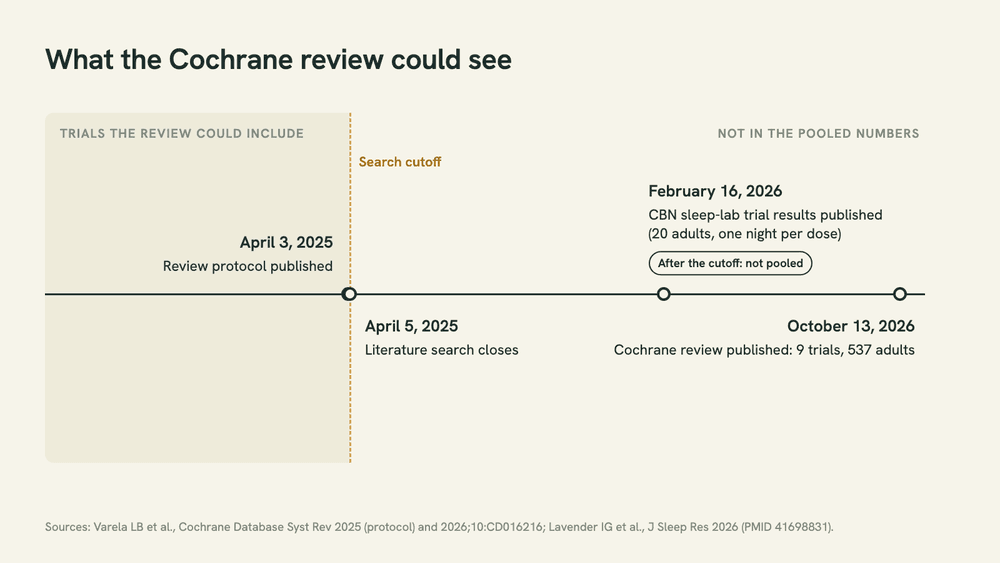
The scope, as the abstract describes it: 9 trials with 537 participants aged 18 to 76, 72.66% of them women. Most trials studied primary insomnia, meaning insomnia that is not explained by another condition; one focused on insomnia that came with other health problems. Three studied acute insomnia and six studied chronic insomnia, which Cochrane defines as trouble sleeping at least three times a week for three months or more. Eight trials compared cannabis with a placebo, and one compared it with amitriptyline, an antidepressant. Two trials used licensed medicines (one plant-based cannabinoid, one synthetic) and seven used magistral preparations. The review's published protocol uses that term for prescribed, pharmacy-made preparations with a defined THC or CBD content, such as plant extracts, resins or herbal cannabis. The search covered CENTRAL, MEDLINE, Embase, Global Index Medicus and two trial registers, and it last ran on April 5, 2025, which is why Cochrane's plain-language summary says the evidence is current to April 2025. The review had no dedicated funding, and its authors declare no conflicts of interest relevant to it.
A note on how we read it. The full text was not publicly available to us on publication day, so this report rests on the published abstract, Cochrane's plain-language summary and press release, and the open protocol. Where those sources are silent, we say so rather than guess. Citation: Varela LB, et al. Medical cannabis for the treatment of insomnia. Cochrane Database Syst Rev 2026;10:CD016216. doi:10.1002/14651858.CD016216.pub2.
The numbers, outcome by outcome
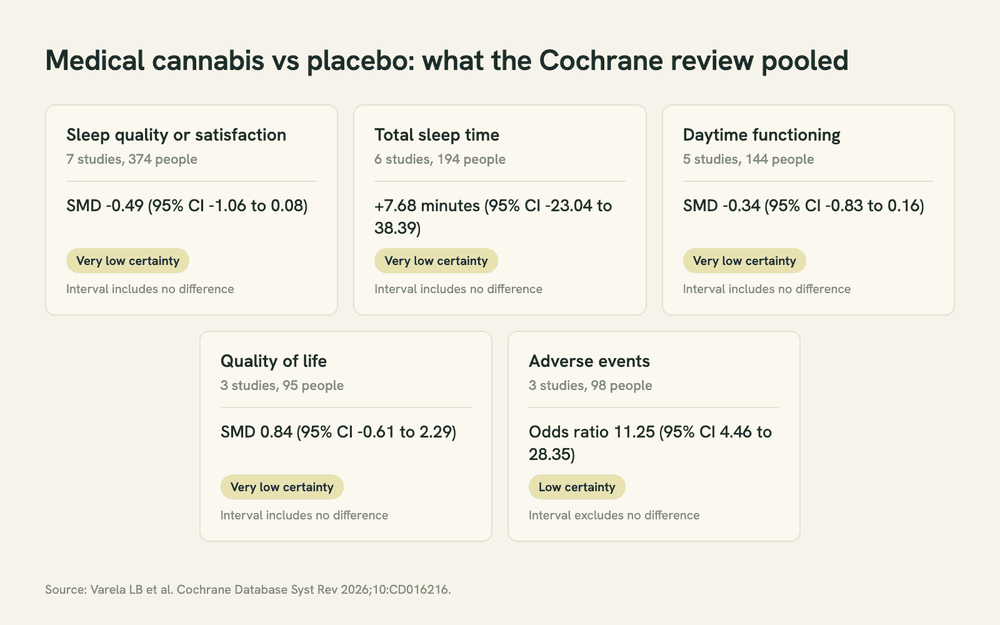
Here is every pooled result the abstract reports for medical cannabis compared with placebo, with the number of studies and people behind each one and the certainty Cochrane assigned to it. None of the news coverage we read on publication day printed these figures.
| Outcome | Studies | People | Pooled estimate (95% CI) | I² (inconsistency) | Certainty (GRADE) |
|---|---|---|---|---|---|
| Sleep quality or satisfaction | 7 | 374 | SMD -0.49 (-1.06 to 0.08) | 91% | Very low |
| Total sleep time | 6 | 194 | MD 7.68 minutes (-23.04 to 38.39) | 80% | Very low |
| Daytime functioning | 5 | 144 | SMD -0.34 (-0.83 to 0.16) | 65% | Very low |
| Quality of life | 3 | 95 | SMD 0.84 (-0.61 to 2.29) | 78% | Very low |
| Adverse events | 3 | 98 | OR 11.25 (4.46 to 28.35) | 0% | Low |
How to read it. A 95% confidence interval (CI) is the range of effects the data are reasonably compatible with. For the first four outcomes, the interval includes zero, the point of no difference, so the data fit no effect about as well as they fit a small one. Total sleep time is the easiest to picture: on average about 8 more minutes of sleep (6 studies, 194 people, very low certainty), with an interval running from 23 minutes less to 38 minutes more. An SMD, or standardized mean difference, puts different sleep questionnaires on one common scale so they can be pooled. Whether a minus sign means better or worse depends on how each questionnaire is scored, so we do not read anything into the sign and take direction only from the authors' words. I² estimates how much the trials disagree with each other beyond what chance would explain: 65% to 91% on the efficacy outcomes means they disagreed a lot. For quality of life, the authors write that cannabis "may lead to an improvement", but the evidence is very uncertain: 3 studies, 95 people, and an interval that Cochrane's press release on the review calls "compatible with anything from a slight worsening to a large improvement." The review also looked at how long it takes to fall asleep, time spent awake after falling asleep, and withdrawal effects. Those results are not in the published abstract or summary.
The side-effect signal, and two ways of describing it
Adverse events are the one outcome where the interval does not include no difference. The pooled result comes from 3 studies with 98 participants in total. These were crossover trials, so each person spent one period on cannabis and one on placebo, and the abstract counts who had an adverse event in which period.
An odds ratio compares the odds of an event in one group with the odds in another, and 1 means no difference. Here the estimate is 11.25, with a plausible range from 4.46 to 28.35 and no measurable disagreement between the three studies beyond chance (I² 0%), rated low certainty. Cochrane describes this one result in three different ways. The abstract says medical cannabis "may result in a slight increase in adverse events, but the certainty of this evidence is low." The plain-language summary says it "may cause slightly more unwanted effects". The press release says participants "were substantially more likely to experience mild adverse events, such as a dry mouth and dizziness, than those on placebo; but this was based on a small pool of studies." We are not going to choose between "slight" and "substantially" for you. The counts above are what all three descriptions refer to, and you can weigh them yourself. Two limits apply to every reading: the result rests on three small studies and 98 people, rated low certainty, and it pools mixed preparations, so it is not a safety verdict on any specific product. For the side effects reported with CBD in other human research, see our guide to CBD side effects and who should be careful.
Why the evidence rates as very low certainty
Cochrane downgraded the efficacy evidence for three reasons, in the authors' words "high risk of bias, serious inconsistency, and imprecision." In practical terms, using what the abstract, the summary and the press release report:
- Risk of bias: the trials had design or reporting problems that could tilt their results, judged with Cochrane's standard risk-of-bias tool, RoB 2.
- Inconsistency: the trials disagreed with each other, with I² between 65% and 91% on the efficacy outcomes.
- Imprecision: each outcome rests on 95 to 374 people, and every efficacy interval includes no difference.
- Small and short: Cochrane's summary says most trials included fewer than 50 people and lasted only a few weeks, and the longest followed participants for 12 weeks.
- Narrow populations: 72.66% of participants were women, and many trials did not include older adults or people with other health problems.
- Mixed products: THC, CBD or both, in different forms and amounts, mostly compounded, pooled as one category called medical cannabis.
“This does not mean that medical cannabis is ineffective. It means that, based on the evidence we have, we cannot draw reliable conclusions about its effectiveness for insomnia in the general population.”
What this review does not tell you about CBD, CBN or store-bought products
Cochrane's summary says the trials used products "containing tetrahydrocannabinol, cannabidiol, or combinations of both", given "as oils, capsules or gel". Seven of the nine used magistral preparations and two used licensed medicines, which is a different world from a retail shelf; the difference between a licensed cannabinoid medicine and an over-the-counter CBD oil explains why results do not transfer cleanly from one to the other. The protocol planned to compare product types, along with sex, insomnia type, treatment length and age under or over 65. No such result appears in the abstract or Cochrane's summary, and the full text was not available to us on publication day. So the pooled result is not a CBD-only result and not a CBN-only result, and the review does not rate any specific retail product. The table below places the sleep trials you are most likely to have read about relative to the review.
| Trial | What was tested | Who and how long | Relation to the Cochrane review |
|---|---|---|---|
| Narayan 2024 | 150 mg CBD vs placebo, sublingual | 30 adults, primary insomnia, 2 weeks | Cited in the reference list. Main insomnia measures similar to placebo. |
| Wang 2025 | 300 mg CBD + 8 mg terpenes vs placebo, capsules | 125 adults with insomnia, crossover, 4 weeks | Cited. No CBD-only arm. |
| Walsh 2021 | ZTL-101 sublingual cannabinoid extract vs placebo | 24 randomized, chronic insomnia, 2 weeks per arm | Cited. |
| Suraev 2024/2025 | Single dose 10 mg THC + 200 mg CBD vs placebo | 20 adults, insomnia disorder, one night each | Cited. Less total sleep and less REM sleep on the active night. |
| Hausenblas 2025 | Soft gel, 3 mg THC + 6 mg CBN + 10 mg CBD + terpenes | 20 adults, subthreshold insomnia, 10 days | Cited. |
| Lavender 2026 | 30 or 300 mg CBN vs placebo | 20 adults, insomnia disorder, one night each | Results published February 2026, after the search. Only the protocol and registry are cited. Not in the pooled numbers. |
| Bonn-Miller 2024, Kolobaric 2024 | CBN, with or without CBD, industry-run | Poor sleepers, 1 to 4 weeks | Not in the reference list. |
Two points in that table matter most if you have read about CBN for sleep. First, the 2026 placebo-controlled sleep-lab trial of CBN in adults with insomnia disorder was published in February 2026, ten months after the review's search, and it missed its main outcome, time awake after falling asleep. The review cites only that trial's protocol and its registry record, so its results are not in the pooled numbers in either direction. Our CBN and melatonin comparison reads that trial and the industry studies in detail, and if you are not sure what CBN is, start with our explainer on cannabinol and how it forms. Second, the review's reference list also cites a 2025 pilot of a product that contained CBN alongside THC and CBD, and we cannot see whether it was pooled. On CBD alone, the best-known insomnia trial, a 2024 pilot in 30 adults with primary insomnia, found its main insomnia measures similar to placebo and is cited in the review; our evidence guide to CBD and sleep reads that trial in full.
What did not change
- No new trial. The review pools trials found by its April 5, 2025 search. It adds pooled estimates and certainty ratings, not new data.
- No cannabis or cannabinoid product is FDA-approved for insomnia, as of October 13, 2026.
- CBT-I is still the recommended first-line treatment for chronic insomnia in the American College of Physicians and American Academy of Sleep Medicine guidelines, both strong recommendations.
- The 2025 VA/DoD insomnia guideline already suggested against cannabis and its derivatives for chronic insomnia, a weak recommendation made before this review existed.
- The adverse-event signal is low certainty and comes from 3 studies and 98 people. It is not a safety verdict on any product.
- Nothing in the review rates a specific CBD, CBN or THC retail product, and nothing on this page is about Planntz products.
The sources behind that list, read on October 13, 2026. The FDA's page on cannabis research and drug approval states that "the FDA has not approved a marketing application for cannabis for the treatment of any disease or condition," and none of the cannabinoid drugs it has approved is indicated for insomnia. The American College of Physicians' 2016 insomnia guideline recommends that all adults with chronic insomnia disorder receive cognitive behavioral therapy for insomnia (CBT-I) as the initial treatment, a strong recommendation based on moderate-quality evidence. The American Academy of Sleep Medicine's 2021 behavioral treatment guideline gives multicomponent CBT-I a strong recommendation for chronic insomnia in adults. The 2025 VA/DoD clinical practice guideline for insomnia, written for the Veterans Affairs and Defense health systems, recommends CBT-I and states "we suggest against the use of cannabis and/or its derivatives" for chronic insomnia disorder, a weak recommendation. And NCCIH's page on sleep disorders, last updated May 2024, calls CBT-I "the most strongly recommended treatment for insomnia" and summarizes a 2020 review of 12 studies with 250 participants that found insufficient evidence for cannabinoid therapies in any sleep disorder. The Cochrane review does not change any of these positions.

If sleep is the problem you are trying to solve
This review is a statement about evidence, not about your nights. If sleep is what you want to fix, the guideline starting point is CBT-I, a structured talking therapy aimed at the habits and thoughts that keep insomnia going, and a clinician can help you find it in person or through a structured program. If you use cannabis, including THC at bedtime, tell your clinician, because it matters for how your sleep is assessed. Our look at what THC does to sleep stages, including REM covers that side of the question.
What comes next
The authors call for "adequately powered, well-designed randomized trials with longer follow-up, standardized outcomes, and detailed reporting of efficacy and safety, including long-term harms," with results broken down by sex and age. Trials published after April 5, 2025, including the 2026 CBN trial, will only enter the pooled numbers when Cochrane updates the review. Other syntheses can reach different answers because they pool different trials in different people: a separate 2025 meta-analysis in Sleep Medicine Reviews that also counted people without insomnia reported a pooled improvement in self-rated sleep quality, and no significant effect in its CBD-only subgroup. Different trials and different people are one reason reviews disagree. We will update this page if the full text adds anything material, such as a breakdown by product type.
“Rather than viewing the findings as either an endorsement or a rejection of medical cannabis, clinicians and patients should recognize the uncertainty and consider individual circumstances while better evidence is generated.”
Questions readers are asking
No. It found that medical cannabis may have little to no clinically meaningful effect on sleep quality, total sleep time or daytime functioning, on very low-certainty evidence. The lead author put it plainly in Cochrane's press release: this does not mean medical cannabis is ineffective, it means the evidence does not allow reliable conclusions. The honest summary is unproven, not disproven.
Not directly. The trials used THC, CBD or both, mostly as compounded medical preparations, and the published summary reports no CBD-only result. The review assesses medical cannabis as a category and does not rate any retail product. Separately, the best-known CBD-only insomnia trial, a 2024 pilot in 30 adults, found its main insomnia measures similar to placebo.
Cochrane's summary describes the products as THC, CBD or combinations of both and does not mention CBN. The reference list cites a 2025 pilot of a soft gel that contained CBN alongside THC and CBD, but we cannot see whether it was pooled. The only placebo-controlled sleep-lab trial of CBN in insomnia was published in February 2026, after the April 2025 search, and missed its primary outcome.
In the 3 studies with 98 people that reported them, 37 people had adverse events only during the cannabis period, 0 only during placebo, 14 in both periods and 47 in neither. The pooled odds ratio was 11.25 (95% CI 4.46 to 28.35), rated low certainty. Cochrane's press release names dry mouth and dizziness as examples and describes the events as mild.
It is the lowest of the four GRADE levels. It means the real effect could be quite different from what the pooled numbers show. Here the reasons were high risk of bias, trials that disagreed with each other, and small samples that left confidence intervals wide enough to include no effect.
Cognitive behavioral therapy for insomnia (CBT-I) as the first-line treatment for chronic insomnia, a strong recommendation from both the American College of Physicians (2016) and the American Academy of Sleep Medicine (2021). The 2025 VA/DoD guideline also recommends CBT-I and suggests against cannabis and its derivatives for chronic insomnia, a weak recommendation. Decisions about medicines belong with a clinician.
Single trials are small and often rely on self-reported sleep, populations differ (people with diagnosed insomnia versus people who simply sleep poorly), and products differ. A separate 2025 meta-analysis that also included people without insomnia reported a pooled improvement in self-rated sleep quality, with no significant effect in its CBD-only subgroup. Different trials and different people are one reason syntheses disagree.
Cochrane reviews follow a protocol published in advance, search widely and grade certainty openly, which is why clinicians and guideline panels use them. A review is only as strong as the trials it pools, though, and here those trials were few, small and short. Cochrane is an independent evidence-synthesis organization, not a regulator.
The evergreen question, what human research does and does not show about CBD and sleep, lives in our full guide to the CBD and sleep evidence, which we are updating with a dated note on this review.
Writing about hemp, wellness and the small rituals that keep us balanced.