HHS Proposes Changes to Federal Drug Testing: What Changes, and What Stays the Same for THC and CBD
HHS proposed revisions to the federal workplace drug-testing guidelines on October 29, 2026. Most changes are lab mechanics. Marijuana stays on every test, cutoffs do not move, and secondhand smoke is still not an accepted explanation. Comments close December 28.

On October 29, 2026, HHS's Substance Abuse and Mental Health Services Administration (SAMHSA) published proposed revisions to the federal workplace drug-testing guidelines for urine, with a companion proposal for oral fluid. It is the first proposed revision since the current rules came out in October 2023, and most of it is laboratory mechanics. If you use CBD or hemp products, the bigger news is what it leaves alone. Nothing in it is in effect, and comments are open until December 28, 2026.
What HHS proposed on October 29
The urine document is Federal Register document 2026-22122 (91 FR 68398, 48 pages), and you can read HHS's proposed revisions to the urine guidelines in full. Its companion, document 2026-22121 (91 FR 68364, 32 pages), is the proposed revision of the oral-fluid guidelines. Both would revise the rules in force today: the urine guidelines published October 12, 2023 (88 FR 70768) and the 2023 oral-fluid guidelines (88 FR 70814).
These guidelines govern how federal agencies drug-test their employees: how specimens are collected, which drugs labs test for, how certified laboratories run and report tests, and how the Medical Review Officer (MRO), the physician who reviews a lab result before the employer sees it, decides what it means. HHS estimates federal agencies test about 275,000 urine specimens a year under these rules. This page reflects both documents as we read them on October 30, 2026. It is news reporting, not legal advice.
What would change
Section numbers below refer to the proposed urine guidelines. Each item would apply only if HHS finalizes it.
- pH line: the invalid pH range for urine would start at 9.5 instead of 9.0 (Sections 3.10(b), 11.18 and 12.14).
- Biomarker check: an MRO could authorize a lab to test a specimen reported invalid on creatinine and specific gravity for an HHS-authorized biomarker, to determine whether it was substituted (11.19).
- Biomarker process: the split-specimen lab could reconfirm with a different authorized biomarker (14.4(b)), and a new Section 3.3 would require HHS authorization before a lab tests for one.
- Panels: the drug panel would leave the guideline text, the yearly republication would end, and HHS would publish a notice only when panels change (3.5).
- Lab types: HHS could certify labs that test only split (B) specimens, and labs that run additional drug or validity tests (1.5).
- Quality control: screening batches would carry 4 percent control samples instead of 10 percent; confirmation batches would stay at 10 percent (11.12, 12.11).
- Refusal to test: failing to cooperate would expressly include a donor who "does not consent to testing or withdraws consent for testing" (1.7(a)(8)).
- Refusal to test: "prosthetic or other device that could be used to interfere" would become "device intended to subvert or interfere with the collection process" (1.7(a)(12)).
- Observed collections: the definition of "gender identity" would be deleted, and the observer would have to be the same sex as the donor (4.4(b)).
- Pre-employment: tests would cover "all applicants including federal agency employees" (2.2(a)).
Two changes concern what the MRO does next. Under the 2023 text, when an invalid result has a legitimate explanation, the MRO tells the agency a recollection is not required, whatever the reason for the test. The proposal would tie the next step to the reason for the test: the same outcome for a random, post-accident or reasonable-suspicion test, but an immediate new collection, unobserved urine or oral fluid, when a negative result is required, as for a pre-employment, return-to-duty or follow-up test (13.5(f)). Section 13.6(b) would apply the same logic when a donor cannot provide enough urine and a medical evaluation finds a condition, in several cases pointing to an oral-fluid collection. Separately, HHS's oral-fluid proposal states: "No laboratories have been certified to test oral fluid at this time."
Why HHS wants to move the pH line
pH measures how acidic or alkaline urine is, and it is one of the checks labs use to decide whether a specimen is valid. Citing laboratory data presented at the December 2024 meeting of SAMHSA's Drug Testing Advisory Board, HHS says extended time at high temperature after collection can push urine in the normal range to pH 9.1 to 9.3, that results between 9.0 and 9.5 rise in summer months, and that pH above 9.5 does not come from heat and shipping time.
HHS puts that 9.0 to 9.5 band at about 0.2 percent of specimens, roughly 15,000 a year, in data from HHS-certified laboratories. It says handling that band is "a significant burden to HHS-certified laboratories, MROs, and federal agencies that does not result in identifying additional adulterated specimens." HHS also reviewed which drug markers can degrade in high-pH urine during shipping. It named three: benzoylecgonine (a cocaine metabolite), phencyclidine (PCP) and 6-acetylmorphine (a heroin marker). HHS did not name the marijuana metabolite among them, and its pH discussion does not mention it.
What stays the same for THC, CBD and hemp users
This is the part that matters if you use CBD or hemp products. Each row below reads the same in today's rules and in the proposed text. The proposal changes how panels are published, not the numbers in them: the current panel is HHS's January 16, 2025 notice of authorized testing panels (90 FR 4662, effective July 7, 2025), which HHS republished on March 13, 2026 with no changes to analytes or cutoffs. For how that panel and the MRO review play out in practice, see our delta-8 THC drug test guide.
| Unchanged | Where | What it says |
|---|---|---|
| Marijuana on every test | UrMG 3.1(a) and its oral-fluid equivalent | Each specimen is tested "for marijuana and cocaine metabolites" (urine) or "for marijuana and cocaine" (oral fluid) |
| Marijuana cutoffs | 90 FR 4662, reaffirmed in 91 FR 12308 | Urine, marijuana metabolite: 50 ng/mL initial test, 15 ng/mL confirmatory test. Oral fluid, THC: 4 ng/mL initial, 2 ng/mL confirmatory |
| Secondhand smoke | 13.5(d)(2)(i) | "Passive exposure to a drug (e.g., exposure to marijuana smoke) is not a legitimate medical explanation" |
| Food products | 13.5(d)(2)(ii) | Ingestion of "products containing marijuana" is not a legitimate medical explanation for a positive urine result |
| Doctor's recommendation | 13.5(d)(2)(iii) | An authorization or recommendation "for a Schedule 1 controlled substance is not a legitimate medical explanation" |
| Oral-fluid labs | Oral-fluid proposal, preamble | "No laboratories have been certified to test oral fluid at this time" |
| Extra tests such as THCV | 3.6 (numbered 3.5 today) | A lab may run added tests case by case for the MRO, naming tetrahydrocannabivarin as an example; already allowed |
| DOT's hemp rule | 49 CFR 40.151(f) | Not amended by this notice |
HHS's food-products rule never uses the word "hemp." DOT's rule does: under 49 CFR 40.151(f), an MRO "must not accept an assertion of consumption or other use of a hemp or other non-prescription marijuana-related product as a basis for verifying a marijuana test negative." How trace THC in a CBD product can lead to a positive is covered in our guide to CBD and drug tests, hemp foods in our hemp seed oil drug test explainer, and passive exposure in what the research says about secondhand smoke and drug tests. No product can guarantee a drug-test result.
Two rows are easy to misread. The THCV clause is not new: the 2023 text already names tetrahydrocannabivarin as an example of an extra test, and the proposal only renumbers it (why THCV can matter is in our THCV vs CBD comparison). And the missing oral-fluid lab is not new either; it matches what we reported on FDA's drug-test device exemption and in our mouth swab drug test guide.
A search of both documents for "hemp," "cannabidiol," "Schedule III" or "reschedul" returns nothing, and the physician clause still says "Schedule 1." The proposal does not address the April 2026 change for state-licensed medical marijuana, which our Schedule III ruling explainer covers. We do not interpret what that silence means for medical-card holders. Your employer or testing program administrator is the authority for your situation.
Who these rules apply to
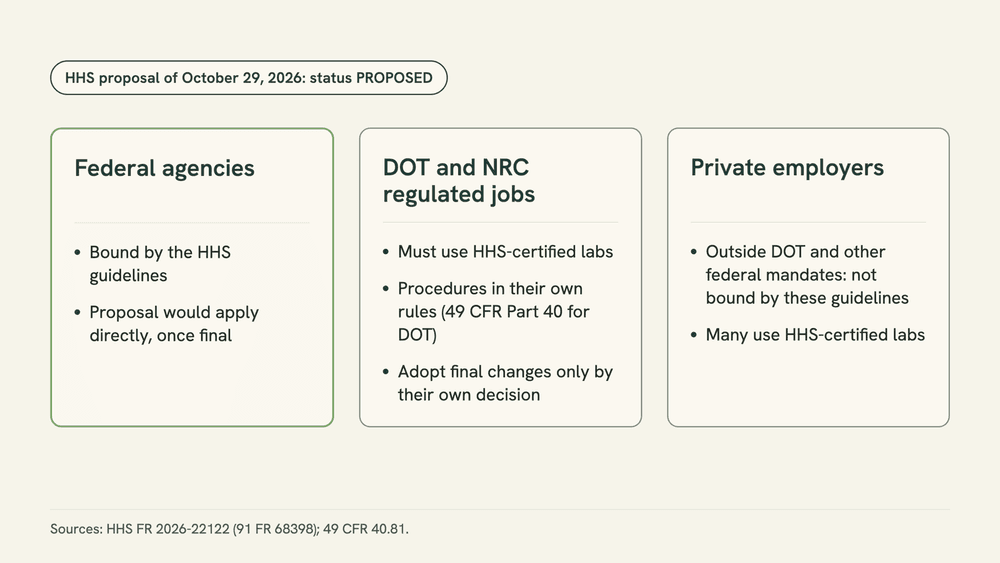
Federal agencies. The guidelines bind federal workplace drug testing programs, set up under Executive Order 12564 and related federal law. That means testing-designated federal jobs and, under the proposal, every applicant for one, current federal employees included.
DOT and NRC jobs, only if those agencies act. DOT-regulated employers must use HHS-certified labs (49 CFR 40.81), but DOT's testing procedures live in its own rule, 49 CFR Part 40, which this notice does not amend. HHS says the proposal may affect DOT- and NRC-regulated industries "depending on these agencies' decisions to incorporate the final UrMG revisions into their programs under their own authority." Separately, DOT published an October 1, 2026 notice of a petition for rulemaking on invalid-specimen determinations, including abnormal pH values. That is a petition, not a proposal, and a separate process.
Private employers. These rules do not bind private employers outside DOT and other federal mandates, though many use HHS-certified labs. For what can follow a positive result at work, see whether you can be fired for failing a drug test; for the drugs a standard panel covers, see our 10-panel drug test guide.
A short history of the federal guidelines
HHS recounts the lineage in the proposal's preamble. This is where the October 29 document fits.
- 1April 11, 1988: HHS publishes the first Mandatory Guidelines, later revised in 1994, 1997, 1998, 2004 and 2008.
- 2January 23, 2017: the urine guidelines are renamed the UrMG.
- 3October 25, 2019: HHS publishes the first oral-fluid guidelines, the OFMG.
- 4October 12, 2023: the current UrMG and OFMG are published.
- 5January 16, 2025: the current drug panel is published, adding fentanyl; it takes effect July 7, 2025.
- 6March 13, 2026: the panel is republished with no changes to analytes or cutoffs, the yearly step the proposal would end.
- 7October 29, 2026: the proposed revisions are published.
- 8December 28, 2026: the comment period closes.
- 9Next: a final notice in the Federal Register, date not set.
How to comment
Anyone can comment. The urine proposal is docket SAMHSA-2026-0002 and the oral-fluid proposal is docket SAMHSA-2026-0001; both can be found by searching the docket number on regulations.gov. The procedure, from the documents themselves:
- Deadline: on or before December 28, 2026.
- Online: open the docket for the guidelines you want to comment on and use "Submit a comment."
- Mail: SAMHSA CSAP DWP, 5600 Fishers Lane, Room 16N02, Rockville, MD 20857.
- No fax: SAMHSA says it cannot accept comments by facsimile.
- Public record: comments are posted in their entirety, including any personal or confidential business information you include.
What we will update when the final version is published
HHS will publish the final revisions as a Federal Register notice; the proposal gives no date. When it appears, we will check it against this page and our 10-panel, mouth swab and FDA device-exemption pages. We will watch three things: whether the pH, biomarker and panel-publishing changes survive, whether DOT or the NRC adopt them, and when HHS's monthly list of certified labs first includes an oral-fluid laboratory.
Frequently asked questions
No. HHS published proposed revisions on October 29, 2026, and comments are open until December 28, 2026. Federal tests still follow the guidelines published October 12, 2023 and the drug panel published January 16, 2025. A final version would come as a separate Federal Register notice, and no date is set.
No. It changes how drug panels are published, not the numbers in them. HHS would stop republishing the panel every year and issue a notice only when it changes. The current panel is the January 16, 2025 notice, which HHS republished on March 13, 2026 with no changes to analytes or cutoffs.
No. Neither word appears in either document. The rules that food products containing marijuana and passive exposure to marijuana smoke are not legitimate medical explanations for a positive stay as they are. DOT's separate rule says hemp product use cannot be the basis for verifying a marijuana test negative. No product can guarantee a drug-test result.
Not directly. DOT uses HHS-certified labs, but its procedures are in 49 CFR Part 40, which this notice does not amend. HHS says DOT and the Nuclear Regulatory Commission would each decide whether to adopt the final changes.
Three things, all on the lab and MRO side. The invalid pH range for urine would start at 9.5 instead of 9.0. An MRO could authorize a biomarker test on a specimen reported invalid on creatinine and specific gravity. And what happens after an invalid result with a legitimate explanation would depend on the reason for the test.
No. The proposal does not mention Schedule III or rescheduling, and the clause saying a physician's authorization or recommendation for a "Schedule 1 controlled substance" is not a legitimate medical explanation stays in the text. We do not interpret what that means for medical-card holders. Your employer or testing program administrator is the authority for your situation.
This page is dated October 30, 2026, and describes a proposal, not a final rule. For the bigger picture of what federal drug panels cover and how urine, saliva and hair tests compare, start with the full 10-panel drug test explainer, and for the wider legal picture, see whether CBD is legal under federal and state law.
Writing about hemp, wellness and the small rituals that keep us balanced.