How Far Back Does a Mouth Swab Drug Test Go for Weed?
Most pages say THC stays in saliva for 24-48 hours and cite nothing. Here is what controlled studies measured for occasional, frequent and daily users, smoked versus edibles, why a roadside reader and a lab can disagree, and why no federal program can run a swab test yet.
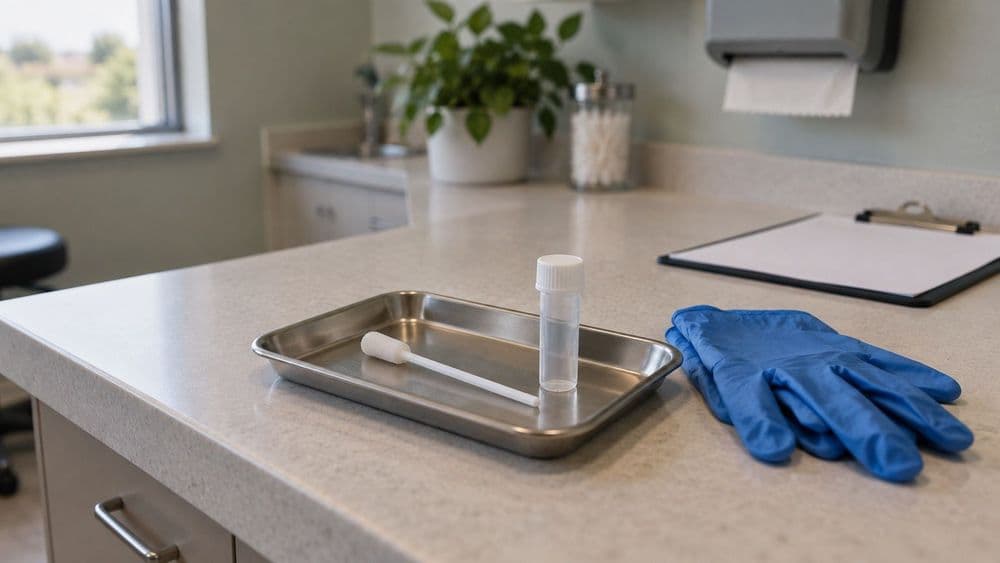
A mouth swab drug test looks for THC itself, and most of what it finds is THC left in your mouth after you used cannabis. That is why it works as a recent-use test, and why the honest answer to "how far back does a mouth swab drug test go?" depends on three things: whether the THC was smoked or swallowed, how often you use, and which device and cutoff the tester applies.
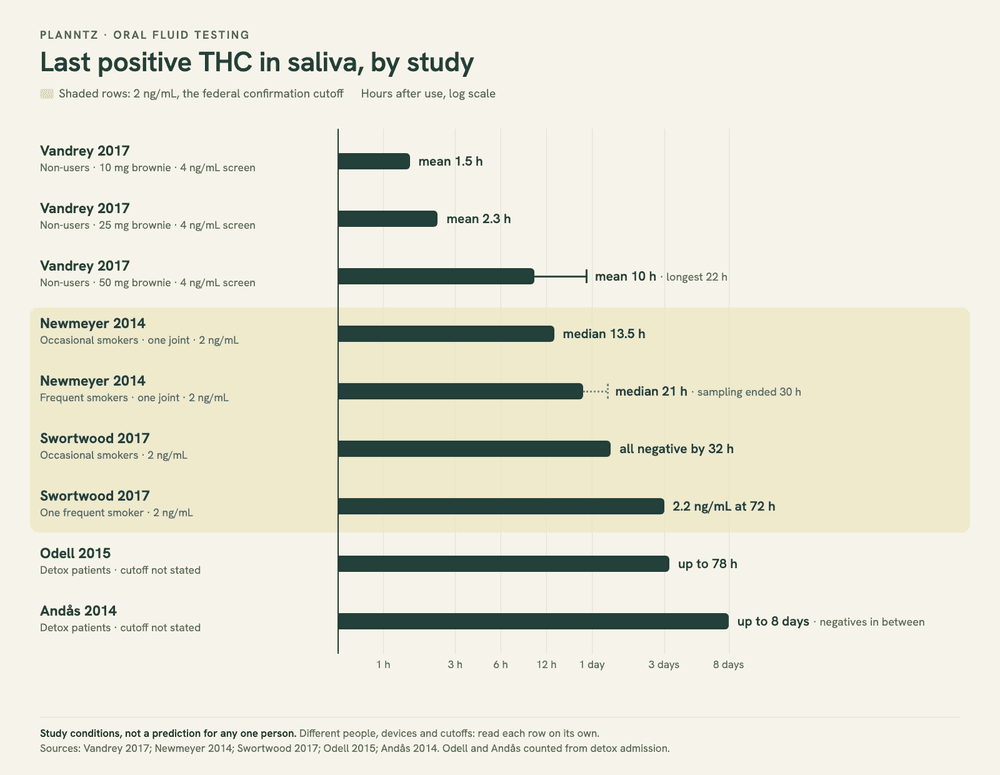
The short answer. In controlled studies, occasional users who smoked or vaped were last positive at the 2 ng/mL federal confirmation level after roughly a day or less: a median of about 13.5 hours after one joint in one study, and nobody past 32 hours in another. A brownie eaten by people who had not used cannabis in months kept saliva above a 4 ng/mL screen for hours, up to 22 hours at the highest dose tested. Frequent smokers ran longer, and some were positive before their next session even began. Heavy users entering detox have produced positives for more than 3 days and, in one study, up to 8. These are what studies measured, not a prediction for any one person.
Most pages that rank for this question print a flat "24 to 48 hours" with no study behind it. That number is not wrong so much as incomplete: it erases the differences that matter most. Below is what each controlled study actually measured, who was in it, and which cutoff produced the number, so you can see where your own situation sits and where the evidence stops.
What a mouth swab actually detects
A urine test looks for THC-COOH, a metabolite your body makes as it breaks THC down, which lingers after use. A mouth swab looks for something else. Under the HHS mandatory guidelines for federal oral fluid testing, revised in October 2023, the target is delta-9 THC itself, the active molecule, with a 4 ng/mL screening cutoff and a 2 ng/mL confirmation cutoff. Urine works on a different molecule and different numbers, and our guide to CBD and drug tests covers those.
Where does the THC in saliva come from? Mostly from your mouth. In a NIDA crossover trial of smoked, vaporized and eaten cannabis led by Swortwood, saliva THC peaked at the very first sample after people smoked, vaped or ate a brownie. The authors put that down to contamination of the lining of the mouth: the swab is mostly reading what was left behind. A Johns Hopkins study of THC brownies led by Vandrey reached the same conclusion for edibles, describing peak saliva THC as a reflection of "local topical residue rather than systemic bioavailability."
“OF cannabinoid Cmax occurred during or immediately after cannabis consumption due to oral mucosa contamination.”
The mouth is not the whole story. Frequent users can stay positive long after the residue from their last session should be gone, as the next sections show. But because the main source is the mouth, a swab tracks recent use better than it tracks how much THC is in your body. It tracks impairment poorly too. A 2022 meta-regression of 28 publications by McCartney and colleagues found that oral-fluid THC after inhalation correlated only weakly with impairment (r = -0.36) and concluded that blood and oral-fluid THC are relatively poor indicators of it. That is a science point, not a legal one: where a law or workplace policy sets a number, the number is what counts. How per se driving limits work is covered in our guide to CBD and driving, and the separate question of how long the effects themselves last is in how long a weed high lasts.
How long does weed stay in your saliva? What the studies measured
Here are the studies behind the numbers on this page, with the conditions that produced each one. Read each row on its own. The people, doses, devices and cutoffs differ, and three rows are the same 24 people measured with three different devices, which is itself a lesson in why the device matters.
| Study | Who | Route and THC dose | Device and cutoff | Last positive reported |
|---|---|---|---|---|
| Vandrey 2017 | 18 adults, no use in 3 months (6 per dose) | Brownie, 10 / 25 / 50 mg | Spit sample, 4 ng/mL screen | Mean 1.5 h / 2.3 h / 10 h; longest 22 h |
| Spindle 2019 | 17 adults, no use in past month | Smoked or vaped, 10 / 25 mg | Lab analysis, sampled for 8 h only | Some still positive at 8 h, when sampling ended |
| Newmeyer 2014 | 10 occasional, 14 frequent smokers | One joint, about 54 mg | Oral-Eze, 2 ng/mL | Median 13.5 h (5 to 26) occasional; 21 h (6 to 30) frequent; sampling ended at 30 h |
| Anizan 2013 (same people) | Same 24 people | Same joint | StatSure, 2 ng/mL | Up to 24 h occasional; up to 26 h frequent |
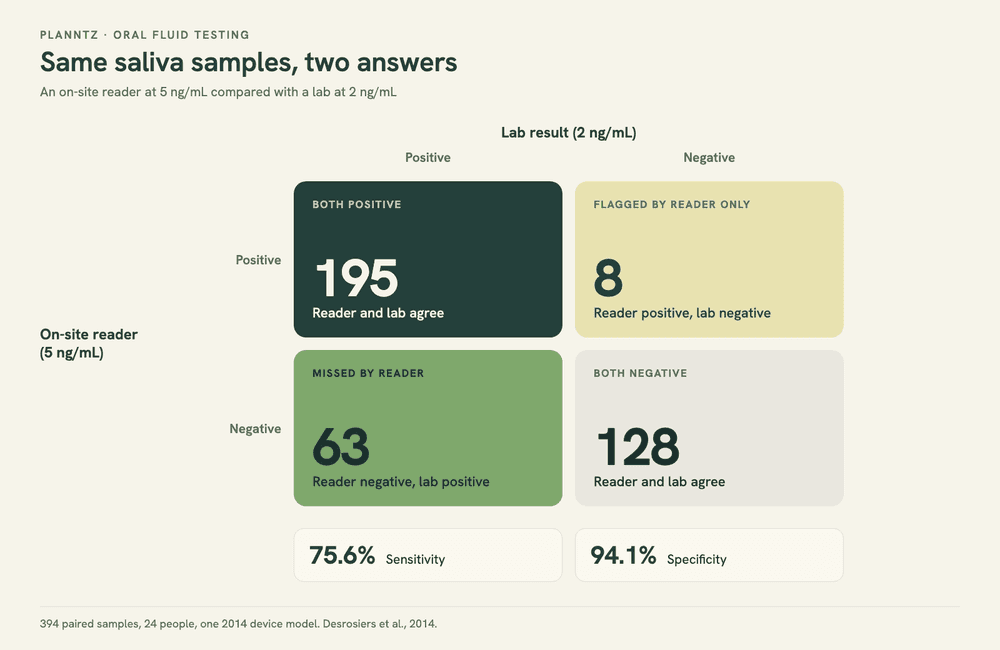
| Desrosiers 2014 (same people) | Same 24 people | Same joint | DrugTest 5000 on-site reader, 5 ng/mL | Median 12 h (4 to 24) occasional; 21 h (1 to 30+) frequent |
| Swortwood 2017 | 9 occasional, 11 frequent smokers | Smoked, vaped or brownie, about 50.6 mg | Quantisal, 2 ng/mL | All occasional negative by 32 h; one frequent smoker at 2.2 ng/mL at 72 h |
| Lee 2011 | 28 daily smokers, abstinent on a research unit | Their own prior use | Quantisal, 0.5 ng/mL | THC generally measurable for about 48 h; 89% of samples at admission, 18% at 48 h |
| Odell 2015 | 21 dependent users in detox | Their own heavy use | Cutoff not stated in abstract | Up to 78 h after admission (some people) |
| Andås 2014 | 26 detox patients (THC found in 11) | Their own heavy use | Intercept; cutoff not stated in abstract | Up to 8 days, with negative samples in between |
Three things help when you read the table. A median is the middle person: half were last positive earlier, half later. A range shows the earliest and the latest person. And when a row says sampling ended, the true window may be longer, because researchers simply stopped collecting. In the one-joint study by Newmeyer and colleagues, the frequent smokers' range ran to 30 hours, and 30 hours was when sampling stopped, not when THC disappeared.
How far back does a mouth swab drug test go? Occasional, frequent and daily use
Occasional use. If you use cannabis occasionally (less than twice a week in the Newmeyer study), the controlled numbers line up: about a day or less at the federal confirmation level. After one 6.8% THC joint, about 54 mg of THC, half of the 10 occasional smokers were last positive at 2 ng/mL by about 13.5 hours, with a range of 5 to 26 hours. In the Swortwood trial, every occasional smoker was below 2 ng/mL by 32 hours. Even people with no use in the past month can stay positive for a while: in a double-blind study of 17 adults led by Spindle, THC was still present in some saliva samples when collection ended 8 hours after smoking or vaping 10 or 25 mg, and it was detectable longer in saliva than in blood.
Frequent use. Frequent smokers, defined as four or more times a week, ran longer: a median of 21 hours in the one-joint study, ranging from 6 to 30. In the Swortwood trial, one frequent smoker was still at 2.2 ng/mL when discharged 72 hours after smoking, and detection rates in that group never reached zero before discharge. The more striking finding came before anyone was dosed. After an overnight stay on a locked research unit, nearly all the frequent smokers already had THC in their saliva above 1 ng/mL, most of them above 2. In other words, a frequent user can carry a positive saliva level into a day when they have not used at all.
Daily and heavy use. In a study of 28 chronic daily smokers held on a secure research unit by Lee and colleagues, THC was in 89% of saliva samples at admission and 18% two days later. Those rates were measured at 0.5 ng/mL, a quarter of the federal confirmation level, so a test at 2 ng/mL would be expected to catch fewer samples. Two detox studies mark the far edge. In 21 people entering detox in Melbourne, some still had THC in their saliva 78 hours after admission. In a Norwegian detox unit, THC appeared in the saliva of 11 of 26 heavy users, in some for up to 8 days after admission, with negative days in between. Both relied on self-reported last use and their abstracts do not state the reporting cutoff, so treat them as the outer limit, not a typical case.
Can a mouth swab detect edibles?
Yes, for a shorter time. Eating cannabis leaves THC in your mouth too, because you chew it. In the Swortwood trial, peak saliva THC right after a brownie averaged 297 ng/mL in frequent smokers and 202 ng/mL in occasional smokers. That is far below what the same people reached after smoking (2,789 and 837 ng/mL), and the authors reported that detection rates dropped more quickly after the oral dose.
The Vandrey study gives the clearest edible numbers. Eighteen adults who had not used cannabis in 3 months ate a brownie containing 10, 25 or 50 mg of THC, six people per dose. Saliva stayed above a 4 ng/mL screen for an average of about 1.5 hours at 10 mg, 2.3 hours at 25 mg and 10 hours at 50 mg; the longest single case was 22 hours. Two cautions: these were spit samples analyzed in a lab, not a commercial swab, and the doses are study conditions, not servings. The authors' takeaway was that route of administration matters when you interpret a saliva result.
Notice that this runs opposite to how edibles feel. A swallowed dose takes a while to kick in, for reasons we explain in why edibles take so long to kick in, yet the saliva signal is highest right away and fades as the residue clears. The effect clock and the detection clock run on different schedules. These numbers describe how saliva THC behaved in a lab; they are not a way to plan around a test.
Screen vs confirmation: why a roadside reader and a lab can disagree
A mouth swab result can come from two very different places: an on-site reader that gives an answer in minutes, or a laboratory. They do not always agree. In a comparison led by Desrosiers, researchers ran 394 paired samples from the same 24 NIDA participants through a roadside-style reader (the Dräger DrugTest 5000, set at 5 ng/mL) and through a lab at 2 ng/mL. The reader missed 63 samples the lab confirmed and flagged 8 the lab did not, for a sensitivity of 75.6% and a specificity of 94.1%. The authors noted that the reader's higher 5 ng/mL cutoff was generally the limiting factor. Same mouth, two machines, two answers.
The collection device matters as well. The same 24 people, sampled with a second collection device in a study led by Anizan, were positive at 2 ng/mL for up to 24 hours (occasional) and 26 hours (frequent), close to but not identical with the first device's results. And a 2017 Clinical Chemistry evaluation of two roadside devices by Newmeyer and colleagues found the usual 80% performance targets hard to meet when the lab cutoff sits below the device cutoff, and recommended that a roadside swab screen be confirmed by a lab.
What happens to a sample at a federal collection
Federal programs cannot run oral-fluid tests yet (more below), but the HHS guidelines spell out the process, and it shows why a lab confirmation is the result that counts.
- 1The collector checks your mouth before the collection begins.
- 2The collector starts a 10-minute wait, and you stay at the collection site in view; leaving is reported as a refusal to test.
- 3The collector takes at least 1 mL of undiluted saliva and splits it into two sealed specimens, A and B.
- 4At the lab, specimen A is screened for delta-9 THC at 4 ng/mL; a non-negative screen goes on to a confirmation test at 2 ng/mL.
- 5Specimen B stays sealed so a second certified lab can retest it if you ask, which is why DOT requires two certified labs before it can use oral fluid.
Can CBD or hemp products put THC in your saliva?
A swab looks for THC, not CBD. The real question is whether a CBD product carries enough THC to put some in your saliva, and two controlled trials say it can. In a 2026 trial led by Vikingsson and co-authored by staff of the federal office that administers workplace drug testing, people took 100 mg of CBD in MCT oil with small, measured amounts of THC, twice daily for 14 days, 10 people per condition. At 0.5 mg of THC, one in ten had saliva at or above 2 ng/mL within hours of a single dose; at 2.8 or 3.7 mg, eight in ten did. The abstract reports the 2 ng/mL confirmation level and does not say whether those samples also cleared the 4 ng/mL screen a federal positive needs first.
Even the CBD-only group produced five positive samples 30 minutes after dosing. The authors attributed those to a tiny share of CBD, 0.02% to 0.15%, converting to THC during the lab analysis itself. That fits a 2022 crossover study led by Bergeria in which neither THC nor its main metabolite turned up in the blood of any of 18 participants after 100 mg of CBD alone, while 12 of 18 had THC in their blood after a CBD-dominant flower containing 3.7 mg of THC. The THC risk comes from THC in the product. The broader conversion question has its own page: does CBD turn into THC.
Skin products surprised researchers too. In a 17-day trial of five commercial hemp CBD topicals led by Zamarripa, with 46 participants including a placebo group, the authors reported that, unexpectedly, nine people (seven using the same lotion, one a patch and one a gel) had saliva THC at or above 2 ng/mL, the level federal guidelines use to confirm a positive. None of their urine samples met federal positive criteria, and blood THC stayed below the detection limit for everyone. The abstract does not explain how THC from a skin product reached saliva, and one co-author worked for a CBD company, so read it as an open signal rather than a settled mechanism. For how trace THC in CBD products plays out on urine tests, see our CBD drug test guide.
Secondhand smoke and mouth swabs
Because a swab reads THC in the mouth, passive exposure is the scenario people worry about most with saliva tests. Sitting in a room with cannabis smoke is a different exposure from using it, and the controlled chamber studies, including their saliva results, are laid out in our page on whether secondhand smoke can make you fail a drug test.
Where mouth swabs are used, and why federal programs can't use them yet
Outside federal programs, mouth swabs are popular because collection is quick and observed. Private employers that are not federally regulated choose their own devices and cutoffs, which can differ from the federal 4 and 2 ng/mL, and what happens after a positive depends on your state and your employer's policy; that is the subject of can you get fired for failing a drug test. Some jurisdictions also use roadside oral-fluid screens, which is where the device-versus-lab gap above matters most. Breath is a different specimen with its own science, covered in our explainer on the weed breathalyzer.
For federal workplace programs, oral fluid is authorized on paper and unavailable in practice. The Department of Transportation added oral fluid to its rules in May 2023, but the rule says an employer can't implement it until HHS certifies at least two labs, one for the main sample and one for the split sample a worker can ask to have retested. As of HHS's most recent monthly list of certified labs, published September 30, 2026, no laboratory was certified to run federal oral-fluid tests. DOT acknowledged the gap in a May 2026 final rule: with no HHS-certified oral fluid labs, observed urine collection is used where its rules would call for oral fluid.
FDA's October 6, 2026 order removed a device hurdle, but FDA itself says the order does not decide whether oral fluid testing may be used in these programs. We break it down in what FDA's drug-test 510(k) exemption changes. Until HHS certifies labs, federal programs have no lab that can run one.
Mouth swab vs urine vs hair
These tests answer different questions, so "which is stricter" has no single answer. If your test is part of a multi-drug panel, our 10-panel drug test explainer covers which drugs it includes and which specimen it uses. Other drugs on a swab panel have their own windows; this page covers cannabis only.
| Mouth swab (oral fluid) | Urine | Hair | |
|---|---|---|---|
| What it looks for | Delta-9 THC itself | A THC metabolite (THC-COOH) | Not covered on this page |
| Where most of the signal comes from | THC residue in the mouth after recent use | THC your body has already processed | Not covered on this page |
| What a positive mostly reflects | Recent use | Use over a longer period | Not covered on this page |
| Federal status, October 2026 | Authorized, but zero certified labs (HHS list, Sept. 30, 2026) | In use in federal programs | Not part of the HHS panels |
| Federal cutoffs | 4 ng/mL screen, 2 ng/mL confirmation | See our CBD drug test guide | None set by HHS |
The practical upshot is that a swab and a urine cup can disagree about the same person on the same day, and neither is malfunctioning. The urine side, including cutoffs and how long the metabolite tends to linger, is covered in our CBD drug-test guide, linked below.
What the research still can't tell you
- Product types: the controlled trials used herbal cannabis, brownies or MCT oil. We found no comparable saliva-window data for commercial vapes, concentrates or gummies.
- Sample sizes: 6 people per dose in the Vandrey edible study, 10 per condition in the Vikingsson CBD trial, 24 in the shared NIDA smoking cohort. Small groups mean wide uncertainty.
- Sampling ceilings: several studies stopped collecting at 8, 30 or 72 hours, so their last positive is a floor, not the true end of the window.
- Detox studies: the 78-hour and 8-day figures rely on self-reported last use, and their abstracts do not state the reporting cutoff.
- Devices change: the on-site reader comparison used a 2014 device model; current readers and the cutoffs employers choose may behave differently.
- Individual prediction: no study can tell you your own window. Use history, dose, route, device and cutoff all move the answer.
- Impairment: a saliva THC number says little about whether someone was impaired at the time.
Frequently asked questions
In controlled studies, usually hours to about a day for occasional users at the 2 ng/mL federal confirmation level (a median of about 13.5 hours after one joint, and no occasional smoker positive past 32 hours in a second trial). Frequent users ran longer: a median of about 21 hours after one joint, and one frequent smoker was still positive at 72 hours in another trial. In one study of heavy users in detox some were positive for up to 8 days. The answer depends on route, use pattern, device and cutoff, and no study predicts an individual result.
Yes, for a shorter time than smoking. Chewing leaves THC in the mouth, so saliva THC peaks right after eating. In a Johns Hopkins study of adults who had not used cannabis in 3 months, a brownie kept saliva above a 4 ng/mL screen for an average of about 1.5 hours at 10 mg, 2.3 hours at 25 mg and 10 hours at 50 mg, with the longest case at 22 hours.
Swabs look for THC, not CBD, but CBD products with trace THC can put THC in saliva. In a 2026 trial, 8 of 10 people taking 100 mg of CBD with 2.8 or 3.7 mg of THC had saliva at or above 2 ng/mL after a single dose, and in a 2024 trial some people using hemp CBD topicals reached that level too. No hemp or CBD product can guarantee a drug-test result.
They measure different things, so they are not on one scale. A swab looks for delta-9 THC itself, mostly from recent use; urine looks for a metabolite that lingers longer in the body. A person can be negative on one and positive on the other on the same day. Our CBD drug test guide covers the urine side.
Not yet. DOT added oral fluid to its rules in May 2023 but requires at least two HHS-certified oral-fluid labs before employers can use it, and HHS's list published September 30, 2026 showed none. Where DOT rules call for oral fluid, observed urine collection is used instead.
On-site devices read in minutes. A lab result takes longer, and in federal testing the lab confirmation at 2 ng/mL is the result that counts. On-site readers and labs can disagree, which is why researchers recommend lab confirmation of a roadside screen.
Not necessarily. A 2022 meta-regression of 28 publications found oral-fluid THC is a poor indicator of impairment, and frequent users can be positive with no recent use. But where a law or workplace policy sets a number, the number is what counts, regardless of how you felt.
If you use CBD and are subject to testing, the saliva question is only half of it. Our guide to how CBD and trace THC interact with drug tests walks through urine cutoffs, product types and the residual risk no label can remove.
Writing about hemp, wellness and the small rituals that keep us balanced.