Massachusetts and Idaho Marijuana Measures Failed, AP Reports. What a No Vote Did Not Do
Massachusetts Question 8 and Idaho HJR 4 both failed in unofficial AP counts shown by Fox News on Nov. 6. Neither state's database showed certified totals. Here is what a no vote left in place, what it did not do, and what to check.

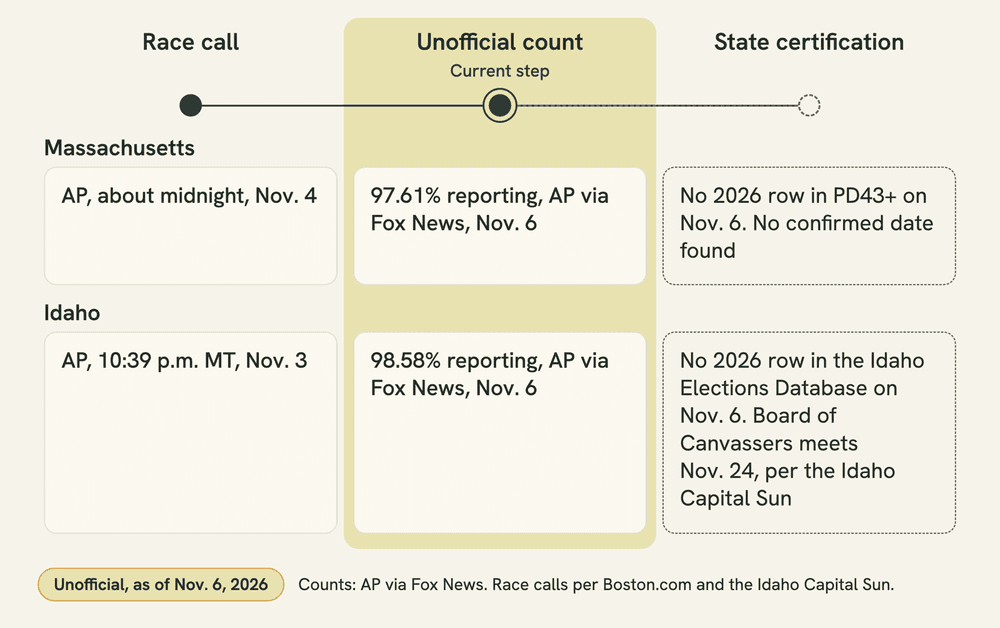
Did the Nov. 3 votes change marijuana law in Massachusetts or Idaho? On the counts available so far, no. The Associated Press has both measures failing, in unofficial figures shown by Fox News on Nov. 6: Massachusetts Question 8 at 75.57% no and Idaho HJR 4 at 66.27% no. A failed measure adds no new right, so Idaho legalized nothing; the Idaho Capital Sun reports marijuana remains illegal there. Neither state's results database showed certified totals when we checked.
What voters did on Nov. 3
The Associated Press count shown by Fox News on Nov. 6 had Massachusetts Question 8 at 1,962,147 no (75.57%) to 634,159 yes (24.43%), with 97.61% reporting. AP's Idaho count on Fox News the same morning had HJR 4 at 471,321 no (66.27%) to 239,906 yes (33.73%), with 98.58% reporting. Both are unofficial.
AP called Massachusetts around midnight, with about 48% counted, Boston.com reported. It called Idaho at 10:39 p.m. Mountain time on election night, the Idaho Capital Sun reported in a story republished on Yahoo. No led in all 44 Idaho counties on the Nov. 4 count, CBS2 reported. Those are calls and unofficial tallies, not certifications.
Neither state's results database listed these votes when we checked on Nov. 6: the Massachusetts PD43+ ballot question search and the State of Idaho Elections Database both showed no 2026 rows. Both are archives of past elections, so a gap this soon after the vote is not surprising, and it says nothing about the outcome. It does mean no state record we could read documents either 2026 result yet.
The two votes, side by side
Put together, on AP's unofficial counts, these votes share one feature: each no left a law where it was. The table gives each measure as the Boston Globe's Nov. 4 report, Boston.com's Oct. 5 explainer and the Idaho Capital Sun described it. We could not read either text, so the descriptions are theirs.
| Massachusetts Question 8 | Idaho HJR 4 | |
|---|---|---|
| What a yes would have done, as reported | Boston Globe: adult-use shops close by the start of 2028 or become medical dispensaries; the medical market is unaffected; adults could still possess or gift up to an ounce | Idaho Capital Sun: only the Legislature could legalize marijuana and other drugs, with no voter initiatives on them |
| What a no leaves in place, as reported | Boston.com: existing laws, with sales continuing. Those laws are the adult-use law as amended in April 2026 | Idaho Capital Sun: voters keep the initiative power, and marijuana and cannabis remain illegal |
| Unofficial count, Nov. 6 | 75.57% no, 24.43% yes, 97.61% reporting | 66.27% no, 33.73% yes, 98.58% reporting |
| Official status | Unofficial. No 2026 row in PD43+ on Nov. 6. We found no confirmed certification date | Unofficial. No 2026 row in the Idaho Elections Database on Nov. 6. The Idaho Capital Sun reports the State Board of Canvassers meets Nov. 24 |
Massachusetts: a no vote on a law already amended in April
One point stays unresolved: home growing. The Globe said Question 8 would have stripped away protections for growing at home, and Boston.com said it would have repealed the laws permitting it. WBUR's Oct. 9 explainer said home cultivation would remain legal. We could not read the measure's text, so we are not settling that here. The conflict is about what a yes would have done, not about the count.
The more practical change for a Massachusetts adult came before the election. The law a no left in place is not the 2016 law as voters passed it. The Massachusetts Cannabis Control Commission describes Ch. 65 of the Acts of 2026 as "a new state law that restructured the Commission and changed cannabis laws" in its Oct. 8 statement. The April law raised the limit from one ounce to two for adults without medical cards, the Globe reported. We could not open the act itself, so treat any summary of it, including this one, as a pointer to the text.
Regulation keeps moving on its own track. The Commission said on Oct. 22 it would discuss draft testing regulations at its next public meeting on Nov. 12. That is a draft, not a rule. In September it said it planned a December vote on three sets of draft regulations, then public comment and a hearing. The Globe reported that its chair said the work continues. We found no Commission statement on the result as of Nov. 6.
The Commission's Oct. 8 statement, which predates the vote, said that a decade on, the industry has generated $10 billion in gross sales. It counted nearly 800 operating businesses and reported $285 million in fiscal 2026 state excise and sales tax. Our explainer on how states tax cannabis is general background and does not cover Massachusetts.
Idaho: reported as a vote about who may legalize, not about legality
As the Idaho Capital Sun reported it, HJR 4 would have left only the Legislature able to legalize marijuana and other drugs, ending voter initiatives on them. KTVB reported that it did not itself legalize anything. On those descriptions, a vote against it was about who decides, not a vote for legal marijuana. Marijuana and cannabis remain illegal in Idaho, the Capital Sun reported, and voters retain their initiative power. We could not open the Idaho Code or the resolution, so that statement is the paper's.
Marijuana Moment reported on July 14, quoting the Secretary of State, that a 2026 medical marijuana initiative failed to qualify. It gave the requirement as 6%, or 70,725 signatures, in 18 of 35 districts. The campaign disputed that, and we do not know where the dispute stands now. That drive is separate from HJR 4.
What changed, and what neither vote touched
What changed: if certification matches AP's counts, two proposals failed and neither wrote anything into law. What did not change is the longer list.
- Massachusetts law. A failed repeal changes nothing in the statute it targeted and adds no new right. The Commission says Ch. 65 had already changed the state's cannabis laws.
- Idaho law. HJR 4 was reported as a change to who may legalize. Its failure legalizes nothing.
- Federal marijuana status. Marijuana remains a controlled substance under federal law. A state vote does not change that.
- Federal hemp law. Neither vote touched it.
- CBD rules. A measure that fails creates no new rule, so neither vote added one for CBD.
- Other states. Neither result binds any other state.
On the federal side, the Schedule III order published April 28 covers state-licensed medical marijuana and FDA-approved products. As of Nov. 6 we found no final rule on adult-use marijuana in the Federal Register. Our report on the appeals court order follows what is still pending.
Federal hemp timing runs on its own calendar. One narrow exclusion still arrives Nov. 12, for cannabinoids "not capable of being naturally produced by a Cannabis sativa L. plant" and nothing broader. The rest of Section 781 of P.L. 119-37 waits until after Dec. 11, under timing set by P.L. 119-103. Our breakdown of the two hemp deadlines has the detail, and the federal rule and state exceptions for CBD live in our hub.
Why the numbers keep moving
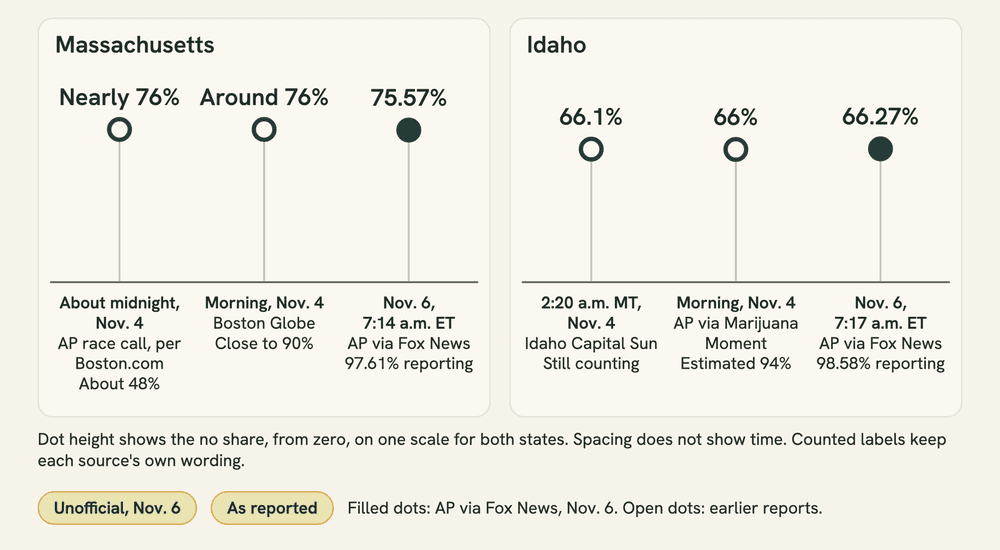
If you saw 76-24 or 66-34 earlier in the week, that was an earlier unofficial snapshot, not an error. The shares barely moved as the count grew. The yardsticks differ, though: Fox's table says percent reporting, while Marijuana Moment's Idaho report used AP's estimated share of ballots counted. Those are not one series. KTVB's Nov. 4 report said "more than 67%" voted against HJR 4, citing unofficial results without naming who compiled them; later AP figures do not match it.
| State | As of | Reported by | No | Yes | Counted |
|---|---|---|---|---|---|
| Massachusetts | About midnight, Nov. 4 | AP race call, per Boston.com | Nearly 76% | About 24% | About 48% |
| Massachusetts | Morning, Nov. 4 | Boston Globe | Around 76% | About 24% | Close to 90% |
| Massachusetts | Nov. 6, 7:14 a.m. ET | AP via Fox News | 1,962,147 (75.57%) | 634,159 (24.43%) | 97.61% reporting |
| Idaho | 2:20 a.m. MT, Nov. 4 | Idaho Capital Sun | 425,809 (66.1%) | 218,312 (33.9%) | Still counting |
| Idaho | Morning, Nov. 4 | AP via Marijuana Moment | 66% | 34% | Estimated 94% |
| Idaho | Nov. 6, 7:17 a.m. ET | AP via Fox News | 471,321 (66.27%) | 239,906 (33.73%) | 98.58% reporting |
For comparison, the state's own record shows 2016 Question 4 passing with 1,769,328 yes votes to 1,528,219 no. By our arithmetic that is 53.7% of yes and no votes, or 52.4% of all ballots counting blanks. That record is final and this year's count is not, so hold any direct comparison until certification. Our dated history of cannabis law gives the longer context.
What to check before you rely on this
- 1Look for the word certified. Until a state certifies, treat every count as unofficial.
- 2Check the date and the source on any figure, and prefer the latest dated one.
- 3In Massachusetts, read the current law. A summary written before April 2026 may predate Ch. 65.
- 4Treat the reporting on what Question 8 would have done to home growing as unsettled until you have read the measure. For today's rules, read the statute.
- 5For your own situation, ask your state regulator or a lawyer who practices in your state.
Dates to watch, as of Nov. 6. The two Nov. 12 items are unrelated: one is a Massachusetts agency meeting, the other a federal statute.
- Nov. 12: the Cannabis Control Commission meets, with draft testing regulations up for discussion.
- Nov. 12: the narrow federal hemp exclusion takes effect.
- Nov. 24: Idaho's State Board of Canvassers meets, the Idaho Capital Sun reports, and the paper says results are not official until the board certifies them.
- December: the Commission plans its vote on draft regulations.
- Dec. 11: the date set by P.L. 119-103. The rest of Section 781 waits until after it.
Questions readers are asking
The reporting says a no keeps it in place: Boston.com's Oct. 5 explainer said a no would keep existing laws, with sales continuing. The law in question is the state's adult-use law as amended in April 2026, not the 2016 text alone. The vote figures are unofficial, and this is not legal advice.
No. KTVB reported that HJR 4 did not itself legalize anything, so voting it down could not have done so either. The Idaho Capital Sun reported that marijuana and cannabis remain illegal in Idaho.
Nothing is added to the law. If AP's unofficial result is certified, the shift to Legislature-only legalization that the Idaho Capital Sun described does not happen, and the paper reports voters retain their initiative power.
No. The Idaho Capital Sun reports that Idaho's results are not official until the State Board of Canvassers certifies them, and that it meets Nov. 24. We found no confirmed date for Massachusetts. Neither state's database showed a 2026 ballot question row on Nov. 6.
No. A measure that fails creates no new rule, and a state vote cannot change federal hemp law. One narrow federal exclusion still arrives Nov. 12, and the rest waits until after Dec. 11.
If your question is about CBD and not marijuana, these two votes do not change the answer. The page to keep is our guide to whether CBD is legal, with its state exceptions and flying rules.
Writing about hemp, wellness and the small rituals that keep us balanced.