Weed Tax Explained: Three Ways States Tax Cannabis, and How to Read Your Receipt
Weed tax is three designs under one name: a share of the price, a fee per ounce, or a rate tied to THC, with sales and local taxes on top. How to read the receipt, a $40 eighth worked five ways, how hemp CBD differs, and what 280E is. Rates as of October 25, 2026.
Weed tax is not one tax. It is three different designs wearing one name: states charge a percentage of the price, a fee per ounce, or a rate tied to THC potency. Then state sales tax and local taxes stack on top, and in some states they tax each other. That is how a $40 eighth can leave a California counter at about $55. Rates and rules as of October 25, 2026.
Here is the full picture behind that number. Below you will find the three designs, with one real state for each; a hypothetical $40 eighth worked through five states, with every rate cited and the arithmetic shown; how hemp and CBD fit in (a state-by-state answer that will change in Illinois on November 12, 2026); and why the federal tax that weighs hardest on dispensaries, Section 280E, never appears on your receipt. Each rate is attributed to its source, a state statute or state tax agency wherever one was available. This area moves fast: California, Maine and Connecticut each changed their cannabis tax between July 2025 and October 2026, and Minnesota has raised its rate to 15%. Treat every number here as a dated snapshot, and check your state for today's rate.
The three ways states tax cannabis
The Tax Foundation's 2026 review of state marijuana taxes sorts state cannabis taxes into three designs: "Some states tax by weight, some by price, and others by THC content." Its January 2026 table lists 23 states with a cannabis excise tax on adult-use sales, and it leaves out general sales taxes and local add-ons. The Census Bureau's September 2026 look at cannabis excise collections counts more states: 30 plus D.C., which together collected an estimated $3.55 billion from July 2025 to June 2026. That count includes medical-only states, which is why it is higher than the number of states that tax adult-use sales. The Census Bureau describes the same split, noting that retail excise taxes "often differ by product weight, THC content or form (such as 'flower' or 'vapor' products)."
The example rates in the table below come from each state's own sources: California's tax agency, the CDTFA, Washington's cannabis excise statute, Alaska's Department of Revenue, Maine's cannabis sales tax law and cannabis excise law, the Illinois Department of Revenue and Connecticut's Department of Revenue Services.
| Design | How it is calculated | Example state and current rate | What happens as price or potency rises |
|---|---|---|---|
| Percent of price (ad valorem) | A percentage of the retail or wholesale price | California: 15% of gross receipts (October 1, 2025 through June 30, 2029). Washington: 37% of the selling price. | Tax rises and falls with the price. Potency does not matter. |
| Weight (ad quantum) | A fixed dollar amount per ounce or pound, usually paid before retail | Alaska: $50 per ounce of mature flower, paid by the grower. Maine: $223 per pound of flower since January 1, 2026 (down from $335), plus a 14% sales tax at retail. | Tax stays the same when prices fall, so it takes a bigger share of cheaper flower. Potency does not matter. |
| THC potency | A rate set by THC level and product type, or a charge per milligram of THC | Illinois: 10% for flower at or under 35% adjusted THC, 25% above 35%, 20% for infused products. Connecticut used a per-milligram tax until September 30, 2026. | Stronger products pay more at the same price. |
Each design has a trade-off, and the Tax Foundation spells it out. Price-based taxes are "simpler" but bring "greater revenue volatility" when prices drop. Weight-based taxes give "more stable revenues" but "do not account for potency." THC-based taxes "most directly target the harm-causing element, but this adds complexity." The same review warns that such "disparate structures render state-by-state comparisons of rates or overall tax burden difficult." Some states have walked away from THC-based taxes. Per the Tax Foundation, New York "swapped its specific tax by THC content for a 9 percent ad valorem wholesale tax" in 2024. Connecticut dropped its THC-based tax this fall. Until September 30, 2026, it charged 0.625 cents per milligram of THC in flower, so a 3.5 g eighth at 20% THC (700 mg) owed $4.38, and the same eighth at 30% THC (1,050 mg) owed $6.56, at the same shelf price. Since October 1, both owe the same 10.75% of the price. And because state-legal marijuana cannot lawfully cross state lines (the rules on mailing weed show how strict that line is), each state runs its own market and its own tax, which is why no two states' receipts look alike.
How to read a dispensary receipt
A dispensary receipt can carry up to four tax lines, and some of the cannabis tax you pay never shows up as a line at all. Here is what to look for.
- State cannabis excise: the design-specific tax from the table above, often printed as its own line. Washington's statute requires its 37% to be "separately itemized" on the receipt.
- State sales tax: the general sales tax many states also charge on cannabis. Washington's state rate is 6.5% of the selling price; California's statewide base rate is 7.25%, higher where district taxes apply.
- Local cannabis tax: a city or county tax on cannabis, where one exists. In Connecticut it is a 3% municipal tax; in California, cities and counties set their own.
- Local sales tax: city, county or district sales taxes added on top of the state rate.
- Taxes you never see: some are paid before the product reaches the shelf and are already in the price, such as Alaska's per-ounce tax on growers, Illinois' 7% cultivation privilege tax and New York's 9% wholesale tax.
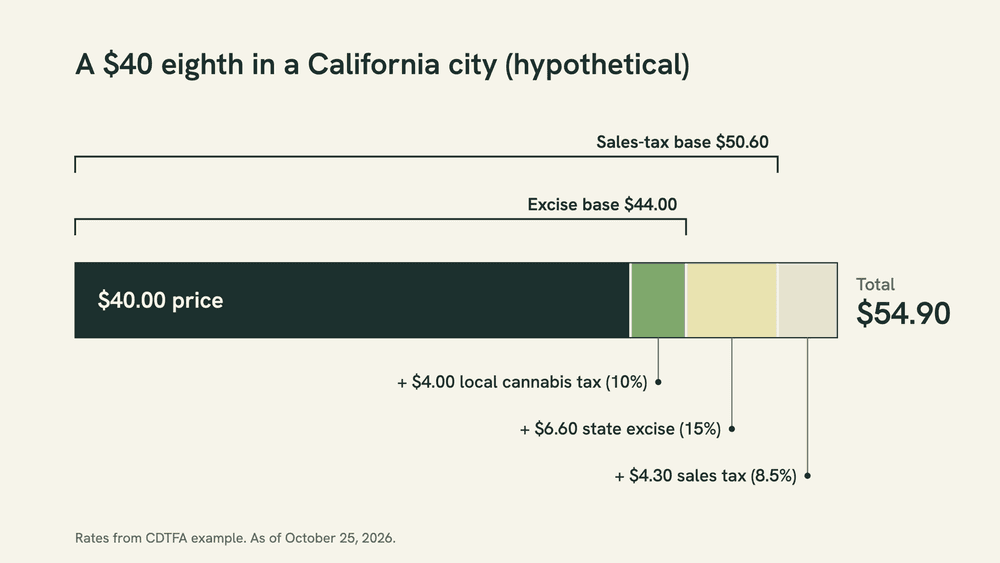
The order of these lines matters, because some taxes are charged on other taxes. California's tax agency publishes the math. The gross receipts subject to its excise include "any local cannabis business tax" passed on to you, and "the cannabis excise tax is included in gross receipts subject to sales tax." In the CDTFA's own example, a $35.00 item with a $3.50 local tax (10%) and a $5.00 delivery fee has an excise base of $43.50, so the 15% excise is $6.53. Sales tax at 8.5% then applies to $50.03, adding $4.25, for a total of $54.28. Washington does the opposite. Its 37% excise is "not part of the total retail price to which general state and local sales and use taxes apply," so sales tax (the state's 6.5% rate plus any local rate) is figured on the price before excise. The same statute says the excise "must be reflected in the price list or quoted shelf price," so in Washington the sticker can already include the 37%.
A $40 eighth, taxed five ways
To see how much the design matters, take one hypothetical purchase: an eighth of flower (3.5 grams, the standard eighth of an ounce) with a $40.00 pre-tax price, and run it through each state's current rules. Rounding is to the nearest cent. These are not the prices any particular store charges, and your city may add taxes not shown here.
| State and design | Tax lines, in order | Total | Above $40 |
|---|---|---|---|
| California, price-based, no local tax, 7.25% base sales tax | Excise $40.00 × 15% = $6.00. Subtotal $46.00. Sales tax $46.00 × 7.25% = $3.34. | $49.34 | +23.4% |
| California, with a 10% local cannabis tax and 8.5% sales tax (the CDTFA's example rates) | Local tax $4.00. Excise $44.00 × 15% = $6.60. Subtotal $50.60. Sales tax $50.60 × 8.5% = $4.30. | $54.90 | +37.3% |
| Washington, price-based, state sales tax only | Excise $40.00 × 37% = $14.80. Sales tax on $40.00 (excise excluded) × 6.5% = $2.60. Plus any local sales tax. | $57.40 or more | +43.5% before local tax |
| Connecticut, flat rate since October 1, 2026 | Cannabis tax 10.75% = $4.30. Sales tax 6.35% = $2.54. Municipal tax 3% = $1.20. Each on the $40.00 price, as in the DRS example. | $48.04 | +20.1% |
| Illinois, potency tiers | Flower at or under 35% adjusted THC: $4.00 (10%). The same $40 as an edible: $8.00 (20%). As a concentrate above 35%: $10.00 (25%). Then state and local sales tax and any local cannabis tax. | $44.00 / $48.00 / $50.00 before sales tax | +10% / +20% / +25% before sales tax |
| Alaska, weight-based | $50 per ounce × 1/8 ounce = $6.25, paid by the grower and already inside the shelf price. Not a receipt line. | Not shown on the receipt | $6.25 is 15.6% of a $40 eighth |
Two rows stand out. First, Alaska: a weight tax does not care what the flower sells for. The same $6.25 is 15.6% of a $40 eighth but 25% of a $25 eighth, so as prices fall, a weight tax takes a bigger bite. Maine runs a hybrid. Its flower tax, cut from $335 to $223 per pound on January 1, 2026, now works out to about $1.74 per eighth before retail (a pound holds 128 eighths), and then the 14% adult-use sales tax applies at the counter. Second, Illinois: the same $40 pays 10%, 20% or 25% depending on what you buy. Illinois measures "adjusted THC" as delta-9 THC plus 0.877 times THCA, and it taxes concentrates and vapes by that THC percentage rather than as infused products. Connecticut's own published example follows the flat-rate pattern: a $22.00 chocolate bar comes to $26.43 with all three taxes.
Why is weed tax so high?
A large part of the answer is stacking. A state retail excise, from 10% to 37% among the examples on this page, sits on top of sales tax (which in California is charged on the excise too), plus any local cannabis and sales taxes. Taxes collected from growers and wholesalers are already in the shelf price before any of that. Separately, the businesses themselves carry an unusually heavy federal income tax bill, which the 280E section below explains. That is a cost of doing business, not a tax line on your receipt.
What are the taxes trying to do? The Census Bureau puts the balancing act neutrally: "states aim to generate revenue without driving prices so high that consumers turn to illegal markets." The Tax Foundation goes further and argues a position: "Squeezing the legal marijuana industry for revenue unnecessarily burdens a growing industry and encourages consumers to stick to established illicit markets." That is the think tank's argument, and it is one side of a live policy debate.
Research that measures how price moves buyers between legal and illicit sellers is limited. In a 2019 study in the journal Addiction of 724 adult cannabis users in legal states, participants treated legal cannabis as the better product and said they would pay somewhat more for it. The authors concluded that "somewhat higher consumer costs for legal cannabis relative to contraband (but not excessively higher costs)" would not be expected to expand the illegal market. The limits are real: it measured hypothetical choices in an online sample, not actual purchases, and the data come from 2018.
Where the money goes: one state's 2026-27 budget
Every state decides this differently, so here is one dated example rather than a 50-state list. California's cannabis taxes flow into a Cannabis Tax Fund, and the Department of Finance's 2026-27 Governor's Budget table for that fund lays out the order: regulatory and administrative costs first, then specified amounts for research and other programs, then a percentage split of what remains. For 2026-27, that final split comes to about $404 million, based on prior-year collections, divided 60/20/20:
- About $242 million (60%) for youth substance-use education, prevention, early intervention and treatment.
- About $81 million (20%) for environmental restoration and protection.
- About $81 million (20%) for state and local law enforcement, which the CDTFA says includes enforcing laws on driving under the influence.
The same budget table shows how much the revenue can swing. California collected about $813 million in cannabis tax in 2021-22 and about $601 million in 2024-25, and the Department of Finance estimates about $598 million for 2026-27. The budget table does not say why collections fell, so read those figures as a record of revenue, not an explanation of it. If you want to know where your own state's money goes, its budget office or revenue department is the place to look.
Is CBD or hemp taxed like weed?
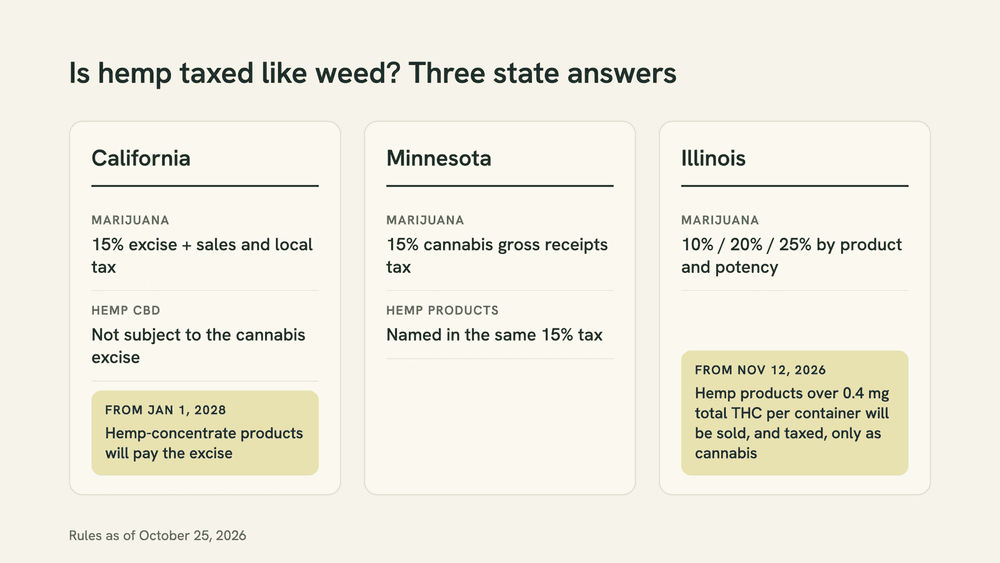
It depends on the state, and the answer is changing. California is explicit: "CBD products which are derived from industrial hemp plants and do not contain cannabis are not subject to the cannabis excise tax, even if the CBD product contains trace amounts of tetrahydrocannabinol (THC)." That is California's rule, not a national one, and ordinary sales tax can still apply. At the federal level, the IRS's cannabis industry FAQ says a business dealing only in hemp (0.3% THC or less) is not subject to Section 280E. Other states draw the line in different places, as these three examples show.
| State | Adult-use marijuana | Hemp-derived products | Dates and exceptions |
|---|---|---|---|
| California | 15% excise, plus sales tax and any local tax | Hemp CBD without cannabis is not subject to the cannabis excise, even with trace THC. | From January 1, 2028, products containing hemp concentrates (other than CBD-isolate-only products) will pay the cannabis excise (AB 8). |
| Minnesota | 15% cannabis gross receipts tax, on top of other taxes | The same 15% tax names "hemp-derived consumer product" and "lower-potency hemp edible." Hemp-derived topicals are excluded from the first term. | Purchases by patients in the medical registry are exempt. The rate was raised from 10% to 15% (Census Bureau). |
| Illinois | 10%, 20% or 25% by product and potency, plus sales taxes, with a 7% cultivation tax paid before retail | From November 12, 2026, a consumable or topical product with more than 0.4 mg of total THC per container will no longer be "hemp" under state law. | Public Act 104-0463. Such products will be sold, and taxed, only as cannabis. |
Minnesota is the clearest case of hemp being taxed like weed: its 15% cannabis gross receipts tax names "hemp-derived consumer product" and "lower-potency hemp edible" in the same list as cannabis flower, and says the tax is "in addition to any other tax." Illinois has set its own date: from November 12, 2026, a consumable or topical product with more than 0.4 mg of total THC per container will stop being "hemp" under state law and will be sellable only as cannabis. And under a 2025 California law, AB 8, hemp products containing hemp concentrates will be taxed like cannabis at retail starting January 1, 2028, with CBD-isolate-only products excluded.
Federal law is also about to move the line between hemp and marijuana, in two steps. Public Law 119-37, signed November 12, 2025, will rewrite the federal hemp definition. A later law, Public Law 119-103, signed September 2, 2026, limits the piece that will take effect on November 12, 2026 to products with cannabinoids "not capable of being naturally produced" by the plant, and the rest, including the total-THC and 0.4 mg per container limits, will take effect on December 11, 2026. That is not a tax change, but it decides which products land on which side of the tax line. The math behind the new hemp definition and why the main change slid to December 11 have their own pages, and if you want the background on the legal line itself, start with how hemp and marijuana differ.
280E: the federal tax on the business, not on you
Section 280E of the federal tax code is a 1982 provision, and it is aimed at the seller, not the shopper. The statute, 26 U.S.C. § 280E, says "no deduction or credit shall be allowed" for any business that "consists of trafficking in controlled substances (within the meaning of schedule I and II of the Controlled Substances Act)." For a dispensary, that means income tax on a figure much closer to gross profit than to real profit. It is not a sales tax, and it never appears on your receipt. (Using the tax code against cannabis is an old federal habit: the 1937 Marihuana Tax Act used a tax to work as a ban.) The IRS says a marijuana business can still subtract the cost of the goods it sells from gross receipts, but not its other expenses:
“A marijuana dispensary may not deduct, for example, advertising or selling expenses.”
In April 2026, the federal government moved two narrow categories of marijuana to Schedule III. The April 2026 final order in the Federal Register says state medical licensees "will no longer be subject to the deduction disallowance imposed by Section 280E," while adding that "nothing in this rule constitutes a determination regarding federal tax liability." The order also says any form of marijuana other than the categories it moved "remains a schedule I controlled substance." Read together, that means adult-use dispensaries were not moved and remain under 280E. That is a reading of the order, and the IRS FAQ page does not mention the order. Court challenges to the April order are still pending, and broader rescheduling of marijuana remains a proposal with no final rule as of October 25, 2026. The full record of the Schedule III ruling tracks the litigation, and why dispensaries are still cash-only explains why a tax change did not fix banking. California's tax agency adds that, for its own taxes, "the point of taxation and amount subject to tax" remain unchanged. If you run a cannabis business, this is a question for a tax professional, not a blog.

Rates move: how to check your state's current tax
Rates and rules on this page are as of October 25, 2026, and they will not stay put. The past year and a half shows it. California's excise rose to 19% on July 1, 2025 and went back to 15% on October 1, 2025, under a 2025 law (AB 564) that holds it there through June 30, 2029. On January 1, 2026, Maine raised its adult-use sales tax from 10% to 14% and cut its flower excise from $335 to $223 per pound. Connecticut replaced its THC-based tax with a flat 10.75% on October 1, 2026, on top of its 6.35% sales tax and 3% municipal tax. Minnesota's cannabis tax rose from 10% to 15%. Even the Tax Foundation's January 2026 table was out of date for Maine, Connecticut and Minnesota by October. So use national tables to understand the designs, and use your state for the number. Check your state revenue department for the current rate. Then run through this list, and if a line on your receipt still puzzles you, a good budtender can walk you through it.
- 1Find your state revenue or tax department's cannabis page, not a blog or a national roundup (this one included).
- 2Check the page's "last updated" date, and look for any notice about upcoming changes.
- 3Look up your city or county's cannabis tax and local sales tax, which state pages often leave out.
- 4Ask whether the shelf price already includes the excise. In Washington, the law requires it to.
- 5If you have a medical card, ask which taxes it removes. In California, a state medical ID card removes the sales tax but not the 15% excise.
- 6For hemp products, check whether your state has pulled them into its cannabis tax, as Minnesota has and as Illinois will on November 12, 2026.
- 7At the counter, ask to have the receipt lines explained. It is a normal question.
Weed tax FAQ
It depends on your state's design and how its taxes stack. On a hypothetical $40 eighth, with rates as of October 25, 2026, total tax comes to about 20% in Connecticut (10.75% cannabis tax plus 6.35% sales tax plus 3% municipal tax), about 37% in a California city with a 10% local cannabis tax and 8.5% sales tax, and 43.5% in Washington before any local sales tax. Your city may add more.
Washington's 37% retail excise is the highest single rate in the Tax Foundation's January 2026 table, and the Census Bureau estimates that Washington and Montana collect the most per resident, more than $50 a year each. All-in totals are harder to rank, because local add-ons vary by city and can push some city totals above what a statewide ranking suggests.
In the four states covered here, medical purchases get some tax relief, but not the same relief. In California, a state Medical Marijuana Identification Card plus a government ID removes the sales tax but not the 15% excise. Illinois does not impose its purchaser excise or local cannabis taxes on medical cannabis, which is taxed at the qualifying-drug sales tax rate instead. Washington exempts qualifying patients with a recognition card from the 37% at medically endorsed stores, for compliant products, until June 30, 2029. Minnesota exempts purchases by patients in its registry from its 15% tax.
Not in every state, and not the same way in any two. California says hemp CBD that does not contain cannabis is not subject to its cannabis excise, even with trace THC. Minnesota's 15% cannabis tax names hemp-derived consumer products and lower-potency hemp edibles. Illinois will treat consumable or topical products with more than 0.4 mg of total THC per container as cannabis from November 12, 2026. Check your own state's rule.
A 1982 federal tax provision that denies deductions and credits to businesses trafficking in Schedule I or II controlled substances. It raises a dispensary's income tax, not your receipt. The April 2026 order says state medical licensees are no longer subject to it; court challenges to that order are pending, and adult-use stores were not moved. If you own a cannabis business, talk to a tax professional.
Because several separate taxes apply, and some states spell out how they must appear. Washington requires both: its 37% excise must be itemized on the receipt and also reflected in the shelf price. In California, the taxes are figured in a set order: the local cannabis tax is inside the excise base, and the excise is inside the sales-tax base. If the total matters to you, ask before you get in line.
Each state sets its own rules. In California, after regulators and specified programs are paid, the rest is split 60/20/20. The Department of Finance's 2026-27 estimate puts that at about $242 million for youth substance-use education and prevention and about $81 million each for environmental restoration and law enforcement.
Tax rules sit inside a bigger legal picture: which products are legal where, and why hemp and marijuana are treated differently at all. For that backdrop, start with our guide to CBD's legal status in the US, then read how the federal hemp definition will count THC.
Writing about hemp, wellness and the small rituals that keep us balanced.