Ryan's Law: Medical Cannabis in California Care Facilities
Most guides to Ryan's Law stop in 2021. Three amendments later, here is who can use medical cannabis in a California hospital, skilled nursing facility, hospice or home health visit, what the facility controls, and what the April 2026 federal order did not change.
California's Compassionate Access to Medical Cannabis Act, which the statute itself also calls Ryan's Law, lets certain seriously ill patients use their own medical cannabis inside hospitals, skilled nursing facilities, hospices and a few other licensed settings. Most of what you will find about it was written in 2021. The Legislature has amended it three times since, and those changes decide who is covered today.
The short answer, as of October 27, 2026 (California only): Ryan's Law covers two kinds of patients. Terminally ill patients, meaning a prognosis of one year or less, are covered in general acute care hospitals, skilled nursing facilities, hospice facilities, congregate living health facilities, special hospitals and licensed home health agencies. Patients over 65 with a chronic disease and a physician's assessment are covered in all of those settings except regular (general acute care) hospitals. Inside a facility there is no smoking or vaping, the law does not apply in the emergency department during emergency care, and the patient or a caregiver brings and gives the cannabis. Staff cannot.
Other laws share the name, including a California street-racing law and unrelated measures in other states. This page covers only the medical cannabis law in California Health and Safety Code sections 1649 through 1649.6. It is a legal explainer, not legal advice: the facility's written policy and, where needed, a California attorney are the right sources for a specific case.
What Ryan's Law is, and who Ryan was
Ryan's Law lives in Chapter 4.9 of Division 2 of the California Health and Safety Code, sections 1649 to 1649.6. Section 1649(b) still states its original purpose in the Legislature's words: "to support the ability of a terminally ill patient to safely use medicinal cannabis within specified health care facilities in compliance with the Compassionate Use Act of 1996." That Act is Proposition 215, which California voters approved on November 5, 1996. Notice that the purpose clause still says "terminally ill" only. It was never updated when the law grew, which is one reason older summaries and the current text disagree.
The law is named for Ryan Bartell. According to a 2019 letter from Senator Brian Jones asking the Governor to sign the first version, Ryan was a 41-year-old San Diegan who had served in the Coast Guard and died of pancreatic cancer in 2018. His father, Jim, pushed for a law after Ryan could not use medical cannabis in the facility where he was being treated. Some press reports spell the name Bartel; the Senate uses Bartell.
That first version, SB 305, passed in 2019 and was vetoed. Governor Newsom's veto message, quoted in the Senate Judiciary Committee's analysis of SB 302, said "health facilities certified to receive payment from the federal Center for Medicare and Medicaid Services must comply with all federal laws" and that the bill "would create significant conflicts between federal and state law that cannot be taken lightly. Therefore, I begrudgingly veto this bill." The Legislature tried again with SB 311, which the Governor signed on September 28, 2021 (Chapter 384, Statutes of 2021). As the California Department of Public Health (CDPH) told licensed facilities in its January 2022 letter on SB 311, the law took effect January 1, 2022.
Who is covered in 2026
Section 1649.1 defines a "patient" in two ways. The wording matters, so here it is close to the statute's own language:
- Terminally ill: "a prognosis of life of one year or less, if the disease follows its natural course." This group has been covered since January 1, 2022.
- Over 65 with a chronic disease: "over 65 years of age with a chronic disease," plus a physician's assessment of a serious medical condition and that medicinal cannabis is appropriate. Covered since January 1, 2024.
Two details trip people up. First, "over 65" is the statute's phrase; it does not say 65 and older. Second, the enacted law never defines "chronic disease." Committee analyses of SB 302 described a definition while the bill was moving, but that wording did not make it into the code. What the law requires instead is a physician's assessment declaring that the patient has a "serious medical condition" as defined in Health and Safety Code section 11362.7(h), the same definition California's medical cannabis program uses. That list runs from arthritis and cancer to migraine and severe nausea. It is an eligibility list, not a statement that cannabis works for any of those conditions.
The third detail is the biggest. In a general acute care hospital, which is what most people mean by "the hospital," only the first group is covered. Section 1649.2(b) says a general acute care hospital "shall not permit a patient with a chronic disease to use medicinal cannabis unless the patient meets the definition of 'terminally ill'." CDPH's January 2024 letter on SB 302 puts it plainly: hospital patients over 65 with a chronic disease are excluded, while terminally ill hospital patients may continue to use medicinal cannabis. Every 2021-era page in the search results misses this, because the over-65 group did not exist yet.
Which facilities are covered, and how the rules differ
The law applies to five facility types licensed under Health and Safety Code section 1250, plus home health agencies licensed under section 1725 and following. It also names three exclusions. Here is how the pieces fit together:
| Setting | Terminally ill patient | Over 65 with a chronic disease | Smoking or vaping | Storage |
|---|---|---|---|---|
| General acute care hospital | Covered | Not covered unless also terminally ill | Must be prohibited | Locked container |
| Skilled nursing facility | Covered | Covered | Must be prohibited | Locked container |
| Hospice facility (inpatient) | Covered | Covered | Must be prohibited | Locked container |
| Congregate living health facility | Covered | Covered | Must be prohibited | Locked container |
| Special hospital (dentistry or maternity only) | Covered | Covered | Must be prohibited | Locked container |
| Licensed home health agency (care at home) | Covered | Covered | Agency must bar it immediately before or while staff are present | Storage rule does not apply |
| Emergency department, while receiving emergency care | Excluded | Excluded | Not applicable | Not applicable |
| Chemical dependency recovery hospital or state hospital | Excluded | Excluded | Not applicable | Not applicable |
| Assisted living (residential care for the elderly) | Not on the law's list | Not on the law's list | Facility policy | Facility policy |
"Locked container" means a locked container in the patient's room, in a designated area, or kept with the primary caregiver. Assisted living deserves its own note, because families ask about it most. What most people call assisted living is licensed as a residential care facility for the elderly under a different part of the code (Health and Safety Code section 1569 and following, overseen by the Department of Social Services), and it is not among the facility types Ryan's Law lists. That does not mean the law bans cannabis there. It means the law is silent, and the facility's own policy decides.
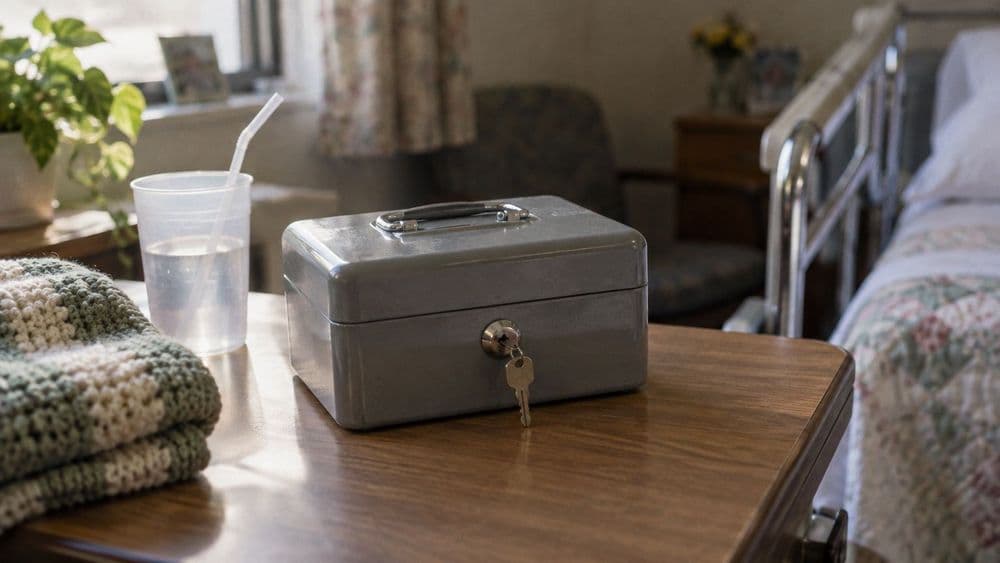
Home health is the other setting that works differently. When a licensed home health agency sends staff to your home, the agency only has to bar smoking or vaping "immediately before or while home health agency staff are present in the residence." The storage, written-guideline, staff-training and discharge-removal rules do not apply at home, but agency staff still may not give the cannabis. Ryan's Law does not itself make smoking legal anywhere: it limits what the agency must prohibit. A lease or building rule can still forbid it, as our explainer on what leases and state law say about cannabis at home walks through.
The rules inside a covered facility
Section 1649.2 sets the floor every covered facility must meet. Several of these rules came from SB 988, signed September 2, 2022 (Chapter 242) and effective January 1, 2023. As CDPH explained to facilities in its January 2023 letter on SB 988, the patient or primary caregiver is responsible for acquiring, retrieving, administering and removing the cannabis, and facility staff are prohibited from administering it or retrieving it from storage. Today, a covered facility must:
- Permit the patient's use as indicated by the attending physician (the recommending physician under section 11362.7) in the medical record, and record the use in the chart.
- Require a copy of the patient's medical marijuana identification card or the physician's written documentation.
- Prohibit smoking and vaping as ways to use medicinal cannabis (home health agencies: only immediately before or while staff are present).
- Leave acquiring, retrieving, administering and removing the cannabis to the patient or the patient's primary caregiver.
- Bar physicians, nurses, pharmacists and other staff from administering medicinal cannabis or retrieving it from storage.
- Keep the cannabis in a locked container in the patient's room, in a designated area, or with the primary caregiver.
- Adopt written guidelines on medicinal cannabis use and train staff on them (not required of home health agencies).
- Make sure the patient is not denied admission, in whole or in part, because of medicinal cannabis use (since January 1, 2024).
- At discharge, have the patient or caregiver remove whatever is left; otherwise it stays locked until it is disposed of under facility policy.
Section 1649.4 covers what the facility does not have to do. The law "does not require a health care facility to provide or furnish a patient with a recommendation" or to include medicinal cannabis in a discharge plan, and the facility is not required to supply the cannabis itself. Enforcement belongs to CDPH under section 1649.5, but compliance is not a condition for obtaining, keeping or renewing a facility's license. In practice that means a problem is raised through a complaint to CDPH, not through a licensing fight.
The 2023 and 2024 changes most guides missed
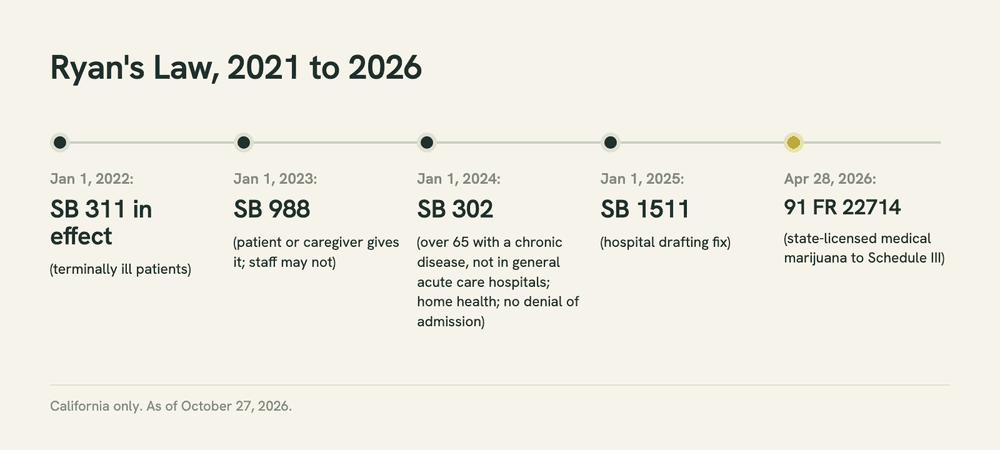
SB 302, signed October 8, 2023 (Chapter 484) and effective January 1, 2024, did most of the expanding. It added the over-65 chronic-disease patient, brought in home health agencies, created the no-denial-of-admission rule and the staff-training duty, and added a federal "inquiry" as a reason a facility may suspend compliance. When he signed it, the Governor flagged a problem in his SB 302 signing message: "the bill excludes hospitals from its provisions, but could be interpreted to narrow existing law for hospital patients that have both a terminal illness and chronic disease. It is my understanding this was not the intent." SB 1511, a 2024 health omnibus bill signed September 22, 2024 (Chapter 492), fixed that in section 1649.2(b), effective January 1, 2025. Only one section of SB 1511 touches Ryan's Law, which is why it is easy to miss. CDPH has not issued a facility letter on SB 1511; we checked its 2025 and 2026 letter indexes on October 27, 2026.
| Date | What happened |
|---|---|
| November 5, 1996 | Voters approve Proposition 215, the Compassionate Use Act |
| 2018 | Ryan Bartell, 41, dies of pancreatic cancer |
| 2019 | SB 305 passes and is vetoed |
| September 28, 2021 | SB 311 signed (Chapter 384, Statutes of 2021) |
| January 1, 2022 | Ryan's Law takes effect for terminally ill patients |
| September 2, 2022 | SB 988 signed (Chapter 242): patient or caregiver administers, staff may not, locked storage, disposal guidelines |
| January 1, 2023 | SB 988 takes effect |
| October 8, 2023 | SB 302 signed (Chapter 484); the Governor flags a drafting error |
| January 1, 2024 | SB 302 takes effect: over-65 chronic-disease patients (not in general acute care hospitals), home health agencies, no denial of admission, federal inquiry trigger |
| September 22, 2024 | SB 1511 signed (Chapter 492), fixing the hospital drafting error |
| January 1, 2025 | SB 1511 takes effect |
| April 28, 2026 | DEA final rule 91 FR 22714 moves marijuana subject to a state medical marijuana license to Schedule III |
| September 9, 2026 | D.C. Circuit declines to stay the April order; petitions remain pending |
| October 27, 2026 | Our check: no CMS or Justice Department document on patient use in facilities; no CDPH letter after January 2024 |
The federal escape hatch, and what changed in April 2026
The federal tension that sank SB 305 is built into the law as section 1649.6. A facility may suspend compliance with the patient-use rules if a federal regulatory agency or the US Department of Justice starts an enforcement action against it (including a notice to suspend funding), if a federal agency, the Justice Department or the Centers for Medicare and Medicaid Services (CMS) issues a rule, guidance or notification expressly prohibiting patient use, or if one of them "makes an inquiry about the health care facility's activities." The suspension lasts until the agency notifies the facility that it may resume. The inquiry trigger arrived with SB 302. But the exit has a limit, written into the next subsection:
“"...does not permit a health care facility to prohibit patient use of medicinal cannabis due solely to the fact that cannabis is a Schedule I drug pursuant to the federal Uniform Controlled Substances Act, or other federal constraints on the use of medicinal cannabis that were in existence prior to the enactment of this chapter."”
Federal hospital rules do not mention cannabis at all. The CMS hospital condition of participation on nursing services, 42 CFR 482.23, says drugs "must be prepared and administered in accordance with Federal and State laws," and lets a hospital allow patients to self-administer their own medications "as defined and specified in the hospital's policies and procedures." Hospitals raised the federal question from the start. When SB 311 was debated in 2021, the California Hospital Association asked that it apply only once medical cannabis left Schedule I (per the Senate Health Committee's analysis that year), and the 2023 Senate Judiciary analysis notes that the hospital association and the California Association of Health Facilities remained opposed when SB 311 passed. That same analysis listed no known opposition to SB 302. All of this is history, not a prediction of how any hospital behaves today.
Then the federal picture moved. As of April 28, 2026, a DEA final rule (91 FR 22714) moved two narrow categories of marijuana from Schedule I to Schedule III: marijuana in an FDA-approved drug product, and marijuana subject to a state medical marijuana license. Everything else stays in Schedule I, and marijuana remains a controlled substance under federal law. On September 9, 2026, the D.C. Circuit declined to stay the April order while petitions challenging it remain pending. Our explainer on the Schedule III ruling tracks that case and what the rule does elsewhere.
What has not changed matters more for a family. Section 1649.6 has not been amended since the April order, and it still refers to Schedule I. The suspension triggers still stand, including the inquiry trigger. As of October 27, 2026, we found no CMS or Justice Department document addressing patients' own medical cannabis in health facilities, and no agency statement on how the April order applies to facility use. A search finding nothing is not a federal green light, and we are not going to guess how a court or a facility would read subsection (b) after rescheduling.
What about CBD in the hospital?
Ryan's Law is written around medicinal cannabis used under California's medical cannabis program: section 1649.1 defines it as cannabis or a cannabis product used in compliance with the Compassionate Use Act and the state's Medical Marijuana Program statutes (section 11362.7 and following). It does not mention hemp-derived CBD bought off the shelf, so whether you can keep a CBD product in the hospital is a facility policy and medication-list question. Bring the bottle and the label to admission and list it with your medicines.
We are deliberately not telling you that California law treats hemp CBD as something other than cannabis. A 2025 state law, AB 8, rewrote California's hemp definitions, and that line is still moving, so the safe frame is Ryan's Law's own definition plus the facility's own rules. Why disclosure matters to the care team is covered in our guides to CBD before surgery and how CBD interacts with prescription drugs. For the plant-level distinction, see hemp vs marijuana, and for questions that come with age and multiple prescriptions, see our guide to CBD and older adults.
Before admission: a family checklist
Ryan's Law sets a floor; the facility's written guidelines decide the logistics. Work through this list before admission or on the first day:
- 1Confirm the facility type (hospital, skilled nursing, hospice facility, congregate living, home health or assisted living). It decides who is covered.
- 2Confirm the patient's category: a prognosis of one year or less, or over 65 with a chronic disease and a physician's assessment.
- 3Bring a copy of the medical marijuana identification card or the physician's written documentation.
- 4Ask that the recommending physician's indication be recorded in the medical record.
- 5Ask for the facility's written medicinal cannabis guidelines (every covered facility except a home health agency must have them).
- 6Decide who will acquire, retrieve and give each dose: the patient or a named primary caregiver. Staff may not.
- 7Bring non-smoked, non-vaped forms only, and ask where the locked container will be kept.
- 8List every product, including any hemp CBD, with the medication history at admission.
- 9Plan discharge: agree on who removes whatever is left.
- 10If a facility refuses a qualifying patient, ask which provision it relies on (for example a federal notice under section 1649.6). Complaints go to CDPH.
If a refusal still looks wrong for a specific patient, a California attorney can advise on that case. Keep notes of who you spoke with and what they cited; it makes a CDPH complaint far easier to file.
What the law does not settle
Ryan's Law leaves real gaps. Facility guidelines vary, so two skilled nursing facilities can handle storage and timing differently and both comply. Enforcement runs through complaints to CDPH, and we did not verify how many complaints have been filed or how they were resolved. The age line is contested even inside the Legislature: the Senate Judiciary analysis said "precedent suggests that this classification exists in a gray area," using the example of a 66-year-old and a 63-year-old with the same symptoms. No court has ruled on it. CDPH has issued no facility letter on the 2024 hospital fix, we found no published federal guidance testing the suspension clause, and the statute's Schedule I language has not been updated for 2026. Finally, everything on this page is California law only.
Frequently asked questions
Yes, if the nursing home is a licensed skilled nursing facility. Terminally ill residents have been covered since 2022, and residents over 65 with a chronic disease and a physician's assessment since January 1, 2024. Assisted living, which is licensed as residential care for the elderly, is not among the facility types the law lists, so the facility's own policy decides.
In a general acute care hospital only terminally ill patients are covered, so a patient over 65 with a chronic disease who is not terminally ill is not. For a covered patient, the hospital cannot refuse solely because cannabis is a Schedule I drug or because of federal constraints that existed before the law, and it cannot deny admission over it. It can set storage and use rules, and it may suspend compliance if a federal agency takes enforcement action, issues an express prohibition or makes an inquiry.
No to both. The facility is not required to supply cannabis, provide a recommendation or put cannabis in a discharge plan. Since 2023, physicians, nurses, pharmacists and other staff may not administer it or retrieve it from storage. The patient or a primary caregiver brings it, gives it and takes home what is left.
Not in a hospice facility or any other covered facility: the law requires them to prohibit both. If you receive care at home from a licensed home health agency, the agency must bar smoking or vaping immediately before or while its staff are present. Ryan's Law does not make smoking legal anywhere else, and a lease or local rule can still forbid it.
No. The law excludes an emergency department while the patient is receiving emergency services and care. Chemical dependency recovery hospitals and state hospitals are excluded too.
Not if it is a covered facility and you are a covered patient. Since January 1, 2024, section 1649.2 requires covered facilities to make sure a patient is not denied admission, in whole or in part, because of medicinal cannabis use. The facility can still apply its written guidelines on storage and use.
Ryan's Law does not mention hemp-derived CBD bought off the shelf, so it is a facility policy and medication-list question. Bring the bottle and the label to admission, list it with your other medicines, and let the care team and the facility's policy decide whether it stays with you.
No. It is a California statute that applies to facilities licensed in California. Other states set their own rules for health facilities, so check the specific state and facility.
Ryan's Law is one piece of a larger picture in which federal scheduling, California's medical cannabis program and hemp rules all overlap. For the full framework, including where hemp-derived CBD fits, read our guide to whether CBD is legal.
Writing about hemp, wellness and the small rituals that keep us balanced.