Does Weed Help You Focus? Why It Can Feel Like It, and What the Task Scores Show
Weed can feel like focus, but placebo-controlled studies show THC lowers working memory and attention for hours and dulls your sense of how you are doing. Here is why, what tolerance in daily users really means, and what the ADHD research shows.

Plenty of people say a little weed helps them lock in: the essay flows, the chores finally get done. Researchers have tested that feeling against task scores in placebo-controlled studies, and the two do not line up. Here is what they measured, why the feeling is real anyway, and why daily users see it differently.
So does weed help you focus? In controlled tests, THC does not sharpen focus. It dulls it. Placebo-controlled studies show lower working memory, planning and attention for hours after a dose, more so at higher doses and in occasional users. Daily users show less impairment at the same dose, which is tolerance, not a boost. The absorbed feeling is real, but THC also blunts your ability to judge how well you are doing, and that is a big part of why a high can feel productive.
Why weed can feel like focus
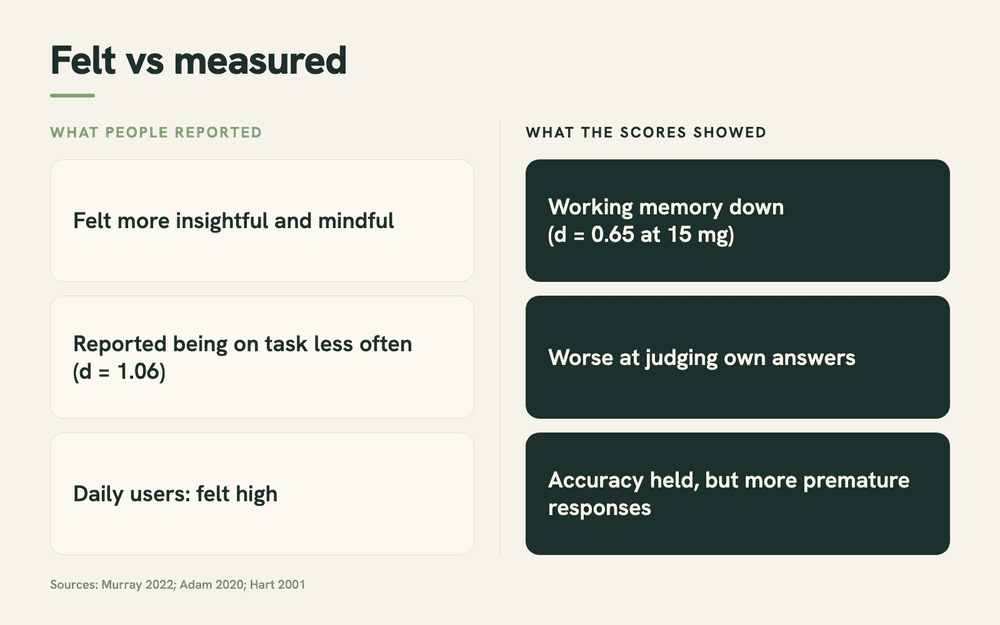
Start with the feeling, because it is not imaginary. In a placebo-controlled University of Chicago study of 25 infrequent users, oral THC at 7.5 mg and 15 mg raised ratings of an altered state in a dose-dependent way, including feeling insightful, and raised ratings of both mindfulness and mind-wandering. The sense of depth and the drifting arrived together. These were self-reports, and the authors themselves ask whether the insight is real or simply part of the altered state.
The same research program measured what happens underneath. In two double-blind crossover trials published in 2020, 46 healthy occasional users took 15 mg of oral THC or a placebo. On THC they held less in visual working memory, reported being on task less often, and were worse at telling which of their own answers were right. That last finding matters most: THC lowered the score and also the gauge you would use to notice the drop. Feeling locked in while doing worse is exactly what the data predicts. The same gap between felt and measured effects shows up in research on cannabis and creativity.
Does weed help you focus? What controlled tests measured
Some of the clearest dose data comes from a 2006 Maastricht crossover study. Twenty recreational users smoked 13% THC cannabis on separate days at a placebo and two doses, 250 and 500 micrograms of THC per kilogram of body weight (about 17.5 mg and 35 mg for a 70 kg adult; study doses, not a guide). THC impaired a tracking task, cut correct answers on the Tower of London planning puzzle, and slowed the stop-signal response, a measure of how fast you can cancel an action you have started. Impairment lasted up to 6 hours, and the higher dose roughly doubled the effect sizes.
The 2020 trials add effect sizes, a standard measure of how big a difference is. At 15 mg, visual working memory dropped by d = 0.65, which the authors note is smaller than the normal spread between healthy people. People were slower without gaining accuracy, and the impairment held steady across the session, so it was not fatigue. At 7.5 mg the memory effect was not apparent in that sample. The authors do not call that a safe level; they point to statistical power instead.
Power is also why so many articles call this research mixed. The same paper looked back at earlier placebo-controlled studies: across 57 conditions using the Digit Span memory test, more than 70% failed to detect an effect. When the team shrank their own data to those typical sample sizes, the effect vanished on paper too. Mixed results partly means small studies.
Context changes the size of the effect. A 2011 Scripps review of cannabis and executive function found deficits vary with how much you use, how recently, how young you started and for how long. This page covers the hours after use. A 2026 review in Psychopharmacology that some sites cite on focus is about how cognition changes over years of use; it found too little evidence on attention to say, and it did not test whether a high helps you focus. For the long-term picture, see whether weed harms the brain.
Felt vs measured: the studies side by side
Here are the main records in one place. Notice how often self-reports and scores point in different directions, and how much depends on who was tested.
| Study | Who | THC and route | What people reported | What the scores showed |
|---|---|---|---|---|
| Ramaekers 2006 | 20 recreational users | Smoked, 250 and 500 µg/kg vs placebo | Not the main measure | Worse planning, tracking and impulse control for up to 6 h; about double the effect at the higher dose |
| Adam 2020 | 46 occasional users | Oral, 7.5 and 15 mg vs placebo | On task less often; more mind-wandering | Working memory down at 15 mg; worse at judging own answers |
| Murray 2022 | 25 infrequent users | Oral, 7.5 and 15 mg vs placebo | More insightful, more mindful, more mind-wandering | Self-report study, no task score |
| Hart 2001 | 18 heavy smokers, about 24 joints a week | Smoked, 0%, 1.8% and 3.9% THC | Felt high; rated a good drug effect | Accuracy unchanged; more premature responses; slower |
| Ramaekers 2009 | 12 occasional vs 12 heavy users | Smoked, 500 µg/kg vs placebo | Not the main measure | Occasional: tracking, divided attention, impulse control worse. Heavy: impulse control only |
| Desrosiers 2015 | 11 occasional vs 14 frequent smokers | One 6.8% THC cigarette, no placebo | Not the main measure | Divided attention down, more in occasional; no group difference on working memory |
| Safati 2025 | 48 regular users, own pre-rolls | Self-dosed, estimated mean about 83 mg, no placebo | Minds drifted more | Worse timing task; less control over mind-wandering |
Daily users and tolerance: why regulars swear it helps
If you use every day, those results may not match your experience, and the reason is tolerance. In a 2001 study of heavy smokers at the New York State Psychiatric Institute, 18 experienced users averaging about 24 joints a week smoked cigarettes of 0%, 1.8% and 3.9% THC in separate sessions. Accuracy on tests of cognitive flexibility, mental calculation and reasoning did not change. Premature responses and the time needed to finish several tasks went up, as did ratings of feeling high. The authors called the effects minimal, at a potency low by today's standards.
Putting both kinds of user in one lab makes the point sharper. In a 2009 Maastricht comparison of occasional and heavy users, 12 of each smoked the same weight-adjusted dose. Occasional users were impaired on tracking, divided attention and impulse control; heavy users only on impulse control. A NIDA study of frequent and occasional smokers saw divided attention drop after one 6.8% THC cigarette, more in the 11 occasional smokers than the 14 frequent ones, which the authors called some tolerance.
“Cannabis use history strongly determines the behavioural response to single doses of THC.”
A 2018 systematic review of cannabis tolerance found cognitive effects show the highest degree of tolerance, and a 2008 lab study of frequent users found their cognitive impairment blunted but not their euphoria. So regular users can feel high with less measurable impairment, which is exactly why it can seem to help. Less impaired than a beginner is not the same as better than sober, and none of these studies tested real exams or jobs. Tolerance also has edges: in a 2011 study of 21 heavy users, THC alone barely moved task scores, but THC plus alcohol hurt divided attention more than alcohol alone. If you want to bring tolerance down, see how a tolerance break works.
Mind-wandering: absorbed but drifting
The 2020 trials also asked people, at random moments, what their mind was doing. On THC, on-task reports fell (d = 1.06), mind-wandering rose (d = 0.92), and zoning out, drifting without noticing, rose too (d = 0.45).
A 2025 Waterloo study of 48 regular users took the question outside the lab. The participants, mostly students with a mean age of 23, did a rhythm task sober, then after a session they had already planned with legally bought pre-rolls, then sober again. High, their minds drifted more without their choosing, their timing got sloppier, and they were worse at letting their minds wander more or less on request. With no placebo, no blinding and self-chosen amounts, it supports the lab results rather than replacing them. The common thread: THC does not just pull attention away, it loosens your grip on where attention goes.

THC, CBD and terpenes: what was actually tested
Every controlled record above tested THC. The idea that a terpene can steer it usually points to a 2024 Johns Hopkins trial of THC with d-limonene, the lemon-scented terpene. Twenty adults vaporized THC with and without limonene. Only the top combination, 30 mg THC with 15 mg limonene, lowered ratings of feeling anxious and paranoid; THC's other effects, including on cognitive tasks, were unchanged. That session included 12 of the 20 people and always came last, the ratio is unlikely in ordinary flower, and Johns Hopkins has filed a patent application on limonene, with several authors reporting industry ties. It tested anxiety, not focus. Why THC brings on anxiety in the first place is covered in why weed can make you paranoid.
CBD is a separate question, and the trials do not show a focus benefit there either. In a 2023 randomized trial of 300 mg CBD in 40 healthy college students, attention lapses on a vigilance test ran slightly longer on CBD than on placebo; it was one small feasibility trial. Not being intoxicating is not the same as improving focus, and we found no placebo-controlled trial showing that CBD improves attention in healthy adults. The morning-for-focus framing around CBD is mostly a marketing split, and the energy claims around minor cannabinoids are weighed in our CBG and THCV comparison. For what human research does and does not show about CBD, start with the CBD evidence overview. We also found no human trial of sativa against indica for attention, and the couch-lock research shows why those labels do not reliably predict chemistry.
Weed and ADHD focus: what a survey and one trial show
The ADHD claim you see most often traces to a 2022 Washington State survey of 1,738 students. People with ADHD who used cannabis reported that it eased their symptoms and some medication side effects. It is an online survey of what people believe, with no control group and no measured attention, so it cannot tell you whether cannabis improved anything.
The only placebo-controlled cannabinoid trial in adults with ADHD we found on PubMed is a 2017 pilot of a prescription THC:CBD spray in 30 people. On its main measure, a computerized test of attention and activity, the spray did not beat placebo (p = 0.16), and other results did not survive correction for multiple comparisons. One serious adverse event, muscle spasms, occurred in the active group. That is not evidence that cannabis treats ADHD. If you take a stimulant, our guide to CBD and Adderall covers interactions.
Studying, exams, work and driving: timing matters
The trials measured impairment in hours: up to 6 in the 2006 study. A 2021 meta-analysis of 80 publications on driving-related skills found most skills recovered within about 5 hours of roughly 20 mg of inhaled THC and almost all within 7, with oral THC taking longer; how long a weed high lasts breaks this down by route. For studying, a cohort study of college students traced more frequent use to more skipped classes, lower first-semester grades and a longer time to graduation. It is observational, and the path ran mainly through attendance, not in-the-moment focus.
This is not advice on how to work high; it is a way to decide when not to. Before you mix THC with anything that needs your attention, the evidence points to these checks.
- 1Is the task safety-sensitive, like driving, operating machinery or caring for someone? Do it sober. Alcohol on top of THC made divided attention worse.
- 2Is it graded or high-stakes? Planning and working memory dropped for hours in the trials, and people were worse at spotting their own mistakes.
- 3How long has it been? Most driving-related skills recovered within about 5 hours of inhaled THC; edibles take longer.
- 4Are you judging by feel? Your sense of how well you are doing is the very measure THC weakened.
- 5Do you use daily and feel fine? Less impaired than a beginner is not unimpaired; impulse control slipped even in heavy users.

What is still unknown
- We found no controlled trial of THC during a real study session, exam or workday; the evidence is lab tasks.
- Few controlled studies test daily users at modern potency. The 2001 heavy-user study topped out at 3.9% THC.
- How fast cognitive tolerance builds, and how fully it reverses after a break, is not well mapped.
- We found no controlled trial showing that CBD improves attention in healthy adults.
- The ADHD evidence is mostly self-report surveys plus one 30-person pilot trial. Whether any cannabinoid helps attention in ADHD is an open research question.
Frequently asked questions
The controlled evidence points the other way. THC lowered working memory and planning scores for hours and made people worse at judging their own answers. A college cohort study also linked more frequent use to skipped classes and lower grades, though it was observational.
THC raises the feeling of being absorbed and insightful while making you worse at judging how well you are doing. So the sense of focus can rise while on-task attention falls. If you use often, tolerance can also make you feel less impaired than you once did.
Daily users are less impaired than occasional users at the same dose, and in one study heavy smokers kept their accuracy. That is tolerance, not improvement over being sober. Even heavy users responded prematurely more often and slowed on an impulse-control task.
A 2022 survey found people with ADHD reported benefits, but a survey measures beliefs, not attention. The only placebo-controlled cannabinoid trial in adults with ADHD we found, 30 people using a prescription THC:CBD spray, missed its main measure. That is not evidence cannabis treats ADHD; talk to your prescriber.
THC is what the controlled trials tested, and it impaired attention and memory. CBD is not intoxicating, but that is not the same as improving focus: we found no placebo-controlled trial showing it improves attention, and one small 2023 trial saw slightly longer attention lapses at 300 mg. Neither has evidence as a focus aid.
We found no human trial that tested strain labels for attention, and sativa and indica labels do not reliably predict chemistry. The terpene trial often cited, on limonene, tested anxiety, and THC's effects on cognitive tasks were unchanged.
Focus is one half of the productivity question; drive is the other. If what you really want to know is whether weed affects motivation and getting things done, our evidence review on whether weed makes you lazy picks up where this page stops.
Writing about hemp, wellness and the small rituals that keep us balanced.