CBG vs THCV: Same Daytime Label, Different Chemical Families
CBG and THCV get sold as the same daytime cannabinoid. They are different chemical families: THCV is THC with a shorter tail and does not even come from CBG. Here is what each has been measured for, what federal rules name, and what our certificates print.
Search for CBG vs THCV and most of what comes back tells one story twice. Both get filed as daytime cannabinoids, CBG pitched for focus and THCV for appetite, and some products put the two in the same bottle, sometimes with caffeine. The shelf treats them as siblings. Chemically they are not. THCV is a close structural relative of THC and CBG is not, and the two do not even share a parent. That difference runs through everything else: what has been measured in people, how much research exists, how federal rules name each one, and how much of either is actually in a bottle.
The short answer is in the box below, and each part of it gets its own section. If you are new to this family of molecules, start with what cannabinoids are and how they are grouped. If you already know CBG, our CBG profile covers its identity and scarcity, and this page covers only the pairing.
CBG vs THCV, read from their chemical names
| Property | THC | THCV | CBG |
|---|---|---|---|
| Formula | C21H30O2 | C19H26O2 | C21H32O2 |
| Molecular weight (g/mol) | 314.5 | 286.4 | 316.5 |
| Ring system | Closed, fused ring system | Closed, the same ring system as THC | None closed: an open chain attached to a benzene ring |
| Side chain (the tail) | Pentyl, 5 carbons | Propyl, 3 carbons | Pentyl, 5 carbons |
| Key part of the official IUPAC name | ...3-pentyl-6a,7,8,10a-tetrahydrobenzo[c]chromen-1-ol | ...3-propyl-6a,7,8,10a-tetrahydrobenzo[c]chromen-1-ol | 2-[(2E)-3,7-dimethylocta-2,6-dienyl]-5-pentylbenzene-1,3-diol |
| PubChem CID | 16078 | 93147 | 5315659 |
Put the official names next to each other and the family tree draws itself. PubChem's record for tetrahydrocannabivarin, or THCV, gives the same IUPAC name as THC, word for word, except that one says 3-propyl and the other says 3-pentyl: a tail two carbons shorter. The record for cannabigerol, or CBG, has no ring system in its name at all, just an open chain (a geranyl group) hanging off a benzene ring, and it keeps THC's five-carbon tail. So THCV is THC with a shorter tail, and CBG is THC's tail on a ring that never closed. That means CBG and THCV differ from each other in both places at once, the ring and the tail.
Be clear about what this does and does not tell you. It tells you which family each molecule belongs to. It does not tell you what either one does in a person: structure predicts nothing about effect on its own, and the rest of this page is about what has actually been measured. The ring question is the whole subject of our CBG and CBD comparison. THCV's identity, including why delta-9 THCV and delta-8 THCV are not the same molecule, lives on our THCV vs CBD page.
THCV is not one of CBG's children
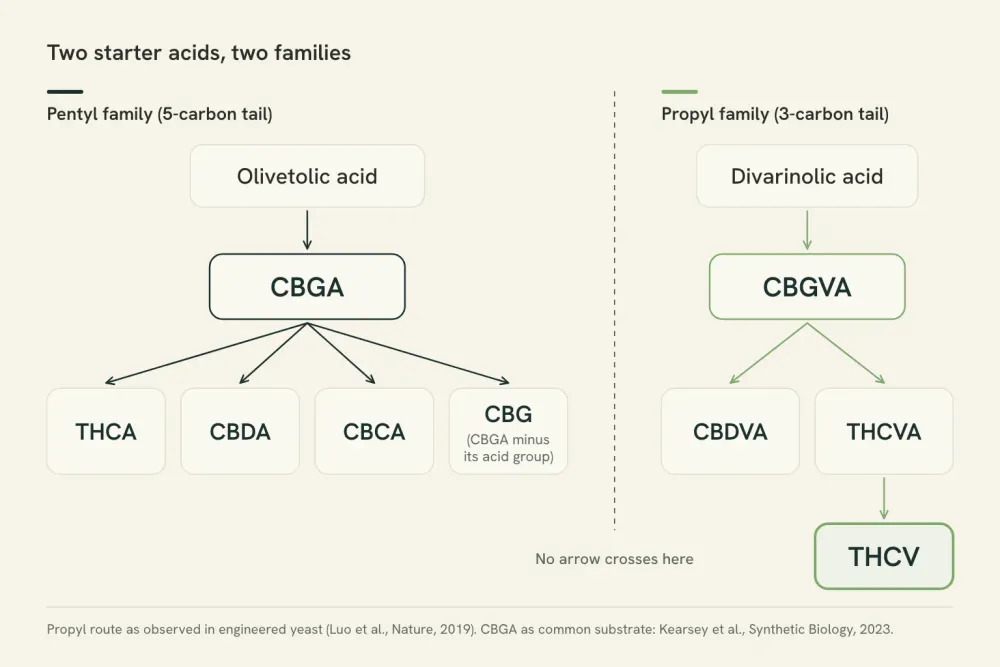
Almost every seller page on this pairing calls CBG the mother cannabinoid, the molecule every other cannabinoid comes from. That is half right, and the wrong half matters here. The plant's working raw material is the acid form, CBGA, which a 2023 synthetic biology paper describes as the common substrate to multiple cannabinoid synthases: the starting block several enzymes compete for. One of those enzymes turns CBGA into THCA, the acid form of THC, a step characterized in a 2004 plant enzymology paper by Sirikantaramas and colleagues in the Journal of Biological Chemistry (doi:10.1074/jbc.M403693200), using tobacco roots and insect cells rather than a person. That branch is covered on our page comparing CBG and THC. CBG itself is what CBGA becomes when it loses its acid group, and our page on CBGA explains that branch point.
THCV sits on a different branch, and the split happens before CBG exists. In a 2019 Nature study that rebuilt the cannabinoid pathway in engineered yeast, the pentyl route ran through olivetolic acid and CBGA. The propyl route ran through divarinolic acid, a starter with a shorter propyl side chain, and its prenylated form, CBGVA, and ended at THCVA, the acid form of THCV. Two caveats belong in the same breath: this was yeast, not a plant, and the authors include people affiliated with the companies Demetrix and Genomatica. The plant side is catching up. A 2026 University of Connecticut study in Plant Molecular Biology (doi:10.1007/s11103-026-01690-1) followed one cannabis family that splits into high-propyl and high-pentyl plants. It found more of a four-carbon starter acid (butanoic acid) in the high-propyl group and a distinctive DNA pattern at one locus in almost all of them, and the authors could not yet say which gene is responsible. So whether a plant makes much THCV at all is a genetic trait. THCV is not one of CBG's children. It is a child of CBG's propyl cousin, CBGVA.
What the receptor studies measured, and in what
Receptor findings are where marketing copy borrows the most authority, so read each one with three questions in hand: what tissue or animal, given how, and at what amount. Every study in this section is preclinical. None was done in a person, and none measured a feeling. If CB1 and CB2 are new terms, our guide to the endocannabinoid system explains the receptors first.
Start with CBG. In a 2010 study using mouse brain membranes, CBG activated the alpha-2 adrenergic receptor at very low concentrations (EC50 0.2 nM), blocked the 5-HT1A serotonin receptor (KB 51.9 nM), and at 10 micromolar behaved as a competitive antagonist at CB1, the receptor THC acts on. The authors themselves flagged that their assays did not all agree. In a 2018 study in living human-derived cells engineered to carry the receptors, CBG acted as a partial agonist at CB2 (Ki 152 nM), while its mechanism at CB1 remained uncertain. Four of that paper's authors were employed by Phytoplant Research S.L.
THCV comes at the same receptor from the opposite direction. In a 2005 study of mouse brain membranes and cells carrying human CB2, THCV bound CB1 with a Ki of 75.4 nM and CB2 with a Ki of 62.8 nM, and behaved as a competitive antagonist at both: it blocked the receptor THC acts on rather than switching it on. A Ki is a binding constant measured on a lab preparation, not a strength in a body. Then the picture turns dose-dependent. In a 2007 study in mice given THCV intravenously, synthetic delta-9 THCV and delta-8 THCV at 0.1 to 3 mg/kg blunted two of THC's effects in the animals, a reduced response to a painful stimulus and a drop in body temperature. Given on their own at 3 or 10 mg/kg, both produced ring immobility, a cannabinoid-type catalepsy screen. That is the preclinical root of the idea that THCV blocks THC at low doses and acts more like it at higher ones.
The newest data point agrees only in part. In a 2025 drug-discrimination study in rats, 16 male rats were trained to tell a THC injection from a blank one, and 13 learned the task. Injected THCV produced what the authors call an inverted U-shaped curve. At 3 mg/kg the rats chose the THC lever 54.6% of the time on average (plus or minus 17.8), a partial substitution. At 6 mg/kg, THCV blocked a small dose of THC instead. The same paper cites an earlier study in another rat strain where THCV from 3 to 30 mg/kg did not substantially alter THC's effects in the same kind of task. These are injected animals dosed per kilogram of body weight. Lever choice asks whether something feels like THC to a rat, not whether a person feels high, and no human amount follows from any of these numbers. The full binding ladder, THCV against the other cannabinoids, is set out on our side-by-side of THCV and CBD, so we do not rebuild it here.
The daytime story, traced to its evidence
A daytime claim is a claim about people, so it needs human evidence. Here are the human studies most often cited behind each half of the pairing, with what each measured and what it was not built to test. On the THCV side, that means a 2015 brain-imaging study of 20 healthy volunteers, a second 2015 imaging study that looked at brain connectivity at rest, and a 13-week trial in 62 adults with type 2 diabetes. Those three, plus two smaller THCV studies (a five-day pilot and a dose-ranging study of the delta-8 form), are inventoried one by one on our THCV vs CBD page, so here they are compressed into rows and set beside CBG's.
| Molecule | Study | Design and people | What it measured | Not designed to test |
|---|---|---|---|---|
| CBG | Russo 2022, first CBG user survey | Self-selected online survey, 127 US adults already using CBG-predominant cannabis; 29.1% said their product also contained THC | Self-reported reasons for use and side effects | Any effect under controlled conditions |
| CBG | Lutz 2026 survey, published online September 15, 2026 | Self-selected survey, 239 CBG or CBGA users | Self-reported conditions for use and perceived efficacy | Any effect under controlled conditions |
| CBG | Cuttler 2024 | Placebo-controlled crossover at home, 34 healthy adults, single 20 mg study dose | Anxiety, stress and mood ratings; secondary drug-effect, impairment and memory measures | Whether CBG improves energy, focus or productivity |
| THCV | Tudge 2015 | Double-blind crossover brain imaging (fMRI), 20 healthy volunteers, single 10 mg study dose | Brain responses to food reward and aversion cues | Eating, weight, energy or focus |
| THCV | Rzepa 2015 | Double-blind crossover brain imaging (fMRI), 19 healthy volunteers per its Methods (20 in its abstract), single 10 mg study dose | Brain connectivity at rest | Eating, weight, energy or focus |
| THCV | Jadoon 2016 | Randomized parallel trial, 62 adults with type 2 diabetes, 13 weeks | Not restated here: see our THCV vs CBD page | Effects in healthy people |
Read down the last column and the daytime story has nothing under it. None of these studies was designed to test energy, focus or productivity, in either molecule. THCV's two imaging studies recorded changes in brain signals, and their volunteers reported no subjective differences after the single study dose. CBG's side is thinner still, and it points somewhere the marketing does not. The first survey of CBG users recruited 127 people who had already chosen CBG-rich cannabis. Asked why they used it, 51.2% named anxiety, 40.9% chronic pain, 33.1% depression and 30.7% insomnia. Asked about side effects, 16.5% reported dry mouth and 15% reported sleepiness. Increased clarity or focus appears once, as a write-in answer from two people. The survey's first author, Ethan Russo, is affiliated with CReDO Science, and 29.1% of respondents said their CBG product also contained THC.
A second survey, published online on September 15, 2026 in the Journal of Psychoactive Drugs (doi:10.1080/02791072.2026.2727651), asked 239 CBG and CBGA users what they use it for. The most common answer was insomnia or disturbed sleep, at 62%, followed by inflammatory chronic pain at 44% and anxiety at 33%. Two of its authors have commercial affiliations: Russo again, through CReDO Science, a company that works with CBG, and an author affiliated with Healer Hemp. Hold both surveys at arm's length. They recruited people who already use CBG and chose to answer, they record what those people believe, and they cannot tell you what CBG does. What they can tell you is narrower and still useful: the self-report record behind CBG's daytime reputation does not describe a daytime molecule. The one placebo-controlled CBG study in the table, a 2024 at-home crossover in 34 healthy adults, was funded by CReDO Science, counts its chief executive among the co-authors, and measured anxiety, stress and mood ratings rather than energy or focus. Our CBG vs CBD comparison covers it with its limits.

Counted: how much human research exists for each
We ran these counts on September 22, 2026, and counts move, so treat the date as part of the number. On ClinicalTrials.gov, the federal trials registry, a search for cannabigerol as an intervention returned 15 registered studies, none with results posted. Tetrahydrocannabivarin returned 5, and adding THCV's development code, GWP42004, brings the total to 6 distinct records, 2 with results posted. For scale, the same kind of search for cannabidiol returned 536. The largest registered THCV study, which enrolled 207 people and was completed in February 2016, has no results posted. A registration is a plan, not a finding. On PubMed, 9 records mentioning cannabigerol in the title or abstract are tagged as randomized controlled trials, and that tag is an indexer's label rather than a check on the design.
Then we looked for the study the pairing implies: one that gave anyone CBG and THCV together. The registry search for both returned zero. PubMed has exactly two clinical-trial records whose titles or abstracts mention both molecules, and both measured them as markers in body fluids after people took cannabis itself. Neither gave either molecule as a product. So any claim about what CBG and THCV do together is a claim about something nobody has tested.
Where they differ on paper: federal law and the drug-testing rule
Here is the one legal paragraph this page owns, dated September 22, 2026. Section 781 of Public Law 119-37 rewrites the federal definition of hemp, and Section 2019 of H.R. 6500, enacted on September 2, 2026 as Public Law 119-103, split its start into two dates. On November 12, 2026 only subclause (I) arrives, covering cannabinoids "not capable of being naturally produced" by the plant. On December 11, 2026 the rest arrives: subclause (II), for cannabinoids that are capable of being naturally produced but "were synthesized or manufactured outside the plant", along with the total THC standard and a 0.4 mg per container ceiling. The plant can make both CBG and THCV, so the first date's clause is not written for either. The second date's clause turns on how a product was made, not on which molecule it is. Every CBG-specific statutory question is answered on our page on whether CBG is legal, and the container arithmetic is worked through in our explainer on the 2026 hemp changes.
One more sentence of the statute matters for this pairing, and it is where readers usually want an answer we cannot give. The per-container ceiling counts "total tetrahydrocannabinols" plus any other cannabinoid with similar effects "as determined by the Secretary of Health and Human Services". The law does not list which molecules those are, and as of September 22, 2026, the lists it told the FDA to publish have not been published. So we are not going to tell you whether THCV counts toward that ceiling, and nobody else can tell you with a federal document behind them. How total THC became the operative number covers the measurement itself.
The clearer difference is in the Code of Federal Regulations. On September 22, 2026, a search of the electronic CFR found cannabigerol in zero sections and tetrahydrocannabivarin in exactly one: 49 CFR 40.141, the Department of Transportation's rule on how the reviewing doctor verifies a drug test. Paragraph (b), which deals with an employee saying a prescription explains a result, lets that doctor ask a lab to test for THCV, the same way it can ask about the forms of amphetamine. THCV is in the cannabis plant and not in prescription THC, which is why a lab would look for it. That makes it a verification option inside one federal testing program, not a routine screen. No product can guarantee a drug-test result. Trace amounts and test sensitivity carry residual risk.
“...to conduct testing for D,L stereoisomers of amphetamine and methamphetamine or testing for tetrahydrocannabivarin (THC-V) when verifying lab results, as you determine necessary.”
What a CBG product can do on a drug test is its own question, and we answered it on a separate page about CBG and drug testing. THCV's longer history as a laboratory marker of cannabis use is traced on our THCV vs CBD page. Put side by side, the asymmetry is simple to state: one of these molecules is named in a federal testing rule, and the other is named in no federal regulation at all.
What our certificates print for both rows
Now the question the shelf never answers: how much of either molecule is actually in a bottle. We read the CBG and THCV rows on all 13 certificates published on our lab results page, issued by Infinite Chemical Analysis Labs using UHPLC-DAD, in milligrams per package. The figures below are composition as printed on each batch, not a dose and not something any bottle promises to deliver. If ND or limit of quantitation (LOQ) is new to you, how to read a certificate of analysis explains both.
| Product and batch | CBG printed | THCV printed |
|---|---|---|
| Broad Spectrum, Mango & Peach, batch 260320 | 145 mg | 17.7 mg |
| Broad Spectrum, Lemon & Raspberry, batch 260321 | 96.4 mg | 20.1 mg |
| Broad Spectrum, Natural, batch 260319 | 97.5 mg | 19.1 mg |
| Full Spectrum CBD, batches 260310, 260309 and 260303 | ND on all three | ND on all three |
| Full Spectrum CBD + CBG, batches 260314, 260315 and 260313 | 6,290 / 6,520 / 6,520 mg | ND on all three |
| Full Spectrum CBD + CBN, batches 260311, 260312 and 260304 | 17.5 / 19.3 mg / ND | ND on all three |
| Full Spectrum tablets, Mint, batch 260505 | ND | ND |
Three things stand out. First, the pairing barely exists in our own catalog. The only product line where both rows print a number is Broad Spectrum, where THCV sits between 17.7 and 20.1 mg per package. Our Full Spectrum CBD certificates print ND for both CBG and THCV on all three batches. Across all 13 certificates, THCV prints a number on 3 and CBG on 8. Second, ND is not zero. On batch 260320 the THCV row reads 0.291 mg/mL, about 1.7 times that report's limit of quantitation of 0.172 mg/mL, while on Full Spectrum batch 260310 the ND means below 0.179 mg/mL. In concentration terms those two certificates are less than a factor of two apart. Third, trace and formulated are different worlds. Our Full Spectrum CBD + CBG tincture is labeled at 6,000 mg CBG in a 60 mL bottle, and its three certificates print 6,290 to 6,520 mg. Divide that by the Broad Spectrum CBG traces of 96.4 to 145 mg and you get roughly 40 to 70 times more. That is our arithmetic, not the lab's. The same bottle prints ND for THCV, and the largest THCV figure on any certificate we publish is 20.1 mg per package.
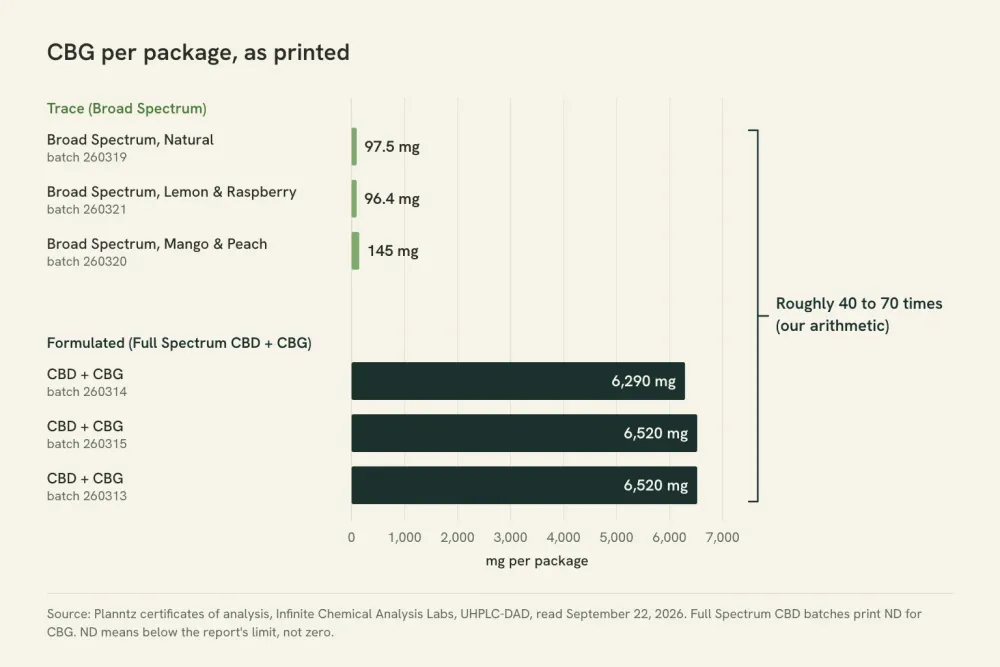
That gap is the practical point of the whole comparison. Abundance is what separates a major cannabinoid from a minor one, and at the trace levels above, CBG and THCV are lines on a certificate rather than the reason a product exists. If you want to see what changes when CBG is formulated in rather than carried along, our three-bottle comparison of CBD, CBG and CBN puts the certificates side by side.
A five-line check for any product sold on CBG or THCV
You do not need a chemistry degree to test a CBG or THCV product against the evidence. You need the label, the batch certificate and about five minutes. Run these in order.
- 1Name the molecule and the form. CBG and THCV are different families, and delta-9 THCV and delta-8 THCV are different molecules. A label that only says THCV has not told you which one it contains.
- 2Find the CBG or THCV row on the batch certificate and read milligrams per package, not a percentage and not a blend total. If there is no certificate, or no row for the named molecule, stop there.
- 3Compare that row to the front label. A product formulated with the molecule should print roughly what the label claims. On our certificates, formulated CBG prints above 6,000 mg per package; traces print 145 mg or less, or ND.
- 4For every effect word on the package, such as energy or focus, ask which human study was designed to test that effect for that molecule. As of September 22, 2026, we found none for either molecule.
- 5Read the Total THC row too. Some products pair these molecules with THC or caffeine, and the federal hemp definition changes on November 12 and December 11, 2026.
What nobody has measured yet
Here is the honest edge of the record as of September 22, 2026. We found no human study designed to test whether CBG or THCV affects energy, focus or productivity; the small controlled CBG studies were built to look at anxiety, safety, drug effects and impairment instead. We found no study that gave people the two together. On THCV and how it feels, the human data are thin: the two imaging studies found no subjective difference at a single 10 mg study dose, and the animal data run in more than one direction depending on dose, species and route. The largest registered THCV study has not posted results, and none of the 15 registered CBG studies has either. The one fact this page can state flatly is structural: THCV shares THC's ring system and CBG does not. That tells you about family, not effect. What has and has not been measured about CBG and intoxication is laid out in our CBG and THC comparison.
Frequently asked questions
No. THCV (C19H26O2) has the same closed ring system as THC with a three-carbon tail. CBG (C21H32O2) keeps THC's five-carbon tail but has no closed ring. They do not share a direct parent either: THCV descends from CBGVA, the propyl cousin of the CBGA that CBG comes from. Being sold in the same paragraph does not make them the same kind of molecule.
What has been measured depends on species, route and dose, so a flat yes or no is not supported. In mouse brain membranes THCV blocked the CB1 receptor. In mice given it intravenously, lower doses blunted some of THC's effects while higher doses produced a cannabinoid-type immobility on their own, and in a 2025 rat study one injected dose partly felt like THC to the rats while a higher one blocked THC. In two small human imaging studies, volunteers reported no subjective differences after a single 10 mg study dose. The few other small human studies, including one of the delta-8 form, are walked through one by one on our THCV vs CBD page.
In the small placebo-controlled human studies that looked, at single study doses, researchers reported few or no subjective drug effects from CBG. They were small, and our CBG vs THC comparison goes through their sizes, study doses and limits. One point from this page matters: in the first CBG user survey, 29.1% of respondents said their CBG product also contained THC, so user reports on their own cannot separate the two.
We found no human study designed to test either one for energy or focus, so there is no evidence-based way to rank them for it. The only human record behind CBG's daytime reputation is two surveys of self-selected users. In one, 15% of 127 respondents reported sleepiness as a side effect, and clarity or focus came up as a write-in from two people. In the other, the most common reason for use among 239 users was sleep, at 62%. Those are beliefs reported by people who already chose CBG, not measurements, and they do not show that CBG causes or relieves sleepiness either. THCV's human studies measured brain signals, not energy or focus.
We cannot give you an amount, and nobody can with evidence behind it. As of September 22, 2026, the federal trials registry listed no study giving people both, and the only indexed clinical-trial records that mention both measured them in body fluids after cannabis use. Some products combine them, sometimes with caffeine or THC, so read the full certificate, including the Total THC row, before you buy. If you take any medication, ask your doctor or pharmacist before adding a cannabinoid product.
We don't give legal conclusions, but here are the dates. Section 781 of Public Law 119-37 rewrites the federal hemp definition, and a September 2026 law splits its start in two: November 12, 2026 for cannabinoids the plant cannot naturally produce, and December 11, 2026 for the rest, including the clause on cannabinoids made outside the plant and a 0.4 mg per container ceiling. The plant can make both CBG and THCV. On testing, one federal rule, 49 CFR 40.141, lets the reviewing doctor ask a lab to test for THCV when verifying a result, and no federal regulation names CBG. No product can guarantee a drug-test result. Trace amounts and test sensitivity carry residual risk.
If you want to check any of this against a real label, every certificate quoted on this page, CBG and THCV rows included, is posted batch by batch on our lab results page.
Read the rows yourself
Every Planntz product has a published third-party certificate that prints its CBG and THCV rows, ND included. Pick a product, then follow its batch to the full lab report.
See the Planntz tincturesWriting about hemp, wellness and the small rituals that keep us balanced.