CBG vs THC: Does CBG Get You High? What Was Measured
CBG is not a weakened THC. It is the molecule the plant spends to make THC, one enzyme step apart. Three published studies have given CBG on its own to a person, the largest dose was 200 mg, and nobody has published a study that gave the same people CBG and THC.
Almost every page ranking for CBG vs THC tells you the same three things: that CBG is the daytime cannabinoid, that it does not fully activate CB1 receptors so it cannot get you high, and that it takes the anxious edge off THC. Not one of the three arrives with a citation attached. The first is a marketing description rather than a finding. The second describes something that happened in a dish as though it happened in a person. The third, as of September 10, 2026, has zero supporting records in the medical literature and zero registered trials measuring it, which we checked three separate ways and printed below.
Here is the short version, up front. CBG and THC are not a mild version and a strong version of one thing. They are a precursor and a product: the plant builds CBG's acid form first, then spends it, in a single enzyme step, to make THC's acid form. That reframes the question, because a precursor is not a diluted product, and the relationship between the two molecules tells you nothing on its own about how either behaves in a person. That has to be measured. Below is what has been measured, in whom and at what dose, and what has never been measured at all. And on the bottle in your hand, the line that answers will this get me high is not the CBG line at all.
Does CBG get you high? What has actually been measured in people
The honest answer has two halves, and consumer pages only ever print the reassuring one. Here is the first half. In July 2026, researchers at Johns Hopkins and the University of Maryland published the first dose-ranging human laboratory study of oral CBG. Twelve healthy adults took 0, 25, 50, 100 and 200 milligrams of CBG isolate suspended in medium-chain triglyceride oil, single ascending doses, with placebo slotted randomly into the sequence and flavor and volume standardized so nobody could tell the sessions apart. Plasma and pharmacodynamic measures were taken at nine timepoints across eight hours. No drug-related adverse events occurred. Liver function tests never exceeded the upper limit of normal after the two highest doses. The subjective changes that reached statistical significance were decreases in self-reported ratings of Jittery and Active at 50 mg, a decrease in Calm at 100 mg, and an increase in Appetite at 200 mg, which are movements on named self-report scales in twelve people rather than properties of the molecule. The authors' own significance statement calls CBG well tolerated while yielding "few pharmacodynamic or psychoactive effects". One author is affiliated with a cannabinoid company, which is worth knowing and does not change what was measured. Twelve people, single doses, one laboratory, an isolate rather than a product, not replicated.
A second placebo-controlled trial, a crossover in 34 adults at a single 20 mg dose, ran a digital impairment app alongside its main measures and reported no evidence of subjective drug effects or impairment; we walk through that trial properly on our CBG and CBD comparison rather than re-running it here. A third study gave 25 mg to volunteers to watch how it moves through the blood. That is the entire published human record for CBG on its own: three studies, all small. Worth knowing before you read anyone's summary of "the research": PubMed's filters for randomized controlled trials and for clinical trials return nine and ten records mentioning cannabigerol, but those filters are publication types, so most of those records are studies that merely mention the molecule. Three gave it to a person by itself. It is also worth separating two words that get used as synonyms and are not, psychoactive and intoxicating, a distinction our CBN and THC page unpacks: a compound can act on the nervous system without impairing you, and the two questions need different evidence.
Now the half nobody prints. Not one of those three studies included THC. Nobody has published a study that gave the same people CBG and THC and compared what happened. Which means that every sentence you have read ranking one against the other, including the ones on this page, is an inference from separate experiments rather than a measured comparison. That is not a small caveat; it is the actual state of the evidence.
CBG is not THC with a piece removed. It is what THC is made from.
The comparison pages describe CBG as a milder relative of THC, which gets the direction of the relationship backwards. In a cannabis plant, the first cannabinoid assembled is cannabigerolic acid, CBGA, the acid form of CBG. Everything else is built out of it. The step from CBGA to THC's acid form has a name, a gene and a protein behind it: in 2004 a team cloned the enzyme that performs it and published the work under the title The gene controlling marijuana psychoactivity. The reaction they describe is the "oxidative cyclization of cannabigerolic acid into THCA, the precursor of Delta(1)-tetrahydrocannabinol". The enzyme is a 545-amino-acid, FAD-dependent polypeptide, and the authors proved the point the direct way: they put the cDNA into transgenic tobacco hairy roots, fed those roots cannabigerolic acid, and the roots produced THCA.
So the plant is not stripping something off THC to arrive at CBG. It is spending CBG to make THC. That is also why a CBG-rich plant exists at all. A 2021 paper in Genes reports that CBGA dominance is inherited as a single recessive gene, "potentially governed by a non-functioning allelic variant of the THCA synthase", a variant the authors say may render the enzyme unable to convert CBGA to THCA, so the CBGA accumulates instead. Both of those hedges are the authors' own, and the authors are employed by a hemp seed company. The same acid is also the branch point for the CBD and CBC families, a story our page on CBGA tells properly, and the molecular comparison between CBG and CBD belongs to the CBG and CBD page. If you arrived here still unsure what this molecule is in the first place, start with what CBG is.
What the receptor data says, and what preparation it came from
The SERP's second claim is that CBG "does not fully activate CB1, which is why it produces no high". That sentence describes a person and cites nothing. What actually exists is in-vitro work, and it is more interesting than the summary. In mouse brain membranes and mouse vas deferens, at a concentration of 10 micromolar, CBG behaved as a competitive antagonist at CB1: a different direction from a weak agonist, not a gentler version of one. In transfected cells, the authors of a 2018 study wrote that CBG's effect at CB1 "was measurable but the underlying molecular mechanisms remain uncertain"; several of those authors are employed by a cannabis company. Delta-9-THC, by contrast, is catalogued as a partial agonist at CB1, and our CBD and THC comparison sets out that pharmacology with its sources. What matters here is the rung nobody climbs: a binding or functional value measured in a dish is not a dose, not a potency and not a feeling, and we walk that ladder rung by rung on our THCV comparison.
"CBG cancels THC anxiety and paranoia": we went looking for the study
This is the most repeated claim on the CBG internet and the easiest one to check, so we checked it three ways on September 10, 2026. Three searches, chosen because their failure modes do not overlap: one for the exact vocabulary of the claim, one for the broader version of it, and one for studies that were run but never published.
| What we searched | Exactly what we ran, on September 10, 2026 | What came back |
|---|---|---|
| The words of the claim | PubMed, cannabigerol and paranoi* in the title or abstract | 0 records |
| The broader version | PubMed, cannabigerol and anxiety in the title or abstract | 32 records. We read all 32 titles. The ones that involve people are a CBG-against-placebo trial, two surveys of self-reported use and a urine study of a CBD supplement. None of the 32 gave CBG and THC to the same people |
| Studies that were run but never published | ClinicalTrials.gov, cannabigerol as an intervention | 14 studies. None has posted results. We read every outcome list. Not one measures THC-induced anxiety or paranoia |
Read the middle row slowly, because it is the interesting one. We read all 32 titles. The records that involve people at all are the 20 mg placebo-controlled trial from the first section, a 2022 survey of 127 US adults already using CBG-predominant cannabis, a second survey of how often people reach for each of the minor cannabinoids, and a study of what a daily broad-spectrum CBD supplement leaves in urine. Not one of the 32 gave CBG and THC to the same people, and not one measured whether CBG changes anything about THC. The rest are rodent behavior, cell and receptor work, analytical chemistry and review articles. The 2022 survey deserves its own sentence, because its authors call it the first patient survey of CBG-predominant cannabis use, and because what it measures is the beliefs of people who had already chosen the product rather than effects. What they said they were using it for was anxiety (51.2%), chronic pain (40.9%), depression (33.1%) and disturbed sleep (30.7%). Not one of those four is the word the comparison pages lead with. The authors' own conclusion is that CBG-predominant preparations "should be studied in randomized controlled trials", and one of them founded and runs a company that formulates with CBG.
So where did the claim come from? Two places, probably. The first is a real result read as though it happened in a person. "Competitive antagonist at CB1", in a mouse membrane preparation at 10 micromolar, is one short and wrong step from "blocks THC". Turning the first into the second requires a person, and the person has not been studied. The second is migration from a neighboring literature. The cannabinoid that does have human trials against THC-induced anxiety is CBD, not CBG, and even there the results turn heavily on ratio and do not line up neatly; we set that record out on does CBD get you high and in the entourage effect. A finding about one molecule does not transfer to another because they came out of the same plant.
The animal literature does not rescue the claim either, because it does not agree with itself. A 2022 mouse study titled The Cannabis Constituent Cannabigerol Does Not Disrupt Fear Memory Processes or Stress-Induced Anxiety in Mice found nothing. A 2026 mouse study reported that CBG at its peak brain concentration produced anxiogenic-like effects on the elevated plus maze, unaffected by rimonabant, which the authors read as indicating "a mechanism independent of CB1 signaling". And the rat experiment in the next section found no anxiolytic effect on acoustic startle while its benzodiazepine control worked as expected. These are rodents on rodent tests and none of them says anything about a person in either direction. What they establish is that the preclinical picture is inconsistent, which is precisely why the human question is still open rather than settled.

The only intoxication comparison that has reported is in rats
There is one experiment that put both molecules through the same intoxication screen at the same time, and no consumer page cites it. The cannabinoid tetrad is the standard four-part rodent screen for cannabinoid-type intoxication: locomotor activity, body temperature, tail-flick antinociception and catalepsy. A compound that behaves like THC moves all four. In 2024, a group at Johns Hopkins ran oral CBG through the tetrad in male and female Sprague Dawley rats at 30 to 600 mg/kg, with oral THC at 0 to 30 mg/kg as the positive control in the same experiment. Their result sentence reports that "CBG did not produce cannabimimetic actions in the tetrad", while "THC produced typical dose-related cannabimimetic effects".
Three things to hold on to. The same paper notes that CBG increased locomotor activity at its highest doses, 300 to 600 mg/kg: that is a rat locomotor reading at hundreds of milligrams per kilogram and it is not a word about how anybody feels. The same experiment ran acoustic startle, where CBG "did not produce anxiolytic effects" while the lorazepam control did reduce startle, and the authors close by writing that "these data do not support the use of oral CBG for anxiety or inflammatory pain", which is a negative rather than a claim. And the tetrad is a screen for a behavioral signature, not a measure of a subjective high, which no rat can report anyway. Rats, milligrams per kilogram, oral dosing in a species whose cannabinoid absorption is not ours. As of our read of the published literature and the trials registry on September 10, 2026, it is still the only controlled comparison of these two molecules that has produced a result.
The comparison in people is registered, and it has not reported
The study that would settle this has been run. It is registered as NCT04859296, sponsored by the University of California, Los Angeles with the Center for Medicinal Cannabis Research, and it is a randomized, double-masked crossover with nine arms: placebo, vaporized CBG on its own at 5 mg and at 15 mg, vaporized THC on its own at two dose levels, and four CBG-plus-THC combinations in the same volunteers. We are printing only the CBG doses on purpose. The record contradicts itself on the high THC dose, listing one figure in the intervention description and a different one in the arm-group description, so we quote neither. Its primary outcomes are analgesia on a cold pressor test, appetite stimulation, and abuse liability, measured as Good Drug Effect on a 0 to 100 mm visual analogue scale. One of its registered secondary outcome measures is the exact thing this page is about.
“Subjective ratings of intoxication”
Primary completion is listed as December 4, 2025, actual. Overall status is active, not recruiting. We read the record on September 10, 2026 and no results have been posted. That is not an accusation: posting takes time, and a registration is a plan rather than a result. It is also not unusual in this corner of the literature. On the same day, the federal trials registry listed fourteen studies with cannabigerol as an intervention, and not one of the fourteen had posted results. Estimated enrollment on the UCLA study is 20 adults aged 21 to 55, so whenever it does report, it will be a small first look rather than a verdict. Until then, the sentence "CBG will not affect your THC experience", and its opposite, are both guesses.

Read the Total THC line, not the CBG line
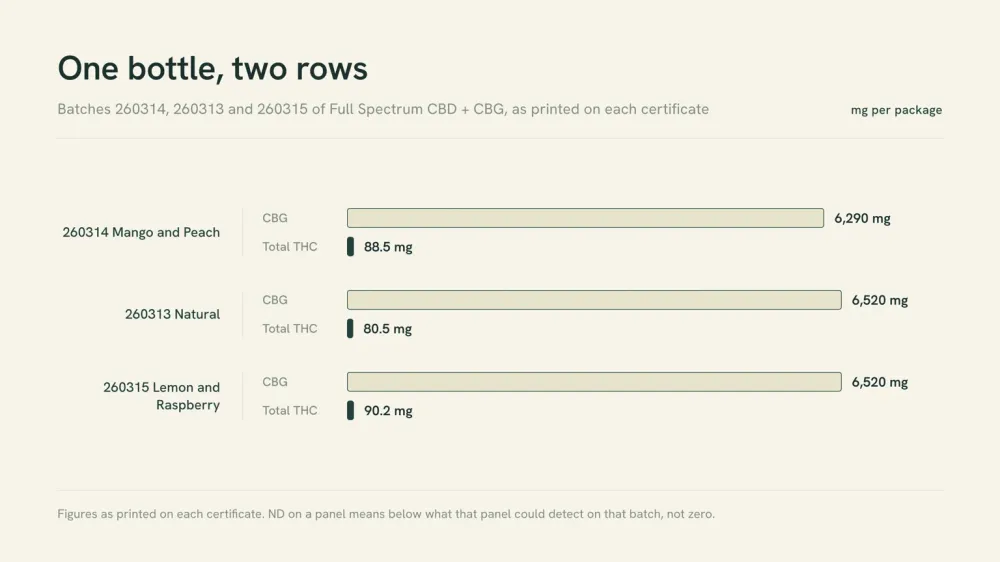
Here is the practical inversion, and it is the part you can use today. Does CBG get you high is not a question CBG can answer on its own, because CBG does not arrive on its own. In a full-spectrum product it arrives dissolved in a whole-plant hemp extract, and that extract has its own THC row. On our Full Spectrum CBD + CBG tincture, read from the certificates published at our lab results page on September 10, 2026, the two rows look like this.
| Batch (Full Spectrum CBD + CBG) | CBG on the certificate | Total THC on the certificate |
|---|---|---|
| 260314, Mango and Peach | 6,290 mg per package (103 mg/mL) | 88.5 mg (0.156%) |
| 260313, Natural | 6,520 mg per package (106 mg/mL) | 80.5 mg (0.142%) |
| 260315, Lemon and Raspberry | 6,520 mg per package (110 mg/mL) | 90.2 mg (0.159%) |
Put the two columns side by side. The CBG row is a four-figure number and the Total THC row is a two-figure number, and only one of those two has ever been shown to do anything to a person. It is the small one. For contrast, take a bottle with no CBG in it at all: our Full Spectrum CBD in Mango and Peach, batch 260310, prints 15,900 mg of CBD, a Total THC line of 136 mg at 0.239%, and cannabigerol as ND. The point is not that any of these numbers is alarming. The point is that the CBG figure and the intoxication question sit on different rows of the same page, and the comparison pages spend all their time on the wrong row. Why "Total THC" and "delta-9-THC" read identically on these three certificates, and why they often do not, comes down to a summation formula printed on the report itself; the total THC arithmetic is worked through on our CBD and THC page, and how to read a certificate of analysis covers the rest of the panel, contaminant sections included.
Drug tests, in three sentences
Standard workplace panels are built around a THC metabolite, and cannabigerol is not on the list of compounds they target. What a full-spectrum CBG bottle does carry that a panel looks for is its trace THC, which is the row in the table above. No product and no article can guarantee a drug-test result, and the whole subject, including what the immunoassay actually reacts to and where the residual risk sits, has its own page: what a CBG drug test is looking for.
The legal line, in two sentences
The federal definition of hemp changes on two dates in 2026, November 12 and December 11, and the parts of it that reach a cannabinoid the plant makes arrive on the second one. What that means for a CBG product, including the clause about cannabinoids synthesized or manufactured outside the plant, is a separate page: is CBG legal, which reads the enacted text line by line. Nothing on this page is a legal conclusion about any product.
How to answer "will this get me high" from a certificate, in four steps
- 1Find the Total THC row, not the CBG row. On a full-spectrum product that is the line answering the question you are actually asking, and it is usually printed twice, once as a percentage and once as milligrams per package.
- 2Check what feeds it. Total THC is a summation, so read the delta-9-THC, delta-8-THC and THCA rows beneath it. Where one says ND, read the detection limit printed beside it: ND means below what that panel could see on that batch, not zero.
- 3Convert to the amount you take. At about 0.05 mL per drop, our CBD + CBG bottle gives roughly 7.5 mg of CBD and 5 mg of CBG per drop, and at batch 260314's printed 1.45 mg/mL total THC, about 0.07 mg. Dropper technique changes drop size.
- 4Notice which column has evidence attached. The largest CBG dose in a placebo-controlled human study is 200 mg, a study condition. Your certificate's CBG row tells you what is in the bottle, not what CBG does, because that has been measured three times.
CBG vs THC: the questions people actually ask
The accurate answer is a description of what has been measured rather than a label. Two placebo-controlled studies looked for subjective drug effects from CBG: one at a single 20 mg dose in 34 adults, which reported no evidence of subjective drug effects or impairment on a digital impairment app, and one across 25 to 200 mg in 12 adults, whose authors summarized the result as few pharmacodynamic or psychoactive effects. No published study has compared CBG against THC in the same people. Note too that psychoactive and intoxicating are not synonyms, a distinction our CBN and THC page unpacks: a compound can act on the central nervous system without impairing judgment or coordination. What the record supports is that at the doses studied, in small samples, very little was observed. It does not support a flat statement about the molecule.
Stronger needs a measurement before it is a question, and the measurement does not exist in people. In the one experiment that put both through the same intoxication screen at the same time, in rats, THC produced the classic four-part pattern and CBG did not, at oral doses of CBG up to 600 mg/kg against oral THC up to 30 mg/kg. Those are rodent study doses in milligrams per kilogram, not anything a person takes. In people the comparison has not been published, so no potency ratio between the two exists, and any page printing one has invented it.
The only registered study that gives the same people CBG on its own, THC on its own and the two together is a nine-arm crossover with four combination arms, and it has posted no results. What is left is anecdote, and it runs in both directions: some people describe a stronger or longer THC effect alongside CBG, others a milder one. That pattern, confident disagreement with no controlled data underneath it, is what an absent literature looks like from the outside. This page is not a recommendation to combine them and does not give an amount for either.
We ran three searches on September 10, 2026 to find out. Cannabigerol paired with paranoia in a title or abstract returns zero records. Cannabigerol paired with anxiety returns 32 records, and we read every title: the ones that involve people are a CBG-against-placebo trial, two surveys of self-reported use and a urine study of a CBD supplement, and not one of the 32 gave CBG and THC to the same people. The federal trials registry lists 14 studies with cannabigerol as an intervention, none of them with results posted, and not one registers THC-induced anxiety or paranoia as an outcome. So there is no evidence for the claim, and there is none against it either. The cannabinoid that does have human trials against THC-induced anxiety is CBD, and even there the picture depends heavily on the ratio, which we cover on our does CBD get you high and entourage effect pages.
Standard workplace panels look for a THC metabolite, and cannabigerol is not among the compounds they target. What a full-spectrum CBG product carries that a panel does look for is its trace THC. No product and no article can guarantee a drug-test result, and our dedicated CBG drug test article covers the panels, the sport rules and where residual risk actually sits.
Three published studies have given CBG on its own to a person: 20 mg in one placebo-controlled trial, 25 to 200 mg across the ascending-dose study, and 25 mg in a pharmacokinetics study. Those are study conditions, not servings, and none of them is a recommendation. For scale, our CBD + CBG tincture is labeled 9,000 mg of CBD and 6,000 mg of CBG in 60 mL, which is 150 mg/mL and 100 mg/mL, so a dropper at roughly 0.05 mL per drop carries about 7.5 mg of CBD and about 5 mg of CBG. Drop size varies by dropper and technique, so treat that as arithmetic rather than a serving suggestion.
None of this makes CBG interesting or uninteresting. It makes it early. Three small human studies, one rat tetrad with THC standing beside it as the control, a nine-arm crossover sitting on a completed primary phase with an empty results section, and a consumer internet that made up its mind years ago. If you want the number that answers the question you actually asked, it is on the certificate, and ours are published batch by batch at our lab results page. If you want the map rather than this one comparison, start at what cannabinoids are.
Read the Total THC row yourself
Every Planntz batch publishes its full certificate of analysis, with the CBG row and the Total THC row on the same page. No claim required: just the numbers the laboratory printed, batch by batch.
See the Planntz tincturesWriting about hemp, wellness and the small rituals that keep us balanced.