
Does Weed Make You More Creative? The Work vs the Judge
Cannabis makes people feel more creative and rate their own ideas higher, but blind raters score the work the same, and a high THC dose cut idea output by a third. Here are the four questions the trials answered, and what none of it says about CBD.

Does weed make you more creative? In controlled studies, no. What cannabis changed was how creative people felt and how they judged ideas, not the quality of the ideas as scored by people who did not know who had used anything. And in a double-blind, placebo-controlled trial that compared two doses, the higher THC dose cut idea output by about a third, while the lower dose made no measurable difference either way.
The feeling of ideas flowing is real. The question is what is producing it. Most coverage merges four questions that researchers answered separately: does cannabis change the work, does it change how you judge the work, are cannabis users simply more creative people to begin with, and does it change how things like music feel? Each has its own study and its own answer. This page takes them one at a time, prints the numbers the headlines leave out, and then separates THC from CBD, which no top result does. It is general information for adults 21 and over, not medical advice, and it belongs to our evidence-literacy series that starts with what the research on CBD does and does not show.
Does weed make you more creative? Four questions in one
When someone asks whether weed makes you more creative, they can mean four different things, and a yes to one is not a yes to the others. Feeling that your ideas are better is not the same as producing better ideas. A pattern among people who choose to use cannabis is not the same as an effect of the drug. And a song feeling more meaningful is not the same as hearing it more accurately. Here is the map for the rest of the article.
| Question | How it was tested | Key study | What was found |
|---|---|---|---|
| Does it change the work? | Placebo-controlled trial, idea tests scored by researchers | Kowal et al., 2015 (54 regular users) | High THC dose lowered scores; low dose no different from placebo |
| Does it change how you judge the work? | Randomized use vs abstain, ideas scored by blind raters | Heng, Barnes and Yam, 2022 (331 adults) | Users rated ideas as more creative; blind raters saw no difference |
| Are users just more creative people? | Users tested sober vs non-users, personality measured | LaFrance and Cuttler, 2017 (721 adults) | The gap vanished once openness to experience was accounted for |
| Does it change how things feel, like music? | Placebo-controlled brain scan while listening | Freeman et al., 2018 (16 users) | Sound felt enhanced; the brain's reward response to music went down |
What happens to the work: the dose the headlines left out
The study that matters most for this question is a 2015 double-blind trial in Psychopharmacology, run in Leiden, in the Netherlands. Researchers randomly assigned 54 regular cannabis users to vaporize a placebo, 5.5 mg of THC or 22 mg of THC, using a standardized flower of about 19% THC. Then they gave everyone two kinds of test. The first measured divergent thinking, the ability to generate many different ideas: participants listed as many uses as they could for a pen and a shoe, and each sheet was scored for fluency (how many ideas), flexibility (how many different categories), originality (how unusual) and elaboration (how detailed). The second, the Remote Associates Task, measured convergent thinking: finding the single word that links three others.
The 22 mg group produced about a third fewer ideas than the placebo group and scored lower on flexibility and originality, significantly worse than both placebo and the 5.5 mg group. The 5.5 mg group did not differ from placebo. Its average originality score (27.5) was numerically higher than placebo's (21.2), and you will sometimes see that gap quoted as a benefit. It is not one: the difference was not statistically significant, so the trial cannot tell it apart from chance. Neither dose changed the convergent-thinking test. In the authors' words, "cannabis with low potency does not have any impact on creativity, while highly potent cannabis actually impairs divergent thinking." That is a finding about dose. It is routinely reported as "weed doesn't help", when the more precise reading is that more THC made the work worse and less THC made no measurable difference.
Read it with its limits. There were only 18 people per group, 48 of the 54 were men, and each person took part in one session in one condition, so nobody was compared with themselves. Everyone had used cannabis at least four times a week for at least two years, so a first-time or occasional user could react quite differently to the same dose; our guide to tolerance breaks explains why regular use shifts the response. The authors note that the placebo was not entirely free of THC, and one author had been paid by Bedrocan, the company that supplied the cannabis. Finally, those milligram figures describe what a research team loaded into a vaporizer for regular users, not a serving size for anyone.
What happens to the judge
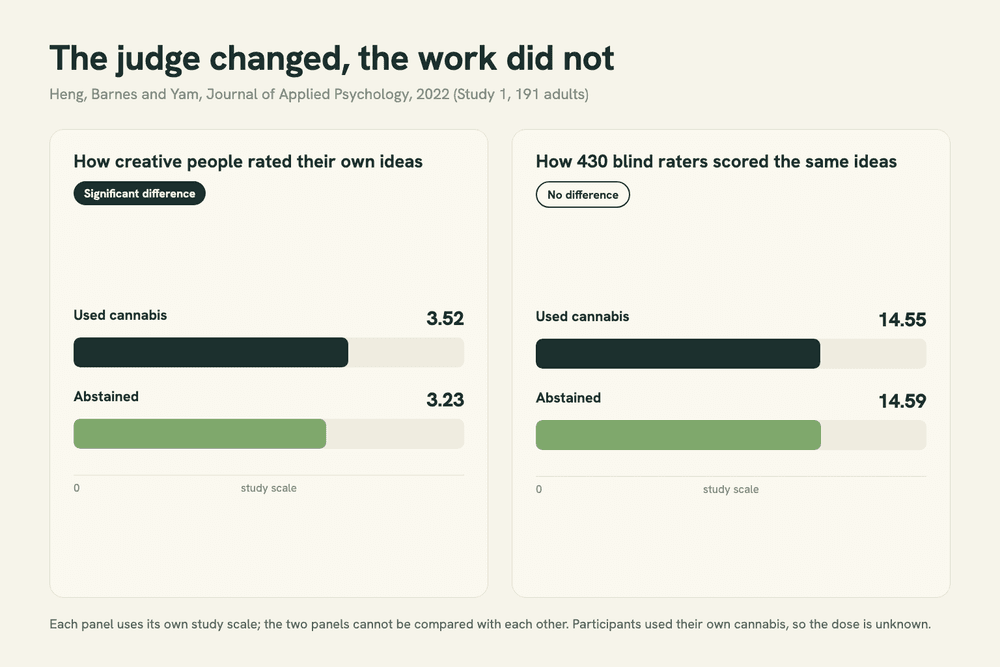
The study behind most of the headlines is a 2022 paper in the Journal of Applied Psychology by Heng, Barnes and Yam (in print in 2023). It ran two randomized experiments in Washington State, where recreational cannabis is legal, with 331 adults aged 21 and over. Nobody was given or told to use cannabis. Instead, people were randomly assigned to start the task either within 15 minutes after their own usual use, or at least 12 hours after any use. In the first study, 191 people spent 4 minutes listing uses for a brick. The cannabis group felt more cheerful (a joviality score of 3.08 vs 2.66) and rated their own ideas as more creative (3.52 vs 3.23). Then 430 online raters, who did not know who had used anything, scored the ideas: 14.55 for the cannabis group and 14.59 for the controls. That is no difference at all. The research assistants' ratings did not differ significantly either.
The second study repeated the test with 140 full-time employees, who spent 5 minutes on ideas to raise a band's revenue and then rated ideas other people had written. Again, cannabis made people more jovial, and that cheerfulness carried through to rating both their own ideas and other people's ideas as more creative. Novice, expert and trained raters found no significant difference between the two groups' ideas. The authors' conclusion: cannabis may positively bias evaluations of creativity but have no impact on creativity. Put simply, the drug changed the judge, not the work.
“...we urge them to be cognizant that using cannabis may bias their evaluation of ideas. Particularly if their job entails creativity evaluation, it might be best to refrain from cannabis at work.”
This is the best field evidence on the question, and it has weaknesses the coverage skips. People used their own products, so nobody knows what dose they took. Everyone knew which group they were in, and the studies were not preregistered. Assignment was also imperfect. In the first study only 117 people returned a usable saliva test. Among them, 72% of the cannabis group tested positive for THC and 64% of the group told to abstain tested negative. The authors read those checks as general compliance and kept everyone in their assigned group for the analysis, which they describe as the more rigorous approach, but it means some people counted as abstainers had a positive test. One more nuance: a direct gap in self-ratings appeared only in the first study. In the second, the effect ran through mood (cannabis raised cheerfulness, and cheerfulness raised ratings), and the authors note that the direct link was inconsistent across studies. The mood-to-judgment path is still the finding with the most direct meaning for anyone who makes things.
Are cannabis users just more creative people?
There is a third explanation for why cannabis and creativity seem linked, and it has nothing to do with the drug's effect in the moment. A 2017 Washington State University study in Consciousness and Cognition compared 412 cannabis users, tested sober, with 309 non-users. The users did look more creative, on their own ratings and on one objective test, until the researchers accounted for personality. Users scored higher in openness to experience, the Big Five trait that covers curiosity, imagination and appetite for new experiences, and once that was controlled the difference vanished. Creative, curious people may be more likely to try cannabis, rather than cannabis making people creative. The study was a single snapshot, so it cannot tell which came first.
A second study hints at who might notice a change. A 2012 University College London study tested 160 people who smoked their own cannabis on one day and stayed sober on another, seven days apart. On a simple test, naming words that start with a given letter in one minute, the least creative quarter improved while intoxicated, up to the level of the most creative quarter, who did not improve at all. Psychosis-like experiences rose in both groups. There was no placebo, nobody controlled the dose, and word fluency is a narrow slice of creativity, so this is a clue, not a recommendation.
Why do ideas feel more connected when you are high? One measured reason: a 2010 study of 36 users in Psychiatry Research found that being high increased automatic semantic priming, the way one word calls up related ones, part of a pattern the authors call hyper-priming. Schizotypal, psychosis-like symptoms rose at the same time, and the authors discuss the change in that context, not as a route to better ideas. Loose associations can feel like insight. Whether they turn into good work is exactly the question the blind-rater studies answered.
Does weed make music sound better?
This is where the feeling and the measurement split most clearly. In a 2018 University College London trial in the International Journal of Neuropsychopharmacology, 16 cannabis users (8 men, 8 women) took part in three sessions in random order: vaporized cannabis with 8 mg of THC, cannabis with 8 mg of THC plus 10 mg of CBD, and placebo. Each time they listened to classical music, and to a scrambled version of it, inside an MRI scanner. A PubMed search on September 23, 2026 turned up no other brain-imaging trial of cannabis and music.
- Went up with both cannabis versions: how enhanced sound seemed, and how much people wanted to keep listening.
- Went down with THC alone: the brain's response to music in the auditory cortex and in regions tied to reward and emotion, including the amygdala and ventral striatum.
- Did not change significantly: how much people said they enjoyed the music (ratings of 5.53 on placebo, 4.78 on THC and 5.16 on THC with CBD).
- THC with CBD: no difference from placebo on any brain-scan measure. The CBD was never given on its own.
So music can feel more vivid while the brain's reward signal to it goes down. One likely piece of the explanation is salience: THC can make ordinary sights and sounds seem more significant than usual. It is the same shift that, pointed at the wrong thing, is part of why weed can make you paranoid. A song feeling more meaningful is a real change in experience. It is not evidence that you are hearing more accurately, or that the music you make in that state is better. The study had 16 people, one genre and a scanner setting, so treat it as one careful look rather than the last word.
Weed and productivity: where impairment starts
No study in this set found that cannabis made people do more work or better work. The dose-controlled result in this set points the other way: at 22 mg of vaporized THC, regular users generated about a third fewer ideas. Heavier THC doses measurably impair thinking, and the Heng experiments suggest that your own rating of your work is the measure most likely to be skewed upward. The authors' own advice, quoted above, was to refrain at work if your job involves judging creative work. For how THC impairment plays out where the stakes are highest, see our guide to cannabis, CBD and driving.
Does CBD make you more creative?
Every study above used cannabis containing THC. As of September 2026 we could not find a single controlled trial that gave people CBD on its own and measured creativity. A PubMed search on September 23, 2026 for cannabidiol together with creativity or divergent thinking returned five records, and none of them was a creativity trial. That is not a hint that CBD helps. It means nobody has measured it. The one study here with a CBD arm, the music trial, always gave CBD together with THC, so it tells you nothing about a CBD-only product.
The closest CBD trials measured something else: whether CBD gets in the way. In a 2022 crossover trial in the Journal of Psychopharmacology, 17 healthy adults took 15, 300 or 1,500 mg of synthetic CBD by mouth, and no dose impaired the cognitive tests used or caused intoxication. Not getting in the way is not the same as helping, and creativity was never tested. If your real question is whether a CBD product will make you feel altered at all, our explainer on whether CBD gets you high walks through it.
If you make things: how to read a creativity claim
You do not need a new routine to use this research. You need a way to check the claims you will keep running into, from strain menus to articles like this one. Five questions sort most of them.
- 1Which question does it answer? Feeling creative, rating ideas highly, being a creative type and producing better work are four different findings.
- 2Was a dose named? In the dose-ranging trial above, the answer depended on dose, so a claim without one cannot tell you much.
- 3Did someone who did not know who had used cannabis score the work? Self-ratings are exactly what cannabis was shown to bias.
- 4Was there a placebo or a sober comparison? Studies of people using their own cannabis, knowing they used it, cannot rule out expectation.
- 5Was it CBD alone, or cannabis with THC? No creativity study has tested CBD alone.
The same logic applies to your own experience. The Heng authors addressed their advice to employees: be aware that cannabis may bias how you evaluate ideas, and refrain at work if judging creative work is part of the job. The broader lesson in their data is that a good mood made ideas look better to the person judging them, so a feeling of brilliance is not a verdict on the work. And if what you want to know is how any cannabinoid product affects you personally, a gut feeling in the moment is the weakest evidence you have. Our step-by-step guide to telling whether CBD is working explains why a felt improvement is not proof and how to set a baseline before you start.
What the research still can't tell you
Everything above comes from a small number of short studies, and the gaps are large. There is also no trial comparing named strains, despite the lists of "creative strains" online. A 2015 genetic analysis of marijuana and hemp, a plant-science study rather than a human one, found that marijuana strain names often do not reflect a meaningful genetic identity, so a strain label tells you little about what is in the jar.
- Small samples: the lab trials had 16 to 54 people, and in the dose-ranging trial almost all were men.
- Regular users: the dose-controlled data come from people using cannabis at least four times a week, and may not apply to occasional users.
- Short-term only: every study measured effects on the day of use. None followed anyone's creative output over months or years.
- Narrow tasks: listing uses for a brick or a pen is a lab stand-in for creativity, not a novel, a painting or an album.
- Missing comparisons: no CBD-only trial, no strain comparison, and one music genre in one brain-scan study.
Questions people ask about weed and creativity
Several measured effects can add up to that feeling. In the 2022 Heng experiments, cannabis made people more cheerful, and that mood lifted how creative they rated ideas. A 2010 study found being high increased automatic semantic priming, the way one word calls up related ones. And perception can feel more vivid. The feeling is real; the quality of the ideas, as scored by blind raters, did not rise.
People say it does. In a 2018 placebo-controlled trial, both THC and THC with CBD made sound seem enhanced and made people want to keep listening. But THC alone turned down the brain's reward and emotion response to music, and how much people said they enjoyed it did not change significantly.
Nobody knows, because nobody has tested it. As of September 2026 we found no controlled trial of CBD alone on creativity, and the music study above always combined CBD with THC. We sell CBD, and we are telling you there is no evidence either way.
No trial has compared named strains on creativity, and a 2015 genetic study found that strain names often do not reflect a meaningful genetic identity. We do not recommend any strain, dose or product for creative work.
The evidence says it changes how you judge the work more than the work itself. In the first Heng experiment, people who used cannabis rated their ideas as more creative while blind raters saw no difference. In the 2015 dose trial, the higher THC dose cut the number of ideas people produced by about a third.
No study here found a productivity benefit, and the higher of two THC doses measurably impaired idea generation in regular users. Cannabis may also bias how you judge your own work, so you may not notice. Do not drive after using THC.
If this page left you questioning how much a feeling in the moment can tell you, that instinct is worth keeping. The next step is how to tell whether CBD is actually doing anything for you, which applies the same skepticism to your own results.
Writing about hemp, wellness and the small rituals that keep us balanced.