Is Salvia Legal? Federal, State and Military Rules (2026)
Salvia divinorum is not federally controlled, and the DEA says so in writing. But at least 16 states restrict it, every military branch bars it, and its active compound acts on a different receptor from THC. Here is the law, layer by layer.
Is salvia legal? It depends on where you live and who you answer to. As of November 2026, Salvia divinorum and its active compound, salvinorin A, are not controlled substances under federal law, and the DEA says so in writing. That is where the simple answer ends. At least 16 states restrict it by statute or regulation, most of them as a Schedule I drug. Every branch of the military prohibits it. And not being scheduled is not FDA approval, a safety finding or a pass at work.
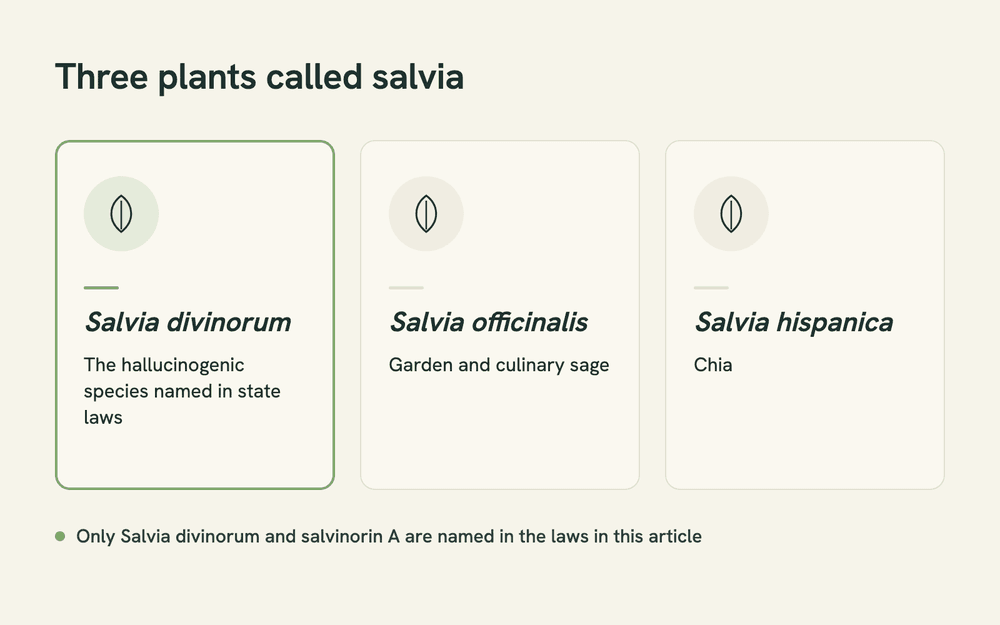
This page is about Salvia divinorum, the hallucinogenic sage species, not the garden or culinary sage (Salvia officinalis) in your spice rack, which these laws do not cover. The federal answer comes straight from the DEA's December 2025 fact sheet on salvia and salvinorin A. From there we read the law layer by layer: federal drug law, the FDA, 16 state codes we checked section by section, the military and your employer. Then we take the question people ask next, how salvia compares with weed, using placebo-controlled human studies rather than anecdote. Everything here is dated November 2026 and is general information, not legal advice. For how hemp and marijuana fare under the same layers, see our guide to whether CBD is legal.
What "salvia" means here (and why it isn't your garden sage)
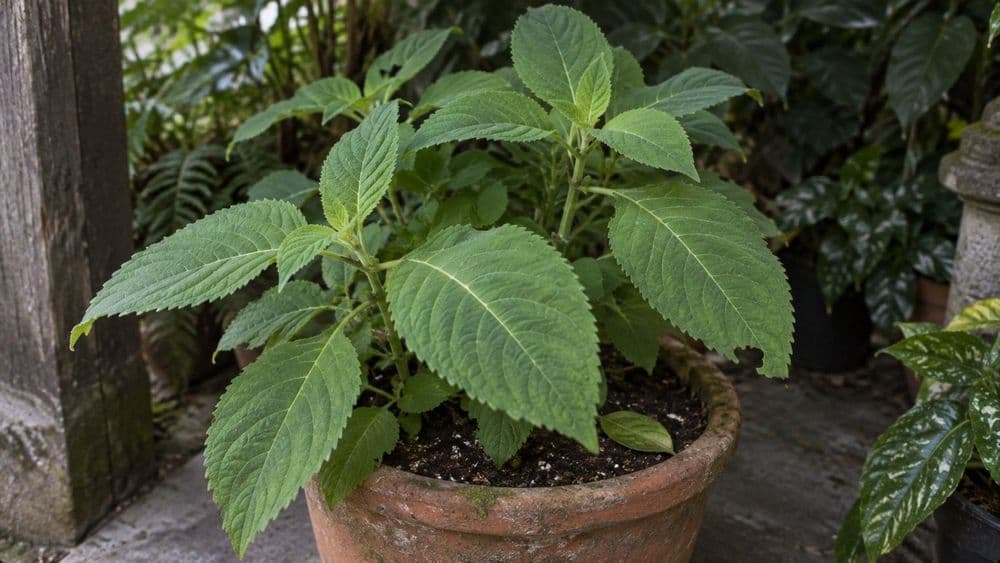
Salvia is a large plant genus. It includes garden sage, chia, the Chinese herb danshen and a long list of ornamental bedding plants. The laws on this page target one species, Salvia divinorum, a perennial in the mint family native to the Sierra Mazateca region of Oaxaca, Mexico. The DEA's fact sheet notes that the Mazatec have used it in ritual divination. Its leaves contain salvinorin A, which the DEA identifies as the plant's active constituent. Almost every state law below names both the plant and salvinorin A, and Hawaii also lists divinorin A, which the DEA gives as another name for salvinorin A. Several of these laws date from the mid-to-late 2000s: Louisiana's hallucinogenic-plant statute from 2005, Maine's minor-sale law from 2007 and California's from January 1, 2009.
The name confusion is not just a curiosity. When researchers reviewed a decade of California Poison Control System cases involving salvia, they found 37 exposures to Salvia divinorum and 96 to ordinary sage and other non-hallucinogenic Salvia species. Of the 37, 18 involved salvia alone. That was a retrospective review of one state's calls through about 2008, so it cannot tell you how common either kind of exposure is today. It does show that a "salvia" case in a poison-center record was more often about some other Salvia species than about the hallucinogenic one.
Is salvia legal in the US? The answer by layer
Most answers online collapse five questions into one. Whether salvia is "legal" depends on who is asking: the DEA, the FDA, your state, your commanding officer or your employer. Each has its own rulebook, and a yes from one tells you nothing about the others. Here is each layer as it stood in November 2026, with the record behind it.
| Layer | Status, November 2026 | Primary record |
|---|---|---|
| Federal drug law (DEA) | Not controlled: "S. divinorum and salvinorin A are not controlled under the CSA." | DEA Drug & Chemical Evaluation Section fact sheet, December 2025 |
| FDA | Not approved for medical use. No federal regulation names salvia or salvinorin A. | DEA fact sheet, December 2025; our eCFR search, November 2026 |
| States | Restricted in at least 16 states we checked: 12 as a controlled substance, 4 by act (sale, possession misdemeanor, products for human consumption, minors) | Each state's own code or regulation, checked November 2026 |
| Military | Prohibited in every branch; on the DoD Prohibited Dietary Supplement Ingredients List | Operation Supplement Safety (DoD); Army Regulation 600-85, 2020 edition |
| Workplace drug tests | Not on the federal workplace panel. Employers can set their own policies. | HHS authorized testing panels, 90 FR 4662 (2025) |
| Canada | Schedule IV controlled substance. Simple possession isn't an offense under the Act, but trafficking in it, or importing or exporting it without authorization, is. | Controlled Drugs and Substances Act, Schedule IV |
Canada gets a short note because it comes up in searches: its Controlled Drugs and Substances Act lists Salvia divinorum, its preparations and derivatives, including salvinorin A, in Schedule IV. The Act's simple-possession offense covers Schedules I to III only, while its trafficking and import-export offenses reach Schedule IV. For any other country, check local law before you travel. The rest of this page is about the United States.
Federal law: not scheduled, in the DEA's own words
The DEA's Diversion Control Division publishes short fact sheets on drugs it monitors. Its salvia sheet, dated December 2025, describes salvinorin A as a kappa-opioid receptor agonist that does not activate the serotonin 2A receptor, notes that salvia is sold online and in head and tobacco shops as plants, leaves and concentrated extracts, and then gives the legal status in one sentence:
“S. divinorum and salvinorin A are not controlled under the CSA.”
The same sheet adds that salvia and salvinorin A "are not approved for medical use in the United States." We also checked the federal record directly. In November 2026, a full-text search of the eCFR, the official compilation of federal regulations, returned no section that mentions Salvia divinorum or salvinorin. The Federal Register returned two documents that mention salvia, both 2007 SAMHSA notices about the national drug-use survey questionnaire. No DEA proposal to control salvia appears there. Plant compounds do get scheduled when the DEA acts, and our report on the DEA's proposed 7-OH threshold shows what that process looks like. For salvia, no such proposal appears in the record we searched.
The fact sheet also prints how often salvia turns up in crime labs. NFLIS-Drug, the DEA's National Forensic Laboratory Information System, collects drug identifications from federal, state and local forensic labs. Reports of salvinorin A fell from 104 in 2012 to 9 in 2024, and reports of the plant itself from 3 to 0. Read that as a picture of what reaches crime labs, which reflects enforcement and testing choices as much as use. It is not a count of how many people use salvia, and it does not show why the numbers fell.
| NFLIS-Drug reports | 2012 | 2016 | 2020 | 2024 | Total |
|---|---|---|---|---|---|
| Salvinorin A | 104 | 28 | 12 | 9 | 712 |
| Salvia divinorum (plant) | 3 | 3 | 0 | 0 | 25 |
The sheet cites national survey figures too. Read the two youth numbers with care: the 2009 figure covers 12th graders alone and the 2022 figure pools three grades, so they are not a trend line.
So the federal answer is a narrow fact. In practice, "not a controlled substance" does not mean any of the following:
- That the FDA has approved it. It is not approved for medical use.
- That it is legal in your state. At least 16 states restrict it.
- That you can use it in uniform. Every branch prohibits it.
- That anyone has checked the label. No federal regulation names salvia at all, so none sets what a product sold as salvia must contain.
- That it is safe. Controlled human studies cover small groups of screened volunteers in research units.
State law: what 16 state codes actually say
Most state-by-state lists online repeat a count without a single section number. We did it the slow way: for each state below, we read the controlled-substance schedule or criminal code on the state's own legislature or regulator site. Several of those sites refuse automated connections, so for them we read the official page through an Internet Archive capture dated 2025 or 2026. Sixteen states passed that test. Many others, including Texas, Pennsylvania and Georgia, are reported to restrict salvia too, but we could not verify their text, so they are not in the table. Treat it as a floor, not a full list.
| State | Type | What the text covers | Citation |
|---|---|---|---|
| Delaware | Controlled | Schedule I: salvia and salvinorin A | 16 Del. C. § 4714(d)(24)-(25) |
| Florida | Controlled | Schedule I: salvia and salvinorin A, except any FDA-approved drug product | Fla. Stat. § 893.03(1)(c)35-36 |
| Hawaii | Controlled | Schedule I: salvia, salvinorin A and divinorin A | HRS § 329-14(d)(39)-(41) |
| Illinois | Controlled | Schedule I: salvinorin A and all parts of the plant, its seeds and extracts | 720 ILCS 570/204(d)(10.1), (10.5) |
| Iowa | Controlled | Schedule I: salvia and salvinorin A | Iowa Code § 124.204 |
| Kansas | Controlled | Schedule I: the plant, growing or not, its seeds and extracts, and salvinorin A | K.S.A. 65-4105, item (30) |
| Michigan | Controlled | Schedule I: all parts of the plant, growing or not, and salvinorin A | MCL 333.7212(1)(v)-(w) |
| Missouri | Controlled | Schedule I: salvia and salvinorin A | RSMo § 195.017, items (ss)-(tt) |
| North Dakota | Controlled | Schedule I hallucinogen: salvia, salvinorin A or any of its active ingredients | N.D.C.C. § 19-03.1-05(5)(y) |
| Ohio | Controlled | Schedule I: salvia and salvinorin A (rule effective November 8, 2025) | Ohio Admin. Code 4729:9-1-01 |
| Connecticut | Controlled (by regulation) | Statute directs the state to designate salvia and salvinorin A as controlled substances by regulation | Conn. Gen. Stat. § 21a-243(i) |
| Virginia | Controlled (compound only) | Schedule I lists salvinorin A; the plant itself is not named in this section | Va. Code § 54.1-3446 |
| Louisiana | Restricted by act | Making, selling or possessing salvia material intended for human consumption; also on the prohibited-plant list | La. R.S. 40:989.1 and 40:989.2 |
| Minnesota | Restricted by act | Selling any amount: gross misdemeanor. Possessing any amount: misdemeanor | Minn. Stat. § 152.027, subd. 5 |
| California | Restricted by act (minors) | Selling or giving it to anyone under 18: misdemeanor | Cal. Penal Code § 379 |
| Maine | Restricted by act (minors) | Transfer to a minor: civil violation. Minors may not buy, possess or use it | 17 M.R.S. §§ 2012-2013 |
The verbs matter as much as the list. In the 12 states in the first group, salvia or salvinorin A is treated as a controlled substance, mostly in Schedule I alongside other hallucinogens, so possession itself can be a drug crime. Ohio's Schedule I rule, effective November 8, 2025, and Iowa's Schedule I statute both name the plant and salvinorin A. Florida's Schedule I listing carves out any FDA-approved drug product containing salvia or salvinorin A; the DEA's December 2025 fact sheet says neither is approved for medical use in the United States. Virginia lists only the compound, salvinorin A; how that applies to the leaf is a question for a Virginia lawyer, not for us. Connecticut's statute tells a state agency to designate salvia as a controlled substance by regulation; we read the statute, not the regulation.
The second group works differently. Minnesota's statute makes selling any amount a gross misdemeanor and possessing any amount a misdemeanor, without placing salvia on a schedule. California Penal Code section 379, in effect since January 1, 2009, targets only selling or giving salvia to someone under 18, with up to 6 months in county jail, a fine of up to $1,000, or both. We found no adult possession offense in that section. Maine's law makes transferring it to a minor a civil violation with a fine of $50 to $1,500, plus court costs, and bars anyone under 18 from buying, possessing or using it.
Louisiana stacks two laws. Its 2005 hallucinogenic-plant statute, RS 40:989.1, makes it a crime to produce, distribute or possess with intent to distribute material "intended for human consumption" that contains a listed plant, salvia included, with 2 to 10 years in prison and a fine of up to $20,000. Possessing such material carries up to 5 years and a fine of up to $5,000. Growing a listed plant strictly for aesthetic, landscaping or decorative purposes is exempt, as are some products labeled and made as federal dietary supplements. Salvia also appears on Louisiana's separate prohibited-plant list in RS 40:989.2, the same law that covers blue lotus; our explainer on blue lotus law reads that statute line by line.
How to check the law where you live
Laws change, and our table is a floor. These steps work for any state, including the ones we could not verify:
- 1Search your state's code for both names, "Salvia divinorum" and "salvinorin". Some states list only the compound, and Hawaii also lists divinorin A, another name for salvinorin A.
- 2Check the controlled-substance schedules first, then the criminal code. Minor-sale laws often live outside the schedules: California's is in its Penal Code, Maine's in Title 17.
- 3Remember that some states schedule drugs by regulation, not statute. Ohio's list is an administrative rule, and Connecticut's statute hands the job to a state agency.
- 4Note which act the law covers: possessing, selling, selling to a minor or making products for human consumption. Each carries a different penalty.
- 5Check city and county ordinances, which can be stricter than state law.
- 6If you serve in the military or are tested under a federal program, those rules apply no matter what your state allows.
- 7Write down the date you checked. If the stakes are real, ask a lawyer licensed in your state.
Salvia in the military
For service members there is no state-by-state question. The Defense Department's supplement-safety program, Operation Supplement Safety (OPSS), puts it plainly in its salvia note: "Salvia divinorum isn't currently a controlled substance, but it is on the DoD Prohibited Dietary Supplement Ingredients List." That prohibited ingredients list was last updated September 3, 2026. The OPSS note also lists the prohibiting rule for every branch: Air Force DAFMAN 44-197, Army Regulation 600-85, Navy OPNAVINST 5350.4E and SECNAVINST 5300.28F, Marine Corps SECNAVINST 5300.28F and MCO 5300.17A, and Coast Guard COMDTINST M1000.10B. Those are the editions OPSS cites; some may have been revised since.
The Army's rule names it outright. Army Regulation 600-85, in its 2020 edition, prohibits soldiers from using listed substances "for the purpose of inducing excitement, intoxication, or stupefaction of the central nervous system," and the list includes "Salvia divinorum (diviner's sage)." A second item, on naturally occurring substances, names salvia again. A 2024 revision exists that we could not retrieve, so we cite the 2020 text. The same mechanism, a DoD rule that overrides civilian legality, is why hemp products are a problem in uniform too, as our guide to CBD in the military explains.
Salvia vs weed
People ask how salvia compares with weed because both are psychoactive plants. Pharmacologically, they are not close. In a 2002 lab study in PNAS, using cloned human receptors in cells and guinea-pig brain tissue, salvinorin A acted as a potent, selective agonist at the kappa-opioid receptor and showed no significant activity across a screen of 50 receptors, transporters and ion channels, including the serotonin 5-HT2A receptor that classic hallucinogens like LSD and psilocybin act on. That was lab work, not a human study. THC, by contrast, is a partial agonist at the CB1 and CB2 cannabinoid receptors, and it works mainly through CB1.
| Question | Salvia (Salvia divinorum) | Cannabis (Cannabis sativa) |
|---|---|---|
| Plant family | Lamiaceae, the mint family | Cannabaceae, shared with hops |
| Main active compound | Salvinorin A | THC (delta-9-tetrahydrocannabinol) |
| Main receptor | Kappa-opioid receptor; no action at serotonin 5-HT2A in lab work | CB1 and CB2 cannabinoid receptors |
| Time course in controlled studies | In the Johns Hopkins studies, effects peaked within 2 minutes and were largely gone by about 20 minutes | Varies by route and product; not measured in the salvia studies |
| Controlled human evidence | A few small placebo-controlled studies; the Johns Hopkins series enrolled 8, then 6 | A large clinical literature on THC |
| Federal status | Not a controlled substance | Controlled; two narrow categories moved to Schedule III in April 2026 |
| Federal workplace drug panel | Not a target | THC metabolite (THC-COOH) is a standard target |
The human data adds one telling detail. In the full eight-person Johns Hopkins study published in 2013, volunteers rated how much salvinorin A resembled 15 drug classes. As the dose rose, only its rated similarity to classic hallucinogens increased significantly; its similarity to cannabis did not. That is a rating by eight experienced volunteers, not a verdict on either drug, and it does not make one "safer" than the other: they are different drugs with different risks. For where cannabis itself sits among drug classes, see our explainer on whether weed is a depressant, and for THC next to its non-intoxicating cousin, our CBD vs THC comparison. On the federal side, marijuana remains a controlled substance, with FDA-approved products and marijuana covered by a state medical license moved to Schedule III by a DEA final rule in April 2026, while other marijuana stays in Schedule I.
What the human research found (and how little there is)
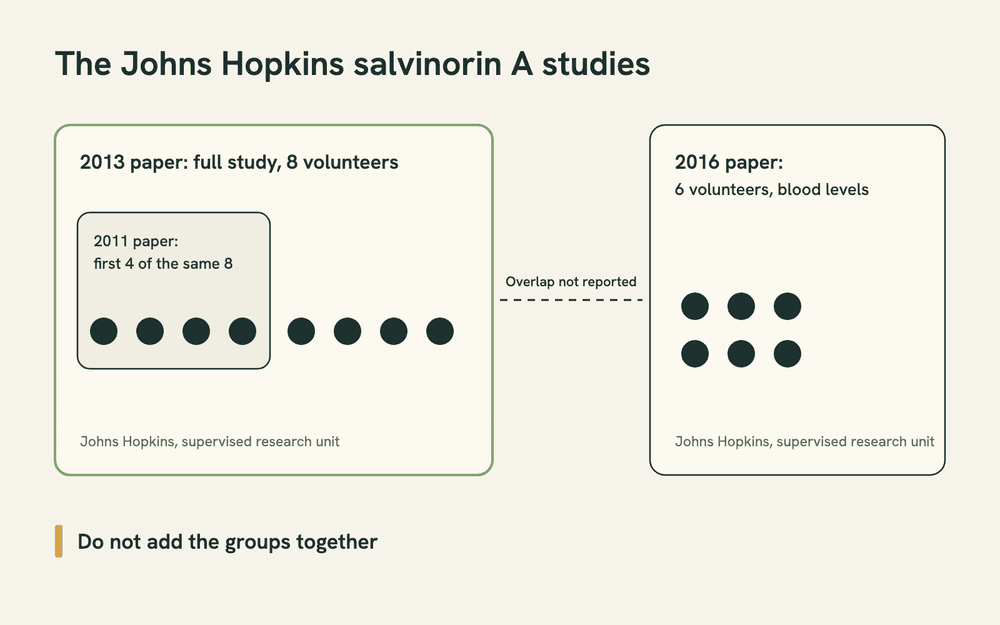
Placebo-controlled studies of salvinorin A in people are few and small. The most detailed dose-effect and time-course data come from one research group at Johns Hopkins. In a 2011 study in Drug and Alcohol Dependence, four healthy volunteers who had used hallucinogens before inhaled salvinorin A at ascending doses, alongside placebo, under double-blind conditions in a supportive research unit. Drug-strength ratings peaked at 2 minutes, the first time point measured, and definite effects were gone by about 20 minutes. Salvinorin A did not significantly raise heart rate or blood pressure in those four people.
That paper was a first look at the same study reported in full in 2013, which included those four plus four more: eight adults aged 21 to 35, three of them women, all with prior hallucinogen experience. Effects were intense. At high doses, volunteers often gave maximal drug-strength ratings or stopped responding. Salvinorin A also caused dose-related dissociation and impaired recall and recognition memory. The authors reported no persisting adverse effects at a one-month follow-up, a finding that applies to those eight people only. A 2016 study of six volunteers measured blood levels after a single high dose: they peaked at 2 minutes and dropped fast, matching how short the effects were, and the hormone prolactin rose from 5 minutes and peaked at 15. That paper does not say whether its six overlap with the earlier eight, so the two groups should never be added together.
The Johns Hopkins series is not the only one, and the others are just as small. A 2012 double-blind study in Connecticut gave inhaled salvinorin A or placebo to 10 healthy adults and reported psychosis-like effects and changes in perception. A 2015 study in Barcelona gave vaporized salvinorin A and placebo to 8 volunteers with prior psychedelic experience and described a disconnection from external reality. Like the Johns Hopkins work, both were run with screened volunteers under supervision.
Here is what that research cannot tell you:
- Anything general about people. The Johns Hopkins samples were 8 and 6, the first 4 were part of the 8, and the other placebo-controlled studies are similarly small.
- How salvia affects the general public. Volunteers were screened, healthy and already experienced with hallucinogens.
- What a store product does. The Johns Hopkins studies used pure salvinorin A in a supervised research unit, not leaves or extracts of unknown strength.
- How it acts in the human brain at the receptor level. The receptor findings come from cells and animal tissue.
- What repeated use does. None of these studies followed people using salvia on their own over months or years.
Will salvia show up on a drug test?
On a standard workplace test, salvia is not a target. The federal workplace drug-testing panels cover marijuana, cocaine, opioids including fentanyl, amphetamines including MDMA, and PCP, and the published rule does not mention salvia or salvinorin A anywhere. Our explainer on the 10-panel drug test walks through what common panels include. Two things change that picture. First, the military can look for it: OPSS notes that although salvia is "difficult to detect through routine testing, DoD labs have reported some positive test results when specific testing has been requested." Second, employers outside federal programs can add tests and write their own policies, as our guide to whether you can be fired for failing a drug test explains.
The bigger unknown on any test is what else is in a product. Products sold as herbal can carry more than their label says, a problem our overview of herbal smoking blends covers. Synthetic cannabinoids sold on plant material are a separate risk again, covered in our comparison of K2 and natural cannabis. Not being on a standard panel is not a reason to use something, and a negative result does not tell you what a product contained.
Red flags: when to get help
The DEA lists incoordination, dizziness and slurred speech among salvia's adverse effects. In the Johns Hopkins study, high doses often left volunteers unresponsive, with gaps in memory, even in a supervised setting. And in the California poison-center review, using salvia together with alcohol or other drugs was tied to a high rate of complications. The signs below are general emergency guidance. Get help if you or someone with you has any of these:
- Not responding, a seizure, a collapse or an injury: call 911.
- Chest pain, a racing heartbeat or trouble breathing: call 911.
- Severe confusion, panic or agitation that is not easing: call 911. Stay with the person and keep them away from stairs, water, traffic and anything sharp.
- Salvia used with alcohol or other drugs and the person seems worse than expected: call Poison Help, or 911 if any sign above appears.
- For any other question about an exposure in the US, call Poison Help at 1-800-222-1222.
Frequently asked questions
Federally, salvia is not a controlled substance: the DEA's December 2025 fact sheet says Salvia divinorum and salvinorin A "are not controlled under the CSA." But at least 16 states restrict it, 12 of them as a controlled substance, every military branch prohibits it, and it is not approved for medical use. This is general information as of November 2026, not legal advice.
Not under federal law. It is a controlled substance in at least 12 states we checked against their own codes, including Florida, Illinois, Iowa, Michigan, Missouri and Ohio, and in Canada it is listed in Schedule IV of the Controlled Drugs and Substances Act.
As checked against each state's code in November 2026, it is a controlled substance in Delaware, Florida, Hawaii, Illinois, Iowa, Kansas, Michigan, Missouri, North Dakota and Ohio; Connecticut designates it by regulation; and Virginia lists the compound, salvinorin A. Louisiana and Minnesota restrict it by act, and California and Maine restrict it for minors. Many other states are reported to restrict it as well, so check your own state's code rather than any map, including ours.
California Penal Code section 379, in effect since January 1, 2009, makes it a misdemeanor to sell or give salvia or salvinorin A to anyone under 18, punishable by up to 6 months in county jail, a fine of up to $1,000, or both. We found no statewide adult possession offense in that section. Local ordinances can differ, and federal programs, the military and employers set their own rules.
It depends on your state. Some schedules, such as those in Illinois, Kansas and Michigan, cover all parts of the plant "whether growing or not," so a living plant is covered too. Louisiana exempts growing a listed plant strictly for aesthetic, landscaping or decorative purposes. Check your state's exact wording before assuming a houseplant is outside the law.
No. They share a genus but are different species. Garden and culinary sage is Salvia officinalis and chia is Salvia hispanica; the laws discussed here name Salvia divinorum and salvinorin A. In one California poison-center review, calls about ordinary sage and other non-hallucinogenic Salvia species outnumbered calls about Salvia divinorum, 96 to 37.
Salvinorin A is not on the federal workplace drug-testing panel. The military, however, says DoD labs have reported some positive results when specific testing was requested, and private employers can add tests. Products sold as herbal can also contain undeclared ingredients, and a negative result does not tell you what a product contained.
No. Salvia divinorum is on the DoD Prohibited Dietary Supplement Ingredients List, every branch has a rule prohibiting it, and the Army's substance-abuse regulation (2020 edition) names "Salvia divinorum (diviner's sage)" on its list of prohibited substances.
As a legal matter: federal law does not control salvia, but buying, receiving or possessing it can be a crime in a state that schedules it, and having it shipped does not change your state's law. In states with minor-sale laws, selling to anyone under 18 is an offense. Being for sale online is not evidence that something is legal where you live.
Salvia divinorum and salvinorin A are listed in Schedule IV of Canada's Controlled Drugs and Substances Act. The Act's simple-possession offense covers Schedules I to III, so possessing a Schedule IV substance is not that offense, but trafficking in it, or importing or exporting it without authorization, is.
Salvia is a clear case of a plant that is legal at one layer and prohibited at another. Blue lotus and kratom follow the same pattern, and our guides to whether blue lotus is legal and to kratom and weed apply the same layered reading. For how hemp and marijuana fare under federal and state law, start with our federal and state guide to CBD law.
Writing about hemp, wellness and the small rituals that keep us balanced.