Propranolol and Weed: What Nine Lab Studies Actually Measured
One site says nobody has studied propranolol and weed. Nine lab papers did, from 1972 to 1979. Propranolol consistently blunted THC's racing heart; its effect on the high was mixed. Here is what was measured, why one checker says 'major', and what to tell your prescriber.
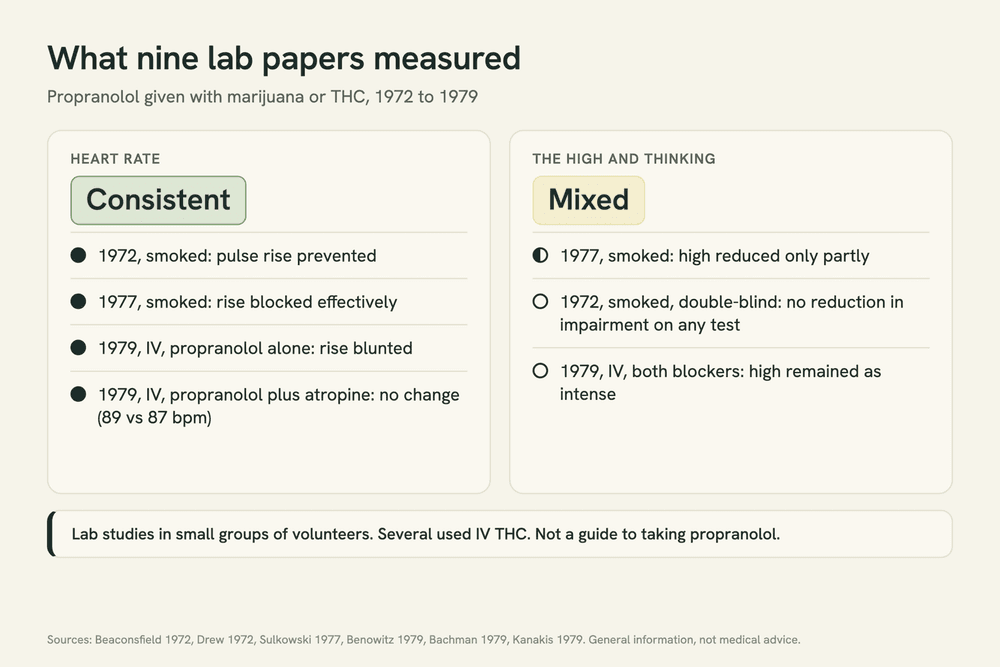
Propranolol and weed have been studied together, just not recently. As of October 24, 2026, we found nine lab papers, published from 1972 to 1979, that gave people propranolol with marijuana or THC. One result is consistent: propranolol blunted the racing heart that THC causes. Its effect on the high and on thinking was mixed. Separately, smoke speeds up a liver enzyme that clears propranolol. None of this settles what you should do with your own prescription. Your prescriber can.
If you take propranolol, you are probably asking one of two questions. Does cannabis change how your propranolol works? Or does propranolol change how cannabis feels? The pages that rank for this disagree in a way that should make you suspicious. One medical-card site says no current research has examined the combination. At least one consumer drug-interaction checker rates it a "major" interaction. The first claim is wrong, and the second rests on a mechanism nobody has measured with these two drugs. Below is what was actually tested, in whom, and what never was. This is general information for adults 21 and over where cannabis is legal, not medical advice, and nothing here is a reason to change how you take a prescription.
What propranolol is and what it's prescribed for
Propranolol (brand names include Inderal LA and InnoPran XL) is a beta blocker. It blocks the receptors that adrenaline acts on in the heart and blood vessels, so your heart beats more slowly and with less force, and blood pressure falls. The FDA label for propranolol tablets, revised July 2026, lists these uses: high blood pressure, angina (chest pain from the heart), rate control in an irregular rhythm called atrial fibrillation, use after a heart attack, migraine prevention, essential tremor, a thickened-heart-muscle condition called hypertrophic subaortic stenosis, and as an add-on in a rare adrenal tumor called pheochromocytoma. The Inderal LA label, the long-acting capsule, lists a shorter set: high blood pressure, angina, migraine prevention and hypertrophic subaortic stenosis. Anxiety is not on either label's list of indications. Whatever the reason you were prescribed it, the person who prescribed it knows why, and that matters for the rest of this page.
The label also explains how your body clears propranolol, which is where cannabis smoke comes in later. In its words, "aromatic hydroxylation of propranolol is catalyzed mainly by polymorphic CYP2D6. Side-chain oxidation is mediated mainly by CYP1A2 and to some extent by CYP2D6," and "propranolol is also a substrate of CYP2C19." CYP2D6, CYP1A2 and CYP2C19 are liver enzymes from the cytochrome P450 family. Keep CYP1A2 in mind: it is the one that smoke speeds up.
What happened when researchers gave propranolol and THC together
Between 1972 and 1979, researchers published nine papers that gave people propranolol together with marijuana or THC. They came from six research groups, and three of the papers came from one program at the University of California, San Francisco (UCSF). Two of those UCSF papers each studied four volunteers and very likely studied the same people, so read the list as nine reports, not nine independent confirmations. Every study enrolled small groups of volunteers, and several gave THC by IV injection, which is nothing like smoking a joint or eating an edible.
Start with smoked marijuana, the closest to real life. A 1972 paper in the New England Journal of Medicine studied people smoking marijuana for the first time. The rise in pulse and limb blood flow still appeared after atropine, a drug that blocks the other nerve input to the heart, but "not after pretreatment with propranolol." The authors counseled caution with anesthetics and drugs that act on the blood vessels in people who may have been smoking. A 1977 study of six experienced smokers is the one most often cited. Propranolol taken as a pretreatment "blocked effectively the cardiovascular effects of marihuana" from a joint containing 10 mg of THC. On its own, propranolol lowered the volunteers' resting heart rate and blood pressure and did not change their scores on attention, memory or learning tasks.
The injection studies push the question further. In a 1976 study in Circulation, IV THC at 25 µg per kg of body weight raised heart rate by 32 beats per minute on average in 10 healthy men, with no change in blood pressure. In 9 other volunteers given a beta blocker first, the rise was smaller but still there. The same Chicago group's 1979 follow-up blocked both nerve inputs to the heart at once, with IV propranolol plus IV atropine, in 10 volunteers. Heart rate before and after THC was 89 and 87 beats per minute, no significant difference, measured "at a time approximating peak psychologic high." At UCSF, a 1979 study of four volunteers found that the peak heart-rate rise after IV THC "was attenuated by atropine and by propranolol, and nearly abolished by atropine-propranolol pretreatment." One additional volunteer in that paper developed high blood pressure after IV or smoked marijuana. That is one case, and it tells you people vary, not how often it happens.
Two more papers round out the list. A 1977 UCSF study gave inpatient volunteers oral THC for 14 days and used IV propranolol and atropine only as probes of the nervous system. The interaction it flagged was atropine, not propranolol: "During THC ingestion, atropine had a pronounced pressor effect, which might represent a clinically significant drug interaction." And a placebo-controlled 1978 breathing study in 8 people found that propranolol "completely abolished" one effect of smoked marijuana on breathing control, a stronger response to carbon dioxide, and "did not affect the other changes."
| Year | Study (group) | People | THC | Blocker | Heart rate | High or thinking |
|---|---|---|---|---|---|---|
| 1972 | Beaconsfield, NEJM (London) | First-time smokers | Smoked | Propranolol or atropine | Pulse rise prevented by propranolol, not by atropine | Not reported in the abstract |
| 1972 | Drew, Clin Pharmacol Ther | Paid male volunteers, double-blind | Smoked, 25 µg/kg | Propranolol or placebo, several doses before smoking | Not in the abstract | No reduction in impairment on any test |
| 1976 | Kanakis, Circulation (Chicago) | 10 healthy men, plus 9 others pre-blocked | IV, 25 µg/kg | Beta blockade | +32 bpm unblocked; smaller rise when blocked | Not studied |
| 1977 | Sulkowski, Psychopharmacology | 6 experienced smokers | Smoked, 10 mg | Oral propranolol, 120 mg | "Blocked effectively" | Learning impairment prevented; high reduced only partly |
| 1977 | Benowitz and Jones, Clin Pharmacol Ther (UCSF) | Inpatient volunteers | Oral, 14 days | IV propranolol and atropine as test probes | Higher after blockade while on THC | Not the question; atropine flagged |
| 1978 | Zwillich, Am Rev Respir Dis (Denver) | 8, placebo-controlled | Smoked | Propranolol | Breathing study | Blocked one breathing effect only |
| 1979 | Benowitz, Clin Pharmacol Ther (UCSF) | 4 | IV | Propranolol, atropine or both | Blunted by propranolol; nearly abolished by both | Not in the abstract |
| 1979 | Bachman, Psychopharmacology (UCSF) | 4 | IV, 30 to 44.8 µg/kg | IV propranolol 0.2 mg/kg, atropine or both | No change after both blockers | High "remained as intense" |
| 1979 | Kanakis, Ann Intern Med (Chicago) | 10 | IV, 25 µg/kg | IV propranolol 0.1 mg/kg plus atropine 2 mg | 89 vs 87 bpm, no change | Measured at peak high; high not scored |
Read down the heart-rate column and the pattern holds across smoked and injected THC: propranolol alone blunted THC's heart-rate rise, and propranolol plus atropine erased it. The Chicago team concluded that THC's effects on the heart "appear to be mediated totally via the autonomic nervous system," the network of nerves that sets your heart rate without you thinking about it. That heart-rate rise is not a 1970s quirk; our look at a 2026 THC and CBD heart-rate trial covers how it shows up with modern products.
Does propranolol change the high? The studies disagree
This is where most summaries go wrong. The six-person 1977 study found that propranolol "prevented the learning impairment and, to a lesser degree, the characteristic subjective experience." In plain terms, the high was reduced only partly. That is the one positive result, and it is the one people quote.
Two other studies point the other way. A double-blind 1972 trial gave paid male volunteers propranolol or a placebo in several doses before they smoked marijuana dosed at 25 µg of THC per kg of body weight. Marijuana disrupted their recall of a story they had heard and moderately impaired a connect-the-dots task called the Trail Making test. Propranolol "failed to interact with marihuana to reduce its disruptive effects on any of the tests." Then a 1979 UCSF study gave four volunteers IV THC on four occasions: after saline, after atropine, after propranolol, and after both. With both blockers on board, THC no longer moved their heart rate at all. Their high did not budge:
“After combined autonomic blockade, THC had no effect on heart rate, while subjective and EEG changes remained as intense.”
The likely reason is location. The high happens in the brain. The racing heart is driven through the nerves that run to the heart, and blocking the heart's response does not reliably reach the part of the experience that happens in your head. The UCSF authors wrote that their findings "argue against the hypothesis" that THC's subjective and brain-wave effects run through those nerve receptors. So the honest summary has two parts: the heart-rate result is consistent, and the effect on the high and on thinking is not.
Why one interaction checker calls it "major": smoke and CYP1A2
The other direction is about blood levels: does cannabis change how much propranolol stays in your system? At least one consumer drug-interaction checker rates cannabis with propranolol a "major" interaction. Its reasoning is that cannabis induces CYP1A2, one of the enzymes that clears propranolol, so propranolol could be cleared faster and do less, with the effect greatest in people who inhale cannabis regularly. What it does not tell you is where that evidence comes from.
Start with the propranolol label. It says: "Cigarette smoking also induces hepatic metabolism and has been shown to increase up to 77% the clearance of propranolol, resulting in decreased plasma concentrations." That is tobacco. The label does not mention cannabis or marijuana anywhere. For cannabis smoke, the evidence comes from a different drug. In a 1978 study of drug clearance in smokers, 7 chronic marijuana smokers cleared theophylline, a drug broken down largely by CYP1A2, at 74 ml/kg/hr, against 52 ml/kg/hr in 43 control subjects the authors describe as nonsmokers. By our arithmetic, that is about 42% faster. Seven people who smoked both marijuana and tobacco cleared it at 93 ml/kg/hr. The authors wrote that "concern over enhanced metabolism of other drugs is probably warranted in tobacco and cannabis smokers."
Two reviews explain the mechanism. A 2016 review of drug interactions with tobacco and cannabinoids says both marijuana and tobacco smoking induce CYP1A2 through a sensor in liver cells called the aromatic hydrocarbon receptor, that "the induction effect between the two products is additive," and that stopping smoking is followed by rapid downregulation of these enzymes. A 2014 systematic review of cannabinoid drug interactions concluded that smoked cannabis "likely induces CYP1A2 mediated theophylline metabolism, although the role of cannabinoids specifically in eliciting this effect is questionable." In plain terms, the smoke is the likely cause, not the THC.
Put together, the "major" rating is a reasoned inference from tobacco data and a theophylline study. No study has measured propranolol blood levels in cannabis smokers. Whether a lower level would matter for you depends on why you take propranolol and at what dose, which only your prescriber can weigh. Three practical points follow. If you smoke cannabis regularly, and especially if you smoke tobacco too, your prescriber should know. If you cut down or quit, the enzyme effect may fade, which is also worth mentioning. And for edibles, there is no evidence either way: the smoke mechanism does not carry over to a gummy, but nobody has tested an edible with propranolol, so that is a gap, not a clearance. The label adds one more line: "Alcohol when used concomitantly with propranolol, may increase plasma levels of propranolol." If drinking is part of your night too, our guide to being crossfaded covers alcohol and weed together.
| Direction | What could happen | What was measured | Route that matters |
|---|---|---|---|
| Cannabis smoke changes propranolol levels | Smoke speeds up CYP1A2, one of propranolol's clearance enzymes, so levels could fall | Tobacco and propranolol: clearance up to 77% higher (label). Marijuana smoke and theophylline: about 42% faster (1978). Marijuana and propranolol: never measured | Smoking, regular use |
| CBD changes propranolol levels | Enzyme inhibition, a different mechanism | No human CBD and propranolol study found | Any product containing CBD |
| Propranolol changes the body's response to THC | Smaller heart-rate rise | Consistent in lab studies, 1972 to 1979 | Smoked and IV studied; edibles not studied |
| Propranolol changes the high or thinking | Maybe less impairment, maybe none | Mixed: one partial reduction (1977), no change in two studies (1972, 1979) | Smoked and IV studied; edibles not studied |
Standing up, dizziness and a slower heart
Nobody has measured what happens to blood pressure when someone on propranolol uses THC and then stands up. What is documented, separately, is this. In a placebo-controlled study of posture and marijuana, six of 10 people reported moderate to severe dizziness on standing after marijuana but not after placebo. A 2002 review of marijuana's effects on the heart and circulation notes that THC can on occasion produce marked orthostatic hypotension, a drop in blood pressure when you stand. Meanwhile, the CDC's page on cannabis and heart health says cannabis "can make the heart beat faster and can raise blood pressure immediately after use." And propranolol lowers resting heart rate and blood pressure, which is its job.
So the overlap is a reasoned caution, not a measured result. Get up slowly after using cannabis, sit or lie down if you feel lightheaded, and tell your prescriber if it keeps happening. Our article on whether weed raises blood pressure covers the standing-up effect and what it means for people who already take blood pressure medicine.
"Can propranolol stop a bad high?" Why it's not a home remedy
Some people search this after reading a trip report or a forum thread. Here is what the studies actually support. The heart-rate result is real in a lab: in monitored settings, with doses chosen by researchers and often given by IV, propranolol blunted the racing heart. The high is a different story: one small study saw a partial reduction, and two saw none. And every participant was a volunteer in a research setting, not someone taking propranolol as an everyday prescription or reaching for a pill at home.
The Inderal LA label explains why this is not a do-it-yourself fix. Propranolol is contraindicated in bronchial asthma, and the label says "patients with bronchospastic lung disease should not receive beta-blockers." It warns that "beta-blockers may prevent early warning signs of hypoglycemia, such as tachycardia," meaning a fast heartbeat that would normally tell someone with diabetes their blood sugar is low can be hidden. And for people already on it, the label warns of "exacerbation of angina and, in some cases, myocardial infarction, following abrupt discontinuance," and says patients should be cautioned against stopping therapy without the physician's advice.
If you are too high right now, our guide to greening out covers what usually happens, what helps while it passes, and the signs that mean you should get help. If an edible is the reason, why edibles take so long to kick in explains the delay that leads so many people to take a second dose too soon.

If your product contains CBD
Everything above is about THC and smoke. CBD raises a different question, because it acts on liver enzymes through inhibition, a different mechanism from smoke induction. We found no study that gave people CBD with propranolol. Our guide to CBD and blood pressure medication covers CBD with beta blockers and other blood pressure drugs, and the wider guide to how CBD interacts with medications explains the enzyme side in full. If your product is a 1:1 blend or full-spectrum, both this page and those apply.
What to tell your prescriber or pharmacist
You are not asking permission. You are giving the person who knows your heart, your dose and your history what they need to judge whether any of this matters for you. Bring this list:
- 1What you use: smoked or vaped flower, edibles, tinctures, and whether any product contains CBD.
- 2How often: daily or occasional. The smoke effect on liver enzymes is a regular-use issue.
- 3Whether you also smoke tobacco. The enzyme effects of the two smokes add up.
- 4Whether you are cutting down or quitting either one, since the enzyme effect fades after you stop.
- 5How much you drink. The propranolol label says alcohol may increase propranolol levels.
- 6Any dizziness when you stand, any fainting, or a pulse that feels very slow or irregular.
- 7Whether you have asthma or diabetes, both of which carry their own warnings on the propranolol label.
- 8Every other medicine and supplement you take, including anything for sleep, mood or pain.
- 9That you will not stop, skip or retime a dose on your own, and ask what to do if a change is ever needed.
Know the red flags too. MedlinePlus guidance on chest pain says to call 911 for sudden crushing, squeezing, tightening or pressure in the chest, pain that spreads to the jaw, left arm or between the shoulder blades, or chest pain that comes with nausea, dizziness, sweating, a racing heart or shortness of breath. Its page on heart palpitations says to call 911 when palpitations come with chest pain, shortness of breath, unusual sweating, dizziness or loss of consciousness, and to contact your provider right away if your pulse is over 100 beats per minute without exercise, anxiety or fever, or the palpitations are new or different. Its page on low blood pressure says to call 911 if someone passes out, and to call your provider right away for an irregular heartbeat.
What the propranolol and weed studies can't tell you
The limits are large, and they cut both ways. Every controlled study here is from 1972 to 1979. Where a sample size is reported, each enrolled 4 to 10 volunteers per group, several gave THC by IV injection, and two of the nine papers probably share the same four people. The marijuana and THC doses of the 1970s do not map onto today's flower, vapes or edibles. None of the studies was designed around people with heart disease, asthma or diabetes, and none tested patients taking propranolol long term. We searched PubMed on October 24, 2026, pairing propranolol and beta blockers with cannabis, marijuana, THC, dronabinol and nabilone. The search returned 64 records; after reading every title, the nine papers on this page are the only human studies that gave the two together. A search of ClinicalTrials.gov found no relevant registered trial.
Four things have never been studied, as far as we can find: propranolol blood levels in cannabis smokers; an edible or other swallowed THC product tested with propranolol as an interaction question; CBD with propranolol in people; and metoprolol, atenolol or any other beta blocker with THC. A 2012 systematic review of treatments for cannabis intoxication is sometimes cited as if it settled the question. It called the evidence "scarce" and said further studies were necessary, and its discussion of propranolol leans on the 1972 NEJM paper and the 1977 smoked study. It does not include the 1972 double-blind trial or the 1979 UCSF study, the two that found no effect on thinking or on the high.
Propranolol and marijuana: questions people ask
No study answers that for a person with a heart condition, and we will not give a verdict. In healthy volunteers in the 1970s, propranolol blunted the heart-rate rise from smoked marijuana. Separately, regular smoking can speed up a liver enzyme that clears propranolol: the label says cigarette smoking raised propranolol clearance by up to 77%, and in a 1978 study marijuana smoke sped up the clearance of another drug handled by the same enzyme. Tell your prescriber whether, and how often, you smoke.
At least one consumer interaction checker rates it major, based on enzyme induction from regular inhalation. That mechanism was measured with tobacco and propranolol, and with marijuana smoke and theophylline, never with marijuana and propranolol. It is a good reason to tell your prescriber, not a measured result.
No study has tested an edible with propranolol as an interaction question. One 1977 study gave oral THC for two weeks but used propranolol only as a test probe. The enzyme effect behind the 'major' rating is tied to smoke, so it does not carry over the same way, but that is an absence of evidence, not a clearance. Edibles still raise heart rate and can make you dizzy when you stand. Ask your prescriber.
Not reliably. A six-person 1977 study saw the high reduced only partly. A double-blind 1972 trial saw no reduction in impairment on any test, and a 1979 study saw the high stay 'as intense' even when THC no longer moved heart rate. Do not use propranolol, yours or anyone else's, to manage a high.
Every study on this page used propranolol, and its findings cannot simply be copied to other beta blockers. Metoprolol's label says it is primarily metabolized by CYP2D6, and atenolol's label says it undergoes little or no metabolism by the liver, so the smoke and CYP1A2 point may not carry over to them. We found no study that tested metoprolol, atenolol or any other beta blocker with THC. Ask your prescriber, and see our guide to CBD and blood pressure medication for the CBD side.
No, not on your own. The propranolol label warns that stopping abruptly has been followed by worse angina and, in some cases, heart attack, and that patients should not interrupt or stop therapy without the physician's advice. If you are thinking about cannabis, talk to your prescriber first and keep taking propranolol as prescribed.
Propranolol is one of many prescriptions people take alongside cannabis, and the pattern on this page repeats across them: a few measured results, a lot of inference, and a real need to tell the person who prescribed it. If you take other medicines, our pages on what is known about gabapentin with cannabis, how Zoloft and THC overlap and the human evidence on ibuprofen and THC walk through three more, each with its own kind of overlap. For the wider picture of which medicines share liver enzymes with cannabinoids and how to raise it with a clinician, read our guide to CBD and medications.
Writing about hemp, wellness and the small rituals that keep us balanced.